Transport Ties: Russia - Norteast Asia Countries
Sergei KAZANTSEV
*1
.Introduction
This paper is presented to the 7
thNortheast Asia Academic Network Symposium
“Economic Ties in Northeast Asia Countries”. It shows an important intercontinental transport ways that go across Russia and connect Eastern states and Russia with Northeast Asia Countries. The role and significance of such intercontinental transport links are increasing as the countries develop and the process of globalization goes heard.
For Russia intercontinental transport ways are particularly important due to its geographical location, which gave to some scholars and journalists a ground to call the Russian Federation a ‘bridge between the West and the East’. To cross a bridge is usually more convenient and less time consuming than to take a long round way. For example, it is very true for the Trans-Siberian railroad. Though this road it is less than 14 000 kilometers from Rotterdam to Yokohama instead of 21000 km by sea via the Suez Canal or 23000 km via the Panama Canal.
As this paper deals with transport ties with the Northeast Asia countries, it mainly copes with the transport ways that are located in Siberia and the Russian Far East. First, there is the largest part of Trans-Siberian railroad; there also are oil and gas pipelines, and HOHFWULFSRZHUOLQHVWKDWPD\JRIURP5XVVLDWRWKH1RUWKHDVW$VLDVWDWHV7KHUHZH¿QGDOVR the main deposit of natural resources which Russia exports (Figure 1).
Fig. 1. The Share of Siberian in Prospect Stocks of Some Russia’s Natural Resources
8575
65 65
45
0 30 60 90
Gas Coal Oil Wood Hydroe ne rgy
%
* Vice-Director of Institute of Economics and Industrial Engineering Siberian Branch of Russian Academy of Sciences, 17 Lavrentiev Prospect, Novosibirsk, 630090, Russia. This is the paper submitted for the 7th Northeast Asian Academic Network Symposium.
6HFRQGDIWHUWKHGLVLQWHJUDWLRQRIWKH8665LWEHFDPHPRUHGLI¿FXOWIRU6LEHULDQ producers to export their goods to European and Middle East countries and to import commodities from them. These circumstances turn the attention of Siberian businessmen to the Asia.
There also are some 50 thousand rivers in Siberia. The power generating potential of only two of them - the Yenisei and the Lena - exceeds that of all the rivers in the US. Lake Baikal is the largest of Siberia's one million lakes. It is the biggest reservoir of fresh water on the globe.
I started to think about all these issues (transport communications and commodities ÀRZVIURP6LEHULDDQGWKH5XVVLDQ)DU(DVWWR$VLDHWFVHYHUDO\HDUVDJRDQGIRUPXODWHG the principle points of this paper in 2005. To the large extend my studies are based on materials given to my by Ph.D. Anatoliy A. Kin, Professor Vladimir Yu. Malov (The Institute of Economics and Industrial Engineering, Siberian Branch of the Russian Academy RI6FLHQFHVDFDGHPLFLDQRI5$63DYHOȺ0HHQDNHHU7KH,QVWLWXWHIRU(FRQRPLF6WXGLHV Far Eastern Branch of the Russian Academy of Sciences), member-correspondent of RAS Boris G. Saneev (The Energy Systems Institute, Siberian Branch of the Russian Academy of Sciences). I express my gratitude to all of them and regard myself as their coauthor of this paper.
2
.Russia’s Transport System: General Description
The transport system of the Russian Federation, as transport systems of many other FRXQWULHVQRWRQO\VDWLV¿HVGRPHVWLFQHHGVLQSHRSOHDQGFRPPRGLWLHVWUDQVSRUWDWLRQEXWLV also used for foreign trade purposes and for a transit of the third countries goods. Channels for transportation the transit commodities are called ‘the international transit corridors’.
Usually an international transit corridor is constructed for a set of different types of transport: air, automobile, pipe-line, railway, river and sea transport. Each of these types of transport is to satisfy to the international standards requirements. They cooperate and help each other to carry goods and to move passengers.
As a rule the corridor includes the air, automobile, pipe-line, railway and water routs with corresponding infrastructure and information services. For example, the international transit corridor that connects Russia and the Northeast Asia countries contains the Trans- Siberian railroad, Baikal-Amur railroad, Arctic shipping lane, airlines, river routes, river and sea ports, airports, railway stations, logistic centers, etc.
The international transit corridors of Russia permit us to move people and carry
goods by railway transport form Europe and Russia to Asian countries throughout Trans-
Siberian and Baikal-Amur railroads; by automobile transport using motor road ‘Brest -
Sent-Petersburg – Moscow – Irkutsk – Habarovsk – Vladivostok’: form America, Europe
and Russia by airlines ‘West-East’, ‘West-South’, ‘North-South’; by sea transport via Cape
of Good Hope, Suez Canal, Arctic shipping lane.
The transit potential
1of Russia is high enough
2due to the following circumstances:
- geographic location of the country;
- political, economic, social and military stability in Russia;
- growth in volumes of commercial international transactions among European states and Asian countries;
- a number of intercontinental transportation projects need a participation of Russia;
- developing new large mineral resources deposits (oil, gas, metals, etc.) in East Siberia and the Russian Far East;
- growing interest of Asian states in resources of Siberia and the Russian Far East;
- the proximity of Siberia and the Russian Far East transport lines to the markets of neighboring countries in the East, West and South;
- an increase in international tourism.
For a better realization of this potential and for creation in the East Siberia and in the Russian Far East transit corridors for a shipment of the large volumes of oil, gas, coal, electricity and some other goods to consumers in the East and in the South, for moving the passengers and transit commodities the Russia has to:
- develop new deposits of hydrocarbons;
- construct the systems of long-distance pipe-line transport;
- built plants for natural gas processing and liquefaction;
FUHDWHDQLQIUDVWUXFWXUHIRURLORLOSURGXFWVOLTXH¿HGQDWXUDOJDV/1JDVDQGFRQGHQVDWH shipment;
- reconstruct the Trans-Siberian and Baikal-Amur railroads;
- build multimodal transport centers;
- build logistic centers;
- modernize and renew a water transport;
- upgrade water ports, wharfs, wharfs’ services and utilities;
- build a railway connection between Sakhalin Island and mainland Russia;
- develop infrastructure on the Russian borders;
- build electricity generating stations and electricity transmitting units;
- create so called electricity transmitting bridges;
- keep the water ways in an appropriate order; maintain an operating depth of river ways.
It is clear that it is a tremendous volume of works, which needs large long-term investment.
From all that was said above one may draw several conclusions.
1. The projects of transit corridors formation shall to be realized step by step, stage by stage:
DDQH[LVWLQJWUDQVSRUWV\VWHPPRGHUQL]DWLRQLQRUGHULWSHUPLWXVWRIXO¿OOQHZWDVNV of socio-economic development of the country and its cooperation with other countries;
1 Transit potential is a capability of the foreign states goods and people transportation through the country’s territory. This transportation is going under the custom authorities control; no custom duties are to be paid.
2 According to the Chinese scholar’s estimations, the Russia will be the main accumulation and distribution place in Eurasian continent.
b) an elaboration of elements of a new transport system;
c) a creation of the new transport system and integration them into the world transport network.
2. A formation of transit corridors should follow after or go neck by neck with an elaboration of subjects that are moved though these corridors, or economic units that create such subjects and/or conditions for their transportation. It may be, for instance, commercial goods, new mineral resources deposits, enlargement of existing or generation of new passenger turnover, and so on.
3. It seems expediently to include into transit corridors not only railways and motor routes, but also oil and gas pipelines and product pipelines, power transmission lines. Such integration may reduce the volume of investment and a pay-back period, make the transit corridors construction projects more attractable for investors.
4. The transit corridors’ construction must be supported by development of other sectors of economy, supplied with qualified personnel, modern knowledge, required technologies, and funding properly.
5. Elaboration of decisions about the transit corridors’ creation, finding their itineraries and fixation the time periods of their construction are under the influence of different social groups, which interests are nearly concerned by these corridors. Such groups are: business-groups in Russia, regional authorities, population, social associations and humane societies, foreign states and corporations, multinational and transnational companies. The geopolitical situation and foreign policy of Russia and foreign states are also count.
6. For more reliable economic safety it worth to have not one but several different exits of the transit corridors on international markets.
7. Speaking on the transit corridors one has to keep in mind not only commercial but DOVRVWUDWHJLFEHQH¿WVRQQDWLRQDOOHYHO
3
.Railway Transport
The work of a railway transport is supplemented by the work of automobile, water and air transport. This kind of transport acts in cooperation with a pipe-line transport and logistic centers.
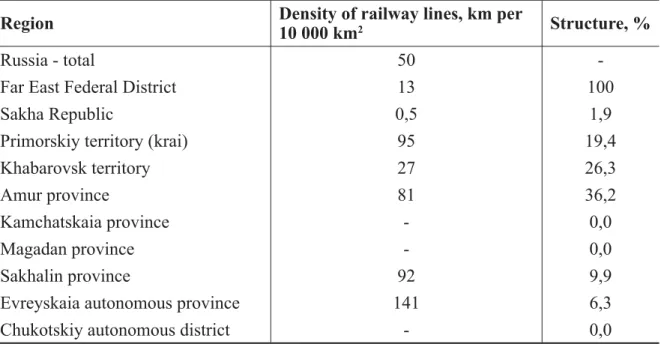
Although the general length of the railway lines in Russia is rather impressive, a density of railway lines is rather low in comparison with Northeast Asia countries
3. This density is strongly differentiated not only among regions of Russia but also inside each region. The vast space of the region needs a better transportation system. It is true and for the Russian Far East where the density of railway lines is much lower than in the country as a whole (Table 1).
The Trans-Siberian railroad (Trans-Sib) is the longest transport line in Russia and main transport route on the East of the country. Its length from Moscow to Vladivostok
3 The density of railways and motor roads in Siberia are approximately equal to an average density of roads in Russia.
equals to 9288 km. Under the USSR the intensity of turnover throughout Trans-Sib was two times higher than an average turnover intensity of railway transport in the U.S.A.
In the mid of 1980
th7UDQV6LEIXO¿OOHGWKHFUXFLDOVKDUHRIDOOLQWHUQDWLRQDOFRQWDLQHU WUDI¿FEHWZHHQ&HQWUDO(XURSHDQG1RUWKHDVWDQG6RXWKHDVW$VLDDERXWWKRXVDQG containers a year).
Table 1. Density and Geographic Structure of the Russian Far East Railway Lines in 2008
Region Density of railway lines, km per
10 000 km
2Structure, %
Russia - total 50 -
Far East Federal District 13 100
Sakha Republic 0,5 1,9
Primorskiy territory (krai) 95 19,4
Khabarovsk territory 27 26,3
Amur province 81 36,2
Kamchatskaia province - 0,0
Magadan province - 0,0
Sakhalin province 92 9,9
Evreyskaia autonomous province 141 6,3
Chukotskiy autonomous district - 0,0
Technical equipment of Trans-Siberian railroad permits us to transport up to 130 million ton of freight every year, including 250 thousand containers (in 20 pounds equivalent) of international transit.
Now the railway transport is used to transport oil and petroleum products form 6LEHULDWR3DFL¿F5LPFRXQWULHV$ERXWRIWKHPJRWRWKH&KLQHVH3HRSOH¶V5HSXEOLF (CPR).
The Trans-Siberian railroad may be extended up to Japan, crossing island of Sakhalin, in the future. This rail way between Europe and Northeast Asia will be 8000 km shorter than sea way, the time of transit and the cost of transportation will also reduce
4. They estimate that the volume of transit by this line may be equal to 10–12 million ton a year, it may double in 30-40 years (a volume of turnover between Japan and Russia may exceed 20 million ton by this time.
In early 1990
thalmost a half of foreign clients decided not to use the Trans-Siberian railway, and in the middle of 1990
thonly 1/3 of Trans-Sib capacity was in use. One of the reasons was a decline in the level of trust in the safety of transportation by Russian railways
4 Shipping cargo from Tokyo to Europe takes some two months, by extended Trans-Sib freight from Tokyo or Seoul to London may come in 15-17 days.
According to preliminarily estimations, the cost of transportation of one 40 pounds container by Trans- Sib will be $500 less than by sea.
after 1991.
Now the situation improved. The Russian government cut tariffs, eased custom procedures, solved problems of safety, and increased a speed of transportation, and so on.
In a control center one may now follow a movement of every freight in a computer monitor, look at locking arms.
Baikal-Amur railroad. In order to organize direct railway connection ‘Russia- Japan’ and to integrate the Trans-Siberian railway into the world transportation system it is necessary modernize not only Trans-Sib, but also the Baikal-Amur railroad.
One of the aim of the Baikal-Amur railroad, that goes from the Eastern Siberia city of Tayshet to the sea port Vanino in the Russian Far East and is 4358 km long, was to help WRGHOLYHUFUXGHRLOWRWKH3DFL¿FRFHDQFRDVW2QHNQRZVWKDWQRZWKLVDLPLVQRWWRWDOO\
UHDOL]HG$IWHUDIXO¿OOPHQWRIWKHSURJUDPRIFRQVWUXFWLRQRIDFRQWDLQHUWUDQVSRUWEULGJH
‘Europe-Asia’ the Baikal-Amur railroad may become a full scale understudy of Trans-Sib and to serve as additional channel of crude oil transportation form Siberia to the East.
Railway passage “Mainland Russia – Sakhalin Island’. A transcontinental bridge (Europe-Japan) creation presumes a construction of railway passes from the mainland Russia to Sakhalin and from Sakhalin to Hokkaido.
Now the mainland Russia and Sakhalin are connected by a ferry which goes from the seaport Vanino to the seaport Kholmsk. It works since 1973 and can transport up to 30 million ton of cargo a year. But severe climate conditions make the work of ferry rather unreliable.
The Railway passage “Mainland Russia – Sakhalin Island’ will eliminate the dependence of transport communication with Sakhalin from climate conditions and seasons factors.
There are two ways to crate this passage: (i) to construct a tunnel under the Tatar strait, (ii) to build a complex bridge (car-railway, oil and gas pipe-lines) over the strait of Nevel’skiy.
Tunnel. An idea to dig a tunnel from a cape of Lazareva to a cape of Pogibee (8 km) discoursed as far as in the end of 1930
th. The engineering design and preparation for the tunnel construction were interrupted when Hitler Germany attacked the USSR and started again in 1947. Engineering design of a tunnel ‘cape Sredniy-cape Pogibee’ (12.9 km) was ready in 1951. But all works were stopped in May 1953.
In the middle of 1990
tha new project of a tunnel was designed. Its realization costs about $3×10
9, time of construction – 2 or 3 years, pay back period – up to 10 years.
Bridge. An idea to construct a bridge instead of tunnel was put forward by scholars of Far East branch of Russian Academy of Sciences. They suggested to the government to build a complex bridge, which will combine railway and motor roads, oil pipelines and gas pipelines. They proposed to place the turbines for waves and tide electrical equipment in the body of this bridge, and to use piers for aquaculture.
Railroad ‘Europe-Japan’. The Railway passage “Mainland Russia - Island
Sakhalin’ will be a link of railroad ‘Europe-Japan’. Another link is to be a passage from
Sakhalin to Hokkaido
5.
Japanese experts discussed an idea to create such passage at the end of 1960
th. With the help of modern technologies a tunnel under the strait of Laperusa (50 km) can be constructed during relatively short period. But the economic aspects of this project are not clear yet. The rail road ‘Europe-Japan’ may add its mite to make Japan more open to the ZRUOGDQGH[SDQGVÀRZVRISHRSOHDQGJRRGVWRDQGIURP$VLDDQGWKHZRUOG
Railroad ‘Europe-Republic of Korea’. UN suggested a project of construction of a railroad ‘Seoul-Vonsan-Vladivostok’. Though Trans-Sib it will connect North and South Koreas with Europe. Using this railroad can double a speed of freight (containers) transportation from Pusan (The Republic of Korea) to Western Europe.
There are two variants of the project realization; they differ in the places where railroad from the North and the South Korea joints the Trans-Siberian railroad.
Perspective of this project realization crucially depends on political relations between North and South Korea.
4
.Water Transport
Huge part of commodities transported by Trans-Sib and Baikal-Amur railroad to then Russian Far East after transfer from rail to vessels are shipping to their places of GHVWLQDWLRQE\ULYHUVVHDVDQGRFHDQ0HULGLDQGLUHFWLRQRIÀRZRIPDQ\6LEHULDQDQG)DU East rivers makes them natural connection links between the Arctic sea lane and Trans- Siberian railroad.
The Arctic sea lane is the main Russia’s sea route in Arctic (5600 km). Since 1991, it is open for international navigation. This way is used not only as a transit road but also as a way of export commodities delivery from Northern regions of Siberia and Far East.
By expert estimation, it can earn for Russia $100 000 and more only in a form of payment for leading one foreign vessel though Arctic sea lane (ASL). There are estimations, DFFRUGLQJWRZKLFKE\DWRWDOFDUJRÀRZVKLSSLQJE\$6/PD\UHDFK
×106ton and by 2015 – 14×10
6-15×10
6ton (shortly before 1991 it was from 4×10
6to 6×10
6ton.
When so called ‘Amuro-Yakutskaia railroad’ is put into operation an opportunity ZLOODSSHDUWRRSHQQHZWUDQVSRUWZD\IURPEH(XURSHWR3DFL¿F5LP&RXQWULHVµ$UFWLFVHD ODQHULYHU/HQD7UDQV6LE3DFL¿F5LP&RXQWULHV¶
It should be mentioned that now the Russian vessels ship only about 1/3 of export- import cargo. In the Far East the country lost almost all its modern container vessels, tankers, passengers and auxiliary ships; and a share of foreign vessels, served in the Russian Far East’s ports, is about 75 percent.
5
.Automobile Transport
Automobile transport carries out manly internal transportation but it also is used in
5 According to estimations a connection of the Trans-Siberian railroad and Japanese railroad system can costs $10×109-$15×109.
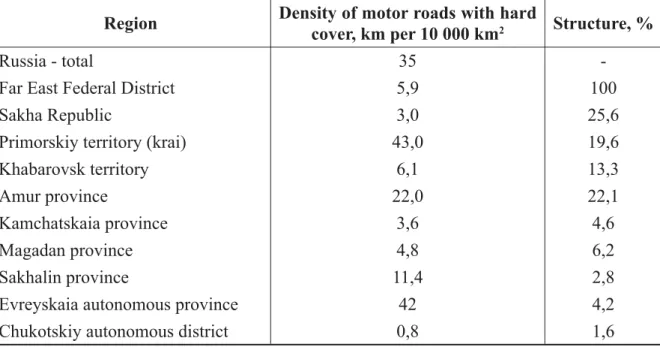
boundary trade with Chinese People’s Republic. The skeleton of motor roads system in the Russian Far East is formed by federal motor roads.
Table 2. Density and Geographic Structure of the Russian Far East Motor Roads Lines
in 2006.
Region Density of motor roads with hard
cover, km per 10 000 km
2Structure, %
Russia - total 35 -
Far East Federal District 5,9 100
Sakha Republic 3,0 25,6
Primorskiy territory (krai) 43,0 19,6
Khabarovsk territory 6,1 13,3
Amur province 22,0 22,1
Kamchatskaia province 3,6 4,6
Magadan province 4,8 6,2
Sakhalin province 11,4 2,8
Evreyskaia autonomous province 42 4,2
Chukotskiy autonomous district 0,8 1,6
Motor roads in the Russian Far East are less developed then in central and Western parts of the country (Table 2). Their quality does not correspond to modern automobiles and world standards. There is an urgent necessity to modernize and develop boundary passes for automobiles on Russian-Chinese and Russian-North Korea boundaries.
6
.Oil Pipelines
It is know that the aim of oil pipelines is to supply petroleum refining plants, petrochemical factories and foreign markets with rude oil. In Russia, almost all lines of oil and gas pipeline system are located in West Siberia and orientated on oil transportation to the West. To the East oil is transported manly by railway and sea transport.
T h r e e r e g i o n s h a v e o i l p i p e l i n e s i n t h e R u s s i a n F a r E a s t : t h e S a k h a Republic (pipeline ‘Talakan-Vetem’ – 110 km); Khabarovsk territory
6(‘krai’) – pipeline ‘Okha-Komsomol’sk-na-Amure’ (635 km); Sakhalin province – pipeline
‘Dagi-Pogeblee-Lazarevo-Tsemermanovskoe-Komsomol’sk-na-Amure’ (500 km).
The terminal of main pipeline system of ‘Transneft’ is located not far from the city of
$QJDUVNLQWKH,UNXWVNSURYLQFH2LOUH¿QHVDW$QJDUVNSHWUROHXPUH¿QLQJDQGJRHVWRWKH(DVW by railway transport from oil bulk unit in a settlement Meget in the Irkutsk province.
It worth to mention, that the projects of oil pipelines construction are realized very slowly. For example, an idea to build oil pipeline from Russia to Chinese People’s Republic
6 7KHUHDUHWZRSHWUROHXPUH¿QLQJSODQWV
was put forward in November 1994; a possibility to construct an oil pipeline to Datsin (CPR) is under discussion more than 8 years; the plan to build an oil pipeline from Eastern 6LEHULDWRWKHFRDVWRIWKH3DFL¿FRFHDQGLGQRUHDOL]HVRPH\HDUVWKHGUDIWRIDODZµ2Q pipeline transport’, elaborated in 1995 and approved by the Parliament (State Duma) in 1999, yet is not implemented in practice.
December 31 2005, the Russian prime-minister M. E. Fradkov signed the JRYHUQPHQWGHFUHHʋɪDERXWFRQVWUXFWLRQDQRLOSLSHOLQHµ:HVWHUQ6LEHULD3DFLILF Ocean’. It should go from the city of Tayshet (the Irkutsk province) to the city of Skovorodino (the Amurskaia province) and feather to the creek Perevoznaia (Primorskiy region). April 28 2006, the construction began from the city of Taishet, and in June 2006, from the city of Skovorodino.
According to estimations, the cost of pumping oil through this pipeline will be 5-7 time less than the cost of railway transportation.
)URPWKH3DFL¿F2FHDQFRDVW5XVVLDPD\H[SRUWRLOWRWKH$VLD3DFL¿FUHJLRQDQGWR WKH3DFL¿F2FHDQFRDVWRIWKH867KHPDMRUFRQVXPHUVLQWKHVHWZRUHJLRQVQHHGRLO
7. 7
.Gas pipelines
The majority of hydrocarbon deposits, which are located in Eastern Siberia and the Russian Far East, contain both oil and gas. The proved stock of gas in this region exceeds 4
×109
cubic meters (8 percent of the Russian as a whole). At the same time a demand for gas LQ$VLD3DFL¿FUHJLRQZLOOJURZ6R5XVVLDPD\EHRQHRIWKHJDVVXSSOLHUVWRWKHFRXQWULHV RI$VLD3DFL¿FUHJLRQ,WPD\EHRQHRIWKHUHDVRQVZK\UHFHQWO\5XVVLDWULHVWRUHLQIRUFH LWVWLHVZLWKWKHVWDWHVRI$VLD3DFL¿FUHJLRQ
8.
Now Russia exports to the East (mainly to China and Mongolia) not more than 1000 WRQRIOLTXH¿HGK\GURFDUERQJDV7KHUHLVQRH[SRUWRIJDVE\SLSHOLQHVWRWKH3DFL¿F5LP countries.
Nevertheless, there are several different ways of natural gas export form western regions of Russia to the Northeast Asian states. They are discussed both in Russia and abroad. Let us list them.
1. Export gas pipeline system: ‘Republic Sakha – Amurskaia province – Khabarovsk territory – Primorskiy territory – North Korea – South Korea’.
2. Export gas pipeline system: ‘Island Sakhalin – Khabarovsk region – Primorskiy region – North Korea – South Korea’ and ‘Island Sakhalin – Hokkaido – Honshu’.
3. Export gas pipeline system: ‘Eastern Siberia – Far East – Northeast Asian countries’. There are two alternative itineraries under this variant: ‘Chita – Zabaykal’
7 Japan, for example, buys oil in the Middle East by higher price than European countries. The difference in prices, called ‘an Asian bonus’, may be up to several dollars per barrel.
8 “Recently, Russia seemingly has begun to look once again to its Far East region, and it is seeking to forge FORVHUWLHVZLWKWKH$VLD3DFL¿FUHJLRQLQRUGHUWRDGYDQFHWKHGHYHORSPHQWRI)DU(DVW5XVVLDDQG(DVWHUQ Siberia”. (When the Pacific Ocean Becomes an "Inland Sea": Five Pledges to a Future Asia that "Acts Together”. Speech by H.E. Mr. Yasuo Fukuda, Prime Minister of Japan May 22, 2008, Tokyo, Japan on the occasion of the 14th International Conference on The Future of Asia http://www.mofa.go.jp/region/asia- paci/speech0805-2.html).
sk – Dallian – Beijing – Piontek’ or ‘Chaiadinskoe- Tinda-Scovorodino – Khabarovsk- Vladivostok- Nakhodka’ with two side-pipelines: one go to Chinese People’s Republic, another – to the North and than to South Korea.
In March 2006, Russian corporation ‘Gazprom’ and ‘China National Petroleum Company’ (CNPC) signed a memorandum on cooperation in a gas sphere. Two way of about 30
×10
9-40
×10
9cubic m of Russian gas export to China are under the study. One starts in the Western Siberia and goes to Chinese People’s Republic via Altai Mountains
9. The pipeline can be connected to trans-china gas pipeline named ‘West-East’.
Liquefied gas from gas deposits in Yamalo-Nenetskiy autonomous district can be export by the Arctic sea lane.
The second itinerary of gas pipeline goes from the Eastern Siberia to the Russian Far East and than to CPR.
There are suggestions to increase natural gas exports from Sakhalin Island. And again this export to the Northeast Asian countries may be realized by two ways.
1. After liquefaction at a plant near the city of Korsakov (Sakhalin province) they transport gas by specialized sea vessels.
To follow this way it is necessary to construct a gas pipeline form the Northwest coast of Sakhalin Island to non-freezing port Korsakov (625 km), to build (according to one RISRVVLEOHYDULDQWVLQWKHFLW\RI1DNKRGNDDOLTXH¿HGSHWUROHXPJDVSODQWLWVFDSDFLW\
have to be 9
×10
6WRQRIOLTXH¿HGJDVSHU\HDUDQGVHDWHUPLQDOWRH[SRUWOLTXH¿HGJDV 7KHWUDGHSDUWQHUVRI6DNKDOLQ±-DSDQ6RXWK.RUHDDQG7DLSHL±QRZEX\OLTXH¿HG gas in other countries, and Chinese People’s Republic plans rapid development of this type of energy carrier markets in southern coastal provinces.
7RUHFHLYHOLTXH¿HGJDVWKH\DOUHDG\DUHEXLOGLQJVHDWHUPLQDOVLQ&35VRLQ years China will have no need in natural gas, transported from Russia by pipelines
10.
2. The second way – to pump gas through pipeline to Khabarovsk territory and Primorskiy territory and than to Japan over the strait of Laperusa.
8
.Electric Power Lines
7KHUHDUHPRUHWKDQRIWKHFRXQWU\¶VHOHFWULFSRZHUFDSDFLW\LQWKH:HVWHUQ Siberia and the Russian Far East. According to the estimations, made in the Energy Systems Institute named after L. A. Melent’ev (Siberian Branch of Russian Academy of Sciences, Irkutsk), after reconstruction the existing electric power stations and ending electric power stations, that are in the process of construction, there will be 25
×10
9-30
×10
9kilowatt-hours surplus of electric power in the Western Siberia
11. The surplus electricity can be exported to China, Mongolia, North and South Koreas, Japan.
9 By experts estimation this pipeline may costs about $10 billions; some experts say there is a chance to construct it by 2011, some argue that only after 2020.
10 Even now CPR does not want to buy, even in 5-10 years perspective, Russian natural gas more than for
$100 per 100 m3, though in Europe this gas costs $160 per 100 m3 and more.
11 6LJQL¿FDQWHOHFWULFSRZHUUHVRXUFHVLQDSRVWVRYLHW$VLDKDYHH[FHSW5XVVLD$]HUEDLMDQ.D]DNKVWDQ Turkmenistan, and Uzbekistan.
Now Russian transmits electricity to the Chinese People’s Republic and to Mongolia.
In the Russian Far East only Amurskaia province exports electricity to CPR. There are two inter-states electric power lines. Analogous lines can be created in the south of Primorskiy region (for electricity transmission to CPR and North Korea) and in the Khabarovsk territory (for electricity transmission to CPR).
There are several projects of electricity transmission. Two of them design electricity export to China.
First, let me call it ‘Small Electricity Bridge’, designs construction short distance electric power line along the Russian-Chinese boarder. They will have voltage equal to 35-110-220 kilovolt, and transmit up to 100 megawatt. Up to 5
×10
9kilowatt-hours can be exported by 2010 in this project. Amurskaia province will be the main exporter.
The second project – ‘Large Electricity Bridge’ – designs powerful high voltage electric power lines construction. They should be able to transmit up to 20
×10
9kilowatt- hours per year.
Next project was named ‘Far East-Korean Peninsula’. Experts from Russia, North and South Koreas study this project since 2001. Some information on this project is given in the Table 3.
Table 3. Electric power lines of the project ‘Far East-Korean Peninsula’
Line Length,
km Voltage, kilovolt Transmission power, megawatt per year
Cost, million dollars Vladivostok-North
Korea 380 500, alternating current Up to 500 180
Vladivostok-Seoul 900 500-600 constant current 2000-3000 1000 The project ‘Sakhalin-Japan’. The first suggestions to export electricity from Sakhalin we found in investment project made by international financial group RHINOCERUS in 1993. In 1996, Siberian Energy Institute in cooperation with ‘RAO UES Russia’ studied a potential of electric power export from Sakhalin Island. Their suggestions were used in the project ‘Russia-Japan Power Bridge’, carried out by ‘RAO UES Russia’ in cooperation with Japanese company ‘Marubeni’ in 1999.
In those two projects they anticipated a construction gas-burning power station in Sakhalin Island. Its power has to be 4
×10
6kilowatt, and it uses Sakhalin gas. They also projected to connect electricity system of Sakhalin with United Electricity System of the Western part of Russia and to build power bridge ‘Sakhalin-Japan’.
They supposed that ‘power bridge’ would consist of aerial electric power lines of constant current and underwater cables for +500 or +600 kilovolt. The length of electric power line on the Russian territory will be 450 km or 780 km (it depends on a converter substation location).
They also proposed to prolong an underwater cable either to the Northern part of
+RNNDLGR,VODQG§NPRUWR+RQVKX,VODQG§NP
Talking about this ‘power bridge’, one should keep in mind that an economic HI¿FLHQF\RIWKLVSURMHFWLQQRWFOHDU
,QDVXPPDU\ZHPD\FRQFOXGHWKDWWRWUDQVPLWDVLJQL¿FDQWDPRXQWRIHOHFWULFLW\
to the Chinese People’s Republic, Korean Peninsula and Japan Russia has to not simply construct power lines but build new power generating capacities. To joint the Russian and 3DFL¿F5LPFRXQWULHVHOHFWULFV\VWHPVWKHSDUWQHUVLQHOHFWULFLW\H[FKDQJHKDYHWRHODERUDWH common principals and conditions of national electric power systems operation and to adopt a legislation that will guaranty a normal functioning of interconnected power grid.
9
.Air transport
There is a project to organize cross-Artic air-route form the Northern America to 6RXWKHDVW$VLDYLDWKH$UFWLF2FHDQDQG6LEHULDDQGWRRUJDQL]HDUHFWL¿HGDLUOLQHJRLQJ form the side of Norway via Novaya Zemlya and Yakutia to Japan. The cross-Artic air-route can economize time (from 40 minutes to 2 hours, it depends on season of a year) and fuel.
6RWKHUHLVDFKDQFHWKDWWKHVHDLUURWHVPD\EHFRPPHUFLDOO\HI¿FLHQW
10
.Challenges
To realize the mentioned above projects one needs at least resources to create international transit corridors, feasibility of objects of transportation (commodities and passengers) on one side of the corridors and desire to obtain them on the other side of these corridors.
Productive investment, qualified labor force, modern technology and information are crucial resources to build international transit corridors. There is a lack of all of them in Russia now.
Investment. There are not many corporations in Russia ready and willing to make long-range investment. They simply do not have enough of them and have to borrow. For example, 23.3
×10
6kilowatt was put into operation in Russia in 2001-2005. This number should grow up to 40.9
×10
6- 41.9
×10
6kilowatt in 2006-2010. To do it the power industry needs investment, but the industry itself gives only about 30 percent of the total amount of investment (approximately70 percent comes from outside investors).
So, a construction of international transit corridors needs an international cooperation.
Labor. Reduction of population is one of the reasons of decline in the number of qualified labor force in Russia. For instance, in 2001-2006, the number of population reduced by 3.8 percent (765 thousand people) in Siberia and by 5.0 percent (345 thousand people) in the Russian Far East. The others are deterioration of the quality of education and HPLJUDWLRQRIKLJKTXDOL¿HGVSHFLDOLVWV
Objects of transportation. The perspectives of the main items of Russia’s export
production are to some extend vague: they forecast a slow down in the rate of oil and gas
extraction (Figure 2.). Moreover, the world may face with a cyclic decline in prices on crude
RLODQGQDWXUDOJDVDQGDQH[FDYDWLRQRIWKHVHK\GURFDUERQVZLOOEHQRVRSUR¿WDEOH
Fig. 2. Achieved (2001-2005) and forecasting (2006-2020) rates of growth of oil and gas production in Russia, %.
Desire to use corridors. Both Russia and the other world have a certain desire to transit goods and transport passengers via Russia. Russia hopes to benefit not only in payments for transit but in development the regions which are located near the transit corridors. But the Russian authorities and businessmen should keep in mind that there are alternative variants of international transit corridors which do not go through the Russia’s territory.
The other world not only remembers about it but is in active search both other than Russia suppliers of hydrocarbons and alternative sources of energy. But in the first half of 2008, they forecast a growing world demand for hydrocarbons in a long-range period (Tables 4-5).
7DEOH6RPHSHUVSHFWLYHVRIRLOH[WUDFWLRQFRQVXPSWLRQDQGLPSRUWVLQ$VLD3DFL¿F
region (An average values of some forecasts), million ton
Oil 2010 2015 2020 2025 2030
Extraction 408 408 391 367 342
Consumption 1510 1765 1970 2100 2205
Net imports 1102 1357 1579 1733 1863
2001-2005
2006-2010
2011-2015
2016-2020
Oil
Natural gas 109,8
111,9 117,4
106,9 145,5
109,4
103,1 102,8
100,0 120,0 140,0 160,0
%
Oil Natural gas 2001-2005
2006-2010
2011-2015
2016-2020
Oil
Natural gas 109,8
111,9 117,4
106,9 145,5
109,4
103,1 102,8
100,0 120,0 140,0 160,0
%
Oil Natural gas
7DEOH6RPHSHUVSHFWLYHVRIJDVH[WUDFWLRQFRQVXPSWLRQDQGLPSRUWVLQ$VLD3DFL¿F
region (Average values of some forecasts), trillion cubic meters
Gas 2010 2015 2020 2025 2030
Extraction 436 489 525 552 571
Consumption 510 625 740 846 952
Net imports 74 136 215 294 381
According to the Word Energy Outlook (2006) Asian countries will be the largest world consumers of energy in the nearest future. I think that there are at least two circumstances which postpone the time of this forecast realization. They are: a slow down in Asian countries economic growth
12and broad utilization of energy saving technologies.
Japan is a world leader in energy saving technologies. A volume of primary energy resources that Japan consumes per $1000 of its GDP is 7 times less than in the former Soviet Union countries and 3 times less than in South Korea. But an average per capita energy consumption in Japan is higher than in Great Britain, or in Germany, or in France. So, for Japan it is vitally important to have friendly relations with the suppliers of energy resources.
The country’s policy shifts from competition fro energy resources to cooperation in energy resources production.
It his speech at the World Economic Forum in Davos January 2008, Mr. Yasuo Fukuda, Prime Minister of Japan, sad that the key words to withstand to new challenges of XXI century are: ‘cooperation with participation of all sides’. Existence of the common interest in transit corridors permits us to rely on cooperation with participation of all LQWHUHVWHGVLGHVLQWKHVHFRUULGRUVFRQVWUXFWLRQWRKRSHWKDWLWZLOOEULQJDPXWXDOEHQH¿W and make our countries not only more open but more closer to each other.
12 The text of the approved in Japan ‘Base Energy Plan’ (‘Enerugi Kihon Keikoku’) says that the main obstacles for economic growth in Japan are:
- a low birth rate;
- aging of population and depopulation;
- unfriendly economic conjuncture;
- economic growth in Asian countries, that makes a competition more hard.
Literature
ȼɚɫɢɥɶɟɜȺȻɈɜɥɢɹɧɢɢɩɪɹɦɨɝɨɠɟɥɟɡɧɨɞɨɪɨɠɧɨɝɨɫɨɨɛɳɟɧɢɹɨɋɚɯɚɥɢɧɆɚɬɟɪɢɤ
ɧɚɬɪɚɧɫɩɨɪɬɧɭɸɫɢɫɬɟɦɭɪɟɝɢɨɧɚhttp://vff-s.narod.ru/sakh/tp/p1/p09.htm).
ȾɟɪɛɢɥɨɜɚȿɌɭɬɭɲɤɢɧȺȼɫɟɬɚɤɢɄɢɬɚɣȼɟɞɨɦɨɫɬɢɚɩɪɟɥɹ
Ʉɨɧɬɨɪɨɜɢɱ Ⱥ ɗ Ʉɨɪɠɭɛɚɟɜ Ⱥ Ƚ ɗɞɟɪ Ʌ ȼ ɋɬɪɚɬɟɝɢɹ ɪɚɡɜɢɬɢɹ ɧɟɮɬɹɧɨɝɨ
ɤɨɦɩɥɟɤɫɚɊɨɫɫɢɢɗɄɈʋ
ɆɢɧɚɤɢɪɉɄɭɱɟɪɹɜɟɧɤɨȼɇɚɞɚɥɶɧɟɜɨɫɬɨɱɧɨɦɪɭɛɟɠɟɆɢɪɩɟɪɟɦɟɧʋ ɊɟɝɢɨɧɵɊɨɫɫɢɢɋɨɰɢɚɥɶɧɨɷɤɨɧɨɦɢɱɟɫɤɢɟɩɨɤɚɡɚɬɟɥɢɋɬɚɬɫɛɊɨɫɫɬɚɬ±Ɇ
2007.
ɋɩɟɰɢɚɥɶɧɨɟ ɜɵɫɬɭɩɥɟɧɢɟ ɉɪɟɦɶɟɪɦɢɧɢɫɬɪɚ əɫɭɨ Ɏɭɤɭɞɚ ɧɚ ȼɫɟɦɢɪɧɨɦ
ɷɤɨɧɨɦɢɱɟɫɤɨɦɮɨɪɭɦɟɜȾɚɜɨɫɟɹɧɜɚɪɹɝɄɨɧɝɪɟɫɫɰɟɧɬɪKWWSZZZ ru.emb-japan.go.jp/NEWS/PERFORMANCE/PRIMEMINISTER/davos-2008.html
ɋɬɪɟɥɶɧɢɤ Ⱥ Ⱥ Ʌɟɨɧɬɶɟɜ Ɋ Ƚ Ɇɟɠɞɭɧɚɪɨɞɧɵɣ ɝɪɭɡɨɜɨɣ ɬɪɚɧɡɢɬ ɧɚ ȾɚɥɶɧɟɦȼɨɫɬɨɤɟɊɨɫɫɢɢɇɚɭɱɧɨɟɢɡɞɚɧɢɟ±ɏɚɛɚɪɨɜɫɤȾȼȽɍɉɋ
ɋɭɫɥɨɜȼɂɄɨɪɠɭɛɚɟɜȺȽɗɧɟɪɝɟɬɢɱɟɫɤɢɟɬɪɚɧɫɩɨɪɬɧɵɟɩɭɬɢɢɬɪɚɧɫɩɨɪɬɧɚɹ
ɢɧɮɪɚɫɬɪɭɤɬɭɪɚɜɋɢɛɢɪɢɢɇɚȾɚɥɶɧɟɦȼɨɫɬɨɤɟ µɗɄɈ¶ʋ
Ɍɚɬɹɧɢɤɨɜ Ⱥ Ʌ Ɉɫɧɨɜɧɵɟ ɬɟɯɧɢɱɟɫɤɢɟ ɪɟɲɟɧɢɹ ɩɨ ɫɬɪɨɢɬɟɥɶɫɬɜɭ ɧɨɜɨɣ
ɠɟɥɟɡɧɨɞɨɪɨɠɧɨɣɥɢɧɢɢɄɨɦɫɨɦɨɥɶɤɧɚȺɦɭɪɟɋɟɥɢɯɨɜɨ±ɇɵɲɫɩɟɪɟɯɨɞɨɦ ɩɪɨɥɢɜɚɇɟɜɟɥɶɫɤɨɝɨhttp://vff-s.narod.ru/sakh/tp/p1/p09.htm).
Ɏɟɞɟɪɚɥɶɧɚɹ ɰɟɥɟɜɚɹ ɩɪɨɝɪɚɦɦɚ ©Ɇɨɞɟɪɧɢɡɚɰɢɹ ɬɪɚɧɫɩɨɪɬɧɨɣ ɫɢɫɬɟɦɵ Ɋɨɫɫɢɢ
ɝɨɞɵªɩɨɞɩɪɨɝɪɚɦɦɚ©Ɇɟɠɞɭɧɚɪɨɞɧɵɟɬɪɚɧɫɩɨɪɬɧɵɟɤɨɪɢɞɨɪɵª
ɒɚɪɚɩɨɜɋɇɉɟɪɫɩɟɤɬɢɜɵɋɚɯɚɥɢɧɫɤɨɣɠɟɥɟɡɧɨɣɞɨɪɨɝɢhttp://vff-s.narod.ru/sakh/tp/p1/p09.htm).
ɗɤɨɧɨɦɢɱɟɫɤɢɟɚɫɩɟɤɬɵɪɚɡɪɚɛɨɬɤɢɬɪɚɧɫɩɨɪɬɧɨɣɫɬɪɚɬɟɝɢɢɊɨɫɫɢɢɆɚɬɟɪɢɚɥɵɤ
ɨɛɫɭɠɞɟɧɢɸɜɐɟɧɬɪɟɫɬɪɚɬɟɝɢɱɟɫɤɢɯɪɚɡɪɚɛɨɬɨɤɝɆɨɫɤɜɚɧɨɹɛɪɹ ɝɩɨɬɪɚɧɫɩɨɪɬɧɨɫɬɪɚɬɟɝɢɢɊɨɫɫɢɢ±ɇɨɜɨɫɢɛɢɪɫɤɂɗɈɉɉ
ɗɧɟɪɝɟɬɢɤɚɊɨɫɫɢɢɩɪɨɛɥɟɦɵɢɩɟɪɫɩɟɤɬɢɜɵɌɪɭɞɵɇɚɭɱɧɨɣɫɟɫɫɢɢɊȺɇɈɛɳɟɟ
ɫɨɛɪɚɧɢɟɊȺɇɞɟɤɚɛɪɹɝɊȺɇ±Ɇɇɚɭɤɚ
ɗɧɟɪɝɟɬɢɱɟɫɤɚɹɷɤɫɩɨɪɬɧɚɹɩɪɨɝɪɚɦɦɚɨɜɚɋɚɯɚɥɢɧɆɟɠɞɭɧɚɪɨɞɧɚɹɮɢɧɚɧɫɨɜɚɹ
ɝɪɭɩɩɚ5+,12&(586Ɇɨɫɤɜɚɨɤɬɹɛɪɶɝ
/$.RVKHHY<1.XFKHURY76DNHPL.1DWRQ, Russia-Japan Power Bridge, in Energy
Integration in Northeast Asia: Perspectives for the creation of interstate electric power systems. Proc. Of The 3
rdInternational World Energy System Conference. The 2
ndInternational Conference on Energy Integration in Northeast Asia, September 21-22, Irkutsk, Russia.
:KHQWKH3DFL¿F2FHDQ%HFRPHVDQ,QODQG6HD)LYH3OHGJHVWRD)XWXUH$VLDWKDW$FWV
Together”. Speech by H.E. Mr. Yasuo Fukuda, Prime Minister of Japan May 22, 2008, Tokyo, Japan on the occasion of the 14th International Conference on The Future of Asia (http://www.mofa.go.jp/region/asia-paci/speech0805-2.html)
http://www.kremlin.ru/appears/2006/04/26/1934_type63374type63378type82634_105038.
shtml
http://www.kremlin.ru/appears/2006/03/21/1641_type63377type63380_103402.shtml
http://www.kremlin.ru/appears/2006/03/22/1123_type63376type63377type82634_103471.
shtml
http://www.titoff.ru/news/index.php?id=7590&gid=0 http://www.rao-ees.ru
Appendix 1. Some Characteristics of the Trans-Siberian railroad (Trans-Sib)
• The longest transport line in Russia and main transport route on the East of the country. Its length from Moscow to Vladivostok equals to 9288 km.
• Under the USSR the intensity of turnover throughout Trans-Sib was two times higher than an average turnover intensity of railway transport in the U.S.A.
• Technical equipment of Trans-Siberian railroad permits us to transport up to 130×
10
6ton of freight every year, including 250 000 containers (in 20 pounds equivalent) of international transit.
• Now the railway transport is used to transport oil and petroleum products form 6LEHULDWR3DFLILF5LPFRXQWULHV$ERXWRIWKHPJRWRWKH&KLQHVH3HRSOH¶V Republic.
• The Trans-Siberian railroad may be extended up to Japan via island of Sakhalin in the future. This railway between Europe and Northeast Asia will be 8000 km shorter than sea way, the time of transit and the cost of transportation will also reduce.
• Shipping cargo from Tokyo to Europe takes about two months, by extended Trans- Sib freight from Tokyo or Seoul to London cargo may comes in 15-17 days.
• According to preliminarily estimations, the cost of transportation of one 40 pounds container by Trans-Sib will be $500 less than by sea.
• They estimate that the yearly volume of transit by this line may be equal to 10×10
6–12
×106ton, it may double in 30-40 years. A volume of turnover between Japan and Russia may exceed 20×10
6ton by this time.
Appendix 2. Key Indicators of Japan Trade by Oil and Oil Products, million ton of oil equivalent
Indicator 1980 1985 1990 1995 2010
(Forecast)
Production (1) 0.7 0.5 0.6 0.6 0.7
Import (2) 249.4 252.2 212.7 262.5 255.0
Export (3) - 1.2 -0.5 -0.6 -3.8 -14.5
Bunkerage (4) -19.0 -11.6 -7.1 -5.1 -5.0
Total consumption
(5) = (1)+(2)+(3)+(4) 229.8 240.7 205.5 254.2 236.2
'HSHQGHQFHRQ,PSRUW
×(2)/ [(1)+(2)]