solids by multiply charged ion impact
K Fukai1, S Fujita1, T Tachibana2‡, T Koizumi1,2 and T Hirayama1,2
1Department of Physics, Rikkyo University, Nishi-Ikebukuro, Toshima-ku, Tokyo 171-8501, JAPAN
2Research Center for Measurements in Advanced Science (RCMAS), Rikkyo University, Nishi-Ikebukuro, Toshima-ku, Tokyo 171-8501, JAPAN
E-mail: [email protected]
Abstract. The interaction of low-energy multiply charged Arq+(q ≤ 7) ions with a solid Ne surface is experimentally studied. Desorption of very large cluster ions Ne+n (n > 100) is observed. The size distribution of smaller (n= 1∼3) cluster ions depends strongly on the charge state of the incident ion, whereas that of larger (n >7) cluster ions exhibits no dependence on the charge state, indicating that desorption of large cluster ions is due to kinetic sputtering. The potential sputtering yield is estimated by analyzing the size distribution of the desorbed cluster ions. The results suggest that the ion desorption mechanism, which is known as desorption induced by electronic transitions, can also be applied to the present results.
1. Introduction
Rare-gas solids (RGS) are interesting materials for investigating the dynamic processes of desorption induced by electronic transitions (DIET) because of their simplicity and because their electronic structures resemble those of isolated atoms. Furthermore, they have several characteristics that differ greatly from those of other materials, including low cohesive energies (e.g., 0.02 eV/atom for Ne), large band-gap energies (e.g., 21.6 eV for Ne), and long exciton diffusion lengths (e.g.,∼200 nm for Ne), etc. [1]
Desorption of atoms and ions by low-energy electron impact, known as electron- stimulated desorption (ESD), or by VUV photon irradiation, known as photon- stimulated desorption (PSD), from the surfaces of RGS has been extensively studied over the past two decades [2–4]. The creation of excitons and ions plays an important role in the desorption of neutral atoms, whereas the formation of an electronically excited ion or a doubly charged ion is essential for the desorption of singly charged ions [5]. This is also true for the desorption of doubly charged ions, where a core- excited ion or a triply charged ion can be the initial state that leads to desorption [6].
Sputtering from RGS by singly charged keV ion impact has been investigated by various groups [7–13], and a kinetically induced sputtering mechanism has been discussed in detail.
‡ Present address: Department of Physics, Tokyo University of Science, 1-3 Kagurazaka, Shinjuku- ku, Tokyo 162-8601, JAPAN
Here, we report for the first time the potential sputtering of ionic species from the surface of solid Ne by low-energy multiply charged Ar ion impact, and we report the potential sputtering yield.
2. Experimental
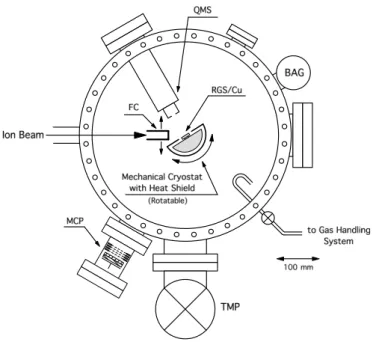
Multiply charged ions (Arq+, q≤7) are generated by an electron cyclotron resonance ion source (NANOGAN). Extracted ions are mass-selected by an analyzing magnet and are focused onto the sample surface at the center of a main chamber (see Fig. 1).
The main chamber is evacuated by a series of turbomolecular pumps and a Ti-getter pump, resulting in a pressure of about 8 ×10⁻⁹ Pa. Rare-gas solids are condensed onto a polycrystalline Cu substrate cooled to 4.5 K by a mechanical cryostat. The sample film is condensed onto the Cu disk by filling the chamber with gaseous Ne to a pressure of 10−6 ∼10−4 Pa. The film thickness was estimated from the exposure by assuming the condensation coefficient to be unity.
?????
?????
?????
?????
?????
?????
?????
Figure 1. Schematic of the main chamber (top view). BAG: Bayard–Alpert ionization gauge, QMS: quadrupole mass spectrometer, MCP: microchannel plate detector, TMP: tandem turbomolecular pump, FC: movable Faraday cup.
Sputtered ionic species are detected by a microchannel plate (MCP) detector or a quadrupole mass spectrometer (QMS; MSQ-400, ULVAC) in pulse-counting mode.
Time-of-flight (TOF) mass spectra are measured using the MCP detector by pulsing the incident ion beam, while a DC beam is used for obtaining mass spectra using the QMS. In the TOF measurements, a bias voltage of +100 V is applied to the sample substrate to accelerate the sputtered ions. When using the QMS, the sample is grounded and the ionizer of the QMS is turned off. The incident ion beam current can be measured to a higher accuracy using the QMS than using a pulsed ion beam
with the MCP detector, although the measurement range is restricted toM/q≤400 with the QMS used in this study.
As the desorption yield is very large for solid Ne [14], a low incident ion beam current (less than 1 nA) is used to minimize the change in sample thickness during measurement. The sample is evaporated and redeposited after each measurement.
3. Results and Discussion
Figure 2 shows TOF spectra of ions desorbed by 2.7 keV Ar3+ion impact. The figure shows that the main desorbing species are the cluster ions Ne+n (n: cluster size) and that very large clusters (n >100) are present (Fig. 2(b)). Clear steps are observed (i.e., magic numbers atn= 14 and 21), as also reported in supersonic cluster beam experiments [15]. The magic numbern= 14 is attributed to an icosahedral structure with a dimer ion at its core [16]. Similar spectra have been observed for low-energy Neq+impact but not for excitation by 100 eV electron impact (nmax∼5). Desorption of such large cluster ions is not detected from the surface of solid Ar (nmax ∼ 20).
A detailed discussion of the growth and desorption mechanism for such large cluster ions will be published elsewhere [17].
Intensity (arb. units)
50 40 30 20 10 0
Flight Time (x10-6s)
1 5 10 15 20 25 30
n =14
n = 21 n =
x10
(a)
Intensity (arb. units)
120 100 80 60 40 20 0
Flight Time (x10-6s) 1 5 10 20 30 50 70 100
n = (b)
Figure 2. Time-of-flight spectra of desorbed ions from the surface of solid Ne by 2.7 keV Ar3+ion impact plotted with (a) linear and (b) logarithmic vertical scales. The sample is about 600 ML (mono-layers) thick. The size n of the desorbed cluster ions Ne+n is indicated in the figure.
Figure 3 shows the mass spectra of desorbed cluster ions from solid Ne by 1 keV Arq+(q= 1, 3, and 6) ion impact measured by QMS. The vertical axis is the number of detected ions normalized by the number of incident ions (i.e.,Ii/q). It clearly shows that the intensities of the smaller cluster ions (n = 1 ∼3) depend strongly on the charge state of the incident ions. The peak area for each cluster size is plotted in Fig.
4 forq =1, 3, 4, 6, and 7, clearly demonstrating the charge state dependence of the size distribution. The figure shows that the desorption yield of larger clusters (n >
7) does not depend on the charge state, indicating that the desorption mechanism of large cluster ions iskineticsputtering.
Considering that the potential energy of Ar+(15.76 eV) is less than the creation energies of an exciton (17.1 eV) and an ion (21.6 eV) in solid Ne [1], we assume that
Intensity (arb. units)
200 150
100 50
0
M / e (AMU)
1 2 3 4 5 6 7 8 9 10
q = 1 q = 6
q = 3 n =
Figure 3. Mass spectra of desorbed cluster ions by 1 keV Arq+ (q= 1, 3, and 6) ion impact measured by the QMS. The vertical axis is the number of detected ions normalized by the number of incident ions.
2 3 4 56
103
2 3 4 56
104
2 3
Intensity (arb. units)
10 8 6 4 2
Cluster size : n
q = 7 q = 6 q = 4 q = 3 q = 1
Figure 4. Dependence of the size distribution on the charge state of the incident ions. Incident energy of the ion is 1 keV for all charge states. See text for details.
12 10 8 6 4 2 0
Potential Sputtering Yield (arb. units)
400 300 200 100 0
Potential Energy [eV]
1 keV 500 eV
Figure 5. Potential sputtering yield of ionic species from the surface of solid Ne by 500 eV (⊓⊔) and 1 keV (◦) Arq+(q= 2, 3, 4, 6, 7) ion impact. The sample is 600 ML thick.
onlykineticsputtering occurs in the desorption of ionic species by Ar+ion impact. To estimate the potential sputtering yield (PSY), the contribution of kinetic sputtering (i.e., the sum of the peak areas of Ar+ impact; shaded area in Fig. 4) is subtracted from the size distribution ofq≥2. The results are plotted in Fig. 5 for incident ion energiesEiof 500 eV and 1 keV. The vertical axis in Fig. 4 corresponds to the number ofcharges(notatoms) per incident ion inarbitraryunits. This figure shows that the slopes the incident energies ofEi= 500 eV and 1 keV are almost identical, and that PSY increases linearly with the potential energy of the incident ion up to the highest charge state (q = 7) used in this study. These observations suggest that the DIET mechanism of the ion desorption confirmed by the ESD and PSD experiments for RGS can also be applied to the ion-induced potential sputtering process. This mechanism resembles the defect-mediated desorption model [18, 19] in the sense that an excited atom or an ion can initiate the desorption.
The x-axis intercept (i.e., the threshold energy of the potential sputtering) is found to be ∼40 eV from the result of Ei = 500 eV. This energy is approximately twice the band-gap energy of solid Ne. The creation of two adjacent ions may lead to desorption of an ion due to Coulomb repulsion, although such a process has not been observed in photon-stimulated ion desorption experiments for solid Ar and solid Kr [5]. Another possibility is that a doubly excited atom is created in solid Ne, which desorbs from the surface, autoionizes, and is detected as Ne+[20].
There is a difference between the two lines in Fig. 5, suggesting that the contribution of kinetic sputtering may not have been completely subtracted from the present results, even for Ei = 500 eV. The threshold energy obtained in the present study is the minimum value, and experiments with a lower incident ion energy are needed to determine the true threshold energy.
Acknowledgments
The authors are grateful to Dr. Osamu Furuhashi for his significant contribution in the initial stages of this work. This work was partly supported by a Grant-in-Aid for Scientific Research from the Ministry of Education, Culture, Sports, Science and Technology, Japan, and by the Rikkyo University Special Fund for Research.
References
[1] Schwentner N, Koch E E and Jortner J 1985 Electronic excitations in condensed rare gases(Springer Tracts in Modern Physicsvol 107) (Berlin: Springer-Verlag) [2] Zimmerer G 1994Nucl. Instrum. Meth. Phys. Res. B 91601
[3] Dujardin G, Philippe L, Rose M, Hirayama T, Ramage M J, Comtet G and Hellner L 1998Appl. Phys. A66527
[4] Hirayama T and Arakawa I 2006J. Phys. Cond. Matt.18S1563
[5] Dujardin G, Hellner L, Besnard-Ramage M and Azria R 1990 Phys. Rev. Lett.
641289
[6] Hoshino A, Hirayama T and Arakawa I 1993Appl. Surf. Sci.70308
[7] Orth R G, Jonkman H T, Powell D H and Michl J 1981J. Am. Chem. Soc.103 60269
[8] David D E, Magnera T F, Tian R, Stulik D and Michl J 1986 Nucl. Instrum.
Meth. Phys. Res. B 14378
[9] Balaji V, David D, Magnera T and Michl J 1990Nucl. Instrum. Meth. Phys. Res.
B 46435
[10] Hiraoka K, Watanabe M, Eguchi D, Okazaki S and Sato T 2002Rapid Commun.
Mass Spectrom.16 1016
[11] Schou J, Ellegaard O, Sorensen H and Pedrys R 1988Nucl. Instrum. Meth. Phys.
Res. B 33808
[12] Ellegaard O, Schou J and Sørensen H 1986Nucl. Instrum. Meth. Phys. Res. B 13567
[13] Pedrys R, Warczak B, Leskiewicz P, Schou J and Ellegaard O 1999Nucl. Instrum.
Meth. Phys. Res. B 157121
[14] Fujita S, Tachibana T, Koizumi T and Hirayama T 2009J. Phys. Conf. Ser.163 012083
[15] M¨ark T D and Scheier P 1987Chem. Phys. Lett.137245 [16] Haberland H 1985Surf. Sci.156305
[17] Tachibana T, Fukai K, Koizumi T and Hirayama Tto be submitted
[18] Neidhart T, Pichler F, Aumayr F, Winter H, Schmid M and Varga P 1995Phys.
Rev. Lett.74 5280
[19] Aumayr F, Varga P and Winter H 1999Int. J. Mass Spectrom.192415 [20] Wiethoff P, Ehrke H U, Menzel D and Feulner P 1995Phys. Rev. Lett.743792