著者 Murakami Eigo
出版者 Institute of Comparative Economic Studies, Hosei University
journal or
publication title
Journal of International Economic Studies
volume 21
page range 33‑51
year 2007‑03
URL http://doi.org/10.15002/00002043
The Consequences of Policy Reform:
Japanese Industrial Training Programs and Female Migrant Workers
Eigo Murakami
Nihon University College of Economics
Abstract
This article examines Japanese migrant worker introduction policy in the 1990s, focusing on the industrial training program and technical intern program. In the early 1990s the Immigration Control Law was amended and the industrial training program was introduced. These subsequently became two of the main migrant worker introduction policies. The former enabled Japanese descendents to work without any restrictions and they are working in relatively high wage sectors of manufacturing industry.
The latter restricts the freedom of trainees in the name of training, although they are working in prac- tice, and they are “accepted” in the lower-wage and high female ratio industries.
1. Introduction
1990 was the turning point of migrant worker introduction policy in Japan. The biggest institutional change was the amendment of the Immigration Control Act (ICA). The status of residence of Japanese descendents was revised to removal all restrictions, including work, on their residence in Japan. Following this, many Japanese descendents came to Japan in order to engage in “unskilled labor”.
In addition to “deregulation” of the status of residence of Japanese descendents, an epoch-making “Industrial Training Program” (ITP) was established in the same year, and is regarded practically as another system for introducing migrant workers. In 1993, the
“Technical Internship Program” (TIP) was founded and trainees who are estimated to have a certain skill may obtain the status of residence for carrying out job training for a maximum of two years. This means the ITP has become a supply system of migrant workers for small and medium-sized enterprises (SMEs).
In the early 1990s, the “bubble economy” collapsed and the Japanese economy rushed into a deep and long depression. The rate of unemployment started to rise and demand for labor power decreased rapidly. Nevertheless, the number of migrant workers continued to grow. Moreover, it was the new ICA, TP and TIP that supported the increase in migrant work- ers throughout the 1990s.
As migrant workers increased in number, various investigations were made. However these analyses mainly focused on the working and/or life conditions of Japanese descendents (The Institute of Statistical Research , 1993; Asou, 1994; Komai, 1994a, 1994b; Watanabe;
1995; Tanno, 1999). Some investigations point out the problem of TP, and ask for reform (Shimada, 1993; Miyajima, 1993; Kajita, 1994; Iguchi, 1998; Suzuki, 1997), but there are few that analyzed the way foreign trainees are actually “employed” (Komai, 1989; Murakami,
2001).
In this paper I firstly examine the features of the reform of Japanese migrant worker introduction policy in the early 1990s and the actuality of working conditions of the Japanese descendent laborers and foreign trainees (including skilled trainees). Furthermore, I will take up the example of an organization which has accepted both Japanese descendent laborers and foreign trainees. By doing so, it will become clear what role these system reforms played in the actual increase in migrant workers in the 1990s.
2. Policy reform in the 1990s
In 1981, the “trainee” status of residence was formally established in ICA. The amend- ment of the law in this year was carried out in response to the fact that refugees from “Indo- China”, Vietnam and/or Cambodia, had increased in number after the second half of the 70s.
Further, the name of the law was changed to “Immigration Control and Refugee Recognition Act”. The reason why the “trainee” status of residence was introduced at this time is that relo- cations of factories to surrounding Asian countries were increasing. However, at this time, the requirements for trainees were not defined clearly. Thus, the criterion for acceptance was already a problem, and the fact that the accepting companies were making the trainee do actu- al work (not training) had already been pointed out.
After the middle of the 1980s, the yen appreciated on international markets and the relo- cation of factories outside the country was further stimulated. A labor shortage also increased the seriousness under which the “bubble economy” was straining. The emigration of Japanese descendents from South America and overstay workers increased in number in order to meet the increasing demand for labor power. This came to attract attention as a “foreign worker problem”. Meanwhile, the “statement of principles” involving migrant worker policy was given in the “economic plan” and the “employment policy master plan” of the Japanese gov- ernment in 1988. “Although positively accepting the foreigners of special/technical fields, acceptance of the so-called ‘simple laborer’1should be carefully examined in consideration of the influence on the economic society of our country”. By this statement, the principle of the Japanese government that Japan will not accept unskilled workers was once again confirmed.
However, following that, the labor shortage became increasingly acute, especially for SMEs.
In order to meet this demand, overstay workers increased rapidly.
The ICA was amended in December 1989, and enforced from June 1st, 1990 in order to correspond with just such a situation. There are four main points in this amendment. Firstly, in order to facilitate easy entry into Japan of foreigners with skills in special or technical fields, the classification of the status of residence was clarified and its range expanded. Secondly, in relation to this, the status of residence which lifted restrictions on Japanese descendents’ activ- ities was accepted. Thirdly, immigration examination procedures were simplified and quick- ened. Fourthly, acceptance of unskilled workers was strictly prohibited. Punishment (called
“Promoting Illegal Employment”) has been stipulated for those who employ persons without a working visa, or those who aid the employment process. Moreover, the ordinance of the Ministry of Justice, the “standard ordinance”, which defined detailed requirements concerning the “trainee” status of residence was announced publicly on May 24, 1990, and was enforced from June 1st of the same year.
1This means unskilled workers.
Superficially, these system amendments were embodiments of the “statement of princi- ples”; acceptance of the foreigner in specialty and/or technical fields and strict prohibition of employment of unskilled workers. But in practice, it is regarded as a legalization of entrance of unskilled workers, while continuing to maintain firmly the statement of principles which denied them acceptance.
The newly defined qualification of trainee was very strict. This type of ITP is now called
“Individual Enterprise-based Training (IET)”. Because of the strict qualification, many SMEs could not use the program, so SME organizations demanded the government “deregulate”
these qualification standards. In response to these demands, a “special measure” of the “stan- dard ordinance” was publicly announced in August, 1990, only two months after the law had come into force. The “special measure” contained provisions that ease parts of the regulations in the “standard ordinance” so that “acceptance of trainees” might also become possible for SMEs. This type of ITP is called “Association Managed Training (AMT)”. This “deregula- tion” opened the way for SMEs to legally “employ” unskilled workers from outside the coun- try in the name of “training” and/or technology transfer”.
In addition to that, TIP was founded in 1993. The purpose of the program was to allow trainees to master more advanced and practical technology, skills, and knowledge through work experience in the production process. Furthermore, it is expected to contribute to inter- national cooperation through the transfer of technology and/or knowledge to developing coun- tries and the cultivation of people’s abilities which lead to the economic development of devel- oping countries. The length of stay of skilled trainees was initially one year, and this was extended to two years in 1997. The number of approved occupations was also gradually expanded from 17 job categories in 1993 to 55 job categories in 1999. In this way, ITP and TIP strengthened their characters as a means of labor supply from outside the country.
As mentioned above, a set of system amendments in connection with migrant workers in the early 1990s had two aspects. One is that regulation of immigration became more severe, stipulating punishment for illegal employment of illegal foreign workers and clarifying the
“trainee” status of residence. Another is that it left room for introducing unskilled foreign workers, deregulating the status of residence of Japanese descendents, and deregulating the
“standard ordinance” which regulates the status of the residence of foreign trainees.
3. Migrant workers after the policy reform
(1) Impact of the revision of ICA
Figure 1 shows the trend in the number of overstay workers and Japanese descendents after the policy reform. Contrary to the statement of principles, professional and/or technical workers increased only slowly. The number of professional or technical workers excluding
“entertainer” was 46,845 in 1990, 62,767 in 1992 and 120,914 in 2003.
On the other hand, the so called “simple laborer” category was increasing rapidly. At first, overstay workers increased in spite of the tightening of the regulations. In 1990 the num- ber of overstay workers was 106,497. It increased to 292,791 in 1992 and subsequently decreased slowly. In the mid-1980s most overstay workers were females who were working in the “sex industry.” From the late 1980s male overstay workers increased. They were working in small factories, construction sites or small restaurants. The number of Japanese descendents was 71,803 in 1990, when their resident status was legitimized. Their number increased steadily to 234,126 in 1997, and is broadly flat after that. Many of them were working in the
manufacturing industry, especially the car industry or electronics industry.
(2) Foreign Trainees and Technical Interns
One of the important policy revisions in the 1990s was the establishment of ITP and TIP, because these may become the key system for migrant worker introduction policy in Japan. I will now consider how Japanese firms “accept” foreign trainees and technical interns. In order to do this, it is necessary to understand about ITP and TIP in detail.
Industrial Training Program
The purpose of ITP is the “transfer of technology, skills, and knowledge of industry as a means of contributing to the development of the human and industrial resources of other countries.” (Ministry of Justice) In order to achieve this, four conditions are imposed on trainees or on despatching organizations. These are,
(a) The technology, skills, and knowledge that the trainee is to obtain through ITP must not be the type that could be obtained through repetition of simple work.
(b) The trainee is expected to engage in a job requiring the technology, skills, and knowledge obtained in Japan after returning to his or her country of nationality or habitual residence.
(c) The trainee must be at least 18 years old.
(d) It must be impossible or extremely difficult for the trainee to obtain the desired technolo- gy, skills, knowledge in the country where he or she resides.
ITP is divided into two broad categories. One includes on-the-job training (OJT), and another does not. Here we are investigating ITP as a source of labor power, so I will examine the former category. In the case of the former category, a number of conditions are imposed on the despatching and acceptance organizations other than those mentioned above.
The training that includes OJT is also divided into two types2. Type I is implemented by Figure 1. Overstay Worker and Japanese Descendant
Source: Ministry of Justice, “Number of Overstay Workers”, and Ministry of Health, Labor and Welfare, ” Results of the Report on the Employment Conditions of Foreigners"
the company itself, called Individual Enterprise-based Training (IET). Type II is implemented by an associative organization and its member company, called Association Managed Training (AMT). IET was defined by the ICA amendment in June, 1990. In order for the system to be applied appropriately in line with the “original purpose” of ITP, namely the cultivation of workers for Japanese companies which intend to transfer their factory outside the country and technology transfer to a developing country, other regulations must be observed: Trainees must be (a) full-time employees of a local subsidiary of an accepting company or a joint ven- ture (including a plan to establish such), (b) full-time employees of the customer of an accept- ing company which satisfies certain requirements, or (c) government officials of a foreign country, employees of the central bank, or an international organization. In the case of (a), the accepting company must be a direct subsidiary or the Japanese counterpart of a joint venture in which the investment ratio is higher than 20%. In the case of (b), an accepting company must have direct trade with a despatching company. Therefore, a company without foreign subsidiaries or a capital relation with a foreign company can not “accept” trainees at all. Even if it could, the number it is able to accept is restricted to less than 5% of the number of its full- time employees. Therefore, small companies with less than 20 full-time employees cannot
“accept” trainees at all.
Thus, IET is regulated so that many SMEs, in which the labor shortage is more serious, could not use this program as a system of labor power supply. AMT was established two months after IET had been established in order to ensure that SMEs could accept foreign trainees by “deregulating” a part of these regulations. In AMT, under the assistance and direc- tion of the Japanese government or local governments, various SME organizations (the Chamber of Commerce and Industry, an Occupation Training Corporation, an Agricultural Cooperative Association, etc.) serves as the first acceptance organization, and SMEs which are members (partners) of the organization “accept” the foreign trainees.
The contents of deregulation are as follows. Firstly, differing from IET, the accepting company does not require a fixed relationship with trainees or a despatching company.
Training can be given to a person who has received a recommendation from the government or local governments, or who has occupational experience of the same kind in which he or she will be trained in Japan. Although the number of trainees that can be accepted under IET is less than 5% of the number of full-time employees of the company, in AMT it is 3 trainees for SMEs with 50 or less employees, 6 for 51 - 100 employees, 10 for 101 - 200 employees, and 15 for 201 - 300 employees. Thus, under AMT more trainees can be accepted for SMEs with less than 300 employees than in IET3.
As mentioned above, IET is seen as an institution for the purpose of supporting the inter- nationalization of larger companies considering moving their factories abroad or forming rela- tions with foreign companies. On the other hand, AMT is a “legal” system for introducing labor power for SMEs from abroad. When we see the amendment of the ITP in 1990 as a migrant worker introduction policy, it can be said that AMT played a central role.
Technical Internship Program (TIP)
TIP was established in April, 1993. The purpose of the program is to “transfer more practical technology, skills, and knowledge to developing countries and to support economic development of developing countries by cultivating human resources who lead their economic
2Besides these two types, there are other cases including acceptance by a government agency, special corporation, etc.
3SME is defined within the terms of the Small Business Basic Act.
advancement4.” After “training” for a maximum of one year, foreign trainees can become tech- nical interns when they have been recognized as having attained a certain level of skill thor- ough evaluations. When a person is recognized as having the relevant skills, the status of resi- dence is changed from “training” to “designated activities”, and can be employed by his or her accepting company. In this case, they are guaranteed salary rewards equivalent to Japanese employees who do the same work, and also receive the benefits of various kinds of labor-relat- ed statutes and social security statutes.
The contents of training for technical interns are more practical and have more advanced technology, skills, and knowledge than the ITP. TIP cannot be carried out in a different organi- zation from which training has been performed as a trainee, a different type of industry or in a different type of work. The length of stay is a maximum of two or three years, including the period of the ITP. Therefore, a company which accepts new trainees continuously, and when all trainees shift to TIP and do “training” for two years following AMT for one year, can in practice utilize 3 times as much labor power as the institutional maximum for acceptance.
Suppose a company has 20 full-time employees (the level at which a company can accept only one trainee under IET), it can “employ” 9 people (3 trainees + 6 interns) from overseas, close to half the number of its full-time employees.
The number of Trainees and Technical Interns
Now, let us consider how such an institutional feature is reflected in the actual situations of trainees and technical interns.
The number of trainees in 2003 was 64,817, 20.8% of them being accepted by the gov- ernment and 79.2% being privately accepted. The break-down of government accepted trainees is 61.5% by the Japan International Cooperation Agency (JICA), 35.3% by the Association for Overseas Technical Scholarship, 1.8% by the Japan Vocational Ability Development Association (JAVDA), and 1.2% by the ILO. On the other hand, most of the pri- vately accepted trainees (84.6%) were supported by the Japan International Training Cooperation Organization (JITCO). Hereafter, we will look at the situations of trainees and technical interns in the private sector by analyzing the statistics published by JITCO.
As we have seen, IET is an institution for the purpose of internationalization of larger companies and AMT is in practice a system of overseas labor power supply for SMEs. This point is clearly shown in the statistics of acceptance by company scale. In 2003, the propor- tion of trainees in AMT of companies with 1-99 employees was 74.9%, companies with 100- 299 employees was 16.4%, 300-999 was 5.5%, 1000 or more was 3.2%. By contrast, in IET companies with 1-99 employees were 7.7%, 100-299 were 20.2%, 300-999 were 21.7%, 1000 or more were 50.4%. Therefore, AMT is mainly used by SMEs and ITP is used by larger com- panies.
Next, we will look at the number of trainees by training period. In AMT, the overwhelm- ing majority (87.7%) was 12 months and more, and only 2.2% were six months or less. On the other hand, in IET about half (47.1%) were six months or less, and 48.4% were 12 months or more. That is, about half of the larger companies which are carrying out IET acceptance are training for a period shorter than half a year, by contrast 85% of SMEs which are accepting trainees under AMT are carrying out “training” for as long as possible.
How many trainees become technical interns subsequent to being a trainee? In 2003, the number of companies which accepted technical interns in companies with 1-99 employees
4JITCO, Technical Internship Program (TIP) <http://www.jitco.or.jp/eng/contents/04_01.htm>
was 74.4%, 100-299 this was 22.6%, and 300 or more this was only 3.0%. 97 percent of com- panies which accepted interns had less than 300 employees (i.e. SMEs)5.
The fact that many larger companies accept trainees for a shorter period and few of them accept technical interns shows that ITP and TIP is performed substantially in larger compa- nies. On the contrary, many SMEs “accept” trainees for a longer period and continuously accept interns. This means that ITP and TIP is utilized as a system of labor supply by SMEs.
Here we take a look at the training allowance. The training allowance is paid not as reward for labor but for living expenses. Therefore, it does not reflect the wage level of the accepting company or the industrial sector. Moreover, it is not certain whether the statistics used here reflect the actual payment. For example, in a famous case, of 50,000 yen of a “train- ing allowance”, only 10,000 yen was actually paid to trainees, 40,000 yen being deducted by the accepting company in the name of “management fees”. So this does not necessarily reflect the actual cost for the “accepting” company. We can guess to some extent the characteristics of accepting companies by these statistics. Among the companies of IET in 2003[ë∫è„1], an allowance of 70,000 - 100,000 yen was the largest (62.1%) , 50,000 - 70,000 yen was next (11.1%), and 22.2% gave 100,000 - 150,000 yen. By contrast, among AMT companies, 70,000 - 100,000 yen was the largest (81.9%), 50,000 - 70,000 yen was the next (16.5%).
Thus, it can be said that those trained under AMT are accepted in lower wage sectors com- pared with IET.
As we have seen, there are two types of TIP. One is for training purposes and the other is for the purpose of introducing low wage labor power. The former is carried out by larger com-
5For reference, see the number of transfers per company in 1998. Companies with 1-19 employees was 2.2 persons compared with a maximum of 3, 20-49 was 2.4 to 3 or 6 trainees, 50-99 was 3.7 to 6, 100-299 was 5.4 to 15, and 300 and more was 8.2 to 15 and more (5% of its full-time employees). These numbers show that SMEs “accept” trainees and techni- cal interns up to the institutional limit.
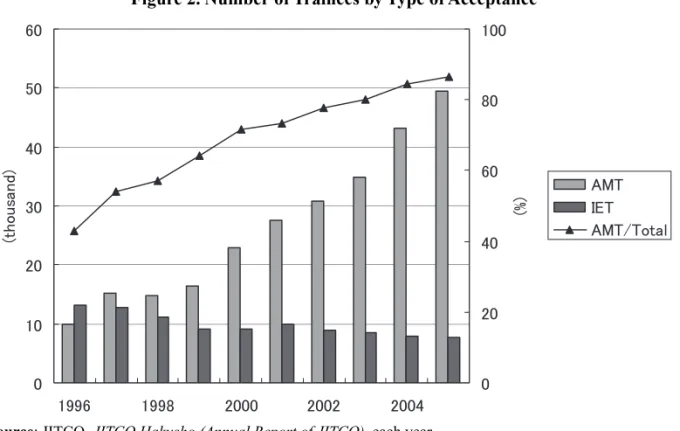
Figure 2. Number of Trainees by Type of Acceptance
Source: JITCO, JITCO Hakusho (Annual Report of JITCO), each year.
panies through IET acceptance and the latter is mainly carried out by SMEs through AMT acceptance. Taking this into account, how has the number of trainees through IET and AMT developed respectively? Figure 2 shows the number of trainees through IET acceptance, AMT acceptance and the AMT ratio, the number of AMT trainees divided by the total number of trainees. IET decreased from 13,183 in 1996 to 7,670 in 2005 and AMT increased rapidly from 9,895 in 1996 to 49,380 in 2005. So the AMT ratio increased from 42.9% to 86.6% dur- ing this period. Thus, ITP has increasingly strengthened its character as a means of supply of labor power to low wage sectors from outside the country in the late 1990s6.
(3) Feminization of foreign trainees and foreign interns
Now we focus on the gender side of ITP and TIP. Table 1 shows the total number of trainees, female trainees and the ratio of female trainees from 1995 to 2005. In 1995 the num- ber of trainees and female trainees was 18,264 and 4,908 respectively. So the ratio of female trainees is 26.9%. Since then, the number of female trainees has increased faster than male trainees and the ratio of female trainees increased rapidly to 56.1% in 2002. Following that the ratio has been broadly flat.
Along with trainees, the number of female interns has increased rapidly. As shown in table 2, the number of total and female interns was 3,611 and 1,483 in 1995. The ratio of female interns is 41.1%. The ratio rose to 61.5% in 2002. Since then the female ratio has slightly receded and has become almost the same level as that of trainees. The intern/trainee ratio was 15.9% for males and 30.2% for females in 1995. It has risen to 67.2% for males and 75.4% for females in 2005.
Table 3 shows the wage levels at which interns are paid for one month (including meal
6Of course, IET may play a role in international exchange or international cooperation. For example, a union alliance in Gifu Prefecture has accepted Chinese trainees through AMT acceptance. Trainee acceptance began in 1982 on the basis of years of friendship with Jiangxi Sheng in China, the sister prefecture of Gifu Prefecture. The organization continues to accept trainees every year and to have relations with trainees who have returned to China. Moreover, strict measures were taken against a member company which treated trainees in a discriminatory way.
There is also an accepting company which started a joint venture in cooperation with a trainee who returned to his country (JITCO, 1999).
Table 1: Ratio of female trainees
Source: JITCO, ibid., each year.
Table 2: Ratio of female interns
Source: JITCO, ibid.
allowance, rental allowance, but not including overtime allowance, commutation allowance or other additional benefits). Among female interns, 27.5% were paid 100,000-110,000 yen, 43.3% were paid 110,000-120,000 yen, and 22.9% were paid 120,000-130,000 yen. So 94.2%
were paid below 130,000 yen. On the other hand, among male interns, 59.4% were paid below 130,000 yen and 40.6% were paid above 130,000 yen.
In order to clarify why female trainees (including interns) have increased, I calculated the ratio of female trainees in 1999 with the fixed female ratio of each industry in 1995. The ratio of females was 26.9% in 1995, 47.2% in 1999. The fixed female ratio in 1999 was 41.4%. Namely, 71.4% of the increase of the female ratio from 1995 to 1999 is explained by the increase of high female ratio industries such as the garment & textile or food industry.
These facts show that ITP and TIP have changed into a system for supplying more low-wage workers than before, especially more low-wage female workers in the high female ratio indus- tries.
4. Foreign Trainee as an “unfree-laborer”
Many people have voiced the criticism that TIP has been used for a purpose which is dif- ferent from “the original purpose.” The view of the Japanese government can be seen in immi- gration control(1992). It is stated here that some trainees hold the “mistaken expectation” that they can obtain a lot of money. After entry into Japan, they expect to receive overtime work with money returns outside training time, or work through a part-time job. Some trainees who are dissatisfied with the content of the training, the training allowance, etc., leave the accep- tance organization and their whereabouts becomes unknown (the so-called “missing person”
problem) (ibid. pp. 1-2). Moreover, regarding the problems of acceptance, there are companies which carry out only OJT and treat its trainees like other employees, do not carry out training according to the training plan, and alter the documents in connection with the application and/or contract. Regarding the problem of the first acceptance organization, it is pointed out that there are alterations of various documents, intermediaries who coordinate between trainees and companies that are not members of the organization, and that some of the organi- zations lack management ability. Thus, in that report, frank and concrete criticisms are made concerning the problems of ITP. However, it looks at the problems only from the point of view of the practice of the institution, and nothing is mentioned concerning the problems of ITP itself.
Table 3: Wage levels of interns by sex (2003)
Source: JITCO, ibid., 2004.
On the other hand, Kajita pointed out that the problem is that the money which trainees receive is far lower than the usual salary because they are not workers but trainees in name, in spite of being used as workers in practice. Furthermore, he posed a question concerning the institution of ITP itself. According to him, ITP is an institution intended to combine by force the solution to the labor shortage with technology transfer (assistance of developing coun- tries). He wrote, “completely heterogeneous subjects are tied up artificially and two purposes are supposed to be attained at the same time” (Kajita, 1994, p.94). Miyajima said that the name “training” makes the qualification and the purpose of residents ambiguous, and as a result TIP has a big problem regarding human rights and fairness in foreign policy (Miyajima, 1993).
Shimada also pointed out the following point as a problem of ITP (Shimada, 1993). That is, trainees are not paid properly as they are accepted in the name of “training” while carrying out labor in practice. Moreover, they do not have the rights which workers have, including employment insurance, health insurance and so on. In that sense, he recognizes the problem as others do. However, the biggest problem for him is that because of the lack of clear rules for acceptance of migrant workers, while demand for extra labor power existed, most migrant workers had been residing in Japan in the form of visa overstay. Based on such recognition, he proposed a reform which can be compatible with both technology transfer and labor-shortage dissolution. The reason why he proposed an institution reconciling the training system with dissolution of the labor shortage was as follows. It is true that the less skilled the trainee is, the bigger the merit for his or her employers is. Although all of the merit for employers cannot be accepted, compromise is necessary as long as it is consistent with social merit. Thus, accepting that the business experience of a trainee has the characteristics of labor, he proposed the establishment of a new residence qualification and supported the acquisition of “middle- class skill”. A middle-class skill is a skill which can be acquired through a few years’ training and work experience, and with which people can work without any assistance. By carrying out this skill training program, which supports migrant workers in the acquisition of a middle- class skill, “Japan will be able to show with pride a skill-cultivation type migrant worker intro- duction model to the world” (Shimada: p. 9)7.
However, it is doubtful whether the acquisition of a required skill really copes with the dissolution of the labor power shortage, as Kajita pointed out. Technologies and skills which despatching countries and/or trainees want to acquire are not necessarily the same as those for which there is a large demand for labor. Moreover, trainees come to Japan for the purpose of gaining money as well as acquiring skills. In ITP, the occupational descriptions under which trainees can be accepted is restricted, and in that sense it can be said that AMT is realized on the basis of the coincidence of completely different purposes. Therefore, like the present ITP, it is expected that the “skill training program” which Shimada has proposed will become just an introduction of migrant workers rather than “a support system for the cultivation of human resources.”
All these criticisms point out the contradiction between the name “training” and the actual condition of “labor”. However, this is only part of the problem. Here, we focus on another part of the problem, “freedom of occupation selection”. Even if activity of a trainee is recognized as labor and a trainee is given enough payment for the labor and the proper status of residence, as Shimada has said, there remains the fact that a trainee is an “unfree laborer”
who does not have “freedom of occupation selection”.
7Iguchi has also proposed the same training program as Shimada. (Iguchi, 2001 : p.197)
After investigating many bad examples in which trainees and technical interns have suf- fered, Hatade pointed out that trainees are restrained in various ways (Hatade, 2000). For example, their passports are usually confiscated, and they are obligated to pay “guarantee money” before departure or upon breach of contract when they resign from the training.
Moreover, accepting companies tend to enclose trainees because they often pay large sums to the acceptance organization. The confiscation of passports, compulsive deposit and obligation to pay forfeits are contrary to the “guidelines” of the Ministry of Justice, and JITCO instructs acceptance organizations towards proper application of the guidelines. In order to solve these problems, Hatade proposed that the government should formulate regulations for acceptance of trainees and technical interns and should correct the attitude of the related organizations and despatching countries.
However, the methods of restraining trainees are not only due to the compulsory behav- ior of accepting companies, acceptance organizations, and depatching organizations. The guidelines state that the acceptance organization should select “volitional trainees without any problem”. In fact, many of the organizations select trainees before they “accept” them. As long as the number of people who wish to come to Japan is larger than the demand for labor and the limit of acceptance, it is difficult for trainees to choose a training company according to their own free will, and sometimes they cannot even choose the skills and technology they wish to acquire. Selection of trainees in advance becomes introduction of labor power to accepting companies rather than acceptance of trainees according to the needs of trainees.
Even when a trainee can become an intern from a trainee and the activity is recognized as
“labor”, he or she cannot be trained in any companies other than the original accepting com- pany. Thus, it can be said that ITP and TIP themselves strongly restrain trainees and technical interns. Such a restraining nature of ITP and TIP is also the cause of far lower pay and the car- rying out of overtime work at no pay. The fact that trainees cannot move to other companies is a great merit for accepting companies in low wage sectors.
5. Difference in working sector between Japanese descendents and foreign trainees
In order to see the difference between Japanese descendents and foreign trainees, we will examine the industries in which they work. As shown in Table 4, among the industries in which trainees are “accepted”, “garment & textiles” is the largest (29.9%), “foods” is the next largest (14.8%), followed by “transportation machinery” (8.3%), and “electric machinery”
(7.2%). As I have already pointed out, the characteristics of ITP as a system of labor power introduction is prominent in AMT. Under AMT, “garment & textile” accounts for 35.3% of acceptance, “foods” accounts for 16.2%, and the sum of these two industries amounts to half of the AMT acceptance. “Agriculture” (7.9%) is next. On the other hand, though not shown in the table, in IET “transportation machinery” (23.2%) is the largest. “Electric machinery”
(17.1%) is the second largest. The sum of these two industries amounts to 40% of the IET acceptance. The ratio of AMT acceptance to the total acceptance in “garment & textile” is 94.8%, “foods” is 87.9%, “agriculture” is 99.6%, and “metal goods” is 75.1%. In contrast,
“transportation machinery” and “electric machinery” are 44.4% and 52.8% respectively8.
8These numbers were only 13.9% and 18.9% respectively in 1999. That means that AMT, that is ITP by SMEs, became popular after 2000 in industries other than garments and foods.
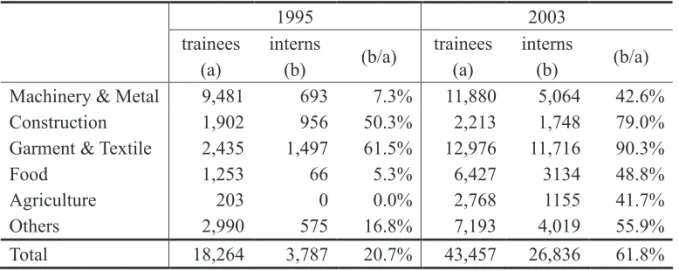
We can also see how many trainees apply to become technical interns (Intern/Trainee ratio) in table 5. Since there are no statistics on the number of TIP applicants by industry, we will use occupational data. In 2003, the ratio of “garment & textile” and “construction” were 90.3% and 79.0% respectively. The reason why the ratio for “foods” is quite low (48.8%) is that only a few occupations are permitted to accept trainees, such as “can seaming”, “fishery processed foodstuff manufacturing”, “fish paste making” and “ham, sausage and bacon mak- ing”. On the other hand, “machinery and metal” is 42.6%. SMEs of garment, foods (especially fishery processed foodstuff manufacturing) and construction industries are utilizing the ITP as a system of supply of labor power. In contrast, it can be concluded that most of the large com-
9But in these two industries, the intern/trainee ratio has fallen slightly.
Table 4: Number of trainees by industry (2003)
Source: JITCO, JITCO Hakusho, 2004.
Table 5: Ratio of interns to trainees
Source: JITCO, ibid., 1996, 2004.
panies in transportation machinery and electric machinery are utilizing ITP for “an interna- tional contribution”, and personnel cultivation in foreign factories, and so on. Comparing the ratios for 1995 to 2003, they have increased as a whole, and the rise in “garment & textile”
and “construction” is remarkable9. Due to the fact that the number of trainees in the construc- tion industry is small, the share of technical interns in the garment & textile industries has increased markedly.
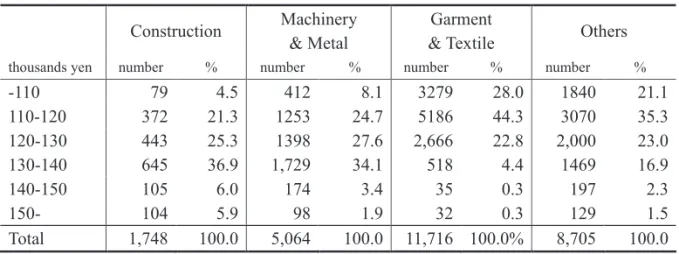
Next, we will examine the relationship between the number of technical interns and the wage level at which the accepting company planned to pay by occupation, as shown in Table 6. In machinery and metal, 34.1% are at 130-140 thousand yen and 27.6% is at 120-130 thou- sand yen.. In construction, 36.9% is at 130-140 thousand yen; 25.3% is at 120-130 thousand yen. Alternatively, in garment & textile, 44.3% is at 110-120 thousand yen, and 28.0% is below 110 thousand yen. In other occupations, including fish food manufacture, fishery, plas- tic molding, painting and furniture making, the wage level is between that of machinery &
metal and garment & textile. The wage foreign interns are paid must be the same as Japanese employees who are working in the same occupation. So this reflects the occupational wage level as a whole. As table 6 shows, the lower the occupational wage, the larger the number of technical interns. We can see ITP and TIP have strong characteristics as a labor power supply system in the low wage industries.
Can this tendency also be seen regarding Japanese descendents? To examine this point, we do well to see the Results of the Report on the Employment Conditions of Foreigners (RECF) by the Ministry of Health, Labor and Welfare. Although this includes only technical interns (not trainees), 70% of manual workers in manufacturing industry are Japanese descen- dents so it mainly reflects the employment situation of these people. In 1999, the largest was
“transportation machinery” (24.2%), “electric machinery” was 19.2%, “food & drink” was 15.4%, “garment & textile” was 7.6%, “general machinery” was 6.3%, “metal goods” was 5.7%, “plastic & rubber goods” was 5.2%, and “others” was 16.4%.
By comparing this with the distribution of foreign trainees, we can understand the rela- tionship between the two migrant worker introduction policies in the late 1990s, namely the
“acceptance” of Japanese descendents and the deregulation of ITP. This is shown in Figure 3.
The vertical axis shows the AMT share of the industry and the AMT curve is shown as a downward slope. In contrast, the IET curve and Japanese descendents curve have upward
Table 6: Wage level of interns by occupation (2004)
Source: JITCO, ibid., 2004.
slopes. Considering that RECF concerns technical interns, garment & textile and foods are lower than this point.
To summarize, it can be said that the transportation and electric machinery industries employ workers of Japanese descent and accept foreign trainees through IET in order to trans- fer technology, skills, and knowledge. On the other hand, it is difficult for SMEs in the gar- ment & textile industry and some occupations in the food industry to employ Japanese descendent workers because the wages in these industries are very low. These industries there- fore utilize foreign trainees and technical interns through AMT in order to fulfill their demands for labor power.
6. The Case of a Fishery Processing Cooperative
I will verify the points that we have seen above by examining the case of a fishery-pro- cessing cooperative. Because it employs (and “accepts”) both Japanese descendents and trainees, it illustrates the difference between these two systems10.
(1) Outline
The cooperative which I examine here is located in a factory complex near the famous port of the largest pelagic fishery in Japan. It consists of twenty union member firms. The member firms are manufacturing various processed fishery products, such as dried bonitos (stick dried bonito, dried bonito shavings), canned food (canned bonito, salted bonito guts), cooked bonito (frozen bonito for sliced raw fish), and seasonings. The amounts of dried boni- to processed in the factory complex exceeded 47,000t in 2000, the largest of its kind in Japan.
10Concerning a case of the garment industry, see Murakami (2002).
Figure 3. Share of migrant workers by industry (1999)
Source: JITCO, ibid., 2000, MHLW, "Results of the Report on the Employment Conditions of Foreigners,"
1999.
In this cooperative, various infrastructure, such as refrigerators, warehouses, and water supply and drainage equipment, are used in common. Common purchase of the bonitos used as raw material, as well as common delivery of the products is also performed. The coopera- tive is processing the primary dried bonitos which each member company uses as raw material for the various processed foods. In addition, the cooperative is producing sludge fertilizer from the drainage, animal food or factory fuel from process residue, and by-products, such as calcium products, from the bones of the remnants.
In 1970, the city where the factory complex is located, received the specification of the
“Project of Forming Distribution and Processing Centers in Producing Areas” by the Japanese government. As the part of the project, fishery processing factories were collectivized. Two factors can be pointed out. First, the fishing method was changed to deep-sea fishing at this time. Fishermen became able to land and process fish throughout the year. So it became pro- ductive to collectivize household manufacturing and operate throughout the year, where previ- ously operations had been carried out only in the fishing season. Secondly, water pollution of the port by drainage from paper mills became a serious problem in the late 1960s, and the reg- ulation of drainage in the whole bay became very strict. Thus, in order to operate within the strict regulations, effective management by collectivization of the fishery processing factories in the city was pursued, in addition to rationalization of the production and distribution of the product. In 1972, the cooperative was established. It was at that time that the common equip- ment for the prevention of pollution, such as disposal equipment for drainage and remnants, the common water supply facility and the common refrigerators were installed. In 1974, the fishery processing factory complex was established.
The cooperative engaged in various efforts for the development of related products and the reinforcement of equipment. In 1995, the cooperative plant for dried bonito primary pro- cessing began operations. This plant can process 80 ton of dried bonito per day, the largest production capacity in Japan. With the completion of this plant, large-scale rationalization of the production process and substantial cost cuts were realized, greatly increasing the domestic and international competitive power of the member companies.
(2) Labor process of the dried bonito primary processing
Here we look at the labor process of the dried bonito primary processing, because most of migrant workers employed in the cooperative are working in this plant.
The day before processing, frozen bonito are immersed in water and thawed in the tank next to the plant. On the following day, when the thawed bonito are brought into to the plant, the head of the bonito are cut off with a head cutter. The abdomen is then excised and internal organs are removed. The body of the bonito is divided into two pieces and a break is put into the side of the body. The method of inserting the break differs between each of the member companies. The body of the fish is then put into baskets, carried to a big iron pot, heated there for 1 to 2 hours at 70 - 100 degrees centigrade before being cooled down again. Male workers carry out these jobs because the work requires heavy physical power for the workers to deal with the heavy raw fish.
After the cooling down, small bones and the skin and scales are removed from the body, and the body is then divided along the break. Because the body is easy to break, the workers are asked to work gently. Since this job is performed in water, physical strength is not needed and it is therefore carried out by female workers. These processes are the most labor intensive portion of the work, and migrant workers are concentrated here. At the time of May, 2001, there were only 5-6 Japanese workers among a total of 40 workers, Japanese descendents
numbering 20 or more, the number of Chinese trainees being 12. Following the above process, the pieces of fish are fumigated and infused with mould. It takes 90 - 120 days for the fish pieces to become a product, and 150 days or more to produce a good quality product.
(3) Composition of employees
There were 575 employees in the factory complex as of April 1, 2001, 357 of them male and 218 female. The average age of male employees was 38.0 years and that of females was 46.7 years old. There were 29 Japanese descendents, 14 of them working in the dried bonito processing plant. 20 persons were directly employed and the remaining employees were intro- duced in the form of contract labor11.
The hourly wage of male Japanese descendents under direct employment is about 1100 to 1200 yen and that of females is about 900 yen. For employees under contract labor, the hourly wage is around 1500 yen for males and around 1200 yen for females. Contract labor thus costs about 300 to 400 yen per hour more than direct employment. Although the hourly cost of contract labor is higher, the cooperative has increased the percentage of employees under contract labor because it is easier to cancel the contracts when the employer is not satis- fied with the contract worker.
(4) Introduction of Japanese descendent workers
Japanese descendent workers were introduced into this cooperative in 1990. At that time the quantity of production was increasing rapidly and a labor shortage problem existed among the member companies. Middle-aged male workers who had previously been fishermen, and female workers who lived near the factory complex were employed there. Fishermen tend to like work in connection with fish after retirement rather than engage in completely new work.
However, there were not sufficient workers to cope with the rapidly increased demand for labor power. Employers found it inconvenient to employ female workers because they also have other kinds of work in their homes such as housekeeping and looking after grandchil- dren, and sometimes take days off. Young workers were previously recruited from fishery high schools. However, recruiting them gradually became more difficult because they generally tended to avoid small firms and dislike the dried bonito processing work, which is dirty, phys- ically demanding, and unpleasant due to the smell of the fish remaining on the body. When the firms posted job vacancies in the job placement office, younger people did not apply.
Under such a situation, the cooperative decided to employ Japanese descendents, who were already being employed in the nearby automobile and/or electronics subcontract facto- ries. As the automobile industry mainly employed single (unmarried) persons, the cooperative could not employ them. The cooperative therefore accepted workers with families. The work- ers with families were expected to live and work in a stable manner, but, this did not necessar- ily turn out as expected.
(5) Shift to trainees and interns
The cooperative started accepting foreign trainees from China in 1997. Since then, the cooperative has accepted trainees as a second acceptance organization from another fishery processing cooperative, which is the first acceptance organization. The trainees are given
“training” in the dried bonito primary processing plant where Japanese descendents are also working. It is called “training”, but in practice it is not training because the trainees can do the
11Dispatch of workers had not been permitted under the labor dispatch law before 2003. Many factories thus intro- duced workers from outside through the contract of processing on commission.
job from the first day, and do not have to be trained for a long period of time. Thus, in prac- tice, the trainees are introduced as labor power. Six trainees were accepted at the beginning and the number has increased gradually after that, up to 12 in May, 2001. In the meantime, the acceptance conditions were also gradually improved. A Chinese interpreter-cum-administrator is employed and he takes care of any trouble concerning the work and lives of the trainees.
From June, 2001, this cooperative started accepting trainees as the first acceptance organiza- tion. The cooperative staff go to China and give a skill test (picking up beans with chopsticks, testing physical strength like measuring gripping power and press-ups, etc.), a written exami- nation (common sense and an aptitude test), and an interview.
There are three reasons why this cooperative decided to increase the number of trainees rather than that of Japanese descendents. First, the cost of “accepting” trainees is cheaper than that of employing Japanese descendents. According to a manager of this cooperative, the hourly cost of trainees is 500 yen cheaper than Japanese descendents. For example, if annual labor amounts to 2000 hours, then the cost of accepting trainees is a million yen lower than that of Japanese descendents. Thus the cooperative has a plan for accepting 100 trainees (including interns) for a reduction of costs of a billion yen in the near future.
Secondly, trainees can be expected to be a stable source of labor power. A problem of the Japanese descendents is that they easily move to other jobs when jobs are offered in relative high wage industries, such as cars and electrical machinery. On the other hand, trainees cannot change the acceptance organization. So the acceptance of trainees has a merit for the accep- tance organization in that they do not have to worry about the influence of labor market condi- tions.
Thirdly, it is because the approved occupations under TIP was expanded making it possi- ble for trainees of the cooperative to become technical interns. Until then, the only approved occupations in the fishery processing field were “can seaming for canned foods” and “fish paste making”. ITP had thus not been a convenient means of labor power supply for the coop- erative and its members. From 1999, “heated fishery processed foodstuff manufacturing work” and “non-heated fishery processed food stuff manufacturing work” were added to the list of approved occupations. Consequently, the cooperative could accept trainees for three years, the first year as trainee and the next two years as technical interns.
This example shows that foreign trainees and interns are more useful for SMEs in the low wage sector than other kinds of labor power such as young and/or middle-aged Japanese female workers and Japanese descendents, because the acceptance organization can secure labor power at low wages.
7. Concluding remarks
In this paper, I have examined Japanese migrant worker introduction policy in the 1990s, focusing on TIP and ITP. In the late 1980s, while the demand for labor power in the SME sec- tor was strong, the Japanese government formulated a “statement of principles”. Though it claims that Japan will act positively to accept migrant workers in special and technical fields, but carefully examine the acceptance of “simple laborers,” in practice the Japanese govern- ment opened the side and back door for “simple laborer” migrant workers. That is, one of the doors was opened for Japanese descendents by amendment of ICA and another was opened for foreign trainees and interns by establishment of ITP and TIP. SMEs in the low wage industry, especially in the high female ratio industries such as garment & textile and the food
industry, have utilized ITP and ITP as a system of supply of migrant workers.
As a result of the policy reform, overstay workers and Japanese descendents working as unskilled labor rapidly increased. Trainees and interns, on the other hand, have steadily increased. In 2003 there were as many as 230,866 Japanese descendents and 219,418 overstay workers in Japan, but only 43,457 trainees and 20,747 interns,12both supported by JITCO. The number of trainees and interns is less than that of Japanese descendent and overstay workers, but there are some reasons why we should pay attention to TIP and ITP.
First, due to the falling birth rate, Japan will face a serious labor power shortage in the near future. It is therefore considered that Japanese society will need to introduce many more migrant workers than previously. Secondly, the introduction of Japanese descendents into the Japanese labor market by amendment of ICA is a policy that can be used only once. It is said that all the Japanese descendents who have an intention to work in Japan have already come, and so an increase in their number in the future cannot be expected. Besides this, there are many problems concerning their children. Many of their children are not able to follow the course of study at Japanese schools and drop out from the school system. It is very difficult for them to get a job. Crime committed by these children has become a serious social problem.
Thirdly, the Japanese government plans to revise ITP and ITP, including the expansion of approved occupations, extension of the intern residence period from 2 years to 4 years, and improvement of the permissible number of trainees per organization13. Fourthly, in 2004 the Japanese government agreed on a guest worker program with the Philippine government in association with the economic partnership agreement (EPA). The program will allow a limited number of Philippino nurses and caregivers to work in Japan during their preparation for acquisition of a national qualification. Under the agreement of September 9, 2006, the number will be limited to 1,000 over two years and the program will start in the latter half of 2007.
The same kind of caregiver acceptance program has already been agreed with the government of Thailand and the Japanese government plans to conclude similar agreements with other Asian governments14. These programs are not the same as ITP, but there is a similarity between these programs and ITP. All of these facts suggest that TIP and a similar system of migrant worker introduction will expand in the future. In order to evaluate these revisions of the migrant worker introduction system, TIP and ITP should be carefully reexamined.
References
Iguchi, Y (1998) Challenges for Foreign Traineeship Programs in Japan, Japan Labor Bulletin, Vol.37, No.10, October.
Iguchi, Y (2001) Gaikokuji’n-roudousha Shinjidai (New era of foreign workers), Tokyo: Chikuma shobo.
Gaikokujin Kenshu Ginoujisshu Seido Kenkyukai ed. (1999) WAKARU! KENSHU, GINOUJISSHU (Industrial Training Program and Technical Internship Program easily understood), Tokyo:
Nihon Kajo Shuppan.
Gaikokujin Kenshu Mondai network (2000) Mayakashi no Gaikokujin Kenshu Seido (The Deceptive Foreign Training System), Tokyo: Gendai Jinbun Sha.
Kajita, T. (1994) Gaikokujin Rodosha to Nihon (Foreign workers and Japan), Tokyo: Nihon Hoso Shuppan Kyokai.
12These figures are taken from RRECF data.
13Nihon Keizai Shinbun, September 22, 2006.
14Concerning the introduction of care workers, see Murakami (2005).
JITCO (1995-98) Deta de Miru Gaikokujin Kenshu Ginoujisshu (Data on Foreign Trainees and Interns).
JITCO (1996) Kokusai Kenshu Kyoryoku (International Training Cooperation), Vol. 27.
JITCO JITCO Hakusho (Annual Report of JITCO).
Komai, H (1989) Teichin’gin Roudouryoku tooshiteno Gijyutu Kenshusei (Technical Trainees As Low Wage Labor Power), Ekonomisuto, Tokyo: Toyo Keizai Shinpo Sha.
Komai, H (1994) Iminshakai Nihon no Koso (Plan of Japan As a Migrant Society), Tokyo: Kokusai Shoin.
Ministry of Justice (1990) The guideline on management of migration and residents of trainees and technical interns.
Murakami, E (2001) 1990 Nendai niokeru Chusho-kigyo no Gaikokujin-kenshu-seido Katsuyou Jittai (On the Reality of Industrial Training Programs in the 1990s), Working Paper No.101, Institute of Comparative Economics Studies, Tokyo: Hosei University.
Murakami, E (2002) Ifuku-sangyo niokeru Seisan-katei no Kokugai-iten to jyosei-ijyu-roudousha no Dounyu (International Relocation of Production Process and Introduction of Migrant Workers in Japanese Garment Industry), Shakaiseisaku-gakkaishi (The Journal of Social Policy and labor Studies), No. 7, Tokyo: Shakaiseisaku-gakkai honbu jimukyoku.
Murakami, E (2005) Kaigo no sukima to kea roudousha no kokusai idou (The Caring Gap and International Migration of Care Workers), Hara, N (ed), Shijyo to Jendah (Market and Gender), Tokyo: Hosei University Press.
Shimada, H (1994) Japan’s “Guest Workers”, Tokyo: University of Tokyo Press.
Suzuki, J (1997) Chushokigyo no Gaikokujin Kenshu, Ginou Jisshu Seido no Kaikaku ni Mukete (Towards the Revision of the Industrial Training Program and Technical Internship Program), Journal of Japan Institute of Labor, No. 445.
Tanno, K (1999) Zainichi Burajiru Jin no Roudou Shijyo (The Labor Market of Brazilians Resident in Japan), Ohara Shakai Mondai Kenkyu Zasshi, No. 487.