Creating a Biotechnology Cluster : Lessons to Learn from Singapore's Experience
著者(英) Yumiko Okamoto
journal or
publication title
Doshisha University Policy Studies
number 3
page range 198‑217
year 2009‑03‑15
URL http://doi.org/10.14988/pa.2017.0000011690
198
Abstract
In 1999, the government of Singapore announced that it would strive to develop a world-class biotechnology cluster. The paper aims to illustrate the salient features of Singapore’s new economic initiative and examine the degree of its success. While the biotechnology cluster seems very promising for the future economic and employment growth of Singapore, big challenges remain to be overcome. The case of Singapore reminds us of the importance of a balanced policy mix. The establishment and development of a biotechnology cluster requires the building of not just scientific infrastructure and a manpower base but also biomedical business capabilities and the promotion of a local biotechnology private sector.
1.Introduction
At the end of the 1990s, the Singaporean government announced that it would strive to develop a world-class biotechnology cluster. The government’s push into life sciences and biotechnology is part of the Industry 21 Program formulated by the Economic Development Board (EDB) of Singapore (Koh and Wong 2005: 279). With this new economic strategy, biomedical sciences are expected to become the fourth growth pillar of Singapore’s high value added clusters, joining the ranks of electronics, chemicals, and engineering.
Strong impetus was given to biotechnology as the government realized the risk of overdependence on information technology (IT) and sought to take advantage of the growing opportunities generated by recent progresses in the field of biosciences (Finegold et al. 2004: 921).
Additionally, demand for health care and high-quality medication is emerging in Southeast Asia and South Asia as the illnesses of affluence
such as cancer, heart disease, and obesity become increasingly widespread in the region (Yusuf and Nabeshima 2006: 111). In its efforts to move up the technological ladder, the Singaporean government seems
Creating a Biotechnology Cluster:
Lessons to Learn from Singapore’s Experience
Yumiko Okamoto
199 to consider the biotechnology industry as an engine of growth with high
prospects.
However, Yusuf and Nabeshima (2006) appear to view Singapore’s new growth strategy as an unusual and risky one for various reasons.
First, the government is attempting to develop an advanced science- based industry without the benefit of having a long tradition of academic research in organic chemistry or indigenous capabilities in research and development (R&D) and marketing in the field of pharmaceuticals.1) Second, even in the U.S. where biotechnology has generated a hive of activity only a small number of new biotechnology companies have actually been profitable. In aggregate, the sector has incurred losses for a very long time (Pisano 2006: 184).
In contrast, Marshall Cavendish Business Information (2005) emphasizes the rising reputation of Singapore as a biomedical science hub. According to the scientific trade media, Fierce Biotech, Singapore now ranks among the top five locations for biotechnology research.2)
Although less than a decade has passed since the launch of Singapore’s Biomedical Sciences Initiative in 2000, the country seems to have achieved several early successes.
Instead of considering which of the above views is closer to the truth, this paper aims to examine both the various achievements that the Singapore biotechnology industry has made to date and the tasks that remain for it to undertake. It also draws some policy lessons from Singapore’s experience in establishing and developing the biotechnology industry, which is a science-based industry. This paper is organized as follows. Section 2 reviews the cluster theory and clarifies some salient features of Singapore’s biotechnology cluster. In addition, this section highlights some of the differences between the electronics and biotechnology clusters in Singapore. Section 3 examines the biotechnology achievements of Singapore from the beginning of the 21st century to date.
Section 4 reviews some of the challenges that remain for Singapore’s biotechnology industry. In particular, rising competition from other Asian countries such as China, India, and Korea seems to be increasingly severe in spite of Singapore’s early successes. Finally, Section 5 concludes the paper and presents some policy implications based on the case of Singapore.
200
2.Salient Features of Singapore’s Biotechnology Cluster Policy
2.1.Literature review of theories regarding industrial clusters and industrial cluster policies
The analysis of industrial clusters was initiated over a century earlier by the British economist Alfred Marshall, who was struck by geographical concentrations of industry such as the cluster of cutlery manufacturers in Sheffield and the cluster of hosiery firms in Northampton that could not be easily explained by the availability of natural resources alone (Krugman and Obstfeld 2006: 136). Marshall argued that there were three major reasons that could explain such concentrations of industry. First, a cluster is able to support specialized suppliers. Second, a geographically concentrated industry allows labor market pooling. Third, a geographically concentrated industry helps foster knowledge spillovers (Krugman and Obstfeld 2006: 136). Indeed, it can be said that these three reasons continue to be relevant even in the contemporary modern economy.
However, it was only in the early 1990s that a microeconomic framework was created to understand the formation and growth of industrial clusters. Special economics often called the “new economic geography” represents a new branch of economics that aims to explain the formation and growth of various forms of industrial clusters on the basis of a general equilibrium framework combined with an evolutionary approach (Fujita 2008: 18). More specifically, it provides “a general equilibrium story about the centripetal forces that pull economic activities together and the centrifugal forces that push them apart, explaining these in terms of the trade-offs between various forms of increasing returns and different types of mobility costs” (Fujita 2008:
19-20).
Since the beginning of the 1990s, not only academicians but also policy makers have been paying increasing attention to the role of industrial clustering in the promotion of national and/or regional economies. In particular, since the extensive works of Michael Porter, many policy makers and practitioners have initiated the adoption of industrial cluster policy as an important economic development strategy in both developed and developing countries.
Porter (1990, 1998, and 2000) defines clusters as geographic concen-concen- trations of interconnected companies, specialized suppliers and service providers, firms in related industries, and associated institutions in
201 particular fields that simultaneously compete and cooperate. In his
works, he emphasizes the development of clusters because they are increasingly regarded as a system of interconnected firms and institutions whose value as a whole exceeds the sum of its parts. In other words, the creation of clusters is now considered to be an important source of competitive advantage in the global economy.3)
2.2.Singapore’s biotechnology cluster
In apparent agreement with the above theoretical argument, the govern-govern- ment of Singapore formulated the Strategic Economic Plan in 1991, which emphasizes the need to form competitive world-class industrial clusters. More recently, the Singaporean government expressed a desire to strengthen and develop four key clusters: electronics, chemicals, biomedical sciences, and engineering (Ministry of Trade and Industry Singapore 2003: 12). Biotechnology was newly added in 1999 as the fourth pillar of the Singaporean economy for the 21st Century.
Singapore’s policy for the biotechnology cluster seems to be different from the earlier ones, such as the policy pertaining to the electronics cluster, in several respects. First, the policy for the biotechnology cluster was designed to concurrently create an entire value chain in Singapore ranging from basic research to clinical trials, product/process development, full-scale manufacturing, and healthcare delivery rather than focus on just one aspect of the biotechnology complex (Yusuf and Nabeshima 2006: 114; Finegold et al. 2004: 922). In other words, it can be said that Singapore’s biotechnology cluster policy follows the “big push” approach.
In contrast, the movement along the value chain has been more or less gradual in the case of electronics. Table 1 presents the number of existing Japanese electronics companies in Singapore, which are classified
Table 1 Number of Japanese Electronics and Electrical Companies in Singapore by Type and Year of Establishment
Note: R&D stand for research and development. RHQ stands for regional headquarters.
Source: Japan Electronics & Information Technology Industries Association (2006).
~1975 1976-80 1981-85 1986-90 1991-95 1996-2000 2001-2005
Production 7 13 1 6 3 2 0
R&D 0 0 1 0 2 3 1
RHQ 2 4 2 9 8 8 0
202
by both their year of establishment and the type of economic activity that they primarily pursue. In the 1970s and early 1980s, Singapore was very successful in attracting the production bases of many Japanese electronics companies. However, it was only during the latter half of the late 1990s that Singapore began to attract the higher value added segments of the electrical and electronics industry, such as those involved in research and development (R&D), marketing, and logistics.
The difference between the two cluster policies arises partly from the difference between the characteristics of the two clusters. In particular, the process by which biotechnology clusters are formed is very different from the one implied in the conventional regional cluster theory. In clusters such as the electronics cluster, a large anchor company exists initially, and its supply chains are very important drivers of new company formation (Nelsen 2005). In contrast, the roots of biotechnology lie in the laboratories of universities or public research institutes. Thus, not just engineering but also scientific knowledge constitutes an important base of the biotechnology cluster (Henderson et al. 1999: 268). As such, the Singaporean government envisioned Singapore becoming Asia’s important hub for biomedical sciences, with the concurrent establishment of world-class capabilities across the entire value chain.
3.What Has Been Achieved Thus Far?
3.1.Several early successes
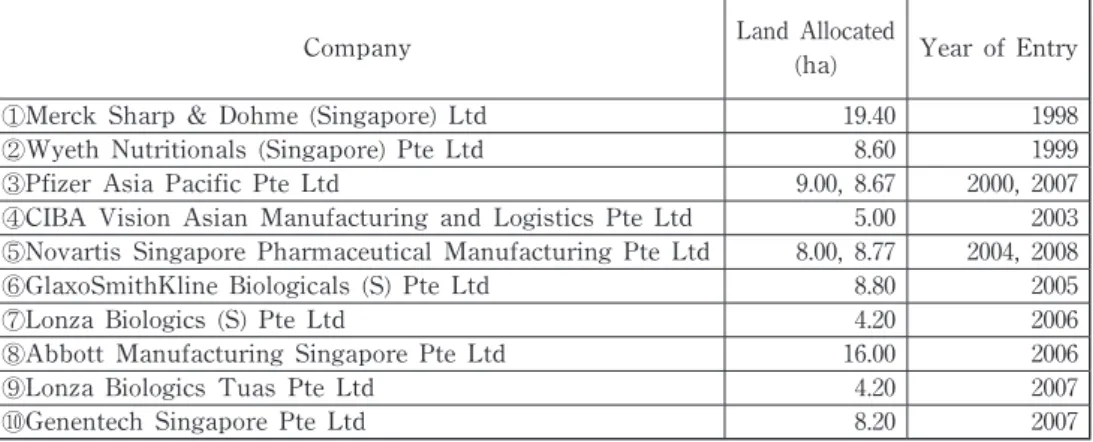
The government’s aggressive push into life sciences seems to have resulted in several early successes. One is the fact that Singapore has established itself as the most competitive and trusted site for pharmaceutical manufacturing. The Tuas Biomedical Park symbolizes the commitment of the Singaporean government to developing a world- class manufacturing hub for the biomedical industry. As many as ten world-class pharmaceutical or biotechnology companies have been established in the park within the span of a decade, that is, in 1998-2008 (see Table 2).
The contribution of the bioscience manufacturing industry to Singapore’s economy is, therefore, substantial. Table 3 lists the shares of manufacturing output and value added by industry in 1996, 2001, and 2006. The total share of the pharmaceutical manufacturing industry increased significantly, particularly its contribution to manufacturing
203 value added, between 2001 and 2006 (Table 3). Moreover, the target of
reaching approximately S$12.5 billion in value added by 20154) was almost achieved in as early as 2006.
Table 3 Shares of Manufacturing Output and Value Added by Industry (%)
Source: Author’s construction based on data obtained from Yearbook of Statistics Singapore 2007.
Industry Manufacturing Output (%) Value Added (%)
1996 2001 2006 1996 2001 2006
Chemicals 16.0 21.4 32.6 11.1 11.8 13.4
Pharmaceuticals 1.4 3.8 9.2 5.2 8.7 22.4
Electronics 53.8 47.4 33.7 42.5 38.9 30.6
Others 28.8 27.4 24.5 41.3 40.6 33.6
Another success story is found in the promotion of health care services. Figure 1 illustrates the percentage changes in the business receipts index for services industries between 2001 and 2006. During the first decade of the 21st century, health care businesses have demonstrated the highest growth rate within Singapore’s services sector. Moreover,
“expenditures on medical services may continue to displace other expenditures, reflecting high income elasticity and low price elasticity of demand “(Yusuf and Nabeshima 2006: 130). The biotech cluster appears to have succeeded in fulfilling the needs of Singapore by serving, to some extent, as a reliable engine of growth.
Table 2 Biomedical Manufacturing Companies Located in the Tuas Biomedical Park
Source: “Tuas Biomedical Park” downloaded from http://www.Biomed-Singapaore.com on August 25, 2008.
Company Land Allocated
(ha) Year of Entry
①Merck Sharp & Dohme (Singapore) Ltd 19.40 1998
②Wyeth Nutritionals (Singapore) Pte Ltd 8.60 1999
③Pfizer Asia Pacific Pte Ltd 9.00, 8.67 2000, 2007
④CIBA Vision Asian Manufacturing and Logistics Pte Ltd 5.00 2003
⑤Novartis Singapore Pharmaceutical Manufacturing Pte Ltd 8.00, 8.77 2004, 2008
⑥GlaxoSmithKline Biologicals (S) Pte Ltd 8.80 2005
⑦Lonza Biologics (S) Pte Ltd 4.20 2006
⑧Abbott Manufacturing Singapore Pte Ltd 16.00 2006
⑨Lonza Biologics Tuas Pte Ltd 4.20 2007
⑩Genentech Singapore Pte Ltd 8.20 2007
204
3.2.The building of research capabilities in biosciences assessment based on input measures
Leading the way in developing Singapore’s biomedical sciences research capabilities is the Biomedical Research Council (BMRC), which falls under the auspices of the Agency for Science, Technology and Research (A*STAR). Since its establishment in 2000, the BMRC has been overseeing all public biomedical sciences research activities in Singapore and developing human capital to support, sustain, and stimulate the country’s biomedical sciences sector (Marshall Cavendish Business Information 2005: 18). Thus, the BMRC has facilitated Singapore’s progress in building human capital and research capabilities in the field of life sciences.
Table 4 provides the number of researchers, classified by area of research, in both public and private sectors. According to the table, the total number of researchers increased by as much as 42 percent between 2001 and 2006. In addition, during the same period, the number of researchers increased significantly in all areas of research, with the exception of computer science and its related fields. This indicates that the government of Singapore has charted a course for Singapore’s transition from an investment-driven economy to an innovation-driven Figure 1 Percentage Changes in Business Receipts Indexes for Services Industries
between 2001 and 2006
-10 0 10 20 30 40 50
Percentage Change
(%)
Services Industries Source: See Table 3.
205 economy, with emphasis on the building of intellectual capital.
Table 4 also illustrates that between 2001 and 2006, human capital accumulated most rapidly in fields such as biomedical sciences and biomedical engineering. That is, the number of researchers in these two fields increased significantly, by 107 percent in biomedical sciences and 842 percent in biomedical engineering. This is further evidence of the Singaporean government’s firm commitment which was made in the beginning of the 21st century to build innovation capabilities in order to become an R&D leader in the field of life sciences.
The government’s commitment to turn Singapore into a biomedical hub in Asia is also demonstrated through its R&D expenditure trend.
Table 4 shows that between 2001 and 2006, in the field of biosciences, not only did the absolute amount of R&D expenditure increase significantly from S$310 million to S$1.1 billion but also the share of expenditure in biosciences with respect to the total R&D expenditure expanded sharply from 9.6 percent to 22.0 percent.5) Thus, in a very short period of time, the government of Singapore has demonstrated a level of commitment to research that is unprecedented.
3.3.The building of research capabilities in biosciences assessment based on output measures
In Singapore, considerable progress has been made in various fields such as cancer research, infectious diseases research, genomics, and medical device development. In 2005 alone, the BMRC research institutes6)
published almost 300 scientific papers in the world’s top scientific Table 4 Number of Researchers and R&D Expenditure by Area of Research
Source: Author’s construction based on data obtained from A*STAR (2002, 2007).
Area of Research
Number of Researchers R&D Expenditure
2001 2006
Percentage Change (%)
(2006/
2001)
2001 (S$Mil.)
2006 (S$Mil.)
Percentage Change (%)
(2006/
2001)
Agricultural and Food Sciences 296 325 9.8 47.25 58.28 23.3
Computer & Related Sciences 4437 2822 -36.4 548.30 254.83 -53.5
Engineering 10574 17987 70.1 1663.06 2882.87 73.3
Biomedical 43 405 841.9 12.96 58.91 354.6
Biomedical Sciences 2075 4287 106.6 297.74 1042.52 250.1
Natural Sciences 1134 1868 64.7 139.94 221.62 58.4
Other Areas 2129 2189 2.8 536.39 549.58 2.5
Total 20645 29478 42.8 3232.68 5009.70 55.0
206
journals (Marshall Cavendish Business Information 2005: 19). Indeed, Singapore has been producing a rapidly increasing number of scientific papers, a remarkable feat given the fact that only two out of the current seven BMRC research institutes existed before 2000. The total number of annual publications went up to 392 by 2007.7)
The capacity to generate technology by utilizing new scientific findings also seems to be expanding in Singapore. Table 5 compares the number of applications filed by the top ten Singapore-based patent applicants in 2001 and 2007. First, it is clear that in the first decade of the 21st century, Singapore has become more active than previously in terms of not only research but also patenting activity. In fact, the total number of patent applications filed by the top ten Singapore-based applicants increased from 211 in 2001 to 319 in 2007 (see Table 5).
In addition, the type of institution to which the above patent applicants belong has changed significantly in Singapore between 2001 and 2007. At the end of the 1990s, electronics or IT-related private firms were important players in the patenting activities in Singapore. However, nowadays, public research institutes such as those under the umbrella of A*STAR and higher educational institutions such as the National University of Singapore (NUS) and Nanyang Polytechnic have come to be listed among the top ten Singapore-based patent applicants.8)
This has two implications. First, the separation between science and technology is no longer clear cut. This is especially true in fields such as life sciences. Within the scope of modern biotechnology and biosciences, science and technology are so closely linked that the division between cutting edge biotechnology and modern bioscience has almost completely disappeared (Brink et al. 2004: 273). Second, as Wong (2007:
207) points out, the role of tertiary educational institutions and public research institutions has changed qualitatively since 2000. More specifically, there has been a shift from their traditional role in education and research to a more visible role in knowledge commercialization through increased patenting activity, etc.
The government of Singapore announced in 1999 that it would establish Singapore as a hub of research in biomedical sciences by 2010.
Although it is too early to conduct a full assessment of the biotechnology cluster in Singapore, since the introduction of the Biotech Cluster Initiative in 2000, considerable progress seems to have been made to date.
207
Rank
20012007 ApplicantNumber of ApplicationsApplicantNumber of Applications 1Chartered Semiconductor Manufacturing Ltd88A* STAR123 2Institute of Microelectronics28Chartered Semiconductor Manufacturing Ltd68 3Kent Ridge Digital Labs24Creative Technology Ltd.37 4Data Storage Institute18ASM Technology Singapore Pte Ltd23 5Sony Electronics (Singapore) Pte Ltd13National University of Singapore22 ST Assembly Test Service Limited 6Instituteof MaterialsResearch &Engineering12Singapore Technologies Aerospace Ltd10 ST Microelectronics Asia Pacific Pte Ltd 7Plexus Multimedia Pte Ltd10Nanyang Polytechnic9 8Institute of Molecular Agrobiology8Singapore Technologies Dynamics Pte Ltd8 Nanyang Technological University 9Advanced Systems Automation Limited6Hui Wing Feh7 FCI Asia Technology Pte Ltd Singapore Technologies Aerospace Limited 10Singapore Technologies Marine Limited5Advanced Systems Automation Limited6 United Test and Assembly Center Ltd.6 Total212Total319
Table5 TopTenSingapore-basedPatentApplicantsinSingaporein2001and2007 Source: Author’s construction based on dataobtained fromthe Intellectual PropertyOffice of Singapore (Datawere downloaded fromhttp://www.ipos.gov.sg on October 13, 2008).
208
4.Tasks Ahead For Singapore
4.1.How to overcome the “Innovation Paradox”
In the late 1990s, the European Commission introduced the famous concept of the “European Innovation Paradox” (Wright et al. 2007: 5).
According to this concept, the European Union (EU) plays a leading role in top-level scientific output but lags in terms of its ability to transform this strength into wealth-generating innovation. In other words, “Europe performs well in science but badly in innovation “(Wright et al. 2007: 6).
Singapore’s experiences also seem to suggest that the promotion of science and technology alone is not sufficient for the rapid introduction of innovative products in the marketplace. Whether the biotechnology cluster can be the fourth engine of growth and employment for Singapore depends greatly on its ability to increase its biomedical business capabilities.
Despite the government’s established target of developing Singapore into a regional center for drug discovery and development as well as drug manufacturing, it does not appear as though the industrial R&D base of the private sector is adequately strong at present. Table 6 compares the rate of progress in drug discovery and development among the Asian countries such as China, India, Korea, Taiwan, Singapore, Malaysia, Indonesia, Thailand, and the Philippines.
Singapore leads the Association of Southeast Asian Nations (ASEAN) in drug discovery and development (Table 6). This is primarily because the biomedical industrial sector has yet to be developed in the other original ASEAN member countries. Nevertheless, Singapore has not established a clear competitive advantage in the field of biomedical sciences in Asia despite its leading position in this sector with respect to the ASEAN countries.
First, the number of Singapore-based companies undertaking drug discovery and development remains small. Specifically, only seven Singapore-based companies9) can be described as currently and actively undertaking the process. This number is lower than that of such companies based in China, India, Korea, and Taiwan. In addition, Singapore-based companies not only have failed to introduce any drugs but also appear to be currently developing only a small number of drugs (Table 6).
Moreover, among the above five10) countries listed in Table 6, the share of biotechnology drugs drugs developed through the application
209
Table6 NumberofDrugsbyDevelopmentStageinAsianCountries Notes: 1) Refers to drugs whose current status is unknown, although they were in the pipeline before. 2) Abiotechnologydrugis one that is produced usinglivingorganisms, often byapplyingmodern biotechnologysuch as recombinant DNA technology. Here, biotechnology drugs are defined as those whose primary therapy code starts with T in the PharmaProjects v5.2 on the Web. 3) Singapore-based pharmaceutical or biotechnology companies engaged in drug discovery and development. Source: Author’s construction based on data obtained fromthe PharmaProjects v5.2 on the Web downloaded on October 20, 2008.
ChinaIndiaKoreaTaiwan
ASEAN SingaporeIndonesiaMalaysiaPhilippinesThailand Launched123450100000 Pre-registered316000000 Preclinical19621281880000 Phase I61420320000 Phase II81926430000 Phase III216000000 No development report 1)3815223118290022 Discontinued0928000000 Share of biotech drugs 2) 46.60%8.90%23.00%6.80%4.80%0.00%0.00%0.00%0.00% No. of companies 3) 2132491170021
210
of biotechnology is the lowest in Singapore (Table 6). In the early 1990s, biotechnology drugs constituted only 12.6 percent of the total number of new drugs approved worldwide. Within a decade, the share of biotechnology drugs almost doubled (Takatori 2007: 12). Obviously, the future success of pharmaceutical and biotechnology companies increasingly depends on their ability to develop and/or sell biotechnology drugs in the international market. Singapore seems to lag behind other Asian countries in this respect as well.
4.2.Necessity of developing local innovative biotechnology firms
Singapore’s weakness with respect to the process of drug discovery and development seems to be partially due to the underdevelopment of independent biomedical spin-off or start-up companies. Both European and Japanese policy makers are increasingly aware that economic growth depends on the promotion of technology transfer from public research institutes to private industry. One means of accomplishing this is by facilitating the establishment of new technology-based firms, particularly spin-offs or start-ups that utilize the results of public research (Wright et al. 2007: 7).
In recent decades, there has been unprecedented growth in corporate partnering among high-tech companies. Indeed, such companies have now shifted their focus away from the “in-house development principle” to the development of external relationships, particularly in the R&D segment of the value chain. The most frequently touted rationales for this sudden increase in collaboration include “some combination of risk sharing, obtaining access to new markets and technologies, speeding products to market, and pooling complementary skills” (Powell et al. 1996: 116).
All of these rationales seem to be appropriate, particularly in the case of industries that are highly R&D-intensive, such as the biotechnology industry. This is because the scientific knowledge base of biotechnology advances very fast, and it is impossible for a single company alone to accumulate all the knowledge. In addition, activities that biotechnology businesses must undertake, such as drug R&D, are becoming riskier: while the cost of development of one drug has become extraordinarily expensive, the probability of success remains low.
Moreover, the process of R&D is very long for one drug, it can easily take around 10 years or more to progress from discovery to
211 marketization.
Nevertheless, several successful biotechnology spin-offs or start-ups have begun to emerge in Singapore. For instance, Finegold et al. (2004) well document the first biotechnology company that was spun off from the NUS, called Link Biotechnologies. Additionally, the founder and current chief scientific architect11) of a drug discovery and development company named Chakra Biotech holds a Ph.D. in Biochemistry earned at the NUS. The co-founder and current chief scientific officer of ProTherapeutics, which engineers novel therapeutic peptides, is also a professor at the Department of Biological Sciences of the NUS.12)
Furthermore, some companies began to spin off from public research institutes under the umbrella of the Biomedical Research Council A*STAR. For instance, Dr. Namyong Kim and Dr. Kwong-Joo Leck from the Institute of Bioengineering and Nanotechnology (IBN) obtained a patent for DropArrayTM; subsequently, in 2007, they spun off a company called Curiox Biosystems from the IBN.13) The technology developed by Dr. Kim and Dr. Leck is a convenient and efficient platform technology for drug discovery and other life sciences applications.14)
Despite the emergence of various successful spin-off or start-up companies, there remains considerable scope for the development of Singapore’s private sector, particularly in the field of life sciences. Table 7 lists the shares of private sector R&D expenditure by field, ownership,
Table 7 R&D Companies’ Shares of Private Sector R&D Expenditure by Field and Type in 2006 (%)
Notes: 1) SMEs stands for small-medium enterprises.
2) Private sector R&D expenditure does not include that of manufacturing companies.
Source: Author’s construction based on data obtained from A*STAR (2007).
R&D Companies Local SMEs Local Large Enterprises
Foreign
Companies Total
Chemicals 1.8 0.0 2.0 3.9
Electronics 4.2 0.0 20.5 24.7
Engineering 3.9 0.0 4.1 8.0
IT 3.3 0.0 4.7 8.1
LifeSciences 2.6 7.8 15.2 25.6
Others 11.3 0.0 18.5 29.8
Total 27.1 7.8 65.1 100.0
212
and size in Singapore.15) Among the five fields of chemicals, electronics, engineering, IT, and life sciences, the share of expenditures relating to life sciences is the largest with respect to the total private R&D expenditure (25.6 percent); however, local small-medium enterprises (SMEs) involved in the field of life sciences contribute very little to the total R&D expenditure (2.6 percent).
Local SMEs involved in the field of life sciences may be working under severe financial constraints because the development of new products such as drugs is very costly, time consuming, and risky in comparison with other types of products and services. Moreover, it is believed that the low availability of venture capital funds in the private sector and a lack of foreign venture capital participation as well as limited capital market access16) make the establishment and subsequent growth of innovative biotechnology companies in Singapore very difficult.
In fact, for such companies, very few funding sources exist outside the Singaporean government (Finegold et al. 2004: 925).
There are two reasons why further development of independent biotechnology spin-offs or start-ups needs to be encouraged so that Singapore can become a biomedical hub either in the Asian region or globally. First, both technological and market developments may promote the entry of smaller-scale biotechnology firms. The new wave of drugs or vaccines thus generated might enable us to tackle rare illnesses or cater to the needs of individuals with a specific genetic profile, which is increasingly used owing to the rapid progress in genome research. Yusuf and Nabeshima state as follows: “Such drugs or vaccines could cost less to research, develop, and market than the blockbuster drugs and could thereby facilitate entry of smaller companies germinating in such countries as Singapore” (2006: 129).
Second, Singapore may not be able to rely solely on foreign companies to establish R&D or clinical research operations and bridge the gap between research and business. The widespread, rising demand for biotechnology products and services seems to be too numerous to depend solely on foreign biotechnology companies.
5.Conclusion: Lessons to be Learnt From The Case of Singapore In 1999, the Singaporean Government announced that it would strive to develop a world-class biotechnology cluster as part of the Industry 21 Program formulated by the EDB of Singapore. The purpose of this paper
213 was two-fold: illustrate the salient features of Singapore’s new economic
initiative and examine the degree to which Singapore has succeeded in building the biotechnology cluster thus far.
First, this paper explained that the industrial cluster policy is not new to Singapore. The government has emphasized the need to form competitive world-class industrial clusters since the formulation of its Strategic Economic Plan in 1991. Moreover, this policy closely follows Porter’s (1990, 1998, 2000) cluster theory, which considers the creation of clusters as an increasingly important source of competitive advantage in the global economy.
The Singaporean government’s policy for developing a world-class biotechnology cluster was, however, different from the earlier policies it formulated for the creation of other clusters, such as the electronics cluster. In brief, the government attempted to concurrently create an entire value chain in Singapore rather than focus on just one segment of the biotechnology complex at a time. Thus, Singapore adopted a “big push approach” in the construction of the biotechnology cluster.
Singapore succeeded in attracting a number of world-class pharmaceutical companies to the country and establishing itself as an important regional hub for pharmaceutical manufacturing sites. In fact, Singapore is now recognized as an important provider of high quality healthcare services in the region. Moreover, Singapore has been very successful in building its scientific infrastructure and manpower base.
However, while the biotechnology cluster seems to be very promising for the future economic growth of Singapore, a large task remains for its complete success. The author found that to be a regional or world-class hub for biomedical sciences, Singapore needs to expand the private sector’s R&D base and increase the number of independent local companies undertaking the discovery and development of new drugs and medical devices. This, in turn, requires the strengthening of the business capabilities of Singapore’s private sector in terms of new product and/or process innovations and increased availability of risk money for high-tech start-up companies. Otherwise, Singapore might be unable to compete with not only the U.S. and Europe but also Asian countries such as China, India, Korea, and Taiwan.
The important lesson to be learnt from the case of Singapore is the necessity of having a balanced policy mix. As Finegold et al. (2004: 939) concludes, Singapore needs to integrate policies to not only attract global
214
companies and establish a scientific foundation but also build its local biomedical business capabilities and promote the local biotechnology private sector.
Endnotes:
Remark: Funding from the Japan Society for the Promotion of Science (Grant-in-Aid for Scientific Research (c) No.19530260) and the Nomura Foundation for Research Promotion (Gakujutsu Shinko Nomura Kikin) is acknowledged.
*Corresponding address: Dep. of Policy Studies, Doshisha University, Kyoto 602-8580, Japan. Tel and fax: 81-75-251-3503. E-mail: yokamoto
@mail.doshisha.ac.jp.
1)See Yusuf and Nabeshima (2006: 104).
2)Marshall Cavendish Business Information (2005: 18).
3)Regardless of the several differences between their theoretical frameworks, special economics and Porter’s cluster theory seem to complement each other. While Porter focuses on a class of industrial clusters in which innovation is continuous, spatial economics examines a broader class of clusters and can, therefore, help us reconsider Porter’s cluster theory from a broader perspective (Fujita 2008: 20).
4)Marshall Cavendish Business Information (2005: 20).
5)This figure in Table 4 includes both biomedical sciences and biomedical engineering.
6)It includes the Bioinformatics Institute (2001), Bioprocessing Technol-Technol- ogy Institute (1990), Genome Institute of Singapore (2000), Institute of Bioengineering and Nanotechnology (2003), Institute of Medical Biology (2007), Institute of Molecular and Cell Biology (1987), and Singapore Institute of Clinical Sciences (2007). The figures in parentheses represent the year of establishment five of the seven research institutes were established after 2000. See Economic Development Board Singapore, Biomedical Sciences Factsheet 2008 (http://
www.biomed-singapore.com) for further details.
7)The number of publications was obtained from A*STAR Yearbook 2007/8 (p.54). The report was downloaded from http://www.a-star.edu.
215 sg on October 10, 2008.
8)The Nanyang Technology University frequently joined the list during the first decade of the 21st century, although it was not ranked among the top ten Singapore-based patent applicants in 2007.
9)Chakra Biotech, ES Cell, MerLion Pharmaceuticals, ProTherapeutics, SBIO, SingVax, and TauRx Therapeutics.
10)China, India, Korea, Singapore, and Taiwan.
11)Dr. Anil K. Ratty. For further details, visit http://www.chakrabiotech.
com.
12)Professor R. Manjunatha Kini. For further details, visit http://www.
protherapeutics.com.
13)See A*STAR Yearbook 2007/8 for further details.
14)See endnote 12.
15)The table does not include the R&D expenditures of private sector manufacturing companies.
16)These points were emphasized by Dr. Foo Fatt Kah, the Chief Executive Officer of Maida Vale Consulting, in his presentation entitled “Financing Trends in Biotechnology” (June, 2005).
References
Agency for Science, Technology, and Research (A*STAR) (2002), National Survey of R&D in Singapore 2001. Singapore: Agency for Science, Technology and Research.
(2007), National Survey of R&D in Singapore 2006. Singapore:
Agency for Science, Technology and Research.
Brink, Johan; Linus Dahlander; and Maureen McKelvey (2004), “The Dynamics of Regional Specialization in Modern Biotechnology:
Comparing Two regions in Sweden and Two regions in Australia, 1977-2001,” in The Economic Dynamics of Modern Biotechnology, edited by Maureen McKelvey; Annika Rickne; and Jens Laage- Hellman. Cheltenham, UK: Edward Elgar.
Finegold, David; Poh-Kam Wong; and Tsui-Chern Cheah (2004), “Adopting a Foreign-Direct Investment Strategy to the Knowledge Economy:
216
The Case of Singapore’s Emerging Biotechnology Cluster,” European Planning Studies 12 (No.7): 921-941.
Fujita, Masahisa (2008), “Formation and Growth of Economic Agglomera-Agglomera- tions and Industrial Clusters: A Theoretical Framework from the Viewpoint of Spatial Economics,” in The Flowchart Approach to Industrial Cluster Policy, edited by Akifumi Kuchiki and Masatsugu Tsuji. Basingstoke: Palgrave Macmillan.
Henderson, Rebecca; Luigi Orsenigo; and Gary P. Pisano (1999), “The Pharmaceutical Industry and the Revolution in Molecular Biology:
Interactions Among Scientific, Institutional, and Organizational Change,” in Sources of Industrial Leadership: Studies of Seven Industries, edited by David C. Mowery and Richard R. Nelson.
Cambridge: Cambridge University Press.
Japan Electronics and Information Technology Industries Association (2006), List of Overseas Companies 2006 (in Japanese). Tokyo: Japan Electronics and Information Technology Industries Association.
Koh, Winston T. H., and Poh Kam Wong (2005), “Competing at the Frontier: The Changing Role of Technology Policy in Singapore’s Economic Strategy,” Technological Forecasting & Social Change 72:
255-285.
Krugman, Paul R. and Maurice Obstfeld (2006), International Economics:
Theory and Policy, 7th edition. Boston: Pearson Addison-Wesley.
Marshall Cavendish Business Information (2005), Singapore Biotech Guide 2006/2007. Singapore: Marshall Cavendish Business Information Private Limited.
(2006), Singapore Biotech Guide 2007/2008. Singapore: Marshall Cavendish Business Information Private Limited.
Ministry of Trade and Industry Singapore (2003), New Challenges, Fresh Goals Towards a Dynamic Global City. Singapore: SNP SPrint Pte.
Ltd.
Nelsen, Lita (2005), “The Role of Research Institutions in the Formation of the Biotech Cluster in Massachusetts,” downloaded from web.mit.
edu/lis/Nelson.pdf, on March 1, 2007.
Pisano, Gary P. (2006), Science Business: The Promise, Reality, and the
217 Future of Biotech. Boston, Mass.: Harvard Business School Press.
Porter, Michael E. (1990), The Competitive Advantage of Nations. New York: Free Press.
(1998), On Competition. Boston, Mass.: Harvard Business School Publishing.
(2000), “Locations, Clusters, and Company Strategy,” in The Oxford Handbook of Economic Geography, edited by Gordon L. Clark, Maryann P. Feldman, and Meric S. Gertler. Oxford, England: Oxford University Press.
Powell, Walter W; Kenneth W. Koput; and Laurel Smith-Doerr (1996),
“Interorganizational Collaboration and the Locus of Innovation:
Networks of Learning in Biotechnology,” Administrative Science Quarterly 41: 116-145.
Singapore Department of Statistics (2007), Yearbook of Statistics Singapore, 2007. Singapore: Ministry of Trade and Industry.
Takatori, T. (2007), “International Comparison of Biotech Drug Develop-Develop- ment” (in Japanese), OPIR Views and Actions No.23 (August): 12-15.
Wong, Poh Kam (2007), “Approaches to University-Industry Links: The Case of the National University of Singapore,” in How Universities Promote Economic Growth, edited by Shahid Yusuf and Kaoru Nabeshima. Washington, D.C.: World Bank.
Wright, Mike; Bart Clarysse; Philippe Mustar; and Andy Lockett (2007), Academic Entrepreneurship in Europe. Cheltenham, UK: Edward Elgar.
Yusuf, Shahid and Kaoru Nabeshima (2006). Postindustrial East Asian Cities: Innovation for Growth. Washington, D.C.: World Bank.