Fundamentals of Nursing Art Courses that Utilized Cooperative Learning Methods
journal or
publication title
Journal of Yamato University
volume 3
page range 101‑110
year 2017‑03‑15
URL http://id.nii.ac.jp/1677/00000108/
大和大学 研究紀要 第3巻 保健医療学部編 2017年3月
平成28年12月18日受理
The Context of Beginning Students in Fundamentals of Nursing Art Courses that Utilized Cooperative Learning Methods
UNO Mayumi* YAMAMOTO Takako*
Introduction
Active learning refers to any learning method based on a “learner-centered” paradigm wherein students take an active role in the learning process. This is not a new idea; approximately half a century ago, Chickering (1969) advocated a shift from a teacher- centered paradigm to a learner-centered paradigm, and suggested that the goals of university education should include the following seven points: “developing competence”, “managing emotions”, “developing autonomy”, establishing identity”, “developing mature interpersonal relationships”, “developing purpose”, and
“developing integrity”. Later, Fink (2010) summarized the elements of learning experiences, including studentsʼ thoughts and feelings about the contents, and how they integrated them into their existing knowledge, in points; “Foundational Knowledge: understanding and remembering the terminology for key concept s”, “Application: learning how to use and apply the material”, “Human Dimension: learning about oneself and society by studying a subject”, “Caring: Caring about a Subject”, and “Learning How to Learn: learning how to
continue learning after courses have ended”, suggesting that the significance of learning is not simply the acquisition of knowledge, but extends more broadly into the development of skills, attitudes, and ultimately the learnerʼs growth as a person.
These classroom techniques, which are based on the concept of active learning, include “cooperative learning”
and “collaborative learning,” both of which utilize methods of group learning. It has been reported that in cooperative learning, students work together as a team on assignments by assuming responsibility for group learning (Goodfellow 1995; Huff 1997; Rowles et al 1998; Matthews 1995); this is a more structural form of group learning than collaborative learning. Additionally, Johnson & Johnson (2005) have shown that cooperative learning is more eff ective than competitive learning or individualistic methods. Furthermore, they suggest that cooperative learning builds social interdependence, which is different from a simple relationship of dependence, and suggest that cooperative learning is part of a higher-order of group dynamics. There have also been scholarly reports done on the structure of Abstract
The aim of this study was to understand the context of beginning students in Fundamentals of Nursing courses, based on their texts, after the introduction of cooperative learning techniques, in which students taught each other throughout the program. A portion of Barkley et al.ʼs (2005) jigsaw method, which is a cooperative learning method (in which students teach each other), was modified and introduced into the Fundamentals of Nursing Art courses (lectures and practice on the techniques for disease prevention and safety assurance) for fi rst-year students in the Department of Nursing at
“University A”. A descriptive survey was conducted in September 2015, and was followed by text mining and related analyses, to investigate studentsʼ sense of responsibility in learning (and exchanging) with other students (at the early stages of their studies that resulted from the introduction of this method, regardless of the teaching unit). The texts showed that, as a result of this intervention, a foundation was developed in regards to a sense of student responsibility for their own (and othersʼ) learning, for their continued autonomous study and skill development, and for the communication that was necessary for nursing students. These findings suggest that students who were the early stages of their studies, and who took part in cooperative learning courses in the Fundamentals of Nursing Art, “recognized their own responsibility for learning”, “understood methods for continued study after the course was completed”, and “developed the foundations for social interdependence”.
Keywords:active learning, cooperative learning, fundamentals of nursing art, descriptive survey, text mining pp.101〜110
*大和大学保健医療学部
cooperative learning thus far (Lazarowitz et al 1994;
Watson and Marshall 1995); Lazarowits (1994) that emphasize its usefulness for self-esteem and conflict.
Cooperative learning has been adopted in various academic disciplines, and has enhanced studentsʼ ability to think through and solve problems, including math (Norwood 1995), college learning (Johnson et al. 1991), science (Watson and Marshall 1995), and social studies (Vansikle 1990). As this has also been shown in nursing research (Goodfellow 1995; Beck 1992; Cravener 1997;
Elberson et al. 2001; Huff 1997), the positive eff ects of cooperative learning are certain.
Barkley et al.ʼs (2005) cooperative learning technique, in which students teach each other, is wide-ranging.
The Jigsaw method is a widely-used cooperative learning technique that is named as such, because each student in a Jigsaw group must become an expert on one part of the puzzle. Students teach the other group members in order for everyone in the group to learn all the components. Each student is in a position to bring to their group unique knowledge that is not readily available, and allows group members to use each other as resources (Aronson & Patnoe 1997; Kagan 1994;
Slavin 1995). Studies have shown the usefulness of Jigsaw methods for learning and skill-development (Slavin 1995; Aronson & Patnoe 1997); jigsaw methods reduce test anxiety, have a positive effect on learning (Maloof 2004), and promote critical thinking skills in nursing students (Ulrich & Glendon 1995). Thus, we concluded that in the study of Fundamentals of Nursing Art, in which proactive learning and regular repetitive practice are necessary, jigsaw methods would be effective. Since no studies exist that focus on the context of beginning students whose courses have utilized jigsaw methods, I believe that it was important to investigate the eff ects of these methods on learning, by studying studentsʼ texts.
Objective
The cooperative learning technique (of teaching each other) in the Fundamentals of Nursing Art courses is: To understand, through their texts, the contexts of students at the early stages of their studies, that result from the introduction of jigsaw methods.
Method
The subjects of the study were first-year nursing students at “University A.” Barkley et al.ʼs (2005) jigsaw method, which is a cooperative learning technique in which students teach each other, was partially modifi ed
and introduced into the Fundamentals of Nursing Art courses (teaching units included lectures and practice on techniques for disease prevention and safety assurance) in the fi rst academic term of 2015.
1. The instructor explained how the jigsaw method would be integrated into the course, and how students would learn in class. The jigsaw method is one cooperative learning strategy. Just like a Jigsaw puzzle, each studentʼs part is essential for the completion and full understanding of the material. The team member is valued by others because s/he provides a part of the practice.
2. Classes were 90 minutes long, and based on a teacher-centered paradigm. This made it possible for students to understand the basic learning structure.
3. Since each group was composed of five to six people, four people used the jigsaw method for basic tasks, and one to two people used the jigsaw method for developmental free tasks. For each teaching unit, students were given pre-tasks for their respective parts, and depending on the teaching unit, students exchanged roles between performing the basic tasks and the free tasks. Since groups were formed at a stage in which the context of each student was unknown, the composition of each group was determined by the student registration number.
4. Courses were conducted using the jigsaw method.
In a 90-minute class, the first 10 minutes were used to confi rm the type of lesson being introduced and the learning method, while the last 10 minutes were used to wrap up and to consolidate studentsʼ thoughts. In 70 minutes of substantive learning time, each group worked cooperatively to teach each other the four basic tasks. For the developmental free tasks, handouts of related material and study notes were provided.
5. Data was collected through an anonymous descriptive survey conducted in September 2015. On the survey, students were asked to recall the cooperative learning methods that were introduced into their courses, with no diff erentiation between the teaching units. Instructions were also written on the survey sheet.
6. To determine the survey items, the researchers used Barkley et al.ʼs (2005) cooperative learning evaluation as a guide, considered its validity for use in this study, and finally decided on the following five items:① changes in studentsʼ sense of responsibility for learning as a result of teaching each other the given tasks,② feelings of satisfaction regarding the jigsaw method,
The Context of Beginning Students in Fundamentals of Nursing Art Courses that Utilized Cooperative Learning Methods
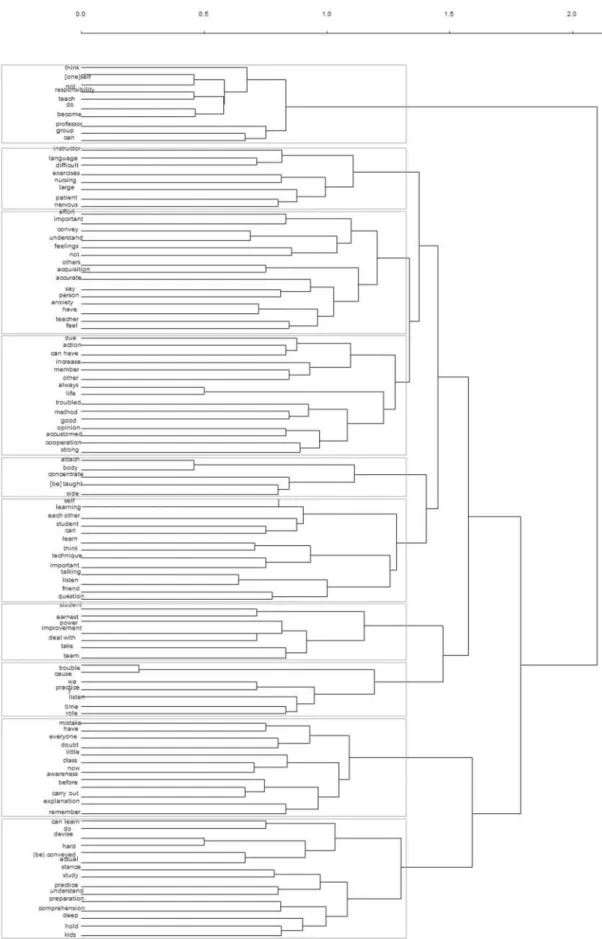
in advance in order to not “cause trouble” for others (Figure 1).
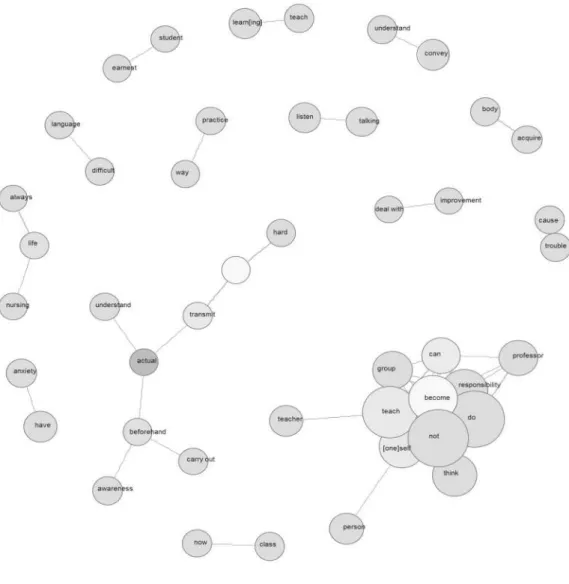
The co-occurrence network analysis showed the distinctive use of the expressions: “the language we need to convey is diffi cult”, “I become earnest about teaching other students”, “I think more about my learning,”
“it is necessary to understand in order to convey [information],” “acquire [a skill],” “listen to [someone]
talking,” and “practice the method” (Figure 2).
Student Interactions as a Result of Learning Together The total number of words was 2099. The most frequently used words were “group,” in fi rst place, which appeared 58 times; “person,” in second place, which appeared 47 times, and “think,” in third place, which appeared 46 times.
The cluster analysis showed characteristic use of the expressions “become friendly,” and “[my] circle broadens” (Figure 3).
The co-occurrence network analysis showed the distinctive use of the expressions “[my] circle broadens”,
“fellow students enhance each other together”, “we practice teamwork before tests”, “we cooperate with each other for the exercises from the beginning”, “by talking with students in different classes, we may become friendly” (Figure 4).
Discussion
The point of greatest concern when performing general group activities is that there are students who do not participate sometimes. In these cases, not only do the learning opportunities decrease for the student in question, but the other group members also lose the chance to acquire the “new ideas” that come from the group. In the jigsaw method used in this study, the opportunity for each student to participate equally is guaranteed, since each student is given a role, for which they have a responsibility to teach others.
From statements such as “the language we need to convey is diffi cult, so it makes me [try] earnest[ly]” and
“it makes me think about my learning beforehand,”
the results of the analyses suggest that teaching other students led students to recognize their responsibility for learning (Stiles 2005). Additionally, with regard to teaching other students, the distinctive use of the phrase “practice the method” showed an earnest attitude among students. Kagan (1990) defines “individual responsibility” as something that exists when members of a group each have to do something in front of everyone, and the jigsaw method used in this study which was introduced into the course③ changes in
student interactions as a result of learning from each other, ④ impressions about the course methodology, ⑤ the learning status that students acquired through the course contents.
7. The analytics software used was IBM SPSS Text Analytic for Surveys 4.0.1, SPSS Statics ver.23, R ver.3.0.1.
The text data from all of the survey items was carefully read, and particular attention was paid to items ① and
③, which were understood to be in closest conformance with the goals of this study. Language processing was then conducted on these sections, followed by the creation of a lexicon, a word frequency analysis, a hierarchical cluster analysis, and a co-occurrence analysis. Items ②, ④, and ⑤ were used as reference materials for overall understanding. Furthermore, a university professor well-versed in qualitative research, text mining, and related analyses provided supervision in order to ensure the accuracy and validity of the analyses.
Ethical Considerations
The goals of the study were explained both verbally and in writing. The submission of the descriptive survey paper was taken as consent, and students were assured that even if they did not submit the papers, that it would not aff ect their grades. It was also explained to students that they would be free to withdraw their consent to use the descriptive survey papers, even after they had submitted them. Approval was also received from the researcherʼs institution.
Results
Response rate: 94.9%, eff ective response rate: 80.5%, subjects of analysis: 95 people.
Sense of Responsibility for Learning as a Result of Students Teaching Each Other the Assigned Task The total number of words was 2400. The most frequently used words were “teach”, in fi rst place, which appeared 127 times; “responsibility”, in second place, which appeared 93 times; and “self ”, in third place, which appeared 83 times.
The cluster analysis showed a distinctive use of language that related to the sense of responsibility that developed as a result of this learning method; such examples included “the diffi culty of teaching,” “acquire [a skill],” and “on the receiving side of [being] taught.”
Furthermore, the analysis showed that when students taught each other, they prepared thoroughly for classes
a method to increase nursing studentsʼ participation arguments through the application of active teaching methods that can provide the opportunity for increased communication skills. Mutually recognizing diff erences in values, and working together to solve problems are important elements of the nursing profession.
The discussion of components necessary to develop such critical thinking and problem-solving skills are included in the jigsaw method; language such as “I become friendly with students from other classes and my circle broadens,” “fellow students enhance each other together,” and “we cooperate on exercises from the beginning,” suggests that guiding each other is a learning technique that students can acquire naturally (Aronson 1997; Johnson & Johnson 2005).
Conclusion
The results of this research suggest that when cooperative learning was used at the early stages of the Fundamentals of Nursing Art classes (for beginning students who had entered the program within six months prior), a foundation was laid for students to:
recognize their own responsibility for learning, to understand how to regularly practice after classes were complete, and to build social interdependence through communication amongst themselves.
Limitations and Future Prospects
This study explored cooperative learning among fi rst- year university students in the beginning stages of their programs. In the future, we would like to investigate the changes that occur when the Fundamentals of Nursing Art students are at diff erent stages of their studies and their primary causes, and to develop effective classes while continuing to explore ways of addressing the student unease about learning from other students.
Also, since at this stage, instructors did not have a clear understanding of the type and level of their students, groups were organized according to student registration number; but, in the future, it will be necessary to ascertain student types and levels, and thereby create uniform groups. In this study, since the aim was to understand the context of students at the beginning stages of learning, no comparisons were conducted on the results between diff erent teaching units. However, it will be necessary in the future to consider the suitability of this technique for diff erent teaching units.
Acknowledgements
I would like to express my appreciation to everyone who participated so enthusiastically in this study.
promoted this. Because of this context, in which the student must share in the responsibility for learning, I believe that instructors should always pay attention to the studentsʼ “equal participation”, and should aim to stimulate studentsʼ growth and learning by attentive observation, and through minimal intervention. On the other hand, instructors must fi nd the appropriate times to intervene in situations in which students feel anxious about teaching each other in groups.
What is important in learning the Fundamentals of Nursing Art, is that students learn autonomously outside of class time and engage in regular repetitive practice. The language that students used (in the results of this study), such as “fellow students enhance each other together,” and “we cooperate with each other for exercises, from the beginning,” suggests that the experience of learning together with peers (due to the introduction of cooperative learning) is linked to continuous learning. Thus, it is likely that the motivation necessary to continue regular practice, even after classes and tests have ended, will be sustained.
As for student interactions, the research suggests that through Fundamentals of Nursing Art courses, students can interact with students in other classes, with whom they normally have no contact; students thereby recognize that they cannot cause trouble for others, and that they can broaden their circle of friends. Students practice together with others in their group, learn as they think through issues, enhance each otherʼs skills and awareness, and deepen their aspirations to learn.
Therefore, communication that incorporates others for mutual exchange in a context that utilizes cooperative learning will likely show positive eff ects on learning.
Communication is the process of exchanging information, and the process of generating and transmitting meanings between two or more individuals (Taylor et al., 2008). A wide range of previous researchers have studied nursesʼ communication skills, ranging from beginning students, to nurses who deal with critical patients (Heaven and Maguire, 1996;
Jarrett and Payne, 2000; Macleod, 1988; Navabi and Asri, 2003; Sabzevari et al., 2006; Wilkinson, 1991), and thus have explained the importance of acquiring communication skills as a foundation of nursing.
According to Baghcheghi et al. (2011), cooperative learning is an effective skill of nursing students, especially for interactive skills, and skills in which one must follow-up on the problems. It is recommended as
The Context of Beginning Students in Fundamentals of Nursing Art Courses that Utilized Cooperative Learning Methods
A portion of this research was presented at the 42
ndJapan Society of Nursing Research conference.
References
Aronson E. & Patnoe S. (1997) The Jigsaw Classroom:
Building Cooperation in the Classroom, 2nd edition.
Addison-Wesley Educational Publishers Inc,
Wokingham.Baghcheghi N., Koohestani H. R., Rezaei K. (2011) A comparison of the cooperative learning and traditional learning methods in theory classes on nursing studentsʼ communication skill patients at clinical settings.
Nurse Education Today.
31, 877- 882.Barkley E. F., Cross K.P, Major C.H. (2005) Collaborative Learning Techniques: A handbook for college faculty.
John Wiley & Sons, Inc.
Barr R.B., Tagg J. (1995) From teaching to learning:
A new paradigm for undergraduate education.
Change.
27(6), 12-25.B e c k S . ( 1 9 9 2 ) T h e d e v e l o p m e n t , a n a l y s i s , implementation and evaluation of a cooperative learning teaching model using action research in RN/BSN nursing education. Doctoral Dissertation, Widener University.
Chickering A.W. (1969)
Education and identity.
San Francisco: Jossey-Bass.Cravener P. (1997) Promoting active learning in large lecture classes.
Nurse Educator.
22(3),21-26.Elberson K., Vance A., Stephenson N., Webb C. R. (2001) Cooperative learning a strategy for teaching pathophysiology to undergraduate nursing students.
Nurse Educator.
26(6), 259-261.Fink L. D. (2010) Designing our courses for greater student engagement and better student learning.
Perspectives on Issues in Higher Education.
13(1), 3-12.Goodfellow L.M. (1995) Cooperative learning strategies:
an effective method of teaching nursing research.
Nurse Education.
20(4), 26-29.Heaven C.M., Maguire P. (1996) Training hospice nurses to elicit patient concerns.
Journal of Advanced Nursing.
23,280-286.Huff C. (1997) Cooperative learning: a model for teaching.
Journal of Nursing Education.
36, 434- 437.Jarret N.J., Payne S.A. (2000) Creating and maintaining
optimism in cancer care.
International Journal of Nursing Studies.
31, 81-90.Johnson D., Johnson R., Smith K. (1991) Cooperative learnig Increacing college faculty instructional productivity.
School of Education and Human Development, The George Washington University.
Higher Education report 4. Washington, D. C.
Johnson D. W., Johnson R. T. (2005) New developments in social interdependence theory.
Genetic, Social, and Genaral Psychology Monographs.
131(4), 285-358.
Kagan S. (1990) The Structural Approach to Cooperative Learning.
Educational leadership.
Dec./Jan.12-15.Lazarowitz R., Hertz L. R., Barid J. H. (1994) Learning science in a cooperative setting: academic achievement and affective outcomes.
Journal of Research in Science Teaching.
31(10), 1121-1131.Macleod C. (1998) Communication the continuing challenge.
Nursing Times.
84, 24-27.Matthews R.S., Cooper J.L., Davidson N., Hawkes P.
(1995)
Building bridges between cooperative and collaborative learning.
Change.
27(4), 35-40.Navabi N, Asri M. (2003) Practice rate of nursing students about communication with patients.
Journal of Babol University of Medical Science. 5(2), 48-51.
Norwood K. (1995) The eff ects of the use of problem- s o l v i n g a n d c o o p e r a t i ve l e a r n i n g o n t h e mathematics achievements of under prepared college freshmen.
Problem Solving and Cooperative Learning.
5(3), 229-252.Rowles C.J. Brigham C. (1998) Strategies to promote critical thinking and active learning.
Teaching in Nursing: A Guide for Faculty.
WB Saunders;Philadelphia, 247-274.
Sabzevari S., Soltani A., Shekarabi R., Koohpayehzadeh I. (2006) Nursing studentsʼ communication with patients in hospitals affi liated to Kerman University of medical sciences Iranian. Journal of Medical Education. 6(1),43-49.
Slavin R.E. (1995) Cooperative Learning, 2nd edition.
Allyn & Bacon,
Needham Heights, Massachusetts.Stiles A. S. (2005) Cooperative learning: enhancing individual learning through group process. In:
Oerman M.H., Heinrich K.T. Eds. Annual Review of Nursing Education. Springer, New York, 131-159.
Taylor C., Lillis C., Lemone P. (2008) Fundamentals of
Nursing: the Art and Science of Nursing Care, Sixth ed. Lippincott Williams & Wilkins.
Ulrich D., Glendon K. (1995) Jigsaw: A critical-thinking experience. Nurse Educator, 20(3), 6-7.
Vansickle R. (1990) Problem solving in social studies education: Implications of research on problem solving and cooperative learning. Journal of Social Studies Research. 14(1), 33-43.
Watson S., Marshall J. (1995) Effects of cooperative incentives and heterogeneous arrangement on achievement and interaction of cooperative learning groups in a college life science course. Journal of Research in Science Teaching. 32(3), 291-299.
Wilkinson S. (1991) Factors which infl uence how nurses communicate with cancer patients. Journal of Advanced Nursing. 16, 677-688.
The Context of Beginning Students in Fundamentals of Nursing Art Courses that Utilized Cooperative Learning Methods
Figure 1. Studentsʼ Sense of Responsibility in the Fundamentals of Nursing Art Courses that Incorporated Cooperative Learning: A Cluster Analysis
Figure 2. Studentsʼ Sense of Responsibility in the Fundamentals of Nursing Art Courses that Incorporated Cooperative Learning: A Co-occurrence Network Analysis
The Context of Beginning Students in Fundamentals of Nursing Art Courses that Utilized Cooperative Learning Methods
Figure 3. Student Interactions in the Fundamentals of Nursing Art Courses that Incorporated Cooperative Learning: A Cluster Analysis
!
Figure 4. Student Interactions in the Fundamentals of Nursing Art Courses that Incorporated Cooperative Learning:
A Co-occurrence Network Analysis