国際日本研究
第10号 2018(平成30)年2月
目 次『印刷版』
論文
■Nazira SODATSAYROVA 1
Expanding Education through Local and International Borders: Tajikistani Students in Japan
■ 戸川 和成 23
なぜ、特別区の政策満足度に地域差が生じるのか
─ ソーシャル・キャピタルとメタ・ガバナンスの視点から ─
■Iain MACPHERSON and Teri Jane BRYANT 39
Softening Power: Cuteness as Organizational Communication Strategy in Japan and the West
■Lisander MARTÍNEZ OLIVER 57
Cool Japan, Warm Mexico: Bounded Others and National Identity
■ 平沢 照雄 81
筑波山および周辺地域の観光資源・イベントに対する大学生の関心度と体験・参加実態
─ 長期アンケート調査の分析 ─
研究ノート
■ 青尾 謙 103
ソーシャルイノベーション理論の展開と課題
─ 日本、欧州、北米の比較分析を中心に ─
■ 王 昭 121
白川静の『詩経』研究における興詞について
─ 魚と草摘みのイメージをめぐって ─
http://japan.tsukuba.ac.jp/research
論文
■Sherzod ERALIEV 137
Growing Religiosity Among Central Asian Migrants in Russia:
Why Does Migration ‘Theologize’ ?
■ 馬 梓豪(Zihao MA) 151
日中比較からみる日本古代朝政の特色
研究ノート
■Bobur NAZARMUHAMEDOV 169
Japan’s ODA Policy toward Central Asia and the Caucasus: An Analysis of Japanese Assistance to Economic Development in Kyrgyzstan and Armenia
■Yi ZHU 187
Managing Diversity in a Contemporary Organization: Pursuing “Authenticity”
in the Process of Overseas Expansion
■ 小松 明子 203
日本の戦時ペニシリン開発研究にみる「技術と文化」の相互性
─複合的な「出来事」としてのペニシリンものづくり─
盧本紀要は、筑波大学大学院人文社会科学研究科国際日本 研究専攻により発行され、国際比較、国際学の観点から 行われる広義の日本研究領域(政治、経済、社会、メデ ィア・情報研究、文化、言語学と言語教育学、芸術、文 学研究等)の専攻内外の先端的な研究成果を公表するこ とによって、開かれた議論を促進するために刊行される。
盪本紀要は、盧の目的にかなう原稿「s1」、また本専攻の教 育研究活動に資する原稿の投稿を受け付ける。
蘯本紀要に投稿できる原稿は、以下のものとする。
①未投稿・未発表の原稿。
②口頭発表の要旨などをプリントしたものであり、その 旨を明記した原稿。
盻他の学会誌、研究紀要等への投稿原稿と著しく重複する 内容の原稿を本紀要に並行投稿することは、これを認め ない。
眈本紀要に投稿できる原稿の種別は、以下のものとする。
①研究論文:「研究論文」とは、新規性を有する研究を報 告するものであり、その原稿は、導入部分、当該研究 分野に関する文献及び当該研究に用いられた理論上の 構成概念又は構想に対する批評、研究を行うために使 用した方法、研究のデータ及び結果、そして調査結果 及びその意味について論じた結論部分を含んでいるこ とを要する。
②研究ノート:「研究ノート」とは、研究論文のように厳 密な構成の文書である必要はないが、学会誌の読者の 目に新たな見解をもたらし、理論的な視点、研究計画 又は方法論的アプローチを進展させることを試みるも のであることを要する。
③その他:書評論文、研究調査の内容を資料として提供 するもの、教育研究活動についての報告、研究プロジ ェクトの報告、オーラルヒストリー(史・資料の紹介 に重点を置きつつ、考察を加えたもの)等。
眇本紀要に投稿することができる者は,次の者とする。
①大学教員(国内・外を問わない。投稿の際、所属・肩 書、住所、電話番号、所属機関から発行されている投 稿者のメールアドレス(Gmail などのフリーメール、
自宅のメールは不可)が明記されていること。)
②当専攻に所属する研究員、学生および修了生、短期プ ログラム等に参加中もしくは参加経験のある学生
③その他本紀要編集委員会が認める者 眄本紀要に投稿する者は、以下の責務を負う。
①投稿者は、大学が定める CITI Japan、eL Core の e- learning 等の研究倫理教育を、最低5年ごとに受講す る。但し、これらの e-learning 教育を受けることがで きない者は、これと同等の研究倫理教育を受講するこ とで代替することができる。
②投稿者は、iThenticate 等の論文剽窃検知ツールによ りチェックを行い、投稿原稿に既存の著作との類似が ないことを確認する。
③投稿者は、投稿原稿に剽窃、データの捏造、改ざん、
個人情報の不当な扱い等の不適切な作成方法が含まれ ていないという誓約書を提出する。
眩同一投稿者が複数の原稿を投稿することは、特に禁じな い。
眤原稿は、日本語または英語を使用し、ワープロ(A4サイ ズ)にて横書きで作成する。執筆は原則として執筆要領で 指定した形式(国際日本研究専攻ホームページ参照)に 合わせることとする。
眞原稿には日本語と英語の双方で、氏名、論文タイトル、
プロフィール(所属・肩書)、サマリー(300語程度の英 文要旨および800字程度の和文要旨)、キーワード(日本 語と英語各3〜5語程度)を添付する。
眥原稿が共同執筆の場合には、本文末にそれぞれの執筆分 担箇所を明記する。明記できない場合は、役割分担を明 記する。
眦英文原稿は英語母語話者のチェック、和文原稿は日本語 母語話者のチェックを受けておくことが望ましい。
眛一度提出した原稿の差し替えは原則として認めない。ま た、投稿原稿は返却しない。
眷投稿原稿に対する査読は、以下の規定に従って行われる。
①投稿原稿の全てについて査読を行い、本紀要編集委員 会は、査読者の意見を考慮して、投稿者に原稿の加 筆・修正を求めることができる。
②査読者は、投稿原稿1件について2名以上とし、当該 原稿が該当する研究分野を専門とする者とする。
③査読は、本紀要編集委員会が、原則として人文社会系 構成員に対して依頼する。人文社会系構成員に適任者 がいない場合には、人文社会系以外の教員又は学外者 に対して、国際日本研究専攻長及び本紀要編集委員長 が依頼する。
④査読者は、査読結果について、国際日本研究専攻長及 び本紀要編集委員長に報告する。投稿原稿に不適切な 作成方法が含まれている疑いがあると判断する場合は、
その旨を国際日本研究専攻長及び本紀要編集委員長に 報告する。
⑤本紀要編集委員長は、採否及び加筆・修正の要求につ いての査読結果を、その理由を付して投稿者に通知す る。個々の査読者の判定結果及び査読者の氏名は、投 稿者に対して通知しない。
⑥投稿者は、査読結果について、別途定める手続きにより、
本紀要編集委員長に不服申立てをすることができる。
眸投稿原稿の採録、条件付き採録または不採録に関する裁 定は、査読結果に基づき、本紀要編集委員会が行う。投 稿原稿の採否について査読者の意見が分かれた場合、国 際日本研究専攻長及び本紀要編集委員長は、別の査読者 に査読を依頼し、本紀要編集委員会が最終的に採否を決 定する。
睇採録決定者は、査読結果に関する通知を受けた後、入稿 用の原稿を作成し、電子ファイルをメール添付で指定さ れた日時までに提出する。
睚『国際日本研究(印刷版)』に掲載された原稿の著者には、
『国際日本研究(印刷版)』紀要2冊を配布する。また、
『国際日本語研究』の印刷版またはオンライン版に掲載さ れた原稿は、筑波大学つくばリポジトリ等で電子化され、
保管され、本専攻の HP においても、PDF 形式で公開さ れる。
睨発行回数は年1回以上とする。紀要別冊を設ける場合も ある。
原稿提出先・問い合わせ先
〒305-8571 茨城県つくば市天王台1-1-1 筑波大学大学院人文社会科学研究科国際日本研究専攻
『国際日本研究』紀要編集委員長宛 [email protected]
※原稿募集および執筆要領については、以下のウェブサイ トをご参照ください。
http://japan.tsukuba.ac.jp/research/
(H30. 2月改訂)
1. The Journal of International and Advanced Japanese Studiesis published by the Master’s and Doctoral Programs in International and Advanced Japanese Studies, Graduate School of Humanities and Social Sciences, University of Tsukuba. The Journalaims to promote open debate through publishing the results of leading research in Japanese Studies and welcomes submissions from the perspectives of cross-national and international studies (encompassing politics, economy, society, media and information studies, culture, linguistics and pedagogy, ?ne arts, and literature).
2. Manuscripts that contribute to the purpose outlined above and to the Programs’ educational practice and research activities will be considered.
3. The following manuscripts will be considered for publication:
A) Unpublished that are not being under review elsewhere manuscripts.
B) Manuscripts that are clearly identified as based on oral presentations.
4. Manuscripts that significantly overlap in content with those submitted to other academic journals or research bulletins will not be accepted.
5. The following types of manuscripts will be considered:
A) Research Articles: A “research article” is a fully structured academic paper that reports on original research. The manuscript must include an introductory section, a critical review of the literature in the field and any theoretical constructs or framework used in the research, the method(s) employed to undertake the research, the data/results of the research, and a concluding section discussing the findings and implications.
B) Research Notes: In terms of content and structure, a “research note” may differ from a full academic paper. However, it should attempt to advance a new idea, theoretical perspective, research program, or methodological approach.
C) Other papers: Review articles, research survey reports, reports on educational or research activities, research project reports, and oral histories (with a focus on introducing and discussing historical and factual materials), etc.
6. Those who are eligible to submit to the journal are as follows:
A) University-afiliated faculty members (in Japan and abroad;
contributors must provide their affiliation, title, phone number, and institutional email address. In order to confirm affiliation, free email addresses such as Gmail and private email addresses are not acceptable.).
B) Researchers, students, and short-term program students who are affiliated with the Programs or alumni of the Programs.
C) Other contributors as deemed eligible by the editorial committee.
7. Authors intending to submit manuscripts for consideration by the Journal have the following responsibilities:
A) Authors must demonstrate that they have taken an educational course on research ethics, such as those provided online by the University of Tsukuba that include CITI Japan and eLCore, within the past five years. Those potential authors who are unable to take the University of Tsukuba’s online research ethics courses are allowed to submit proof that they have taken one or more equivalent courses.
B) Authors must undertake the task of checking their manuscripts with anti-plagiarism software (such as iThenticate) to confirm that the content of their submission does not significantly overlap with that of previously published research.
C) Authors must be prepared to attest that their manuscripts are not plagiarized, that the data referred to within the manuscript has not be falsified, and that there has been fair and legal treatment of any collection of personal and identifiable data.
8. There is no limit as to the number of manuscripts that may be submitted.
9. Manuscripts must be written in either Japanese or English and formatted for A4-size paper using word processing software.
Manuscripts are required to follow the formatting guidelines that are available on the Program’s website.
10. Each manuscript must be submitted with a cover sheet that includes: (1) Author(s’) name(s), (2) Paper title, (3) Affiliated institution(s), (4) Abstract (about 300 words in English or about 800 characters if written in Japanese), and (5) Keywords (3 to 5 words or character combinations).
11. Co-authored manuscripts should include a statement as to the contribution by each author (pages or sections) or, if difficult to specify pages, note the contributions of each author at the end of the manuscript.
12. Prior to submission, it is highly recommended that English- language manuscripts be checked by a native English speaker and Japanese-language manuscripts be checked by a native Japanese speaker.
13. In principle, originally submitted manuscripts may not be replaced by updated versions, and submitted manuscripts will not be returned.
14. Submitted manuscripts will undergo the following peer review process:
A) The Editorial Committee will review all manuscripts and may ask authors to supplement or revise the content of their manuscripts, taking into consideration the opinions of the peer reviewers.
B) Each manuscript will undergo a peer review process by at least two peer reviewers whom are specialists in the academic field appropriate to the content of each manuscript.
C) In principle, the Editorial Committee will request reviews from researchers affiliated with the Faculty of Humanities and Social Sciences, University of Tsukuba. If necessary, the Program Chair of the Master’s and Doctoral Programs in International and Advanced Japanese Studies and/or the Editorial Committee will request reviews from researchers affiliated with other programs within the University of Tsukuba or from researchers affiliated with educational institutions outside the University of Tsukuba.
D) Peer reviewers will report the results of the peer review process to the Program Chair of the Master’s and Doctoral Programs in International and Advanced Japanese Studies and the Editorial Committee. Any issues that may arise concerning inappropriate creation methods (including plagiarism, data falsification, or breaches in the handling of personal and identifiable information and/or data) will be reported to the Program Chair of the Master’s and Doctoral Programs in International and Advanced Japanese Studies and the head of the Editorial Committee.
E) The head of the Editorial Committee will inform the author(s) of the decisions of the peer review process, as well as reasons for acceptance, amendment, or non-acceptance. Neither individual peer reviewers’ judgements nor their names will be communicated to the authors.
F) Authors may appeal the results of the peer review process to the head of the Editorial Committee through a separate set of procedures.
15. Decisions as to acceptance, conditional acceptance, or rejection, based on the results of the peer review process, will be made by the Editorial Committee. In cases where there is non-agreement between peer review results, the Program Chair of the Master’s and Doctoral Programs in International and Advanced Japanese Studies and/or the head of the Editorial Committee may request further peer reviews of the manuscript under consideration. The final decision as to acceptance, conditional acceptance, or rejection will be Inclusions of other manuscripts will be decided by the Editorial Committee.
16. Authors whose papers have been accepted for the Journalmust prepare the manuscript for publication and submit it through email by the due date designated by the Editorial Committee.
17. The authors of the papers appearing in a volume of the print edition of the Journalwill receive two copies of the volume. In addition, papers published in both the print edition and online editions of the Journalwill be stored electronically in the Tsukuba Repository (University of Tsukuba Library). The papers will be also available in PDF format on the Program’s website.
18. The Journalis published at least once per year. Supplements may also be published.
Address for submissions and/or inquiries: Editorial Committee Journal of International and Advanced Japanese Studies
Master’s and Doctoral Programs in International and Advanced Japanese Studies Graduate School of Humanities and Social Sciences
University of Tsukuba Tennodai 1-1-1, Tsukuba-shi, Ibaraki-ken,
JAPAN 305-8571 [email protected]
* For the CFP and Formatting Guidelines, please refer to our website: http://japan.tsukuba.ac.jp/research/
(Revised February 2018)
国際日本研究専攻長 辻中 豊
It is my pleasure to introduce Volume 10 of the Journal of International and Advanced Japanese Studies.
This volume marks the 10thanniversary of the founding of our Ph.D. program. When we created the Doctoral Program in International and Advanced Japanese Studies in 2008, we had high hopes and expectations for our students, researchers, and faculty members to undertake cutting-edge research in all facets of Japanese studies.
Since that time, we have continued to expand our program in terms of instruction and academic inquiry.
Since we added our Master of Arts program in 2015, our annual enrolment figure in the master’s program alone has exceeded 50 students. Our graduates from both programs have achieved professional academic success in their chosen areas, and we continue to support their research endeavors.
From now on, at the forefront of international and advanced Japan-related research, taking a comprehensive perspective from the humanities and social sciences to Japanese-language education, we will continue to expand our range of research, education, and knowledge. As we enter our second decade, we will pursue new methods and approaches in all aspects of Japan-related research, including new interdisciplinary fields, education in English, and international dissemination of our research results. We thank you for your support of our efforts.
この度『国際日本研究』第10号を刊行できることになりました。本号は本専攻創設10周年を迎 える記念すべき節目となります。2008年に国際日本研究専攻として博士後期課程を創設して以来、
学生、研究者、教職員が日本研究のあらゆる面で最先端の研究を行うことを期待しております。
これまで研究指導および学術調査の面で本プログラムを拡大してきました。2015年に新たに博 士前期課程を開設して以来、学生数は常に定員を上回り、博士前期課程のみで毎年50人を超える ときもあるほどです。前期課程および後期課程の卒業生は、各分野で専門的に優れた成果を修め ており、引き続き研究を奨励すべく支援を行っております。
今後は、国際日本研究の最前線において、包括的な視野に立つ人文社会科学から日本語教育に 至るまで、研究、教育、専門性を拡げていくよう進めております。次の段階として、新しい学際 的分野や英語での教育や国際発信も含め、日本研究のあらゆる面において新しい方法やアプロー チを追求したいと考えています。皆様のご支援に感謝いたします。
Japanese Studies
Graduate School of Humanities and Social Sciences, University of Tsukuba
Article
Expanding Education through Local and International Borders:
Tajikistani Students in Japan
Nazira SODATSAYROVA
University of Tsukuba, Graduate School of Humanities and Social Sciences, Ph.D. Student
This article explores local education and its connection to the international mobility of students regarding culture and education in terms of preparation ʻback home’ and their experience in their host country. It examines the importance of the presence of institutions that enable students to take further steps to continue their education internationally, in particular, focusing on the motivations of Tajikistani students in going to Japan. This paper approaches the topic through the concept of culture and social structures, and explores how cultural concepts and social structures could shape and re-shape student’s actions, as well as student responses to the new changes. The conceptualization of culture explores how students find cultural values help them in their new situation, for example kase shudan or
“becoming master of oneself,” which becomes extended in the context of living and studying in a different environment.
Using qualitative methodology, the research focused on ʻhow’ mobility is experienced and ʻwhat’ motivates student mobility. The findings demonstrate that, contrary to expectations of the collapse of the education system during the civil war, Tajikistan’s educational system has not totally collapsed. Although this appears to be true from an overall standpoint, when examined carefully, the situation is found to be more complicated. Students seek out high-quality institutions within the local settings of Tajikistan that help them move beyond their local area and across international borders. These institutions include schools such as the Russian-Tajik Lyceum of Hotam and P.V.,1 and other public and private lyceums in different regions. There are also other non-formal pathways to education through non-governmental organizations (NGO) internship and volunteering that develop young people`s critical thinking, analytical and creative thinking skills, which in turn prepare students to apply and to succeed in their goals related to studying abroad.
Keywords: Post-Soviet Tajikistan, Japan, Motivation, Educational Mobility, Local Institutions, Agency, Culture Introduction
This article draws on empirical research from interviews and secondary sources to show the motivation of Tajikistan students to come to Japan from an insider’s perspective2 and contributes to the limited academic study on Tajikistani students’ educational mobility in higher education (HE) in the context of Japan (see sections 4.2 and 4.3). Furthermore, this article explores why students have turned to the East to acquire
1 Hotam is the head of Hotam and P.V. school in Tajikistan and he includes name of his Russian friend Pavel Vasil’evich who helped him to establish Russian-Tajik Lyceum in Tajikistan.
2 Scholarly debates argue on the importance of conducting research and contributing to “peripheral regions” (Takayama et al., 2015, p.5) and indigenous intellectual voices (Chankseliani, 2017, p.1).
further education abroad. Since achieving independence and later after signing a peace treaty,3 the mobility of international students slowly increased from Tajikistan towards new established social, political and historical borders4 such as post-Soviet countries, western and eastern Asian countries. Within the academic studies of Asian students in Western countries or Asia, research on the mobility of Tajikistani students remains limited.
This study draws attention to the conditions and motivation of students, as well as their preparation in their home country, exploring the how and what of student motivations and experiences to make decisions about continuing their education. International students are an important group of a skilled population, but they remain an unrecognized group5 in the context of Tajikistan, and therefore are understudied.
This region of Central Asia and the countries within this area are multicultural and complex (MacKay, 2013).
The clash of multiple agendas by different groups led to a civil war in Tajikistan after the collapse of the Soviet Union (1991) and it resulted in the collapse of the central education system, educational institutions6 and, led to prolonged civil war in Tajikistan (1992-1997). The fall of the Soviet Union has also changed the educational mobility of people within the country and beyond. While Tajikistani students were seeking asylum, (having left their university studies and moving to rural areas or neighboring countries such as Afghanistan), other central Asian students were already mobile within their countries and beyond, studying in both domestic and international institutions. The consequences of the civil war led to the creation of new borders which resulted in people becoming immigrants without moving from the locations where they lived. The notion of belonging and exclusion became more prominent than inclusion within different regions. Tajikistan’s situation is unique among other Central Asian countries in terms of its geographical locations, economic and social stability.
The civil war had an impact on the deterioration of the education system, the effects of which remain apparent today.7 However, after 25 years of independence in Tajikistan, while the education system is apparently in decline, the number of students abroad is growing through different pathways that have been created and affected by local and international institutions. This article shows that contrary to expectations, Tajikistan’s system has not totally collapsed, as even within the current system, new institutions8 and programs9 exist that can support the young generation of Tajikistan by improving their competency and giving them knowledge and skills with which to compete globally, despite existing challenges and issues.
1. Expanding Education through Mobility: Insights from the Literature
Student mobility is on the rise and the statistics clearly show an increase in student mobility worldwide from 2.1 million in 2000 to 4.5 million in 2012 (OECD, 2015). In OECD countries, the number increased from 1.6 million in 2000 to 3.4 million in 2012 (OECD, 2015). Educational mobility and moving to another country is a complex, life-changing process that is affected by economic, social, political and cultural motives (Chirkov, Vansteenkiste, Tao & Lynch, 2006). Research studies approach the phenomenon of student mobility from
3 Conciliation Resources: Working Together for Peace, Key Elements of the Tajikistan Peace Agreement, 1997 General Agreement of the Establishment of Peace and National Accord and its Related Protocols (1995-97). Accessed June 2, 2016. url: http://www.c-r.org/accord-article/key-elements-tajikistan-peace-agreement.
4 In some cases, it is the borders that have moved rather than people.
5 There are an increased number of scholarly debates focusing on Tajikistan people migration, particularly towards Russia.
6 One-fifth of the public schools were damaged or destroyed during the civil war and the gross domestic product decreased from 9.2% in 1991 to 2.1% in 1995 (ADB, 2015, p.2).
7 The average salary in 2010 in the education sector was USD 60.38 per month, much lower than industry and government workers who earned USD 119 per month and finance at around USD 298 and even transportation sector who earned USD 188 per month (ADB, 2015, p.3)
8 NGOs, public/private lyceum/lyceum boarding schools such as Hotam and P.V., presidential lyceums, and the Aga Khan Lycee.
9 The Aga Khan Humanities Project and also the School of Professional and Continuing Education (SPCE).
different perspectives. Economists study this situation based on demand of labor migration, brain drain and brain gain (see neoclassical economic of migration). Sociologists focus on structural, political and social factors (Singh et al., 2014; Chirkov et al., 2007; Mazzarol & Soutar, 2002) and some research studies focus only either on the educational perspective of students or on acculturation and the emotional impact of international education. Other research focuses on the destination countries or the different programs such as Erasmus, Bologna program (Gonzalez, Mesanza, & Mariel, 2011; O’Hara, 2013) which also becomes a motivating factor for mobility of students.
The new emerging trend on the study of higher education focuses on the ranking system that was developed in 2003 by the Shanghai Jiao Tong University and draws attention to geographical centers of knowledge or knowledge “hubs.” Various groups and interrelated scholarly debates on internationalization and educational mobility seem to suggest that universities say “I want to be a world class leader” and students say “I want to be a world class expert.”
Within these studies there are paradoxes that could be difficult to explain without knowing where ideas and concepts are sourced, such as the complex idea of brain drain. Studies show that developing countries want to send their students abroad (sometimes without any clear agenda) and developed countries are more concerned about brain drain than developing countries. However, if looking from the country’s perspective, one loses the importance of individuals and their families and, as recent articles emphasize, the financial interest by universities and those who can supply it, particularly parents (Findlay, 2010) that form a transnational capitalist class (Sklair, 2001). The notion of push and pull factors also becomes very prominent in the study of migration and educational mobility that will be discussed below.
(1) Educational Mobility, Push-Pull and Supply-side Motivations
The mobility of students was studied in relation to push and pull, or home and host, countries and determinants of mobility of students in home and host countries. Push factors are attributed to decisions made in a student’s home country and pull factors are related to the attractiveness of universities in host countries.
Although push- pull factors sound like two different notions, when analyzing scholarly articles, the two notions sometimes seem to be discrete, sometimes overlap, and sometimes there are larger factors which cannot be explained. At the same time, push- pull factors do not reflect the big picture including individual, family, country, policies, and geopolitical diplomacy.
What comes out from the studies is that most scholars divide the phenomenon of educational mobility into only push-pull factors, but Findlay (2010) suggests that not only the decisions or motivation of students and the role of their parents (see section 2) are significant, but also the role of the supply side needs to be researched and emphasized.
Some scholars argue that parents’ level of education is significant as a motivating factor for their children to continue higher education (Gonzales et al., 2011, p.413), however Findlay et al., (2006) underline that it is rather parent’s social capital and also institutional agendas that could become motivating factors for students, as well as the parents’ occupations (Findlay et al., 2006). Limited access to education in the case of students from Africa and poor quality of tertiary education in their home countries also has resulted in those students’ migration overseas (Mazzarol & Soutar, 2002). Limited access to education and at the same time the reputation of the host country for quality education were key drivers of mobility.
Studying student migration reveals that students from other countries are similarly motivated and also that commonality of language, cost of living, social networks and recommendations from friends could become factors which motivate students to move across international borders (Gonzales, et al., 2011;
Mazzarol & Souter, 2002). The awareness space,10 which indicates from where potential mobile students get information, is also significant in educational mobility and identifies the role of contacts, networks and friends (Gonzales et al., 2011). This research also finds awareness space and networks significant motivating factors for students.
Students’ movement was also studied as a form of migration in response to the question of the consequences of the movement and was linked to the debate on the brain drain that would weaken the national economy (Skeldon, 1997, p.108) in which skilled workers who are mobile or migrate are thought of as being lost resources (Portes, 2016). However, some oppose this idea and suggest that instead mobility connects different economies and opens up new markets (De Hass, 2010). What was not emphasized was that brain drain could also happen if people do not move.
There are some important pull factors that were also underlined by scholars in regard to the role of host countries. Studies have found that country size, geographical proximity, social costs such as crime and safety, cost of living, part-time jobs, university quality, linguistic commonality as well as science and technology, can become key pull factors for international students (Gonzales et al., 2011; Mazzarol & Soutar, 2002). What comes out from examining the push-pull factors is that they are framed by local and international economic, political, social and cultural aspects, and, at the same time, it becomes evident that decisions are connected to larger local and global life and ideas. Therefore, it is important to go beyond the macro-level to understand the impact of cultural beliefs that can “frame, reframe, and finally form responses and outcomes that allow people to make sense of what is going around them” (Cohen & Sirkeci, 2011).
But there are barriers to push-pull factors such as rising costs and as well as the language of the country.
However, compiling the list of push-pull factors as a theory of migration does not provide the reader with the significance of the culture and the structure that leads to mobility. It is important to understand and explore the impact of the structural factors and the culture that leads to the mobility of individuals.
(2) Cultural Lens in Education and Mobility
There is a strong relationship between culture and education as culture plays a great role in the framing, delivery (Stephens, 2007) and shaping of education. The importance of looking from a cultural perspective is to bring the context of the person into discussion, as context is the main part of culture that can shape and re-shape education and mobility of students. The purpose of looking through a cultural lens is not to frame individuals’ decisions only from a cultural perspective, but to see the role of culture as something dynamic and transformative that can become a motivating factor for individuals in making decisions about relocation.
There is research that focuses more on cultural aspects that impact migrants and lead to stress (Bhugra
& Becker, 2005) but there are very few studies that look at culture as the motivating, or pull-and-push factor of mobility. Culture is part of the system of values of a society that is passed on generation by generation and at the same time it is a distinguishing marker (Bhugra & Becker, 2005). Chirkov et al. (2006) investigate self-determined motivation to study abroad and self-determined motivation is closely linked to culture that focuses on “what is” and “what is acted upon” (Stephens, 2007). Educational mobility is influenced by various factors before, during and after mobility, and culture becomes an important factor in the process of mobility.
Cultural beliefs can sometimes become motivating factors for mobility or at the same time can limit it.
Although there is discussion about the importance of culture and structure, the literature does not give an emphasis on these two aspects related to how culture and structure could be main factors that prepare the young generation for mobility. There is great discussion regarding cultural capital, but there is not an emphasis
10 The “awareness space” is also explained as an available opportunity or a network for new individuals to become mobile students (Gonzales, et al., 2011, p. 422).
on cultural aspects that have an impact on the actions of individuals.
(3) Experience of Students
Most studies show that the aim of higher education and particularly international education is intellectual and professional development that leads to personal growth and intercultural understanding (Carlson &
Widaman, 1988). The main principle of education is consistent but there are some new ideas surrounding the debate of international experience of students according to time, space and individual interest. Time spent overseas was researched, and it was argued that spending extended periods of time internationally leads to enhanced international understanding (Carlson & Widaman, 1988, p. 3). Thieme (2011) indicates that degrees from prestigious universities are always seen as a ladder for better career prospects in the context of Central Asia, specifically in Kyrgyzstan, and the same applies to the context of Tajikistan.
International education is about individual and institution and how one can impact the other. Different types of institutes, such as universities, can affect students’ experiences and at the same time social classes can be
“modified, reinforced or transformed through the experience of going to university, particularly in relation to how students develop their learner identities” (Reay et al., 2010). According to Robertson (2011), the process of international education leads to “student switching” depending on the policies of the host countries. The phenomenon of student switchers indicates the close connection of personal and political realms (Reay et al., 2010). The experience and its impact are always multidimensional; it is not only educational but there are personal, economic and cultural aspects that are relevant and connected to the experience.
2. Conceptual Framework
Based on the analysis of the literature, conceptual frameworks from migration, culture and sociology have been brought together to understand the phenomenon of the mobility of students. The concepts were developed to understand student mobility and motivation from the cultural perspective, as culture is “what is” and “what is acted upon” (Stephens, 2007, p. 50), and the existing social structures (institutions) that could be produced and reproduced through individual actions (Giddens, 1984). Understanding the role of social structures in the context of Tajikistan also helps to understand human actions but, as Giddens suggests, structures can influence actions but do not determine them. Exploring the role of social structures allows the reader to see how actions could be shaped and re-shaped by such structures.
Looking from a cultural perspective allows us to look at both the motivation of students and their experiences, as the experiences are also personal and reflect individuals’ desire to improve their own lives and lives of their families. One of the important concepts that comes out of these findings is kase shudan or “to become master of oneself,” a concept which will be discussed in more detail in the findings and analysis.
3. Data Collection Methods: How the Data was Collected
This research used a qualitative approach to collect data from current and former students who have studied in Japan for more than a year. A biographical research method was used to understand “both social reality and the subjects, worlds of knowledge and experience” and how these experiences are constantly transformed (Apitzsch
& Siouti, 2007, p. 5). In this study, the life story method was used to understand the notion of the international education phenomenon (Apitzsch & Siouti, 2007). The approach allowed current and former students to think of their experiences before and during the period of international mobility (for those who have finished, sharing
their experience after international education). In this study, 35 students from different parts11 of Tajikistan who studied and are studying at different universities in Japan were interviewed (Table 1).
Table 1. Sample Description Sex Number of
Participants Age of Participants Number of Participants According to Age Groups
Male 26 Minimum Range 20 to 25 5
Female 9 Maximum Range 25 to 40 30
Firstly, students were contacted and the purpose of the study was explained to them, after which the date of the interview was decided according to the time and availability of each student. Then biographical interviews were conducted with the students in order to understand their educational history and how they progressed with their understanding and ideas about education. The question of “tell me about yourself” was used at the beginning of each discussion to assess how students are motivated to continue their education locally and internationally. This question led to discussions of how their families valued education, the role of their teachers, the role of their situation and their own interest to continue their education.
The interviews were conducted with former students who have already finished any level of university in Japan and who are currently working either in Tajikistan or Japan. Interviews were also conducted with current students in their second year of education in Japan. The fieldwork (interviews) started from July 2016 and ended December 2017. Some participants were interviewed in Tajikistan and the rest were contacted and interviewed in Japan.
The semi-structured interview questions were translated into the Tajik language, however, two students preferred to speak in English rather than in Tajik. Out of 35 students, 10 of them were already in their home country either in search of work or were working in a particular institution. Ages ranged from 20 years to 44 years. The age differences are significant to the students’ mobility decisions. Most of the older students already have children (very few are not married yet) and most of the younger students are not married yet (only a few are married). At the same time, the age difference reveals their educational background; the older ones studied in the Soviet period and the younger ones studied during Tajikistan’s independence period.
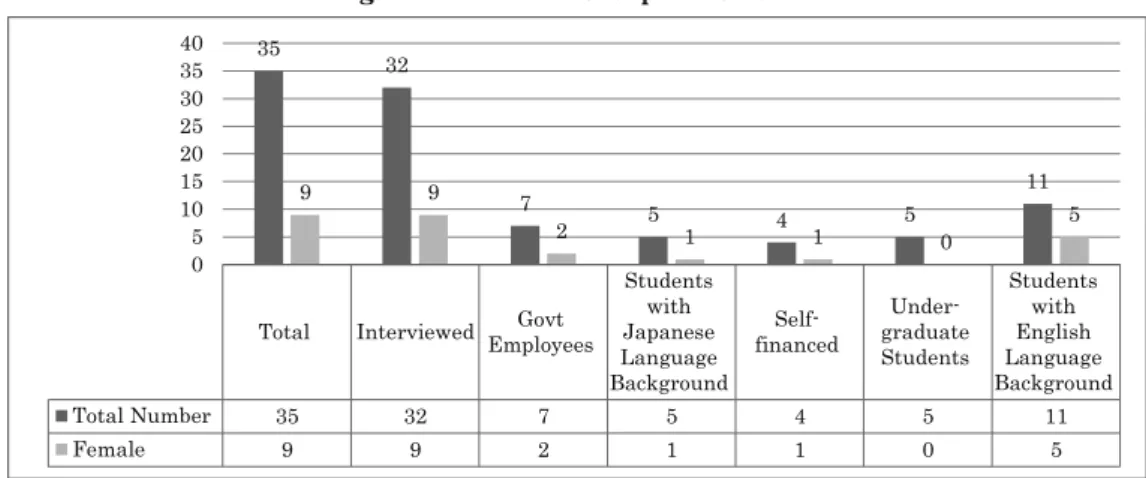
In terms of scholarship, majority of students received MEXT12 ( Ministry of Education, Culture, Sports, Science and Technology Japan) or JDS13 (Project of Human Resource Development by Japanese Grant Aid) scholarships. There were different groups of students who were in undergraduate studies, language-learning programs, first-year Master of Arts, second-year Master of Arts and three-year doctoral programs. The diverse group of students (Figure 1) came from different perspectives, as those masters and doctoral students were from Tajikistan’s pre-independence generation, and the undergraduate and some language students were post- independence students.
11 The different parts of Tajikistan place different emphasis on and have different perspectives of the importance of education. The different parts also have different cultural values, language and geographical condition.
12 Ministry of Education, Culture, Sports, Science and Technology Japan (文 部 科 学 省 Monbu kagaku shō) offers scholarships to international students.
13 JDS, or the Project of Human Resource Development by Japanese Grant Aid, was established in Tajikistan by the Government of Japan in 2008. It is funded through official development assistance (ODA) supported by Japanese taxpayers. The program targets young government officials and provides two-year Master’s courses in Japan and from 2017, it also provides one scholarship for doctoral students.
Figure 1. Different Groups of Students
The ethical issues of consent, oral, written form, confidentiality and anonymity are central aspects of this paper, therefore before the interviews, the researcher obtained informed consent from all research participants.
In order to maintain the anonymity of the participants, the researcher refers to them as participant SO, NP and so on, according to the letters used in their surnames.
4. Brief Context of Higher Education in Tajikistan: Change and Continuity
Tajikistan youth comprise 35% of the population (ADB, 2015) and people aged 14 to 30 comprised 2.851 million out of 8.351 million people in 2014 (Statistical Yearbook, 2015). The majority of youth live in rural areas and strive to get out of the complexities and difficulties that are created by geographical locations. It should be emphasized that the rural minds are different from previous years as they are connected and influenced by new physical (tourists, organizations, visitors) and virtual/technological information channels. Virtual and physical connectivity have influenced the world view, thinking and mobility of people in regard to future opportunities and notions of quality of life.
Immediately following the fall of the Soviet Union in 1991, the centralized education system collapsed in the former Soviet republics and state funding was reduced for higher education, particularly in Tajikistan. The higher education system in Tajikistan is still shaped by its Soviet heritage. Universities follow the same patterns as the most universities in other post-Soviet countries. One simple example could be “students cannot take classes outside their departments and are destined to graduate in a pre-determined field of study” (Froumin
& Malinovsky, 2015, p.12). Although the education system today does not closely follow the former Soviet centralized system, the traces of that ideology remain.
Schooling generally starts from age 7, however some private school preparatory groups start from age 6, and compulsory education continues until grade 9. Those who wish to continue their education in higher education should finish secondary education (Grades 10 and 11), a system which has continued since the Soviet period.
Statistics show that in 1990-91, around 80% of students progressed to secondary education, but in 2011- 12, around 52% advanced to secondary education, which also indicates the decline of qualified people in the workforce, although job creation remains a major issue in Tajikistan (ADB, 2015).
Recent online news also indicated that from one small region of Tajikistan, as many as 4,700 students studied abroad and now the government administration emphasizes that they do not have a problem with the availability of qualified workers, noting that “some of our qualified students are working internationally
Total Interviewed Govt Employees
Students Japanesewith Language Background
Self- financed
Under- graduate Students
Students Englishwith Language Background
Total Number 35 32 7 5 4 5 11
Female 9 9 2 1 1 0 5
35 32
7 5 4 5
9 9 11
2 1 1 0 5
0 5 10 15 2025 30 35 40
which is the indicator of the quality of education in the region.”14 There is a paradox surrounding how the international community places emphasis on brain drain, but locals look at it as an achievement and result of the good quality of education that their students can work internationally.
Tajikistan primary school, secondary school and universities follow Russian structures that were inherited from the Soviet period. It has been emphasize that some countries gained political power but still remain academic colonies (Teichler, 1999, p.100). Although, Tajikistan remains dependent on the policies and relationships of Russia (Silova, 2011), at the same time it seeks to expand beyond its borders. Nevertheless, higher education reforms in the newly independent countries affected their geopolitical configurations (Silova, 2011). Looking through an educational lens, Tajikistan is trying to maintain the Russian-derived structure of its educational system and at the same time include additional aspects based upon Western educational systems.
Local universities in Tajikistan do not have autonomy to address their problems and do not offer or prepare capable researchers to do quality research domestically. The increased number of universities from 13 in 1991 to 38 in 2015-16 in Tajikistan are not indicative of the quality of education (Tajikistan Statistics Agency, 2016), but is simply indicative of the increased number of buildings, which have tripled since 1991. What is significant regarding the increase of universities is that it has led to an increase of new academic disciplines in the country.
However, the question remains as to whether new disciplines and faculties have qualified personnel, a topic which is beyond the scope of this current research.
Table 2. Yearly Statistics of Higher Education Institutions and Students in Tajikistan
Item/Year 1991-92 1997-98 2003-04 2009-10 2015-16
Number of institutions 13 25 35 36 38
Number of students 69,300 76,700 107,600 157,800 176,500
Population increase - - - 7,622,000 8,352,000
Source: Tajikistan Statistics Agency, Education in the Republic of Tajikistan: 25 Years of Independence (2016, pp.90-98).
The increase in the number of universities also has led to an increase in the number of the students, but at the same time, the increase in the population should not be forgotten as well. It could be said that more people are attending higher education, simply because of the increase in the population.
Importantly, the allocation of budget to higher education increased to 16.0 percent in 2015, compared to 6.4.
percent in 2007 (Tajikistan Statistics Agency, 2016, p. 9.). Compared to other Central Asian countries, the budget remains low, although within the country comparatively the amount is increasing.
(1) An Institutional Effect on Students Motivation
Why and how Tajikistan students move beyond local boundaries is also dependent on particular institutional structures, behaviors of authority and diplomatic relations15 between Tajikistan and other countries. There is a clear connection or bridge between individual action and institutional structures,16 as “individual actions take place in, and are created by social structures, and social structures are created by individual and collective actions” (Kupfer, 2015, p.30). In the absence of quality education in public schools, some individuals decided to establish their own private schools which provide relatively better education by hiring better qualified teachers
14 Radioi Ozodi (Radio Free Tajikistan), Interview given by Eraj Djonmirzoev, Chief Educational Officer (CEO) in GBAO, Tajikistan.
15 Globalization and internationalization does not mean that everyone is open to apply wherever they wish but there are always check-points. One of those checkpoints is nationality and diplomatic relations. The applications clearly state that “applicants must hold the citizenship of a country that has diplomatic relations with Japan.”
16 Institutional structure creates a space for students to exercise their mobility choices.
in the context of Tajikistan. This has occurred in response to the collapse of overarching structural factors, such as political and economic of the former Soviet Union, as well as national and regional institutions. The schools were not only targeted to help communities, but also the school owners themselves. Significantly, the private schools have achieved far better results than public schools. Such private schools exist in very special areas such as population and city centers which attract students from far and near. A few such schools are the Russian-Tajik Lyceum-Boarding School of Hotam and P.V. in Dushanbe, Azizov College in Isfara, Abdurahmoni Jomi a Lytceum-Boarding School in Kuibeshev, the Aga Khan Lycee in Khorog, Turkish Lyceums and International School. These schools are salient to this article17 in that they are becoming significant facilitators of student mobility through their quality education and qualified teachers.
The aforementioned schools have been successful in developing highly skilled individuals (grade 9 to 11) who take part in national and international educational Olympiads, where almost every year, students receive distinctive positions. In 2017, in competition with students from 10 other countries, four Tajikistani students received gold medals, of which three students were from Hotam and P.V. in the field of natural science (mathematics, physics, biology and chemistry).18 These experiences also have become significant events and motivating factors in the mobility decision of the students, as it was indicated by one interviewee that:
“I took part in one international Olympiad and I realized that I am equal to other students. Why not? I can study in the best prestigious universities the same as other international students” (MD, 2016).
What this shows is that the institutions provide the parameter of possibilities and the educational institutions and individuals can shape and re-shape each other (Reay et al., 2010).
However, it should be emphasized that the educational expansion of Tajikistan remains unclear. Government of Tajikistan provides certain amount of scholarship for students (Wilmoth, 2011) to study internationally and at the same time signed the contract with some countries such as Japan to encourage Tajikistani students to study abroad. It is uncertain why Tajikistan encourages students to study abroad, as it does not encourage students to return, or those who return are not adequately supported or motivated to work in different sectors.
Even if the government encourages students to come back, there is no clear support system that provides job opportunities for educated young scholars. Although, Tajikistan wants to expand its connections and boundaries, it still keeps hold of its national language and is very slowly moving to incorporate other languages such as English or Japanese in its educational system. The next paragraph will discuss the aims of building new relations and expanding educational borders.
(2) Expanding Opportunities Globally: Looking at Tajikistan and Japan’s Relations
After the collapse of the Soviet Union, the major power of the West and the East such as the United States, Britain, China and Japan were interested in (re)-defining their relationships with newly intendent countries in central Asia (Dadabaev, 2014; Rakhimov, 2014; DeDanieli, 2013; Linn, 2012). At the same time, Central Asian countries also were interested to expand their borders (Linn, 2012).
Tajikistan was a country that faced civil war and was ready to expand diplomatic relations with almost any developed country. Japan was important for several reasons because of its technological advancement and preservation of its cultural values (Dadabaev, 2013). Its emphasis on contributing to general and human
17 A great number of Presidential Schools are emerging in different regions of the country which provide students with comparatively better education and places to stay. Aga Khan Lycee, Turkish Lyceums and International school are considered to be the best schools that prepare competitive students locally and globally.
18 ASIA-Plus, Tajikistan Students Received Gold Medal in International Olympiad in India (Tadjikskie Shkolniki Poluchili Zolotie Medali Mejdunarodnoi Olimpiadi v Indii). Accessed May 30, 2017. url: https://news.tj/ru/news/
tajikistan/society/20170530/tadzhikskie-shkolniki-poluchili-zolotie-medali-mezhdunarodnoi-olimpiadi-v-indii.
resource development was also significant. In signing bilateral agreements and acknowledging the sovereignty of Tajikistan, in December 1991, Japan International Cooperation Agency (JICA) started its mandate as a capacity-building cooperative agency. The organization provides assistance in peace building, rebuilding collapsed economies and structures and contributing to development of human resources (JICA Tsukuba profile, 2015). In 1993, JICA has offered 21 opportunities for Tajikistani citizens to study in Japan. Since 1993 to 2015 around 1500 individuals received trainings in Japan (ASIA-Plus, 2017). Through these new approaches to human development and other projects, Japan has extended its links with Central Asian countries.
Although Central Asian countries and Japan have signed bilateral agreements, Japan still has a “lack of clearly defined goals for regional engagement”(Dadabaev, 2013, p.511). The statistics also does not show clear explanation of why there are big difference in the number of Central Asian students (on an individual-country level) who study in Japan. For example, the number of Tajikistani participants remains lower than those from Kazakhstan, Kirgizstan or Uzbekistan).19
For some Tajikistani students, Japan’s education system is seen to be as advanced as the West but concurrently unique in inculcating Asian cultural values. But the attraction of international students is not as much about Western or Eastern education systems as it is about opportunities and recruitment policies. The international dimension of higher education is becoming the main priority of many countries such as Japan to attract international students20 and to open up the country to the global knowledge society and economy (Ninomiya et al., 2009). Bilateral cooperation in area of education is part of the building capacity of youth and government officials, and simultaneously expanding its soft power through internationalization of education.
Through greater internationalization of education, Japan wants to become a gateway between Asian countries and the rest of the world (Ninomiya et al., 2009).
Students do not look at major and minor powers, they look for opportunities. Structural factors also influence students’ choices, as mentioned previously, 35 percent of the Tajikistani population is composed of young people. At the same time, the aging population in Japan has also created a need for workers from overseas.
The policies of Japan in terms of part-time labor migration seem to suggest that human recourse development is part of attracting highly skilled labor migrants (Liu-Farrer, 2011). Student mobility is also a way to attract highly skilled labor migrants (Liu-Farrer, 2011). Japan remains in the list of the top 10 countries that have high levels of international student enrolment (OECD, 2011).
Japan’s goal is the internationalization of its education system and becoming a hub among the Asian countries, in order to maintain its global competitiveness, political and economic power (Yonezawa & Shimmi, 2015). This is also important to recognize when considering the diplomatic relations between Japan and Tajikistan (Yonezawa & Shimmi, 2015; Yonezawa, 2009). There is a paradox within the educational mobility of students in Tajikistan as well as Japan. In most host countries, especially those which are non-English speaking countries, students struggle in two arenas “between national system… and international” visibility (Teichler, 1999, p.105). To provide more detail about the complexity of interests, the next section focuses on international programs and institutions that also have an impact on both mobility decisions and experiences of students in particular situations.
(3) International Structures as a Motivating Factor
The support and encouragement of some international organizations play key roles in international education. This research will mainly focus on institutions and programs that have direct ties to Japan and Tajikistan. Institutions such as JICA and JDS (both are Japanese projects) play great roles in encouraging and spreading Japanese soft power in most developed countries, including Tajikistan, albeit to a very limited group
19 http://www.immi-moj.go.jp/toukei/index.html. Access date: January 15, 2018.
20 Japan Prime Minister in 2007 announced to attract 300,000 students by 2020.
of people.21 Although the capital of Tajikistan is the country’s major economic center, as previously discussed (see section 1), almost 72% of the population lives in rural areas scattered throughout the country. The limited group of people who have access to JICA and JDS projects use the opportunity to either work as employees or take Japanese language training.
In addition to JDS and JICA, there are different programs that provide courses in developing English language proficiency. One such program mentioned by a research participant is the AKHP (Aga Khan Humanities Project)22 not only focuses on developing English language skills but on philosophy and humanity that develop critical thinking skills and change individual perceptions (FH, 2016). The AKHP program possibly could be the only project that develops students’ academic critical writing skills in the context of Tajikistan.
The JDS project, which focuses on the “Project for Human Resource Development Scholarship,” also has operated in Tajikistan since 2008. In July 26, 2016 the ambassador of Japan to Tajikistan and the Ministry of Foreign Affairs of Japan exchanged notes on increasing the quota for Tajikistani students in Japan from 2017 onwards (Asia-Plus, 2016), however compared to other Central Asian countries,23 the number of young Tajikistani nationals studying in Japan remains very low. Above sections (see section 1, 2, and 3) show that the structures prepare and motivate students back home toward taking new steps to move beyond local and national boundaries.
5. Findings: The Role of Culture, Institutions and Individuals
Two key themes can be derived from this study: The first is cultural factors, and the second is structural factors. These themes appear to be the main motivating factors for students which encourage them to study and continue their stay in a different country. Both exist within local borders and these factors prepare individuals to take further steps towards international arenas. This section will discuss the notion of cultural factors and the new concept of kase shudan or “to become master of oneself” which is becoming a motivating factor for students in local areas (Sodatsayrova and Waljee, 2017). The following section will discuss these structures by referring to the experiences of students.
Educational mobility is not an immediate irrational decision but is connected to economic, social, religious and cultural aspects of life. The economic part has already been highlighted in this paper (see section 1), but here the focus is to see how culture can impact the decisions of the students. In addition to economic factors, a further emphasis can be found in the cultural aspects that have an impact on individual decisions in specific local contexts. When it comes to educational mobility, the notion of mobility expands beyond economic situations. Student mobility is not only about the availability of scholarships, as there are always students who move in search for connections within new places and culture. Students coming to Japan have indicated that they find the Japanese culture to be respectful of people, wherein respect for older people and humbleness is similar to the Tajikistani culture. What is significant is that a majority of students mentioned in the interviews that “Japanese people are not Muslim but they act according to the Islamic values that are required from Muslims.” For example:
21 The programs are located in the capital city of Tajikistan and as it was mentioned almost 72% of the population lives in the rural areas. Therefore, the program remains limited to some group of people in the specific area.
22 The University of Central Asia’s Aga Khan Humanities Project (AKHP) “cultivates and develops critical thinking and academic writing skills through providing multidisciplinary courses and program.” Accessed March 10, 2017.
url: http://www.ucentralasia.org/Schools/HumanitiesProject.
23 Immigration bureau of Japan statistics, 2016 shows there are 158 individuals from Tajikistan, 1,986 Uzbekistan, 461 Kazakhstan, 445 Kyrgyzstan and Turkmenistan 55.
“The only thing is that they [Japanese people] do not pray but they [Japanese people] act according Islamic tenet that is required from Muslims [highlighted idea of honesty, punctuality, kindness]” (MD,2016).
Another mentioned that:
“My experience in Japan shaped me and it helps one to reflect not only on their personal development, it helps one to reflect on their role as a human being [again emphases is on values as human being]” (MF, 2017).
These responses suggest that the cultural values of Japanese people are becoming pull factors for encouraging international students to choose Japan as an educational destination. In addition, one student mentioned that:
“Europe changed me; I became too much open and confident, but Japan made me think before I take any action. It makes you humbler and more respective towards other human beings and nature” (SO 2017).
As noted earlier, student mobility is not only about push-pull factors or economic and political crises. The fieldwork data obtained by exploring the subject more deeply in this research suggests that individual decisions and motivations are influenced by culture, wherein kase shudan is a concept that is reflected and analyzed in the new circumstances. The new geographical space creates new personal space that allows for reflection and understanding of their own cultural concepts. The concept embodies both motivation and experience of the individuals that will be discussed below in more detail.
(1) Kase Shudan or Becoming Master of Self: Cultural and Self Motivating Factors
One understudied notion of cultural values in the local context of Tajikistan is the idea of becoming one’s own master (kase shudan or sohibi khud shudan). The phrase sohibi khud shudan, meaning to shape one’s own destiny, is considered to be a cultural value of personal obligation. At the same time, it is an internal process.
There are four features which constitute the notion of becoming a master of oneself. The elements below are not discrete; rather, they share the same and sometime overlapping ideas.
First of all, there are certain factors that define the notion of either empowering or discouraging to continue their inner search and obligation. The idea of a search and self-fulfillment appear to be embedded in the notion of kase shudan. The notion is that this is an obligation passed from generation to generation; a thinking and internal search which leads to self-fulfillment. Searching deeply to understand the root and foundation of the notion, the notion is not only cultural it takes source from people’s religious teaching, from Islamic24 values which is now embedded in their cultural life. It is a process, not a product, as dynamic and changes according to the time. Also, in terms of individuals it is a process that leads to becoming master of oneself. The search could be done differently by different people; through education and travel. The study also shows that the place is becoming important to reinforce the notion.
In some specific areas geographical conditions also play a big role in shaping the concept of kase shudan.
Students move out in order to become master of self. It is the new environment or location that can also impact the element of self. The environment could be school, home, specific programs or a new geographical location that becomes a springboard for the student on which to move towards self-realization.
24 There is very famous saying (hadith) of Prophet Muhammad “Search for knowledge even if it takes you as far as China” or “Seek for knowledge from the cradle to the grave” is very famous among people of the region that suggests person to be in constant search for knowledge no matter where it is.