as a Second Language (ESL) classroom in Japanese university
1. Introduction
Young students at universities wonʼt easily feel satisfied with traditional teacher-centered English classes any more. As a generation grown up with smartphones, they get used to receiving faster speed and new information.
Through teaching many English classes, the author found that university students nowadays tend to soon lose concentration or fall into a sleep with a teacher-centered teaching style. They may feel fed up with the things even they showed much interest in the last class. At the same time, teachers at university also complain about the low performance and motivation of students, if not all, in English studying. How to recharge students motivation and lead an active and efficient class has always been a great challenge for EFL (English as a Foreign Language) teachers.
Game activities recently are widely used for young English learners in elementary schools, because play is commonly regarded as children-level. Actually play occurs at any life stage. In psychology and ethology, play is a range of voluntary, intrinsically motivated activities normally associated with recreational pleasure and enjoyment (Garvey C, 1990). The author thinks that studying through playing could make a good approach to arouse students curiosity, help students keep up with the teacher, keep focused on the lesson and grasp English skills happily.
Aiming at solving the thorny problem of how to construct a happy and highly active, enriched and motivated ESL classroom, the author designed and developed an innovated quiz activity-based teaching strategy. In this study, the author systematically applied the approach to first-year university students ESL classes, analyze and evaluate its effect on various aspects of students English studying, such as improvement of
English skills, studying motivation, classroom atmosphere and so on, to seek for any qualitative changes in the classroom. This teaching methodology may also provide some hints to classrooms other than English.
2. Methodology
2.1 Participants
The participants in this study consisted of 166 first-year non-English-speaking students from 4 different classes at Ehime University, majoring in Teacher Education (Edu), Regional Resource Management (RRM), Materials Science and Engineering (Mat), and Civil and Environmental Engineering (Civil & Env). In the four classes, two are of social sciences and humanities background (Edu, RRM), and the other two are of engineering one (Mat, Civil &
Env). All the participants are nonselective students whose GTEC test scores ranging from as low as 82 to as high as 323 (average GTEC score was 201.5). The researcher of this study gave English speaking and communication skill lessons to all the participants twice a week in the first quarter in 2018 when GTEC test was conducted. The GETC scores (combining Listening and Reading) could basically reflect the fundamental English skill levels of the participants.
2.2 Construction of quiz activity-based teaching strategy As the name implies, quiz activities are compact activities full of quizzes, commonly following the sequence from easy ones to difficult ones. Students are asked to share their answers as fast as they can. Early and correct answerer can get participation bonus point as rewards. The system is similar to the quiz buzzer games, following the rule of first come, first served", expect for that students raise their hands in stead of using a buzzer.
Quiz activities were designed to meet the needs of
Wei Z
HOUEnglish Education Center, Institute for Education and Student Support, Ehime University
middle-level English learners, which cover a wide range of English-related abilities: 4 basic skills (speaking, listening, writing, reading), basic grammar, vocabulary, culture, and miscellaneous knowledge relating to English studying and English application. The author originally designed and developed some of the activities used in this research, adopted some others from free or openly published resources and modified them. Some of the quiz activities were air warm-up ones, some others were closely related to lesson content, and some were short and fun games for students to relax. According to their functions, quiz activities in this study can be divided into 4 types. They are summarized in Table 1 as below.
2.3 Unit Rationale and Design
The author designed three different teaching styles by changing the class proportion of quiz activities and implemented them in this study, with the aim to verify the novelty of quiz activity and investigate if there is any significant influence or effect of the quiz activity- based teaching approach on the English classroom of non-English majors, such as English studying extrinsic motivation or of English ability/skills improvement and so on. The three teaching styles are:
1. Regular lesson (abbreviated as regular): A 90-minute lesson was conducted with teacher-centered teaching and explanation, students practicing plus students task activity and presentation, etc. There was no quiz activity in the class.
2. 30% quiz activity-based teaching style (abbreviated as 30%): within 90-minute lesson, quiz activities and participation bonus point system were applied frequently at the beginning and throughout the class occupying around 30% of the teaching content in the class on the base of a regular lesson.
3. 50% quiz activity-based teaching style (abbreviated as 50%): within 90-minute lesson, quiz activities and participation bonus point system were applied frequently at the beginning and throughout the class occupying around 50% of the teaching content in the class on the base of a regular lesson.
2.4 Unit implementation
This study was implemented over four weeks in the English speaking course in the first quarter as stated in the Introduction, where the classes met 8 times. The form, content, scope, sequence and frequency of quiz activities conducted would flexibly vary slightly on the base of the major, English level, gender proportion or class atmosphere in each class, but basically all the classes from different department or schools will be taught and analyzed equally. Teacherʼs performance for all the classes is assumed to be same. Table 2 shows all the lesson plans and the research schedules of the 3 teaching styles with or without quiz activities that were applied in this study. 30% and 50% quiz activity lessons were conducted 3 times respectively, and regular lessons without quiz activity were conducted over the span of the 2 lessons. During the procedure of quiz activities, the researcher consciously tried to give equal chances to all the participants in the class to encourage positive participation from all.
Table 2. Class plans and schedule
Lesson plan Research schedule
Lesson 1 Orientation, Speaking Unit 1
Lesson 2 Speaking Unit 2 30% quiz activity Lesson 3 Speaking Unit 3 30% quiz activity Lesson 4 Speaking Unit 4 30% quiz activity Lesson 5 Speaking Unit 5 50% quiz activity
Lesson 6 GTEC Test
Lesson 7 Speaking Unit 6 50% quiz activity Lesson 8 Speaking Unit 7 50% quiz activity Lesson 9 Speaking Unit 8 Regular lesson Lesson 10 Speaking Unit 9 Regular lesson Lesson 11 Speaking Unit 10
Lesson 12 Speaking Unit 11 Lesson 13 Speaking Unit 12 Lesson 14 Review and Practice Lesson 15 Final Test
Table 1. Types and characteristics of quiz activities
Type Place Characteristics Function
1 Warm-up quiz activity Beginning of the lesson Friendly Warm-up
2 Topic background-related quiz activity Former part of the lesson Interesting Understanding 3 Topic-related quiz activity Middle part of the lesson Serious Learning
4 Relaxing quiz activity Anywhere Fun Relaxation
2.5 Data collection
Once the class was over, feedback survey sheets were handed out to the participants to write comment on their experiences in that lesson by answering the questions the researcher prepared. The survey was conducted anonymously to allow the participants to tell how they feel honestly. At the end of the research (the 8th class), the participants were asked to answer a questionnaire and score the 3 different teaching styles with five-point Likert scale respectively.
3. Results
The data of feedback from the participants were collected and statistically analyzed. The participants rated 30% quiz activity, 50% quiz activity, and regular lesson (0% quiz activity) teaching approaches respectively by scoring them 0 〜 5, from 6 different aspects for class evaluation. The scores were analyzed both separately according to different majors and as a whole. Data were shown in histogram charts that accurately represent of the distribution of the scores the participants made.
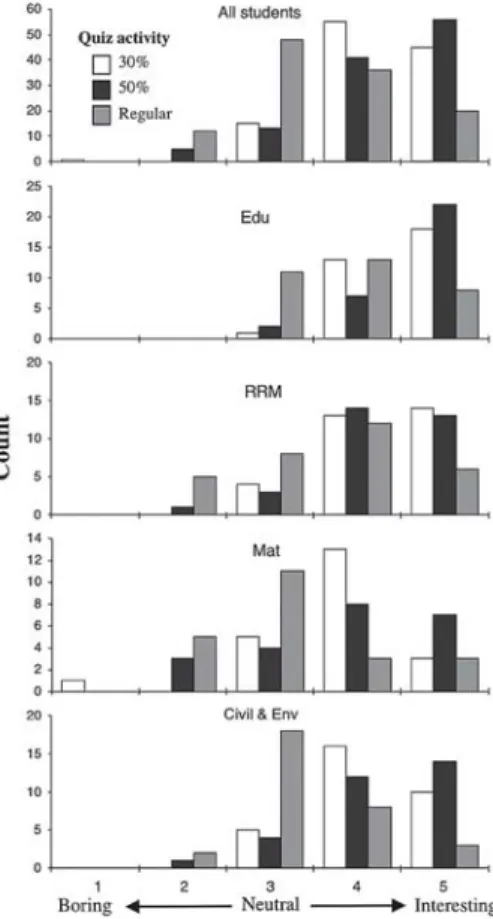
First, the data in Figure 1 demonstrates that when asked about the impression of the class as a whole, most
students from the 4 different departments gave highest score to 50% quiz activity teaching style, the next is 30%, and the last is regular lesson. Among the 4 classes, Civil & Env showed greatest reception to quiz activity and they prefer more activities. Edu students have similar tendency, and they gave high scores to both 50%
and 30% significantly compared to regular one. RRM students rated 50% most as 4 points, but still showed more interest in quiz activities than regular lessons. Mat students are the most neutral toward quiz activity, but the sum of scores tells that quiz activity is more popular than regular.
About changes in motivation, most students from the 4 classes said clearly in the feedback comments that their motivation has been promoted. As shown in Figure 2, Edu and Civil & Env students particularly showed improved motivation in 30% and 50% lessons compared to regular. RRM students showed constancy of motivation in all teaching styles, and Mat students gave jagged results.
Figure 4 and Figure 5 show if the students think quiz activities help improve their English skills. Most students felt that their English speaking ability increased through quiz activities except for RRM, who tend to prefer regular lessons. However, they donʼt expect much for
Fig 1. Overall Impression Fig 2. Motivation of English Studying
English improvement except for speaking, because the quiz activities applied in this research were basically developed for English speaking.
When asked about the atmosphere in the classroom, in their survey comments, most students showed great satisfaction with the “happy”, “active”, “approachable” and
“relaxing” air in 30% and 50% classes. Data in Figure 3 also absolutely demonstrates that.
The last aspect of the class evaluation is the likeability.
Most 30% and 50% drop in 4 points or 5 points while regular goes 3 points (Figure 6). Among the 4 classes, Edu and Civil & Env like quiz activity much more than RRM and Mat students. In the questionnaire, 90 students answered with great likeability of quiz activity (Yes, like a lot), 24 showed some likeability (Yes, like a little), and 2 gave negative answer (No).
Fig 3. Atmosphere in English Classroom
Fig 4. Improvement of English speaking
Fig 5. Improvement of English skills other than speaking
4. Discussion and conclusion
The results of this research proved the novelty of quiz activity-based teaching strategy. Different from the teacher-centered traditional exercises and student- centered task activities (Ellis R, 2003), quiz activities are short, light and fast-paced, which makes great interactions, both between teacher and students, and between students too. Compared to task activities, students have lower hurdle due to the insufficiency of their 2nd language skills and gaps of information or knowledge between each other commonly seen in task activity.
The psychological factors behind this strategy are play and competitive nature of young people. During the quiz activity, the participants think together, stimulate and inspire each other, teach, help and learn from each other. Quiz activities promote language acquisition and uptake of knowledge by raising learners awareness of the issues of both language and knowledge because the answers would be shared and explained soon.
Also, this research demonstrates that quiz activity- based teaching strategy could bring vigor and change the classroom into a skyrocketed motivated one (Fig.
2). Most students said that quiz activities promoted their motivation. As Deci and Flaste (1996) said that motivation comes from oneʼs within, teachers are still trying to explore new approaches to improve students extrinsic motivation. By observing the whole class and student performance when teaching in the classroom in this research, the author found that quiz activity could always realize 100% participation from the participants.
Not even one sleeping or absent-minded person was observed during the activities. The students joined activities actively, and showed much higher performance than regular lessons. The data from the feedback of the students in Edu and Civil & Env showed clear tendency that quiz activity-based teaching approach improved their English studying motivation. Interestingly, students of RRM gave good performance in classes both with and without quiz activity. They said in the comment that they “get used to the regular classes that are similar to the traditional lessons they took in high schools”, and they welcome both.
This research was conducted in an English speaking course and the quiz activities used in this research were mainly designed for English speaking. The students affirmed the positive role of quiz activity in their English speaking improvement, but doubted its effect on English ability other than speaking. More quiz activities will be designed and developed that are suitable for English 4 basic skills in future to investigate if quiz activities also work well in other English classes except for speaking.
In this research, two classes (Edu, RRM) were of social sciences and humanities background with the gender ratio of 1:1, and two (Mat, Civil & Env) were of engineering that have less female (Mat: male=19, female=2; Civil & Env: male=24, female=7). The collected data showed no remarkable inclination depending on social sciences background or engineering background as the author expected. Each class showed its characteristic and preference.
The quiz activity-based teaching strategy was established and verified in English lessons for non-English speaking students. Further effort will be taken to improve and refine this strategy for English learning including speaking, and more research is needed to investigate its effect on classrooms.
Fig 6. Likability of quiz activity-based teaching strategy
References
Deci, E. L. and Flaste R. (1996) Why we do what we do:
Understanding self-motivation. New York: Penguin.
Ellis, R. (2003). Task-based language learning and teaching.
Oxford: Oxford University.
Garvey, C. (1990) Play. Cambridge, Massachusetts: Harvard University Press.
Appendix
Some picked comments from the participants about quiz activity teaching strategy that were collected through paper-based questionnaire or web feedback at the end of the 30% teaching styles, 50% teaching styles and the whole course.
会話表現が多く学べたこと。Activity が増えて良かった。
意欲的に取り組めた。主体的に取り組む活動が増えた。
瞬時に考える力が身についた。
ペアワークが増えた。
考える時間が多くなった。
英語で話すことが多くなった。
眠気が吹っ飛ぶこと。
英語に対する意識がポジティブな方向に変わることがで きました。
先生の気持ちが伝わってきてほんとにやる気が出てがん ばれました!
“You made it fun for us to study English. I looked forward to your classes every time and came to like speaking English.”
“Your classes were always exciting, and we students could practice speaking a lot.”
“I knew the fun of speaking English from your class.”
“I learned happiness of English speaking in this class.”
“That was a very fun class. I came to like English more than before!!”
“I was looking forward to your class every week. I'm glad that I UHFHLYHG\RXUHQMR\DEOHDQGSUR¿WDEOHFODVV´
“Your English class was the most exciting course in this university!!”
“Your class was very interesting. I want take more your class.”
“You made me like English.”