アルゴリズム論
Theory of Algorithms アルゴリズム論
Theory of Algorithms
第8回講義 動的計画法
(1)
アルゴリズム論
Theory of Algorithms アルゴリズム論
Theory of Algorithms
Lecture #8
Dynamic Programming (1)
問題
P20: n
個の異なるものからk
個取り出す組合せの数C(n,k)
を 計算せよ.組合せの数の計算
公式によると,
C(n, k) = C(n-1, k-1) + C(n-1, k), 0<k<n
のとき,C(n, 0) = C(n, n) = 1,
であるから,直ちに次のプログラムを得る.
int C(int n, int k){
if(k==0 || k==n) return 1;
return C(n-1, k-1) + C(n-1, k);
}
左のプログラムを実際に実行して みると,かなり時間がかかることが わかる.
時間がかかる原因は?
計算時間の解析:
C(n,k)
を計算するのに要する時間をT(n,k)
とすると,が成り立つ.よって,
( )
k k
n n ne
k k k
⎛ ⎞ ≤ ≤ ⎛ ⎞
⎜ ⎟ ⎜ ⎟
⎝ ⎠ ⎝ ⎠
Problem P20: Calculate the number C(n, k) of combinations to choose k items from n different items.
Number of combinations
Using the formula,
C(n, k) = C(n-1, k-1) + C(n-1, k), if 0<k<n
,C(n, 0) = C(n, n) = 1.
Therefore, we have the following program.
int C(int n, int k){
if(k==0 || k==n) return 1;
return C(n-1, k-1) + C(n-1, k);
}
When you implement the program in practice, you will find that it takes much time. Why does it take time?
Analysis of computation time
:Let T(n,k) be time to compute C(n,k). Then, we have
プログラムの動作を調べてみよう!
C(5,3)
C(4,2) C(4,3)
C(3,1) C(3,2) C(3,2) C(3,3)
C(2,0) C(2,1) C(2,1) C(2,2) C(2,1) C(2,2)
C(1,0) C(1,1) C(1,0) C(1,1)
関数の呼び出しの様子
同じ値に対して関数が何度も呼び出されている.
例:
C(3,2)
は2回呼び出されているÎ
無駄初めて
(n,k)
の組についてC(n,k)
の値を計算するとき,そのC(1,0) C(1,1)
Let's analyze behavior of the program!
How is the function called
The function is called many times for the same value.
Example
:C(3,2) is called twice.Îredundant
If we store the value C(n,k) as the (n,k) element of an array C(5,3)
C(4,2) C(4,3)
C(3,1) C(3,2) C(3,2) C(3,3)
C(2,0) C(2,1) C(2,1) C(2,2) C(2,1) C(2,2)
C(1,0) C(1,1) C(1,0) C(1,1) C(1,0) C(1,1)
C(n,k)
の表を埋めよう!公式:
C(n,k) = C(n-1,k-1) + C(n-1,k)
n-1
行目の値が分かっていれば,簡単にC(n,k)
が計算可能Î
よって,1
行目から順に埋めていけばよい.5 4 3
1 2 1 2
1 1 1
1 0
5 4 3 2 1 0
5 4
1 3 3 1 3
1 2 1 2
1 1 1
1 0
5 4 3 2 1 0
5
1 4 6 4 1 4
1 3 3 1 3
1 2 1 2
1 1 1
1 0
5 4 3 2 1 0
1 5 10 10 5 1 5
1 4 6 4 1 4
1 3 3 1 3
1 2 1 2
1 1 1
1 0
5 4 3 2 1 0
C(n-1,k-1) C(n-1,k)
表の各要素は定数時間で 計算可能.
よって,全体の計算時間は
Fill in the table C(n,k)!
Formula
:C(n,k) = C(n-1,k-1) + C(n-1,k)
If the values in the (n-1)-st row are available, C(n,k) is easily computed. ÎThus, we should fill in the table from the 1st row.
5 4 3
1 2 1 2
1 1 1
1 0
5 4 3 2 1 0
5 4
1 3 3 1 3
1 2 1 2
1 1 1
1 0
5 4 3 2 1 0
5
1 4 6 4 1 4
1 3 3 1 3
1 2 1 2
1 1 1
1 0
5 4 3 2 1 0
1 5 10 10 5 1 5
1 4 6 4 1 4
1 3 3 1 3
1 2 1 2
1 1 1
1 0
5 4 3 2 1 0
C(n-1,k-1) C(n-1,k)
Each element of the table can be computed in constant time.
Thus, the total time is
C言語のプログラムは下の通り:
int C(int n, int k){
C[0][0]=1;
for(i=1; i<=n; i++){
C[i][0]=1; C[[i][i]=1;
for(j=1; j<i; j++)
C[i][j] = C[i-1][j-1] + C[i-1][j];
}
return C[n][k];
}
C(n,k) = n!
であることを用いると,O(n)
時間で計算可能.(n-k)! k!
素朴な方法2:
ただし,この方法では整数のオーバーフローに注意.
演習問題
E8-1
:素朴な方 法2
で、C(n,k)
がオーバー フローしないならば途中で もオーバーフローしないよ うな計算方法を考えてみよ。C program is as follows
:int C(int n, int k){
C[0][0]=1;
for(i=1; i<=n; i++){
C[i][0]=1; C[[i][i]=1;
for(j=1; j<i; j++)
C[i][j] = C[i-1][j-1] + C[i-1][j];
}
return C[n][k];
}
Using the formula C(n,k) = n!
,it can be computed in O(n).
(n-k)! k!
Naive Algorithm 2
:Here, note that this algorithm may suffer from numerical overflow.
Exercise E8-1
:Consider
an algorithm that computes
C(n,k) based on the Naïve
idea such that it computes
C(n,k) correctly if C(n,k)
itself does not overflow.
フィボナッチ数の計算
問題
P21:
次式で定義されるフィボナッチ数F(n)
を求めよ.F(n) = F(n-1) + F(n-2), n>1
のとき,F(0) = F(1) = 1.
演習問題
E8-2
:問題P20
と同様の議論を展開せよ.フィボナッチ数
F(n)
は,黄金比φ
を用いて,F(n) = O(φ n )
と表すことができる.
φ=(1+
√5)/2
≒1.61803
フィボナッチ数:1, 1, 2, 3, 5, 8, 13, 21, 34, 55, 89, 144, 233, ...
Computation of Fibonacci number
Problem P21: Compute the Fibonacci number F(n) defined by F(n) = F(n-1) + F(n-2), if n>1
,F(0) = F(1) = 1.
Exercise E8-2
:Have an argument similar to that in Problem P20
.Using the golden ration φ, the Fibonacci number F(n) can be
represented as F(n) = O(φ n )
where φ=(1+
√5)/2
≒1.61803.
Fibonacci number
:1, 1, 2, 3, 5, 8, 13, 21, 34, 55, 89, 144, 233, ...
最長共通部分文字列
問題
P22:
長さn
とm
の2つの文字列A
とB
が与えられたとき,両方 の文字列に共通する部分文字列で最長のものを求めよ.例:
A = G A A T T C A G T T A , B= G G A T C G A
のとき,GATCA
は共通部分文字列である.A= GAATTC AGTTA B=GGA T CGA
文字列
A
の任意の部分文字列A’
が文字列B
の部分文字列か どうかは,A’
の文字が文字列B
において同じ順に出現するか どうかを調べればよい.Î
線形時間で判定可能演習問題
E8-3
:2つの文字列を入力して,最初の文字列が2番目の文字列の部分文字列になっているかどうかを線形時間で 判定するプログラムを書け.
Longest Common Subsequence
Problem P22: Given two strings A and B of lengths n and m, find the longest substring common to both of them.
Example
:For A = G A A T T C A G T T A and B= G G A T C G A, the longest common substring is GATCA
.A= GAATTC AGTTA B=GGA T CGA
Any substring A' of A is a substring of B if characters of A' appear in the same order in the string B.
ÎIt can be determined in linear time.
Exercise E8-3
:Write a program to determine whether the first
string of two input strings is a substring of the second string in
linear time.
アルゴリズム
P22-A0:
(腕力法)文字列
A
のすべての部分文字列A’
について,A’
が文字列B
の 部分文字列になっているかどうかを確かめ,最も長い共通文字 列を最後に出力する.計算時間の解析:
・長さ
n
の文字列の部分文字列は全部で2 n
通りある.・この文字列が文字列
B
より長いときは,明らかに文字列B
の部分文字列ではない.・そうでないとき,それぞれに
O(m)
の時間がかかる.・よって,全体の計算時間は,
O(2 n m)
時間となる.高速化は可能か?
多項式時間のアルゴリズムは存在するか?
Algorithm P22-A0:
(Brute-Force Algorithm
)For each substring A' of a string A, determine whether A' is a substring of a string B, and finally output the longest common substring.
Analysis of computation time
:・
There are 2 n different substrings of a string of length n
.・
If this substring is longer than the string B, obviously it is not a substring of B.
・
Otherwise, each test takes O(m) time.
・
Thus, the total time is O(2 n m) time.
Is it possible to have faster algorithm?
Is there any polynomial-time algorithm?
アルゴリズム
P22-A1:
A= a 1 a 2 ...a n , B= b 1 b 2 ... b m
L[i,j] = a 1 a 2 ...a i
とb 1 b 2 ... b j
の最長共通部分文字列の長さ 観察:(0) i=0
またはj=0
のとき,L[i,j]=0.
(1) a i
=b j Æ L[i,j] = L[i-1,j-1]+1
(2) a i
≠b j Æ L[i,j] = max{ L[i,j-1], L[i-1, j]}
A=GAATTC AGTTA B= GGATC GA
a i
=b j
のときA=GAATTC AGTTA B=GGATCG A
a i
≠b j
のときしたがって,今度も表
L[i,j]
を順に埋めていけばよい!表のサイズは
n*m
だから,計算時間もO(nm)
時間.Algorithm P22-A1:
A= a 1 a 2 ...a n , B= b 1 b 2 ... b m
L[i,j] = the length of the longest substring common to a 1 a 2 ...a i and b 1 b 2 ... b j
Observation
:(0) if i=0 or j=0
,L[i,j]=0.
(1) a i
=b j Æ L[i,j] = L[i-1,j-1]+1
(2) a i
≠b j Æ L[i,j] = max{ L[i,j-1], L[i-1, j]}
A=GAATTC AGTTA B= GGATC GA
when a i
=b j
A=GAATTC AGTTA B=GGATCG A
when a i
≠b j
Therefore, it suffices to fill in the table L[i,j] in order.
アルゴリズム
P22-A1:
for(i=0; i<=n; i++) L[i][0]=0;
for(j=0; j<=m; j++) L[0][ j] = 0;
for(i=1; i<=n; i++) for(j=1; j<=m; j++)
if( a[i] == b[j]) L[i][j] = L[i-1][j-1]+1;
else L[i][j] = max{ L[i][j-1], L[i-1][j] };
return L[n][m];
5 5
5 5 4 4 3 3 3 2 2 1 0 7
5 5
5 4 4 4 3 2 2 2 2 1 0 6
5 4
4 4 4 3 3 2 2 2 1 1 0 5
4 4
4 4 4 3 2 2 2 1 1 0 0 4
3 3
3 3 3 3 2 2 2 1 1 0 0 3
2 2
2 2 2 2 2 2 2 1 1 0 0 2
1 1
1 1 1 1 1 1 1 1 1 0 0 1
0 0
0 0 0 0 0 0 0 0 0 0 0 0
12 11
10 9 8 7 6 5 4 3 2 1 0
A=XYXXZXYZXY, B=ZXZYYZXXYXXZ
のときの動作例A= X Y XXZXYZXY,
Algorithm P22-A1:
for(i=0; i<=n; i++) L[i][0]=0;
for(j=0; j<=m; j++) L[0][ j] = 0;
for(i=1; i<=n; i++) for(j=1; j<=m; j++)
if( a[i] == b[j]) L[i][j] = L[i-1][j-1]+1;
else L[i][j] = max{ L[i][j-1], L[i-1][j] };
return L[n][m];
5 5
5 5 4 4 3 3 3 2 2 1 0 7
5 5
5 4 4 4 3 2 2 2 2 1 0 6
5 4
4 4 4 3 3 2 2 2 1 1 0 5
4 4
4 4 4 3 2 2 2 1 1 0 0 4
3 3
3 3 3 3 2 2 2 1 1 0 0 3
2 2
2 2 2 2 2 2 2 1 1 0 0 2
1 1
1 1 1 1 1 1 1 1 1 0 0 1
0 0
0 0 0 0 0 0 0 0 0 0 0 0
12 11
10 9 8 7 6 5 4 3 2 1 0
Example for the case
A=XYXXZXYZXY and
B=ZXZYYZXXYXXZ
最適解の構成
最適解の値は表を埋めることにより求められるが,その値を 達成する最適解はどのように構成すればよいか?
最長共通部分文字列の問題では最長の共通部分文字列の 長さ(最適解の値)だけでなく,文字列そのもの(最適解)も 求めたい.
(1) a i
=b j Æ L[i,j] = L[i-1,j-1]+1 (i-1, j-1)
を記憶(2) a i
≠b j Æ L[i,j] = max{ L[i,j-1], L[i-1, j]}
L[i,j-1]>L[i-1,j]
のとき,(i, j-1)
を記憶,表を埋めるとき,
L[i][j]
の値が同じ表のどの値によって決まった かを記録する:Construction of an optimal solution
The value of an optimal solution is obtained by filling in the table.
How can we construct an optimal solution achieving the value?
In the problem of finding the longest common substring, we want to find not only the length (value of an optimal solution) but also the longest such substring (optimal solution) itself.
(1) a i
=b j Æ L[i,j] = L[i-1,j-1]+1 (i-1, j-1) is memorized
(2) a i
≠b j Æ L[i,j] = max{ L[i,j-1], L[i-1, j]}
if L[i,j-1]>L[i-1,j] then (i, j-1) is memorized
,and
When we fill in the table, we memorize which table element
determined L[i][j].
for(i=1; i<n; i++) for(j=1; j<m; j++){
if( A[i] == B[j] ){
L[i][j] = L[i-1][j-1] + 1;
B1[i][j] = i-1; B2[i][j] = j-1;
} else {
L[i][j] = max2(L[i][j-1], L[i-1][j]);
if( L[i][j-1] > L[i-1][j] ){
L[i][j] = L[i][j-1];
B1[i][j] = B1[i][j-1]; B2[i][j] = B2[i][j-1];
} else {
L[i][j] = L[i-1][j];
B1[i][j] = B1[i-1][j]; B2[i][j] = B2[i-1][j];
} } }
具体的なプログラム
演習問題
E8-4
:実際にプログラムを作って動作をfor(i=1; i<n; i++) for(j=1; j<m; j++){
if( A[i] == B[j] ){
L[i][j] = L[i-1][j-1] + 1;
B1[i][j] = i-1; B2[i][j] = j-1;
} else {
L[i][j] = max2(L[i][j-1], L[i-1][j]);
if( L[i][j-1] > L[i-1][j] ){
L[i][j] = L[i][j-1];
B1[i][j] = B1[i][j-1]; B2[i][j] = B2[i][j-1];
} else {
L[i][j] = L[i-1][j];
B1[i][j] = B1[i-1][j]; B2[i][j] = B2[i-1][j];
} } }
Concrete program
Exercise E8-4
:Write a program in practice to see
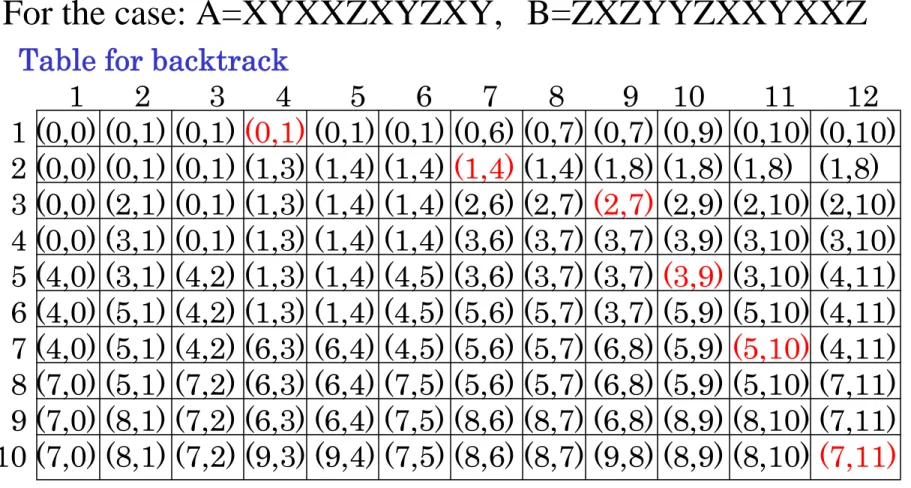
バックトラック用の表
1 2 3 4 5 6 7 8 9 10 11 12 1 (0,0) (0,1) (0,1) (0,1) (0,1) (0,1) (0,6) (0,7) (0,7) (0,9) (0,10) (0,10) 2 (0,0) (0,1) (0,1) (1,3) (1,4) (1,4) (1,4) (1,4) (1,8) (1,8) (1,8) (1,8) 3 (0,0) (2,1) (0,1) (1,3) (1,4) (1,4) (2,6) (2,7) (2,7) (2,9) (2,10) (2,10) 4 (0,0) (3,1) (0,1) (1,3) (1,4) (1,4) (3,6) (3,7) (3,7) (3,9) (3,10) (3,10) 5 (4,0) (3,1) (4,2) (1,3) (1,4) (4,5) (3,6) (3,7) (3,7) (3,9) (3,10) (4,11) 6 (4,0) (5,1) (4,2) (1,3) (1,4) (4,5) (5,6) (5,7) (3,7) (5,9) (5,10) (4,11) 7 (4,0) (5,1) (4,2) (6,3) (6,4) (4,5) (5,6) (5,7) (6,8) (5,9) (5,10) (4,11) 8 (7,0) (5,1) (7,2) (6,3) (6,4) (7,5) (5,6) (5,7) (6,8) (5,9) (5,10) (7,11) 9 (7,0) (8,1) (7,2) (6,3) (6,4) (7,5) (8,6) (8,7) (6,8) (8,9) (8,10) (7,11) 10 (7,0) (8,1) (7,2) (9,3) (9,4) (7,5) (8,6) (8,7) (9,8) (8,9) (8,10) (7,11)
A=XYXXZXYZXY, B=ZXZYYZXXYXXZ
の場合L[10][12]
から逆に辿るとL[10][12] ÆL[7][11]ÆL[5][10]ÆL[3][9]ÆL[2][7]ÆL[1][4]ÆL[0][1]
a[8]b[12] a[6]b[11] a[4]b[10] a[3]b[8] a[2]b[5] a[1]b[2]
ゆえに,最長共通部分文字列は
Table for backtrack
1 2 3 4 5 6 7 8 9 10 11 12 1 (0,0) (0,1) (0,1) (0,1) (0,1) (0,1) (0,6) (0,7) (0,7) (0,9) (0,10) (0,10) 2 (0,0) (0,1) (0,1) (1,3) (1,4) (1,4) (1,4) (1,4) (1,8) (1,8) (1,8) (1,8) 3 (0,0) (2,1) (0,1) (1,3) (1,4) (1,4) (2,6) (2,7) (2,7) (2,9) (2,10) (2,10) 4 (0,0) (3,1) (0,1) (1,3) (1,4) (1,4) (3,6) (3,7) (3,7) (3,9) (3,10) (3,10) 5 (4,0) (3,1) (4,2) (1,3) (1,4) (4,5) (3,6) (3,7) (3,7) (3,9) (3,10) (4,11) 6 (4,0) (5,1) (4,2) (1,3) (1,4) (4,5) (5,6) (5,7) (3,7) (5,9) (5,10) (4,11) 7 (4,0) (5,1) (4,2) (6,3) (6,4) (4,5) (5,6) (5,7) (6,8) (5,9) (5,10) (4,11) 8 (7,0) (5,1) (7,2) (6,3) (6,4) (7,5) (5,6) (5,7) (6,8) (5,9) (5,10) (7,11) 9 (7,0) (8,1) (7,2) (6,3) (6,4) (7,5) (8,6) (8,7) (6,8) (8,9) (8,10) (7,11) 10 (7,0) (8,1) (7,2) (9,3) (9,4) (7,5) (8,6) (8,7) (9,8) (8,9) (8,10) (7,11)
For the case: A=XYXXZXYZXY, B=ZXZYYZXXYXXZ
If we trace the table from L[10][12] in reverse order,
L[10][12] ÆL[7][11]ÆL[5][10]ÆL[3][9]ÆL[2][7]ÆL[1][4]ÆL[0][1]
a[8]b[12] a[6]b[11] a[4]b[10] a[3]b[8] a[2]b[5] a[1]b[2]
Thus, the longest common substring is
問題
P23:
(全点対間最短経路問題)重みつきのグラフが与えられたとき,全ての頂点対について それらの間の最短経路の長さを求めよ.
ダイクストラ法
入力:
n
個の頂点とm
本の辺からなる重みつきグラフ 出力:任意の1点から残りのすべての頂点への距離 計算時間:O(m + n log n)
時間,またはO(n 2 )
時間したがって,各頂点を始点としてダイクストラ法を適用すると,
計算時間は
O(nm + n 2 log n)
またはO(n 3 )
となる.辺の本数
m
はO(n 2 )
になるから,最悪の場合は,O(n 3 )
である.1 4
2 3
5 50
30 5
5 15 15
15 1 2 3 4
1 0 5
∞ ∞2 50 0 15 5 3 30
∞0 15 4 15
∞5 0 L=
距離行列
Problem P23:
(All-pairs shortest path problem
)Given a weighted graph, for every pair of vertices find the length of a shortest path between them.
Dijkstra's algorithm
Input
:Weighted graph consisting of n vertices and m edges Output
:Distances to all the vertices from one arbitrary vertex.
Computation time
:O(m + n log n) time, or O(n 2 ) time.
Hence, applying the Dijkstra's algorithm for each vertex, computation time is O(nm + n 2 log n) or O(n 3 ).
Since the number m of edges is O(n 2 )
,it takes O(n 3 ) in the worst
1 4
2 3
5 50
30 5
5 15 15
15 1 2 3 4
1 0 5
∞ ∞2 50 0 15 5 3 30
∞0 15 4 15
∞5 0
L= distance
matrix
最短経路の性質
v
: 頂点u
から頂点w
までの最短経路上の任意の頂点Î u
からv
までの部分経路と,v
からw
までの部分経路はそれぞれ,
u
からv
までと,v
からw
までの最短経路である.u v w
理由:
u
からv
までの部分経路が最短でなければ,この部分経路を最短経路で置きかえると,
u
からw
へのより短い経路が得られる.これは矛盾.Property of a shortest path
v
:Any vertex on a shortest path from vertex u to vertex w.
Î subpath from u to v and subpath from v to w are both shortest paths from u to v and from v to w, respectively.
u v w
Why: If the subpath from u to v is not shortest
,we can shorten the path from u to w by replacing its
subpath by the shorter one, which is a contradiction.
D k [i,j] =
集合{1,2,...,k}
に属する頂点だけを経由して頂点i
から 頂点j
に至る最短経路の長さケース1:最短経路が頂点
k
を経由しないÎ D k-1 [i,j]
と同じ ケース2:最短経路が頂点k
を経由するÎi
からk
までの最短経路+k
からj
までの最短経路D k [i,j] = min{ D k-1 [i,j], D k-1 [i,k] + D k-1 [k,j] }
ただし,
D 0 [i,j] = L[i,j]
(直接の距離=
辺の長さ)D 0 , D 1 , D 2 , ... , D n
の順に計算を行えばよい.アルゴリズム
P23-A0:
距離行列を
D0
とする.for(p=1; p<=n; p++)
すべての
(i,j)
についてD k [i,j] = the length of a shortest path from vertex i to vertex j only through the vertices in the set {1,2,...,k}.
Case 1
:if the shortest path does not pass through vertex k Î same as D k-1 [i,j]
Case 2: if the shortest path passes through vertex k Îshortest path from i to k
+that from k to j D k [i,j] = min{ D k-1 [i,j], D k-1 [i,k] + D k-1 [k,j] }
where
,D 0 [i,j] = L[i,j]
(direct distance=edge length
)D 0 , D 1 , D 2 , ... , D n should be computed in this order
.Algorithm P23-A0:
Let D0 be the distance matrix.
for(p=1; p<=n; p++)
for each (i,j)
1 4
2 3
5 50
30 5
5 15 15
15 1 2 3 4
1 0 5
∞ ∞2 50 0 15 5 3 30
∞0 15 4 15
∞5 0 D 0 =
距離行列
1 4
2 3
5 50
30 5
5 15 15
15 1 2 3 4
1 0 5
∞ ∞2 50 0 15 5 3 30 35 0 15 4 15 20 5 0
1 4
5 50
30 5
5 15
15 1 2 3 4
1 0 5 20 10 2 50 0 15 5 3 30 35 0 15 D 1 =
D 2 =
頂点1を途中に 通ってもよい.
頂点1,2を途中に
1 4
2 3
5 50
30 5
5 15 15
15 1 2 3 4
1 0 5
∞ ∞2 50 0 15 5 3 30
∞0 15 4 15
∞5 0 D 0 =
distance matrix
1 4
2 3
5 50
30 5
5 15 15
15 1 2 3 4
1 0 5
∞ ∞2 50 0 15 5 3 30 35 0 15 4 15 20 5 0
1 4
5 50
30 5
5 15
15 1 2 3 4
1 0 5 20 10 2 50 0 15 5 3 30 35 0 15 D 1 =
D 2 =
vertex 1 can be passed through
vertices 1 and 2 can
1 4
2 3
5 50
30 5
5 15 15
15 1 2 3 4
1 0 5 20 10 2 50 0 15 5 3 30 35 0 15 4 15 20 5 0
D 2 =
頂点1,2を途中に 通ってもよい.1 4
2 3
5 50
30 5
5 15 15
15 1 2 3 4
1 0 5 20 10 2 45 0 15 5 3 30 35 0 15 4 15 20 5 0
D 3 =
頂点1,2,3を 途中に通っても よい.1 4
2 3
5 50
30 5
5 15 15
15 1 2 3 4
1 0 5 15 10 2 20 0 10 5 3 30 35 0 15 4 15 20 5 0
D 4 =
頂点1,2,3,4を 途中に通ってもよい1 4
2 3
5 50
30 5
5 15 15
15 1 2 3 4
1 0 5 20 10 2 50 0 15 5 3 30 35 0 15 4 15 20 5 0
D 2 = vertices 1 and 2 can
be passed through
1 4
2 3
5 50
30 5
5 15 15
15 1 2 3 4
1 0 5 20 10 2 45 0 15 5 3 30 35 0 15 4 15 20 5 0
D 3 = vertices 1, 2, and 3
can be passed through
1 4
2 3
5 50
30 5
5 15 15
15 1 2 3 4
1 0 5 15 10 2 20 0 10 5 3 30 35 0 15 4 15 20 5 0 D 4 =
vertices 1, 2, 3,
and 4 can be
passed through
最短経路の長さだけでなく,最短経路も求めたい
P k [i,j] = {1, 2, ... , k}
を経由するi
からj
への最短経路上で 頂点j
の直前の頂点の番号これを用いると,終点から始点まで経路を戻ることが可能.
記憶スペースの問題
先の方法では3次元の配列が必要になる.
ÎD k
の計算が終わったときD k-1
は必要がない.よって,1つの配列だけで十分.
We want to compute not only the lengths of shortest paths but also shortest paths themselves.
P k [i,j] = the vertex number immediately before the vertex j on the shortest path from i to j through {1, 2, ... , k}.
Using it, we can trace back from the terminal vertex to the initial vertex.
Problem on Space Requirement
The previous algorithm requires a 3-dimensional array.
Îwhen we have computed D k , we don't need to store D k-1
.Hence, only one array is sufficient.
1
4
2 50 3
30 5
15
5
9 40
10 25 20
演習問題