• 検索結果がありません。

Academia Arena, 2011:3(7) http://www.sciencepub.net 28 SERUM TRACE METAL LEVELS IN DIABETIC PATIENTS ATTENDING A TETIARY HEALTH CENTRE IN NIGERIA

N/A
N/A
Protected

Academic year: 2021

シェア "Academia Arena, 2011:3(7) http://www.sciencepub.net 28 SERUM TRACE METAL LEVELS IN DIABETIC PATIENTS ATTENDING A TETIARY HEALTH CENTRE IN NIGERIA"

Copied!
4
0
0

読み込み中.... (全文を見る)

全文

(1)

Academia Arena, 2011:3(7) http://www.sciencepub.net

28

SERUM TRACE METAL LEVELS IN DIABETIC PATIENTS ATTENDING A TETIARY HEALTH CENTRE IN NIGERIA

1

Idonije B.O,

2

Okogun G.R.A,

3

Iribhogbe O.I,

4

Ekhator C.N,

2

Tijani T.T,

2

Salimon A.Z and

2

Omonrogieva O

1

Department of Chemical Pathology,

2

Department of Medical Laboratory Science,

3

Department of Pharmacology and Therapeutics, and

4

Department of Physiology, College of Medicine, Ambrose Alli

University, Ekpoma, Edo State, Nigeria. [email protected]

ABSTRACT: The clinical significance of trace element evaluation with regards to diabetes mellitus have been increasingly recognised. Hence, the need to assess trace element levels in diabetic patients. In this study, the plasma levels of chromium, magnesium, zinc, manganese, copper and selenium were determined in 85 subjects which includes 45 previously diagnosed diabetic patients and 40 apparently healthy non- diabetic control subjects. Samples were analysed using atomic absorption spectrophotometric methods.

Plasma concentration of magnesium (11.64±0.96mg/L), zinc (12.0±9.18µg/dl), chromium (65.42±5.44µg/L) and selenium (62.22±7.62µg/L) were significantly decreased (P<0.05) in patients with diabetic mellitus when compared with control. Conclusively diabetic mellitus is associated with a significant decrease in serum trace element levels, this is consistent with the findings of other researchers.

[Idonije B.O, Okogun G.R.A, Iribhogbe O.I, Ekhator C.N, Tijani T.T, Salimon A.Z and Omonrogieva O.

Serum Trace Metal Levels in Diabetic Patients Attending a Tertiary Health Centre in Nigeria. Academia Arena. 2011;3(7):28-31] (ISSN 1553-992X). http://www.sciencepub.net.

Key Words: Trace Elements, Diabetes Mellitus, Antioxidants, Hypomagnesemia

INTRODUCTION

Diabetes mellitus is a syndrome of disordered metabolism, usually due to a combination of heriditary and enviromental causes, resulting in abnormally high blood glucose levels (Walker et al., 2000 ; Tierney et al., 2002). This is due to a defect in either insulin secretion or insulin action in the body (Niel et al., 2000 ; Wild et al., 2004 ; Rother, 2007).

Blood glucose levels are controlled by a complex interaction of multiple chemicals and hormones in the body, including the hormone insulin made in the beta-cells of pancreas.

Diabetes develops due to a diminished production of insulin in (type 1 diabetes) or resistance to its effects in (type 11 and gestational diabetes). This results in hyperglycemia which ultimately cause the acute signs of diabetes; excessive urine production, a resultant compensatory thirst and increased fluid intake, blurred vision, unexplained weight loss, lethargy and changes in energy metabolism (WHO, 1999; Walker et al., 2000).

Trace elements are inorganic molecules that are essential for life (Tiffany, 2001). They occur in human and animal tissues in milligram per kilogramm amount or less. Intake requirement of trace element per human are reported in milligram per day. Essential trace metal such as chromium, magnesium, selenium, cadmium and cobalt are essential for optimal

growth, development and reproduction.

However, all essential trace elements become toxic when their concentration become excessive. Usually this happens when their level exceed 40-200 fold those required for correct nutritional response. There is accumulating evidence that the metabolism of essential trace element is altered in diabetes mellitus.

Hypomagnesemia might increase the risk of ischemic heart disease and cause severe retinopathy. Chromium increases tissue sensitivity to insulin and elevate high density lipoprotein (HDL) cholesterol and low desity lipoprotein (LDL) cholesterol ratio (Walker et al., 2000). Selenium is involved in processes which protect the cell against oxidative damage by peroxides produced from lipid metabolism.

MATERIALS AND METHODS

Sample Area and Population

This study was carried out in Irrua Specialist Teaching Hospital (ISTH), Irrua, in the outskirt of Ekpoma, Esan West Local Government Area of Edo State. Ekpoma is a semiurban community located at latitude 6.75

0

N and longitude 6.13

0

E with a populationof 61,870 (Population Census, 2007).

Study Subjects

(2)

Academia Arena, 2011:3(7) http://www.sciencepub.net

29 A total of 85 subjects consisting of 45 already diagnosed DM patients attending the outpatient clinic of Irrua Specialist Teaching Hospital and 40 apparently healthy volunteers (control group). Ethical clearance was obtained from an ethical review board and appropriate informed consent was obtained from the participants. The recruited participants were appropriately age and sex matched.

Sample Collection/Analysis

Blood samples (5mls) were collected by venepuncture into a plain container. The samples were spun in a bucket centrifuge at a speed of 2500rps to separate serum from red cells. Serum trace elements (copper, zinc, chromium, magnesium and selenium) levels were determined by atomic absorption spectrophotometer technique as described before.

Data Analysis

Data obtained was analyzed using SPSS version 17 statistical soft ware package. Results were expressed as mean ± SD and a P value of

<0.05 was considered significant.

RESULTS

The mean serum chromium, magnesium, zinc, copper and selenium levels were lower in diabetic patients (65.42±5.44 µg/L, 11.64±0.96 mg/L, 12.0±9.18 µg/dl, 68.73±2.86 µg/L and

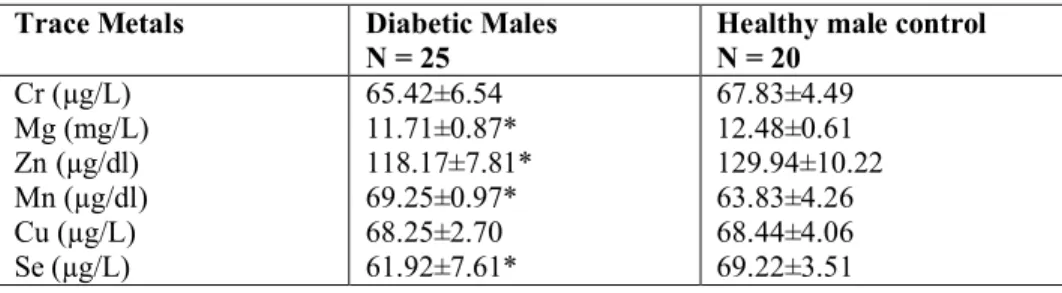
62.22±7.62 µg/L respectively) when compared with control (Table 1). This however, was statistically significant for Mg, Zn and Se (P<0.05). Among male diabetics, a similar statistically significant reduction (P<0.05) in trace element (Mg, Zn and Se) levels was noted (Table 2); this however, was not the case with serum manganese concentration (69.25±0.97 µg/dl) which was more significantly elevated (P<0.05) in diabetic patients when compared with male control (63.83±4.26 µg/dl). These findings were however, different in diabetic females. Serum Cr, Mg and Se levels were significantly reduced (P>0.05) in female diabetics when compared with apparently healthy female control (Table 3). The serum manganese level in diabetic females (66.24±3.62 µg/dl) was not significantly different (P>0.05) from male diabetics (69.25±0.97 µg/dl) and apparently healthy female control. This reveals the fact that serum trace element levels in diabetics may be sex dependent.

Table 1: Serum Trace Element Levels in the Study Participants Trace Metals Diabetic Patients

N = 45

Control N = 40 Cr (µg/L)

Mg (mg/L) Zn (µg/dl) Mn (µg/dl) Cu (µg/L) Se (µg/L)

65.42±5.44 11.64±0.96*

12.0±9.18*

67.04±3.40 68.73±2.86 62.22±7.62*

68.03±4.01 12.46±0.90 12.76±9.67 65.03±4.36 69.30±3.47 68.85±3.45 Values are expressed as Mean ± SD, *P<0.05 is considered significant.

Table 2: Mean Serum Trace Element Levels in Male Diabetic Patients

Values are expressed as Mean ± SD, *P<0.05 is considered significant.

Trace Metals Diabetic Males

N = 25

Healthy male control N = 20

Cr (µg/L) Mg (mg/L) Zn (µg/dl) Mn (µg/dl) Cu (µg/L) Se (µg/L)

65.42±6.54 11.71±0.87*

118.17±7.81*

69.25±0.97*

68.25±2.70 61.92±7.61*

67.83±4.49

12.48±0.61

129.94±10.22

63.83±4.26

68.44±4.06

69.22±3.51

(3)

Academia Arena, 2011:3(7) http://www.sciencepub.net

30

Table 3: Mean Serum Trace Element Levels in Female Diabetic Patients

Trace Metals Diabetic Females

N = 20

Healthy Female control N = 20

Cr (µg/L) Mg (mg/L) Zn (µg/dl) Mn (µg/dl) Cu (µg/L) Se (µg/L)

65.42±5.10*

11.61±1.01*

120.85±9.64 66.24±3.62 68.91±2.93 62.33±7.73*

69.41±3.29 13.22±0.64 125.64±8.97 66.00±4.29 70.00±2.80 71.09±2.14 Values are expressed as Mean ± SD, *P<0.05 is considered significant.

DISCUSSION

Trace elements are uniquely required for growth and maintenance of Life and Health.

Lack of adequate supply produces nutritional impairment which may result in disease. In this study it was observed that serum Mg, Zn and Se levels were significantly decreased in patients with diabetes mellitus while the serum Mn level was more elevated in diabetic patients when compared with apparently healthy control. This observation is in agreement with the study of Retuam and Bhanderkar, (2009), Scott and Fischer (1938) and Tuvemo, (1990). Also from the study, serum Mg, Zn and Se were significantly decreased in male diabetic patients, with a significant increase in manganese levels.

This finding corroborates the finding of Seeling and Heggtueit, (1974). From our study, it was observed that Mg, Se and Cr were significantly decreased in female diabetic patients while the serum levels of Mn, Cu and Zn though decreased were not statistically different from apparently healthy female control. This suggests that the serum trace element levels may be sex dependent. This observation was in agreement with the study of Rabinowitz et al., (1980) and Tuvemo, (1990).

CONCLUSION

Conclusively, this study revealed that the level of Mg, Zn, Se and Cr were significantly reduced in diabetic patients; this may contribute to the complications of diabetic mellitus due to added metabolic alterations that may result from this. Hence we suggest that these trace elements should be incorporated as adjuvants in the dietary management of diabetic mellitus.

Correspondence to:

Idonije B.O

Department of Chemical Pathology, College of Medicine,

Ambrose Alli University, Ekpoma, Edo State, Nigeria

E mail:[email protected]

REFERENCES

Kaneko J.J (1999). Clinical Biochemistry of Animal. 4

th

Edition. Kaneko, J.J. Edition Academic Press. Inc. New York. Pp 932.

Neil H.A, Adler A.I, Stratton I.M (2000).

Association of Systolic Blood Pressure with Macrovascular and Microvascular Complication of Type 2 Diabetes: Prospective Observational Study. BMJ, 321 (7258): 412-419.

Rabinowitz M.B, Levin S.R, Gonick H.L (1980). Comparison of chromium status in diabetic and normal men metabolism. 29: 355- 364.

Retuam U.J, Bhanderkar S.D (2009). Trace elements in Diabetes Mellitus. J. Postgrad. Med.

27: 129-131.

Rother K.I (2007). Diabetes Treatment;

Bridging the divide. N. Engl. J. Med.

356(15):1499-1501

Scott D.A, Fischer A.M (1938). The insulin and Zinc content of Normal and Diabetic Pancrease.

J. Clin. Nutr. 27:59-79.

Seeling M.S and Heggtyeit A (1974).

Magnesium inter-relationship in ischaemic heart disease. Amer. J. Clin. Nutr. (27): 59-79.

Tiffany T.O (2001). Reproductive Endocrine Function. In: Buttis C.A and Ashwood E.R (eds).

Tietz Fundamental of Clinical Chemistry, 5

th

Edition, Pp 891-897.

Tirmy L.M, Mcphee S.J, Papadakis M.A (2002). Current Medical Diagnosis and Treatment. International Edition. New York, Large Medical Books/Mc Graw-Hill. Pp, 891- 897.

Tuvemo T, Gebra M.M (1990). The role of trace elements in juvenile diabetes mellitus.

Diabetes Res. Clin. Pract. 10 (1): 59-63.

(4)

Academia Arena, 2011:3(7) http://www.sciencepub.net

31 Walker E, Knowler W, Fowler S, Hamman R, Nathan D (2000). Reduction in the incidence of type 2 diabetes with life style intervention or metformin. N. Engl. J. Med. 346 (6): 393-403.

Wild S, Roglic G, Green A, Sicree R, King H (2004). Global Prevalence of Diabetes: Diabetes Estimates for the Year 2000 and Projections for 2030. Diabetes Care. 27 (5): S1047-1053.

World Health Organization; Department of Non-communicable Disease Surveillance (1999).

Definition, Diagnosis and Classifications of Diabetes Mellitus and its Complications (PDF).

Pp 1-14.

7/10/2011

Table 2: Mean Serum Trace Element Levels in Male Diabetic Patients
Table 3: Mean Serum Trace Element Levels in Female Diabetic Patients

参照

関連したドキュメント

Consistent with the results of echocardiographic and histo- logical measurement, the mRNA expression levels of these cardiac remodeling markers were significantly decreased

The correlation between IL-17 levels and disease duration was not also recognized, although patients with normal serum IL-17 levels showed significantly higher modified Rodnan

The present study demonstrated a correlation between serum fractalkine levels and response to UDCA; although patients with low fractalkine levels (&lt;3 ng/ml) before

Methods: IgG and IgM anti-cardiolipin antibodies (aCL), IgG anti-cardiolipin-β 2 glycoprotein I complex antibody (aCL/β 2 GPI), and IgG anti-phosphatidylserine-prothrombin complex

We measured blood levels of adiponectin in SeP knockout mice fed a high sucrose, high fat diet to examine whether SeP was related to the development of hypoadiponectinemia induced

We present sufficient conditions for the existence of solutions to Neu- mann and periodic boundary-value problems for some class of quasilinear ordinary differential equations.. We

Goal of this joint work: Under certain conditions, we prove ( ∗ ) directly [i.e., without applying the theory of noncritical Belyi maps] to compute the constant “C(d, ϵ)”

[Mag3] , Painlev´ e-type differential equations for the recurrence coefficients of semi- classical orthogonal polynomials, J. Zaslavsky , Asymptotic expansions of ratios of