A Method for Creating a Genealogical Tree of
Khom Script Manuscripts:
A Case Study from the Mahāvagga of the Saṃyuttanikāya
Suchada S
RISETTHAWORAKUL1. Background
Khom script palm-leaf manuscripts are found in central and southern Thailand. Conven-tionally, a bundle of palm-leaf manuscript was separated into several small fascicles (phūk) and a scribe would copy text on both sides of a palm leaf, i.e. front and back. A page num-ber or Anga numnum-ber was inscribed on the back side. The manuscripts can be divided into two categories by their source or creation circumstances and repositories: royal manu-scripts which relate to a king and a non-royal manuscript which do not relate to a king. Most royal palm-leaf manuscripts were made from the best quality palm leaf and inscribed by skillful experts in Khom script. Normally, we can know the year of creation by reading its colophon1). However, more than 80% of Khom manuscripts of the Pāli canon in
Thai-land have no colophon, which creates difficulty in finding information about their creation. It is therefore challenging to determine the age of a manuscript. Under the circumstances, information about the age and creation of manuscript can be determined by studying its physical appearance such as the decorations on the first or last page, a king s emblem, the edition it belongs to, and the style of handwriting which differs by period and royal reign. To create a genealogical tree of Khom script manuscripts, a scholar is required to appraise each manuscript from multiple aspects and conduct a comparative study of the various sets of information.
2. Acquiring Information from a Manuscript
2.1. Physical appearance
This paper makes use of eight copies of the Mahāvagga of the Saṃyuttanikāya of Khom script manuscripts from the National library, Bangkok, Thailand. The information
regard-ing the physical appearance of each manuscript is as follows:
Most manuscripts are in good condition with complete text. They can be divided into two groups by the number of small fascicles. The manuscripts N1, N2, N3, N4, N7, and N8 have 17 fascicles (around 800–900 pages), while N5 and N6 have only 14 fascicles (around 700 pages). Only three manuscripts have a colophon that clearly shows the infor-mation about the manuscript creation. However, detailed study is needed to determine the age of the rest of manuscripts.
2.2. Information from a colophon
The colophons of the manuscripts N5, N6, and N7 are available and the year of creation is described clearly. The manuscript N6 was created in the Ayutthaya period and the N5 and N7 were created in the reign of King Rama II and IV in the Rattanakosin period.
For the manuscripts N1, N2, N8, there are some traces of the scribe or donor which hint to the manuscript age. In the manuscript N1, the name Phraya Srisahadeva is de-scribed as the donor. He was a well-known person in the reign of King Rama III in Rat-tanakosin period. Therefore, it can be assumed that N1 was created in the reign of King Rama III (1824–1851). For the manuscript N2, the scribe was the novice named Phuek of Wat Sa Ket temple. Even though the scribe was not a well-known person in history, the name of the temple does give important information. In the Ayutthaya period, the temple Wat Sa Ket was called Wat Sa Kae, which changed into Wat Sa Ket in the Rattanakosin period. Moreover, the cover of N2 is decorated with a painting style called Rod Nam Dam2), which was popular during the reign of King Rama III. Therefore, it seems that N2 was created in the Rattanakosin period around in the time of King Rama III (1824–1851). For the manuscript N8, the donor s name is Krom Maen Phra Mahesuan Sivavilad who
MS Colophon Age (years) Available fascicles Number of pages
N1 Not available; the donor s name is found Unknown 1–17 852
N2 Not available; the scribe s name is found Unknown 1–17 912
N3 Not available Unknown 1–17 856
N4 Not available Unknown 2–17 798
N5 Available 206 1–14 696
N6 Available 379 1–14 686
N7 Available 151 1–17 906
N8 Not available; the donor s name is found Unknown 1–17 848
was a person in the reign of King Rama IV (1851–1868) in the Rattanakosin period. In conclusion, based on the above information, the manuscripts N1, N2, and N8 were created in the reigns of King Rama III to IV. However, for the manuscripts N3 and N4, there is no way to determine their age.
3. A Comparative Study of the Text in Manuscripts
3.1. Start point of each chapter
In each manuscript, the start points of each chapter of the Mahāvagga of the Saṃyuttanikāya3) are shown with their fascicle, page and line number. For example, the
start points of the first chapter, Magga-saṃyutta, in all manuscripts is 1-kab-2, which
means the text of the first chapter begins from the 1st fascicle, page ka (b side) and the
2nd line. The details of the start points of each chapter in all manuscripts are shown in the
table below.
The results show that the start points of each chapter of the manuscripts N1, N2, N3, N4, N7, and N8 are mostly identical, and the N5 and N6 are clearly different from the others. 3.2. Uddāna
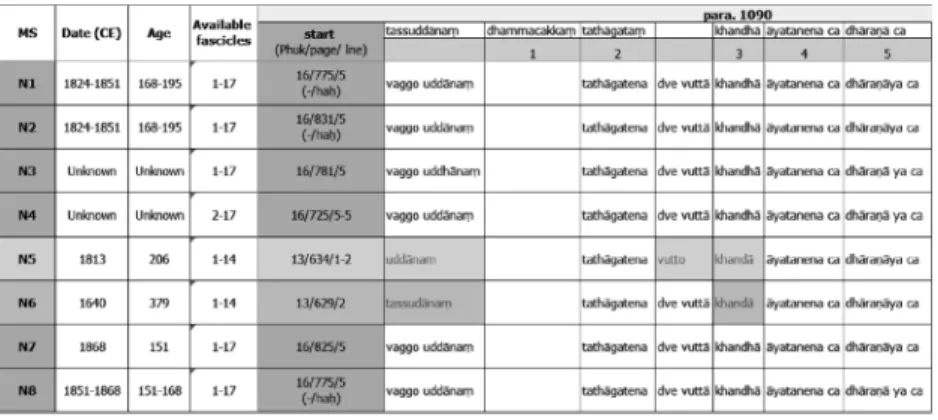
An uddāna is a summary list added after each chapter of the text but it is not counted as content of the Pāli canon. Therefore, the details of uddāna are more likely to differ by the manuscript lineages than the text itself. Thus, uddāna provide more information to deter-mine the age of manuscripts.
The comparison results show that most uddāna of the manuscript N1, N2, N3, N4, N7,
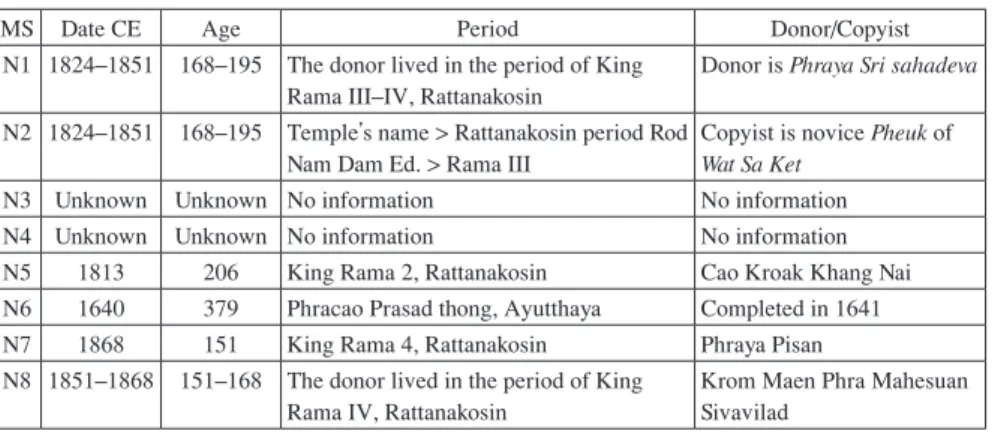
MS Date CE Age Period Donor/Copyist
N1 1824–1851 168–195 The donor lived in the period of King Rama III–IV, Rattanakosin
Donor is Phraya Sri sahadeva N2 1824–1851 168–195 Temple s name > Rattanakosin period Rod
Nam Dam Ed. > Rama III
Copyist is novice Pheuk of Wat Sa Ket
N3 Unknown Unknown No information No information
N4 Unknown Unknown No information No information
N5 1813 206 King Rama 2, Rattanakosin Cao Kroak Khang Nai
N6 1640 379 Phracao Prasad thong, Ayutthaya Completed in 1641
N7 1868 151 King Rama 4, Rattanakosin Phraya Pisan
N8 1851–1868 151–168 The donor lived in the period of King Rama IV, Rattanakosin
Krom Maen Phra Mahesuan Sivavilad
and N8 are similar. It also seems that the manuscripts N1, N2, and N8 are occasionally in the same sub-group. But the N5 and N6 are different from the others.
3.3. Selected passages
Results of comparing selected passages found that the manuscripts N1, N2, N3, N4, N7, and N8 are similar and the N2, N7 are occasionally in the same sub-group. It is interesting that in the fascicle no. 8 of N1 and N3, both manuscripts skip page ṇaṃ but have page ṇaḥ twice which is different from the N2, N4, N7, and N8. It seems that the manuscripts N1 and N3 are also in the same sub-group. On the other hand, the manuscripts N5 and N6 are partially similar and distinctive from the above group.
Figure 3: A sample detail of comparing the manuscripts by their uddāna
4. Conclusion
Based on the acquired information and comparison results, the eight copies of the manu-scripts can be divided into two groups:
Group A (N1, N2, N3, N4, N7, N8): the manuscripts of this group have 17 fascicles and were created in the Rattanakosin period (Rattanakosin Lineage). Moreover, they can be di-vided into three sub-groups which are A1 (N1, N8, N3), A2 (N2, N7) and A3 (N4). Group B (N5, N6): the manuscripts of this group have 14 fascicles and were created in the Ayutthaya period (Ayutthaya Lineage).
Finally, a genealogical tree of selected Khom script manuscripts of the Mahāvagga of the Saṃyuttanikāya can be drawn as follows:
Notes
1) A colophon is a scribe s statement at the beginning or end of a manuscript. Normally, it provides in-formation about the creation of the manuscript.
2) Painting style with golden and black colors.
3) The Mahāvagga of the Saṃyuttanikāya consists of 12 chapters (saṃyuttas).
Bibliography
HRH Prince Damrong
กรมพระยาดํารงราชานุภาพ
. 1916. Tamnan Hor Phrasamud Hor Phra Motien Tham Hor Vajirayana Hor Buddhasangghaha lae Hor Phrasamud Samrub Phranakorn.ตํานานหอพระสมุด
หอพระมณเฑียรธรรม
หอวชิรญาณ
หอพุทธสาสนสังคหะ
แลหอพระสมุดสําหรับพระนคร
. Bangkok: Krom Silapakorn.Key words Genealogical tree, Khom script, Palm leaf manuscript, Thailand, Pāli canon, Saṃyuttanikāya (Dhammachai Tipitaka Project Thailand, Ph.D) Figure 5: The genealogical tree of Khom script manuscripts of the Mahāvagga of the Saṃyuttanikā