Title
A study on adaptive complex systems under some simple
conditions
Author(s)
Miyagi, Tetsu; Nakao, Zensho; Chen, Yen-Wei
Citation
琉球大学工学部紀要(57): 71-74
Issue Date
1999-03
URL
http://hdl.handle.net/20.500.12000/1964
A study on adaptive complex systems under some simple conditionst
Tetsu Miyagi*, Zensho Nakao**, and Yen Wei Chen**
Email: {miyagi, nakao, chen}@augusta.eee.u-ryukyu.ac.jp
Keywords: Boids, Artificial life, Complex systems
Abstract
Each one of birds flying in a flock seems to be flying based on its own will, and not thinking of the whole shape of the flock. But the entire shape of the flock looks as if all birds have discussed the flocking plan.
Based on the phenomenon, we have built a model of artificial creatures, hi computer simulation, we observe their adaptive behavior and general shape of the flock under simple conditions and rules.
1. Introduction
Today, there are many kinds of artificial life with complex systems which make the dynamics of the whole system be complex with one or several simple changes. We focus on the behavior of a whole group when we define some simple conditions for individuals, hi the artificial model it is assumed that the creatures decide their behavior based on a few conditions extracted from the Boids[l] behavior, which is a simulation of a flock of birds. Boids have simple rules, which are:
1) avoiding collision against neighbors, 2) matching and coordinating own moves
with neighbors, 3) gathering together.
Though the flock's behavior is very complex, boids define rules only for each bird. The artificial model creatures also need to get feeds. Adding a simple feature of "searching for feeds," we see if the group can get feeds efficiently while each creature acts upon its own interest in feeds.
Received on: December 1, 1998.
*Graduate Student, DepL of Electrical and Electronics Eng. **Dept. of Electrical and Electronics Engineering.
fPart of the paper was presented at IIZUKA'98 (Iizuka, Japan), October 16-20, 1998.
2. Conditions
Next, we consider the conditions which are required for each creature. Each creature can only be aware of the movements of its neighbors, hi our model we assume that each creature searches for feeds, so we add a condition on searching for feeds. The condition "searching for feeds"
will make each creature act similar to its neighbors, and
due to the condition there will be a general objective as a
group.
We use the "searching for feeds" condition in place of the Boid's second rule of "matching and coordinating own moves with neighbors." Here are the three conditions we propose for the model:
1) searching for feeds,
2) keeping a distance from other creatures, 3) gathering together.
We will observe how the artificial creatures match their movements with the neighbors, guided only by the above three features. We also observe how the creatures
flock, and how they move around the feeds, as well.
3. Territory
In search of feeds, we will adopt two rules. In the first rule, the creature's individual benefit is given priority over group benefit. This is done making search-feed energy higher than keep-distance energy, and hence, resulting in an uncooperative search.
In the second rule, the group benefit is given
priority over the individual benefit by making
keep-distance energy higher than search-feed energy, and thus, making a cooperative search.
72 T. Miyagi, Z. Nakao, Yen Wei Chen : A study on adaptive complex systems under some simple conditions
Giving the creatures high keep-energy means encouraging them to make their own territory (Fig.l). This territorial behavior is essential for making use of the space in search of feeds. We examine which rule is more essential in resembling the real world under three conditions[2].
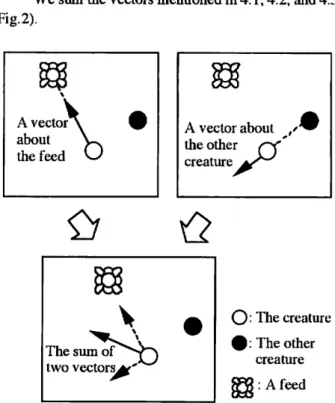
We sum the vectors mentioned in 4.1,4.2, and 4.3
Fig. 1 The creatures and territories
4. Vectorization
We treat each condition or rule expressed as a vector.
4.1 Searchingforfeeds
A creature can reach for a feed which is the nearest one in
a limited space (neighborhood). It calculates a vector to the location of the feed. The creature has a vector for searching for feeds in the same direction of the vector and inversely proportional to the size of the vector.
4.2 Keeping a distancefrom other creatures
A creature obtains vectors to the locations of creature's
neighborhood. The size of vectors corresponds to the distance to the other creatures in the neighborhood. When the size is smaller than minimum size allowed, the
creature obtains a vector for keeping a distance from
other creatures, in the opposite direction of the vector and inversely proportional to its size. The operation applies
to all creatures in the neighborhood. 4.3 Gathering together
This feature works the same way as the feature keeping a
distancefrom other creatures, in (4.2); the size of vectors corresponds to the distance to the other creatures in the
neighborhood. When the size is more than a maximum size allowed, the creature obtains a vector for gathering together in the same direction of the vector and directly
proportional to its size.
(Fig.2). A vector \
about
\~
the feed
\J
A vector about the other creature The sum of two vectors^"O: The creature
0: The other creature8^8 : A feed
Fig.2 An example of the sum of two vectors
The resulting vector gives the direction and magnitude of the creature's next move.
5. Flow of the system
Grasp the state
Vectorize and sum
Move to a position
Fig.3 Flow chart of the system
We show a flow chart of the system (Fig.3). At first, we focus on a creature; we search for feeds and other creatures around the creature. Next, it vectorizes and sums these
data and the creature decides the next action. Repeating the process, the artificial creatures can make a group like that
of natural creatures.
6. The Experiments
6.1 Placing feeds
We need to determine methods for the creatures' feeds gathering. Here is a brief description of our artificial model: we assume that several artificial creatures and many feeds exist in a limited space. We assume two
arrangements of feeds. In the first, we place feeds at
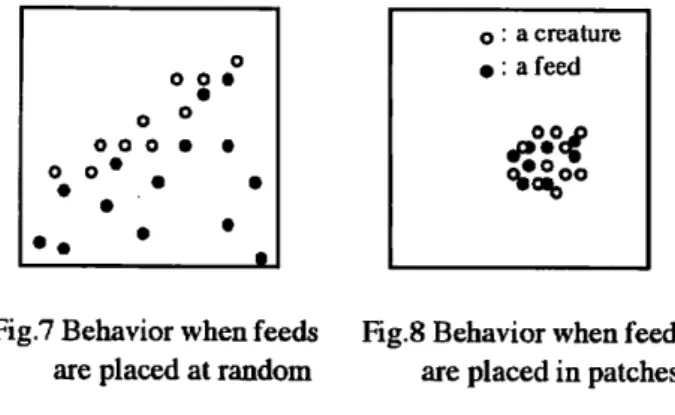
random(Fig.4). In the other, feeds are in patches[3] scattered non-uniformly in the space (Fig.5). A patch is a set of feeds, similar to worms on a tree in nature.
• * • •
Fig.4 Feeds placed at random
Fig.5 Feeds in patches
6.2 Placing creatures
We place creatures randomly within the space. We observe how the creatures gather together, and how long
it takes for them to gather. 6.3 Priority
We must consider priority of the three features: search-feed, keep-distance, and gather-together. It is obvious that search-feed is searching for its own feed, keep-distance, is keeping its own property, and gather-together is
protecting individual/group interest, thus, we can set up the following basic priority levels:
Priority level 1 2 3 Feature Search-feed Keep-distance Gather-together
The priority order may change depending on various situations. In general, if a creature is coming near other creature(s), then the highest priority is
keep-distance, and so on.
6.3.1 Uncooperative search
Uncooperative search means that the creature's individual benefit is given priority over group interest. This is done making search-feed energy higher than keep-distance
energy. So the creatures are searching for feeds for the
sake of their own individual benefit. Thus, when the
creatures want to eat feeds, they consider their own
territory less frequently, consequently, the priority of keep-distance becomes low; resulting in the following
priority level: Priority level 1 2 3 Feature Search-feed Gather-together Keep-distance 6.3.2 Cooperative search
Cooperative search means that the group benefit is given higher priority over individual benefit, so it is the opposite of the uncooperative search. The creatures share a place to search feeds, and the search is expected to be an efficient move. In case of a cooperative search, keep-distance priority is maintained as the highest. The priority for keep-distance is to make each own territory, and for the keep-distance feature, we set up three levels: safe
distance, recognition distance, and collision distance
(Fig.6). These levels make the creatures' move flexible.
Thus, we adopt the following priority levels for cooperative search below:
Priority level 1 2 or 3 2or3 Feature Keep-distance Search-feed Gather-together Safe distance Recognition distance Collision distance
Fig.6 A creature's territory 64 Other environmental parameters
Here are other environmental parameters in the
74 T. Miyagi, Z. Nakao, Yen Wei Chen : A study on adaptive complex systems under some simple conditions
Size of the space: 600 * 600 Population of the creatures: 50 Number of the patches: 5
Number of feeds: 50 in a patch
The behavior of creatures was observed, and
performance of the artificial model was evaluated. 7. Results
Here are the results of the experiments. 7.1 Placing feeds
In the experiment, we watch how the creatures behave when we place feeds randomly, and when they are placed in patch(es).
7.1.1 At random
The creatures get feeds individually(Fig.7), and at the end of searching feeds action, the creatures gather.
7.1.2 In patches
The creatures get feeds, while they are gathering(Fig.8).
Fig.7 Behavior when feeds are placed at random
Fig.8 Behavior when feeds are placed in patches 7.2 Placing creatures randomly and placing no feeds
The creatures gather, but it is not always the case that all
of creatures gather, due to their limited field of vision (Fig-9).
7.3 Priority
In the experiments we change only the parameter of keep-distance vector, and we see the difference in searching-feeds.
7.3.1 Uncooperative search
The creatures gather very closely and get feeds while keeping a shape of flock(Fig.lO). As a result they waste time for getting all feeds.
7.3.2 Cooperative search
Compared with the uncooperative search, the creatures break down flock to match appropriately with the size of the patch(Fig.ll). As a result they get all feeds about twice as fast as in the uncooperative search.
Fig. 9 No feeds are placed and creatures are placed randomly
Fig. 10 Uncooperate search Fig. 11 Cooperate search
8. Conclusion
From simulation results we conclude that we can create creatures whose performance is close to that of real creatures in the real natural world under some simple conditions.
In future work, we will create a more efficient system with more intelligent creatures that have short-memories to remember the previous movement. Also, we are considering applying the system to some real society problems.
9. References
[1] Craig W. Reynolds: Flocks, Herds, and Schools: A Distributed Behavioral Model, SIGGRAPH'87, pp.25-34,
1987.
[2] You Iwasa: Adaptive Strategies of Creatures (in Japanese), Science Co., Tokyo, 1981.
[3] You Iwasa: Introduction to Mathematical Biology (in Japanese), HBJ Publishing, Tokyo, 1990.