LETTER
QoS-Constrained Robust Beamforming Design for MIMO Interference Channels with Bounded CSI Errors
Conggai LI†a),Nonmember, Xuan GENG†,Member,andFeng LIU†,Nonmember
SUMMARY Constrained by quality-of-service (QoS), a robust transceiver design is proposed for multiple-input multiple-output (MIMO) interference channels with imperfect channel state information (CSI) un- der bounded error model. The QoS measurement is represented as the signal-to-interference-plus-noise ratio (SINR) for each user with single data stream. The problem is formulated as sum power minimization to reduce the total power consumption for energy efficiency. In a centralized manner, alternating optimization is performed at each node. For fixed transmitters, closed-form expression for the receive beamforming vectors is deduced.
And for fixed receivers, the sum-power minimization problem is recast as a semi-definite program form with linear matrix inequalities constraints.
Simulation results demonstrate the convergence and robustness of the pro- posed algorithm, which is important for practical applications in future wireless networks.
key words: MIMO interference channel, QoS constraints, bounded CSI error, robust transceiver design
1. Introduction
The multiple-input multiple-output (MIMO) technology sig- nificantly increases the spectrum efficiency of wireless com- munication. Unlike the conventional multiuser channels where there is only transmitter for the downlink or only one receiver for the uplink, there are multiple transmitters and receivers in the interference channels. This brings new challenges for the transceiver design, which is adaptive to the multi-cell scenario. With multiple antenna support, the re- quest for better performance has led researchers to jointly op- timize the transceiver design in the MIMO scenario[1],[2].
Perfect channel state information (CSI) were often as- sumed at beginning. Joint design of linear transceivers were considered for the multi-user MIMO interference channels with quality-of-service (QoS) constraints in[1]and for the MIMO interfering broadcast channel in[2]to achieve max- min fairness, respectively. In[3], the relationship of the QoS and the fairness approach was elaborated with single-antenna users. Therein, both the QoS and max-min fair problems were proven NP-hard and approximated by the semi-definite relaxation (SDR). For the multiple-antenna users, the receive beamformers are also needed in addition to the transmit ones.
A common approach named alternating optimization was adopted in[4]and its related references.
However, perfect CSI at the transmitters and receivers is often unavailable and impractical due to channel estimation
Manuscript received February 13, 2019.
Manuscript revised June 1, 2019.
†The authors are with the College of Information Engineering, Shanghai Maritime University, Shanghai, China.
a) E-mail: [email protected] DOI: 10.1587/transfun.E102.A.1426
and quantization errors. For the cases of CSI uncertainty, robust versions of beamforming optimization have been stud- ied. In[5], different types of imperfect CSI were considered to maximize the worst-case signal-to-interference-plus-noise ratio (SINR). Robust transceivers were designed by con- sidering the max-min fairness problem in [6]–[8] for the MIMO interference channels. In[9], a two-tier beamform- ing scheme is proposed based on interference alignment to minimize the interference leakage to other cells or users for a downlink MIMO interference network. These works suc- cessfully addressed the fairness issue under different max- min or min-max forms. By contrast, efficiency issue gener- ally gains higher interest with some QoS constraints. How- ever, the robust QoS transceiver design based on bounded CSI uncertainty for MIMO interference channels has not been considered, to the authors’ best knowledges.
In this letter, we investigate the QoS-constrained ro- bust beamforming design with bounded CSI uncertainty in MIMO interference channels. For simplicity, only single- stream message transmission is considered. For the purpose of energy efficiency, the QoS-constrained sum power mini- mization problem is solved by an iterative algorithm based on the alternating optimization in a centralized manner. With fixed transmit beamformers, a closed-form solution for re- ceiver is derived. With fixed receive beamformers, the QoS problem is recast to a semi-definite program (SDP) prob- lem by introducing slack variables. The convergence and robustness of the proposed scheme are demonstrated by sim- ulation, indicating potential applications in the future wire- less networks such as the device-to-device communications [10],[11]and the underwater acoustic networks[12].
Notation: k · k denotes the spectral norm of a vec- tor/matrix, k · kF denotes the Frobenius norm of a matrix, Tr(·) is the trace of a square matrix, vec(·) is the operator that stacks up all the columns of a matrix into a vector, and K , {1,2, . . . ,K}denotes the set of user index. The su- perscripts (·)T,(·)∗and(·)H denote the transpose, complex conjugate and Hermitian transpose, respectively. RandC denote the sets of real and complex numbers, respectively.
2. System Model
We consider aK-user MIMO interference channel denoted by Txk 7−→Rxk(k∈ K), where each user is composed by one transmitter and one receiver. All theK users interfere with each other. Each transmitter is equipped withManten- nas, while each receiver has Nantennas. We assume single Copyright © 2019 The Institute of Electronics, Information and Communication Engineers
data stream transmission for each user. The received signal at thekth receiver is
yk =Hkkfksk+
K
X
i=1,i,k
Hkifisi+nk, i,k (1) whereHki ∈CN×M is the channel matrix from Txi to Rxk, fk ∈CM×1is the transmit beamformer,skis the transmitted symbol withE[sksk∗]=1, andnk ∈CN×1 ∼ CN(0, σ2kI)is the additive white Gaussian noise vector. Each transmitter is assumed to have its own power constraint, i.e., kfkk2 ≤ Pk (∀k ∈ K).
Assuming a linear equalizer at thekth receiver denoted byuk ∈CN×1, the linearly processed signal can be written as
ˆ
sk =uHk yk. Then, the SINR at thek-th receiver is expressed as
SINRk =γk(uk,{fi}i=1K ,{Hki}i=1K )
= |ukHHkkfk|2
K
P
i=1,i,k|ukHHkifi|2+σk2kukk2
(2)
Under the assumption of perfect CSI, the channel{Hki} is perfectly known at the transmitters and receivers. Given the required QoS γ0, a common strategy is to minimize the total transmit power. The joint design of transceiver beamformers can be posed as
minimize
{uk} {fk}
XK
k=1
kfkk2
s.t. γk(uk,{fi}i=1K ,{Hki}i=1K )≥γ0 kfkk2 ≤Pk
(3)
Lemma 1[13]: Assuming kukk2 =1, the optimal re- ceive beamforming vector can be achieved by maximizing SINRk (Max-SINR), i.e.,
uk =arg max
kukk2=1SINRk
=
σ2kI+P
i,k
HkififiHHkiH−1Hkkfk k σ2kI+P
i,k
HkififiHHkiH−1Hkkfkk (4) The detailed solution of the above Max-SINR problem can be obtained by using the generalized eigen-problem and Rayleigh-Ritz theorem. We omit the detail due to space limitation.
The channel uncertainty is modeled as a bounded error [5], i.e., the CSI error matrix∆ki is bounded in a certain hyper-spherical region with a radiuski
R ,{∆ki: k∆kikF ≤ki} (5) As a result, the true channel between thekth transmitter and theith receiver can be written as
Hki=Hˆki+∆ki (6)
where ˆHki ∈CN×M is the estimated channel matrix, which is available at all transmitters and receivers. In other words, global estimated CSI is assumed.
Defining γk , γk(uk,{fi}i=1K ,{Hˆki+∆ki}i=1K ) and de- noting P = [P1,P2,· · ·,PK]T, the problem for robust transceiver design can be formulated as∀k,i
Q(γ,P): minimize
{uk} {fk} K
X
k=1
kfkk2 (7a)
s.t. γk ≥γ (7b)
kfkk2 ≤Pk (7c)
k∆kikF≤ki (7d) whereγ >0 is the given QoS constraint.
In this letter, we are interested in designing robust trans- mit and receive beamformers to minimize the sum transmit power while the users’ QoS requirements are satisfied, i.e., solving problemQ(γ,P)in (7).
3. Robust Beamforming Design
We provide an iterative algorithm in this section by adopting the alternating optimization to solve the joint transceiver problem. The robust receiver beamforming vector is derived with fixed transmit beamforming vectors, while the robust transmit beamforming vector is obtained via SDR with fixed receive beamformers.
3.1 Robust Receive Beamforming
As the SINR expression involves independent CSI errors, the optimal receive beamforming vector can be alternatively obtained from the following problem.
uk =arg max
kukk2=1min{∆k i}γk (8)
Definingξk ,min{∆k i}γk as the worst-case (smallest) SINR over the uncertainty regions, from (2) we have
ξk = min{∆k i}
|uHk (Hˆkk+∆kk)fk|2
K
P
i=1,i,k|ukH(Hˆki+∆ki)fi|2+σ2kkukk2
= min∆k k|uHk (Hˆkk+∆kk)fk|2 P
i,kmax∆k i|uH
k (Hˆki+∆ki)fi|2+σ2
kkukk2 (9) By the triangle inequality, the numerator and denomi- nator in (9) can be recast as
|uHk (Hˆkk+∆kk)fk|2 =|uHk Hˆkkfk+ukH∆kkfk|2
≥ |uHk Hˆkkfk|2− |ukH∆kkfk|2 (10) and
|uHk (Hˆki+∆ki)fi|2=|ukHHˆkifi+uHk ∆kifi|2
≤ |uHk Hˆkifi|2+|ukH∆kifi|2 (11)
respectively. Moreover, with CSI error k∆kikF ≤ ki,
|ukH∆kifi|2can be reformulated as
|ukH∆kifi|2 = Tr(ukH∆kififiH∆kiHuk)
= Tr(ukukH∆kififiH∆kiH)
≤ Tr(ukukH)Tr(∆kiH∆ki)Tr(fifiH)
= 2ki|uk|2|fi|2 (12) Therefore, we have
|ukH(Hˆkk+∆kk)fk|2 ≥ |uHk Hˆkkfk|2−2kk|uk|2|fk|2 (13) and
|ukH(Hˆki+∆ki)fi|2 ≤ |uHk Hˆkifi|2+ki2 |uk|2|fi|2 (14) As a result,ξk in (9) can be expressed as
ξk = |uHk Hˆkkfk|2−2kk|uk|2|fk|2
K
P
i=1,i,k|uHk Hˆkifi|2+2ki|uk|2|fi|2+σ2kkukk2 (15) Therefore, the beamforming vector at thek-th receiver is recast as
uk =arg max
kukk2=1ξk (16)
Define
Ak =HˆkkfkfkHHˆHkk−2kkkfkk2IN (17) and
Bk = XK
i=1,i,k
(HˆkififiHHˆkiH+ki2 kfik2IN)+σ2kIN (18) The robust receive beamforming vector is given as the prin- ciple eigenvector corresponding to the largest generalized eigenvalue ofB−k1Ak according to Lemma 1 in (4).
3.2 Robust Transmit Beamforming
Since the SINR constraint in (7b) is not convex, it can be rewritten as
1
γ|ukH(Hˆkk+∆kk)fk|2 ≥ XK
i=1,i,k
|ukH(Hˆki+∆ki)fi|2+kukk2σ2k (19) Introducing auxiliary variables{bki} ∈ R+, the SINR constraints (7b) and (7d) can be recast as∀i,k
|ukH(Hˆkk+∆kk)fk| ≥ tk (20)
|uHk (Hˆki+∆ki)fi| ≤ bki (21)
∀k∆kikF ≤ ki (22)
wheretk ,
rγ P
i,k
b2
ki+kukk2σ2
k
.
Using the properties of Kronecker products [14], the above inequalities can be equivalently reformulated as∀i,k
|(fkT⊗uHk )vec(Hˆkk+∆kk)| ≥ tk (23)
|(fiT ⊗ukH)vec(Hˆki+∆ki)| ≤ bki (24)
∀ kvec(∆ki)k ≤ ki (25) Letwki=fTi ⊗uHk ,hki=vec(Hˆki), andeki=vec(∆ki). We can further rewrite the above constraints as∀i,k
(hkk+ekk)HwkkHwkk(hkk+ekk) ≥ t2k (26) (hki+eki)HwHkiwki(hki+eki) ≤ b2ki (27)
∀ kekik ≤ ki (28) DefiningFi ,fifiH,Rk ,ukukH, andWki ,wHkiwki, we haveWki =FTi ⊗Rk with the properties of Kronecker products, where rank(Fi)=1. Then the above non-convex constraints can be relaxed using the SDR or S-procedure as follows.
Lemma 2: (S-procedure [15]) Let φi(x) , xHAix+ bHi x+xHbi +ci, for i = 1,2, where Ai ∈ CNt×Nt is a complex Hermitian matrix,bi ∈CNt andci ∈R. Suppose there exists an ¯x ∈ CNt with φ1(x)¯ < 0. Then the two conditions are equivalent:
1)φ2(x)¯ ≥0 for allxsatisfyingφ1(x)¯ ≤0;
2) There exists aλ≥0 such that
"
A2 b2 bH2 c2
# +λ
"
A1 b1 b1H c1
# 0
By applying the above S-procedure, we can recast (26)–
(28) as the linear matrix inequalities,∀k,i Tkk(Fk,{bki}i,k, λkk),
"
Wkk+λkkI Wkkhkk
hkkHWkk hkkHWkkhkk−t2k−λkk2kk
#
0 (29)
Φki(Fi,bki, λki),
"
−Wki+λkiI −Wkihki
−hHkiWki b2ki−hkiHWkihki−λki2ki
#
0 (30)
λki≥0 (31)
where{λki ≥ 0} are slack variables. Consequently, (7) is reformulated as a SDP form
minimize
{Fk},{bk i},{λk i} K
X
k=1
Tr(Fk)
s.t. Tkk(Fk,{bki}i,k, λkk)0 Φki(Fi,bki, λki)0, ∀i,k Fk 0,Tr(Fk) ≤Pk
(32)
As previously noted, rank-one solutions of (32) are con- sidered feasible. If the obtained solution is not of rank-one,
then additional solution approximation procedure, such as the Gaussian randomization method[16]can be employed to generate a set of rank-one solutions to (32). In general, a good approximation solution can be obtained by sampling enough time from the complex-valued Gaussian distribution, i.e.,fk ∼ CN(0,Fk). However, we find that the maximum eigenvalue related eigenvectors ofFk can be chosen as the approximate solutionsfk in simulations, which greatly sim- plifies the solving processing.
In summary, the proposed algorithm is outlined as Al- gorithm 1.
Algorithm 1The Proposed Algorithm
Initialize: Initialize {f(0) k }; 1: for{u(n)
k },{f(n)
k }(n≥1 is the number of iterations)do 2: Substitute{f(n−1)
k }into (15);
3: Solve problem (16) to get{u(n) k }; 4: Substitute{u(n)k }into (32);
5: Solve problem (32) to get{f(n) k }; 6: end for
Since each node performs the same algorithm with global CSI, the proposed scheme is working in a central- ized matter. The computational overhead is mainly caused by solving the SDP problem which performs O((M2 + N2)K3.5M4.5N4.5) arithmetic operations in each iteration [15]. Let the iteration number beL. Since each node runs the same algorithm, the total complexity is 2K L-fold. Ob- viously, this is a polynomial complexity. We should remark that the initialization of {fk0} should be the same choice at all nodes. At the same time, all nodes should agree on the iteration number. Otherwise, the mismatch problem might degrade the system performance. The convergence of the proposed scheme will be shown in the next section.
4. Simulation Results
In this section, we provide numerical example to evaluate the performance of the proposed algorithm. We consider a three- user (K =3) MIMO interference channel withM =4 anten- nas at each transmitter andN=2 antennas at each receiver.
For all simulations, the MIMO channel is randomly gen- erated from independent and identically distributed (i.i.d.) complex Gaussian distribution with zero-mean and unit- variance. 1000 channel realization are considered. The noise power is set toσk2=σ2=1.
Since there is no related reference, we consider the perfect CSI scenario, i.e.,ki =0 (∀k,i) as the baseline to assess the performance of the proposed scheme. To solve the optimization problems we use CVX, a package for solving convex programs[17].
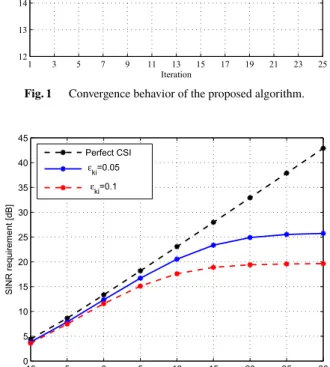
Figure 1 demonstrates the convergence behavior of the proposed algorithm. It can be seen that the total transmit power values decrease monotonically as expected, and most of the improvements are achieved in the first few iterations.
Fig. 1 Convergence behavior of the proposed algorithm.
Fig. 2 Average target SINR versus the average transmitted power.
Fig. 3 Total transmit power versus CSI errors.
In the following simulation, we set the iteration number as 6, which is quite close to the converging value of target transmit power. In this case withK=3 andL=6, the SDP problem will be solved 36 times for each channel instance.
Figure 2 shows the equal SINR requirement of each
user versus the average transmitted power. As expected, the achievable SINR increases with the growth of the average transmitted power. This figure also illustrates the negative effect of the channel uncertainty imposed on the growth of the target SINR. The higher uncertainty, the lower achievable target SINR.
In Fig. 3, we compare the total transmit power perfor- mance of the proposed and baseline scheme in[6], where the minimum SINR requirements of each user are 8 dB and 15 dB, respectively. It can be observed that the total transmit power increases with increasing CSI error, and the proposed scheme needs lower total transmit power. For example, the proposed algorithm saves 3.2 dBm transmit power compared to the baseline forγ=8 dB withki=0.1.
5. Conclusion
Robust linear transceiver design for MIMO interference channels with QoS constraints was provided under bounded CSI error model. The problem of the total power minimiza- tion with QoS constraints is formulated and solved. The robust beamformers at the receiver are achieved as modified max-SINR, while the robust transmit beamformers are ob- tained through SDP. This alternating approach determines a centralized algorithm for the transceiver design. Simula- tions show the fast convergence and the good robustness of the proposed scheme, which provides potential for its prac- tical applications.
Acknowledgments
This work was supported in part by the National Natu- ral Science Foundation of China under Grants 61271283, 61401270, and U1701265.
References
[1] A. Tolli, M. Codreanu, and M. Juntti, “Linear multi-user MIMO transceiver design with quality of service and per-antenna power constraints,” IEEE Trans. Signal Process., vol.56, no.7, pp.3049–
3055, July 2008.
[2] M. Razaviyayn, M. Hong, and Z.-Q. Luo, “Linear transceiver de- sign for a MIMO interfering broadcast channel achieving max-min fairness,” Signal Process., vol.93, no.12, pp.3327–3340, Jan. 2013.
[3] D. Christopoulos, S. Chatzinotas, and B. Ottersten, “Weighted fair multicast multigroup beamforming under per-antenna power con- straints,” IEEE Trans. Signal Process., vol.62, no.9, pp.5132–5142, Oct. 2014.
[4] R. Mochaourab, P. Cao, and E. Jorswieck, “Alternating rate profile optimization in single stream MIMO interference channels,” IEEE Signal Process. Lett., vol.21, no.2, pp.221–224, Feb. 2014.
[5] J. Wang, M. Bengtsson, and B. Ottersten, “Robust MIMO precod- ing for several classes of channel uncertainty,” IEEE Trans. Signal Process., vol.61, no.12, pp.3056–3070, June 2013.
[6] E. Chiu, V.K.N. Lau, H. Huang, T. Wu, and S. Liu, “Robust transceiver design forK-pairs quasi-static MIMO interference chan- nels via semidefinite relaxation,” IEEE Trans. Wireless Commun., vol.9, no.12, pp.3762–3769, Dec. 2010.
[7] C. Li, C. He, and L. Jiang, “Robust beamforming with block diag- onalisation for MIMO interference channels,” IET Communication, vol.10, no.8, pp.945–949, 2016.
[8] C. Li, C. He, L. Jiang, and F. Liu, “Robust beamforming design for max-min SINR in MIMO interference channels,” IEEE Commun.
Lett., vol.20, no.4, pp.724–727, April 2016.
[9] X. Xie, H. Yang, and A. Vasilakos, “Robust transceiver design based on interference alignment for multi-user multi-cell MIMO networks with channel uncertainty,” IEEE Access, vol.5, pp.5121–5134, 2017.
[10] Z. Dai, “QoS-based device-to-device communication schemes in heterogeneous wireless networks,” IET Communication, vol.9, no.3, pp.335–341, 2014.
[11] Y. Xu, and F. Liu, “QoS provisionings for device-to-device con- tent delivery in cellular networks,” IEEE Trans. Multimedia, vol.19, no.11, pp.2597–2608, 2017.
[12] S. Jiang, “On securing underwater acoustic networks: A survey,”
IEEE Commun. Surveys Tuts., vol.21, no.1, pp.729–752, 2019.
[13] Z.K.M. Ho, and D. Gesbert, “Balancing egoism and altruism on the interference channel: The MIMO case,” Proc. IEEE ICC, Cape Town, Soth Africa, 2010.
[14] J.R. Magnus, and H. Neudecker, Matrix Differential Calculus with Applications in Statistics and Econometrics, John Wiley & Sons, 2007.
[15] S. Boyd, and L. Vandenberghe, Convex Optimization, Cambridge University Press, 2004.
[16] Z.-Q. Luo, and T.-H. Chang, “SDP relaxation of homogeneous quadratic optimization: Approximation bounds and applications,”
Convex Optimization in Signal Processing and Communications, Cambridge University Press, 2010.
[17] M. Grant and S. Boyd, “CVX: Matlab software for disciplined convex programming, version 2.0 beta,” http://cvxr.com/cvx, Sept. 2013.