Original Paper
Effect of Organic Modifier on the Retention of Low-Molecular-Weight Organic
Compounds in Low-Temperature HPLC Using a Liquid CO2 Mobile Phase and
an Octadecyl Stationary Phase
Kohei MATSUO, Mina OTSUBO, Tomohiro MOTONO, Shinya KITAGAWA
*,
Yoshinori IIGUNI, Hajime OHTANI
Department of Life Science and Applied Chemistry, Graduate School of Engineering, Nagoya Institute of Technology, Gokiso, Showa, Nagoya 466-8555, Japan
Abstract
The retention behaviors of various low-molecular-weight compounds in low-temperature HPLC with an ODS (octadecyl silica) column and liquid CO2 mobile phase containing methanol or acetonitrile as modifiers were investigated. The addition
of methanol/acetonitrile reduced the retention of xanthone, which was dominated by the liquid CO2 content, independent of the
modifier. Additionally, the retention of polycyclic aromatic hydrocarbons (PAHs) was reduced by the addition of methanol/acetonitrile. Because acetonitrile resulted in a rapid reduction in the retention compared with methanol, it was suggested that the CH- interactions have an important role in the retention of PAHs in the C18 stationary phase. Notably, the retention of alkylbenzenes were only slightly affected by the addition of methanol/acetonitrile. Acetonitrile slightly increased the retention of alkylbenzenes with longer alkyl chains than those with shorter alkyl chains. It is suggested that the interaction of the phenyl moiety in alkylbenzenes with C18 chains was reduced by the increase in the acetonitrile content, and enhanced in the case of the alkyl chain moieties. The retentions of alkyl benzenes were approximately compensated, when the alkyl chain length was relatively short.
Keywords: Low-temperature HPLC; Liquid carbon dioxide; Organic modifiers; Retention factor
1. Introduction
High performance liquid chromatography (HPLC) is a general separation method used in various research fields and is applied to the separations of diverse analytes with different separation modes, such as reversed-phase, normal phase, hydrophobic interactions, and ion-exchange. The analysis of various compounds using HPLC has been reported even today [1-6]. Conventional HPLC separation is generally performed at an ambient temperature. It is well known that temperature is one of the crucial factors controlling chromatographic behavior in addition to the retention and separation efficiency of the analyte. Therefore, HPLC at high temperatures (~210°C) has been investigated [7-12]. Focusing on HPLC at low temperatures, analyses of thermally labile compounds, such as terpenoids and metal
chelates, were reported in early days [13-15], and separations of both natural and synthetic unstable compounds, such as unstable proteins and essential oils, were also demonstrated [16,17]. Moreover, the enhancement in enantiomer selectivity at low temperatures has been investigated [18-20], and Pan et al. reported low-temperature HPLC at -20°C to suppress the amide hydrogen/deuterium exchange [21]. As a unique HPLC at low temperatures, Okada et al. developed ice chromatography, in which water ice was used as a stationary phase [22-24].
The majority of previous studies on HPLC at low temperatures were performed in the range from 0 to -60°C. As HPLC at further lower temperature, Motono et al. reported an ultra-low temperature HPLC (the lowest
*Corresponding author: Shinya KITAGAWA Received: 25 December 2020
Tel: +81-52-735-5368; Fax: +81-52-735-5368 Accepted: 27 January 2021
E-mail: [email protected] J-STAGE Advance Published: 7 February 2021
DOI: 10.15583/jpchrom.2020.025 - 61 -
temperature was -196°C), in which liquefied nitrogen and its mixture with hydrocarbons were used as the mobile phase without solidification under cryogenic conditions [25,26]. In addition, they reported ultra-low temperature
HPLC at approximately -176°C using
low-molecular-weight hydrocarbons as the mobile phase [27].
Recently, we reported low temperature HPLC using liquid carbon dioxide as the mobile phase [28,29]. Carbon dioxide is generally used as the mobile phase in supercritical fluid chromatography (SFC). In SFC, modifiers, typically methanol and water, are added to the supercritical CO2 mobile phase to control the separation
behavior [30-35]. The effect of the modifier on chromatographic behavior, particularly for analyte retention, has been investigated often in SFC. However, in the case of low-temperature HPLC using CO2 mobile phase,
investigations on the effect of an added modifier were limited. The dielectric constant of liquid CO2 is
approximately 1.6 to 1.7 in the temperature range from 0 to -30°C [36], and this value is almost compatible with general organic solvents, such as hexane (1.9) and heptane (1.9) [37], which are often used in normal-phase liquid chromatography. Currently, the use of organic solvents is not preferred from an environmental viewpoint. Therefore, the use of CO2 based mobile phases, instead of general
hydrophobic organic solvents, is suitable for developing an HPLC mode with a relatively low environmental load. However, as described above, a fundamental study to support the development of such green HPLC mode is still lacking.
In this study, the effect of organic modifiers in the liquid CO2 mobile phase on chromatographic behavior in
low-temperature HPLC with an ODS column is investigated with respect to the retention coefficient. We investigated the effect of the addition of methanol/acetonitrile to the liquefied CO2 mobile phase on the retention of various
low-molecular-weight organic compounds at approximately -30℃.
2. Experimental
2.1. Apparatus
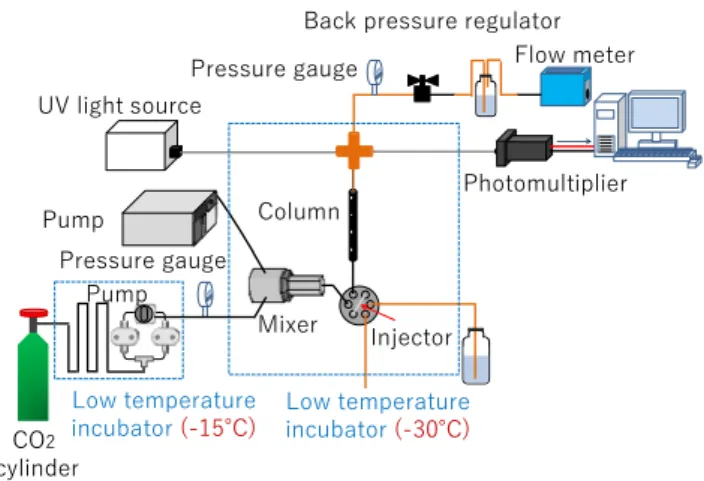
The apparatus used in this study is similar to that used in our previous work, except for the pump system (see Fig. 1) [29]. The apparatus is composed of a pump (LC-20AD, Shimadzu, Kyoto, Japan) equipped with a cooling system for liquid CO2, a pump (LC-20AD, Shimadzu) for organic
modifier, a static mixer, an automated rotary valve injector (Valve Unite FCV-20AH2, Shimadzu, injection time: 500 ms), a backpressure regulator (KPB1L0A422P20000, Swagelok, Solone, OH, USA), two pressure gauges (KDM30, Asone, Osaka, Japan), a gas flowmeter (Mass Flow Sensor Model 3810DSII, Kofloc Kyoto, Kyoto,
Japan), UV light source (high-power UV-Vis fiber light source L10290, Hamamatsu Photonics, Shizuoka, Japan) equipped with a band pass filter (detection wavelength, 254.66 ± 4.68 nm, VPF-25C-10-12-25370, Sigma Koki, Tokyo, Japan), fiber optics (CUV-CCE, Ocean Optics, Dunedin, FL, USA), a photomultiplier (H5783-06, Hamamatsu Photonics), and a low-temperature incubator (38 L JF-NU40G-S, Haier, Qingdao, China). An ODS column (Chemcobond 5-ODS-H, Chemco, Osaka, Japan) was mainly used in this experiment, and additionally, a column packed with fully porous bare silica-gel particles (Chemcobond 5-Si, Chemco) was used for the analysis of xanthone.
2.2. Chemicals
CO2 (> 99.9% purity) for the mobile phase was
purchased from Sogo Kariya Sanso (Nagoya, Japan). Methanol, acetonitrile, ethanol, n-hexane, used for the mobile phase, were purchased from FUJIFILM Wako Pure Chemical Corporation (Osaka, Japan). All analytes, xanthone, PAHs (naphthalene, anthracene, and pyrene), and alkylbenzenes (ethylbenzene, propylbenzene, n-butylbenzene, n-pentylbenzene, n-hexylbenzene, n-nonylbenzene, and n-undecylbenzene) were purchased from FUJIFILM Wako Pure Chemical Corporation, except for hexamethylbenzene (Tokyo Chemical Industry, Tokyo, Japan). The concentration of xanthone and PAHs was 1 mM each and that of alkylbenzenes was 10 mM each.
3. Results and discussion
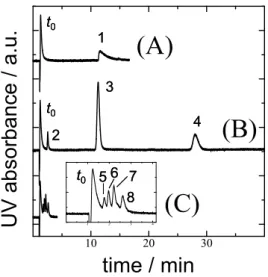
3.1. Effect of organic modifier on the retention of xanthone The effect of organic modifier on the retention of a relatively polar compound, xanthone (log P = -0.73), in an ODS column was investigated. The chromatogram of xanthone in low-temperature HPLC with pure liquid CO2
mobile phase is shown in Fig. 2A. As shown in Fig. 3A, the Low temperature incubator (-30℃) Injector Low temperature incubator (-15℃) Column Flow meter Mixer Pressure gauge
Back pressure regulator
Pressure gauge Photomultiplier Pump UV light source Pump CO2 cylinder
Fig. 1. Schematic diagram of the low-temperature HPLC using
liquid CO2containing the organic modifier as the mobile phase.
addition of both methanol and acetonitrile reduced xanthone retention. The addition of a polar organic modifier enhances the affinity or solubility of the polar xanthone to the mobile phase and reduces its retention on the hydrophobic ODS stationary phase. Notably, the retention reduction behavior
was approximately compatible with the
methanol/acetonitrile addition, which indicated that xanthone retention in the ODS column was dominated by the liquid CO2 concentration rather than that of
methanol/acetonitrile. In a typical HPLC, the dielectric constant of the mobile phase is an important parameter for controlling analyte retention. The dielectric constant of liquid CO2 (r is approximately 1.6 to 1.7 in the temperature
range from 0 to -30°C) is significantly smaller than that of methanol (r = 32.6 at 25°C) and acetonitrile (r = 37.5 at
21°C) [37]. The interaction of xanthone with C18 chains is reduced due to increase in the dielectric constant of the mobile phase.
In addition, the effect of methanol/acetonitrile addition on xanthone retention was investigated with a bare-silica column. As shown in Fig. 3B, the addition of methanol and acetonitrile reduced xanthone retention. However, a clear difference was observed, wherein the methanol addition rapidly reduced xanthone retention compared to the acetonitrile. Therefore, it can be concluded that hydrogen bonding with silanol groups played an important role in xanthone retention on the bare silica column. In addition, the retention due to hydrogen bonding to the residual silanol groups was negligible in the ODS column.
3.2. Effect of organic modifier on the retention of PAHs The effect of organic modifier concentration on the retention factors of PAHs in ODS columns is shown in Fig. 4 and the typical chromatogram is shown in Fig. 2B. The elution of PAHs was in the order, naphthalene, anthracene, and pyrene, and the addition of the modifiers resulted in a decrease in PAHs retention. As clearly shown in Fig. 4, the magnitude of the reduction due to acetonitrile was larger than that due to methanol. In general, acetonitrile can suppress the interaction between the stationary phase and the electrons in the analytes. Therefore, this behavior suggests that the CH- interactions is one of the forces for PAH retention in the ODS column.
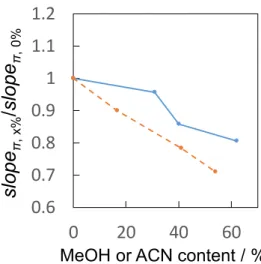
In the chromatography for PAHs, a linear relationship ( electron selectivity) is often observed between the numbers of PAH electrons and the retention factor. In our study, approximately linear relationships were observed with mobile phases containing methanol and acetonitrile of any content (Fig. S1). We calculated the values of slope (slope)
to evaluate the electron selectivity for each mobile phase of various methanol or acetonitrile content. The relationship
10 20 30 1 2 3 4
time / min
(B)
(A)
(C)
t0 t0 t0 1 2 3 4 5 8 6 7UV abs
orbance /
a.u.
t0 t0 t0 1 2 3 4 5 8 6 7Fig. 2. Chromatograms of (A) xanthone, (B) PAHs, and (C)
alkylbenzenes in low-temperature HPLC using an ODS column and pure liquid CO2 mobile phase. Peaks: 1. xanthone, 2.
naphthalene, 3. anthracene, 4. pyrene, 5. ethylbenzene, 6. propylbenzene, 7. n-butylbenzene, 8. n-pentylbenzene.
‐3 ‐2 ‐1 0 1 2 3 4 0 20 40 60 80 ln k
MeOH or ACN content / %
(A) ‐3 ‐2 ‐1 0 1 2 3 4 0 20 40 60 80 ln k
MeOH or ACN content / %
(B)
Fig. 3. Comparison of the effect of methanol and acetonitrile on
the retention of xanthone in (A) ODS column with those in (B) bare-silica column. Methanol (solid line) and acetonitrile (dashed line) were added to the liquid CO2 mobile phase.
‐3
‐2
‐1
0
1
2
3
4
0
20 40 60 80
ln
k
MeOH or ACN content / %
Fig. 4. Effect of methanol and acetonitrile on the retention of
PAHs in an ODS column. Methanol (solid line) and acetonitrile (dashed line) were added to the liquid CO2 mobile phase.
between the organic modifier content and the relative selectivity (slope, x%/slope, 0%) is shown in Fig. 5. The
relative selectivity decreased with an increase in the organic modifier content, and the magnitude of the decrease for acetonitrile was larger than that for methanol. This implies that the addition of acetonitrile effectively reduced the electron selectivity.
3.3. Effect of organic modifier on the retention of alkylbenzenes
The retention and separation of alkylbenzenes in the ODS column was also studied and the typical chromatogram is shown in Fig. 2C. As shown in Figs. 2C and 6, the retention of alkylbenzenes increased with an increase in the alkyl chain length. As shown in Figs. 3 and 4, the addition of methanol/acetonitrile reduced the retention of both xanthone and PAHs in the ODS column. However, in contrast, the retentions of alkylbenzenes were not affected by the organic modifier content in the ODS column, particularly methanol, as shown in Fig. 6. In the case of acetonitrile, the retentions of alkylbenzenes with shorter alkyl chains were almost constant. However, a slight increase was observed for those with longer alkyl chains. In a typical HPLC, the retention of alkylbenzenes in an ODS column is easily controlled by the organic modifier concentration. Therefore, the retention behavior independent of the mobile phase composition, shown here, is unusual.
In the case of entropy-based separation (separation based on molecular size or size exclusion mode), the elution time is independent of the mobile phase composition ideally. In this mode, the analyte having the longer alkyl chain length will be eluted initially. However, the elution order in the ODS column was C2 to C11, as shown in Fig. 6. These
results indicated that the separation behavior is not entropy-based separation or the size exclusion mode.
The contribution of the entropy- and enthalpy-oriented retention depends on the temperature, as shown in the van't Hoff equation.
The constant retention may be observed as a result of the compensation of entropic and enthalpic retentions. Therefore, we also investigated the relationship between the retention factors of alkylbenzenes and the organic modifier content at -10°C. In this case, however, approximately constant retentions, independently of modifier addition, were observed similar to Fig. 6 (Fig. S2).
Meanwhile, the addition of ethanol to the hexane mobile phase (the dielectric constant of the liquid CO2 is
approximately compatible with that of hexane) increased the retention of the alkylbenzenes in the ODS column (Fig. S3). The increase in the mobile phase polarity enhanced the analyte retention, as similar to the general behavior in reversed-phase HPLC. As shown in Fig. 6, the retention of alkylbenzenes with relatively longer alkyl chains (C7-11) slightly increased with the addition of acetonitrile. A similar tendency barely observed for alkylbenzenes with the alkyl chain length C2 to C5. As shown in Fig. 6, the alkylbenzenes with longer allyl chains exhibited longer elution times, confirming stronger interactions with the ODS chains. Therefore, the enhancement in the retention due to the addition of acetonitrile indicated that the interaction of alkyl chain moieties in alkylbenzenes with C18 chain (ODS column) increased with the increase in the acetonitrile content.
The retention of alkylbenzenes is given by the following equation,
As shown in Fig. 4, the retention of PAHs was decreased
�������������� �������� � ����� ����� �� � � ����� �° ��� � ���°
0.6
0.7
0.8
0.9
1
1.1
1.2
0
20
40
60
slope
π , x%/slope
π , 0%MeOH or ACN content / %
Fig. 5. Effect of organic modifiers on electron selectivity in an
ODS column. Methanol (solid line) and acetonitrile (dashed line) were added to the liquid CO2 mobile phase.
‐3 ‐2 ‐1 0 1 2 3 4 0 20 40 60 80 ‐3 ‐2 ‐1 0 1 2 3 4 0 20 40 60 80 ln k MeOH content / % (A) ln k ACN content / % (B)
Fig. 6. Effect of the organic modifier content, (A) methanol and
(B) acetonitrile, on the retention of alkylbenzenes in an ODS column.
by the acetonitrile addition in the ODS column. Therefore, kphenyl is reduced by the acetonitrile addition. However, if
the kalkyl chain is increased by the acetonitrile addition, similar
to a general reversed-phase HPLC, the longer alkyl chain will result in kphenyl + kalkyl chain > 0. In contrast, the
shorter alkyl chains will result in kphenyl + kalkyl chain ≈ 0
with the addition of acetonitrile. In methanol addition, kphenyl + kalkyl chain ≈ 0 was observed.
As shown in Fig. 4, the decrease in PAH retention due to acetonitrile was larger than that due to methanol. Therefore, the reduction in kphenyl in the alkylbenzenes due to
acetonitrile will be larger than that due to methanol. Therefore, these results suggest that the kalkyl chain owing to
the acetonitrile is larger as compared to methanol.
The retention variations for hexamethylbenzene due to methanol/acetonitrile addition are also shown in Fig. 6. The modifiers reduced the retention of hexamethylbenzene. The methyl group is electron-donating, and the electron density of hexamethylbenzene is higher than that of monoalkylbenzene (Fig. S4). Therefore, the retention of hexamethylbenzene is dominated by the interaction with the phenyl moiety, not the methyl groups. The larger kphenyl
(<0) due to the addition of modifiers reduced the retention of hexamethylbenzene.
4. Conclusions
The effect of acetonitrile/methanol addition to the liquid CO2 mobile phase was investigated using low-temperature
HPLC at -30°C with an ODS column. The xanthone retention was dominated by the liquid CO2 content
independent of the modifier species (acetonitrile/methanol). The retention of PAHs decreased upon modifier addition, and the suppression efficiency of acetonitrile was superior to that of methanol. This results suggest that the CH- interactions played important role for the PAH retentions in an ODS column, whereas CO2 contains electrons for
suppressing the CH- interaction. For alkylbenzenes, the retentions were less affected by the modifier addition, and slight increase in the retention was observed for alkylbenzenes with longer alkyl chains due to for acetonitrile addition.
Our investigation revealed that the interactions of the electrons and polar functional groups with the ODS stationary phase play an important role in analyte retention in low-temperature HPLC using a liquid CO2-based mobile
phase. Low-temperature HPLC with multiple retention mechanisms has the potential to achieve unique separation. We intend to investigate separation using a chiral stationary phase, in which multiple interactions could play an important role.
Supporting information
Figures S1-S4 are available via the WEB at
http://chromsoc.jp/Journal/SI.html. Acknowledgments
This work was supported by JSPS KAKENSHI Grant Number 18K19097.
References
[1] Shibata, Y.; Yamada, T.; Sugiyama, E.; Mizuno, H.; Todoroki, K. Chromatography 2020, 41, 123-128. [2] Takada, M.; Ohba, Y.; Kabashima, T.; Nakashima, K.
Wada, M. Chromatography 2020, 41, 79-84.
[3] Ishii, C.; Furusho, A.; Hsieh, C. -L.; Hamase, K. Chromatography 2020, 41, 1-17.
[4] Kodamatani, H.; Sugihara, K.; Tanisue, T.; Kanzaki, R.; Tomiyasu T., Anal. Sci. 2020, 36, 1393-1399. [5] Miura, M.; Nogami, M.; Sakai, M.; Sato, M.;
Yatsushiro, T. Anal. Sci. 2020, 36, 1243-1249.
[6] Yamamoto, T.; Sakamoto, K.; Esaka, Y.; Uno, B. Anal. Sci. 2020, 36, 1285-1288.
[7] Ooms, B. LC-GC 1996, 14, 306-324.
[8] Smith, R. M.; Burgess, R. J. J. Chromatogr. A 1997,
785, 49-55.
[9] Fields, S. M.; Ye, C. Q.; Zhang, D. D.; Branch, R. B.; Zhang, J. X.; Okafo, N. J. Chromatogr. A 2001, 913, 197-204.
[10] Droux, S.; Felix, G. Chirality 2011, 23, E105-E109. [11] Shibukawa, M.; Shimasaki, T.; Saito, S.; Yarita, T.
Anal. Chem. 2009, 81, 8025-8032.
[12] Shibukawa, M.; Morinaga, R.; Saito, S. Bunseki Kagaku 2016, 65, 615-624.
[13] Henderson, D. E.; O’Conner, D. J. in Giddings, J. C.; Grushka, E.; Cazes, J.; Brown, P. R. (Eds.) Adv. Chromatogr., Marcel Dekker: New York, 1984, 23, pp 65-95.
[14] Henderson, D. E.; High, L. E.; O’Conner, D. J.; Kirby, J. F.; Sears, C. P., III J. Chromatogr. Sci. 1985, 23, 477-483.
[15] Beyer, J.; Becker, H.; Martin, R. J. Liq. Chromatogr. 1986, 9, 2433-2441.
[16] Kaufmann, M. J. Chromatogr. Biomed. Appl. 1997,
699, 347-369.
[17] Sajewicz, M.; Wojtal, L.; Staszek, D.; Hajnos, M.; Waksmundzka-Hajnos, M.; Kowalska, T. J. Liq. Chromatogr. Relat. Technol. 2010, 33, 936-947. [18] Pirkle, W. H.; Burke, J. A. III J. Chromatogr. A 1991,
557, 173-185.
[19] Wolf, C., Pirkle, W. H., J. Chromatogr. A 1997, 785, 173-178.
[20] Sabia, R.; Ciogli, A.; Pierini, M.; Gasparrini, F.; Villani, C. J. Chromatogr. A 2014, 1363, 144-149. [21] Pan, J.; Zhang, S.; Parker, C. E.; Borchers, C. H. J.
Am. Chem. Soc., 2014, 136, 13065-13071.
[22] Tasaki, Y.; Okada, T. Anal. Chem. 2006, 78,
4155-4160.
[23] Tasaki, Y.; Okada, T. J. Chromatogr. A 2008, 1189, 72-76.
[24] Takahashi, S.; Harada, M.; Okada, T. Anal. Methods 2016, 8, 105-110.
[25] Motono, T.; Kitagawa, S.; Ohtani, H. Anal. Chem. 2016, 88, 6852-6858.
[26] Motono, T.; Kitagawa, S.; Ohtani, H. J. Chromatogr. A 2017, 1503, 32-37.
[27] Motono, T.; Kanayama, T.; Kitagawa, S.; Iiguni, Y.; Ohtani, H. Chromatography 2020, 41, 109-114. [28] Motono, T.; Nagai, T.; Kitagawa, S.; Ohtani, H. J.
Sep. Sci. 2015, 38, 2381-2386.
[29] Otsubo, M.; Motono, T.; Kitagawa, S.; Ohtani, H. Chromatography 2017, 38, 31-37.
[30] Lesellier, E. J. Sep. Sci. 2008, 31, 1238-1251.
[31] Mangelings, D.; Heyden, Y. V. J. Sep. Sci. 2008, 31, 1252-1273.
[32] Bamba ,T; Lee, J. W; Matsubara, A.; Fukusaki, E. J. Chromatogr A, 2012, 1250, 212-219.
[33] Layton, C.; Ma, S.; Wu, L.; Lee, H.; Fandrick, K.; Fandrick, D.; Senanyake, C.; Yee, N.; Grinberg, N.; Clark, J. J. Sep. Sci., 2013, 36, 3941-3948.
[34] Yamada, T.; Uchikata, T.; Sakamoto, S.; Yokoi, Y.; Nishiumi, S.; Yoshida, M.; Fukusaki, E.; Bamba, T., J. Chromatogr. A, 2013, 1301, 237-242.
[35] Zhang, X.; Ji, F.; Li, Y.; He, T.; Han, Y.: Wang, D.; Lin, Z.; Chen, S. Anal. Sci., 2018, 34, 407-413. [36] http://www.ddbst.com/en/EED/PCP/DEC_C1050.php,
accessed at 2020.12.02.
[37] https://www.kabusa.com/Dilectric-Constants.pdf, accessed at 2020.12.02.