H29:様式甲/Style Kou 2-1
学位論文の要旨
Abstract of Thesis 研究科
School
Graduate School of Environmental and Life Science
専 攻
Division
Division of Environmental Science
学生番号
Student No.
77426502
氏 名
Name
Abdul Muaz Hapipi Bin Mohd Yusoff
学位論文題目 Title of Thesis(学位論文題目が英語の場合は和訳を付記)
Pyrolysis of sugarcane bagasse and polyvinyl chloride in superheated steam atmosphere (過熱水蒸気雰囲気下での砂糖キビバガスとポリ塩化ビニルの熱分解)
学位論文の要旨 Abstract of Thesis
Organic waste is considered as an important source of energy because of the presence of the organic compound.
Organic waste can be converted into energy such as solid and liquid fuels which are renewable and environmentally friendly. Pyrolysis is a process which converts organic waste into liquid (tar and other organics), solid (charcoal) 1, 2 and gaseous products (H2, CO, CO2, CH4, C2H4, C2H6) by heating in the absence of oxygen or very low oxygen level. A considerable amount of research has been conducted to the pyrolysis process using inert gas such as nitrogen. Less attention has been paid to the others pyrolysis atmospheres such as superheated steam
3,4. Superheated steam is produced by heating saturated steam to the temperature higher than boiling point.
Compared with hot air and inert gas at the same temperature, this superheated steam has very unique properties such as, 1) a higher heating rate due to radiative heating in addition to convective heating, 2) higher specific enthalpy 3. Thus, using superheated steam in the pyrolysis atmosphere may lead to substantial energy saving if no biomass oxidation occurs. In this research two types of organic wastes, sugarcane bagasse and polyvinyl chloride (PVC) were used and the pyrolysis properties of sugarcane bagasse and polyvinyl chloride by pyrolysis in superheated steam atmosphere were investigated.
In chapter 1, a few types of organic wastes were described and the main process used for the treatment of these wastes. Among the treatment used, one of the thermochemical process, pyrolysis was focused on this study. By using this process sugarcane bagasse was carbonized to obtain biochar as the main product while in the case of PVC waste, chlorine removal through pyrolysis process was investigated. Both of carbonization and dechlorination were studied under superheated steam atmosphere and their results were compared with nitrogen atmosphere.
In chapter 2, the carbonization of sugarcane bagasse and its heat transfer property by superheated steam was described, compared with nitrogen atmosphere. Carbonization was carried out for 5, 10, 15, 20, 25 and 30 minutes at temperature 491,541, 579, 617, 650, and 702 K. The carbonization became constant within 25-30 min and the differences in char yield and higher heating value were small and negligible between superheated steam and nitrogen pyrolysis in spite of the oxidizing in superheated steam. The effect of the temperature was studied at temperature 491,541, 579, 617, 650, and 702 K for 30 minutes. The increasing carbonization temperature led to the decrease in the solid yield and showed almost the same trend in carbon losing rate. The heat transfer properties in superheated steam and nitrogen atmospheres were calculated using a simplified heat balance equation model and the results were compared with the experimental value. The results showed a good agreement between the
H29:様式甲/Style Kou 2-2 Name Abdul Muaz Hapipi Bin Mohd Yusoff
calculated and experimental temperature when h = 7 [W/m2K] was used in case of superheated steam. While for the nitrogen gas pyrolysis, a good agreement was achieved between the experiment and calculation when the value of h = 9 [Wm2K]. The increasing rate of sample temperature in superheated steam was faster than that of nitrogen due to the large heat transfer ability of superheated steam based on radiation and convection as shown in Fig. 1.
From the above results, superheated steam is effective as one of the biomass pyrolysis.
Fig. 1 Comparison of temporal change in calculated temperature change between superheated steam and nitrogen gas at the same carbonization temperature.
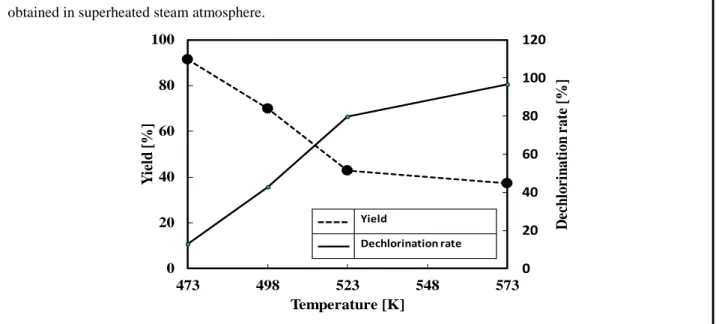
In chapter 3, the chlorine removal from polyvinyl chloride (PVC) with the addition of catalysts such as solid acid catalysts and adsorbents such as alkali and metal oxide adsorbents were described using superheated steam and nitrogen as pyrolysis media. The effect of the dechlorination temperature was studied at 473, 498, 523 and 573 K for 60 min in the case of superheated steam and in the case of nitrogen gas dechlorination was studied at 473 and 523 K for 60 min. Product yield and dechlorination ratio in superheated steam atmosphere are shown in Fig. 2.
This result indicated that the treatment temperature was the important factors to control the carbonization and dechlorination ratio of PVC. The effect of residence time on PVC dechlorination ratio was studied at temperature 523 K for 30, 60 and 90 min. The decomposition and dechlorination became almost constant after 60 min. This indicates that 60 min is enough time for the the declorination of PVC. The effect of solid acid acid catalysts addition on PVC dechlorination was studied with β-zeolite and TiO2 at 473 K and treatment time of 60 min. The addition of solid acid catalysts increased the dechlorination ratio of PVC but lacked in chlorine capture ability. The addition of NaOH as alkali adsorbent increased dechlorination rate from 12.9% to 21.1% and showed a little chlorine capture ability. 56.7% of dechlorination ratio was obtained by CoO addition of 1:1 mole ratio in the case of metal oxide adsorbent. Metal oxide supported adsorbents were prepared in this study by impregnation method in order to increase decomposition and chlorine capture ability of the adsorbent during dechlorination. Prepared metal oxide supported adsorbents were 50ZnO/CoO, 50MgO/ZnO and 50NiO/CoO. These adsorbents showed an increased in dechlorination and chlorine capture ability compared with the results of no addition. The combination of ZnO and CoO adsorbents showed the highest dechlorination and chlorine capture ability. Effect of ZnO loading amount on PVC dechlorination was studied with 10, 25 and 50wt% of ZnO loading. The results indicated that the loading amount increased the decomposition and dechlorination ratio and became almost constant when loading amount over than 25wt%. The comparison between superheated steam and nitrogen atmospheres showed that the effect of superheated steam start at temperature 523 K, with higher decomposition and dechlorination ratio were
H29:様式甲/Style Kou 2-3 Name Abdul Muaz Hapipi Bin Mohd Yusoff
obtained in superheated steam atmosphere.
Fig. 2 The effect of dechlorination temperature on product yield and dechlorination rate.
In chapter 4, the conclusion of this thesis was described. The pyrolysis process of sugarcane bagasse using superheated steam was efficient due to no additive oxidation and better heat transfer property. In case of PVC dechlorination, temperature is the most important factor that effect PVC decomposition and dechlorination.
Superheated steam had a higher decomposition and declorination ratio compared with nitrogen atmosphere.
Declorination temperature could be lowered with the addition of catalysts and adsorbents.
References
1) Titiladunayo, I. F., McDonald, A. G., Fapetu, O. P.: Effect of temperature on biochar product yield from selected lignocellulosic biomass in a pyrolysis process. Waste Biomass Valor. 3(3), 311-318 (2012)
2) Kwaspinski, W., Byrne, C. M. P., Kyyachko, E.: Biochar from biomass and waste. 1(2), 177-189 (2010) 3) Suda, H., Uddin, M. A., & Kato, Y. Chlorine removal from incinerator bottom ash by superheated steam, 184,
753-760 (2016)
4) Hase, T., Uddin, M. A., Kato, Y., & Fukui, M. Drying and organic chlorine thermal decomposition behavior of municipal solid waste using superheated steam, 25, 16-24 (2014)
5) Amatsubo, T., Hagura, Y.: Heat transfer characteristics of superheated steam combined with far infrared heating. Food Sci. Technol. Res. 11, 363-368 (2005)
0 20 40 60 80 100 120
0 20 40 60 80 100
473 498 523 548 573
Dechlorination rate [%]
Yield [%]
Temperature [K]
Yield
Dechlorination rate