On
Weak
Approximation
of
Stochastic
Differential
Equations
with
Discontinuous
Drift
Coefficient
1
Arturo Kohatsu-Higa
DepartmentofMathematical Sciences
Ritsumeikan University
1-1-1 Nojihigashi,Kusatsu, Shiga, 525-8577, Japan.
Antoine Lejay
Project-teamTOSCA, Institut
\’Elie
CartanNancy(Nancy-Universit\’e,CNRS, INRIA)
BP 239, F-54506 Vandoeuvre-les-Nancy, France.
Kazuhiro Yasuda
Faculty ofScienceandEngineering
Hosei University
3-7-2, Kajino-cho, Koganei-shi,Tokyo, 184-8584, Japan.
Abstract
Inthispaper,weakapproximationsofmulti-dimensional stochastic differential
equa-tionswithdiscontinuousdrift coefficientsareconsidered. Hereastheapproximated
pro-cess, theEuler-Maruyama approximationof SDEs withapproximateddriftcoefficients
isused, andweprovidearateofweakconvergenceof them. Finallywepresentarate
ofweakconvergenceof the Euler-Maruyamaapproximationof the original SDEs with
constantdiffusion coefficients.
1
Introduction
Inmathematical finance,
one
describes assetprice processesas
the solutionto the followingstochasticdifferential equations(SDEs):
$dX_{t}=b(t,X_{t})dt+\sigma(t,X_{t})dW_{t}$
.
(1.1)where $b$ and $\sigma$
are
certain fimctions and $W_{t}$ isa
Brownian motion. Thenwe
considera
flmction $f$, which represents
a
payoff mnction in financial derivatives, andone
write itsassociatedoptionprice
as
theexpectation
$E[f(X_{T})]$, where $T$isa
maturity
ofthe optionand
$X_{T}$ isthe assetprice at$T$
.
Notethatwe are
using theinterpretation
oftheexpectation usinga
financial situation, but, ofcourse, it isalso important inmanyother fieldsand applications.
Itis
rare
theoccasion whenone
isabletocalculate theprevious expectationanalytically.Therefore inorder toobtainitsvalue,
one
resortsto computer simulations andtriestoobtainlThispaperisanabbreviated and preliminaryversionof A. Kohatsu-Higa, A. Lejay and K. Yasuda[5]. If
anapproximated value. Inpractice,twokinds ofapproximations
are
neededtosimulate thisexpectation. One is
an
approximation of the SDEs (1.1) and the other isan
approximationof the expectation. For the latter,
one can
typicallyuse
the Monte-Carlo method, which isbased
on
law of large numbersin
probability theory. On the otherhand, forthe former, theEuler-Mamyama approximation is often used. The Euler-Maruyamaapproximation
can
bedescribed
as
follows: For simplicity,we
split theinterval $[0, T]$ equallyin$n$subintervalsandlet the length of eachtime subinterval$\Delta t$be equalto $\frac{T}{n}$,
$\overline{X}_{0}=x$, $\overline{X_{i+1}}=\overline{X_{i}}+b(i\Delta t,\overline{X_{i}})\Delta t+\sigma(i\Delta t,\overline{X}_{i})\sqrt{\Delta t}\xi_{i}$,
where the random variables $\xi_{i},$ $i=0,1,$$\cdots,n-1$,
are
independent ofeach other andare
distributed according to
a
$N(O,I_{d})$ law, where $0$ is the d-dimensionalzero
vector and $I_{d}$ is$d\cross d$-unit matrix. When
we
approximate stochasticprocesses, one
needsa
criteria in orderto determine the quality ofthe approximation. One mainly
uses
the following two criteria(strong
error
and weakerror): the definition ofan
approximation with strongerror
of order$\gamma>0$ is that there
exists
a
positiveconstant$C$,which doesnotdependon
$\Delta t$, such that$E[|X_{T}-\overline{X}_{n}|]\leq C\Delta t^{\gamma}$
.
Under enough regularityfor coefficients $b$ and$\sigma$, the strong $elTor$has the order 1/2 for the
aboveEuler-Maruyama approximation. For
more
details, readerscan
referExercise 9.6.3 inKloeden and Platen[4]. Thedefinition ofweak
error
withorder$\gamma>0$is that forallffinctions$f$in
a
certain class, there existsa
positive constant $C$, which does not dependon
$\Delta t$, suchthat
$|E[f(X_{T})]-E[f(\overline{X}_{n})]|\leq C\Delta t^{\gamma}$
.
Here under enoughregularity
on
the coefficients $\sigma$and $b$ andon
$f$,we
have the weakerror
withorder 1 for the Euler-Mamyama approximation.
The
purpose
ofthis paper is to treatan
SDE with discontinuous drift coefficients andobtain
an
order ofweakerror
foritsapproximation. Precisely speaking,we
consideran
SDEwith
an
approximateddrift coefficient $b_{\epsilon}$,which isapproximatedusingthe Euler-Maruyamaapproximation. Then,
one uses
theapproximatedprocessas
theapproximation ofthe originalSDEs. Then
we
estimatean
order of the weakerror
between the original SDEs and theapproximated process. Inthe latterpart ofthis article,
we
deal withan
SDE with constantdiffusion coefficients and obtain
an
order of the weak elTor between the SDEs and theirapproximated
process
towhich theEuler-Mamyamaapproximationis directly applied.SDEs with discontinuous drift coefficients
are
ofcourse
used in various fields. Forin-stant, in mathematical finance, if
one
wants to modela
stock price process whose trenddramatically changeswhen
a
factorgoes
downa
threshold value. Inthis case, the driftcan
be modeled
as
taking two values specified bysome
indicator hnction. This kind of SDEalso
appears
insome
control problems.Weak
error
of SDEs with discontinuous coefficients(notonly driftcoefficients, but alsotheir
papers,
they only proved weakconvergence
ofthe Euler-Mamyamaapproximation,
notmentioned
an
order ofthe weakconvergence.
Andalsostrongerror
and therateare
studiedin Przybylowicz [10] for SDEs with
some
type of discontinuous coefficients. Note thatinthis
paper,
the diffusion coefficients ofour
SDEs have enoughregularity.This
paper
is organized
as
follows:
Somenotations
andassumptions
are
given in
Sec-tion
2.
Weprovideour
main resulton a
rate ofweakerrors
under SDEs with discontinuousdriftand nonlineardiffusion coefficient in Section3, andalso give results underconstant
dif-ffision coefficientsin Section 4. Finally
we
givesome
numerical resultsin Section 5. Proofsoftheorems and
so
on
belowcan
be found inKohatsu-Higa, LejayandYasuda[5].2
Notations
and
Hypotheses
Let$d\in \mathbb{N}$
.
Thespace
ofcontinuousffinctions thatare
slowly increasingis denotedby$C_{Sl}(\mathbb{R}^{d})$.
Afimction$f$in$C_{Sl}(\mathbb{R}^{d})$is such that forevery$k>0$,
$\lim_{|x|arrow\infty}|f(x)|e^{-k|x|^{2}}=0$
.
Fix $T>0$
.
Let$H$be the set $[0, T)\cross \mathbb{R}^{d}$and$\overline{H}=[0, T]\cross \mathbb{R}^{d}$.
Let $\sigma$ be
a
measurable fimctionon
$[0, T]\cross \mathbb{R}^{d}$ with values in thespace
of symmetric$d\cross d$-matrices. We set$a=\sigma\sigma^{*}$ and
assume
thatthere exist
some
positiveconstants$\Lambda$ and$\lambda(\Lambda\geq\lambda>0)$(Hl)
suchthat$\lambda|\xi|^{2}\leq\xi^{*}a(t,x)\xi\leq\Lambda|\xi|^{2}$, for all $(t,x)\in\overline{H}$, andall$\xi\in \mathbb{R}^{d}$,
$\sigma$isuniformlycontinuous
on
H. (H2)Remark2.1 Note that (Hl)givesa lower andupperboundon the eigenvalues
of
$a$, whichare
from
the veryconstruction equalto the eigenvaluesof
$\sigma$ (wehave chosen $\sigma$ to besym-metric)
for
which(Hl)holds with $\lambda$and$\Lambda$replacedby $\sqrt{\lambda}$and $\sqrt{\Lambda}$.
Let
us
alsoconsidera
measurable fimction$b$ ffom$[0, T]\cross \mathbb{R}^{d}$to$\mathbb{R}^{d}$such that$|b(t,x)|\leq\Lambda$ forall$(t,x)\in H.$ (H3)
From
now
on,we
alwaysassume
(Hl), (H2)and(H3)for$b$ and$\sigma$.
Now,
we
givesome
notations.
Fix $\alpha>0$.
Let $H^{\alpha}(\mathbb{R}^{d})$ be thespace
ofcontinuous,bounded fimctionswith continuous,bounded derivatives uptoorder$\lfloor\alpha\rfloor$and such that$\partial_{x}^{\lfloor\alpha\rfloor}f$is
$(\alpha-\lfloor\alpha\rfloor)$-H\"oldercontinuous. Let$H^{\alpha/2,\alpha}(\overline{H})$be thesetofcontinuous fimctions with continuous
derivatives$\partial_{t}^{r}\partial_{x}^{s}u$ for all $2r+s<\alpha$andsuchthat
$||u||_{H^{\alpha\prime 2.\alpha}}= \sum_{2r+s\leq\lfloor\alpha\rfloor}\sup_{(t,x)\in\overline{H}}|\partial_{t}^{r}\partial_{x}^{s}u(t,x)|+\sum_{2r+s--\lfloor\alpha\rfloor}\sup_{(t,x),(ty)\in\overline{H}}\frac{|\partial_{t}^{r}\partial_{x}^{s}u(t,x)-\partial_{t}^{r}\partial_{x}^{s}u(t,y)|}{|x-y|^{\alpha-\lfloor\alpha\rfloor}}$
$+$$\sup_{0<\alpha-2r-s<2(t,x),(v,x)\in\overline{H}}\frac{|\partial_{t}^{r}\partial_{x}^{s}u(t,x)-\partial_{t}^{r}\partial_{x}^{s}u(v,x)|}{|t-v|^{(\alpha-2r-s)/2}}$$\sum$
3
Main Theorems
Let$\sigma$and $b$ satisfy $(H1)-(H3)$
.
These conditionsare
sufficient toensure
the existenceofa
uniqueweaksolution$(X, (\mathcal{F}_{t}’)_{t\geq 0},\mathbb{P}_{x})$to
$X_{t}=x+ \int_{0}^{t}\sigma(s,X_{s})dB_{s}+\int_{0}^{t}b(s,X_{s})ds$ (3.1)
for
a
Brownianmotion$B$.
Remark3.1 $IfX_{t}=x+ \int_{0}^{t}\sigma(s,X_{s})dB_{s}$hasastrongsolution,then(3.1) also admits astrong
solution (See Veretennikov [11]).
Let$b_{\epsilon}$ be
a
family of measurablecoefficients
on
$\overline{H}$with $|b_{\epsilon}(t, x)|\leq\Lambda$ for $(t,x)\in\overline{H}$
.
Letus
considerthe unique weak solution$(X^{\epsilon}, (F_{t})_{t\geq 0}, \mathbb{P}_{x})$to$X_{t}^{\epsilon}=x+ \int_{0}^{t}\sigma(s,X_{s}^{\epsilon})W_{s}+\int_{0}^{t}b_{\epsilon}(s,X_{s}^{\epsilon})ds$
.
(3.2)Since $b_{\epsilon}$ and$b$
are
bounded, thedistributionof$X^{\epsilon}$may
be deduced ffomthe distributionof$X$through
a
Girsanov transform.For $T>0$, let$T$ bethecontinuoussolution of the Euler-Mamyama scheme ofstep size
$T/n$
.
If$\phi(s)=\sup\{t\leq s|t=k/n$ for$k\in \mathbb{N}\}$,then$T_{t}=x+ \int_{0}^{t}\sigma(\phi(s),z_{\phi(s)})dB_{s}+\int_{0}^{t}b_{\epsilon}(\phi(s),r_{\phi(s)})ds$
.
(3.3)When$\sigma$and$b_{\epsilon}$belongto
an
appropiateclassofffinctions$\mathfrak{M}$(forexample$\mathfrak{M}=H^{\alpha/2,\alpha}(\overline{H})$for
some
$\alpha>0$or
$\mathfrak{M}=C_{b}^{1,3}(\overline{H}))$, and when$f$belongs toa
proper
class of ffinctions $S$ (forexample, $ff=H^{2+\alpha}(\mathbb{R}^{d})$
or
$S=C^{3}(\mathbb{R}^{d})\cap C_{Sl}(\mathbb{R}^{d}))$,a
rate of weakconvergenceof theEuler-Mamyamascheme$\mathscr{K}^{-}$
is known. This
means
thatthereexistssome
constant$C_{\epsilon}$such that$| E[f(X_{T})]-E[f(\overline{X}_{T}^{\epsilon})]|\leq\frac{C_{\epsilon}}{n^{\delta}}$
.
Assumethat$C_{\epsilon}=O(\epsilon^{-\beta})$
.
Thisisin generalthecase
whenone
choosestouse a
regularization$b_{\epsilon}$ of$b$byusingmollifiers.
Onthe otherhand,
as we
will show below inProposition 3.2 and Remarks 3.3 and 3.5,one
has$| E[f(X_{T})]-E[f(X_{T}^{\epsilon})]|\leq C’E[(\int_{0}^{T}|b(s, Y_{s})-b_{\epsilon}(s, Y_{s})|^{p}ds)^{q/p}]^{\iota/q}$ (3.4)
for
some
appropriate values of$p$and$q$and positive constant$C’$.
Assume that thequantity inthe right-hand side of(3.4)decreasesto$0$
as
$O(\epsilon^{\gamma})$.Assume that$f$belongs to
some
appropriate classoffunctions
$\mathfrak{F}$, andan
approximation
$b_{\epsilon}$of
thedrift
$b$belongs tosome
class
offmctions
SEJt
ina
way
such that$|E[f(X_{T})]-E[f(X_{T}^{\epsilon})]|=O(\epsilon^{\gamma})$ (3.5)
and
$| E[f(X_{T}^{\epsilon})]-E[f(\overline{X}_{T}^{\epsilon})]|=O(\frac{1}{\epsilon^{\beta}n^{\delta}})$
.
(3.6)Then
for
$\epsilon=O(n^{-\delta/(\gamma+\beta)})$,$| E[f(X_{T})]-E[f(\overline{X_{T}^{-}})]|\leq O(n^{-\kappa})where\kappa=\frac{\delta\gamma}{\gamma+\beta}$
.
Under the
assumptions
(3.5) and(3.6),we
have the order$\kappa$of the weakerror among
theSDEs (3.1) and the approximated
process
(3.3). Therefore, ffomnow
on,our
interest is
tofind
some
conditions that theassumptions(3.5) and(3.6)hold.3.1
A
Perturbation Formula
Through Theorem
3.2
andthe remarksbelow,we can
findsome
situations
whereAssump-tion(3.5)holds.
Let$X$be the solutionto (3.1) and$X^{\epsilon}$ be the solutionto (3.2).
Theorem3.2 For$\alpha>2$and$p>2$such that $1/\alpha+1/p<1/2$and$f\in C_{Sl}(\mathbb{R}^{d})$,
$|E[f(X_{T})]-E[f(X_{T}^{\epsilon})]|\leq C_{2}(\alpha,p, T)A_{T}(\epsilon)\sqrt{Var_{\mathbb{P}}(f(X_{T}))}$
with
$C_{2}( \alpha,p, T)=T^{1/2-1/p}\exp(T\Lambda^{2}\lambda^{-1}(\alpha-\frac{1}{2}+(1-\frac{2}{\alpha})\frac{\alpha(\frac{1}{2}+\frac{1}{p})-1}{\alpha(\frac{1}{2}-\frac{1}{p})-1}\Vert$ ,
$A_{T}( \epsilon)=E^{0}[\int_{0}^{T}|b_{\epsilon}(s, Y_{s})-b(s, Y_{s})|^{p}ds]^{1/p}$,
where$(Y, \mathbb{P}^{0})$isthe weak solution to $Y_{t}=x+ \int_{0}^{t}\sigma(s, Y_{s})dW_{s}$
for
some
Brownianmotion $W$.
Remark
3.3
Letus assume
thatan
upper Gaussianestimateholdsfor
the transition densityfunction
$p(t,x,y)$of
$Y$defined
by$Y_{t}=x+ \int_{0}^{t}\sigma(s, Y_{s})dW_{s}$.
Thismeans
thatfor
some
constants$C_{1}$ and$C_{2}$,
for
all$(t,x,y)\in \mathbb{R}_{+}\cross \mathbb{R}^{d}\cross \mathbb{R}^{d}$.
Thenfor
any $1<r,q\leq+\infty$satisf2
$ingd/2r+1/q<1$, itfollows
that$A_{T}( \epsilon)\leq C_{3}(\int_{0}^{T}(\int_{\mathbb{R}^{d}}|b(s,y)-b_{\epsilon}(s,y)|^{pq}dy)^{r/q}ds)^{1/rp}=C_{3}||b-b_{\epsilon}||_{L^{rp.qp}(H)}$, where$C_{3}$ isacertainpositiveconstant$C_{3}$,
andfor
$r<+\infty$set$||f \rceil|_{L^{r.q}(H)}=(\int_{0}^{T}(\int_{0}^{T}|f(s,x)|^{q}dx)^{r/q}ds)^{1/r}$
and alsoset$||J||_{L^{\infty,q}(H)}= \sup_{t\in[0,T]}||f(t, \cdot)||_{Lq}$.
Remark3.4 Such estimate (3.7) holds
for
example $\iota f$thediffusion
coefficient
$a$ belongs to$H^{\alpha/2,\alpha}(H)$
for
some
$\alpha>0$ (Seefor
example Ladyzenskaja [7, \S IV. 13,p.
377]).Remark3.5 Even inabsence
of
a Gaussian upperbounds, the$K’\gamma lov$estimate (Krylov [6]orBass [1, Theorem 7.6.2, p. 114]$)$ couldalso be used with Hypothesis(Hl)inorderto get
anestimate
on
$A_{T}(\epsilon)$.
In thiscase
$ofa$homogeneouscoefficient
$b$,from
theKrylovestimate,we
have$|A_{T}(\epsilon)|\leq C(\lambda, \Lambda)e^{T}||b-b_{\epsilon}||_{L^{dp}}$
.
Incase$ofa$time-inhomogeneouscoefficient, asimilarestimatecould be obtained buton the
bounded domaincaseand
one
should thenestimatetheexit timefrom
such domains.3.2
Rates
of
Convergence of
the
Euler-Maruyama Approximation
with
Regular Enough
Coefficients
We
now
exhibitsome
situationswhere Assumption(3.6) holds, underthe weakest possibleassumptions
on
the regularity of the coefficients. Note that other results may hold (SeeTheorem4.3 below).
3.2.1 Caseof$Hlder$continuous coefficients
The weak rate of
convergence
of the Euler scheme when the coefficients of the PDEare
H\"oldercontinuoushas been smdied by R. Mikulevicius and E. Platen[9].
Theorem 3.6(R.Mikulevicius andE. Platen[9])
Iffor
$\alpha\in(0,1)\cup(1,2)\cup(2,3),$ $b$andabelongs to$H^{\alpha/2,\alpha}(\overline{H})$ and$f\in H^{2+\alpha}(\mathbb{R}^{d})$, then thereexists
a
constant$K$suchthat$| E[f(X_{T})]-E[f(\overline{X}_{T})]|\leq\frac{K}{n^{E(\alpha)}}$
with
$E(\alpha)=\{\begin{array}{ll}\alpha/2 \iota f\alpha\in(0,1),1/(3-\alpha) \iota f\alpha\in(1,2),1 \iota f\alpha\in(2,3).\end{array}$
3.2.2
Case
ofsmooth coefficientsTheorem 3.6 requires the coefficientsto beH\"oldercontinuous. Of course, the
convergence
rate isbetter for smooth coefficients. But in orderto achieve
a
rateequal to 1, it requires $a$tobe in $H^{\alpha/2,\alpha}(\overline{H})$with $\alpha>2$ and
a
terminalcondition in $H^{2+\alpha}(\mathbb{R}^{d})$ and then witha
betterregularitythan$C_{p}^{4}$
.
With
a
bitmore
regularityon
$a$ and $b$ (ifwe
use
molifier for the approximation, $b^{\epsilon}$ hasenoughregularity),
we
see
thatwe
achievea
convergence
rate equalto 1 provided that$f$in
onlyin$C^{3}(\mathbb{R}^{d})\cap C_{Sl}(\mathbb{R}^{d})$by using Malliavin calculus.
Theorem3.7 Assumethat$f$in$C^{3}(\mathbb{R}^{d})\cap C_{Sl}(\mathbb{R}^{d}),$ $b_{\epsilon}\in C_{b}^{1,3}(\overline{H})$and$\sigma\in C_{b}^{1,3}(\overline{H})$. Then
for
auniform
stepsize $T/n$,$| E[f(X_{T}^{\epsilon})]-E[f(\mathscr{T}_{T}^{\epsilon})]|\leq\frac{C}{n}||b_{\epsilon}||_{3,\infty}$,
where$C$issomepositiveconstantand$||b_{\epsilon}||_{3,\infty}$ is
defined
as
follows;$||b_{\epsilon}||_{3,\infty}= \sum_{j--0}^{3}\Vert\frac{\partial^{i}b_{\epsilon}}{\partial}\Vert_{\infty}$
3.3
Example
Here
we
providean
example of order of$\epsilon$ in thecase
of the indicator flmction $b(t,x)=$$1_{[\zeta_{1}i2]}(x)$for$x\in \mathbb{R}$ and$\zeta_{1}<\zeta_{2}$
.
Ifwe use
the following$b_{\epsilon}$ foran
approximationof$b,$ $b_{\epsilon}$ hasthe Lipschitz
continuity:
for$\epsilon>0$,$b_{\epsilon}(x)=\{\begin{array}{ll}0, (-\infty,\zeta_{1}-2\epsilon)\cup(\zeta_{2}+2\epsilon, \infty),\frac{1}{2\epsilon}x-\frac{\zeta_{1}-2\epsilon}{2\epsilon}, [\zeta_{1}-2\epsilon,\zeta_{1}),-\frac{1}{2\epsilon}x+\frac{\zeta_{2}+2\epsilon}{2\epsilon}, (\zeta_{2}, \zeta_{2}+2\epsilon],1, [\zeta_{1},\zeta_{2}].\end{array}$
Then
we
have the following orders: for$p>2$,$( \int_{-\infty}^{\infty}|b_{\epsilon}(x)-b(x)|^{p}dx)^{p}\perp=(\frac{4\epsilon}{p+1})^{\frac{1}{p}}=O(\epsilon^{\frac{1}{p}})$ . (3.8)
And therateof the divergence of$||b_{\epsilon}||_{H^{\alpha}}$ is $\epsilon^{-1}$
.
Nowifwe
write the constant$K$in Theorem3.6
as
$K_{1}||b||_{H^{\alpha l2.a}}+K_{2}$ forsome
constants$K_{1}$ and$K_{2}$, which donotdependon
$\epsilon$and$n$,thenan
optimal size of$\epsilon$ is givenas
where$C_{2}(\alpha,p, T)$isthe
same
as
in Theorem3.2
and$C_{3}$ is thesame as
in Remark3.3.
Ifwe
use
a
mollifierwith the Gaussiankemelas
$b_{\epsilon}$:
$b_{\epsilon}(x)= \int_{-\infty}^{\infty}b(\frac{x-u}{\epsilon})\frac{1}{\sqrt{2\pi}\epsilon}\exp(-\frac{u^{2}}{2\epsilon^{2}})du$,
then
we
have thesame
order of theconvergence as
the above (3.8) and this $b_{\epsilon}$ has enoughregularity. And also therateofthe divergence of$||b_{\epsilon}||_{3,\infty}$is $\epsilon^{-3}$. Hence
we
obtainan
optimalsize of$\epsilon$
:
$\epsilon=\frac{1}{n^{p/(1+3p)}}\{\frac{3pC’}{C_{2}(\alpha,p,T)C_{3}C}\}^{\overline{1}+\overline{3p}}1$ ,
where
assume
thatwe
have the following estimations: $C||b_{\epsilon}||_{3,\infty}\leq C’/\epsilon^{3}$ forsome
positiveconstant C’
in
Theorem3.7
and $||b-b_{\epsilon}||_{LP}\leq C’’\epsilon^{1/p}$ forsome
positive constant $C”$ in theaboveestimationwith the mollifier.
4
Constant Diffusion
Case
We
now
considera
simplecase
ofa
time-homogeneous coefficientanda
constantdiffusioncoefficient.
To keepit
simple,we
assume
that$\sigma$is
the identitymatrix
and then that$X$is
solution to
$X_{t}=x+B_{t}+ \int_{0}^{t}b(X_{s})ds$ (4.1)
for
a
Brownian motion $B$ with distribution $\mathbb{P}$.
Let$b_{\epsilon}$ be
a
family of approximations of$b$satisfying (H3).
Let$\overline{X}$
and$Z$be thecontinuousEuler-Mamyama schemes
$\overline{X}_{t}=x+B_{t}+\int_{0}^{t}b(\overline{X}_{\phi(s)})ds$ and $\mathscr{K}_{t}^{-}=x+B_{t}+\int_{0}^{t}b_{\epsilon}(\overline{X}_{\phi(s)}^{\epsilon})ds$
.
Lemma4.1 For$p>2$, thereexistsaconstant$C_{3}(p, \Lambda, T)$such that
$|E[f(\overline{X}_{T})]-E[f(z_{T})]|\leq C_{3}(p,\Lambda, T)\sqrt{Var(f(x+B_{T}))}||b-b_{\epsilon}||_{Lp}$
.
Thenextlemma is
a
direct consequenceofTheorem3.2
and theH\"olderinequality of theGaussiandensity.
Lemma4.2 For$p>d\vee 2$, there exists aconstant $C_{4}(p, \Lambda, T)$such that
Therate
ofweak
convergence
of the
Euler-Mamyamascheme
tothesolution
to(4.1)has
been studied by V. Mackevi\v{c}ius
in
[8] fora
drift coefficient which is Lipschitzcontinuous.
The proofisgivenfor thedimension$d=1$,butit isremarkedinthe articlethat itis suitable
whatever thedimension(See Remark belowTheorem 1 in [8]).
Let
us
denote by $C_{p}^{3}(\mathbb{R}^{d})$ thespace
of fimctionson
$\mathbb{R}^{d}$ thatare
three timescontinu-ouslydifferentiable with all the derivatives upto order3 of polynomial growth. Of course,
$C_{p}^{3}(\mathbb{R}^{d})\subset C_{Sl}(\mathbb{R}^{d})$
.
Theorem4.3 (R.Mackevitius, [8,Theorem 1])
If
$b_{\epsilon}$ is bounded Lipschitz continuous withconstantLip$(b_{\epsilon})$and$f\in C_{p}^{3}(\mathbb{R}^{d})$, thenthereexists
a
constant$C_{5}(T,\Lambda,f)$ such that $| E[f(X_{T}^{\epsilon})]-E[f(z_{T})]|\leq\frac{C_{5}(T,\Lambda,f)}{n}$ Lip$(b_{\epsilon})$.
Remark4.4 The statement
of
Theorem 1 inMackevi\v{c}ius [8] isslightlydifferent
since $b$ isnotassumedtobe bounded. Yet it is
clearffom
theproofthat theconstantislinear in Lip$(b_{\epsilon})$$\iota fb$isalsobounded
For
a
set $G$ in$\mathbb{R}^{d}$,we
define $G(\epsilon)=\{x\in \mathbb{R}^{d}|d(x, G)\leq\epsilon\}$, where$d(x,G)= \inf_{y\in G}|x-y|$
isthedistance between$x$and$G$
.
Theorem
4.5
Let$b$ bea
boundedfmction
on
$\mathbb{R}^{d}$which isLipschitz excepton
aset$G$such
that the
Lebesguemeas
$(G(\epsilon))=O(\epsilon^{d})$.
Thenfor
any
$f\in C_{p}^{3}(\mathbb{R})$and$p>dV2$,$|E[f(X_{T})]-E[f(\overline{X}_{T})]|=O(n^{-d}\overline{p+}7)$
.
Remark4.6 We
see
that the rateof
weakerror
converges to 1/2 (resp. 1/3) when$d>2$(resp. $d=1$) when$parrow d$(resp. $parrow 2$). However, theconstantshidden inthe$O(n^{-d/(p+d)})$
explode to infinity
as
$parrow d\vee 2$.
Thismeans
that withour
estimates,a
better rateof
convergenceisobtainedatthecost$ofa$biggerconstant
infront
of
therate.Remark4.7 Inthe proof
of
Theorem 4.5,we
choosean
optimal sizeof
$\epsilon$as
$\epsilon=\frac{1}{n^{p/(p+d)}}\{\frac{pC_{5}(T,\Lambda,f)C}{d(C_{3}(p,\Lambda,T)+C_{4}(p,\Lambda,T))\sqrt{Var(f(x+B_{T}))}C’}I$,
where
assume
that we have the following estimations: Lip$(b_{\epsilon})=C/\epsilon$for
some
positiveconstant$C$ in Theorem 4.3 and$||b-b_{\epsilon}||_{L^{p}}\leq C’\epsilon^{d/p}$
for
somepositive constant$C’$.
Thenwe
5
Numerical Results
Inthis section,
we
givesome
preliminary numerical experiments inordertodetermine iftherates of weak
convergence are
optimal andto which extent the slower rate ofconvergence
can
be observed. Herewe
consider the followingSDE:$X_{t}=x+ \int_{0}^{t}b(X_{s})ds+W_{t}$, (5.1)
where
$b(x)=\{\begin{array}{l}\theta_{1}, x\leq 0,\theta_{0}, x>0.\end{array}$
This process is called a Brownianmotion with two-valued, state-dependent drift, which is
related to
a
stochastic control problem. Then ffomKaratzasand Shreve [3, Section6.5],thetransitiondensity ffinction is given
as
follows:$p_{t}(x,z)=\{\begin{array}{ll}2 \int_{0}^{\infty}\int_{0}^{t}e^{2b\theta_{1}}h(t-s;y-z, -\theta_{1})h(s;x+y, -\theta_{0})dsdy, x\geq 0, z\leq 0,2 \int_{0}^{\infty}\int_{0}^{t}e^{2(b\theta_{1}+z\theta_{0})}h(t-s;y, -\theta_{1})h(s;x+y+z, -\theta_{0})dsdy +\frac{1}{\sqrt{2\pi t}}\{\exp(-\frac{(x-z+\theta_{0}t)^{2}}{2})-\exp(-\frac{(x+z-\theta_{0}t)^{2}}{2}-2\theta_{0}x)\}, x\geq 0, z>0,\end{array}$
whereset
$h(t;x, \mu)=\frac{|x|}{\sqrt{2\pi t^{3}}}\exp(-\frac{(x-\mu t)^{2}}{2t})$ , $t>0,$ $x\neq 0,$ $\mu\in \mathbb{R}$
.
Note that if$\theta_{1}=-\theta_{0}=\theta>0$and$x=0$, thedistribution of$X_{t}$ is symmetric withrespect to
y-axis. So that when$f$is
an
oddfimction,we
have$E[f(X_{t})]=0$.
Two approximatedprocesses
are
attempted:one
is the Euler-Mamyama approximationof the original SDE (5.1), and the otheris the Euler-Mamyama approximatonof SDE with
the approximated drift coefficient
$b_{\epsilon}(x)=\{\begin{array}{ll}\theta_{1}, x\leq-\epsilon,\frac{\theta_{0}-\theta_{1}}{2\epsilon}x+\frac{\theta_{0}+\theta_{1}}{2}, -\epsilon<x\leq\epsilon,\theta_{0}, x>\epsilon,\end{array}$
for $\epsilon>0$
.
From Remark 4.7, set $\epsilon=n^{\frac{2}{3}}$, where $n$ is
a
numberof time steps of the5.1
Case:
$\theta_{1}=-\theta_{0}=1$and
$f(x)=x$Inthis section,
we
showa
numericalresult inthecase
of$\theta_{1}=-\theta_{0}=1,$ $f(x)=x$and theinitialvalue$X_{0}=0$
.
Then the true valueof$E[f(X_{1})]=0$since$f(x)=x$ isan
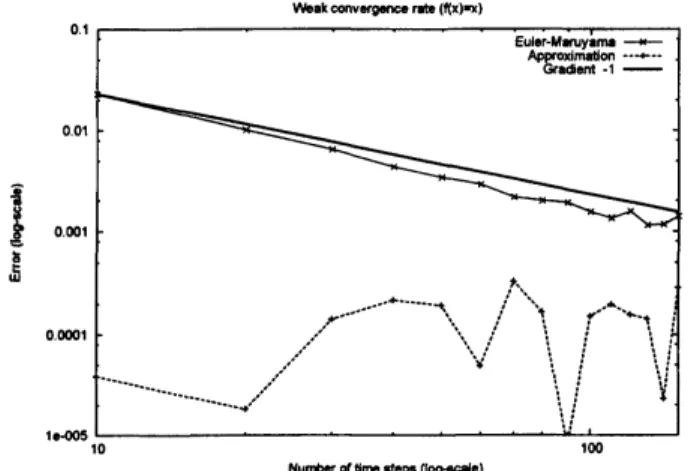
odd ffinction.Through Figure 1 to Figure 3, x-axis denotes the number oftime steps $n$ until time 1
Rom 10 to
150
with logarithmic scale. Weakerrors
of simulation resultsare
reported ata
logarithmic scaleon
they-axis,
thatis
$|E[f(X_{1})]-E[f(\overline{X}_{1})]|$ (thin line) and $|E[f(X_{1})]-$$E[f(\overline{X_{\sim_{1}}^{\sim}})]|arrow$ (dotted line), where to obtain their
expectation
values,we use
the Monte-Carlomethod with $10^{7}$ simulations for each $n$
.
If theyare
parallel to the thick straight line, theconvergence
ratehas the order 1.Thenumericalresultin the
case
of$f(x)=x$is the following:Weakoonvergencerate$(x)r)$
10 100
Number$othm\cdot t\cdot p\cdot(Q\infty 0)$
Figure 1: No. of time steps -weak
error
$(f(x)=x)$.
From Figure 1, it is easytofind that the
convergence
rateofthe Euler-Mamyamamethodhas order 1, but for the Euler-Mamyama methodwith the approximated drift, the
approxi-mation converges
muchfaster than the uncorrectedone.
5.2
Case:
$\theta_{1}=-\theta_{0}=1$and
$f(x)=\mathscr{K}$Here
we
use
thesame
values of parametersintheprevious section andlet$f(x)=x^{2}$.
FromKaratzas and Shreve [3,Exercise6.5.3,pp.441],
we
have$E[X_{t}^{2}]=\frac{1}{2}+\sqrt{\frac{t}{2\pi}}(|x|-t-1)\exp(-\frac{(|x|-t)^{2}}{2t})+\{(|x|-t)^{2}+t-\frac{1}{2}\}\Phi(\frac{|x|-t}{\sqrt{t}})$
$+e^{2|x|}(|x|+t- \frac{1}{2})[1-\Phi(\frac{|x|+t}{\sqrt{t}})]$ ,
where set
Andin the
case
of$x=0$and$t=1$,we
obtain$E[f(X_{1})]=0.333369$.
Thenumerical resultinthe
case
of$f(x)=$ isthe following:Weakconvergencerate$(f(x)-^{A}2)$
$tO$ tOO
Numberoftme steps(log-scale)
Figure2: No. oftimesteps-weak
error
$( \int(x)=x^{2})$.
FromFigure2,
we
easily findthat the rate ofconvergence in the both methodsis 1.5.3
Case:
$\theta_{1}=-\theta_{0}=1$and
$f(x)=1(x>0)-1(x\leq 0)$Inthis section,
we use
$f(x)=1(x>0)-1(x\leq 0)$which does not have regurality and doesnotbelong to
our
theorem. Note that the fimciton$f$is symmetricwithrespect to the origina.e.
and$X_{t}$hasthecontinuousandsymmetric density fimctionso
thatwe
have$E[f(X_{1})]=0$.
The numericalresult inthe
case
of$f(x)=1(x>0)-1(x\leq 0)$ is the following:Weakconvergence rate$(f(x)^{-}-ind|cator)$
70 100
Number of bmesteps$\{\log-\infty de)$
FromFigure3,it
is easy
tofindthat theconvergence
rateofthe Euler-Maruyama methodhas order 1, but
as
before the Euler-Mamyama method with the approximated drift,con-verges
faster.We
have
testedthreecases
above,the weakconvergence
rateof
theEuler-Mamyamaap-proximation in all ofthem is 1. And
in
thecase
oftheEuler-Mamyamaapproximation withthe approximateddrift,
we
couldnotobtain therate ofconvergence
becausetheapproxima-tion
converges
too fast for$f(x)=x$and $1(x>0)-1(x\leq 0)$,butfor$f(x)=x^{2}$,we
find thatthe
convergence
rate is 1. This is probably due to how $\epsilon$ is chosen. In this case,we
havechosen this examplebecause
we
can
obtain the weak limitin closed form. In orderto haveslowerorders,
we
need toconsidermore
complicatedsituations.
References
[1] R.F.Bass,Diffusionsand Elliptic Operators,Springer,1998.
[2] K.S. Chan and O. Stramer, Weak Consistency
of
the EulerMethodfor
Numerically SolvingStochasticDifferentialEquations with Discontinuous Coefficients, Stoch. Proc. Appl. 76(1998),33A4.
[3] I. Karatzas and S.E.Shreve,BrownianMotionandStochasticCalculus,2nded.,Springer, 1998.
[4] P.E. Kloeden and E. Platen,Numerical Solution
of
StochasticDifferentialEquations, 3rded., Springer,1999.
[5] A.Kohatsu-Higa,A. Lejay,and K.Yasuda,Approximationmethods
for
stochasticdifferential
equationswithnon-regular
drift
(2012). Inpreparation.[6] N. Krylov, An inequalilyinthetheoryofstochasticintegrals, Th. Probab. Appl. 16(1971),438A48.
[7] O.A. Lady\v{z}enskaja, V.A.Solonnikov,and N.N.Ural’ceva,LinearandQuasilinear Equations
ofParabolic
Type,AmericanMathematicalSociety, 1967.[S] V.Mackevi\v{c}ius, On theconvergencerate
of
Euler schemefor
SDE with Lipschitzdrift
andconstantdif-fusion, Proceedings oftheEigth Vilnius ConferenceonProbability Theoly and MathematicalStatistics,
Part I(2002),2003,pp.301-310, DOI 10.$1023/A$: 1025754020469.
[9] R. Mikulevi\v{c}iusand E.Platen,Rateofconvergence
of
the Eulerapproximationfor diffusionprocesses,Math. Nachr. 151(1991),233-239, DOI 10.$1002/mana$.19911510114.
[10] P. Przybylowicz, The Optimality
of
Euler-type Algorithmsfor
Approximationof
StochasticDifferential Equations with Discontinuous Coefficients,2010.Presentation slide.[11] A. J. Veretennikov, Onstrongsolutions and explicit
fomulasfor
solutionsof
stochastic integralequa-tions,Math.USSR Sb.39(1981),no.3, 387-403, DOI 10.$1070/SM19Slv039n03ABEH001522$