Japan Advanced Institute of Science and Technology
JAIST Repository
https://dspace.jaist.ac.jp/
Title ビジネスプロセスマネジメントのためのサービスドミ
ナントロジックに基づくサービスメディエータモデル
Author(s) Doan, Minh Chau Citation
Issue Date 2015‑03
Type Thesis or Dissertation Text version ETD
URL http://hdl.handle.net/10119/12761 Rights
Description Supervisor:小坂 滿隆, 知識科学研究科, 博士
A SERVICE MEDIATOR MODEL
BASED ON SERVICE DOMINANT LOGIC FOR MANAGEMENT OF BUSINESS PROCESS
Doan, Minh Chau
Japan Advanced Institute of Science and Technology
a
Doctoral Dissertation
A SERVICE MEDIATOR MODEL
BASED ON SERVICE DOMINANT LOGIC FOR MANAGEMENT OF BUSINESS PROCESS
Doan, Minh Chau
Supervisor: Professor Michitaka Kosaka, Ph.D
School of Knowledge Science
Japan Advanced Institute of Science and Technology
March 2015
b
Acknowledgement
First and foremost, I owe my deepest gratitude to my supervisor, Professor Michitaka Kosaka. Thanks for his warm-hearted instructions, patience that encouraged and helped me during my research period. From the bottom of my heart, I know that it is fortune to have professor Kosaka supervised my research. I am grateful for all his aspiring support, invaluably constructive criticism and friendly treatment which instructed me to be more logical and become mature, not only in this research but also in my real life.
I would once again deeply appreciate my institute, the Advanced Institute of Science and Technology that gave me the GRP scholarship supporting my PhD research. The scholarship not only offered financial assistance to my study but also had a great impact on my motivations and research. Moreover, the strong supports and encouragements from JAIST professors and staffs will never be forgotten. They have helped me to cope with many difficulties, especially lectures, sub-theme research and working environment. I would also like to express my warm thanks to Professor Huynh Van Nam, for his kindly support and valuable instructions in my research papers and the sub-theme.
Through the case studies, I have learned a lot from the interviewers. I would like to thank Mr. Pham Phu Ngoc Trai, Ms. Van Thi Anh Thu of Suntory PepsiCo Vietnam Beverage for their time and consideration. Their given interviews contributed much to this research. It is my honor to thank managers of municipal hospital in Ishikawa, and Mr. Kamada from Hitachi TWX-21. The information provided had been of much help for me in the research.
I am blessed every day of my life to be with a friendly and cheerful group of fellow students. Thanks to them I can have a life filled with joy and happiness.
Besides, it is my pleasure to return the compliments to all my Japanese friends whose kindness helped me to get acquainted to Japanese lifestyle. They introduced to me the beauty of Japan’s landscape, the hospitality of Japanese people, along with the unique in culture and delicious food of Japan. I enjoyed my time being here deeply thanks to their kind-hearted.
Words cannot express how grateful I am to my family. They are my endless hope and inspirations. Mom and dad, thank you for raising me up and always be there through thick and thin. My husband, the one bearing with me that I could cry and lean on anytime. To Mizi, my little daughter, thank you for coming into my world and make me a happy mother. Your being encourages me to do my best in everything. This research is for my beloved family.
i
Abstract
Keywords: service field; service mediator; service dominant logic; information service; business management, human resource management.
The recent upsurge in service management activities in firms has also attracted the investigative interests of research scholars. Issues in service activities have been researched and solved through the lens of service perception. Several approaches to service have been discussed to promote the effectiveness of businesses. The service dominant logic (SDL) proposed by Vargo and Lusch (2004) has notably revealed alternative direction in service management, where service values have been noted as being the most important factor in the service process, in which collaboration between firms and customers is crucial from the viewpoint of the value-in-use concept. On the other hand, the good dominant logic (GDL) concentrated on selling goods (value added) but not considering the real value products could even serve customers (value in exchange). It is a simple model in which suppliers is the providers (firms) selling the products and giving value to the recipients (customers).
Consequently, the conventional mediator based on GDL also existed but it depends greatly on transferring the value added on products/services. This kind of mediator is not really a bridge to match supplies and demands between suppliers and users. It lacks of value co-creation to fulfill the real seeds and needs of organizations and customers.
This research introduces the service dominant logic applied in business process management with service mediator model. The concept of a service mediator has been proposed to IT service business and human resource management to fill the gaps in collaborations between providers and users. Providers and users here are considered equally in service exchange in business and they are both beneficiaries in the process. They could be firms, customers, employers, employees, etc. in the service process. The service mediator supports co-creation between service providers and users by matching services, sharing information, and promoting collaborations.
A service mediator matches providers’ service seeds and customers’ service needs to create service values between providers and customers (Doan and Kosaka, 2011). This research proposes a service mediator model, which based on value co-creation concept and service field concept. In this research, three players model has been emphasized because its role in some business processes is better than two players (organizations and customers) work with each other. The proposed model concentrated on value co-creation in SDL to strengthen the relationship between organizations and its customers.
The effectiveness of the mediator in the IT service business and human resource management has been verified through successful business outcomes from case studies carried out during the research period. With the results finding, this research contributes to create new knowledge to business management. Regarding service experience, this model contributes to understand value co-creation and enhance the service value. Moreover, this research brings practical knowledge to organizations by encouraging them to strengthening firms’ performance by creating good service field equipped with supporting functions. They should focus on IT infrastructure and develop IT system as a competitive tool management. Training T-shape people is also our suggestion to enhance the value co-creation.
ii
List of Abbreviation
SSME: Service Science, Management, and Engineering SDL: Service dominant logic
GDL: Good dominant logic GDP: Gross domestic product HRM: Human resource management
AMD: Administration management department OHS: Organization health survey
MQPI: Management quality performance index
iii
Table of Contents
Acknowledgement ... i
Abstract ... ii
List of Abbreviation... iii
Tables of contents……….………...…iv
List of figures.………..………viii
List of tables………..………ix
Chapter 1 Introduction ... 1
1.1 Backgrounds ... 1
1.1.1 Service economy – A recent important economy trend ... 1
1.1.2 The service perspective in management of business process ... 3
1.1.3 Issues in management of business process ... 4
1.2 Research originality and novelty ... 7
1.3 Objectives and research questions ... 8
1.4 Research methodology ... 9
1.4.1 Hypotheses proposed methodology ... 9
1.4.2 Case study methodology ... 9
1.4.3 Data collection techniques ... 10
1.4.4 Data analysis strategy ... 11
1.5 Organization of the study ... 11
Chapter 2 Literature review ... 13
2.1 Introduction ... 13
2.2 Service science ... 13
2.2.1 Principles of service science ... 13
2.2.2 Core research in service science ... 15
2.2.3 Core collaboration ... 17
2.2.4 Future challenges ... 17
2.3 Good dominant logic versus service dominant logic ... 18
2.3.1 Good dominant logic (GDL) ... 19
2.3.2 Service dominant logic (SDL) ... 23
2.3.3 Contrasting the different of GDL and SDL ... 27
iv
2.4 The emergence of value co-creation in reality ... 31
2.4.1 Value in exchange versus value-in-use ... 31
2.4.2 Value creation versus value co-creation ... 32
2.5 Value co-creation in service field concept ... 35
2.5.1 Definition of service field ... 36
2.5.2 Value co-creation in the service field ... 36
2.5.3 Mechanism to create high service value ... 37
2.6 Business model: Two-sides attendants versus three-sides attendants ... 38
2.6.1 Two-sides attendants in the business ... 39
2.6.2 Three-sides attendants in the business... 39
2.7 Previous approaches of HRM in balancing the relationship between employers and employees ... 40
2.8 Summary ... 41
Chapter 3 Hypotheses for a service mediator model ... 42
3.1 Classification of business models and proposal of a service mediator model. ... 42
3.1.1 Classification of business models ... 42
3.1.2 Proposal of a service mediator model ... 45
3.2 Foundations from SDL ... 46
3.2.1 Importance of SDL in the service mediator model ... 46
3.2.2 How have SDL supported for the service mediator model ... 46
3.3 Foundations from service field concept ... 47
3.3.1 Importance of service field concept in service mediator model ... 48
3.3.2 How have the service field concept supported for the service mediator model ... 48
3.3.3 Identification of the service field to find suitable services for value co-creation .... 50
3.4 Hypotheses for the service mediator model in the business management ... 51
3.4.1 Hypotheses from SDL and the service field concept ... 51
3.4.2 Structure of the proposed service mediator model ... 54
Chapter 4 Case studies in IT service management ... 56
4.1 Introduction ... 56
4.2 Case study of Hitachi TWX-21 ... 56
4.2.1 Organization profile ... 56
4.2.2 Analysis of Hitachi TWX-21 ... 57
v
4.3 Case study of Cookpad ... 65
4.3.1 Organization profile ... 65
4.3.2 Analysis of Cookpad ... 65
4.4 Consideration of required functions of service mediator... 73
Chapter 5 Case study of HRM ... 75
5.1 Introduction ... 75
5.1.1 Human resource management as service management ... 75
5.1.2 Chapter’s objectives ... 76
5.1.3 Cases selection ... 77
5.1.4 Chapter organization ... 78
5.2 The case study of municipal hospital in Ishikawa prefecture ... 78
5.2.1 The case study methodology ... 78
5.2.2 Outline of case organization ... 80
5.2.3 How to solve issues using the service mediators’ functions ... 82
5.2.4 Effects in introducing the service mediator model in the hospital ... 89
5.2.5 Consideration ... 90
5.3 Case study of Suntory PepsiCo Vietnam Beverage (SPVB) ... 95
5.3.1 Case study methodology ... 95
5.3.2 Outline of case organization ... 96
5.3.3 How to solve issues using the service mediators’ functions ... 98
5.3.4 Effects in introducing the service mediator model in SPVB... 104
5.3.5 Consideration from viewpoint of the service mediator ... 108
5.4 Justification and verification of hypotheses and proposals ... 111
5.4.1 Comparison of the case studies’ mediator model and proposed service mediator model ……… 111
5.4.2 Case studies’ summary ... 114
Chapter 6 Conclusion ... 115
6.1 Introduction ... 115
6.2 Answer for research questions ... 115
6.3 Theoretical implications ... 123
6.4 Practical implications ... 124
6.5 Research limitations ... 124
vi
6.6 Suggestions for future research... 125
References ... 126
Appendix A... 133
Appendix B... 134
Appendix C ... 136
Publications ... 137
vii
List of Figures
Figure 1.1 Percentage of service sector in the GDP ………..2
Figure 1.2 Issues in HRM………...6
Figure 1.3 Case study strategy in this research………..10
Figure 2.1 Definition of service ………...14
Figure 2.2 Service research priorities framework………..16
Figure 2.3 References listing unique characteristics of services………21
Figure 2.4 Business model based on GDL……….22
Figure 2.5 Business model based on SDL………..27
Figure 2.6 Collaboration of firms and customers in GDL and SDL………….…………..31
Figure 2.7 Maximizing service value model……….….38
Figure 3.1 Classification of business models………..………43
Figure 3.2 Service field and service value creation………50
Figure 3.3 Structure of proposed service mediator model………..54
Figure 4.1 Structure of Hitachi TWX-21………57
Figure 4.2 Hitachi business framework……….58
Figure 4.3 Hitachi TWX-21 mediator system in China – SCM project...……...60
Figure 4.4 Structure of SaaS business support service……….62
Figure 4.5 Cookpad’s framework……….66
Figure 4.6 Example of Cookpad.com categories……….……….70
Figure 5.1 Management structure of municipal hospital in Ishikawa, Japan……….81
Figure 5.2 Mediator model in hospital’s human resource management………84
Figure 5.3 Gaps in collecting and sharing information between doctors and nurses…….85
Figure 5.4 Gaps in collecting and sharing information between doctors and technicians..88
Figure 5.5 Structure of mediator model in SPVB human resource management…………99
Figure 5.6 Think – Build – Act process of SPVB………101
Figure 5.7 Response rate of employees in OHS………..…104
Figure 5.8 SPVB 2013 summary category score……….105
Figure 5.9 Comparisons of SPVB’s OHS results with Vietnam and APAC norm………..107
Figure 6.1 Structure of a service mediator enhancing collaborations…….………..117
Figure 6.2 Concerns in providers and receivers interactions………...………….118
viii
List of Tables
Table 1.1 Percentages of world force labor in each economy sector………..3
Table 2.1 Foundational premises of SDL………25
Table 2.2 Contrasting of GDL and SDL………29
Table 2.3 Distinguish good-centered logic and service-centered logic………30
Table 2.4 Concept of co-creation……….……34
Table 2.5 GDL vs SDL on value creation………...35
Table 3.1 Roles and proposed functions of the service mediator……….55
Table 4.1 Hypothesis justification of Hitachi TWX-21 and future implications…………64
Table 4.2 Hypothesis justification of Cookpad and future implications……….……72
Table 4.3 Comparison of roles and functions between proposed model and case studies’ models in IT business………..………73
Table 5.1 Objectives and propositions of providers and receivers in HRM………..76
Table 5.2 Hypothesis and summary of hospital case study.………...90
Table 5.3 Real procedure of the service mediator in the hospital………..92
Table 5.4 Hypothesis and summary of SPVB case study………108
Table 5.5 Real procedure of the service mediator in SPVB……….110
Table 5.6 Comparison of roles and functions between proposed model and case studies’ models in HRM ………112
ix
Chapter 1 Introduction
1.1 Backgrounds
1.1.1 Service economy – A recent important economy trend
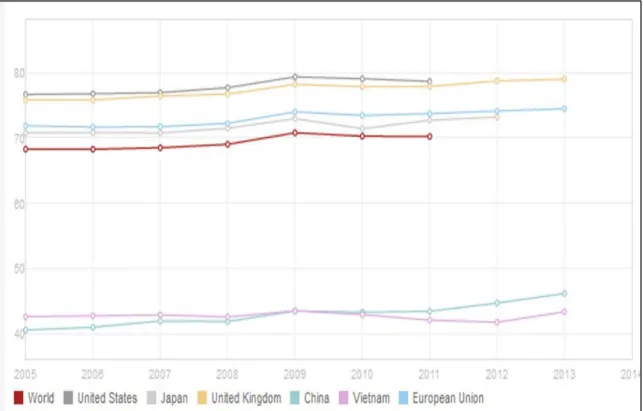
Nowadays, service represents the important and growing contribution to most economies in the world. The industry now dominates the economics with large percentages of GDP come from this sector. In developed countries, service sector forms the largest part of GDP (over 70%), above world average. In developing countries such as China or Vietnam, the service sector has increased every year (Figure 1.1). Globally, new jobs are mostly generated in the service sector. There are many forces which are transforming economies and making them more service-oriented such as government policies, social changes, business trends, advances in information technology and globalization (Lovelock, Wirtz, and Chew, 2008).
Their impacts on the service economy range from the creation of new services, and increase competition to new measures to protect consumers.
The servitization for products impacts the economics activities change. Nowadays products are the distributions of the demanding services. It increases the importance of the service sector in the world economies. Top organizations in the world generate into service companies more than any time before. IBM, Apple, Amazon, etc. are pioneers in developing their company by concentrating on providing services. Even though they sell tangible products, there is no denying that they provide the best services for customers’ needs.
1
Figure 1.1 Percentage of service sector in the GDP Source: The World Bank, access November 2014
Furthermore, world’s labor force in each sector of each country has changed in the last 25 years. As showed in table 1.1, the economy of the world has shifted from agriculture and manufacturing into servitizing. It marked a new era in society as people recognized and affirmed the dominance of service and its influence. Significant development of service firms means improvement in service skills for job candidates. Hence, knowledge on servitization and its components is necessary and would become a competitive edge in the labor market.
Because of its crucial role, emerging research on the science of service is essential. The business industry is not the only one focusing on service, since academic researchers also want to work on service theory and its model. More than any time before, this topic is being concentrated and addressed by interdisciplinary focus in search of the answer to the complex nature of services.
2
Table 1.1 Percentages of world force labor in each economy sector Source: Spohrer and Maglio, 2008
In the past, companies usually thought of manufacturing and selling goods to consumers. Now, many companies catch the service trend by shifting their business from goods to services, especially information companies such as IBM, Hitachi, Fujitsu, etc. They have developed the service business by using Information Communications Technology (ICT) to provide high quality services that can satisfy their customers. Those important and fast changing businesses call for a new business model to help improving the productivity and gaining success.
1.1.2 The service perspective in management of business process
A business process is a combination of activities which assists the delivery of a service or a product to customers. It has also been defined as a set of tasks which when they are completed, they will archive the organizational goals. The process contains many operations
3
within the organization and needs a clear vision to make them work smoothly and support the business process’ management. With the dominance of services in the economy, perspectives of doing a business have changed.
Before the boom of services’ era, firms provide customers with value-added on the products. Customers could only have the value set by providers. Actually they did not even have the chance to decide the value they wanted. In that sense, there was a big gap to fill customers’ satisfaction. Recently, service scientists have recognized the term “service dominant logic” (SDL). SDL is driven by the definition of service as “the application of competences for the benefit of another entity” (Vargo and Lusch, 2004a). It focuses on customer-centric and customer responsiveness.
This logic enhances the strength of the firm to meet customers’ needs and to achieve both organizational and societal objectives. The alternative mindset shifts business’ center of interest from goods manufacturing to service provision. Nowadays, companies might not offer to customer the value-added, but instead the value-in-use to please them. The value should be co-created by both the customers and the firms.
The alternative logic reorganizes the way firms do business and manage their organizational operations. This research argues the new model based on the service mindset to help firms work better and more successful.
1.1.3 Issues in management of business process
The business process needs a completed management for organization performance such as business model, business strategy, human resources management, accounting or etc.
Those factors will contribute to the quality of services or products of the organizations.
Among that, the issues of business model (for example in IT service business) or general human resource management are the core activities, which could affect to business management. Below are the issues that should be concerned.
(1) Issues in IT service management
IT service is a fast growing business nowadays. It is an important service that supports many other businesses in system and database management, procurement, finance or
4
marketing, etc. Being a hot-trend service, besides potential chances for developing and success, there are many issues in this business. The IT service company works with both business partners and users to help deliver suitable services with adequate requirements. In those exchanges, co-creation process is significant in order to build optimized value. IT service is intangible and it is hard to weight or measure it. Satisfaction is based on the experience obtained by actually using the service.
There are a lot of gaps between providers and users. Users usually lack the technically specific information and knowledge. They need a friendly environment to interact with providers and share their values. In fact, customers want to be involved in the service’s creation process because only when they agree with the service propositions, would they have the highest satisfaction. The problem occurs because it is not that easy to encourage people to take part in the value creation process. Not all providers are professional in supporting their users. Shortage in human resource, low ability or bad communications leads to failure when seeking co-creation from users. Therefore, the service mediator must be existed.
The service mediator provides supporting functions that can assist providers and users to collaborate with each other. The service mediator must be equipped with effective tools so that excellent services would be delivered and business exchanges are supported. Because it is the bridge towards solving the problems and matching the seeds and needs between suppliers and users, it requires setting up functions that are essential to respond to customers’
expectations and demands.
(2) Issues in human resource management (HRM)
People are always the significant resource in business success. HRM is recognized as a part of an organization, which involves hiring and controlling the labor force of the business.
HRM plays a more important role in organization activities than just paperwork in managing people. Previous research had found that HRM is one considerable factor that can help an organization become more effective and gain a competitive advantage (Becker and Gergart, 1996; Delery and Doty, 1996; Becker and Huselid, 1998; Rogg et al., 2001, Liu et. al., 2007).
Research attention has recently turned to the effects that HRM system has had on employees’
attitudes and behaviors (Allen et al., 2003; Kuvaas, 2008; Wright et al, 2003; Zacharatos et al., 2005). Results of those researches have demonstrated that HRM is both effective and
5
related to the performance of organizations and employees.
How HRM deals with both obstacles and conflict between employers and employees is a question that has inspired research scholars devoted to this field. Issues associated with human resources such as staffs’ turnovers, recruitments, promotions, motivation, rewards and benefits, education and trainings have been widely identified as critical concerns in the operation of an organization. The expectations of both employers and employees regarding these matters to fulfill each other’s needs have been unraveled. Conflicts of interest have become the focus of attention in this relationship. Furthermore, low adaptation to technology could even limit the ability of HRM to support the business’ processes. Also, lack of communication could even lead to misunderstandings between firms and staffs. As a result, these issues would individually affect the performance of both organizations and employees.
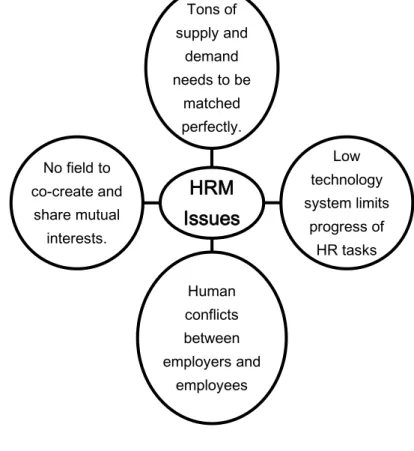
Relationship between organizations and employees is very complicated and thus always requires a system to not only balance on either sides but also inspire collaboration. Moreover, unsolved issues in HRM entail a completed system to solve and simplify cooperative processes within the organization. Figure 1.2 outlines the current issues in HRM.
Figure 1.2 Issues in HRM HRM
Issues
Tons of supply and
demand needs to be
matched perfectly.
Low technology system limits
progress of HR tasks Human
conflicts between employers and
employees No field to
co-create and share mutual
interests.
6
1.2 Research originality and novelty
Recently, the service science is a new academic field so there should be more focus on researching it. There are a great number of previous researches relating to service science, which concentrated on identifying and defining the concepts, characteristics, and applications, etc. of service science in an effort to understand the new circumstances of business. Service perspectives have been argued as significant propositions for managing business process.
Researchers are simultaneously concentrating on raising new perspectives, which drive the service industry in a more correct way. New business models and strategies generated by those new logics provide a foundation for the company’s theory. The service perspectives are changing the viewpoint of value creation, which in turn leads to the transformation of business model. For example, Gadrey et al. (2002) considered that the providers and clients work together to create value. The clients have the power to ask for values from the providers, thus they become co-producers in the value creation process. The service dominant logic (Lusch and Vargo), which has been cited in many kinds of academic research such as marketing theory, organizational dynamics, retail, and etc., affirms the significant and evolutionary prospect of the service mindset. Co-creation concept has also been discussed as a fundamental factor in business exchange. Firms and academia together argued over the significance of the service logic and how to apply it to the real world.
Though there are many researches about how service logic supports the economic system, marketing or health care services, there is not yet any detailed research analyzing the work and role of mediators in business process management from the service perspective. The service mindset has been applied to the eco business system with two players: providers and receivers. In the scope of this research, a new service model for mediator has been proposed to business model of three players. The new model should explain the roles of service mediator for mediating providers and receivers in business exchange, and how the service mediator supports value co-creation between two sides. In the context of service science, understanding the work of service mediator from the service perspective helps firms reorganize their organizational structure and utilize human resources for managing the business process.
In fact, the mediator model has been researched and existed in the real business hence it is not a new model in the business industry. However, the existed model has a lot of gaps and
7
still based on good-oriented perspectives. Therefore it has paid little attention to value co- creation and lacked neither satisfaction from providers nor receivers. This research develops a novel model of mediating process, which involves the collaboration between providers and receivers in order to obtain mutual agreement and extract the highest value through co- creation process. The final results will satisfy all parties in the exchange and fulfill their requirements. Service dominant logic (Vargo and Lusch, 2004a) and the service field concept (Kosaka et. all, 2011) are the key concepts for this new model.
1.3 Objectives and research questions
Having reviewed the existing scholar works / literatures that are relevant to this research, new service mediator model proposal is the direction and outcome needed. The purposes of this research are to explore and develop a service model for organizations which could mediate the service exchange providers and receivers to support the business process.
The case studies have been done to justify the possibility of the proposed model and verify the hypotheses.
With this research, the main outcome is to develop a service based mediator model, and emphasize the role of the service mediator model in helping both providers and receivers.
Through findings on the service mediator roles and functions, suggestions and implications for firms to improve the performance of organizations have also been made.
The research is guided by the major research question (MRQ)
MRQ: How have a service mediator model supported for management of business process?
and three subsidiary research questions:
SRQ1: How have the service mediator enhanced collaborations between providers and receivers and get satisfactions in the business process?
SRQ2: What are roles of the service mediator to support both providers and receivers in the business process?
8
SRQ3: What are the useful functions that promote value co-creation between providers and receivers in the business process?
1.4 Research methodology
1.4.1 Hypotheses proposed methodology
Empirical works and literatures of preceded scholars and scientists have been reviewed to gain an understanding of what have been researched in this field. Having found the gaps and issues of the current situations, the hypotheses are made on the basis of alternative concepts to develop a new model which can solve the existed issues and problems.
1.4.2 Case study methodology
To verify this research’s hypotheses, a qualitative approach was used. To understand about the service phenomena and its applications on management of business process, several ways have been done such as preliminary surveys, questionnaire and interviews. When the questions “How” and “Why” have been asked, the case study is a suitable research method since the investigator has little control over actual events and the research focuses on a contemporary phenomenon (Yin, 2009). Therefore, the case study has been chosen as the main method for this research to explain the service mediator’s behaviors and how the service mediator interacts with and responses to providers and receivers’ needs.
To converse about the management in business process, two types of business process have been chosen: one is the IT service business and another is the human resource management process. The case studies have been chosen based on the performance success of the companies who have their frameworks related to the hypotheses. First, the case studies in IT service have been conducted to verify the hypotheses and explore the real procedure in the service mediator model. After analyzing the data from two organizations, key factors of each mediator model in each company would be discovered and verified with hypotheses. Then the hypotheses and real procedures are justified and verified again in HRM. Prosperous operations of the organizations have proven the effectiveness of the hypotheses. Thanks to great support from key person of each company in the case studies, invaluable information
9
and knowledge that support this research have been obtained.
Figure 1.3 demonstrates the strategy of the case study methodology
Figure 1.3 Case study strategy in this research
1.4.3 Data collection techniques
Four types of data collection techniques have been used in this study including:
questionnaire, interview, website observation and document record. First to mention is questionnaire, which has been distributed in primary survey of the case studies. Based on the questionnaires, results are easy to be analyzed due to clear and closed responses. The questionnaire gave the preliminary results before interviewing people in the organizations.
The second and also the main technique is the interview, which is aimed to gather in- depth and wide variety of information for the case studies. Interviews were conducted with key persons in the companies of the case studies. In this research, they are top managers from Hitachi TWX-21, municipal hospital in Ishikawa, and Suntory PepsiCo Vietnam Beverage.
Another interview was conducted with Mr Miwa, a person who investigated about Cookpad’s operation. His findings gave us a general view of Cookpad’s business framework. Semi-
10
structured interviews were used with clear and opened questions to encourage free responses and opened answers. The interviewees not only answered the questions but also gave deep inside knowledge of their companies for more gainful information.
Website observation and document records have also been used to procure more information for the case studies. The observations of website allowed us to study the dynamics of the situations or aspects of the targeted cases. It has given additional information about those cases and provided good data for analysis. Next, the records of organizational documents consist of existing data such as reports or results of company’s projects. That information contributed greatly to the data collection.
1.4.4 Data analysis strategy
After being collected from the case studies, the data were then analyzed to achieve usable and useful information. The data were summarized and described, and then the key factors of each case study’s framework were identified, consequently comparing those frameworks’ factors with the hypotheses. This analytical technique is called pattern-matching logic (Trochim, 1989; Yin, 2009). The logic compares an empirically based pattern with several alternative predictions. If those patterns match the hypotheses, hence the results will enhance the validity of the case studies.
In pattern matching procedure, the collected data are classified into roles and functions of the organizational mediator. This information is then compared with the roles and functions of the proposed service mediator model to justify and verify the possibility of the proposal. Finally, conclusions are made to answer the research questions and provide future implications.
1.5 Organization of the study
This research has been organized with six chapters. Chapter 1 presents the general introduction of the research.
Chapter 2 introduces the literature reviews with wide range of contents about the service knowledge and research. Service related researches from other literature such as business, HRM, law, philosophy, etc. also has been reviewed for general perception as well. There is a
11
need of carefulness in reviewing the literature of service science for the purpose of understanding and comprehending its concepts and many viewpoints of the service when choosing a right approach for this research project.
Chapter 3 raises the hypotheses extracted from the alternative foundations and concepts.
Having studied previous researches and works from service scientists, hypotheses of service mediator model has been made in order to enhance the value co-creation and step up to achieve customers’ satisfaction.
Chapter 4 and chapter 5 are dedicated to discussion about the case studies in two types of business process. Chapter 4 conducts the case studies in IT service business then finds the actual procedures of their researches and verified them with the hypotheses. Chapter 5 describes the case studies in human resource management. The analysis of these cases studies determined the reality frameworks in organizations and verified the hypotheses. The roles and functions of the service mediator are identified and future implications for both providers and users in service exchange are given.
Chapter 6 concludes the summary of findings to answer the research questions, provide both theoretical and practical implications. Moreover, the limitations of the research have also been discussed and directions for future research will be considered.
12
Chapter 2 Literature review
2.1 Introduction
This chapter reviews existing materials with importance provided by the relevance to research topic and arguments. Many scholars have researched on the field of service in regards to the fast changing service sector in the economy. In accordance with the development of service economy, the importance of the service viewpoint is noticed. Both academia and industry calls for activities and efforts to contribute in the service knowledge.
The purposes of this chapter are to present the established findings and to note any gaps of previous researches, thus making premises for the research. Firstly, what has already been written on the service science topic would be determined. Scientists have founded the principles, concepts for the services science. However, there was innovation from GDL to SDL. In addition, service perspective renovates the business structure of firms. Researchers have emphasized the role of value co-creation and affirmed its essential in the new stage of doing business.
Business model has changed in many business fields with the development of service science. Nonetheless, there was no completed model for those firms in order to response to higher requirements of customers. Reviewing the theme of this topic helps integrate the viewpoints of service and others concepts such as value co-creation, value-in-use so as to propose a service mediator model.
2.2 Service science
2.2.1 Principles of service science
Ever since the service sector became the largest past of most economies, service concepts have been focused on and considered as one of potential topics for social developments. Service science is about studying the service system, defining the framework and service-centered conceptual foundation.
In 2004, IBM has introduce the Service Science, Management, and Engineering
13
(SSME) to illustrate service science, “an interdisciplinary approach to the study, design, and implementation of service systems”. They are complex systems in which people make compromises and use technologies to bring value for others. More precisely, “SSME has been defined as the application of science, management, and engineering disciplines to tasks that one organization beneficially performs for and with another” (Spohrer, Maglio, Bailey, and Gruhl, 2007)
Several definitions of service have been proposed due to different views of scientists.
From the view of service marketing, Lovelock and Wirtz (2007) stated that “services are economic activities offered by one party to another”, such that “bring desired results” to the customers. Another definition is “a service is a time-perishable, intangible experience performed for a customer acting in the role of a co-producer.” (Fitzsimmons and Fitzsimmons, 2003). From the viewpoint of service dominant logic, “Service [is] the application of specialized competences (knowledge and skills), through deeds, processes, and performances for the benefit of another entity or the entity itself.” (Lusch and Vargo, 2004a).
In all of the above, the core premise, which is the “service is to support people or organizations to achieve objectives”, is of most important in considering value creation in the management of business processes. This definition comes from Kameoka (2010) and Sadahiko Oda (Kosaka, 2012). Kameoka defined services as activities to support people or organizations to achieve their objectives. Also, Oda, who is the chairman of Kagaya and is a well-known service practitioner, describes service as an activity that (1) provides professional techniques, (2) satisfies the customer, and (3) results in compensation.
According to his definition, most productive human activities are considered services, and services cover various types of business activities. These definitions are outlined in Figure 2.1
Figure 2.1 Definition of service Source: Kosaka, 2012
Providers Receivers
Professional technique, knowledge, etc.
Compensation (E.g. Money)
Objectives
Satisfaction
14
A service is defined, combining Kameoka’s and Oda’s definitions, as an activity that supports human beings or organizations and enables them to achieve their objectives or desires. This definition can be applied in management of business process such as service business activities or management of human resource.
By clarifying the definition of service, service science is an interdisciplinary academic research which focuses on fundamental service, models, theories, and applications that lead to service innovation, competition, and well process through value co-creation. Many disciplines such as economics, culture, organization theory, marketing service oriented architecture, business strategies, etc. have accumulated knowledge related to understanding service systems, each of which focuses on different aspects of the whole system.
“Service science combines organization and human understanding with business and technological knowledge to categorize and explain many existing types of service systems or model as well as how service systems interact and get involved in co-creating value” (Maglio and Spohrer, 2008). Thus, there should be an intensive collaboration between academia and service firms to learn from each other and contribute to the service research. In the scope of this research, SDL is considered as a potential perspective, an assumption in formulating a theory for service science and a foundation for further service research.
Till now, various perspectives of service science have been explored from different fields. Because there are confronts with lack of data to that might be confusing to choose as a theoretical foundation to lean for. Among the theoretical service perspectives, service dominant logic stands out as the alternative, pioneering and developing service innovations.
In recent years, the service dominant logic has been really focused on and dramatically argued over its applications. From the prominent aspects of the service dominant mindset, it has been used as a theoretical foundation to conduct this research and develop a service model to solve current issues of the business management.
2.2.2 Core research in service science
Nowadays, service research is an emerging topic contributing to the development of humankind. Through a comprehensive project, Arizona State University’s Center for Services Leadership makes an effort to identify and integrate the research priorities on the science of service.
15
After conducting months of research, scientists have worked with over 300 business executives and academics from a variety of disciplines, functions and geographies, which has led to ten overarching priorities for the science of service. Figure 2.2 illustrates the ten future research priorities.
Figure 2.2 Service research priorities framework Source: Ostrom et al., 2010
This figure shows the interests for future research, thus results in a global picture of development in service science. With the intention of providing the context of each priority, researchers should reinforce the research profile of services, intensify the R&D cooperation and create excellent service centers for enhancing the value of the priorities. This research focuses on execution priorities in researching the service model, which aims to enhance co- creation between providers and users to optimize the value of service.
16
2.2.3 Core collaboration
In order to embark effective research in the service science, every party in the society such as the academia, company, government and others should cooperate in the progress.
Engelmann (2008) considered this collaboration as “practice meets theory”. Academia carries out new theories frequently, and eventually expands them to the company as applications for the business. However, in some fast-changing areas, companies are more proactive in researching new topics and propose many inquiries for solving their issues. Nowadays, more and more company research centers are expanding their roles to concentrate on service as a roadmap for business innovations. IBM, Hitachi, etc. are the ones leading those trends. They have a close relationship with universities, research institutes to cooperate in developing the concepts of service science.
In another research, Edvardsson and Gustafsson (2008) emphasized the important relationship of academia and company in service science study. The collaborations among government, academia, and companies are encouraged to build up the innovation process.
With different perspectives about service(s), these parties could fulfill the gaps in each other.
Academies not only obtained research funding from companies and public organizations, but also could learn essential viewpoints from real-life case businesses. On the other hand, companies would benefit from the assistance they receive from academies in their business developing efforts. Moreover, organizations needs significant innovations for competitive advantage, but they lacks of time and human resources for research. Therefore, collaboration between company and academia is good for both sides and creates a win-win condition.
This research has been supported with collaborations from business organizations in finding an effective model concept. The successful framework of case studied companies has provided valuable information to the research project, as a consequence, the service mediator has been verified and back implications for attended organizations are provided. Therefore, useful suggestions for enhancing their operations’ performance by supporting co-creation process would be at service.
2.2.4 Future challenges
We have witnessed the fast growing service sector of the economy, which transforms all
17
economies to be service economy (Lusch and Vargo, 2008). There were a huge amount of works and researches in finding the context of service. Yet, was that enough? A financial crisis in 2008 destroyed the world economy, pointing out that financial systems, market systems, social systems, etc. lack of sustainability, direction and human’s consideration.
Gummesson (2010) believed that “people should be more open-minded, innovative and entrepreneurial in academic research and education as well as in business and government practice”. In his point of view, there should be innovation came from both service management and service science which helps solving issues in the service economy.
Another challenge of future research is how to deal with the complexity, context and change of the service(s) in the new era. The oriented philosophy – SDL in service science guides us to future research, but it seems people lack of a methodology of long term commitment to service issues.
One important additional challenge in further study is the expansion of generating value of service process. Value proposition for customers has always been an issue in the service business. A comprehensive value creation is to be expected in service provision. From the viewpoint of SDL, value creation reaches a new line in the way value is provided and delivered to customers. This research discusses the value creation in the next part of the literature review.
Last but not least, business process management is concerned as one of future science of service’s difficulty. Facing an increasing amount of requirements and expectations from customers day by day, firms are under an obligation to acquire a more productive and effective model to compete with impetuous difficulty of the market. It is not easy to have a good model for managing the business process, especially one that could bring success to the firms. Advanced research on the service is needed to propose an effective model based on suitable concepts and foundations.
2.3 Good dominant logic versus service dominant logic
In general, there are two orientations being discussed in service science. One based on the traditional perspective of economic exchange and value creation, which involves goods (tangible products). This good logic means that firm could turn goods into resources available for customer (Gronroos, 2006). The other service logic suggests that firm facilitates processes
18
that support customers’ value creation (1). There are many ideas about good dominant logic and service dominant logic. Given the scale of this research, orientations of good dominant logic and service dominant logic (Vargo and Lusch, 2004-2011) have been discussed to view the differences of those logics.
2.3.1 Good dominant logic (GDL)
Up to early 20th century, manufacturing industry accounted for most businesses in the economy. Therefore, in those days, the formal study of market focused at first on the delivery and exchange of commodities and manufacturing goods (Vargo and Lusch, 2004b).
That is to say, “good logic was a featured foundation in the economics” (Smith 1776, Shaw 1912, Marshall 1927; cited in Vargo and Lusch, 2004a). The foundation for GDL is begun in economic philosophy and economic science from work of Smith (1776) (2). Thus,
“the goods-centered model became the dominant paradigm for the business related disciplines” (Vargo and Morgan, 2005) (3).
In some of previous researches, the GDL assumes the following: (Vargo and Lusch, 2004a):
• The purpose of economic activity is to make and distribute things that can be sold.
• Those interests are preferably tangible.
• Manufacturers add utility and value to products in order to sell products to consumers.
• The products must offer superior value to consumers compared to competitors’
offerings.
• The firm should set all decision variables so as to have profit maximization.
• For both productivity and efficiency, the goods should be standardized and produced by decision of company.
_____________________________________
(1) Nordic school (School in the Nordic countries) implies the meaning of service logic in their school system.
(2), (3) Vargo and Akaka summarized the previous works in their paper “Service Dominant Logic as a Foundation for Service Science: Clarification”, Service Science 1(1), pp.32-41, 2009
19
As described above, from the viewpoint of GDL, product is the core of the economy.
Business models, strategies and marketing theories were established based on the good logic.
Because of this orientation, in previous researches of economic and market activities, “service was ignored though they existed” (Lusch, Vargo and Wessels, 2008). Over the years, people came to realize the significant role of service in the industry. It was considered as an add-on to the core product (e.g. things which are not agriculture, mining or manufacturing was labeled as services).
A wide range of separate researches on services marketing has seen service as a particular type of good. One of the most influential scientists in the services marketing, Lovelock (2007) defined “services are the performances that bring about the desired results for the customers”.
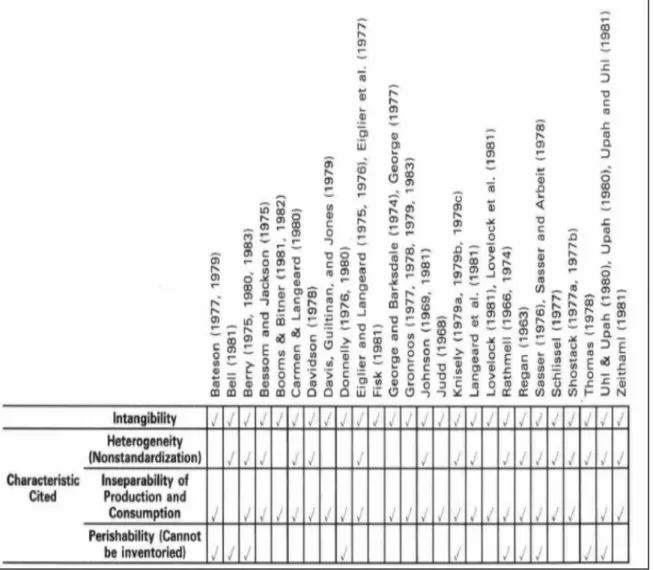
Because services are performances, rather than objects, a number of characteristics have been cited in the literatures includes: “intangibility, heterogeneity, inseparability, and perishability” (IHIP characteristic). Zeithaml, Parasuraman and Berry (1985) have reviewed the characteristics of services through previous researches as displayed in figure 2.3.
20
Figure 2.3 References listing unique characteristics of services Source: Zeithaml, Parasuraman and Berry 1985
Besides those characteristics, , Lovelock (2007) also pointed out some more distinct characteristic of servicessuch as:
• Most service products cannot be inventoried.
• Intangible elements usually dominate value creation.
• Services are often difficult to visualize and understand.
• Customers may be involved in co-production.
• People may be part of the service experience.
• Operational inputs and outputs tend to vary more widely.
• Time factor often assumes great important.
• Distribution may take place through non-physical channels.
21
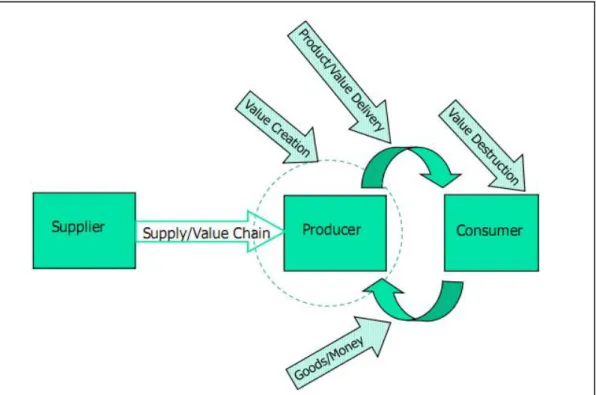
According to the unique characteristic of services, researchers pointed out the famous marketing mix 4Ps: Product elements, Place and Time, Price and Promotion. However, it is argued to be conventional practices in marketing. Through the service management’s perspective, Lovelock (2007) has added 3 more P which are: Process design, Physical environment, and People. This is a step up in GDL but there are still gaps when business comes to face current situation of the economy. Additionally, this business model was defined based on the GDL. It proposes the value-add on for goods/products. Figure 2.4 below explains the business model based on GDL.
Figure 2.4 Business model based on GDL Source: Vargo, 2009
Along with his research in GDL, Vargo (2009) has clarified the problems with GDL:
• Goods are not why we buy goods
• Goods are not what we fundamentally “own” to exchange with others
• Customer is secondary and seen as value receiver and destroyer
• IHIP characteristics do not distinguish services versus goods
Considering the problems of GDL, there will be a need of more service-center views for
22
responding the significant roles of service economy. A recent recommendable service oriented foundation would be the service dominant logic by Vargo and Lusch in their focused research since 2004.
2.3.2 Service dominant logic (SDL)
SDL is a view to understand the purpose and nature of organizations, markets and society. “The foundational proposition of SDL is that organizations, markets, and society should be fundamentally concerned with the exchange of service—the applications of competences (knowledge and skills) for the benefits of one party” (Vargo and Lusch, 2004a).
Thus, “service is exchanged for service; all firms are service firms; all markets are centered on the exchange of service, and economies and societies are all service based”. (Vargo and Lusch, 2004a)
Not up till now do researchers think about the service mindset. In the past, many scientists started to work on their field based on the service orientation. They thought of the service logic to argue with the good logic. Below are some famous arguments concerning the important role of service.
“What is needed is not an interpretation of the utility created by marketing, but a marketing interpretation of the whole process of creating utility.” - Fredric Bastiat (1848) - (4)
“The importance of physical products lies not so much in owning them as obtaining the services they render.” - Wroe Alderson (1957) - (5)
“Customers do not buy goods or services. They buy offerings which render services, which create value...activities render services, things render services.” - Philip Kotler (1977) - (6)
“The focus is not on products, but on the consumers' value -creating processes, where value emerges for consumers, and is perceived by them...the focus of marketing is value creation rather than value distribution.” - Evert Gummesson (1995) - (7)
_____________________________________
(4), (5), (6), (7) Cited in the www.sdlogic.net
23
With the proposal of SDL in 2004, Vargo and Lusch provided an alternative perspective for the study of economic exchange. The ideas of the two professors made a hit in the field of service science. It impressed the audiences and attracted them to an interesting topic: service dominant logic. Leading scholars in service science quickly joined in the discussion and appreciated for what Vargo and Lusch had done. SDL is considered as a foundation which can puzzle out the unsolved problems in the GDL. It is more consistent and can deliver more real value (applied, specialized knowledge) and value-in-use than the GDL.
SDL proposes the exchanges of service, not goods. Therefore, the definition of service in SDL refers to “service” (singular) which is a process, distinct from “services,” particular types of goods (Vargo and Lusch, 2004a). The ten foundation premises (Vargo and Lusch, 2008) help present the patchwork of the emerging dominant logic. Table 2.1 will intelligibly define 10 premises and explain what have been implied in those premises.
24
Table 2.1 Foundational premises of SDL Adapted from Vargo and Lusch, 2008
Foundation Premises Explanations
FP1 Service is the
fundamental basis of exchange.
The application of operant resources (knowledge and skills), “service,” is the basis for all exchange. Service is exchanged for service.
FP2 Indirect exchange masks the fundamental basis of exchange.
Goods, money, and institutions mask the service-for-service nature of exchange.
FP3 Goods are distribution mechanisms for service provision.
Goods (both durable and non-durable) derive their value through use – the service they provide.
FP4 Operant resources are the fundamental source of competitive advantage
The comparative ability to cause desired change drives competition.
FP5 All economies are
service economies.
Service is only now becoming more apparent with increased specialization and outsourcing.
FP6 The customer is always a co-creator of value.
Implies value creation is interactional.
FP7 The enterprise cannot
deliver value, but only offer value propositions
The firm can offer its applied resources and collaboratively (interactively) create value following acceptance, but cannot create/deliver value alone.
FP8 A service-centered view is inherently customer oriented and relational.
Service is customer-determined and co- created; thus, it is inherently customer oriented and relational.
FP9 All economic and social actors are resource integrators
Implies the context of value creation is networks of networks (resource integrators).
FP10 Value is uniquely and phenomenological determined by the beneficiary
Value is idiosyncratic, experiential, contextual, and meaning laden.
25
The ten premises above generalize the foundations which SDL would implicate and justify. In this research, the most important point of SDL is the value co-creation theoretical concepts. As mentioned in GDL, value is created at the moment of the exchange. After that, customers use the goods, or the value-added inside on their own. In the service mindset, value co-creation happens after the value exchange. Values for customers mean that, after customers have been offered a service process, they feel better than before using it. The service helps them to solve their issues. Customers themselves determine satisfaction, not by the service suppliers. It is said that value is co-created when customers’ needs and requirements are fully met.
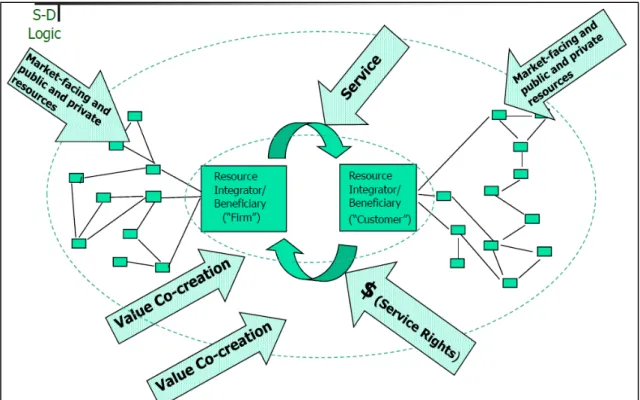
In order to help firms provide better value-in-use for customers, Vargo created a value co-creation model for firms and customers (Figure 2.5). This model implies that the firm can only make an offer on value creation through customers’ requirements and then, if accepted, value is co-created in concert with the customer. In this case, both firms and customers are resource integrators/beneficiaries in the business. Both must take part in the service process and co-create the value. It would bring great satisfaction to customers when co-created value makes service more dynamic and innovative to fulfill customers’ desired outcomes. The firm should strive to leverage interactions and relationships with its customers to have better cooperation, thus lead to productive and satisfactory co-created value.
SDL embraces concepts of the value-in-use and co-creation of value rather than the value added concepts of GDL. As a result, instead of simply providing or delivering value to customers, firms cooperate with customers, as well as understanding and tightening the relationship to build more useful and sufficient value to customers.
26
Figure 2.5 Business model based on SDL Source: Vargo, 2009
Overall, SDL might be a foundation of a paradigm shift in marketing. This perspective can help marketers understand the role of markets in society, therefore making it a basis for general theory markets and marketing. More generally, it is also a basis for “service science”, a foundation for theory of the firms which leads them to gain customers satisfaction and consequently success. This recent perspective causes the reorientation for economic theory and changes viewpoints of both academic and business industry.
2.3.3 Contrasting the different of GDL and SDL
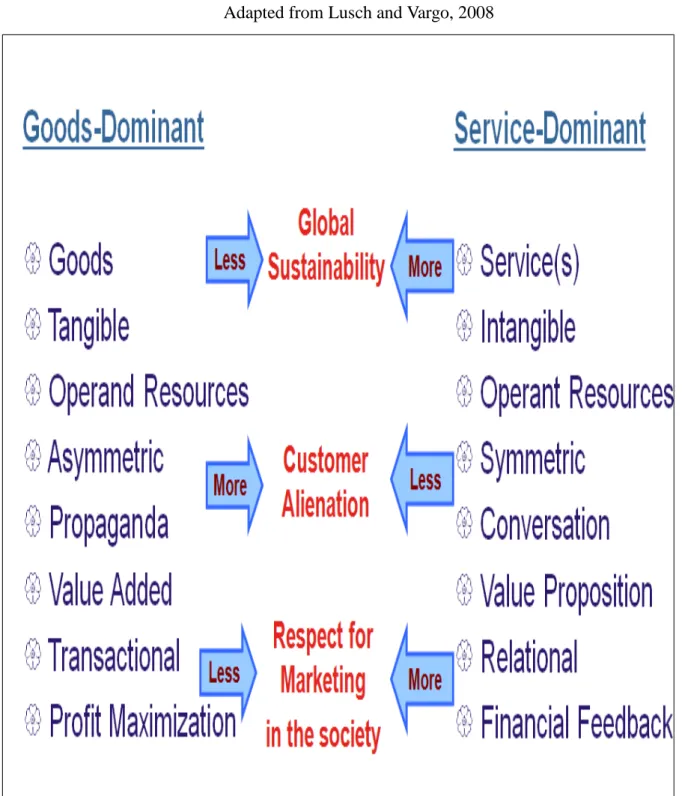
SDL represents a shift in logic of exchange. If GDL see market as good-based models, SDL suggests a service-based foundation, for understanding all economic activities. There are some different points between GDL and SDL. This part summarizes those contrastive thinking to help classify GDL and SDL. First, different mindsets of the two logics in the way they view the economic activities have been discussed. This shift is captured in eight areas
27
(Lusch and Vargo, 2008).
• A shift to the process of serving rather than the creation of goods.
• A shift to the primacy of intangibles rather than tangibles.
• A shift to the creation of using dynamic operant resources from operand resources.
• A recognition of strategic advantage is symmetric rather than asymmetric information.
• A shift to conversation as dialog an opposed to propaganda.
• The firm should make the value propositions rather than create or add value.
• Focus to relational than transactional exchange.
• Emphasize on financial performance for information feedback rather than a goal of profit maximization.
Adapted from those eight shifted areas, table 2.2 shows the effectiveness of these shifting and implies the end purposes which SDL aims to.
28
Table 2.2 Contrasting of GDL and SDL Adapted from Lusch and Vargo, 2008
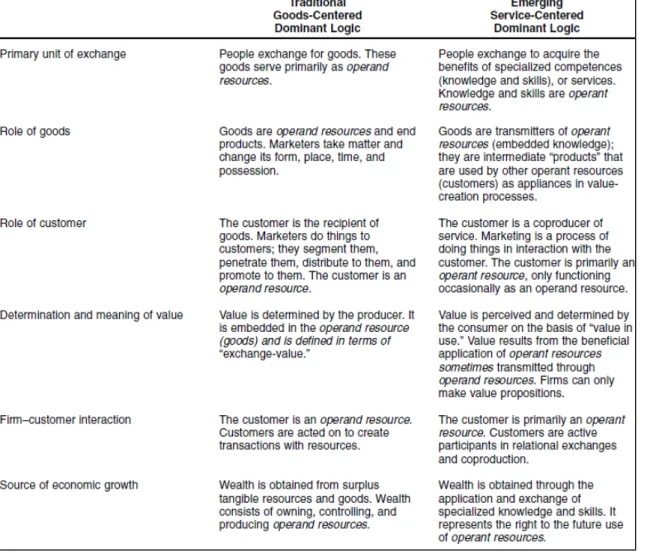
Among these eight characteristics pointed out above, the views of operand and operant resources help distinguishing the logic of good-centered and service-centered views. Table 2.3 will clarify those differences.
29
Table 2.3 Distinguish good-centered logic and service-centered logic Source: Vargo and Lusch, 2004a
Overall, it has been illustrated in figure 2.6 that the traditional GDL is not a good logic since it views the role in the business process of firms and customers separately. They are discrete to each other and cannot be used to build a good corporation for satisfaction.
Otherwise, SDL is a systematic logic and it suggests good collaboration between firms and customers. SDL emphasizes the co-creation of value, and is considered as the value reference for this research.
30
GDL: A logic of separation SDL: A logic of Co-creation
Figure 2.6 Collaboration of firms and customers in GDL and SDL Source: Vargo, 2009
2.4 The emergence of value co-creation in reality
2.4.1 Value in exchange versus value-in-use
When customers purchase a product or service, there is one uprising question “why a consumer should buy a product or use a service?”. The answer should convince potential consumers that the value propositions of a single product or service would make them satisfy than others in the market.
The concepts of “use value” and “exchange value” have been discussed since ancient times. They have a long history in economic and philosophical thought, from Aristotle (384 BC – 322 BC) to Adam Smith, and their meanings evolved. Aristotle is the first to distinguish those two meanings. The qualities related to use-value mean different things for different people. Alternately, exchange-value was considered as the quantity of a substance that could be a commensurable value of all things.
In another research, Adam Smith (1776) recognized that “commodities may have an exchange-value but may satisfy no use-value, such as diamonds, while a commodity with a very high use-value may have a very low exchange-value, such as water”. Those historical researches give us a general view about the difference between value-in-use and value in
31