JAIST Repository
https://dspace.jaist.ac.jp/
Title Web‑based Learningにおける自主的学習支援システム
に関する研究
Author(s) 李, 航宇
Citation
Issue Date 2016‑03
Type Thesis or Dissertation Text version ETD
URL http://hdl.handle.net/10119/13519 Rights
Description Supervisor:長谷川 忍, 情報科学研究科, 博士
Doctoral Dissertation
Research on Learning Support Systems for Web- based Self-directed Learning
Hangyu Li
Supervisor: Dr. Shinobu Hasegawa
School of Information Science
Japan Advanced Institute of Science and Technology
March 2016
To my parents, my wife
Abstract
The world is now developing so fast that today’s knowledge is quickly becoming outdated. This requires us to constantly conduct self-directed learning in order not to be lagged behind. With the fast renovation of internet technologies, it has become really convenient for us to use the internet as an important tool to facilitate our learning. Hence, the field of web-based learning has been drawing attentions from fields of researchers. Compared with before, the World Wide Web has, without any doubt, made our learning, especially self-directed learning more and more efficient and fruitful. No longer does one need to worry about no accessing to needed information which is expected to be found on the internet whenever needed. And no longer does one have no ways of reaching to another people with similar learning interests who are expected to be connected by a cable wherever. Therefore, it has become possible to overcome the restrictions of time and space for people who are learning by themselves.
The most recognizable feature of self-directed learning is that the learners are given full control of their learning activities, which also means that they are completely on their own. Ordinarily, they are expected to be more motivated, persistent, independent, self-disciplined, self-confident and goal oriented than other people. In the reality, however, fulfilling such expectations prove to be very difficult. Since the self-directed learners are in charge of all aspects of learning from deciding what should be learned to the methods and resources used to the evaluation of the success of the effort, the challenges are the lack of external validation for learning content, methods and outcomes. It is true that fast development of information technologies especially the ones on World Wide Web have greatly increased the learning situations for self- directed learners nowadays. However, as always, the conveniences new technologies bring to us often come with new difficulties and challenges needed to be addressed in order to take better advantages of Internet technologies. Firstly, it has become difficult for us to locate suitable learning resources that the Internet provides. We easily lose sight of the learning goals and get drowned in the ocean of information.
Even we might finally manage to find the resources we want, how to get them organized is not easy either. Moreover, learning skills (also referred as cognitive skills) have been recognized as important especially in self-directed learning. How to learn the things we need from piles of learning information effectively by ourselves is perceived quite demanding. When at school, we can learn from teachers or skilled classmates. But on the Internet, where all are virtual existence, getting our learning skills polished seems really difficult. Thirdly, as the final stage of learning, we extracted and absorbed the knowledge from piles of learning resources. But without appropriate forms of recording it down, the learnt knowledge can be easily faded away. This is probably why we take notes, doing after course exercises at school as a way of constructing knowledge. But when faced with the useful information scattered here and there in various forms on the Internet, how to build up perceivable knowledge structure proves to be challenging. All of these problems limit learners engaged in web-based self-directed learning from effective control and assessment of their learning activities.
In order to address these issues, the purpose of this research is to further improve the learning situations for web-based self-directed learners in the three major aspects of learning: Resource Finding & Organization, Learning Skill Cultivation and Knowledge Constructing In the context of this research: resource organization means
arranging one’s learning resources found from the web in a way to facilitate later learning activities such as reviewing or revising. Learning skill cultivation means improving learner’s cognitive capabilities (how to learn) in order to attain knowledge or abilities in a more effective way; Knowledge Constructing means creating one’s knowledge structure from various types of learning resources. Since mapping theories have been prevalently studied in many research in both the educational and learning setting and have been proved to be effective in knowledge attainment and reflection, I proposed a Multi-layer Map-oriented Model (MLM)-a model to offer multi- dimensional management over concepts/topics with hierarchical relations via superposed layer representations, by introducing the concept of Topic Maps through considering the characteristics of self-directed learning on the web and its challenges.
And then designs and develops three learning support systems in an attempt to tackle these issues. Finally, the according cased studies were carried out to evaluate the effectiveness of the developed systems.
Topic Maps are an ISO standard for describing knowledge structures and associating them with information resources. Because of the numerous factors and elements of various kind being involved in the self-directed learning on the web, this model not only offers one-dimensional management over the concepts/topics in the same categories/domain through associations, but also other concepts/topics with hierarchical relations via superposed layer representation (occurrences). I put this model into practical use by basing it to develop three learning support systems: (a). A resource organization system enabling leaners to quickly locate their wanted learning resources and organize the resources to facilitate later learning activities via multi- layer map visualization; (b). A strategy object mashups system enabling learners to build up their own effective learning environment while being made aware of the application of the related learning strategy and tactics; (c). A note-taking systems enabling learners to take non-linear, map-oriented notes for better revision and reflection in VOD (Video on Demand) based learning. These attempts are meant to explore the chances of exploiting this model in the three major aspects of resource finding/organization, learning skill cultivation and knowledge constructing in self- directed learning.
Keywords: web-based learning, self-directed learning, multi-layer map model, topic maps, strategy object mashups
Acknowledgements
When I started to write this this thesis, I could not help looking back the six years I spend in JAIST firstly as a master student, and then as a doctoral candidate. A lot of things had happened during this 6 years, good or bad, which have completely changed the course of my life. From an ignorant young man who just quit his job in China, I have grown in to an adult who not only learnt how to be responsible but also figured out what he wants in his life. Here I want to thank this great school, it offers me the spectacular learning environment, and also the peaceful mind which appears really rare in nowadays society. When thinking about leaving this place after graduation, I cannot help feeling a little sad in my heart for this school has changed me into a better human being which I shall never forget.
It is not possible for me to finish the doctoral course without the help and kind support of many people. I would like to mention their names to express my great gratitude.
Firstly, I would like to give my greatest thanks and gratitude to my supervisor- Associate Professor Hasegawa who has been so kind and patient walking me through these six years, who is always patient and enlightening with my research. He is the one who led me into the world of learning engineering which greatly open my horizon and broaden my way of logical thinking. He has done far more than enough as my supervisor. Without him, there is no way that I can smoothly walk through these six years of research life.
Secondly, I would like to thank every member in Hasegawa-lab. They have been nothing but being supportive. I have been receiving lots of useful suggestions and advises from them which are extremely helpful to my research. Their existence surely added color into my life in JAIST.
Thirdly, I would like to thank my family. Firstly, my great love to my wife Jingya who witnessed every second of these three years of doctoral life, who gave me encouragements when I felt frustrated, who shared joy when I am happy. Without her companionship, my life would not have been so easy. Also my parents, for their generous financial help and warm encouragement all the time.
Finally, I also want thank everyone who has been really helpful and supportive with my research.
Table of Contents
Contents
Abstract ... 3
Acknowledgements ... 5
Table of Contents ... 6
List of Table ... 8
List of Figure ... 9
Chapter1 Introduction ... 11
1.1 Motivation ... 11
1.2 Research Objectives ... 12
1.3 Thesis Outline ... 13
Chapter2 Background ... 15
2.1 Web-based Learning ... 15
2.2 Web-based Self-directed Learning ... 16
2.3 Community-based Learning ... 17
2.4 Research Questions... 19
Chapter3 Research Methodology ... 20
3.1 Introduction to Topic Maps ... 20
3.2 Topic Maps based Multi-layer Map-oriented Model ... 21
Chapter4 Resource Finding & Organization—A Resource Organization System for Web-based Self-directed Learning ... 24
4.1 Introduction ... 24
4.2 Difficulties in Resource Finding and Organization of Self-directed and Community-based Learning ... 25
4.3 Related Work ... 25
4.4 Research Requirements ... 26
4.5 Multi-layer Map Model—for Resource Finding & Organization ... 27
4.5.1 Contents Layer & Resource Map Layer ... 28
4.5.2 Personal Map Layer ... 28
4.5.3 Community Map Layer ... 29
4.5.4 Sequential Spring-Model Map for Visualization of Community Map Layer 30 General Spring Model Algorithm ... 30
Proposed Arranging Algorithm ... 30
4.6 Resource Organization System for Self-directed & Community-based Learning (ROS) ... 32
4.6.1 System Architecture ... 32
4.6.2 System Overview ... 33
Interface of Contents and Resource Map Layer ... 33
Interface of Personal Map Layer ... 36
Interface of Community Map Layer ... 37
System Flow ... 38
4.7 Preliminary Case Study ... 39
4.7.1 Quantitative Case Study... 39
Experiment Procedures & Evaluation Factors ... 40
Data Analysis ... 42
Discussion ... 42
4.7.2 Qualitative Case Study... 44
Questionnaire Content ... 44
Data Analysis & Discussion... 45
4.8 Conclusion ... 47
Chapter5 Learning Skill Cultivation—Cultivating Listening Skills for Academic English based on Strategy Object Mashups Approach ... 49
5.1 Introduction ... 49
5.2 Background ... 50
5.2.1 Listening strategies ... 50
5.2.2 Listening Comprehension Tactics ... 51
5.2.3 Difficulties in Applying Listening Strategies in Academia: ... 51
5.2.4 Limitations in Current CALLs & Research Challenges ... 52
5.3 Approach ... 53
5.3.1 Strategy Object Mashups Approach ... 53
5.3.2 Multi-layer Map Model ... 54
5.3.3 The Relationship among Strategy, Tactics and Objects (STO) ... 55
5.4 System Review ... 57
5.5 Preliminary Case Studies ... 59
5.5.1 Short-term Case Study ... 59
Evaluation Factors ... 60
Data Analysis and Discussion ... 61
5.5.2 Mid-term Case Study ... 63
Evaluation Factors ... 64
Data Analysis and Discussion ... 64
New Tactics ... 69
5.6 Conclusion ... 70
Chapter6 Knowledge Constructing—Using Topic Maps Standards to Improve Note-Taking/Sharing in Video-on-Demand Based Self-directed Learning through Visualization... 72
6.1 Introduction ... 72
6.2 Issue Addressed ... 72
6.2.1 VOD Based Learning ... 72
6.2.2 Related Research on Note-Taking System and the Challenges ... 73
6.3 Approach ... 75
6.3.1 Topic Maps ... 75
6.3.2 The Research Concept... 76
Multi-layer Map Model—for Knowledge Constructing ... 76
The Overall Concept ... 77
6.3.3 The System Architecture... 78
6.4 The Concept GUI of the Proposed System: ... 79
6.5 Conclusions ... 81
Chapter7 Conclusions ... 82
7.1 Future Work ... 83
References ... 85
Publications ... 94
Appendix A ... 96
Appendix B ... 99
List of Table
Table 1. The experiment arrangement (IE Vs ROS)………34
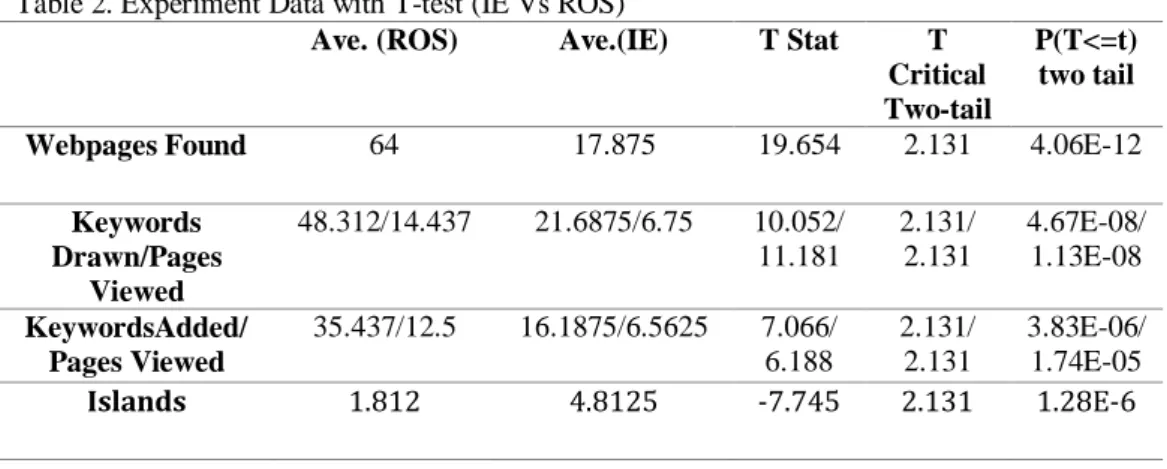
Table 2. Experiment Data with T-test (IE Vs ROS)………36
Table 3. Questionnaire (IE Vs ROS)………40
Table 4. Result of Questionnaire (IE Vs ROS)………41
Table 5. The experiment arrangement (short-term)……….55
Table 6. The experiment data with T-test (short-term)………56
Table 7. Results of the questionnaire (short-term)………57
Table 8. The number of participants with scores up, down and no change of with & without………..57
Table 9. Questionnaire for Mid-term Case Study…..………57
Table 10. Examples of “unreasonable” choices of objects………..………65
List of Figure
Figure1. Web-based Learning………13
Figure2. Self-directed Learning………..14
Figure 3. Community-based Learning………15
Figure 4. Basic Concept of Topic Maps……….17
Figure 5. Multi-layer Map Model (World War I)………...18
Figure 6. Multi-layer Map Model for Resource Finding & Organization…………..23
Figure 7. Relationship Diagram among the layers of Personal Map, Resource Map and Contents………24
Figure 8. Concept of Community Map………25
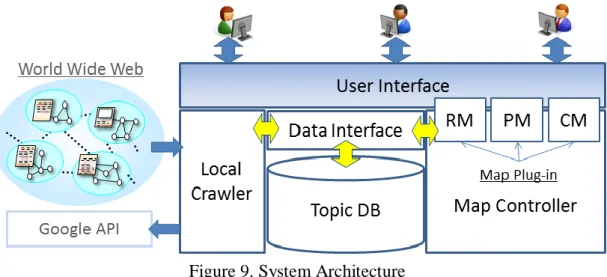
Figure 9 System Architecture………..28
Figure 10. The Interface of the Contents and Resource Map Layer………29
Figure 11. Viewing Contents at Resource Map Layer……….29
Figure 12. Creating Topic and its Association……….30
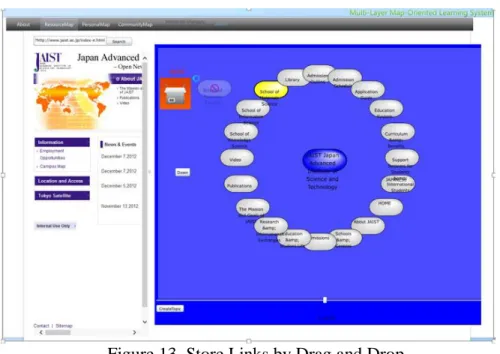
Figure 13. Store Links by Drag and Drop………30
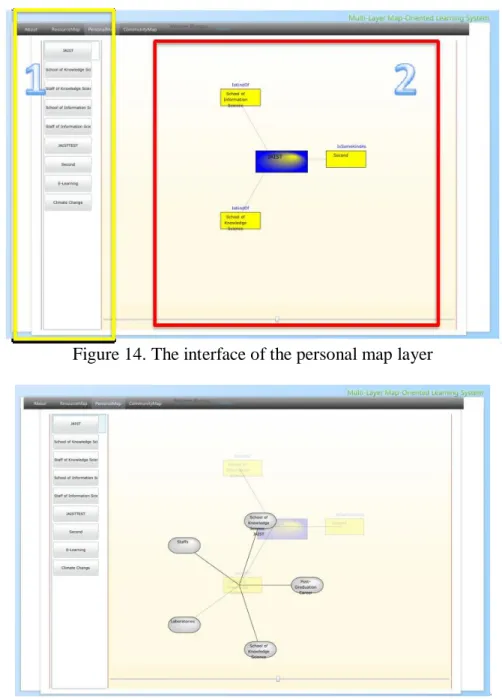
Figure 14. The interface of the personal map layer………..31
Figure 15. Viewing the content of personal map……….31
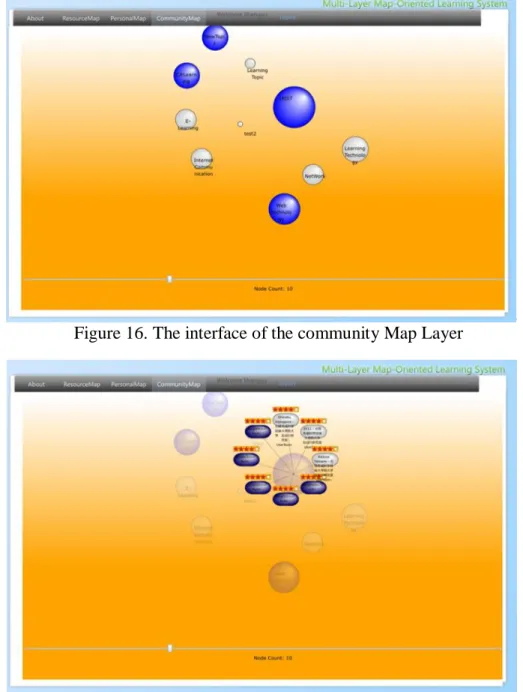
Figure 16. The interface of the community map layer……….32
Figure 17. Viewing learning resources in community map……….33
Figure 18. System Flow………...33
Figure 19. The experimental procedures and tasks………..35
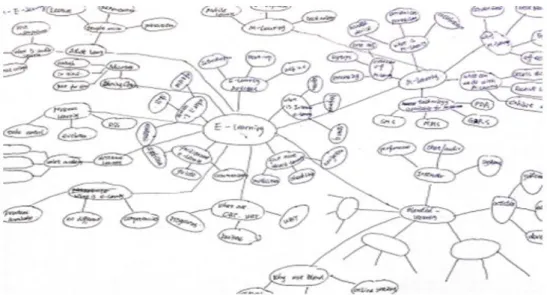
Figure 20. Example of keyword map when using IE………...38
Figure 21. Example of keyword map when suing ROS………...38
Figure 22. The Concept of Strategy Object Mashups Approach……….49
Figure 23. Multi-layer Model………...50
Figure 24. A concrete example of multi-layer model………..50
Figure 25. The relat io ns hip a mo ng st rat eg y mo del, st rategy o bject and mashups………51
Figure 26. An example of the mechanism……….52
Figure 27. The GUI for selecting objects for each listening phase………..53
Figure 28. The GUI for the phase of on-listening……….……...54
Figure 29. The change of the number of objects for each task………59
Figure 30. The changes of the number of mashups for each task………60
Figure 31. The times of object use for each learning phases (for P1 and P4)……….61
Figure 32. The average points of awareness for listening strategies before/after listening tasks………...62
Figure 33. The Percentage of correct answers before/after listening tests…………..63
Figure 34. Note-taking in VOD based learning………...68
Figure 35. The basic concept of topic maps………...71
Figure 36. Multi-layer Map Model for Note-taking……….72
Figure 37. The concept of personal note-taking………...73
Figure 38. The concept of collaborative note-sharing………..73
Chapter1 Introduction
1.1 Motivation
With the rapid development of today’s world, the knowledge learnt at school becomes outdated at a tremendous speed. In order to catch up with the fast developing society and not to be legged behind both professionally and personally, attendance to constant self-directed learning becomes more and more inevitable and important. In those days without the Internet, people go to libraries or book stores to find learning materials for self-improvements. The problems mainly were the shortage of learning contents, not knowing who to consult to when questions arise, and also the lack of companionship with like-minded one to discuss interesting topics. For a long time these three major difficulties are the main obstacles for people who are eager to learn by themselves until the advent of the Internet.
After entering the 21st century, the Internet technologies are moving forward rapidly, causing the contents of the World Wide Web growing exponentially day by day. Along with the cost of computers and other kinds of terminals lowering down, more and more people now have access to the Internet. No exception, the way of learning and receiving information are also greatly changed. The three major problems in the days without the Internet seems to have been resolved. We can now literally find any information we want from the World Wide Web, not only text contents, but also videos, pictures and even sometimes forms beyond imagination. We no long worry about having no wise ones to answer our questions, because the Web is loaded with anything we want to know. Meanwhile, the Internet also enables us to connect easily with millions of people around the world who are just as interest as we are in certain topics of learning and willing to communicate and share happily. Self- directed learning has evolved to another level with adequate learning materials, largest learning communities and wiser guidance.
However, like other new technologies, while they are making our life more convenience, we are also faced with new problems and challenges. There are three inevitable aspects in learning theories: learning resources (materials), learning skills (cognitive skills) and learning outcome (knowledge constructing). Translating into understandable phrases, they are: what to learn, how to learn and what have learnt.
Firstly, we need to find proper learning materials in order to satisfy our learning interests; secondly, we need to exercise our learning skills in order to obtain more knowledge and abilities; and finally we need to come up with a knowledge structure after learning which can best illustrate our learning outcomes and also can serve as effective reminders when we come back later for knowledge review. In the meantime, since the Internet has connected billions of people around the world, a largest ever learning community has been formed and, inevitably, the involvement with other people sharing similar learning interests has become an important element in the learning process. How to efficiently take advantage of this phenomenon presents another challenges. Although the technologies have made the learning situations much better, there are still some issues we need to address. For example, with more than enough information loaded on the Web, Internet users are required not only to navigate web pages to search for useful information but also to control the navigation
all by themselves, which proves to be very troublesome. Supposed that they have found the proper learning materials, but no one will teach them effective learning skills to improve the learning efficiency. The learners are all on their own and easily to be fall in some ineffective customs of learning. Furthermore, the knowledge learnt must be from various learning sources from the Internet, which proved to be difficult to construct a visible yet understandable structures while connecting all the sources for an efficient later review. All of these problems prevent web-based self-directed learners from conducting a more effective, and productive learning activities. In order to address these difficulties, this research is aiming to design and develop several learning support systems which are expected to improve the current learning situation and provide some assistances to learners on web-based self-directed learning combined with community-based learning whose definitions will be explained in next chapter.
1.2 Research Objectives
The purpose of this doctoral research is to further improve the learning situation for web-based self-directed learners in the three major aspects of learning: Resource Finding & Organization, Learning Skill Cultivation and Knowledge Constructing. In the context of this research: resource finding & organization means finding appropriate learning resources more effectively and quickly, and then arranging one’s learning resources found from the web in a way to facilitate later learning activities such as reviewing or revising. Learning skill cultivation means improving learner’s cognitive capabilities (how to learn) in order to attain knowledge or abilities in a more effective way; Knowledge Constructing means creating one’s knowledge structure from various types of learning resources for the purpose of enabling learners to revise and reflect the things they have learnt in a more enlightening way. Considering the characteristics of self-directed learning on the web and its challenges, I proposed a Multi-layer Map-oriented Model (MLM) by introducing the concept of Topic Maps.
Mapping theories have been prevalently studies in many research in both the educational and learning settings and have been proved to be effective in knowledge attainment and reflection. Among those, Topic Maps are ISO standards for describing knowledge structures and associating them with information resources. Because of the numerous factors and elements of various kind being involved in the self-directed learning on the web, this model offers not only one-dimensional management over the concepts/topics in the same categories/domain through associations, but also other concepts/topics with hierarchical relations via superposed layer representations. And then I put this model into practical use by basing it to develop three learning support systems: (a). A resource organization system enabling leaners to quickly locate their wanted learning resources and to organize the resources to facilitate later learning activities via multi-layer map visualization; (b). A strategy object mashups system enabling learners to build up their own effective learning environment while being made aware of the application of the related learning strategy and tactics; (c). A note- taking systems enabling learners to take non-linear, map-oriented notes for better revision and reflection in VOD (Video on Demand) based learning. Finally, the according cased studies are carried out to evaluate the effectiveness of the developed systems. These attempts are meant to explore the chances of exploiting this model in the three major aspects of resource finding/organization, learning skill cultivation and knowledge constructing in self-directed learning.
1.3 Thesis Outline
The thesis is divided into seven chapters as follows:
Chapter one will firstly describe the motivation of doing this research. It firstly describes the current situation for self-directed learners who are either eager young students at school wanting learn more by themselves or those having left school but hope to keep up with the fast developing society by self-directed learning. Secondly, what are the main obstacles presented to the web-based self-directed learners and then it briefly the main purposes of this research and the outline of the whole thesis.
Chapter two is mainly about the background of the research. It will firstly introduce the definition of web-based learning, self-directed learning and community-based learning. Especially the details of the characteristics of web-based self-directed learning combined with community-based learning will be discussed. For example, what has become convenient and helpful because of the advent of World Wide Web, and what are the new challenges which have emerges with the development of web technologies. And then this chapter will generally describe the common difficulties existing in self-directed learning combined with community-based learning over three aspects of resource organization, learning skill cultivation and knowledge constructing, especially in the scenario of web-based learning, and then reveal the research questions of this thesis.
Chapter three is for the introduction of the research methodology. It firstly introduce the base/inspiration of this research—Topic Maps: definition, history for application, features and etc. And then it introduces the concept of multi-layer map model based on the topic maps standard. It only describes the basic features of this model and how this model would visualize the self-directed learning behaviors to improve the learning situations. In the end, it leads to the introduction of the three learning support systems developed to improve resource organization, learning skill cultivation and knowledge constructing, based on the multi-layer map model proposed only with minor changes respectively. The changes will be generally discussed in this chapter.
Chapter four introduces the learning support system of resource organization. In this chapter, there are five main sections. The first section is related work. It mainly describes the research in improving resource finding and organization in the field of self-directed learning especially those using mapping technologies combined with the points they failed to emphasize which would be addressed in my research (such as failing to consider the seamless combination of learning activities such as resource fining and organization). The second section is approach. It mainly describes the model of this system (based on the concept of multi-layer map model described in chapter three), and how the model applies in the system development. The third section is system review. In this section, the main functions of the system will be introduced. The fourth section is evaluation. This section introduces the case study conducted to assess the effectiveness of the developed system and to validate the hypothesis. In this section, the data gathered in the case study will be analyzed and also what the results indicate.
Chapter five introduces the strategy object mashups system for learning skill cultivation. In this chapter, there are five main sections. The first section is related work. It mainly describes the research in improving learning skills in the field of self- directed learning. As I chose the academic listening skills as the subject for learning skill cultivation, the literature would be mainly the field of CALL system (Computer Assisted Language Learning) and those focusing on adaptations, and also the novelty of this research (offering effective learning environment with strategy and tactic information). The second section is approach. It mainly describes the model of this system (based on the concept of multi-layer map model described in chapter three), and how the model applies in the system development. The third section is system review. In this section, the main functions of the system are introduced. The fourth section is evaluation. This section introduces the case study conducted to assess the effectiveness of the developed system and to validate my hypothesis. The final section is discussion. In this section, the data gathered in the case study will be analyzed and also what the results indicate.
Chapter six introduces the learning support system for knowledge constructing. In this chapter, there are five main sections. The first section is related work. As I chose note- taking in VOD based learning as the subject for supporting knowledge constructing, the literature related in VOD based learning will also be included and how this research addresses several points which have not been realized currently but are expected to be useful (for example, providing non-linear way of note-taking, managing note over multiple learning resources, enabling community-based note- taking and etc.). The second section is approach. It mainly describes the model of this system (based on the concept of multi-layer map model described in chapter three), and how the model applies in the system development.
Chapter seven is about conclusion and future work. It will firstly conclude the current research situations from the results of case studies of the three learning support systems. And then it discusses the possibilities for practical applications of topic maps based multi-layer map oriented model in the development of learning support systems.
In the end, it sums up the future work left both in the pilot system developments and further explorations in the use of topic maps in the field of learning support engineering.
Chapter2 Background
2.1 Web-based Learning
First of all, what is learning? It may seem very unreasonable to ask such question, but as a matter of fact, there are many learning theories which keep evolving with the passing of time. Driscoll (2000) defines learning as “a persisting change in human performance or performance potential which must come about as a result of the learner’s experience and interaction with the world”. This definition encompasses many of the attributes associated with behaviorism, cognitivism and constructivism—
three broad learning theories most often utilized in the creation of instructional environments, attempting to address how it is that a person learns. Behaviorism states that it is impossible to understand what goes on inside of a person. It stresses on the learning behaviors other than internal activities (Gredler, 2005). On the contrary, Cognitivism views knowledge as symbolic mental constructs in the learner’s mind, and the learning process is the means by which these symbolic representations are committed to memory (Buedell, 2004). Constructivism suggested that learners create knowledge as they attempt to understand their experiences (Driscoll, 2000). However, these learning theories were developed in a time when learning was not impacted through technology. Especially with the occurrence of the internet, which has reorganized how we live, how we communicate, and how we learn. Furthermore, including technology and connection making as learning activities begins to move learning theories into a digital age. This gives rise to a new learning theory—
Connectivism. Siemens (2004) defines Connectivism is the integration of principles explored by chaos, network, and complexity and self-organization theories. He stressed that since new information is continually being acquired, the ability to draw distinctions between important and unimportant information is vital. Based on the principles of this new learning theory, I assume that web-based learning is actually belongs to the realm of Connectivism.
We have to admit the fact that with the advent of the Internet and the fast renovation of information technology which has made the content of the Internet more colorful and adequate, our life and way of doing things have completely changed. Particularly in the way of learning, for the access to needed information has become easiest ever.
Equipped with a computer connected with the Internet, we can literally learn anything we want. From that time, the information loaded on the Web has been growing exponentially with constant upgrade and renewal. At the beginning, only text-formed information took a main share on the Internet which practically played the role of substituting paper-formed information only with much better accessibility. But later on, pictures, audios and videos exploded on the Internet becoming an indispensable parts of learning materials. Furthermore, the prevailing of portable tablets and smartphones recently unexpectedly made learning on the Web ubiquitous. Invariably, we have gradually changed our habit of turning to wised ones or related books whenever having questions, to surfing on the Internet, feeling sure that the needed information could be found sooner or later. Easy accessibility and stability make the learning on the Web popular, which enable us to surpass the restriction of time and
space which are once great obstacles to us (Thuering, Hannermann, and Haake, 1995).
Therefore, in recent decades, Web-based learning is drawing lots of attentions and expected to play much more positive role in enriching human’s knowledge repository.
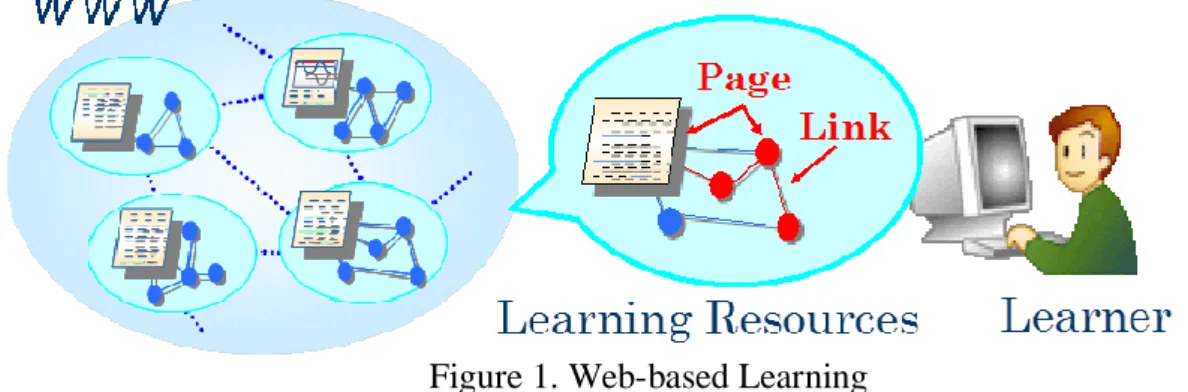
Web-based learning is one way to learn, adopting Web-based contents or technologies in a learning process. To put it in another way, in Web-based learning, learners use mainly computer or the likes (Figure 1) to interact with other people with similar learning interests and learning materials such as watching videos, sharing knowledge, taking e-courses and so on (Jolliffe, Ritter and Stevens, 2001). This form of learning has been adopted in various educational and learning scenarios such as blended learning, but in this research, we only focus on the web-based self-directed learning.
Figure 1. Web-based Learning 2.2 Web-based Self-directed Learning
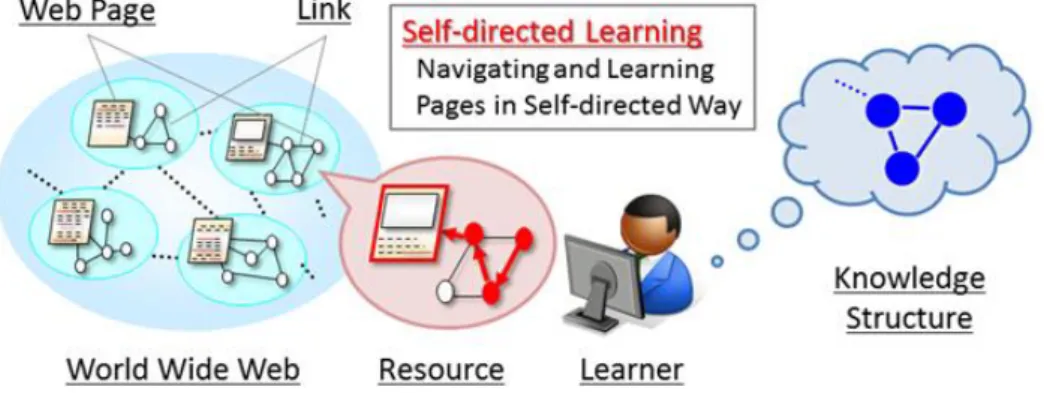
After graduation from school, it has become impossible for us to sit in a classroom to listening to lectures. And it is also not always convenient to have some wise ones around to consult whenever we have questions needed to be answered. In order not to be legged behind by the fast developing society, people need to conduct self-directed learning constantly to fulfil their dreams and be useful to the society. Knowles (1975) described self-directed learning as a process in which individuals take the initiative, with or without the help of others, to diagnose their learning needs, formulate learning goals, identify the learning resources, select and implement learning strategies, and evaluate learning outcomes. For identifying learning resources nowadays, learners can navigate a vast volume of web-based resources to achieve their individual learning goals. Such resource usually provide them with hyperspace which enables them to navigate in a self-directed way by following links among the pages (Figure 2). After finding the right learning resources, learners need to extract the knowledge from them by following a certain way of learning known as learning methodologies or skills.
Finally, they are expected to come up with a concrete knowledge structure as their learning outcomes. Self-directed learning on the web is expected to enhance their information literacy by encouraging the selection of suitable resources, each of which may have a different credibility and/or view point of the same topic (Hasegawa, Kashihara, and Toyoda, 2003; Dabbagh and Kitsantas, 2004). The most recognizable feature of self-directed learning is that the learners are given full control of their learning activities which also means that they are completely on their own. Ordinarily, they are expected to be more motivated, persistent, independent, self-disciplined, self- confident and goal oriented. In the reality, however, fulfilling such expectations prove to be very difficult. Firstly, it has become difficult for us to locate suitable learning resources that the Internet provides. We easily lose sight of the learning goals and get
drowned in the ocean of information. Even we might finally manage to find the resources we want, how to get them organized is not easy either. Moreover, learning skills (also referred as cognitive skills) have been recognized as important especially in self-directed learning. How to learn the things we need from piles of learning information effectively by ourselves is perceived quite demanding. When at school, we can learn from teachers or skilled classmates. But on the Internet, where all are virtual existence, getting our learning skills polished seems really difficult. Thirdly, as the final stage of learning, we extracted and absorbed the knowledge from piles of learning resources. But without appropriate forms of recording it down, the learnt knowledge can be easily faded away. This is probably why we take notes, doing after course exercises at school as a way of constructing knowledge. But when faced with the useful information scattered here and there in various forms on the Internet, how to build up perceivable knowledge structure proves to be challenging. All of these problems limit learners engaged in web-based self-directed learning from effective control and assessment of their learning activities. As a result, the typical scenario for self-directed learning in this research is like this: firstly, a learner needs to decide what to learn and set his/her learning goals; secondly, he/she need to find suitable learning resources in various digital forms from the internet; lastly, he/she learn the learning resources found all the oneself and construct his/her knowledge structure.
Consequently, as Connectivism requires, they are expected to connect their learning topics, learning resources and other aspects in their learning in a meaningful way.
Figure 2. Self-directed Learning 2.3 Community-based Learning
There is a famous saying made by Chinese Confucius, it is “there must be at least one person out of three who can serve as your teacher”. This wise saying indicates that collaboration with other people can greatly boost the efficiency of whatever you are dedicating to. As Self-directed learning is not always an easy job since one can often get lost or frustrated by studying alone, receiving instructions, advises, well-organized knowledge and encouragement from other like-minded people become really necessary. Since the internet has made reaching out for people worldwide possible, Community-based Learning has also been drawing attentions from fields of researchers. In this research, community-based learning is defined as the process of communication by community members who share the similar learning goals for the purpose of encouraging each other’s self-directed learning activity. Figure 3 shows the process that involves not only sharing resources, but also learning skills, peer-
review of the resources found, and the sharing of knowledge. Ordinarily, it is not so easy for self-directed learners to obtain adequate supports since the learning resources and the processes vary from learner to learner (Ota, Kashihara, and Hasegawa, 2005).
However, community-based learning makes it possible for the learners to engage in informal communication as feedbacks in their individual self-directed learning processes (Cook and Smith, 2004). But in reality, how to get effective contact with the other people with similar learning interest on the web proves to be difficult.
Furthermore, the feedbacks among shared learning information, perceptions of learning skills of effective learners and the sharing of learning outcomes of each other are ought to have positive effect on self-directed learning yet hard to be implemented on the web. In this research, how do the community members of different levels contribute/benefit from community-based learning? Firstly, let us suppose that there are three types of learners—high level, middle level, and low level. The low level or the novice learners are the complete benefiters, because at the beginning, they are only getting support or guidance from experienced middle/high level learners without contributing anything to the community. For higher level learners, they are both benefiters and contributors for they are both getting helped and contributing to the leaning community by introducing effective learning resources or outcomes. And eventually, novice learners will evolve into experienced learners who not only contribute but also provide guidance for new comers. Actually this learning scenario of community-based learning is an example of “Legitimate peripheral participation”, a concept brought up by Lave and Wenger in 1991. It describes how new comers become experienced members and eventually old timers of community of practice or collaborative project. According to this concept, newcomers become member of a community initially by participating in simple and low-risk tasks that are nonetheless productive and necessary and further the goals of the community. Through peripheral activities, novices become acquainted with the tasks, vocabulary, and organizing principles of the community.
Figure 3. Community-based Learning
2.4 Research Questions
In this research, I have identified three major research questions:
Firstly, how to improve the resource finding & organization situation of the Web- based Self-directed learning? In the past, we often complained about not having enough learning materials. But now, the large amount of information available on the Web makes it very difficult for us to locate suitable learning resources, let alone having them organized. We have long passed the information shortage, instead we are now embracing the information flooding in this new era. Without help, finding the right learning materials on the Web can be really difficult, and the reasonable management of the found learning resources is not easy either.
Secondly, how to cultivate the cognitive skills of learners though Web-based Self- directed learning? When at school, the teachers always not only taught us the knowledge we need to know, but also instructed the way of conducting efficient learning—the learning skills. Faced with the insurmountable learning resources, it is better if we have a set of personally effective learning skills which could help us absorb more knowledge or strengthen our abilities. However, without proper guidance, knowing how to learn based on one’s personal characteristics can be a bit of challenge.
Thirdly, how to build up knowledge structures as learning outcomes in Web-based Self-directed learning? The purpose of learning is to attain knowledge, but without appropriate forms of recording it down, the learnt knowledge can be easily faded away. As a result, we recite, take notes, doing after course exercises—any ways necessary, for reserve the knowledge permanently in our minds. However, on the Web where all the useful information is scatter here and there in various forms, it proves not easy to summarize the knowledge structures out of it. The knowledge structures need to be visual for later revision, and also be perceivable, making sure that learners later learning activities such revision or reflection can be conducted easily and effectively.
This research aims to address there three major research questions by presenting three learning situations: using the Web to collect and organize learning materials, using proposed systems to improve academic listening skills, and taking non-linear notes combined with collective note-taking in VOD based learning. Accordingly, we proposed three learning support systems which will be discussed in later sections.
Chapter3
Research Methodology
3.1 Introduction to Topic Maps
Topic Maps are ISO standard for describing knowledge structures and associating them with information resources (ISO/IEC 13250, 2002). Michel Biezunski described Topic Maps in the book “XML Topic Maps” like this:
“The World Wide Web enables us to create virtually unlimited quantities of information and to make it immediately available to the world. We do not suffer from lack of information availability, but we do have hard time trying to locate the information we really need. Finding aids are therefore becoming highly desirable.
Topic Maps provide a standard approach to creating and interchanging finding aids. ” Topic Maps were originally designed to handle the construction of indexes, glossaries, thesauri, and table of contents, but their applicability extends to various fields of practical uses. For example, Lu, Feng, and Chen (2010) adopted Topic Maps standards to realize efficient knowledge acquisition, representation, exchange and sharing in the field of data mining. Mase, Yamada, and Nitta (2008), on the other hand, proposed a framework to extract topic maps from a set of web pages for information retrieval. In the field of education, this ISO standard also were adopted in constructing e-learning repositories (Dicheva and Dechev, 2006) and digital course libraries (Dicheva, Dichev, Sun and Nao, 2004). Although Topic Maps are complicated yet practical technologies possible to represent immensely complex structures, this research only borrows three basic concepts—Topics, Associations, and Occurrences (TAO) which are easily grasped (Pepper, 2000). Although by comparison, Wisse (2006) raised questions towards Topic Maps for its isolation resulted from unfamiliar wordings to members of the new information professions, we focus on its capability of representing complex structures in the context of learning which only involves learners with similar learning interests and goals.
Topics
Topics are the main parts of Topic Maps. The word topic is originated from the Greek word topos, which means both location and subject. In the widest generic sense, topics can represent any subjects with meanings perceived by their creator. Every topic has a name that represents it. A name is a string which is privileged in the sense that the knowledge that it is a name for the topic.
Associations
Associations connect topics with each other. The definition of the association semantics is left to the Topic Maps creators, which represent relationships between topics.
Occurrences
Occurrences are subordinated to topics. They can be properties of the topic stored as strings inside the topic map, or they can be references to information resources that are considered relevant to the topic.
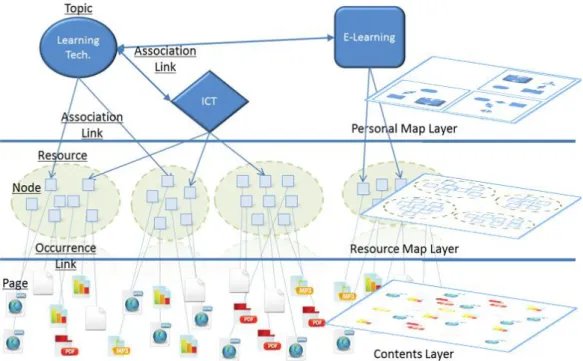
Figure 4 illustrates how the three basic concepts relate to the Topic Maps. Topics represent concepts of a certain field which a learner is concerned. Association links represent hyper-graph relationships between the topics. Occurrence links represent the actual learning materials or knowledge points relevant to a particular topic. In Figure 4, there are three topics of the learners’ interests: Learning Technology, ICT and E- learning. The solid lines among these three topics are associations which depict the various relationships the three topics have with each other. The dotted lines under these three topics are occurrences which represent the actual web contents in various digital forms. Topic maps can be used to qualify the contents and/or data contained in information objects as topics, to enable navigation tools and to link topics together with multiple, concurrent views on sets of information objects.
Figure 4. Basic Concept of Topic Maps 3.2 Topic Maps based Multi-layer Map-oriented Model
Considering the characteristics of web-based self-directed learning and its challenges, I propose a Topic Maps based multi-layer map-oriented model. Mapping theories have been prevalently studied in both the educational and learning settings and have been proved to be effective in knowledge attainment and reflection. The reason for adopting the concept of Topic Maps is because it properly meets all of my requirements. We encounters lots of subjects (such as learning resources of different kind, knowledge points and other learners of similar learning topics) while learning on the Web. Topics can represent various subjects, while Associations can describe complex structures among topic and finally Occurrence presents a good explanation/definition for each topic. Although Topic Maps can represent immensely complex structure, to present all topics of various kind with different features could be really unrecognizable. Especially in the case of Web-based self-directed learning, we are often faced with numerous subjects of different domains, categories or features, which means different levels or kind of topics that are needed to present subjects appeared in the Web-based self-directed learning. Furthermore, there are various
relationships among topics not only within the same level but also different levels.
For example, in history learning, normally we usually learn who did what at what time, meaning people, event and time. These three subjects are three different domains of topic with different characteristics. There were many people did many historical events at different time periods. Meanwhile, there were relationships of different kinds among those people and events, meaning there are relationships needed to be managed not only at the horizontal level but at vertically levels.
Apparently depending only on Topic Maps cannot solve this problem. Therefore, I propose to group one category of topics based on some roles on one layer, other categories of topics can be grouped on other layers. The relationships among layers are represented by certain associations or occurrences. I believe a model of this kind can more clearly represent a structure of concepts so that I come up with this multi- layer map model (MLM) which not only offers one-dimensional management over the topics in the same categories but also other topics with hierarchical relations via superposed layer representation. Figure 5 describe an example of knowledge constructing by adopting the multi-layer map-oriented model. It depicts the historical knowledge about World War I. During the war, there were some battles occurred among several countries, which were led by some great people. Moreover, among those countries involved, there were allies, enemies and neutral nations. Meanwhile, among the battles, which battle were the prelude to the other one, or which one is essential were all important knowledge points to represent. The proposed MLM model can be used to visualize this knowledge structure. The country layer contains all the countries involved in this war. On the layer we can see what countries are allies, what countries are enemies, and what countries declared neutral. The people layer is where all the key persons that affected this war would appear. From the connection between these two layers, we can see where these people came from, the combat layer describes all the battles happen during this war, and from its relationship with countries layer and people layer, and we can see what countries or people got involved. Of course the number of layers can grow depending on the coming up of new categories of topics. The right part of Figure 5 describes that at each layer, not only the associations among the topic, but also the occurrences of each topic also can be represented. This model is expected to be of assistance in visualizing the basic learning behaviours in Web-based self-directed learning.
Figure 5 Multi-layer Map Model (temporary)
This research not only originally proposed this MLM model, but also put this model in practical use to improve the learning situations for web-based self-directed learners in the three major aspects of learning: Resource Finding & Organization, Learning Skill Cultivation and Knowledge constructing, I propose three learning support systems: (a). A resource organization system enabling leaners to quickly locate their wanted learning resources and organize the resources to facilitate later learning activities via multi-layer map visualization; (b). A strategy object mashups system enabling learners to build up their own effective learning environment while being made aware of the application of the related learning strategy and tactics; (c). A note-taking systems enabling learners to take non-linear, map-oriented notes for better revision and reflection in VOD (Video on Demand) based learning. These attempts are meant to explore the chances of exploiting this model in the three major aspect of resource finding/organization, learning skill cultivation and knowledge constructing in self-directed learning. The following three chapters will discuss the three systems in details.
Chapter4
Resource Finding & Organization—A Resource Organization System for Web-based Self- directed Learning
4.1 Introduction
In order to enrich one’s knowledge repository, people need to conduct self-directed learning constantly. With the occurrence of the World Wide Web, accessing to needed information has become easiest ever. From that time, the information loaded on the web has been growing exponentially along with the constant rise of internet technologies. Therefore, it has been believed that the needed information can be accessed on the web conveniently. Consequently, it has become possible to overcome the restrictions of time and space for self-directed learning which has been demonstrated to enhance the learning process (Thuering, Hannermann, and Haake, 1995), but often requires learners not only to navigate web resources to construct knowledge learned from the resources but also to control the navigation and knowledge construction processes (Schnackenberg, Sullivan, Leader and Jones, 1998;
Kashihara and Hasegawa 2005). As a result, web-based self-directed learning has become an important research area in the past decade. In order to address this issue, my approach is to integrate self-directed learning into community-based learning through which the learners are able to have informal community-centered communications (Fujimoto, Hasegawa, Miura, and Kunifuji, 2006; Farooq, Canoe, Xiao, Merkel, Rosson and Carroll, 2007). Community-based learning also attracts attentions along with the rapid growth of the web technology. In particular, there are number of researches on social bookmarking which indicate that the community- based learning resources organized by community members with a similar learning interest are expected to be valuable and effective (Noll and Meinel, 2007; Millen, Yang, Whittaker and Feinberg, 2007). However, it is difficult for the learners to access suitable learning resources from community-based learning since the learning goals vary from learner to learner, which leads to the necessity of proper recommendation for community learning resources. In order to address this problem, I have designed the proposed model, the Multi-layer Map Model (Li and Hasegawa, 2010) based on an ISO standard named Topic Maps (ISO/IEC 13250, 2002). This model enables the learners to visualize common learning behaviors employed on the web, such as locating learning resources, categorizing found resources and sharing the resources among community members. I have proposed a resource organization system (Li, Hasegawa, and Kashihara, 2012) which connects web contents and learning topics by means of multi-layer map visualization. A case study intended to determine whether the learners could improve the efficiency of their self-directed learning was conducted to assess the effectiveness of this system (Li, Hasegawa and Kashihara, 2013). After analysis of the experiment data, some encouraging conclusions were drawn which indicated that through topic map representations provided by the system, learners were able to locate appropriate learning resources
faster, organize learning resources in a more meaningful way, and collect learning resources inside their learning community more easily and effectively.
4.2 Difficulties in Resource Finding and Organization of Self-directed and Community-based Learning
The large amount of information available on the web makes it very difficult for the learners to locate suitable learning resources for particular topics of interests. They may have experienced the tedious job of trying to find a link out of pages of listings triggered by Google. Even in some websites exclusively designed for learning, the numbers of pages are so large that it normally takes a learner so much time to find his/her needed information. Traditional search engines only generate lists of pages ranked according to a matching algorithm. The learners therefore often have to click into certain web pages to find out whether they are appropriate or not to achieve their learning goals, and may miss the opportunity to learn if, after two or three useless clicks, they give up. If the learners do finally successfully locate sufficient learning resources from several URLs as a learning hyperspace, they have to organize these resources and to construct their knowledge by navigating the hyperspace.
Inexperience self-directed learners sometimes lose sight of their learning goals because of the complexity of the hyperspace. Such navigation problems have been recognized as major issues, and have been discussed in the context of educational hypermedia/hypertext system development (Brusilovsky, 1996). It has indeed become easiest ever to find like-minded people as community members on the web, and the learning resources organized by them seem more reliable and beneficial to self- directed learners since they share the same learning interests, the benefit of which has been proved more than once by social bookmarking (Carmel, D., Roitman, H. and Yom-Tov, E, 2010). However, from the perspective of community-based learning which, from the point of view of this research, means people with similar learning interests who are willing to review and share learning information on the similar learning topics, it is difficult to pass on learning resources and get feedbacks among members, for redundancy of learning information is hard to detect, and the viewpoints of each community member is often different.
4.3 Related Work
As web-based self-directed learning has become more and more eye-catching, attentions from many researchers are being drawn. Being aware of the fact that it is difficult to provide adaptive learning resources to self-directed learners, Pythagoras (2005) introduced a methodology which generated all possible learning paths while matching the learning goals, enabling the learners to select the desired resources from the paths proposed; on the other hand, Kashihara, Hasegawa and Toyada (2002) proposed a similar approach of providing the learners with the adaptive preview of a sequence of web pages as potential navigation path. Dragan (2006) adopted a different method of mapping ontology for the improvement for resource searching from a semantic web. For resource managing, there were tools for constructing local indexes for learning resources found from the web (Hasegawa, Kashihara and Toyada, 2003), in which a framework for reorganizing existing web-based learning resources with indexes representing their characteristics was designed, which consist of “How
To Learn” indexes and “What To Learn” indexes, in order to build a learning resource database. As for community-based learning, the learning opportunities of social bookmarking service have also been discussed (Liu and Chang, 2008).
Although these research relating to web-based learning have greatly enhanced the learning situation on the web from various points of view, they either targeted an enclosed learning environment, or certain educational hypermedia which involved not only the learner but also the instructor. Meanwhile, the basic learning behaviors of web-based self-directed learning usually occur in procession, but these research only focused on one or two learning situations and did not take into consideration the seamless combination of learning activities such as resource finding and organization.
Concept map (Novak and Gowin, 1984) and knowledge map (O’Donnell, Dansereau and Hall, 2002) are diagrams that represent ideas as node-link assemblies which has been prevalently studied in many research. Back in the late 90s, Dansereau and Newbern (1997) pointed out that semantic displays, such as knowledge maps, were becoming more prevalent in educational settings, and an experiment conducted by Chmielewski and Dansereau (1998) indicated that training participants on the construction and use of knowledge maps made participants recall more macro and micro level ideas from text passages than those without taking the training. Not only in educational setting but in learning contexts, there were also research proving the concept/knowledge map to be more effective for attaining knowledge retention and transfer than reading text-based learning contents (McCagg and Dansereau, 1991;
John and Olusola, 2006), and more beneficial working as navigational aids than a contents list (Sharon and Rosemary, 1998). Meanwhile, there were also research indicating that the use of concept map can facilitate meaningful learning (Coffey, Carnot et al., 2003) and be of value as a knowledge acquisition and sharing tool (Coffey, Hoffman, et al., 2002). From the perspective of community-based learning, Fischer et al. (2002) found that by being provided with a content-specific visualization tool, both the process and out of the cooperative effort improved.
Furthermore, collaborative concept mapping in a digital learning environment was also proved to be effective in overall learning gains and knowledge retention (Lin, Wong and Shao, 2012). As a result, the concept/knowledge mapping, as a visualization tool, has proved to be effective in both self-directed and community based learning. For these reasons, in order to help those who constantly use the web for resource finding and organization, this research is setting off from the basis of visualizing the basic learning behavior of the learners such as searching for suitable information, organizing found learning information, and getting easier access to community-based well-organized learning resources through super-imposed map representations. We target the open-ended learning resources on the web, with the purpose of providing learners with a user-friendly interface which intends to integrate self-directed into community-based learning.
4.4 Research Requirements
By analyzing these three difficulties described in previous sections and the contexts in which the self-directed learners regularly occur, I come up with three corresponding requirements, which if satisfied, could greatly enhance the current learning situation.
These requirements are:
(1) More semantically structured representations for web resources in order to locate the candidates of learning resources more swiftly and correctly.
(2) More sophisticated methods of resource organization. The learners often use web browsers for information management by simply adding interesting links to their favorite lists; however this does not facilitate later learning activities such as reviewing to build knowledge structures. Here, one point needed to be stressed is that supporting learners with the process of building knowledge structure is not the focus of this research, as it requires considerations such as the attitudes, skills and competences of the learners as well as reflection and self-construction which will be considered in my future work. I simply provide the learners with a meaningful structure of the learning resources as a visual aid for their knowledge constructing while reviewing the learning resources they have organized.
(3) A visual space not only where the status of other learners’ resource collections can be explicitly represented, but also where sharing resources and exchanging feedback can take place.
The following sections discuss how difficulties arising from the three requirements can be effectively addressed.
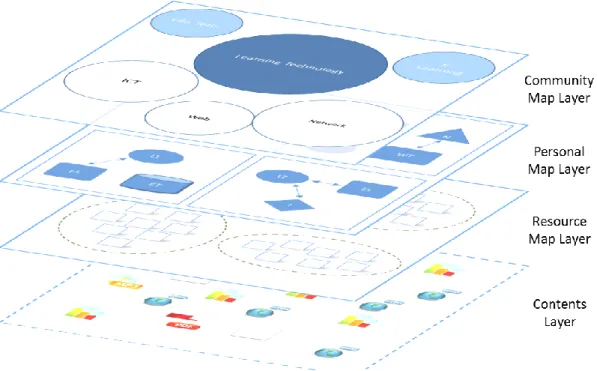
4.5 Multi-layer Map Model—for Resource Finding & Organization Visualization is one of the keywords in this research, for its advantages of making complicated things seem simpler and easy to understand. As the purpose of this research is to visualize the basic learning behaviors of web-based self-directed learning, I proposed a model called Multi-layer Map Model aiming to realize basic learning behaviors on the web via map representation. The Multi-layer Map Model is the core of the proposed learning environment, which is intended to perform as a GUI for self-directed and community-based learning. Figure 6 shows the four layers of the model; each has different functions, yet is dependent on the services provided by their nearest layer. The contents layer is the lowest layer of this model, where actual web contents in various digital forms are located. The resource map layer is the place where the structure of the web contents is visualized as learning resources. The personal map layer is where the learners engage in their self-directed learning. They can define topics, build up connections between topics, and include the learning resources represented on the resource map layer in the topics they create. The community map layer merges the personal topic maps with those of other community members by displaying bubble charts based on their features and relations.
Figure 6. Multi-layer Map Model for Resource Finding & Organization
The model provides members of the community with a communication basis via superposed map representation. It primarily focuses on visualizing the structure of the learning contents in terms of a resource map, and then enables the learners to edit or reconstruct their personal maps according to their learning processes. Moreover, this model includes a community map where the personal maps are merged, viewed and used by other community members who have similar interests. The following sections will describe each layer in more detail.
4.5.1 Contents Layer & Resource Map Layer
Contents Layer is the lowest layer of this model. It means the actual web contents such as web pages, documents, and media files of the web-based learning resources.
Resource map layer is the place to visualize structures of the web contents by a bunch of nodes in a one-to-one manner as shown in Figure 7. This map is intended to provide the learners with an overall perspective of the learning resources which is expected to enable them to grasp the main content of web information more swiftly and precisely (Herman, Melancon, G and Marshall, 2000; Roto, Popescu, Koivisto and Vartiainen, 2006). Every node will be labeled with a typical word such as the title of the web page existed. The learning behaviors of searching for suitable learning resources and categorizing selected ones are conducted at this layer.
4.5.2 Personal Map Layer
Personal map layer is aimed to support the learner’s self-directed learning. It helps the learners to edit and reconstruct their personal topic maps based on the spatial maps created on the resource map layer. At this layer, the learners are capable of defining the topics, adding/deleting the occurrence links under the certain topic, building up