Japan Advanced Institute of Science and Technology
JAIST Repository
https://dspace.jaist.ac.jp/
Title 安全なアプリケーションに向けての暗号に関する研究
Author(s) Mamun, Mohammad Saiful Islam Citation
Issue Date 2014‑09
Type Thesis or Dissertation Text version ETD
URL http://hdl.handle.net/10119/12291 Rights
Description Supervisor:宮地 充子, 情報科学研究科, 博士
Studies on Cryptographic Solutions to Secure Applications
by
MAMUN, Mohammad Saiful Islam
submitted to
Japan Advanced Institute of Science and Technology in partial fulfillment of the requirements
for the degree of Doctor of Philosophy
Supervisor: Professor Atsuko Miyaji
School of Information Science
Japan Advanced Institute of Science and Technology
September, 2014
Abstract
Secure applications protect valuable information and defend every vulnerability. The goal of a secure application design is to create a cost effective system where information is securely protected. Cryptography is one of the effective tools that has powerful impli- cations for information security. Since cryptographic solutions are continuously evolving, algorithms that were once considered secure are no longer secure now in practice. There- fore, poorly deployed systems are being threatened by increasing adversarial processing power, low-cost devices, weaker cryptographic algorithms, new demand of security and privacy issues, and technological advances. This has lead the US and Japan government to launch special programmes and bodies to define cryptography standards, specifications and recommendations to cope with the security and privacy requirement of the future.
This theses presents our research results on the design and analysis of cryptographic solu- tions for Vehicle Ad hoc NETwork (VANET) and low cost Radio Frequency IDentification (RFID) systems.
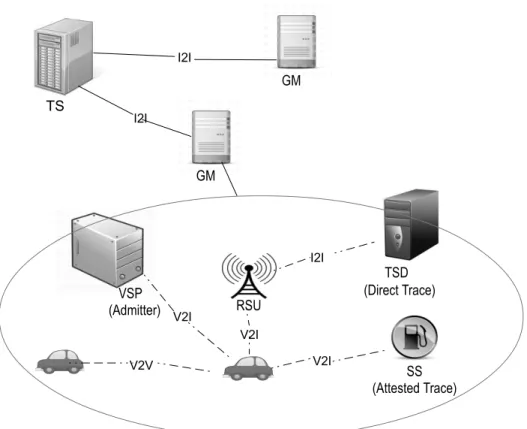
Motivated by the recent attention on exploiting group signature approach in the design of VANET security scheme, we attempt to integrate all the potential properties of group signature in an individual scheme, so that it can best meet the demand and needs of the wide range of VANET services. To this end, we propose a new group signature model that is more application friendly, optimally secure with a relaxed privacy definition to satisfy practical privacy requirement of VANETs. Moreover, we investigate the feasibility of implementing batch verification of group signatures into a real life VANET environment.
In addition, we improve an existing batch verification system on identity based group signature and determine where and when batch verification may be infeasible in practice.
Inspired to realize ubiquitous computing, machine perception and the rapidly grow- ing trend in insecurity and terrorism, the RFID technology plays an indispensable role in various fields. With the use of tags and transponders (tracking & tracing), RFID technology is seeking to venture into the transport and logistics systems, pharmaceutical and clothing industry as well as monitoring and safeguarding the citizen. However, the exclusive features of RFID introduces new security and privacy concern from the end users’ view point and resource restriction into the tag from the engineering perspective.
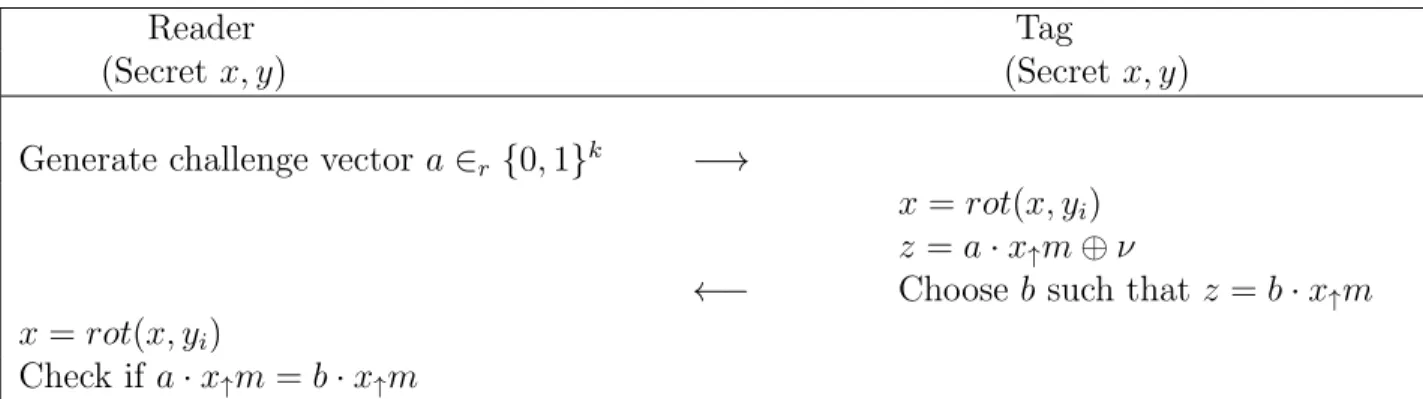
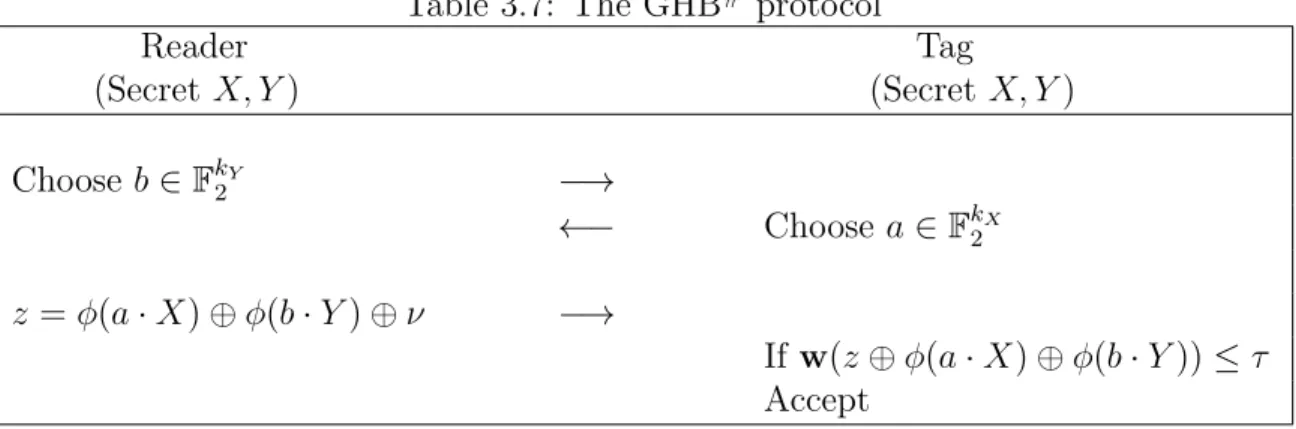
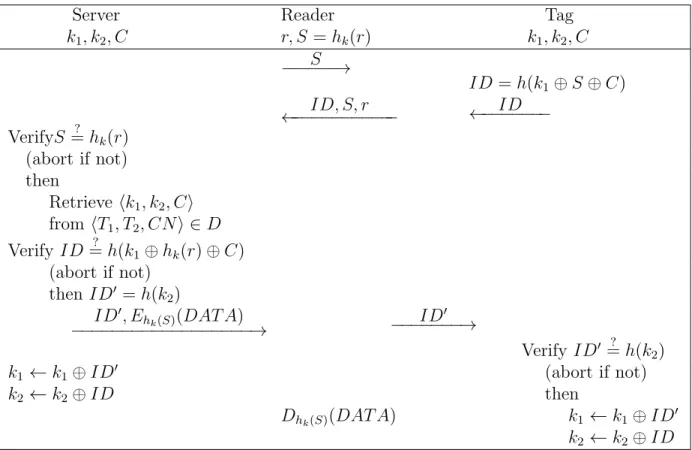
Security concerns in the form of authentication of tags and reader and privacy concerns related to undercover tag/communication tracking of tagged items. Today’s RFID system facilitates the real-time tracking of physical items in the supply chain. This enables the physical data flow of a tagged item with its location to be matched with the information flow in the enterprises information management systems. The weak privacy protection may jeopardize the entire supply chain exposed to industrial espionage, while vulnerable security may lead to the acts of eco-terrorism and economic sabotage. However, we first identified the major prior works in the area of RFID security such as tag authentication, tag ownership transfer, RFID-enabled supply chain path authentication etc. To this end, we adopted a new, growing and promising direction in the lightweight cryptographic re- search, namely Hopper-Blum (HB)-family protocol based on the Learning Parity from
only matrix vector multiplications over GF(2) they are extremely efficient and may even be suitable for practical RFID applications. Meanwhile the security is equivalent to well- known hardness assumptions from coding theory and lattices. We ideated the demand of efficient, robust, forward secure mutual authentication protocol for RFID systems in HB-family settings. We propose two mutual authentication protocols at this end: one is between a tag and a back-end RFID reader/server. The other protocol, that may follow the former one, is among the RFID entities where an RFID reader and a back-end server are not identical. To address the ownership transfer problem in a large inventory system, we build a new, improved model consisting of several Semi Trusted Parties (STPs) and a trusted server. Our model can ease the ownership process for the consumers in the remote location, and allows simultaneous transfer ownership of multiple tags from one owner to another. Our construction uses a new variant of Homomorphic Aggregated signature, a lightweight searchable encryption, Field LPN and pseudo-inverse matrix as cryptographic primitives. Finally, we propose a path authentication protocol for an RFID-enabled sup- ply chain. Compared to Elliptic curve Elgamal Re-encryption based construction our Homomorphic Message Authentication Code on Arithmetic circuit based solution offers a new privacy direction to the path privacy with an efficient and effective label of security and prevention of counterfeiting.
Our innovation has the potential to pave the way for more secure RFID-enabled ser- vices. All the secure and privacy-preserving protocols will enable RFID and vehicle in- dustries to implement confidently and take advantage of emerging opportunities.
Acknowledgments
I would like to express my sincerest gratitude to two lovely ladies who played a sig- nificant role in this journey. One is my adviser Professor Atsuko Miyaji for her excellent supervision during this work. Her rich ideas and wide expertise in the field of security replete me with confidence, lead and motivate me to explore new direction in the world of cryptography. Her critical thinking, positive aptitude and constant guidance towards this research was rewarding for me. The other lady is my beloved wife for her patience, unflagging care, trust, and inspiration. She deserves special acknowledgement for her devotion, sacrifice and commitment to lifelong learning. Without you, this dissertation would have never taken shape.
I would like to convey my special thanks to Professor Hiroaki Takada at Nagoya University for serving as my sub-theme supervisor and external examiner and for providing me many valuable suggestions. I am also grateful to Associate Professor Kazumasa Omote for his support and help during and beyond my PhD program. My heartiest gratitude goes to my theses examination committee, Professor Hajime Ishihara, Professor Ryuhei Uehera for their valuable comments, their attention and effort on this theses.
I am deeply indebted to Associate Professor Yuichi Futa, Assistant Professor Jiageng Chen for their supportive suggestions and exchanging ideas. I am particularly happy to have such all the wonderful members of Miyaji Lab of JAIST for their constant support to remain a pleasant and smooth research environment. I would like to thank many of my friends and colleagues in JAIST by whom I was absolutely exhilarated.
We are very much grateful to all the anonymous reviewers of the conferences and journals for their precious comments and fruitful advices. This work has been partially supported by JAIST Foundation under Graduate Research Program (GRP), Japan As- sociation for Mathematical Sciences Foundation, Japan Telecommunication Association Foundation (TAF) and NEC (C&C) Foundation, Japan.
Dedication
This theses is dedicated to all the Japanese people inside and outside the lab who helped me find what I needed. You are some of His finest gifts to so many people in the world who are blessed to be able to love you back. I love you forever.
Contents
Abstract i
Acknowledgments iii
Dedication iv
1 Introduction 1
1.1 Background . . . 1
1.2 Motivation . . . 2
1.3 Summary of our contribution . . . 3
1.4 Organization . . . 6
2 Preliminaries 7 2.1 Notation . . . 7
2.2 Cryptographic primitives . . . 8
2.2.1 Known Mathematical Facts . . . 8
2.2.2 Computational Hardness Assumptions . . . 9
2.2.3 Ciphers and Encoding . . . 14
2.2.4 Protocol Building Blocks . . . 15
3 Previous Work 20 3.1 VANET security . . . 20
3.2 RFID Authentication Protocols . . . 27
3.3 RFID ownership transfer . . . 35
3.4 RFID-enabled path authentication . . . 36
4 Vehicle Network Security 37 4.1 Secure VANET Applications with a refined Group Signature. . . 37
4.1.1 Introduction . . . 37
4.1.2 Our Contribution . . . 38
4.1.3 Network model and Scheme Description . . . 40
4.1.4 Security Requirement . . . 41
4.1.5 Our Proposal . . . 44
4.1.6 Security and Performance comparison . . . 49
4.1.7 Conclusion . . . 50
4.2 An efficient batch verification system for VANET . . . 51
4.2.1 Introduction . . . 51
4.2.3 Identity based Group Signature . . . 54
4.2.4 The Proposal . . . 57
4.2.5 Security Analysis . . . 65
4.2.6 Performance Analysis . . . 65
4.2.7 Conclusion . . . 68
4.3 A multi-purpose Group Signature for VANET under standard model . . . 69
4.3.1 Introduction . . . 69
4.3.2 Extended GS Properties with prior works . . . 71
4.3.3 The Proposal . . . 74
4.3.4 Security Requirement . . . 76
4.3.5 Efficiency . . . 77
4.3.6 Conclusion . . . 78
5 RFID system Security 80 5.1 A privacy-preserving RFID authentication protocol . . . 80
5.1.1 Introduction . . . 80
5.1.2 Preliminaries . . . 81
5.1.3 Construction . . . 82
5.1.4 Security Analysis . . . 85
5.1.5 SLPN problem . . . 85
5.1.6 Man-in-the Middle Attack . . . 86
5.1.7 Pseudo-random matrix . . . 86
5.1.8 Privacy . . . 87
5.1.9 Comparison and Performance analysis . . . 90
5.1.10 Conclusion . . . 92
5.2 An RFID authentication protocol where reader-server channel is insecure . 93 5.2.1 Introduction . . . 93
5.2.2 Construction . . . 94
5.2.3 Security Analysis . . . 98
5.2.4 Privacy analysis . . . 104
5.2.5 Comparison and Performance . . . 106
5.2.6 Conclusion . . . 107
5.3 A Scalable and Secure RFID Ownership Transfer Protocol . . . 108
5.3.1 Introduction . . . 108
5.3.2 Construction . . . 110
5.3.3 Security Analysis . . . 117
5.3.4 Privacy . . . 118
5.3.5 Performance evaluation . . . 119
5.3.6 Conclusion . . . 121
5.4 An RFID-enabled Path Authentication Protocol . . . 122
5.4.1 Introduction . . . 122
5.4.2 Supply Chain Management . . . 123
5.4.3 Protocol Construction . . . 124
5.4.4 Security Analysis . . . 129
5.4.5 Privacy . . . 131
5.4.6 Performance evaluation . . . 133
5.4.7 Conclusion . . . 135
6 Conclusion and Future works 136
Publications 155
Chapter 1 Introduction
1.1 Background
Our contribution can be split broadly into two major fields: vehicular network security and RFID system security. The former mainly focuses on the security model, efficiency and privacy issues in VANET. The latter examines a broad range of research on the secu- rity and privacy issues of commercial RFID application. Whilst both fields are promising and deal secure communication, they are different in terms of application role, security architecture, privacy definition and threat model etc.
RFID System Security. Recently wireless technologies are developing rapidly to con- struct smart communications with digital data. Networked devices are now automatically communicating among themselves without human interaction in order to carry out effi- cient information transaction.
A Radio Frequency IDentification (RFID) tag containing an unique identification num- bers uses radio waves to transmit data at a distance. Passive RFID tag having no battery power lays dormant until it gets in contact with an RFID reader. Nowadays passive RFID tag is used at vast areas such as key-less entry, real-time location service, supply chain management, electronic passports, tracking inventory of manufacturers, tracking of pa- tients and surgery tools in hospital, cashless point of sale, and access control, to identify things and transmit information when necessary. According to developers and vendors, RFID technology is moving to support new technologies such as Internet of Things (IoT), Machine-to-Machine (M2M) architectures where every physical object (embedded RFID) would have its own unique identity (IP address) encoded into the microchip. Prompted by the promising future goals, RFID technologies are evolving rapidly at the time, with regard to applications, performance and standards. However, due to the wireless nature of RFID technology, RFID system actuates various security and privacy issues concerning its owners and holders without any knowledge or consent of its users. Preventing unau- thorised access to the owner data (confidentiality), tag tracing (linkability), identification of the owners (anonymity) are some classical security threats to RFID systems. This leads to design protocols in such a way that they could be adapted to the new requirements both in terms of security and privacy.
VANET Security. Vehicular Network (known as VANET) employing vehicles as mobile nodes in a Mobile Ad-hoc NETwork (MANET) is a specialization of multi-hop ad hoc network paradigm well motivated by the socio-economic value of advanced Intelligent Transportation Systems (ITS) aimed at reducing the traffic congestions, the high number of traffic road accidents, etc. The research area of VANET security is where ad hoc network security can be brought to their full potential. In order to assure public safety on the roads, safety traffic applications (s.t., collision avoidance, road obstacle warning, safety message disseminations), progress toward future autonomous vehicle, and rapid proliferation of vehicular communications via bluetooth, wifi, and cellular connectivity, VANET technologies are turning tightly incorporated into critical safety systems and are establishing suitable security architectures that can resist potential security and privacy threats. This is concerned with the design and analysis of the security aspects such as authentication and key management, threat model, security architecture, privacy issues for large-scale vehicular networks.
1.2 Motivation
Vehicle network security. Most of the prevention-based security mechanisms in VANETs [8, 9, 20, 24, 46, 56, 19, 21, 44] exploit digital signature as cryptographic primitive. Group Signature is a specialized digital signature that can be directly used to authenticate vehic- ular communication anonymously without generating pseudonyms [1, 3, 6, 7, 22, 23]. Note that, pseudonyms in VANETs [20, 24, 46, 56] are adopted to hide vehicles’ real identity in order to ensure vehicle privacy. We found that existing group signature security models cannot support all the required secure applications in VANETs. In addition, stringent privacy of Group signature resists some real-life application to achieve. Therefore, we attempt to integrate all the potential group signature properties [8, 48, 22, 51, 53, 70]in a single scheme that can best meet the application demands of a large scale VANETs.
Moreover, we relax stringent privacy definition of group signature [59] and propose an op- timally secure and private and application-friendly scheme “Secure VANET Applications with a refined Group Signature” in Chapter 4.1. Since most safety-critical applications have stringent delay requirement [15], verifying huge signatures at a time is challenging [16]. Batch verification, where batch of signatures can be verified together, is one of the solutions to solve this problem [1, 3, 7, 8]. We observe that batch verification is not always feasible for VANET environment and choosing appropriate group signature sometimes de- pends on efficient batch verification system. To this end, we improve an existing batch verification system [1] and then analyze the feasibility of exploiting batch verification.
Our scheme“An efficient batch verification system for VANET” in Chapter 4.2 describes an algorithm to determine the maximum number of signatures to batch at a time and a signature scheduling algorithm (by following single machine job scheduling algorithm [35]) if batch verification is not feasible. Finally, we find that although random oracle model is weaker security notions [74], there is no group signature scheme in the standard security model proposed for VANET. The main reason is signature size and verification cost. At this point, we choose a group signature in the standard security model [74], extend it with necessary properties (e.g. opening soundness [75], linkability [61], revocability [57]) for VANET and propose a simplified group signature scheme from standard security model
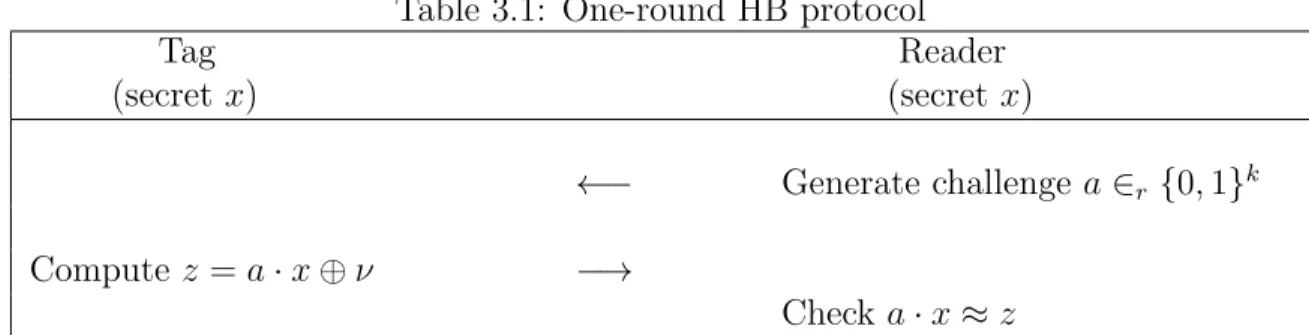
RFID system security. Security basis of RFID authentication protocols can be roughly divided into three fields: factorization and discrete logarithm based schemes [79, 184], el- liptic curve cryptography (ECC) based scheme [84, 85, 183] and learning parity from noise (LPN) based scheme [104, 89, 90, 91, 92, 80]. In this theses, we followed the later one, LPN-based scheme (known as HB-family protocol). Note that, both factorization and ECC based scheme offers average case hardness. ECC based scheme offers smaller key size indeed. In compare to the former two, LPN based scheme has several advantages such as it offers faster computation with the same security parameter, worst case hard- ness, security against attacks using quantum computers etc. Motivated by the aforemen- tioned advantages, we investigate HB-family protocols and found that there is no firmly secure and privacy preserving mutual authentication protocol under LPN problem. There- fore, we propose “A privacy-preserving RFID authentication protocol” in Chapter 5.1, a man-in-the-middle (MIM) attack-free mutual authentication protocol from subspace LPN problem. Later we found that mutual authentication based HB-family protocols [104, 113]
cannot be used directly for insecure reader-server channel. But embedding RFID reader modules into a wireless device such as smart phone is a new research direction in the RFID inventory system [81, 126, 83, 125]. At this point, we extend our former authen- tication protocol and design a fully mutual authentication protocol “An RFID authen- tication protocol in insecure reader-server channel” in Chapter 5.2 where all the entities tag, reader and server can authenticate themselves among each other. RFID inventory system experiences many security and privacy oriented application. Ownership transfer is one of the significant problems among them. We found several ownership transfer models based on trusted party (TP) [120, 115, 145, 135, 136, 137]. Both with or without TP [134, 115, 143, 145] have their own drawbacks. To satisfy new application model (like issuer verification in [121]) and alleviate current shortcomings [116, 148, 139, 154, 120], we propose a semi-trusted party (STP) based RFID tag ownership transfer protocol “A Scalable and Secure RFID Ownership Transfer Protocol” in Chapter 5.3. Finally, we observe that ordinary tag authentication protocols cannot satisfy special security and pri- vacy requirement of RFID-enabled path authentication [156, 149]. Depending on path verification nature there are two kind of path authentication protocols: static [150, 151]
and dynamic [156, 152]. We concentrate on static path authentication protocols and pro- pose “An RFID Path Authentication Protocol” in Chapter 5.4. Compared to existing Elliptic curve Elgamal Re-encryption (ECElgamal) based solution [151], our Homomor- phic Message authentication Code on arithmetic circuit (HomMAC) based solution offers less memory storage (with limited scalability) and no computational requirement on the reader.
1.3 Summary of our contribution
Secure VANET Applications with a refined Group Signature. This work pro- poses an application-friendly group signature (GS) model for wireless ad hoc network like Wireless Sensor Networks (WSN) or Vehicle ad hoc Network (VANET). Our new GS properties can be used to carry out potential solution to some real life problem. We modify Boneh, Boyen and Shacham (BBS) short GS to meet a restricted, but arguably sufficient set of privacy properties. In particular, we aggregate several GS properties like
linking, direct opening, message-dependent opening (MDO), revoking, batch-verification in a single scheme. Our link manager can link messages whether they are coming from the same messages or not without colluding to the opener. It helps relaxing strong pri- vacy properties of GS to a lightly lesser one that fit certain application requirement. We introduce a new application to the ad hoc network security, that is, value-added service provider (VSP) with the help of MDO properties and redesign the traditional GS-friendly VANET architecture. Our revocation algorithm adapts both rekeying and verifier-local revocation (VLR) approaches to revoke illegitimate signers. Finally, we present an op- tional batch verification system to expedite signature verification. Note that all these properties have already been shown in the literature scatteredly. The novelty of our pro- posal stems from accumulating all these properties in a single GS scheme that can best fit to the application demand.
An efficient batch verification system for VANET. In this work, we improve an existing batch verification system on ID based group signature and also compare the per- formance achieved. We also analyze the best possible value of the number of signatures to batch at a time for a large scale VANET and present a scheduling algorithm for signature verification where batch verification cannot be implemented efficiently.
A multi-purpose Group Signature for VANET under standard model. This work adapts a new group signature (GS) scheme to the specific needs of a vehicular ad hoc network (VANET). We modify the Groth GS in order to meet a restricted, but ar- guably sufficient set of privacy properties. Note that Groth GS is secure in the dynamic group signature model of Bellare, Shi, and Zhang (BSZ) without relying on random or- acle Model (ROM). Although some authentication schemes using GS are proposed for VANET, none of them satisfy all the desirable security and privacy properties. Either they follow GSs that rely on ROM, or unable to satisfy potential VANET application requirements. In particular, link management which allows any designated entities (e.g., RSUs in VANET) to link messages, whether they are coming from the same vehicle or a certain group of vehicles, without revealing their identities. Besides that opening sound- ness property prevents malicious accusations by the opener against some honest member of the group . By using this property, we propose a new secure application framework for value-added service providers (VSPs) in VANET. Meanwhile, a real-world VANET deployment must provide a mean torevoke system privileges from fraudulent vehicles like the traditional Public Key infrastructure (PKI). However, in order to achieve the afore- mentioned security properties together in VANET, we propose a new GS model where linkability, sound opening and revocability properties are assembled in a single scheme.
The novelty of our proposal stems from extending the Groth GS by relaxing strong pri- vacy properties to a scheme with a lightly lesser privacy in order to fit an existing VANET application requirements. In addition, we partially minimize the Groth GS scheme to ex- pedite efficiency.
A privacy-preserving RFID authentication protocol. This work presents an au-
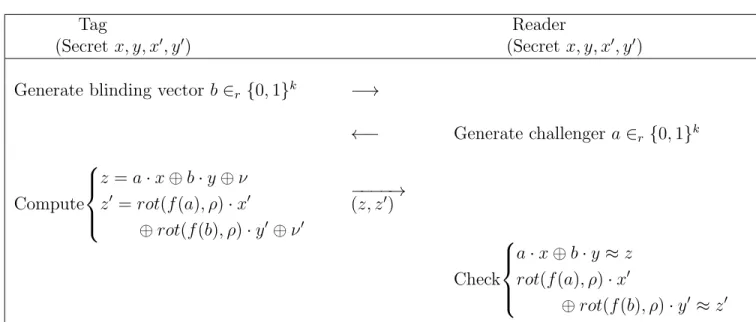
mutually. Optimal performance requirement, considering storage and computation con- straints of low-cost tags, keeping security and privacy policies intact are some major challenges in recent research in this area. However, in order to restrain optimal security and privacy requirement in a cost effective manner, several light-weight authentication solutions have been proposed for RFID system. HB-family is one of the most promising protocol series, based on the hardness of the Learning Parity with Noise (LPN) problem.
We propose a secure and private mutual authentication protocol of HB-family to meet the demand of low-cost tags. It is composed of Subspace Learning Parity from Noise prob- lem (SLPN) and Pseudo-inverse matrix properties, both of them significantly reduce the cost in terms of computation and hardware requirements. In addition, we compare our result with other existing HB-like and ordinary RFID authentication protocols according to their construction primitives and security and privacy achievements.
An RFID authentication protocol in insecure reader-server channel. This proto- col is an extension of our previous mutual authentication protocol where back-end server and RFID reader are identical. In this work, we present a secure collaborative mutual HB-like authentication protocol for an RFID system where both channels tag-reader and reader-server are considered to be insecure and thus upgrade the present HB-family proto- col. More precisely, we introduce a new variant of an HB-like protocol where the complete RFID system is authenticated under LPN-based commitment scheme that can provably resist major security and privacy threats by taking advantage of properties of perfect computational hiding commitment scheme, pseudo-inverse matrix based short signature, and randomized Hill cipher. In addition, through detailed security and privacy analysis, we show that our scheme achieves required security and privacy properties under the standard model.
A Scalable and Secure RFID Ownership Transfer Protocol. In this work, we con- sider scenarios related to ownership transfer of RFID tags in a large inventory system. In this work, we propose a new ownership transfer model with mutual authentication proto- col from Ring LPN problem that leverages the reader authentication phase to incorporate Semi-Trusted Parties (STP) seamlessly in RFID ownership transfer protocol. Employing STPs could ease the ownership transfer process for the consumers in the remote location.
More precisely, we introduce a new variant of Learning Parity from Noise (LPN) based mutual authentication scheme for efficient ownership transfer protocol where ownership of multiple tags can be transferred from one owner to another by taking advantages of an efficient homomorphic aggregated signature (HomSig) and pseudo-inverse matrix proper- ties. To the best of our knowledge, this is the first RFID ownership transfer protocol from LPN problem that is secure, private and scalable under standard model.
An RFID Path Authentication Protocol. RFID ownership transfer protocols con- sider how to securely transfer the ownership of the RFID tag to the other reader. In an RFID-enabled supply chain, where items are outfitted with RFID tags, path authentica- tion based on tag enables the destination checkpoints to validate the route that a tag has already accessed. In this work, we propose a novel, efficient, privacy-preserving path au-
thentication system for RFID-enabled supply chains. However, unlike previous schemes, we allow computational ability inside the tag that consents a new privacy direction to path privacy proposed by Cai et al. inACNS012. In addition, we customize a polynomial- based authentication scheme (to thwart potential tag impersonation and Denial of Service (DoS) attacks), so that it fits our new path authentication protocol.
1.4 Organization
We introduce our notations and preliminaries regarding cryptographic primitives in Chap- ter 2. We briefly discuss prior related works on VANET and RFID systems’ security and privacy in Chapter 3.
We present our all VANET related works in Chapter 4. Firstly, Secure VANET ap- plications with a refined group signatures in Chapter 4.1. Secondly, an efficient batch verification system in Chapter 4.2. Finally, a group signature under standard security model in Chapter 4.3. Subsequently, all the RFID related works are accumulated in Chapter 5. We describe our first RFID authentication protocol in Chapter 5.1. Extended version of our first authentication protocol (fully mutual authentication protocol) is pre- sented in Chapter 5.2. Then we exhibit our ownership transfer protocol for RFID systems in Chapter 5.3. Finally, we provide an RFID-enabled Path authentication protocol for supply chain in Chapter 5.4. At last, Chapter 6 concludes with some future research direction.
Chapter 2
Preliminaries
This chapter presents the notations, mathematics and cryptographic background, cryp- tographic primitives and building tools used throughout the theses.
2.1 Notation
In this section, we define the notations used in this theses.
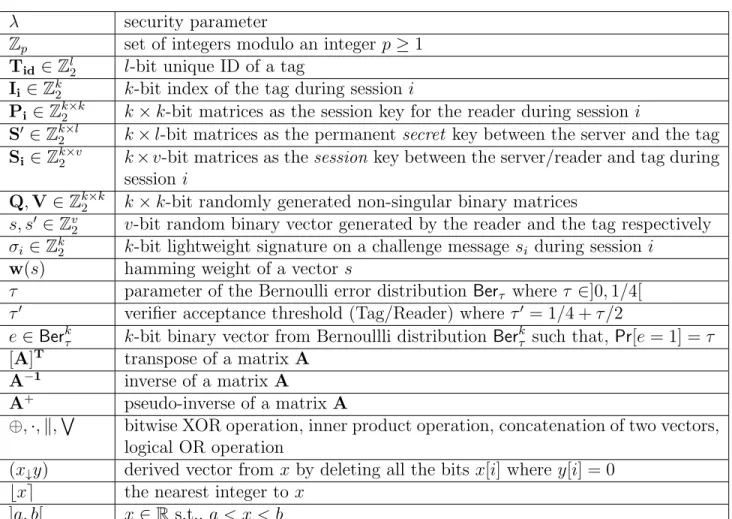
Table 2.1: Notations used in Chapter 5.1 & 5.2
λ security parameter
Zp set of integers modulo an integer p≥1 Tid ∈Zl2 l-bit unique ID of a tag
Ii ∈Zk2 k-bit index of the tag during sessioni
Pi ∈Zk×k2 k×k-bit matrices as the session key for the reader during session i
S0 ∈Zk×l2 k×l-bit matrices as the permanent secret key between the server and the tag Si ∈Zk×v2 k×v-bit matrices as thesession key between the server/reader and tag during
session i
Q,V∈Zk×k2 k×k-bit randomly generated non-singular binary matrices
s, s0 ∈Zv2 v-bit random binary vector generated by the reader and the tag respectively σi ∈Zk2 k-bit lightweight signature on a challenge message si during session i
w(s) hamming weight of a vector s
τ parameter of the Bernoulli error distribution Berτ where τ ∈]0,1/4[
τ0 verifier acceptance threshold (Tag/Reader) where τ0 = 1/4 +τ /2
e∈Berkτ k-bit binary vector from Bernoullli distribution Berkτ such that,Pr[e= 1] =τ [A]T transpose of a matrixA
A−1 inverse of a matrix A
A+ pseudo-inverse of a matrixA
⊕,·,k,W
bitwise XOR operation, inner product operation, concatenation of two vectors, logical OR operation
(x↓y) derived vector from xby deleting all the bits x[i] wherey[i] = 0 bxe the nearest integer to x
]a, b[ x∈R s.t., a < x < b
Table 2.2: Additional notations used in the Chapter 5.3 Rcur,Rnew current and new reader corresponding to a tag uidn secret identifier of the new owner Un
ci shared secret between the reader and the tag for a session i T a unique identifier of a tag T over Field F.
Tb tag index stored in the main server
F∗ multiplicatively invertible elements of a field F
πj :{0,1}λ →F a mapping to F, such that∀s, s0 ∈ {0,1}λ, π(s)−π(s0)∈F/F∗ if c=c0
2.2 Cryptographic primitives
2.2.1 Known Mathematical Facts
Definition 1 A multiplicative group G is a set together with an operation ‘·‘ that combines any two elements x and y to form another element xy or (x·y). (G,·) must satisfy the following requirements known as the group axioms
• ∀x, y ∈G, xy ∈G.
• ∀x, y, z ∈G, x(yz) = (xy)z.
• ∃1∈G, s.t., ∀x∈G, x 1 = 1 x=x.
• ∀x∈G,∃x−1 ∈G, s.t., xx−1 =x−1x= 1.
• |G| denotes the order of the group G or the number of elements in G.
• A group G is called cyclic if ∃g ∈G, s.t., ∀x∈G, ∃a∈Z, ga =x
Definition 2 LetG1andG2 be two cyclic groups of prime orderp, where possiblyG1=G1. g1 is a generator of G1 and g2 is a generator ofG2. Suppose ψ is an isomorphism from G2 to G1, with ψ(g2) =g1. Bilinear groups are a set of three algebraic groups, G1, G2 and GT, together with a non-degenerate bilinear map e : G1 ×G2 → GT, where
|G1|=|G2|=|GT|=p, such that
• Bilinear: for all g1 ∈G1, g2 ∈G2 and a, b∈Z, e(g1a, g2b) =e(g1, g2)ab,
• Non-degenerate: e(g1, g2)6= 1 (i.e., e(g1, g2) is a generator of GT),
• Computable: There exists an efficiently computable algorithm for computing ψ, e.
Definition 3 Pairing-based cryptographyis the use of a pairing between elements of two cryptographic groups (G1, G2) to a third group (GT) such that e :G1×G2 →GT
in order to construct cryptographic systems. If the same group ( , ) is used for the
of one group to an element from a second group. For instance, in groups equipped with a bilinear mapping such as the Weil pairing or Tate pairing, generalizations of the computational DiffieHellman problem are believed to be infeasible while the simpler decisional DiffieHellman problem can be easily solved using the pairing function.
Definition 4 Galois Field (GF), named after Evariste Galois, is known as finite fields.
Let GF(pn) be a finite field where p ∈ P and n ∈ Z+. Then, the order of the field is pn, p is called the characteristic of the Field, and the degree of polynomial of each element is at most n − 1. For instance, GF(23) is Finite Field where GF(23) = {0,1,2,2 + 1,22,22 + 1,22 + 2,22 + 2 + 1} = {0,1,2,3,4,5,6,7}. Hence, The or- der of the Field |GF(23)|= 8 where the maximum degree of polynomial of each element is 2 evaluated at 2.
The multiplicative group of a finite field GF(pn), denoted byFpn, is defined mod- ulo an irreducible polynomial f(X) of degree n over Fp. Clearly, let g(p) and f(p) be the polynomials in GF(pn) and m(p) be an irreducible polynomial of degree at least n in GF(pn). Then, h(p) = (g(p)·f(p) mod m(p)). The multiplicative inverse of f(p), denoted by F∗, is given by i(p) such that (f(p)·i(p)) (mod m(p)) = 1. We use binary Field GF(2n) or F2n that can be implemented efficiently.
2.2.2 Computational Hardness Assumptions
Let G be a probabilistic polynomial-time algorithm that takes a security parameter 1λ as input and generates a parameter (p,G,GT, e, g) of bilinear groups, where p is a λ-bit prime. G and GT are groups of orderp,g is a generator of G. That is,G=hgi is a finite cyclic group of order p with generator g s.t., order of G, |G|=p and λ =log2|G|. And e is a bilinear map: G×G→GT.
Random oracle. A random oracle is a probabilistic polynomial time algorithm that for each inputx∈ {0,1}m returns a uniformly random outputy ∈ {0,1}nwherem, n∈N. More clearly, random oracle starts with an empty look-up table T. When queried with an inputx, it first checks whether it is available in the tabley=T(x). If not, it chooses and returns a uniformly random value y ∈ {0,1}n and sets T(x) = y.
The DL assumption. Let g ← G, a ← Zp. The Discrete Logarithm (DL) problem in G is stated as follows. Given (g, ga), output (a). The advantage of a probabilistic polynomial-time (PPT) algorithm A against DL problem is defined as
AdvDLA (λ) = Pr[A(g, ga) =a].
We say that the DL assumption holds if AdvDLA (λ) is negligible for any algorithmA.
The DDH assumption. Let g ← G,(a, b, c) ← Zp. The decisional Diffie-Hellman problem (DDH) problem in G is stated as follows. Given (g, ga, gb, gc), output 1 if c = ab, otherwise 0 if c = r. The advantage of an algorithm A against the DDH problem is defined as
AdvDDHA (λ) = |Pr[A(g, ga, gb, gc) = 1 | c=ab]−Pr[A(g, ga, gb, gc) = 1 | c=r]|.
We say that the decision linear assumption holds if AdvDDHA (λ) is negligible for any PPT algorithm A.
The `-DHI assumption. Let g ← G, x ← Zp. We say that `-Diffie-Hellman Inverse (DHI) holds in G if for every PPT algorithm A and for ` =poly(λ), the advantage of algorithm A against `-DHI problem
AdvDHIA (λ) = Pr[A(g, gx,· · · , gx`) = g1/x].
is negligible for any PPT algorithm A.
The co-CDH assumption. Let g1 ← G1, g2 ← G2, a ← Zp. The co-computational Diffie-Hellman problem in (G1,G2) is stated as follows. Given (g1, g2, ga1), output (g2a).
The advantage of a probabilistic polynomial-time (PPT) algorithm Aagainst co-CDH problem is defined as
Advco−CDHA (λ) = Pr[A(g1, g2, g1a) = g2a].
We say that the co-CDH assumption holds if Advco−CDHA (λ) is negligible for any algo- rithm A.
The co-DBDH assumption Let (p,G1,G2,GT, e, g1, g2) ← G(1λ) and (a, b, r) ← Zp. The co-decisional Bilinear Diffie-Hellman problem in (G1,G2) is as follows. Given (g1, g2, g1a, gb2, z), output 1 ifz =e(g1, g2)ab, otherwise 0 ifz =e(g1, g2)r. The Advantage of an algorithm A against the co-DBDH-problem is defined as
AdvAco−DBDH(λ) =|Pr[A(g1, g2, g1a, gb2, z) = 1 | z =e(g1, g2)ab]−Pr[A(g1, g2, g1a, g2b, z) = 1 | z =e(g, g)r]|.
We say that the co-DBDH assumption holds if Advco−DBDHA (λ) is negligible for any PPT algorithm A.
The q-SDH assumption. Let (p, e, g,G,GT) ← G(1λ), γ ← Zp and Ai ← gγi for 0≤i≤q. Theq-strong Diffie-Hellman (SDH) problem inGis stated as follows. Given (g,(A) ), output (c, g1/(γ+c)) where c∈ ∗. The advantage of a PPT algorithm A
Advq−SDHA (λ) = Pr[A(g,(Ai)0≤i≤q) = (c, g1/(γ+c))].
We say that theq-SDH assumption holds if Advq−SDHA (λ) is negligible for any algorithm A.
The DLIN assumption. Let (u, v, h) ← G,(α, β, r) ← Zp and g1 ← uα, g2 ← vβ. The decision linear (DLIN) problem in Gis stated as follows. Given (u, v, h, uα, vβ, z), output 1 if z =hα+β, otherwise 0 if z =hr. The advantage of an algorithmA against the DLIN problem is defined as
AdvDLINA (λ) = |Pr[A(u, v, h, uα, vβ, z) = 1 |z =hα+β]−Pr[A(u, v, h, uα, vβ, z) = 1 | z = hr]|.
We say that the decision linear assumption holds if AdvDLINA (λ) is negligible for any PPT algorithm A.
The DBDH assumption. Let (p,G,GT, e, g) ← G(1λ) and a, b, c, r ← Zp. The deci- sion bilinear Diffie-Hellman (DBDH) problem in (G,GT ) is stated as follows. Given (g, ga, gb, gc, z), output 1 if z = e(g, g)abc, otherwise 0 if z = e(g, g)r. The Advantage of an algorithm A against the DBDH-problem is defined as
AdvDBDHA (λ) =|Pr[A(g, ga, gb, gc, z) = 1 | z =e(g, g)abc]−Pr[A(g, ga, gb, gc, z) = 1 | z = e(g, g)r]|.
We say that the DBDH assumption holds if AdvDBDHA (λ) is negligible for any PPT algorithm A.
(t, Q, )-hard protocol. A protocol is called (t, Q, )-hard if there exist a probabilistic polynomial time (PPT) adversary A, usually called (Q, t)-adversary that makes Q- queries in running time t to the honest prover, has an advantage at most ,
P r|[A succeeds]−1/2| ≤
LPN problem [100]. Let for a noise-parameter τ ∈]0,1/2[, Bernoulli distribution Berτ
output 1 with probability τ and 0 with probability (1−τ). Let Uk denote the oracle returning independently uniform k−bit random strings and Πx,τ be the LPN oracle for a hidden vector x∈RZk2 s.t.,
ha∈RZk2, e∈Berkτ : a.x⊕ei
The LPN problem is to retrievexgiven access to the oracle Πx,τ. Any efficient algorithm A(q, t, ) can solve the LPN problem with noise parameterτ, ifA runs in time at most t, makes maximumq queries and
Pr[x∈RZk2,AΠx,τ(1k) = x]≥
The decisional-LPN problem is (k, t, )-hard if any distinguisher D running in time t can distinguish uniform binary vector (r) from noisy inner products of vector (A.x⊕e) such that:
Pr[DΠx,τ(A, A.x⊕e) = 1]−Pr[DUk(A, r) = 1]≤ wherel, k∈N, A∈RZk×l2 , x∈R Zl2 and r∈RZk2.
The search-LPN problem is (k, t, )-hard if for every D running in time t Pr[D(A, A.x⊕e) = x]≤
Let y = A.x⊕e, then computational-LPN problem is to compute x and e from a given (A, y) pair. Note that, in the standard definition of the LPN problem, the error vector e ∈ Zk2, from Bernoulli distribution Berτ with parameter 0 < τ < 1/2, comprises k bits, that yields the expected Hamming weight to bekτ. However, in case of exact-LPN (LPNx) in [117], the problem is defined exactly like an ordinary LPN, except that the Hamming weight of the error vector is defined exactly bkτe. That means, e is chosen independently and identically from Berbkτe.
SLPN problem. The Subspace LPN (SLPN) problem is defined as a biased half- space distribution where the adversary can ask not only with secret x but also with r0.x ⊕ e0; where e0,r0 can be adaptively chosen with sufficient rank(r0). Let x ∈ Zl2 and l, n ∈ Z where n ≤ l. The Decisional SLPN problem is (t, Q, )-hard such that,
AdvSLPNA (τ, l, n) =P r[LP Nτ,l,n(x,·,·) = 1]−P r[Ul :LP N1/2(·,·) = 1] ≤
TheSubset LPN problem(SLPN∗) is defined as a weaker version to SLPN problem where the adversary cannot ask for all inner products withr0·s⊕e0; for anyrank(r0)≥n but only with subset of s. Let (l, n, v) ∈ Z where n ≤ l and w(v) ≥ n where v can be adaptively chosen. Hence, LPN∗τ,l,n(s, v) samples are of the form ([R]T↓v ·s↓v)⊕e and LPN1/2(v) takes v as input and output a sample of Ul. The SLPN∗ problem is (t, Q, )-hard such that,
AdvSLPNA ∗(τ, l, n) = P r[LP N∗τ,l,n(s,·) = 1]−P r[Ul :LP N1/2(·) = 1]≤
The Field-LPN problem. Field-LPNFw problem in [138] states that it is hard to distin- guish uniformly random samples inF×F from those sampled from ΛF,cw for a uniformly chosencand Hamming weightw. The (decisional) Field-LPNFw problem is (t, q, )-hard if for every distinguisher D running in time t making q queries such that
Pseudo-inverse Matrices. In linear algebra, a pseudo-inverse A+ of a matrix A is a generalization of the inverse matrix. The most widely known and popular pseudo- inverse is the MoorePenrose pseudo-inverse, which was independently described by E. H. Moore [96]. An algorithm for generating pseudo-random matrix on non-singular matrix Z2 is given in [97]. However, the matrix A is the unique matrix that satisfies the following properties:
• AA+A=A
• A+AA+ =A+
• (A+A)T =A+A
• (A+)+ =A
• (AT)+= (A+)T
• (AA+)T =AA+ where T :Zn×l2 →Zl×n2
• A+ = (ATA)−1AT, such that col(A) is linearly independent
• A+ =AT(AAT)−1, s.t. row(A) is linearly independent.
Subset Sum problem. Subset Sum problem (SSP) is to take decision whether summa- tion of subset of a given set of integers L := {a1,· · ·an} s.t., ai ∈ Zp,1 ≤ i ≤ n is t ∈Zp. Lett=x1a1+· · ·+xnan for a binary vectorX =hx1,· · · , xnis.t., xi ∈ {0,1}.
Then given L and t, it is hard (NP-complete) to find out X.
Polynomial Reconstruction Problem. Security of the authentication scheme de- scribed in [160] is based on the hardness of the well-known Noisy Polynomial Inter- polation Problem(NPI) [161]. Authors consider query and recovery attack where the adversary queries the tag in order to recover the polynomial assigned to the tag. Be- cause of the difficulty of query and recovery attack can be realized by the difficulty of the NPI problem. We refer to [160] for necessary definitions. Note that we slightly modify the existing protocol to reduce communication and computational overhead of the protocol. Moreover, our modified version is more secure, but requires more param- eters to share between the reader and tag.
In order to respond to the challenge r, the tag evaluates a univariate polynomial r0 = fTi(r + y0). Since y0 is a shared secret between the tag and reader, y0 + r can be considered as random to the adversary. In addition, using secure hash causes h(reader data) to be considered as random even if the adversary knowsreader data.
This r0 is forwarded along with extra b−1 random elements. In every consecutive m queries (m < Q) by the adversary, the tag employs all of its polynomial fi,1≤i ≤m one after another, but in random manner.
2.2.3 Ciphers and Encoding
Hill cipher. It was the first proposed in [118] for the matrix based cryptosystem, where the ciphertext is obtained from the plaintext by means of a linear transformation. The a plaintext vector X ∈Zk is encrypted to get ciphertext Y as:
Y =XK (mod m)∈Zkm
where the key K ∈ Zk×km is an invertible matrix, Zm is a ring of integers modulo m.
Decryption is done as follows:
X =Y K−1(mod m).
0/1-ENCoding and VLR. In [49], authors present an encoding scheme, namely 0/1- encoding, that helps converting thegreater than predicate to theset intersection pred- icate. This property allows the GM to embed the key expiration date into the signer’s certificate and the signer to sign a message with a signature expiration date. Since the signer should not expose its key expiration date d (for privacy purpose), it sets an expiration date t (such that d > t) for each signature. Later verifier can check if the current date ¯t is no later than the signature expiration date t. It ensures (d > t≥ ¯t) that the signature is generated by a non-expired signer. Clearly, verifier will pass the signature if there exists a common element between the signer’s (key) expiration date and signature expiration date.
It converts a date format (in binary) to a value in Zp in the following way.
• Lett ←t[l]. . . t[1] be an l-bit date encoded in binary string.
• 0-Enc: Tt0 ={t[l]. . . t[i+1]1kt[i]= 0,1≤i≤l}, 1-Enc: Tt1 ={t[l]. . . t[i]kt[i]= 1,1≤i≤l}.
• Ifx > y, there is a common element in Tx1 and Ty0.
• To ensure that the sets start with 1, redefine the sets as the decimal number set as follows
Tt0 ={1·10l−i+1+t[l]·10l−i+· · ·+t[i+1]·101+ 1kt[i]= 0,1≤i≤l}, Tt1 ={1·10l−i+1+t[l]·10l−i+· · ·+t[i+1]·101+t[i]kt[i]= 1,1≤i≤l},
• Padding with dummy elements so that the number of elements in the sets are same.
For 0-Enc:
t[i]=
z if z ∈Tt0 and blog10zc −1 =i 2·10i otherwise,
For 1-Enc:
z if z ∈T1 and blog zc −1 =i
• Assume two datesx= ”10100010111” (’1303’ for March,2013) andy= ”1010001010”
(’1301’ for January,2013) in a format0YYMM0. Now
Tx1 ={1,101,1010001,101000101,1010001011,10100010111}, Ty0 ={11,1011,10101,101001,10100011,1010001011}.
and
Tx1 ={11,1101,11010001,1101000101,11010001011,110100010111}, Ty0 ={111,11011,110101,1101001,110100011,11010001011}
• After padding
0-Enc(y)→ {20,111,2000,11011,110101,1101001,20000000,110100011,2000000000, 11010001011,200000000000},
1-Enc(x)→ {11,300,1101,30000,300000,3000000,11010001,300000000,1101000101, 11010001011,110100010111}.
• Since x > y, 1-Enc(x) and 0-Enc(y) have a common element 11010001011. For detailed proof, please find the theorem in [49].
2.2.4 Protocol Building Blocks
Group Signature. A Group signature scheme is a method for allowing a member of a group to anonymously sign a message on behalf of the group. A group signature may have several properties as follows
• Integrity: No outsider can spoof
• Completeness and Soundness: Valid signatures by members should be verified cor- rectly, and invalid signatures should fail in verification.
• Anonymity: Given a message and its signature, the identity of the signer cannot be determined without secret key.
• Linkability: Given two messages and their signatures, an authority can tell if the signatures were from the same signer or not
• Traceability: Given any valid signature, an authority should be able to trace the member issued the signature by breaking member’s anonymity.
• Revocability: No revoked member can make a valid group signature. It can be achieved through Verifier local Revocation (VLR) and Re-keying the group.
• Batch Verification: Batching signatures from different group members in order to accelerate verification.
However, a group signature scheme GS = (GKg, GSig, GVf, Open) consists of basic four polynomial-time algorithms:
• GKg(1k,1n) : Group key generation algorithm takes input (1k,1n) wherek∈Nis the security parameter and n ∈N is the number of members of the group and returns a tuple (gpk, gmsk, gsk), where gpk is the group public key, gmsk is the group managers secret key, and gsk[i] is a secret signing key for each member i∈[n].
• GSig(gsk[i], m) : Group signing algorithm takes as input a secret signing key gsk[i]
and a message m to return a signature of m undergsk[i](i∈[n]).
• GVf(gpk, m, σ) : Group signature verication algorithm is a deterministic algorithm that takes as input the group public key gpk, a message m, and a signature σ for m and returns either 1 or 0.
• Open(gmsk, m, σ) : This algorithm takes as input the group manager secret key gmsk, a messagem, and a signatureσ ofm and returns either an identity ior ⊥if fails.
Batch verification. Batch verification was first introduced for RSA. Later a number of batch verification schemes have been proposed [25][26][27]. M. Bellare et al. gave the first idea about fast batch verification on digital signatures [29].
• Small exponent test. Chooseδ1. . . δn ∈ {0,1}l. Then computea=Pn
j=1ajδj mod q and y =Qn
j=1yjδj. where aj, yj ∈Zq. After this, check whether it holds: ga =y. if yes then accept, else reject.
Later A. L. Ferrara et al. proposed three techniques to develop batch verification for bilinear equation [30]. Here are their techniques in brief:
• Technique 1. Sigma-protocols, usually calledP
-protocols, have three move struc- tures: commitment, challenge and response. This is one of the implementable pro- tocols of Proof of knowledge. These three steps degrade the verification mechanism more. Ferrara et al. suggests to reduce it as (commitment,response) policy to achieve much more verifiable equations. For pairing, they propose two sub-steps:
– Check membership. Only elements that an adversary could attack need to be checked. Public parameters need not be checked, or it can be checked once.
– Small Exponent Test. Perform the test to combine all the equations into one.
• Technique 2. Move the exponent into the pairing, for example, Replace e(gi, hi)δi with e(giδi, hi). It speeds up the exponentiation process.
• Technique 3. If two pairings with common elements appear. It will reduce n pairing to 1. For example, replace Qn
i=1e(gδii, h) withe(Qn
j=1giδi, h)
Homomprphic Aggregated Signature. A Homomprphic Aggregated Signature is de-
• Kgen(1λ, m) On input security parameter λ and m ≥ 1, it outputs (pk, sk) where pk is the public verification key and sk is the secret signing key. Here m is the dimension of the vector space.
• Sign(sk,uidc,uidn,T,Tb) On input secret keysk, current and new owner IDsuidc,uidn, a set of tag ID and index {T, Tb}, it outputs a signature Σ.
• CombSign(pk,uidc,uidn,Tbi,Σi) Given the public key pk, Owner IDs, a set of tag index Tb(i) and their signature Σi, it outputs a new aggregated signature Σ.
• VerSign(pk,uidc,uidn,T(i),Σ) Based on the public keypk, a set of tag ID and index {Ti,Tbi} and a signature Σ, it can verify the signature and outputs 0 (reject) or 1 (accept).
Stateful Signature. In a stateful signature scheme, the signer updates some state after every signature is produced. A stateful signature scheme consists of three efficient algorithms:
• KGen(1k): On input 1k, compute (pk,sk)←KGen(1k). Let [X, X+] :=PseudoInvGen(S), where S is a random parameter and X+ be the initial state of a stateful signature.
Then sk :=X+ and pk:=X+X.
• Sign(m, sk): To sign a messagemusing the current state, it outputs a signatureσm and updates the current state by σm :=mX+.
• Vrfy(σm, pk, m): Verify algorithm outputs 1, if and only if Vrfypk(m, σm) = 1 such that σm =? σm· pk.
Commitment scheme. It is a two-phase protocol between a sender and a receiver where the sender holds a message m. In the first phase, the sender picks a random key ck and then encodes m using ck and sends the encoding message c(a commitment to m) to the receiver. In the second phase, the sender sends the key ck to the receiver and it can open the commitment and find out the content of the message m. More formally, A triple of algorithms (KGen,Com,Ver) is called a commitment scheme if it satisfies the following:
• On input 1l, the key generation algorithm KGen output a commitment key ck.
• The commitment algorithmCom takes as input a messagem from a message space Mand a commitment key ck, and output a commitment-opening pair (c, d).
• The verification algorithm Ver takes a key ck, a message m, a commitment c and an opening d and output 1 or 0.
Searchable Encryption. A Searchable Encryption can be defined by the following algorithm:
• Kgen(m, n) On input the size of the matrix, it outputs a pair of keys (Pc, Sc) where Pc is public key and Sc is secret key.
• Enc(Pc, Q) Given a challenge matrixQn×nand public keyPc, it generates ciphertext E :=Enc(Pc, Q).
• TDoor(Sc, Q) This algorithm takes secret keySc, challenge matrixQ and outputs a trapdoor T :={C, D} correspond to {Sc, Q}.
• Test(Pc, E, T) On input Pc, trapdoor T and ciphertext E, it proves whether T and E are generated from the same Q and outputs 0 (reject) or 1 (accept).
Labelled Program. The notion of labeled data or program was first introduced by Gennaro et al. [159]. Let an entity (e.g., checkpoint) want to authenticate some data τ := {τ0, τ1,· · ·τr} (e.g., tag/reader’s data) with respect to their corresponding labels I := {ι0, ι1,· · ·ιr} (e.g., tag/reader’s unique identifier) where ιi ∈ {0,1}∗. A labeled program can be defined by P := (f,I) where f :{0,1}r → {0,1} is a circuit on data τ. Output of a labeled program can be computed over data τ provided by different entities (e.g., Readers) at different times.
Arithmetic Circuit. An arithmetic circuitf over the variables or dataτ =τ0, τ1,· · · , τr is a labelled directed acyclic graph Gwith its leaves labelled as I :={ι0, ι1,· · ·ιr}and internal nodes labelled as gate O :={+,×} operations. The circuit has a designated output ρ.
In this work, we consider an arithmetic circuit f over a fieldZp such thatf :Zrp →Zp
for a prime p. The circuit f has bounded fan-in, that is, each of its internal nodes has at most two children. The size of a circuit, size(f) is the number of gates/vertices in underlying graph. The depth of the circuit, depth(f) is the length of the longest directed path in the circuit. Note that an arithmetic circuit can compute a polynomial in the natural way and every polynomial defines a unique function. An input gate of an arithmatic circuit can compute a polynomial it is tagged by the labels. A sum gate ‘+’
computes the sum of two polynomials obtained from the incoming wire in the graph.
Similarly, a product gate ‘×’ computes the product of two polynomials.
However, the degree of a circuit is delineated by the maximal degree of the gates in the circuit while the degree of a gate is defined by the total degree of the polynomial it computes. Note that all the polynomials belong to the classVP, the algebraic analog of class P. That is, all polynomials of polynomially bounded degree can be realized by
Pseudo Random Function. Pseudo-random function (PRF) is a family of functions F such that F : K × X → Y such that each function Fk ∈ F can be identified by a unique index k ∈ {0,1}λ. Given the key k ∈ K, the function Fk(·) can be efficiently evaluated at all point x∈ X. Fk can be computed by a deterministic polynomial time algorithm: on input (k, x)∈ K × X the algorithm outputsFk(x)∈ Y.
In this theses, we use circuit-PRF F :K × {0,1}n → Y. For every polynomial circuit C there is a key kc that enables the evaluation of Fkc(x) at all points x∈ {0,1}n s.t., C(x) = 1. Consider a security experiment Expprf−bA where adversary A interacts with a challenger. Let challenger choose k and initialize an oracle that on input x ∈ X outputs Fk(x) ∈ Y if b = 1 and r ∈R {0,1}m otherwise. A returns a bit b0 and wins the security experiment if b = b0. We define adversary’s advantage AdvprfA (λ)=
Pr[Expprf−1A = 1]−Pr[ExpprfA −0 = 1]| ≤ .
Homomorphic Message Authentication. In a homomorphic message authentication scheme, an entity can authenticate data τ with its secret key sk. Later evaluators can homomorphically execute an arbitrary program P over τ and subsequently generate an authentication tag σ without knowing sk. Note that σ certifies P(τ). Finally a verifier that knows sk can assert whether σ is indeed the output of the P(τ) without knowing τ. A Homomorphic Message Authentication scheme consists of the following four algorithms:
• KGen(1λ): On input of the security parameter λ, it generates a key pair (sk,ek) where skis the secret key and ek is the public evaluation key.
• Authentication(sk, ι, τ): Given the secret key sk, a label ι and a message data τ, it outputs a succinct tag σ.
• Evaluate(ek, f, σ): On input of the evaluation key ek, a circuit f : Zrp → Zp and a set of authenticating tags (σ0,· · · , σr), this algorithm outputs a new tag σ.
• Verify(sk, τ,P, σ): On input of the secret key sk, a program P := (f,I) where I := {ι0, ι1,· · ·ιr}, a message data τ (computed on f), and an authentication tag σ, the verification algorithm outputs 0 (reject) or 1 (accept).
Chapter 3
Previous Work
3.1 VANET security
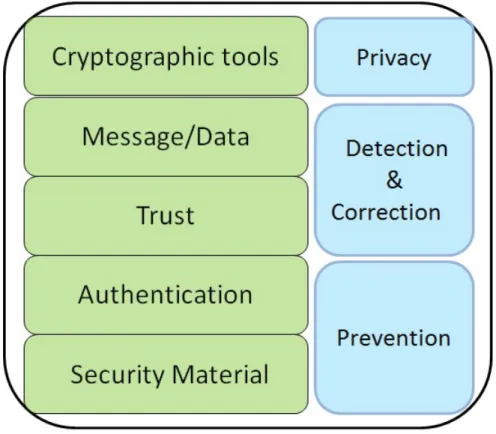
Security mechanisms proposed for VANET in the literatures can be divided into two tech- niques: prevention techniques and detection technique. Detection techniques include:
• Signature-based detection where attacks are detected by comparing network traffic to known signatures of attacks (stored in the attack signature database).
• Anomaly-based detection is a statistical approach that can detect any deviation (anomalies) from the normal communication system behaviour.
• Context Verification collects information from any reliable sources (e.g. telemetric monitoring) in order to create an independent view of its current status and then evaluate the situation based on predefined rule-sets depending on the application.
However, considering the critical and safety nature of VANET application, prevention techniques are more popular. Most of the existing security solutions [8, 9, 20, 24, 46, 56, 19, 21, 44] aim to prevent security breaches rather than detecting them. Prevention techniqueincludes the followings:
• Digital signature that exploit cryptography, either with certification (e.g., [6]) where cryptographic digital signatures are applied to messages or hashes over messages, or without certificate (e.g., [181]) where signatures are combined with digital cer- tificates provided by a trusted Certificate Authority (CA).
• Proprietary systemexploits proprietary (non-public) protocols or hardwares in order to control unauthorized access to the network.
• Temper proof hardware ensures secure input to the communication system and allow only authorized entity to access it.
In this section, we provide some preliminaries regarding wireless communication, ve- hicle addressing mechanisms, vehicle characteristics from Sevecom Project in [182]. In addition, we gather major VANET security and privacy solutions and architectures pro- posed in the literature. Meanwhile, we discuss some projects and standardization studies