Feasibility and Issues of Smart Community in
Japan
著者
Yoshiki Ogawa
著者別名
小川 芳樹
雑誌名
経済論集
巻
38
号
2
ページ
263-284
発行年
2013-03
URL
http://id.nii.ac.jp/1060/00004234/
Creative Commons : 表示 - 非営利 - 改変禁止
Feasibility and Issues of Smart Community in Japan
Yoshiki Ogawa
Abstract
East-Japan earthquake broken out on March 11, 2011 and a large accident in Fukushima nuclear power plant caused
by its tsunami (seismic sea wave) produced quite serious influences on the energy and environment sectors in Japan andthe world. Now, in Japan, the many discussions for revival plans from the East-Japan large disasters are started and themovements to
realize the plan of environmental-friendly future town called as smart community are animated actively. It isexpected that the smart community would be one of important issues in the revival plans from the East-Japan large disasters,relating to the feed-in tar
ぽscheme for renewable energies to purchase whole electricity generated by renewable energies.In this study, I would like to discuss the feasibility and issues of smart community in Japan from the various viewpoints 。
In conclusion , it should be deeply discussed what kind of merits are brought to demand-side consumers in the area wherethe
environmental-friendly future town (smart community)is realized. In the present discussion, it seems that logics ofsupply-side players would be revealed too strongly. Specific and concrete contents of smart community project should be
thoroughly considered, because the survival competitiveness is strongly required in the competitions with so many similarprojects planned at various places in Japan from now on. It is quite important to organize and utilize a public-privatepartnership
(PPP)combining central government, local governments, NPO, related private enterprises, and consumers forthe projects making the most of
local special qualities and competitiveness. The function of comprehensive project managersuch as Accenture and IBM is required to achieve a smart community project. In Japan, we need to train such a player
without delay・
Contents
1. Introduction
2. Programs on smart community made in overseas
2.1 Examples and aims of smart community programs in USA and Europe 2.2 Developments of smart community in new rising countries 3. Challenges to smart community programs in Japan
3.1 Discussions on smart community in Japan
3.2 Domestic demonstration projects on smart community and international expansions
3.3 Intemiediate results and eχtracted problems on demonstration projects 4. Plan of environmental-friendly future town and its issues solved 5. Economics simulation on the role of storage battery and photovoltaic cell
5.1 Assumptions for economics simulation
5.2 Individual introduction of storage battery and photovoltaic cell to house and their economics
5.3 Combined introduction of storage battery and photovoltaic cell and its economics 6. Concluding remarks
References
1. Introduction
East-Japan earthquake broken out on March 11, 2011 and a large accident in Fukushima nuclear power plant caused by its tsunami (seismic sea wave)produced quite serious influences on the energy and
environment sectors in Japan and the world. The people's an χiety to safety of nuclear power plants is nowgrowing large and the matters that the restart of nuclear power plant is not permitted after stopping operation
for regular checks is now also eχpanding at various places in Japan. The situation such as the disapproval forthe restart of nuclear power plants seems to have quite serious and large influences in Japan for several yearsfrom now on
。
Now, in Japan, the many discussions for revival plans from the East-Japan large disasters are started andthe movements to realize the plan of environmental-friendly future town called as smart community areanimated actively. The establishment of smart community started in Europe and the USA has become a bigtopic drawing public and private attentions for
recent five years. It is eχpected that the smart communitywould be one of important issues in the revival plans from the East-Japan large disasters. relating to the
feed-in tari仔scheme for renewable energies to purchase whole electricity generated by renewable energies。 In this study, l would like to discuss the feasibility and issues of smart community in Japan from the
various viewpoints. First, I would like to compare smart community projects in the USA, Europe and Japanand to discuss special characteristics and differences of these projects from the several viewpoints. Second, Iwould
like to check the results on demonstration tests for smart community made at four different cities such as Yokohama, Toyota, Keihanna and Kitakyushu in Japan. Third, l also would like to check project proposals
submitted to public invitation of environmental一friendly future town project by Japanese government. Forth,l would like to make economic simulations on the introduction of storage battery and photo voltaic cell whichare an
2. Programs on smart community made in overseas
2.1 E
χamples and aims of smart community programs in USA and Europe
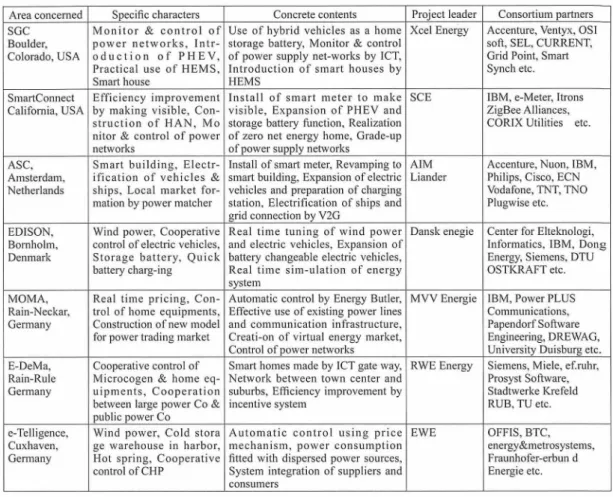
Table l summarizes several representative
examples on smart community programs in USA and Europetogether with special characters, concrete contents, project leader and consortium partners.
Table l Eχamples and Special Characters of Smart Community Programs in Europe and USA
Area concerned Specific characters Concrete contents Project leaderConsortium partners
SGC Boulder,
Colorado, USA Monitor
& control ofpower networks,
Intr-oducti on of PHEV ,Practical
use of HEMS,
Smart house Use of hybrid vehicles as a homestorage battery. Monitor
& controlof power supply net-works by ICT,
Introduction of smart houses by HEMS
χeel Energy Accenture, Ventyx, OSIsoft, SEL, CURRENT,Grid Point, SmartSynch etc.
SmartConnect
California, USA Efficiency improvementby making visible. Con-struction of HAN, Moliitor & control of powernetworksInstall of smart meter to makevisible.
Expansion of PHEV andstorage battery function. Realizationof zero net energy home. Grade-up
of power supply networks SCE IBM,
e-Meter, ItronsZigBee Alliances,CORIX utilities etc.
ASC, Amsterdam,
Netherlands Smart building. Electr-ification of vehicles &ships,
Local market for-mation by power matcherInstall of smart meter, Revamping tosmart building. Expansion of electricvehicles and preparation of chargingstation, Electrification of ships andgrid connection by V2GAIMLiander Accenture,
Niion,IBM,Philips, Cisco, ECNVodafone,
TNT, TNOPlugwise etc.
EDISON ,Bomholm,DenmarkWind power. Cooperativecontrol of
electric vehicles.Storage battery. Quickbattery charg-ingReal time tuning of wind powerand electric vehicles. Expansion ofbattery changeable electric vehicles,Real time sim-ulation of energy
system Dansk enegie Center for Elteknologi,Informatics,
IBM ,DongEnergy, Siemens, DTUOSTKRAFT etc.
MOMA, Rain-Neckar,
Germany Real time pricing, Con-trol of home equipments.Construction of new modelfor power trading
market Automatic control by Energy Butler,Effective use of existing power linesand communication infrastructure.Creati-on of virtual energymarket.
Control of power networks MW Energie IBM,
Power PLUSCommunications,Papendorf SoftwareEngineering, DREWAG,University Duisburg etc.
E-DeMa ,Rain-RuleGermanyCooperative control ofMicrocogen & home eq-uipments
,Cooperationbetween large power Co &public
power Co Smart homes made by ICT gate way,Network between town center andsuburbs,
Efficiency improvement byincentive systemRWE Energy Siemens,
Miele, ef.riihr,Prosyst Software,Stadtwerke KrefeldRUB,
TU etc. e-Telligence,
Cu χhaven,GermanyWind power, Cold storage warehouse in harbor,Hot spring, Cooperative
control of CHP Automatic control using pricemechanism,
power consumptionfitted with dispersed power sources.System integration of suppliers and
consumers EWE OFFIS
,BTC,energy&metrosystems,Fraunhofer-erbun dEnergie etc.
(Note) CHP: Combined Heat & Power, PHEV: Plug in Hybrid Electric Vehicle, HEMS: Home Energy Management System,HAN: Home Area Network
(Source)Made from data gathered through various materials
The construction of smart community is a town development based on the smart grid system which is
defined as a new electricity and information infrastructure interactive between supply-side and demand-side.
In the USA, where the liberalization of power markets had made a progress in 199O's, people has beentroubled with the blackout problems caused by the vulnerability of superannuated power generation andsupply networks. Therefore,
the smart grid system attracts people's attention as a stable and effective system
for electricity use on the whole in the USA。
The reason why the smart grid in the USA was taken a close-up from all over the world is because
President Obama positioned the smart grid as the first priority task and promoted the new policy called “GreenNew Deal" immediately after his inauguration. As shown in Table 1, the forefront demonstration project
of smart grid was started in Boulder, Colorado from 2008 and various smart grid projects such as the Smart Connect project in California followed it at various places in the USA。
0n the other hand. in Europe, the smart grid system was started from the introduction of smart meters
for the sake of preventing electricity stealing. The main important purposes of smart grid in Europe was tosolve network linkage problems of renewable energies such as wind power which was positively promoted to
expand and to make multi-national trading smoothly through real time monitoring and operation 。 In Europe, as shown in Table 1, the forefront demonstration projects of smart community were made
in Netherland and Denmark. Of these, Germany picked up six projects on E-Energy and tackled with therealization of smart grid system eagerly. The attempts in Europe are greatly characterized by the rebuildingof local community through full utilization of local
individuality. These movements are also expanding toother European countries such as France and the United Kingdom.
The important point found from the e χamples of smart community programs in the USA and Europe is thedefinite e
χistence of comprehensive project manager such as Accenture and the definite existence of playerstaking charge of contents making in application sector such as IBM and Google, as shown in the example ofBolder and Amsterdam.
2 . 2 Developments of smart community in new rising countries
As discussed in the preceding section, the construction of smart community was started in the USA and
Europe, but concerns to smart community by new rising countries such as China and India have increasedrapidly in recent times and the smart community project takes concrete shape in these countries. We can listup Masdar City in Abu Dhabi and Tianjin Eco-city in China as a typical e
χample.
The main purpose of smart community in new rising countries is to prepare the new infrastructure which
can make necessary energy supply to drastic eχpansion of energy demand accompanied with rapid economicdevelopment. We should pay attention to the fact that the us companies such as IBM, Google, GE,Accenture and
Cisco, especially speaking information companies. play an important and leading role in the construction of smart community not only in Europe but also in new rising countries.
The smart community projects in new rising countries, from China down. begin to take on aspect of hardtrade war. and not only enterprises in the USA and Europe but also countries such as Singapore and South
Korea are now expanding their activities strategically in order to acquire the market of smart communityprojects. It is not too much to say that Singapore and South Korea are stepping up their demonstrationprojects of smart community in the own country aiming to hold a dominant position in the
trade war.
3. Challenges to smart community programs in Japan 3.1 Discussions on smart community in Japan
In Japan, after the preliminary discussions on the smart grid system. the comprehensive full-scale examinations on smart community started from 2009. After piling up various discussions and results on
various viewpoints of smart community centering by discussion meetings of the Ministry of Economy, Tradeand Industry (METI), the forum on systems related to smart community was organized by 22 large domesticcompanies,
the final report by this forum was completed in June, 2010 (The Secretariat of Smart CommunityForum[2010]).
Based on the various issues presented in this final report, the challenges to establish smartcommunity in Japan are now making a progress strategically 。
Firstly, the platform with public and private partnership (PPP)called “ Smart Community Alliance " wasestablished. The total 652 companies joined to this alliance on June, 2011 and concrete measures and marlcetstrategies
for the smart community are now discussed in the four working groups such as internationalstrategy WG, international standardization WG,
road map 八WG and smart house WG in this alliance 。
Secondly, the works on international standardization have a quite important position on Japan'sinternational e χpansion of smart community. The 26 important items to realize smart community were pickedup in the report on international standardization of neχt-generation energy system made by the workinggroup (METI[2010a]). The works on international standardization of these items are now being developedconcretely.
3.2 Domestic demonstration projects on smart community and international expansions
The council on ne χt-generation energy and social system was set up as a committee under the Agency ofNatural Resources and Energy, and the domestic demonstration projects
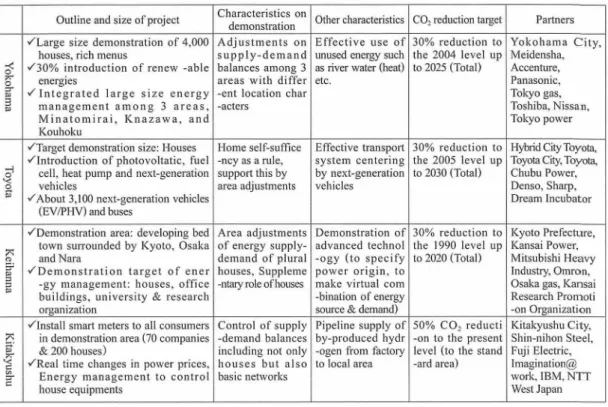
on smart community were startedfrom 2010. After submitting 19 project proposals from different domestic areas. four demonstration projectsin
Yokohama, Toyota, Keihanna and Kitakyushu were adopted. Each proposal from 19 areas showed its individuality quite abundantly (METI[2010c]).
Table 2 summarizes the outline of four demonstration projects adopted and their specific characteristics. We can easily find that four demonstration projects have interesting contents and individual characteristics by
Table 2 Domestic Demonstration Projects of Smart Community in Japan and their Characteristics
Outline and size of project Characteristics ondemonstrationOther characteristicsCO, reduction targetPartners
『
≫^Large size demonstration of 4,000houses,rich menus^^30 %introduction of renew -ableenergies7 Integrated large size
energymanagement among 3 areas,Minatomirai,
Knazawa, andKouhokuAdjustments onsupply-demandbalances among 3areas with differ-ent location char-actersEffective use ofunused energy suchas nver water (heat)etc.30% reduction tothe 2004 level upto 2025
(Total) Yokohama City,Meidensha,Accenture,Panasonic,Tokyo gas,Toshiba,
Nissan,Tokyo power
IF
'Target demonstration size: Houses"^Introduction of photovoltatic, fuelcell, heat pump and neχt-generationvehicles^ About 3,100 neχt-generation vehicles(EV/PHV)andbuses Home self-suffice-ncy as a rule,support this byarea adjustmentsEffective transportsystem centeringby next-generationvehicles30% reduction tothe 2005 level upto 2030
(Total) Hybrid City Toyota,Toyota City, Toyota,Chubu Power,Denso, Sharp,Dream Incubator
「
v^Demonstrationarea:developing bedtown surrounded by Kyoto, Osakaand Narav^Demonstration target of
ener-gy management: houses, office
buildings, university & researchorganizationArea adjustmentsof energy supply-demand of pluralhouses, Suppleme-ntary role ofhousesDemonstration ofadvanced technol-ogy
(to specifypower origin, tomake virtual com
-bination of energy source & demand) 30%
reduction tothe 1990 level upto 2020
(Total) Kyoto Prefecture,Kansai Power,Mitsubishi HeavyIndustry, Omrc n,Osaka
gas. Kansai Research Proinoti -on Organization
万
-/Install smart meters to all consumersin demonstration area (70 companies&200 houses)^Real time changes in power prices,Energy management to control
house equipments Control of supply-demand balancesincluding not onlyhouses but alsobasic
networks Pipeline supply ofby-produced hydr-ogen from factoryto local area50% COj reducti-on to the presentlevel
(to the stand-ard area)Kitakyushu City,Shin-nihon Steel,Fuji Electric,Imagination @work,
IBM, NTTWest Japan (Source)Made from data in METI [2010b]
the combination of different partners, respectively。
Aiming to achieve the international eχpansion of smart community. so many projects have been plannedand carried out already, as represented by the Munbai project in India. In Japan, various activities related onsmart community have been developed for only two or
three years from 2009 by cooperating with the public and private partnership so as not to be behind in international wars for market acquisition.
3.3 Intermediate results and extracted problems on demonstration projects
The four demonstration projects started from August 2010 have almost passed two years. Table 3 summarizes intermediate results and remaining items on four demonstration projects on smart community in Japan (METI[20111) 。
In about two years passed from starting. four demonstration projects on smart community made several
interesting results, respectively, as shown in Table 3. First, as for the Yokohama project, the installation ofsolar power
and solar heat equipments, fuel cells and electric vehicles to the demonstration condominiumwas finished. In addition, the battery storage system and the system to control charge or discharge of batteryby
Table 3 Intermediate Results and Remaining Items of Four Demonstration Projects
Items already done and results Items will be done from now
『
>Introduction of solar power, 珀el cell, solar heat. electricvehicle etc. to the condominium>
Development of both control system and battery storagesystem. The latter can make charge or discharge bycommunicating
from the fomicr.>Submit standard proposal to IEC TC57 for interfacebetween control system and battery storage systemStart the demonstration for accommodation of electricityand heat in the condominium ftom April-v-Aim at
40% reduction of energy use by the introduct -ionof renewable energies, dispersed energies etc.
今Plan to make a demonstration of B route (to supplyelectricity use data to home directly), first in Japan
万
>Constructed 67 smart houses, ofthese moved into 42>Reduced 8.6% of electricity use by making visible>Self-sufBciency
rate of smart house reaehed to 50%>
About 30% of electricity saving by making visible and bydemonstration of
demand response with point incentives>Linked control between storage battery and fuel cell usingHEMS
令Demonstration of electricity supply from storage battens'on vehicle to house in ne χt autumn
今Coramercialization ofV2H system in next winter-V-Self-sufficiency rate of smart house to 70%
■v-Demonstration of avoiding response to congestion withpoint incentives ■{■Demonstration of car sharing system using ultra-smallEV
やDemonstration of electricity supply from fuel cell bus
不mr
p >Making visible to 51 houses, Introduction of
HEMS to 14houses and Li storage battery to 10 houses
>Monitoring function of CEMS in operation. desk verification ofBEMS completed
> Introduction of 60 EV completed. Linkage betweenFEMS and discharge system of EV storage battery (V2 χ)completed>
Development of modal shift simulator completed
今Large-scale demonstration using installed and deve 】-oped systems
-Y-Considering new business developments such as net shop using terminal for making visible. healthcare, securitycheck
etc., together with ESCO to home
今Demonstration of demand response using CEMS-y-Receiving electricity from wide areas by lumpingtogether and operating CEMS by electricity companyitself
万
MF
>Home display ofpower price information by CEMS>Demonstration of peak time power price change fromLevel 1 {15Yen/kWh)to Level 5 (150Yen/kWh)>
Energy saving effects of 11.9% at Level 2 and 26.4% atLevel 3>
Almost zero electricity purchase in daytime using homestorage battery system>Use of by-produced hydrogen from Shin-Nippon Steel onfuel
cell at home -v"Covering 30%
of heat demand by effective use of solarheat and 40% reduction of electricity charge
今Further checking of peak cut effects by price raising atpeak
time (maximum 10 times up)within this year-V-Promoting power saving by showing electricity uses athome and power
price information from CEMS through home terminal display
(Source)Made from data in METI [2011]
interface between both systems was submitted to IEC TC57. The further complicated demonstrations on theaccommodation of electricity and heat among related sectors will be done in neχt one or two years。
Second, as for the Toyota project, 67 smart houses were constructed and of these. 42 smart houses werealready moved in. The rate of energy self-sufficiency reached to 50% and the 8.6% reduction of electricityuse was made by the making visible function of smart
house. The Toyota project also tried the demonstrationof demand response using point incentives.
Because of both factors, about 30% of electricity saving wasachieved up to now. In addition, the linked control was made between storage battery and fuel cell using
CEMS system. In the Toyota project, further demonstration items will be also tried in neχt one or two years。Third,
as for the Keihanna project, the making visible function was installed total 5 1 houses, the HEMSsystem was introduced to 14 houses. and the Li storage battery for home use was installed to 10 houses.60 electric vehicles were also introduced in
the demonstration area. The linkage between FEMS and the discharge system from electric vehicle storage battery (V2χ system)was developed and completed as a quite
Fig. I Electricity Price Changes Prepared for Demand Response by Dynamic Pricing
(Unit:Yen/kWh)
Time Grouping
Season
Time range
Level 1
Level 2
Level 3
Level 4
Level 5
Peak time
May
− October
13:00 − 17:00
15.18
50.22
75
100
150
November − April8:00 −10ニ0018:00
− 20:00
15.09
50.02
75
100
150
Day time
May
− October
10:00 − 13:00
15.18
15.18
15.18
15.18
15.18
November − April10:00 − 18:00
15.09-15.18
15.09
−15.18
−15.18
15.09
−15.18
15.09
−15.18
15.09
Living time
May
− October
8:00 −10:0017:00
− 22:00
10
10
10
10
10
November − April20:00 −22:00
Night time
Whole year
22:00 − 8:00
5.94
5.94
5.94
5.94
5.94
Yen/UWh 160 ・¬ 120 10(1 so 60 0 0 0 4 1 ‘ 匹 Yen/ “h ¬ 160 ¬ 0 0 0 0 0 0 0 0 4 2 0 8 6 4 2 I I I Wh 匹 すぢ寸 ヤう寸
‥
口 ‥-
… …
yTI
…
v^wS − 一一一乍
T 0 】2 3 4 5 6 7 8 9 10II 12 1314 IS 16 1718 192021 222324 (Source)METI[2012a] 0 1 2 3 4 5 6 7 8 9 1011 12131415I6I71SI9202122 23 24important component technology. The Keihanna project also plans to make large-scale demonstrations using these installed and developed systems。
Forth, as for the Kitakyushu project. the electricity price information was supplied to the home displayterminals of 50 offices and 230 houses in the demonstration area using the CEMS system (the localenergy management system). Fig.
1 shows electricity prices changes prepared for the demand responsedemonstration by dynamic pricing in the Kitakyushu project. The electricity saving effect of 1 1 .9% wasobserved at
the dynamic price level 2 of peak time and the same effect of 26.4% was also observed at thedynamic pricing level 3 。
In addition, almost zero electricity purchase in daytime was made at the condominium in the demonstration area. using a home storage battery system. The by-produced hydrogen from Shin-nippon Steel was used
for the fuel cell operation at the houses in the demonstration area. In the Kitakyushu project. furtherdemonstration trials will be made as the same as other projects.
We need to thoroughly consider about the way of promoting the demonstration projects from the following viewpoints: (l)to reconsider the positioning of smart community (especially on the relation with large
disasters), (2)to accumulate know-how of smart community and to strengthen the project managements. (3)toexpand and develop further demand response businesses and (4)to enhance the promotion activities of smartcommunity to domestic and overseas 。
In the sector of rules making for smart community are listed up the following issues: (Dthe liberalization
of low-voltage electricity sending, (2)the promotion of specified electricity business and specified electricitysupply,
(3)the receiving electricity in a lump. (4)the supply of electricity network information and (5)theindependence of electricity supply system at emergency.
4. Plan of environmental-friendly future town and its issues solved
Japanese Government made a proposal report on the framework of revival from the East-Japan large disasters in June, 2011 (Cabinet office [2011a])and the construction of communities practically applying
renewable energies was recommended in the report. Based on this report. the invitation of proposal forenvironmental-friendly future town (smart community)projects was made by Japanese Governmentand several projects were adopted. The large-scale demonstration trials for smart communities are quitemeaningful
from the viewpoint of green innovation, but there are many issues and problems to be consideredand to be solved 。
As discussed in the preceding session, the smart community is a quite important theme which has been eagerly dealt by both public and private sectors in Japan in recent two years. Considering the discussions
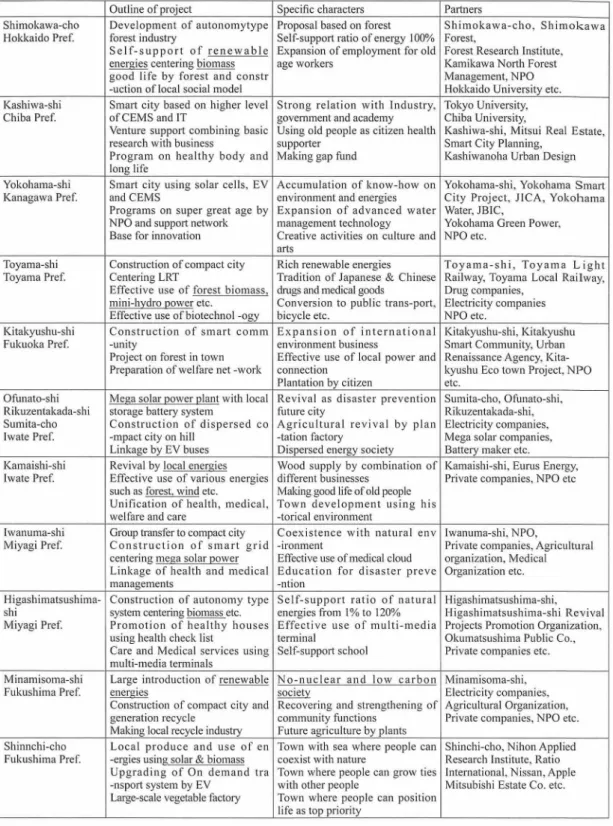
mentioned above, the invitation of environmental-friendly future city project was made by the Japanesegovernment. Total 30 proposals for the future city project submitted and 11 proposals were adopted by thegovernment. Table 4 shows outline and specific characters ofthese 11 projects together with partners
。 As shown in Table 4, Iwate Pref. Miyagi Pref. and Fukushima Pref. suffered from the East-Japan large disasters severely submitted their proposals and two proposals for each Prefecture were adopted specially by the government. The remaining 5 projects were generally adopted with no relation to the disaster area. One common special character of all submitted proposals is to close up the expansion of renewable energies. Another common special character is to deal with problems and measures to future great age society・
Table 4 Outline and Special Characters of Environmental-friendly Future Town Projects
Outline of project Specific characters Partners
Shimokawa-cho
Hokkaido Pref. Development of autonomytypeforest industrySelf-support of renewableenergies centering biomassgood life by forest and constr-uction of
local social model Proposal based on forestSelf-support ratio of
energy 100%Expansion of employment for old
age workers Shimokawa-cho,
ShimokawaForest,Forest Research Institute,Kamikawa North ForestManagement, NPOHokkaido
University etc. Kashiwa-shi
Chiba Pref. Smart city based on higher levelofCEMS and ITVenture support combining basicresearch with businessProgram on
healthy body and
long life Strong relation with Industry,government and academyUsing old people as citizen healthsupporterMaking gap fundTokyo University,Chiba University,Kashiwa-shi, Mitsui Real Estate,Smart City Planning,Kashiwanoha Urban Design
Yokohama-shi
Kanagawa Pref. Smart city using solar cells. EVand CEMSPrograms on super great age byNPO and support networkBase for innovationAccumulation of know-how onenvironment and energiesE
χpansion of advanced watermanagement technologyCreative activities on culture andartsYokohama-shi, Yokohama SmartCity Project, J
【CA ,YokohamaWater, JBIC,Yokohama Green Power,NPO etc.
Toyama-shi
Toyama Pref. Construction of
compact cityCentering LRTEffective use of forest biomass 、mini-hydro
power etc.
Effective use of biotechnol -ogy Rich renewable energiesTradition of Japanese & ChinesedjTJgS and medical goods
Conversion to public trans-port.
bicycle etc. Toyama-shi,
Toyama LightRailway, Toyama Local Railway,Drug companies,Electricity companiesNPO etc.
Kitakyushu-shi
Fukuoka Pref. Construction of smart coram-unityProject on forest in townPreparation of
welfare net -work Expansion of internationalenvironment businessEffective use of local power andconnectionPlantation by citizenKitakyushu-shi,
KitakyushuSmart Community, UrbanRenaissance Agency, Kita-kyushu Eco town
Project, NPO etc.
Ofunato-shi Rikuzentakada-shi Sumita-cho
Iwate Pref. Mega solar power plant with localstorage battery systemConstruction of dispersed CO-mpact city on hillLinkage
by EV buses Revival as disaster preventionfuture cityAgricultural revival by plan-tation factoryDispersed energy societySumita-cho,
Ofiinato-shi,Rikuzentakada-shi,Electricity companies.Mega solar companies,Battery maker etc.
Kamaishi-slii
Iwate Pref. Revival by local energiesEffective use of various energiessuch as forest. wind etc.Unification of health, medical.
welfare and care Wood supply by combination ofdiiferent businessesMaking
good life of old peopleTown development using his-torical environmentICamaishi-shi, Eurus Energy,Private companies. NPO etc
Iwanuma-shi
Miyagi Pref. Group transfer to compact cityConstruction of smart gridcentering mega solar powerLinkage of health and medical
managements Coexistence with natural env-lronmentEffective use of
medical cloudEducation for disaster preve-ntionIwanuma-shi, NPO,Private companies.
Agriculturalorganization, MedicalOrganization etc.
Higashimatsushima-shi
Miyagi Pref. Construction of autonomy typesystem centering biomass etc.Promotion of healthy housesusing health check listCare and Medical services using
multi-media terminals Self-support ratio of naturalenergies
from 1% to 120%Effective use of multi-mediaterminalSelf-support schoolHigashimatsushima-shi,Higashimatsushima-shi RevivalProjects Promotion Organization,Okumatsushima Public Co.,Private companies etc.
Minamisoma-shi
Fukushima Pref. Large introduction of renewableenemiesConstruction of compact city and
generation recycle
Making local recycle industry No-nuclear and low carbon Minamisoma-shi,Electricity companies.Agricultural Organization,Private companies. NPO
etc. society
Recovering and strengthening of community functions
Future agriculture by plants Shinnchi-cho
Fukusliima Pref. Local produce and use of en"ergies using solar & biomassUpgrading of On demand tra"nsport system by EV
Large-scale vegetable factory Town with sea where people cancoexist with natureTown where people can grow tieswith other people
Town where people can position
life as top priority Shinchi-cho,
Nihon AppliedResearch Institute, RatioInternational,
Nissan, AppleMitsubishi Estate Co. etc.
5. Economics simulations on the role of storage battery and photovoltaic cell
In this section. we would like to discuss the results of economics simulations on the introduction of storage battery and photovoltaic cell which are a representative and important facility for the construction of smartcommunity
・
5.1 Assumptions for economics simulation
The several assumptions explained below were adopted for the economics simulations for the introducti nof
storage battery and photovoltaic cell. First of all, the average electricity demand pattern in a house wasestimated by month based on the METI survey report (METI[2012b]) and Cogeneration ComprehensiveManual
(ACEJ[2004]). The category of consumptions was classified into “Lighting, power etc.," "Hot watersupply,"
"Heating," and “Cooling." Fig. 2 shows the estimated average daily patterns of electricity demaadfor several months such as January, April, June and August.
Eleciricily l}eniaiid (kWh) 6 4 2 0 8 6 4 2 0 1 1 1 1 0 0 0 0 0 0 6 4 1 一 〇 8 6 4 2 0 ! − I I 0 0 0 0 0 0 2 2
Fig. 2 Average Electricity Demand Pattern of House by Month [ilanこr> [ Electricity* l)eiRnnil' (kWh)
・ * ' -! = > ≪ > ≪ ・ * . ' ■ ! ≫ I I I I 0 0 0 0 0 6 4 6 8 8 0 E l e c t r i c i り . c -s ; r ) ≫ w -< > t M O ︲ I I 1 0 0 0 0 0 2 4 6 Deniaiid (kWli) 8 匝 ] 10 12 14 [6 18 20 22 「扁 司 1 0 1 2 1 4 1 6 1 S 2 0 2 2
匹祠
搾 Qi ヅT
町 W S昭M
・ . ■ : t T 3 1 ぼぞ ? i ? ? ^ ・麗妬ほ雰ぢ f?fe9 ^ ご フ學
丁 ミ ● 12 0 2 4 6 8 10 12 14 16 IS 20 22The assumptions on storage battery are as follows. The capacity of storage battery installed in a house waschanged from l kWh to 8 kWh every l kWh in the simulation. The cost of storage battery was assumed to
be 200,000 Yen/kWh by examining various data on storage batteries. The one third of initial cost of storagebattery was assumed to be subsidized by the Government. The charging of storage battery is made for 6
hours from O:00 to 6:00 and the discharging of storage battery is made in other hours judging from electricity
price.
The assumptions on photovoltaic (PV)cell are as follows. The average daily pattern of solar powergeneration was estimated by month using NEDO Sunshine Database (NEDO[2006]).The cap acityof photovoltaic (PV)cell was changed from
l kW to 5 kW every l kW in the simulation. The cost of photovoltaic cell was assumed to be 350,000Yen/kW by examining various data on photovoltaic cells. The one third of initial cost of photovoltaic cell was also assumed to be subsidized by the Government. Surplus
electricity generated by photovoltaic cell was assumed to be sold at FIT (Feed in tariff)price of 42 YenノkWh.Electricity price assumption is
as follows. Electricity price is changed from the pricing level l to pricinglevel 5 shown in Fig.l for the peak time (13:00 − 17:00 in summer. and 8:00 − 10:00 and 18:00 − 20:00in winter).
This price assumption is actually used in dynamic pricing in Kitakyushu case of the smartcommunity demonstration project.
The economics of the introduction of storage battery and photovoltaic cell is judged from the simple
payback year which is calculated by dividing the net initial cost (excluding subsidy) of storage battery andphotovoltaic cell by the annual profit. The above-mentioned annual profit is estimated from the difference
between A (= total costs of purchased electricity in the case without storage battery and photovoltaic cell)and B (
=total costs of purchased electricity in the case with storage battery and photovoltaic cell minus therevenue of sold surplus electricity generated by photovoltaic cell).
5.2 Individual introduction of storage battery and photovoltaic cell to house and their economics
First, the changes in electricity demand and supply pattern brought by the introduction of storage batteryto the house was e
χamined. As described already. the charging of storage battery is made in 6 hours betweenO:00 and 6:00 every day when the price of purchased electricity is the lowest. 0n the other hand, with the firstpriority,
the discharging of storage battery is made in 4 hours from 13:00 to 17:00 in summer season (Mayto October), and from 8:00 to 10:00 and from 18:00 to 20:00 in winter season (November to April)when theprice of purchased electricity is the highest because of the peak time pricing
・
With the second priority, the discharging of storage battery is then made in the day time, and after then.
with third priority, it is made in the living time. as both shown in Fig. 1. If the discharging capacity of storagebattery still remains. the
discharging of storage battery is finally made in the night time e χcept the above-mentioned charging time of storage battery ・
The changes in electricity demand and supply caused by installing the storage battery to the house is shown
『
軋 1箕雲naZ 回 にNO 巴 こ112 コ − − Ξ @ − 〃4 喩 寸 りM −e[Jt
果1
中ヽよ:・:':・: || a ;;g i S ■x Σご 旨iZ コ ロ −-●2 かS 卜4 囁 寸 鳴N −Q|
−ll
』
j
|に: ロ na a S S i に 雲 雲 こ ロ2 − − ΞS ∽ トQln9 呵 やl −Q 寮 │:`│
日
nl
1:゛:・t
l
5
心・:: II………卜心喝 心 ● ● ■ . ■ ■ . ■ ■ . ■ - -一 几ii●航跡
㎜ l l:・:::・:::・:ニ:●;j謐Vビj
h.ムM /1:: ・::-;:v●ぷ疹 万 言| 丿 ・ 4 7 4 「 − 1 −c\
↓
り
「ll
| ・::・:■■■t / ぶ i | |・ . j'・■ S 皿 ■ ■ =1打 ■ 冷V
祠
。
j ・::ii* ■●雨
\^・::-:: l「 f 1:・:.:・ イ|
y 、 g m ; ・―下野叩■a l ●7,、十ご四天 む厭廠舜畝 f?sー癩 s四卜皿節 頂礼諒癌融 ■- 'c愈 聊' 1 0艦よ 癌 叫 Vリド」 戴ぐm心溜爾 i r濯拶 脳f t唾]丿友言│ 私4 4L ⊇4 ! K I T . M ^ ^ . r - j § r -i 零 ●4:^^臨辿』ま J ]コ:0] ]O;^r2=! ・Sg -岬町M句JPりOりl一一一ccQφ9l
t
it
軋| a a − 卜 民 雲 竺 にiiZ ロ2 一 一 Ξ かZ 卜Q 囁 寸 心 − −C ぽ ͡ ぷ1 ∽t ●〃Q 軋 l a a −NiSi に2i ヱ ロ2 − ∼ 三 かZ ト4 鴫7 りN −QE
−
{l;g
|
、 : '1・ . : a gl Z 旨 S 竺 l 2 ! Z ロ 2 − −2 か ∽ ト4l £, 寸 呵 − −O ●E
匹
卜
!: :?^嘩・:`:・厦s 顎| E7: m : ・ : ヽ : ' : ヽ : ` : ヽ : ・ :じ希・;‘'- ■ ・・や鼻 へ 1 鮫 1・ :` : 4『 i●■ 丿 − 〃 − − ら 十 − − i ? J ・ :・ ーし:::・:│m
●が
』 土紬
ト
・::・:し:廬ー 座崖・ 卓 │:::・:: X r J ー砂、m鏃
jル
'■mir`這
l ㈹端 毒 眉口 -− 斟 ]3 ]コS22 §?3S? り μ コ コW; コ^; ^ 2 2 2 ^ ^ ご − = ¶ ・ ・ ・ ●_._I ぶ弐ti ゛りりRf り9 り・9 り り4 ゛`“  ̄  ̄’ ゜ ゜ ゜c99977[y
し';.;*. ・ j ヨ a ゴ − 八 尽 ! 芒r こ !iZ コ2 − − 三QZ り4ln ?rj 四 −Cぼ
ミ1
し
|
|y
1 よ 卜 み | a a − ぺ 自 !12 Σこ2Z2 ヱ コ2 ∼ 一 三 − ミ 卜4 囁 マ り かl −C l s £ 1 | ;>. | aa −rlZ S 雲 l 里 i Z 2 1] − −it ∽ へ4 鳴 寸 鳴 四 ∼C 池 φ │※ 祀4ぷ※.※ |1
1
a
モ
1
͡∼ −t 廼 モ ・M n* い 芦│:・:':・:・:・: 卜‥ べー7: りシ ・げ ・ ●●:│●j トj}
U
一 卜 「 g 了 {t41 − ふ = べ 加 J● ':一元 ・ ダ ・| |t
jt
t Q 寸 爽 Z 刷 N 7 4 M , 0 哨 e 7 M i f , 四 争 ●● ● ■■ ● ●● ● ●● ● F 凶”” ’ 一一 ゜ ゜゜ ゜ = 守 = ママ ] ] ] ゴ2122 回2212 Jコ 乙 i ; * t -≪ 5 り り 飛 ^ り 『 り・ = ^ り り Q N N 〃 − 〃 S Q 2 a s Q S ・ ・ l l r − ミ ( q A V > [ 8 l A a a j j B q s S w o i s ] ( q A \ > i t 7 : A J 3 H B q s S b j o j s ) ( q A V > [ I : A j [ 3 W B q s S t j j o j s ] A j 3 ︶ 4 E q 3 S e j o ︶ s 9 1 1 ︸ S u i │ m : │ s u i j ︵ q s s n o u a m u i u j a u E j X i d d n e p u B p u e u i a n i C i i s i j i s a c i n i s s S u e u n c -S i j −275ご 回 目 t
s
暇
呪
a r: ∼ り 尽 已 巴! こ2iZ コ 八 − 一 一 雲 ひ 匈 卜4 り ? 嗚N ∼e J t:.: ・: 詞1 H
g 四 N − − べ C − ひ − Z 一 ト− C − y ・ − 寸 − り∼ M 一 一 − S ∼ S ∽ 卜 4 鳩 寸 鴫 N − O | −J μ2 − | 晋お
宍l
1
a a −fl 目l ! ! !i ここ コ ゴ − −2 ひ ∽ 卜C 鴫 ? 鳴 り −SE
iミ
l
し
モ
1 1 1 ■-●※.E・ : 1‰
卜M
〆 ,・¥ンM1
鶏
羽
§難
OろJゝA・i - &議b
-席
i か迢旧aS
4 §SSSSSRSSft
芸盗 /lies
s /●・ ●"^- へ へ ● り 皿 り /ニ談
l l
フ
: ・ : ' : り/ /f ■ :・ ・fダF
齢 : : : ・y f’ ・:*ン 垂 │・:::・ │ず引: l 1 ・ : . :L
E
t-| ぶ 1 ゛ ! q I f . O 町 O り O U - . S I T . ぶ゛ ゛ ゜ ゜ = - . マ r j り ? 口 − a ・ 5 s り 。 。, c 。 。 。 = 。 −一● ■ 一 ● ● l ● ● ● ● ● 4 ゜ = = ? 7 - r " . ' 7 り ? 乙 J i 呪 o I f . o り o i r . o ゛ j c : i n U 一 一 ゜ ゜ 9 7 7 り り り りl
t
l
U
k !4
aa − り5 之 弐 に2 !Z22 一 一 弐 きZ 卜 心l £.7 りel − ご丑
{
{
|
\i:4
S 1
a a −NaSil 旨iZ22 一 一 Ξ −Z 卜4 寸.t り り −C湊
͡
{l:g
刺│16
1
71に1 −Mg 5li に 忿 i Z 2 2 − − ΞSZ ト4ln ? り りl −S j !f
耐※'E.※C
し 祠・E・※ 1 X・E・E9U
I
i
・?*^ 浹:汐 り 、 a 心 / ク/.■x・ ダ§ r:yM///爵
皿
心 心 ヨocx ≫ χ, ・-|ヽ :‘ :・か; ン ン ・M !a 々りW ;`:・:■M/7/ り≫弊
F
り<j 「 〃 F炉
ダ 長 │× Jむ
LE
J
り1-
4 ∼1 哨Rg ,R り 『 町Ri9 りQ 一 一 ゜ ゜= _- り ? り り − 乞,491 りR り 『v! 9 り9 り ■^一 一= = う-- り り り り ∼ ∼ 1 り 三 馬 9 哨 9 9 『 ’ Q 9 ゛ 1 U ゛ 一 ゜ ゜ 弓 7 7 り り り ? 「 j%
a a 芯 尽 已 芒 に2 雲Z 二Z 一 一 Ξ ㎝ ∞ 卜 心 嗚 卜 鳴N ∼O 五 −∼ ニ 二 − 1 ^ ' S り 三 n a 7; 晟 S ミ! ニ !S ご コ2 − − 三QZ 卜4 り 吋 哨N −C S 匠 − ミ −tcXiま
ズ│
k
71 rl Z 弐 l l t-こ2i こ ロ こ: − 一 三 ひZ 卜4 り7 代N ∼C2ハ
−1 1 Jt ∼|
ま
一 冊 ͡一 一S 昔 − |7.2 ・ FEふE'ヨ筏
*1
|
j
● ●14 ' : : ォ I : H 1 :J ; 色硝
恥・ -Iト
P
M
ヨ§3 m・ 記 : ・ 参 : ‘y
:'淮/ン |:負:な
#^:・:: がy
?
争 4 ・:‘:・│ J -− -2‡-
4 − t ; ・ , 0 ・ Q 4 e S e a c s − ● ● ● ● ● ● ● ● ● ● ● は J’ ゛ ゜ ゜ ? 7 7 ? 7 り り こ・^ ・ C I / ^ £ l / i S < / J O ∽ ^ U ^ 皿一● ● 一 ゜● ● ゜ 9 7 7 9 9● ● ● ■ ● り 7● ● U − S ' f . O U " . O W S U "・ O S s こ一 一 s a 9 7 7 ? り ? 一 国1"nmii'l (MA \ 。>i) c!ris/iU3{i 。<J!>!Ji331H 1 − − −j −5 − 、 ︱ ︵yW >ig :il33 orejiOAOjoqj ︶ ︵ A V 3 I £ -i p O O I B l I O A O J O q j ︶ ︵AV ^l W ^ orej(OAO)oii(j ︶ ︶ 1 1 3 3 3 I E 4 1 0 A O 4 O U j 3 U ︶ S u i │ i c ︶ s u i X q 3 $ n o H 3 U ︶ u i u j 3 ︶ ︶ i 3 j X i d d n e p u B p u e u i 3 ︷ I ^ I 3 U ︸ D 9 i a U I S 9 § U B U 3 p ' g l ^storage battery is made just in the peak time through the whole year. 0n the other hand, in the case of thehighest installing capacity (8 kWh), the discharging of storage battery is made in the peak time, of course,and in the part of day time as for January (winter), in the peak and day times and the part of living time asfor
August (summer), and in the peak, day and living times and the part of night time as for May (spring orautumn) 。
Ne χt, the changes in electricity demand and supply pattern brought by the introduction of photovoltaic(PV)cell to the house
was examined. The electricity generated by the photovoltaic (PV)cell is suppliedto the house in order to fulfill the electricity demand of house with first priority, and the remaining suroluselectricity generated by the photovoltaic cell
is sold to the local electricity company with the FIT price of 42Yen/kWh 。
The changes in electricity demand and supply caused by installing the photovoltaic (PV)cell to the house
is shown in Fig. 4. As shown in this figure, in the case of the smallest installing capacity (1 kW), almost all ofthe electricity generated by photovoltaic cell is used the electricity demand of house almost through the wholeyear. Only in the middle season such as May, the
quite small surplus electricity from the photovoltaic cell is sold to outside. 0n the other hand, in the case of the highest installing capacity (5 kW), through the wholeyear,
there is large surplus electricity generated by the photovoltaic cell after supplying necessary electricityto the house, as shown in Fig.4 。
As the changes in electricity demand and supply pattern by the installation of storage battery and
photovoltaic cell, respectively, could be estimated. the simple payback year of both equipments werecalculated as the ne χt step and then. the economics of storage battery and photovoltaic (PV)cell wereevaluated
from the payback year. The results of simple payback year on storage battery and the ratio of costreduction by the installation of storage battery are shown in Fig. 5 。
The simple payback year of storage battery is more than 45 to 60 years under pricing level 1, but is drastically improved to about 10 years under pricing level 2. As the capacity of storage battery becomes larger, the simple recovery year increases more. because the increasing discharge is made in lower electricity
price levels and thus, the ratio of cost reduction is lowered gradually, as shown in Fig. 5.
The results of simple payback year on photovoltaic (PV)cell and the ratios of PV self-supply to the house
and PV surplus electricity selling by the installation of photovoltaic cell are shown in Fig. 6. Under pricinglevel 1, the simple pay back
year of the smallest capacity of photovoltaic cell (1 kW)is more than 10 years,but the simple payback year is drastically improved to about 5 to 8 years. as the capacity of photovoltaic cell
becomes larger. The reason is because the ratio of PV suqjlus electricity selling is drastically increased and on the other hand, the ratio of PV self-supply to the house is saturated. as the capacity becomes larger, as
Fig.5 Estimated Simple Payback Year of storage Battery and Ratio of Cost Reduction Pりl>a(-k\MMbO ¬ 5S : 5045 祁 お 3 0 巧 卵 5 0 5 0 1 1 川 8 6 0 8 K n t i o o f ( o j i R e d u d i g n ( "≪ ) ・ J =・・ =■㎜■■■■ −・ j - - - ・・・ −・¶ J j・ P r i d r t u l e v e l I P r k i n s l卜 d 2 P r i c H i g k v d 3 P i ・ i d o唱 l e i c ! 4
Slor;iμBalierj Capaciij (kWh)
I ' V C a p a c i t y { k ^\ ) 5 卯 5 ( 1 4 0 3 0 2 0 1 0 0 ≪-―_, ―- ―≫一 七 二 二 IJ222U1ft16141210S64ZO .,-- ゛り.,Q/ ゛'○ . 一一''リ ひ ― ―ぐ 4 _ 。A * ― 二二y4 ぺ 3 4 5 . S t o r a g e B a t t e r y C a p a r i t > ( k W h ) 8
Fig.6 Estimated Simple Payback Year of PV and Ratios of Self-Supply and Surplus Selling Pav hack Years Ralii>( %)
PVCai 珀cih {kW]
4 5
shown in Fig.6 。
Under pricing level 2 and 3, similar changes of the simple payback year mentioned above are also
obsei-ved, but the simple payback year of the smallest capacity (1 kW)is less than 10 years and the changes inthe payback year by increasing capacity of photovoltaic cell is not so drastic. also as shown in Fig. 6. Underpricing level 4
and 5, the simple payback year of the smallest capacity (1 kW)is 4 to 5 years and the paybackyear by increasing capacity is almost the same 。
If the capacity of PV cell reaches to more than 3kW, the simple payback year becomes 4 to 6 years, becausethe ratio of selling surplus PV electricity is more than 50%, as shown in Fig. 6. This result means that theFIT price of 42 Yen
5.3 Combined introduction of storage battery and photovoltaic cell and its economics
As the ne χt works of economics simulation, we would like to discuss the combination of storage batteryand photovoltaic cell in this subsection. As the typical standard capacity of photovoltaic cell required to thehouse
is from 3 t0 4 kW, we fi χed the capacity of photovoltaic cell at 4 kW in this economics simulation.On the other hand, we changed the capacity of storage battery every lkWh from l kWh (the lowest case)to8kWh
(the highest case) 。
We adopted two cases for how to use these two equipments. One is that the discharging electricity from the storage battery is supplied to the house electricity demand with the first priority and the electricity generated
by the photovoltaic cell is sold to the electricity company as much as possible (Storage battery first, and thenPV cell).
The other is that the electricity generated by the photovoltaic cell is supplied to the house electricitydemand with the first priority and the discharging electricity the storage battery is supplied to the remaining
house electricity demand (PV cell first. and then storage battery) 。
First, the changes in electricity demand and supply pattern caused by the combination of storage battei-y (4kWh: the middle case)and PV cell (4 kW)is shown in Fig. 7. In the case of “Storage battery first, and thenPV cell,"
the discharging electricity from storage battery replaces the electricity from PV cell in 8:00 to lO:00for January, 9:00 to 19:00 for May and 10:00 to 17:00 for August, respectively. As the results. the selling PVsurplus electricity is increasing
。
On the other hand. in the case of “ PV cell first. and then storage battery, " necessary supply of thehouse electricity demand in day time is made almost all by the electricity generated by PV cell. Thus, thedischarging electricity
from storage battery is mainly used for the house electricity demand in peak time andliving time starting from evening that is. after 17:00 to 22:00 。
Ne χt, the changes in electricity demand and supply pattern caused by the combination of storage battery(8kWh: the highest case)and PV cell (4 kW)is shown in Fig. 8. In the case of “Storage battery first, and thenPV cell,"
the discharging electricity from storage battery further replaces the electricity from PV cell in thewider range such as 8:00 to 10:00 and 15:00 to 18:00
even for January, 6:00 t0 20:00 for May and 6:00 to 20:00for August, respectively. In addition. the remaining electricity of storage battery is discharged to the houseelectricity demand in
evening and night.
In the case of “PV cell first. and then storage battery, " the increasing electricity stored in the battery isfurther used for the house
electricity demand in from evening to late night. E χcept severe winter season suchas January, the capacity of storage battery at 8kWh is not fully operated. because there is no additional house
electricity demand which should be covered by the discharging electricity from storage batteiT, for e χample,in the case of May and August, as shown in Fig. 8.
D −1 1 .:g
駆
幸− 2 Z Za S 竺 に 2 i ヱ 口 2 − −2 かS 卜C 哨 寸 哨 四 −Q 恥心: 四 回I
分
711
目
幣
Σ哨‘1
i‘:・:':やンタC&i-} 4:遡
匹
恥-皿絲
: ・ : . . ' 1 ・ : ` : ・ :りタ ?-wmw 日・:‘ 漸以 ≫≪>x ● a のλ 凡月 ・■・1:.:・:.濾丿ンfl 賤ダ::f
。4
尚u
灘 四則 a\ ㈲ f回鉛
‘l り R 9 9 阿 9 り 9 9 q 哨 『 哨b; f-l rl“ 一 c °9 7 7 り り り り圖
t
l
4
モ
争ヽ4:|
・ r l ・四 − き l C r l ひ − ∽ − ト 一 乙 − 肌 − 卜 − − 1 − り − − − C − Q ∞ 卜 C り ? り r l − C巾
] y i r - k3
:ヽ:`:*5Hま
ら
I-膠
ま
9 与芦
a | 1 ' ■ J Jがa
S^ 哨 『 り 9 り 『 哨 9 r; 『 9 R 哨a ゛’ ゛l 一 ’Q 0 9 7 7 り り 9 り‖
−1
{
;1 ;1 ぷ; I S 堡 Σこji こ こ に 一 一 三 々 重 へ4y1 ? う 四 −O !・ F・た
│:・:・で劾丼………|⑤
・ じ 爾-J  ̄ : χ v : ' : ・ :易
S
:・:・タs .*fべ// 二−1 Q 果 ら .OJl●● 〃H
♂M ・♂Q : ・ : : ・ ニ . : 雫ソンW
〃 応 zs*cBa |ニ:・争t:ァシシタ i |・:'i*:ろ -べ J無
坦
t^ "'■ R ゛I R 町 9 り 『 9 R g4 R 町J ゛ ” ∼ ゛ づ c 9 7 7 り ? ? 7 [奥」 − モ |:g斟
g
E a M M 尽 ! 堕 ! 旨i212 −一 己SZ 卜4 鳴 ? 哨a −C 価 ! £ ・ : ゛ : ・ : ` : ・ : ` : ・ : ‘ : Wi'・: ほう嫌タシ卜
ら粉Eら
.FI U a … …… I E 一 一 j … … …心鰯 瀞
Q……励g , 5ヽ・.m e-お
/ ノ X.'XfX ! f/J 占w l 珊 i轟
p
証
乙2 り R η q ぼl q り q り q 町 q りa ” ” − - ゜ ゜o 7 7 り り り 7 ・ ( X j s j j B q a S B J O j s u a q j puB 'is.iy 1130 Ad ︶ [J] 1 ' .51 ●W 今、 ■i
廼a
S
n ;1 −Na12 Σこ ・2iZ 口 二 ∼ 一 巳 ひ ミ 「4 叩 寸g ㎝ −Q|
4
|
万万S 戻 mー擾 訟s
●v.・●ζ‐●りべ;i 戻│
蔽 優 優
‘
‐ i暴.s.χ“.-㎜● 朧 ● ● 糎 ● 、:・:\/,皿'.1 ヽ3ろ >' j r毒ヤ 訟』 ' 'I . -甥 願1 話談感 乙 .2 り 『 ゛rl 『 VI 『 哨 R り 9 呪 『 町 ‘ぶ ” ゛l ’  ̄ s 0 9 7 7 り ? り ? 〆. a 至 μ |」 ン |jll 氏 ロコ コ 自己 ! 二jiZ1 コ 一 一 Ξ き 喝 卜 φ 咀 寸 鳴 四 −O j l1
{
QI
心 ド ?吻:1??I
蕃専
D
1 ^卜S つ斗クンシり・C・:・l 4gi 与 ぎ− 号 − 凧凡力りo 〃 ♂♂ クン/Kvやx・:ffl をうンツンiM?♂♂♂♂。り タンクmsssssgi「C
編
難報
1・ j・ ‘ ・ J 臨 ^ Ji二l * ’ ゛ . ミ J J E:・:.:泉
i げ, c f, こ ば,Q tJc v ,c ぼj c tj 口・i ・i ぷ ゛6 6 呼 f f り り づ づ ︵ i p o A d u s q j p u B ' j s j g X j 3 ≪ B q a S B J O J S ) ︵ A V 1 f ' ) A d P ” E ︵ q A \ 1 P ) ^ ^ U ^ Q 3 § B . i o j s j o u o t ( B U ! q u i o 3 i q X { d d n s p u B p u B u i a g £ i p ! . i ︸ 3 9 1 a u i s 3 § u B q 3 i -S i j︲ ︲ − ︲ [! t l ●-.a =
M
実て
F
S
r:a −M 旨 ! 巴 にiiZ ロ2 − −2a 齢 卜C 豹t りfl −Q 刄………匪
陛辱
M…… 心二CO遡匹
-//^J貝_員凡XX爾員」3
ノ りり り りりXnI'/ な; -mv] 50'SSSS i……///Aj汐
│
1
^Jj儒珊1 F 召 ♂ % り 二り 卜呵 に h 5 1 = 1 回 零 =7 ? =7 り 1 り は』 一 一lZ ・ {:i 1 稗 『-郵
;l;l −rlS S 2 ここ2S こ 二 二 − 一 元S ∽ 卜Q 哨 ? りM −C湊
尚 らca^
[ X白
巾尚 ■ . ■ ■ : ■ */ . 片 7 S :・::覗?;s;i乙窟
タ乙、、 │・ ジ 個 亀 ぐ 回飾縦 二皿』 ゛言 閤 ?1心 t;21 り 『 ゛! 9 町 『 IQ 9 9 『 哨 R 町g ” “ “ ` ゜ ゜9 7 7 7 ? 7 7 U 」 ͡1 { k〃
¬蓼
| I L a ;1 − りi ! 雲 に22Z コ2 − −5Q ∽ トgln ?n6l −O謬
偏
心
呵fi
&鴉I" 1 | ・t贈回診§ ':1旨鯵絲置 儡皿l 心A! ■iμりas・i ::初二・ ●-f 回 難n ・牡
−妬
「1
:.:・■\///ンm |・::ふ4: べ -・/ .#r
-争賠螢贈肺皿
と2 哨 『 ■n 9 哨 『 ’り 『 り 9 り 9 りQ ゛` ” 一 一 ゜ ゜ ■? 7 7 り り り り | ͡1 l ●-Q ミJ
E:': n a −el 尽S ! にii こ コ コ ∼ −2SZ 卜4 明 ? 妁M −O ●E2・:・:・:': l這年男7S
i
姉 !OOCCC 鴫 臨 ct こ二夏 ● 章n ゴ如 E− 心 − -ヽ 一 一 ・ 1………皿皿4
囃
^ ` 四難欝
『
9 k t ■ ・- g ー●J.1ダ
‐gg回
1糾鎌
●m絲幽・L1; 乙a り 『 ゛! 9 哨 『 ・ 『 ゛り R 9 9 哨U “ ゛` ゛ “ ゜ ゜= 7 7 9 7 ? 7 ︵ A J S l J B q 3 3 B . I 0 J S U S q j p U B ' j S J g I [ 3 0 A d ]圖
ミ
1
1
・-|ヤ
ミ
・:':・:‘:.l l吼
ー 2a ZS £ 雲 にii ご! コ2 ∼ − 三SZ トQ 鴫 ? ・6l −C生
1
回 鐘^.■.".".■.".".'。i 宍p − 卜1朧p
: ■ : . : 警 │ I^Ji_B_り・ま静
S が l 争心,乱 │・胆
・ 1 ・ ・ 1 i ぶ り 『 町 『 哨 『 り ? 町 『 り 『 "iU “ ゛l “ “ ゜ ゜o 7 ’7 7 9 7 7 りMagaa ﹃S ` 一 二 も︷ ︸﹃ ロ コ コc ︻sz トQt ?n ″ 一s目
回
り R り 『 ゛ 1 9 哨 『 " ■ ; R 哨 R ’ r l s s 一 一 c Q 9 マ マ り 7 悍 り ( M . W I ) < l n S 7 > ≪ " ' n . < ) ! ■ 1 1 -1 l o a n ︵ 1 1 3 0 A d u s q ) p u B ' j s j g X j a j j B q a S B J O J S ︶ ︵ M l P ) A d P U B ︵ M A V I 8 ︶ ' ^ J S H ^ f l a S u j o j s J O U 0 ! 4 B U ! q u i 0 3 ^ q X │ d d n s p u B p u B i u a Q / C { i 3 i j ︸ 3 3 1 3 u j s a S u B q ^ 8 " S i j l −281 −Fig. 9 Comparison of Simple Payback Year by the Combination of Storage Battery and PV Cell (Storage battery first. and then PV cell)
12 11 10 9 8 6 5 4 ―・−Pricing Itvel l 心 ―fticinglevd 2Pr {iiii< ievcl 3 “-A- ・Pricing levd 4 ―* −PiTぐing levd 5 _/−゛ _。
・-r-ノ
ダ 。−
ご ゜
/ :-‘ /c ″/ ″ ○/ .-f ゛゛゛4 ○/ ″゛ぐ ″‘ - ――*"" ン 。&一 ―*二
ニー--2 3 4 5 6Storage Batfery Capacilj (kWTi)
8
(PV cell first, and then storage battery) Payback y tars 1 1 10 9 8 6 5
/
/
/ 。, 一一゜/
.
/
/ a / / ど/,4 / 、.一一 ダ ’ ’ ., ダ ゛ ´ /J ○"'' 。 へごニ
ン ノ
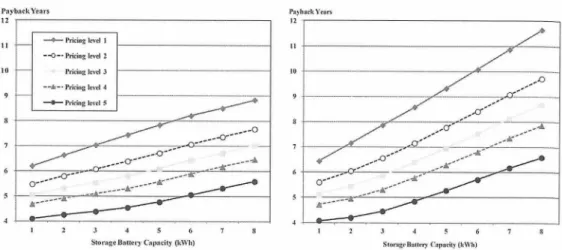
2 3 4 5 6 SiorasiBalltrj・(・apaciiy (kWh) 8Finally, we would like to compare the simple payback year of both cases such as “Storage battery first, andthen PV cell," and “PV cell first. and then storage battery." Figure g shows the compared results of simplepayback year for both cases
。
If the combination of storage battery and PV cell with discharge of storage battery (the first priority)andself-supply of PV cell (the next priority), the simple payback year of total investment becomes 6 to 9 years atpricing leve
□. Compared with 45 to 60 years of storage battery only at pricing level 1, the simple paybackyear is drastically improved by the combination of PV cell 。
On the other hand. if the combination of PV cell and storage battery with self-supply of PV (the first
priority)and discharge of storage battery (the next priority), the simple recovery year of total investmentbecomes 6 to 12 years at pricing level 1, because surplus PV electricity which can be sold to the electricity
company is reduced by supplying to the house electricity demand and the electricity from storage battery is used for the replacement of lower price electricity 。
Figure 10 also shows the compared results of changes in the ratio of PV self supply and the ratio of PV
electricity selling. As shown in this figure, in the case of “Storage battery first. and then PV cell," the ratio ofPV electricity selling is increasing more and the ratio of PV self-supply is decreasing more. as the capacity of
storage battery becomes larger. 0n the other hand, in the case of "PV cell first, and then storage battei-y," bothratios keep each value with no change, even if the capacity of storage batteiy becomes larger. The reason is
because the electricity generated by PV cell is used for the house electricity demand with the first priority. The results obtained from the economics simulations made by this study would suggest the following two implications. One is that the FIT price of 42 Yen/kWh for surplus PV electricity is quite attractive for
Fig. 10 Comparison of Ratio of PV Seif-Supply and Ratio of PV Electricity Selling
(Storage battery first, and then PV cell) Ralio(%)00 90 80 70 60 印 40 0 0 0 0 3 2 1 Ratio <%) 1 0 0 90 80 加 60 so 40 卵 20 0 0 I
(PV cell first, and then storage battery)
= =−= 7¶ - j = 7 =−
- -− −− - - −−
Slunigi'Biittc・り・Caiiacil.v(kWfi) Slorase BaOcry Ciipacity (kWh)
improvement of investment economics for smart community. The other is that the longer and higher prices in day time, that is, the large price difference between day time and night time would be required for the
establishment of smart community. The latter point is gradually reflected to recent movements of pricingmenu by electricity companies.
6. Concluding remarks
First, it should be deeply discussed what kind of merits are brought to demand-side consumers in the areawhere the environmental-friendly future town (smart community)is realized. In the present discussion. itseems that logics of supply-side players would be revealed too
strongly・
Second, specific and concrete project contents of smart community project should be thoroughlyconsidered,
because the survival competitiveness is strongly required in the competitions with so manysimilar projects planned at various places in Japan from now on.
Third, it is quite important to organize and utilize a public-private partnership (PPP)combining centralgovernment, local governments. NPO, related private enterprises, and consumers for the projects making themost of local special qualities and competitiveness.
Finally, the function of comprehensive project manager such as Accenture and IBM is required to achieve asmart community project. In Japan, we need to train such a player without delay
・
References
1 . The Secretariat of Smart Community Forum [2010] ,"Issues and recommendations for smart community- challenges to
new life and new town" httpy/w ww.meti. 只o.ip/re)ort/data/gl00615aj.html (refen-ed on April 5,2012 ), June 2010.
2. M [2010a], " Toward intern n,' 匹
go.ip/report/downloadfiles/gl00129d01i.pdf,│(re 万ferred on April 5, 2012)January 2010.
3. M [2010b ]'Sel i f d m i 呵 i g d i l m ' http:// www-meti.go.ip/committee/materials2/downloadfiles/gl00408a03i.pdf, (referred on April 5, 2012) April 2010.
' List of proposals on domestic demonstration on smart community," http://www.meti.go.ip/ policy/ (referred on April 5, 2012)April 2010.
(referred on April 5, 2012), June 2011. 5. METI [2011] ,"Toward the establishment of ne χt generation energy and social system − findings from demonstration
trials,"
6 . METI[2012a], "As for smart community,pdf. (referred on July 28, 2012), July 2012.
7 . Cabinet Office [2011a], " Recommendation of Revival Hopes in Misery,"http://www.cas. 只oj p/jp/fukkou/ pdf/fukkouhenoteigen ・pdf, (referred on April 5, 2012), June 2011,
8 . Cabinet Office [201 lb], "Projects of Each Future City√http://futurecity.rro.eo.ip/torikumi/, (referred on July 28, 2012),December 2011.
9. METI[2012b] ∧Survey report on energy consumptions 万in the residential sector,"http://www.meti・只oj p/meti lib/report/2012fy/E002203.pdf, (referred on July 28, 2012), March 2012.
10. ACEJ [2004] ,"Comprehensive manual on cogeneration system," Tsusan-shiryo-shuppannkai, 2004.