South East Asian Studies,Vol. 16,No,3, December 1978
Change and DeveloplD.ent of Two Rice-Growing
Villages in Thailand
- Don Daeng and Khok Chyak-Koichi MIZUNO*
I Introduction
Rural change is the most challenging subject for scientists of different disciplines who are dealing with current aspects of Southeast Asian societies. In the anthropological field of Thai studies. the data accumulated through extensive fieldwork on village life over the past quarter of a century permit us to draw blue-prints of the peculiarities of the Thai peasant community with its local variations. But data on change are still too scanty and piecemeal to allow construction of an empirical framework within which these scattered materials could be better integrated into a systematic description.
Changes in peasant life have frequently been discussed under the popular term of "rural development." The concept often has a practical flavor, and the main topics of inquiry thus evolve around such series of tasks as the presentation of development planning, the means of implementing extension works among villagers, follow-up surveys, and the evaluation of particular programs.I ) The results of the studies tend to be program-specific and short run. Another broad concept dealing with rural change is "post-peasant society," which approaches the reality from a completely different perspective.2) The notion derives from the recognition
that recent changes are so remarkable that there emerges a distinctive social form among the rural population whose central features can not be explained by the conceptual framework of "great" and "little" traditions, within which the moral order of peasant society is usually understood. In the context of "post-peasant society," rural development may be restated as the process by which this transformation takes place, and development programs such as the "green revolution" are only a part of various changes imposed upon rural communities. Urgent tasks are thus to specify the core area of change and identify patterns of transforma-tion, which may differ from place to place within a country or may be common to several countries.
This paper aims to give an account of the present conditions and the changing aspects of two rice-growing villages in Thailand, to disclose some of the major features of the
"post-*
71<!l!ft~-, The Center for Southeast Asian Studies, Kyoto University1) See for example,IRRI Annual Report for1975(IRRI: Los Banos,1975);andChanges z'n Rz'ce Farmz'ng z'n Selected Areas of Asz'a (IRRI: Los Banos,1975).
2) For example, James C. Scott, "Some Notes on Post-Peasant Society," presented at the workshop on "Post-Peasant Society of the Southeast Asia" in1978 (mimeograph).
peasantry" by comparing the processes of transformation at micro village level, and thus to add to the fund of information on rural change. The villages surveyed are Don Daeng in the Northeast and Khok Chyak at the margin of the Central region.3 )
II The Villages Surveyed
Don Daeng in the Northeast is a part of the commune of Don Han in Muang District of Khon Kaen Province. The village lies within ten kilometers of the municipality of Khon Kaen, in which the district and provincial seats are located. Khok Chyak in the Central region is situated in the commune of Tan Diaw, which is administratively incorporated into Kaen Koi District of Saraburi Province. It is about four kilometers from the district seat and sixteen kilometers from the provincial office. Access to local towns is now readily available from both villages by bus.
Don Daeng consists of 161 households. It is a compactly nucleated village, and the surrounding fields extend along the Lam Chi River in the heart of the Korat Plateau. Khok Chyak is a little smaller, being composed of 118 households. Itis a rather dispersed village, with several clusters of houses scattered in the fields. The houses and fields lie at the foot of the Khao Phra Hills, which form a part of the eastern mountain range. The history of these villages indicates that the people of Don Daeng are mostly descendants of earlier settlers who moved into the locality around the turn of the century, and whose socio-geographic origins were more or less the same; Khok Chyak was formed somewhat later by a gradual influx of migrants from various places and with diverse socio-economic backgrounds. Thus it seems that Don Daeng traditionally developed a culturally more homogeneous and socially more finely woven form of community than Khok Chyak, which is a kind of melting pot of people who arrived over a longer period and settled over a wider area.
Despite these differences, there are certain similarities between the two villages. Ecologically, both villages have similar physio-hydrographic conditions, having suffered from water deficiency, though in different degrees. The central activity of the peasants is rice cultivation, and both villages are involved to some degree in agricultural diversification. In the social sphere, the family with weak lineality and bilateral kinship, synaptic leadership of the headman, and dyadic organization are the most common features of both villages. And culturally, the villagers are good Buddhists who participate in merit-making activities at the wat they built within the village. The above attributes constitute the general setting for the 3) The field survey was carried out in July and August, 1976. I was a team member of the joint project on "The Role of Education in the Rural Development of Southeast Asia," which was supported by Japanese Ministry of Education. A monograph on Don Daeng Village during 1964-1968 has been published: Koichi Mizuno, Social System of Don Daeng Village-a Community Study in Northeast Thailand, CSEAS Discussion Paper Nos. 12-22 (Kyoto: Kyoto University, 1971). The present article may answer some of the comments by L.J. Fredericks: "Coments on Comparative Analysis of Rural Development: Rice-Growing Villages in Thailand and Malaysia," Tonan Ajt'a Kenkyu [South East Asian Studies] 16, No.2 (Kyoto, 1978), pp. 91-97.
K. MIZUNO: Change and Development of Two Rice-Growing Villages in Thailand
individuals who live a rural life in their own villages. Yet, there are several other forces work-ing in this settwork-ing, with different kinds of specification and varywork-ing degrees of intensity. Internal forces are population growth and decreasing availability of arable land; external forces include communication and media, the market economy, the rising cost of living, and the implementation of various development plans at the national level.
The following sections will compare such aspects of rural life as ecology, economy, society, and culture in order to identify change and persistence in two villages which have a similar pattern of ecological adaptation. The data and statistics used derive from observation and interviews of sample households selected at randoIl;l in each village. Don Daeng provides eighteen samples, all of which are more or less agricultural; and Khok Chyak provides twenty samples, of which seventeen are agricultural and three are laborer families.
III Ecological Adaptation
The agricultural land of Don Daeng covers 2,650 rat"in all, of which 81 percent is rice fields, 16 percent upland fields, and 3 percent vegetable gardens. The rice fields are located in two areas: the lower northern and the upper southern sides of the village. The former is a portion of the alluvial plain along the Lam Chi River and the Lam Huay Waterway and soils are clayey. The land is generally even, but has complex microrelief with shallow ponds and depressions. The latter rice fields occupy a shallow valley at the margin of the rolling interior highland. The valley has a short stream and forms gentle slopes of sandy soil up to the low marginal ridges. About 70 percent of the village rice fields lies in the shallow de-pressions of the lowland plain, and 30 percent on the gentle slopes of the shallow valley.
Khok Chyak has 1,677rat'of rice land, and about 40 percent of peasants plant maize in Pak Chong, which is far from the village. The rice fields extend to the skirts of the Khao Phra Hills, from which a short stream runs down through the area. A provincial road cuts across the area, dividing it into two parts: the higher eastern and lower western slopes. The former consists of sandy hill slopes with some relief, whereas the latter is even with a slight slope and soils are clayey. The whole area forms the upper portion of a fan-terrace complex of the Pasak River. Roughly 70 percent of the village rice fields occupies the hill slopes, and the remaining 30 percent the lower plain.
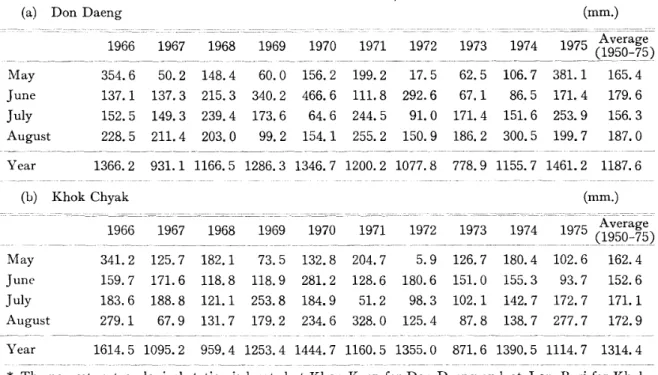
The local topography is thus different in Don Daeng and Khok Chyak, and is not uniform even within each locality. But the resultant physio-hydrographic conditions in the two vil-lages are in fact quite similar, especially in view of the unstable patterns of rainfall in both villages (Table 1). As sample households indicate, the peasants of both villages have tradi-tionally depended on rain water for rice cultivation. At the end of the dry season, the land is completely dry, there is almost no water in the waterway and streams, and the water level is extremely low in the rivers. Not until rain falls during May does the ground soften enough to allow the peasants to start plowing. Then if sufficient rain falls in the following months,
JIU¥'J7::;71Vf~ 16~3%
Table 1 Patterns of Rain Fall, 1966-75*
(a) Don Daeng (mm.)
1966 1967 1968 1969 1970 1971 1972 1973 1974 1975 May 354.6 50.2 148.4 60.0 156.2 199.2 17.5 62.5 106.7 381.1 165.4 June 137.1 137.3 215.3 340.2 466.6 111.8 292.6 67.1 86.5 171. 4 179.6 July 152.5 149.3 239.4 173.6 64.6 244.5 91. 0 171. 4 151. 6 253.9 156.3 August 228.5 211. 4 203.0 99.2 154. 1 255.2 150.9 186.2 300.5 199. 7 187.0 Year 1366.2 931. 1 1166. 5 1286.3 1346. 7 1200.2 1077.8 778.9 1155.7 1461. 2 1187.6 (b) Khok Chyak (mm.) 1966 1967 1968 1969 1970 1971 1972 1973 1974 May 341. 2 125. 7 182.1 73.5 132.8 204.7 5.9 126. 7 180.4 102.6 162.4 June 159.7 171. 6 118.8 118.9 281. 2 128.6 180.6 151. 0 155.3 93. 7 152.6 July 183.6 188.8 121.1 253.8 184.9 51. 2 98.3 102. 1 142. 7 172.7 171.1 August 279.1 67.9 131. 7 179.2 234.6 328.0 125.4 87.8 138. 7 277.7 172.9 Year 1614.5 1095.2 959.4 1253.4 1444.7 1160.5 1355.0 871.6 1390.5 1114. 7 1314.4
* The nearest meteorological station is located at Khon Kaen for Don Daeng and at Lop Buri for Khok Chyak.
they are busy with transplanting by late June and early July. But rainfall from June to
August is rather unstable, and occasionally there is drought. And the traditional means of
irrigation is not effective enough to provide a sustained flow of water into the rice fields. This
is partly because of poor technology and partly because of the unfavorable physiographic environment.
In Don Daeng, for example, peasants attempt during the planting season to lead rain water from the surrounding higher land into the rice fields, and later, during the growing
season, to discharge excess water onto the lower land. The river, waterway, and stream serve
as natural drainages during June to August. But if it rains hard, some fields may be
damaged by water running down the valley slopes. From September through the last part of
the rainy season, rainfall is stable and water covers the terrain. Rice fields in the lowland
plain may sometimes suffer flooding from the Lam Chi River or the stream.
The peasants of Khok Chyak make similar efforts to control water. The only significant
hydrographic difference is that the higher portion of the village has a steep enough slope to allow irrigation works, yet the scope is quite limited, since the stream is short and has a small
catchment. Thus the dam which has long been established in the village is very small and
provides water for hardly more than a few dozen raz' during the planting season. The canal is
very short and runs almost straight down the slope, opening into a field.
Both in Don Daeng and Khok Chyak, when there is insufficient water in the fields the
streams are low; and when the fields are full of water the streams are also running high. The
traditional pattern of ecological adaptation is not conducive to the dissemination of high-356
K. MIZUNO:Change and Development of Two Rice-Growing Villages in Thailand
yielding paddy varieties (HYVs), since these require the efficient control of water on the fields.
At present, no peasants in either village cultivate HYVs. This apparent indifference may
derive from a lack of knowledge, weak economic incentives, or an awareness of the practical
difficulties. Nevertheless, the peasants of Khok Chyak are more informed and realistic than
those of Don Daeng in their attitudes toward the acceptance of HYVs. The experience of a
progressive villager of Khok Chyak suggests that HYV dissemination presupposes the im-provement of the local environment over a sufficiently broad area that a sizable number of peasants can simultaneously adopt the new varieties.
Thus there have been no drastic changes in rice-growing technology. And new
tech-nology seems to have been introduced just as a supplement to the traditional agricultural
technology. The use of fertilizer is the most widespread modern practice in both villages,
although peasants of Don Daeng apply it only to vegetable gardens. About 10 percent of
peasants are estimated to use engines to pump up water from natural or artificial reservoirs. New dams and dikes have been constructed with government subsidies, although their
effic-iency remains uncertain. Since the technological improvement of rice cultivation is limited
in both villages, many peasants have recently introduced upland crops to increase farm
in-come. This agricultural diversification has brought some improvement to the peasants'
household economy and had varying effects upon village life.
IV Income Structure and Villa~e Economy
Despite the similar difficulties faced in rice cultivation, cropping is less stable in Don
Daeng than Khok Chyak. In the peasants' evaluation of the past ten years, Don Daeng has
on average had a normal crop in 5.8 years, a good crop in 1.9 years, and a poor crop in 2.3
years; in Khok Chyak the corresponding figures are 7.8, 0.6 and 1.6 years. This is because
Don Daeng is situated in the drought area of the Northeast.
During the 1975-76 crop year, rainfall was favorable in both villages as well as
through-out the country. But there were still large differences between the villages with regard to
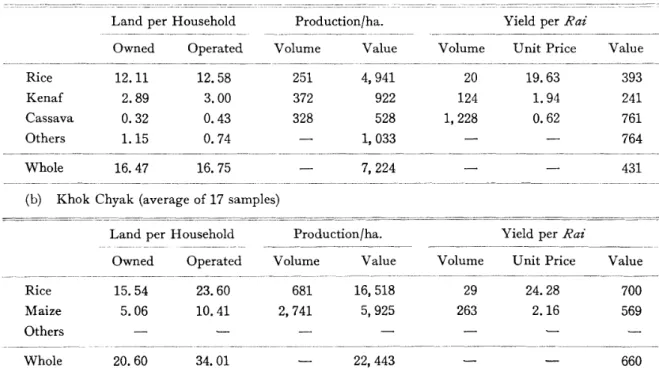
rice production. As shown in Table 2, yields averaged twentythang per rat" in Don Daeng
and twenty-nine thang per rat" in Khok Chyak. This yield differential may derive from the
following facts. First, it seems that rainfall in the surrounding area is more abundant in
Khok Chyak than Don Daeng. Secondly, the rice fields of Don Daeng include several
patches which are not suitable for rice cultivation. Thirdly, none of the peasants of Don
Daeng apply fertilizer to their rice fields, whereas those of Khok Chyak apply on average 11
kilograms of chemical fertilizer and 104 kilograms of organic fertilizer perrat".
Land productivity, however, can not be fully understood unless the pattern of farm management is taken into account in addition to ecological and technological considerations. From earlier times Khok Chyak has produced rice as a commercial crop, and the peasants plant varieties of non-glutinous rice which the town people like most; they not only use 357
Table 2 Land, Production, and Yield, 1975-76* (a) Don Daeng (average of 18 samples)
Land per Household Productionfha. Yield perRai
Owned Operated Volume Value Volume Unit Price Value
Rice 12.11 12.58 Kenaf 2.89 3.00 Cassava 0.32 0.43 Others 1.15 0.74 - - - - " . ~ ~ - - _ . Whole 16.47 16. 75 251 372 328 4,941 922 528 1,033 7,224 20 124 1,228 19.63 1. 94 0.62 393 241 761 764 431 (b) Khok Chyak (average of 17 samples)
Land per Household Productionfha. Yield perRai
Rice Maize Others Whole Owned 15.54 5.06 20.60 Operated 23.60 10.41 34.01 Volume 681 2,741 Value 16,518 5,925 22,443 Volume 29 263 Unit Price 24.28 2.16 Value 700 569 660
*
Unit of land is rai; that of rice is thang, while other crops kilogram; and monetary value is baht.chemical fertilizer but also depend much on hired labor at every stage of rice cultivation; and
merchants from the town visit the rice fields to buy harvested rice. On the other hand, Don
Daeng still produces rice for subsistence, and the peasants plant the traditional varieties of glutinous rice they eat; they are reluctant to spend money on rice cultivation; after the harvest they store the rice in their granaries; and when they want to sell, they must transport the rice to town at their own expense.
As shown in Table 3 (a), the net income per rai for rice cultivation is 349 baht in Don
Daeng and about one and a half times higher in Khok Chyak, at 535 baht. In Don Daeng,
where peasants operate 12.58 rat' of rice land on average, net income amounts to 4,390 baht
per household. This is a little lower than the monetary equivalent of 230 thang of rice kept
for home consumption. In Khok Chyak, the average holding of rice land is 23.60 rat' and
net income from it amounts to 12,626 baht per household. Ifpeasants retain an average of
250 thang of rice for home consumption, the cash income per household will amount to 6,318 baht.
Since it is difficult to increase rice production greatly, the peasants of both villages have been very keen to seize chances of earning cash whenever the family labor force allowed
economic activities other than rice cultivation. Crop diversification is one such opportunity
to which peasants have responded through extensification of land use. Many villagers of
Don Daeng have opened up small plots of land at the margins of their holdings and have been planting vegetables at the edge of ponds and waterways and kenaf on sandy upland fields 358
K. MIZUNO:Change and Development of Two Rice-Growing Villages in Thailand
Table 3 Land Productivity in Baht perRai, 1975-76
(a) Rice Cultivation
Gross Expenditures Net
Samples In
Ir1- .: .1. Income
_.
Maintenance Hired Labor Rent Tax Others Total
Don Daeng (18) 393 0 4 27 13 - - 44 349
Khok Chyak (17) 700 42 6 79 34 3 1 165 535
(b) Upland Crops
Gross Expenditures Net
Samples ...
Income
Irl,prr>;"Q 1" Maintenance Hired Labor Rent Tax Others Total
Don Daeng (18) 548 41 0 15 3 -
-
59 489Khok Chyak (17) 569 0 0 117 42 - 18 177 392
(c) Farming Activities
Gross Expenditures Net
Samples D~..~~ ,~
Irhpn-o;,.."l" Maintenance Hired Labor Rent Tax Others Total Income
Don Daeng (18) 466 10 3 24 11 3 14 65 401
Khok Chyak (17) 671 29 4 91 35 3 8 170 501
for more than ten years. And since the previous year, some of them have been trying to grow cassava, because they think it is better to change crop after several years, and because cassava needs less labor than kenaf. These upland crops are not highly productive, but still bring profit to farm households. On the whole, as shown in Table 3 (b), peasants earn a net income of 489 baht per rai or 2,038 baht per household. In Khok Chyak, maize cultivation has been more attractive for the past few years, and villagers have looked for larger areas of land in a newly opened upland zone outside of the village. As there is no suitable maize land with-in the village environs and the cultivation requires labor arrangement with-in the family, only eight of the seventeen sample farms are operating land for maize, with a net income of 392 baht per rai. The average net income per household from maize cultivation for the seventeen sample farms is 4,081 baht.
Table 3 (c) shows the overall land productivity of the villages, for rice cultivation, upland farming, and other minor farming activities. Net income per rai is 401 baht in Don Daeng and 501 baht in Khok Chyak, about 25 percent higher. Related factors are the slight differ-ences in ecological, technological, and managerial conditions. However, on the basis of the household unit, size of landholding is the major factor in the income differential. The average operated area per household is 16.75 rat" in Don Daeng as compared with 34.01rai in Khok Chyak, and net household incomes are respectively 6,717 baht and 17,040 baht. The net income per household from all farming in Khok Chyak is thus two and a half times higher
than that in Don Daeng.
Another new opportunity to earn cash income is in non-agricultural wage labor.
For-merly, the peasants of both villages used to engage in such occasional activities as mat weaving,
basket making, selling vegetables and fish, small-scale animal trading, and so on. But these
miscellaneous works have recently given way to wage employment. For example, many
villagers of Don Daeng work for private kenaf-packing industries at Tha Phra and in the Northeast Agricultural Center built near the town by the Government; villagers of Khok Chyak find jobs in manufacturing factories along the super-highway and at a large private
Chinese cemetery. This work provides villagers with a more stable source of cash income
than the traditional subsidiary work, and nowadays provides more than 90 percent of the
off-farm income in both villages. My survey indicates that the average income from
non-agricultural labor in Don Daeng accounts for 4,409 baht of the total off-farm income of 4,805 baht per household, and in Khok Chyak for 9,884 baht of the total off-farm income of 10,269 baht.
In sum, the peasants of both villagers have engaged in rice cultivation on land where water
control is difficult. The natural environment is the major factor limiting the introduction of
technological innovations which would bring a startling increase in rice production. There
has been almost no change in Don Daeng and only limited improvement in Khok Chyak. The village economies have been improved largely through crop diversification and non-agricultural wage labor, and the patterns of income structure in Don Daeng and Khok Chyak
are quite similar. However, there are differences between the villages in the availability of
water for rain-fed cultivation, the orientation of rice-farming, the average size of landholdings, the intensity of diversification, and the demand for wage employment, which result in different
levels of income. In the final analysis, the total household income of Don Daeng averages
11,522 baht and that of Khok Chyak 24,754 baht, the latter being about two times higher
than the former.
V Recent Trends in Socio-Economic Differentiation
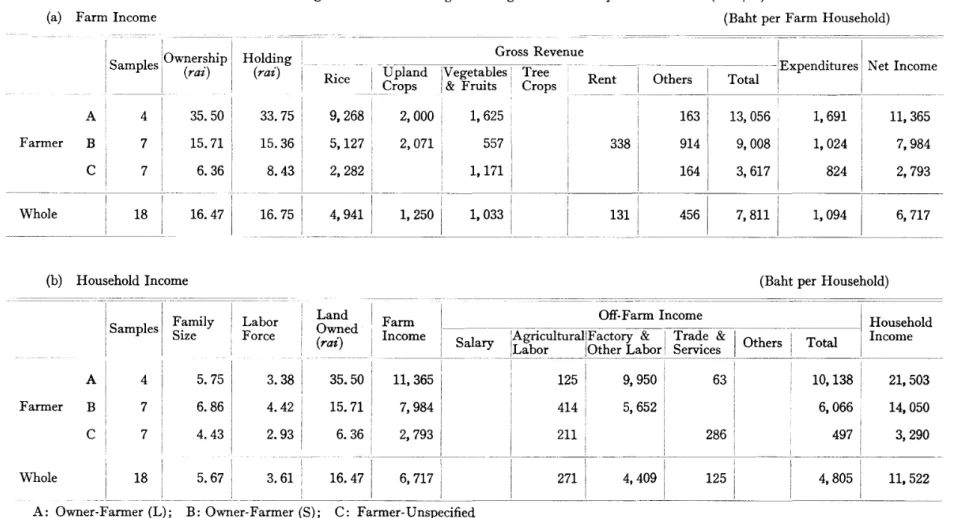
Table 4 and 5 summarize the foregoing account of village economy, and at the same time illustrate income distribution among sample households and the patterns of income structure
in Don Daeng and Khok Chyak during 1975-76. The households can be stratified into three
categories in terms of land tenure. The categorization depends primarily on ownership of
rice land, and is based on criteria of land size specific for each village. In Don Daeng, on
average, the owner-farmers (L) own 25.75 rat"of rice land, the owner-farmers (S) own 11.50
rat', and the farmers-unspecified own 4.93rat"in various forms of holding. Similarly, in Khok
Chyak, the owner-farmers (L) own 28.71rat"of rice land and operate 44.21 rat"of arable land,
the owner-farmers (S) own 15.53rat"of rice fields while operating 17.50rat"of arable land, and
the tenants own no land and cultivate 16.60rat"of arable land, which is mostly rice fields. The
Don Daeng-Economic Standings of Village Households by Land Tenure-(1975j76)
(Baht per Farm Household)
r
~ N c: z o n ::r P> l:l aq Cb P> l:l p.. o ~ Cb 0' '0 S Cba
o .... ~ ~ o :;0 o' Cbf
S' aqa
ii> aq Cb en S';J
e.
ii> l:l p..(Baht per Household)
Off-Farm Income i , Household Income 21,503 14,050 211 286 3,290 271 I 4,409 125 11,522
olding ' - Gross Revenue "JT." 1
Net Income (rai)
Rice . Upland IVegetablesi Tree- Rent Others Total ~ Crops !& Fruits I Crops
33. 75 9,268 2,000 1,625 163 13,056 1,691 11,365 15.36 5,127 2,071 557 338 914 9,008 1,024 7,984 8.43 2,282 1,171 164 3,617 824 2, 793 i i 16. 75 4,941 1,250 I 1,033 131 456 7,811 1,094 6, 717 H (b) Household Income Family Land Samples Owned Size (rai) ~U.\,VJ.1.1't; Salary A 4 5. 75 3.38 35.50 11,365 Farmer B 7 6.86 4.42 15. 71 7,984 7 I 4.43 2.93 6.36 2,793 Table 4
(a) Farm Income
SamplesI (rai) A 4 35.50 Farmer B 7 15. 71 C 7 6.36 Whole 18 16.47 "'nole
A: Owner-Farmer (L); B: Owner-Farmer (S); C: Farmer- Unspecified
~
... 0> ~ W tIjn 1m! 3m '-1 ~ '-1 ~ ~ (Baht per Household)
- - - _.._---_.._ - - - - ~-,-._-.-_.._
-~~n~d
I Farm , ,___ Off-FarmI~come
I IHousehold( ') i Income S 1 ,AgnCUltural/Factory & I' Trade & '0th T t l ! Income
r a t ' a ary ILabor Other Labor Services I ers 0 a
-~0-.-38-I----32-,
4321 : - - 3,5871- 250i 50 c -3 ,-8-8-7--'1----3-6-,3-1-9-I I I I 18. 00 i 11, 808 : 11, 366 i 867 12, 233 I 24, 041o
I 4, 851 40 : 3, 498 I 3, 538 i 8, 389o
1-
01 4
3~,
160I
I
30, 327 1 30,327 I I -1----I
I
I 17.51! 14,485 I 35 ; 9,884 I 335 ! 15 10,269 I 24,754 I ! I I ! - - - -(b) Household IncomeSamples Family Labor
Size Force A 6 7.33 5.17 Farmer B 6 6.17 4.08 C 5 6.40 3.20 Laborer 3 I 6.331 2.67 I Whole 6.60 I 4.03 ~ N
Table 5 Khok Chyak-Economic Standings of Village Households by Land Tenure-(1975/76)
(a) Farm Income (Baht per Farm Household)
- - - - _ . _ - - - ~ - - -- - .
-1
S I Ownership Holding _ Gross Revenue
--- --IExnenditures Net Income
-amp es (rai) (rai)
Rice Upland IVegetablesI Tree
r
Rent Others I TotalCrons !& Fruits Crons i
A 6 40.38 65.04 31,470 13,657 45, 127 12,695 32,432 Farmer B 6 18.00 17.50 10,558 2, 160 485 433 13,636 1,828 11,808 C 1 5 0 16.60 5, 727 1,167 140 60 7,094 2,243 4,851 I Whole ! 17 20.60 34.01 16,518 5,925 41 171 171 22,826 5, 786 17,040
K. MIZUNO: Change and Development of Two Rice-Growing Villages in Thailand
characteristics of these stratified categories as well as the process of differentiation will be examined for each village. Discussion of each village starts with a specification of the core area of change against its general background.
The Vt'llage of Don Daeng
Compared with one or two decades ago, the casual observer would find the changes in village life in Don Daeng striking; nevertheless, the structure of agricultural production has remained almost unchanged over the years. Rice cultivation remains a subsistence activity. Farming requires only a limited amount of capital, although there have been some minor technological changes. Diversification and wage employment have changed the working pattern of peasants and the occupational composition of their households, but neither of them has seriously shaken the means of labor arrangement for subsistence farming. Wage labor remains outside the process of agricultural production, and except in a few cases of weeding of kenaf land, farm labor is always performed by family members and by kinsmen and acquain-tances on the basis of mutual assistance. The subsistence attitude permeates the villagers' strong desire to acquire land. They simply want to have enough land to support themselves and then to enlarge it to secure the means of independent livelihood for their children, especial-ly their daughters' families. Together with the practice of joint farming, land tenure tends still to be a reflection of the pattern of the family cycle, which involves the formation of "multihousehold compounds," and of the mechanism of reproduction of farm households.4)
The process of farm proliferation has, however, brought an irreversible change in the man-land ratio. During the past ten years, the number of households has grown from 132 to 161 (a 22-percent increase), while the total cultivated area has expanded only from 2,533
rat"to 2,650 rat' (a 5-percent increase). As a result, the average area of rice land owned per
farm household has decreased approximately from 16rat'to 12 rat'. This decrease is despite conscious efforts by the peasants to recover from the fragmentation caused by equal division of inheritance. Some of them attempt to expand crops onto whatever small patches of land they might find in marginal scrub or swampy locations; others try to buy sibling's land by redemption. But, by far the greatest recovery from fragmentation is made through the purchase of land from families leaving the village. Twenty-one farm households have left during the past ten years, most of which migrated to the marginal area of the region in search of more land at a lower price. The area of land sold by them amounts to about 300rat'or 12
4) "The multihousehold compound" is a kind of agricultural cooperative organization composed of two or more households or families tied by kinship and joint farming. "The core of organization" is a farmer who owns lands on which one or more of his children's households works jointly with him. These house-holds are "landless cultivators," who become "independent farmers" after they have inherited their share of the land. A full account of the family cycle and land tenure is given in Koichi Mizuno,"Land Tenure and Family in a Rice-Growing Village in Northeast Thailand" (in Japanese), Tonan Ajia Kenkyu [South East Asian Studies] 3, No.2 (Kyoto, 1965), pp. 7-35; idem, "Multihousehold Compounds in Northeast Thailand," Asz"an Survey 8, No. 10 (University of California, 1968), pp. 842-852; and idem, Social System of Don Daeng Village.
percent of the total cultivated land of the village.
The cyclic pattern of land tenure with a general decrease in size of holdings is supported by a close inspection of the agrarian pedigrees of sample households. Eight of the eighteen sample households purchased land during the past ten years. These households are found not only in the category of owner-farmer (L), but also that of owner-farmer (8) and even that of farmer-unspecified. For simplicity, only one example will be cited from each category. N ai Thongma, an owner-farmer (L), was formerly a "landless-cultivator" working on the land of his wife's parent's family.5) Later, having inherited ten rat' of rice fields, he bought another ten rat' of rice fields and eighteen rat' of upland fields. He is now fifty years old and a "core-operator" with one dependent family, that of his eldest daughter. N ai Aphiromjanon, an owner-farmer (8), formerly cultivated five rat' of inherited rice land. As an "independent farmer," he added eight more rat' of rice fields and about two rat' of upland fields. He is forty-three years old and his children have not married yet. N ai Laiad, a farmer-unspecified, is nineteen years old and lives with his wife and child in a small house. He recently estab-lished his own household, and is a "landless-cultivator" depending on his wife's parents, who own twenty rat' of land and fall in the category of owner-farmer (L).
The above trend constitutes the basic feature of the pattern of socio-economic differenti-ation in Don Daeng. Land concentration would not be expected through the equal division of inheritance, and, in fact, there are few noncultivating landlords and tenants. The social units of production are still "landless cultivator," "independent farmer," and "core-operator." Yet, there is a sign of change in the emergence of hopeless families who drop out from the agrarian cyclic process because of the multiple effect of serious fragmentation and loss of the breadwinner. This kind of degradation is exemplified by three sample households in the category of farmer-unspecified. The household heads are all middle-aged women who have lost their husbands by death or divorce. They are very small farmers who own less than five rat' of rice land and also lack sufficient labor within the family, and thus have no hope of increasing their land. The remaining four households in the farmer-unspecified category are two landless cultivators and two extremely small farmers, all of whom are still young and may have a chance to buy more land.
With the rapid fragmentation of land and the general land shortage, the peasants feel that modern life is not like that in the former days. The following examples illustrate the recent changes in their lifestyle. First, with regard to the general practice of joint farming, there are two unusual cases among the sample households. Nai Intha, a fifty-three-year-old owner-farmer (L), has already divided his land between his two married daughters, alienating their shares at an earlier time than usual. N ai Phrathuang, a thirty-one-year-old "landless-cultivator," has been assigned five rat' of rice land by his wife's parents, who intend to give it to him later. The father-in-law, N ai Khen, as well as N ai Intha, works for the Agricultural Center as a watchman.
5) See footnote 4) on p. 363.
K. MIZUNO: Change and Development of Two Rice-Growing Villages in Thailand
Second, in all categories of farm there is a sizable number of peasants who have a negative attitude toward their agriculture and farm life in the village. Of the eighteen samples, eight household heads (44 percent) stated they would move elsewhere if there were a chance for better farming or for better employment in another occupation. Ten household heads (56 percent) out of the same sample would like to change occupation if they stay in the village; five would prefer to engage in local trading activities, four in non-agricultural wage work, and one in weaving.
Third, this negative attitude manifests itself in parents' desires concerning their children's occupation. A reflection of their general discontent with farm life is that no one wanted his children to become a farmer. Teacher was the most popular choice for children of either sex, followed by soldier-policeman for a son and nurse for a daughter.
Fourth, parents hopes for their children's educational level are more realistic than for their children's occupation. Of the thirty-three children of below fifteen years of age in the sample households, parents desire four (12 percent) to complete university, and nineteen (46 percent) lower or upper secondary school, whereas six (18 percent) are expected just to finish the seventh grade of primary school, and the remaining eight (24 percent) to leave after the fourth grade. Generally, sons are expected to attain a higher level of education than daughters.
Fifth, when actual enrollment is taken into account, there are different degrees of gap between the ideal and reality, which have fairly a good correlation with the categories of farms. Parents of owner-farmer (L) households are able to give their children the schooling they desire, although none have yet gone to university. The seven children of primary school age and four of secondary school age are all enrolled in the respective grades. The desires of parents in the owner-farmer (S) category are a mixture of dreams and reality. Of the thirteen children of primary school age, seven are enrolled in the first half of schooling and three in the second half (fifth to seventh grade), while the other three have not completed the course. The parents in the farmer-unspecified category are relatively young and have no children of secondary school age. Of six children of primary school age, five are enrolled in the first half of schooling and the other one has quit the second half. The parents' desires are dreams which may never be realized. On the whole, it seems that children of the owner-farmers (L) have better chances for education and occupation than those of the other cate-gories.
The Village of Khok Chyak
Khok Chyak resembles to Don Daeng in one respect: while there is no available land to be cleared in the village, the number of children is still as large as in former days, and equal division of inheritance is a widely accepted practice among the peasants. In both villages, fragmentation and land shortage constitute the basic features of agrarian change, but Khok Chyak differs fundamentally from Don Daeng in other respects, namely with regards to
agricultural orientation and the relationships between agricultural producers.
First, unlike the villagers of Don Daeng, who are descended from one of the waves of subsistence farmers who migrated from the Northeast, villagers of Khok Chyak have been more or less commercially oriented since earlier days, as the village was settled during the process of expansion of rice cultivation for export in the Central region. This trend has been promoted by the rapid adoption of a new cash crop and the encroachment of non-agricultural enterprises since the mid 1960s, which brought drastic changes in rice production and farm management. The maize cultivation of Khok Chyak is not comparable to kenaf cultivation in Don Daeng: holdings are larger and maize cultivation requires a larger labor force, which must be hired; and since the land is remote, household members often leave the village during the growing season, which coincides with that of rice cultivation. With the increasing demand for labor for the construction of the Chinese cemetery, the peasants were no longer able to rely on the traditional form of labor exchange in the long-established process of rice cultivation. At a rough estimate, hired labor amounts to seventy-two man-days per farm household for rice cultivation alone in Khok Chyak, while in Don Daeng hired labor is seldom employed. The agriculture of Khok Chyak, both in rice and maize cultivation, has become capital-intensive and commercialized. This is the core area of agrarian change in the village.
Furthermore, the basic tmits of agrarian operation in Khok Chyak are conceptually quite different from those in Don Daeng. Available data on Khok Chyak give no indication of "joint farming," which is a common practice among Don Daeng villagers. Children of Khok Chyak do not depend on parents' land when they leave the natal family, but are rather ex-pected to find their own means of production. The relationships between producers are more likely to develop around the usual forms of landownership-such as owner and tenant-rather than "core-operator," "independent-operator," and "land-less cultivator." In contrast to Don Daeng, where the agrarian cyclic process still forms the ideal pattern, socio-economic differentiation in Khok Chyak involves not only the process of fragmentation but also trends toward polarization, which have accompanied agricultural commercialization and the creation of opportunities for non-agricultural employment within the village. A cyclic process of land tenure can be observed, butitis quite limited and occasional. The mode of polarization under conditions of fragmentation and land shortage is singled out in the following.
Equal division of inheritance presupposes continuing reproduction of small farmers. Data indicate that at the time of inheritance the owner-farmers in the sample households operated on average twelve rat"of rice land inherited from their parents on either side or both. This is equivalent to approximately one-fifth or one-sixth of their parents' rice land, and is, according to villagers, a little less than the area from which a middle-aged farmer could secure a livelihood for his family. Such small farmens are most closely represented by the farm households in the category of owner-farmer (S) in Table 5. All but one of these households have added little to their inherited rice lands, and their present holdings of rice land average
K. MIZUNO: Change and Development of Two Rice-Growing Villages in Thailand
thirteenrai. The pattern of farm life for them differs from that in other categories: while they are not obliged to rent land, their present economic standing does not allow them to enlarge their farms. The most popular way of raising standards of living is to send household members to engage in non-agricultural wage labor within the village. Thus they appear to be part-time farmers.
Survey data also suggest the possibility of recovery from the fragmentation caused by equal division of inheritance, although it is limited by the shortage of village land. The process can be recognized in the difference between the area of rice land owned at the time of inheritance and that owned at present. The former is twelve rai, as just stated, whereas the latter amounts to about eighteen rai on average. Yet not all owner-farmers have been able to increase their holdings of rice land. Those who have are exemplified by the category of owner-farmer (L) in Table 5. They have added on average about fourteen rai of rice fields since the time of inheritance, by purchase from relatives, other villagers, or, in one instance, a lawyer living in other district. Since the addition is as large as the land inherited, the pre-sent area of rice land owned by this category amounts to twenty-eight rai on average. This is far smaller than the holdings of the previous generation, but nevertheless exhibits a definite recovery. And it provides a basis from which the households of this category can further expand farm size by investing their accumulated capital. The ways of expansion are various: some have increased their holdings by renting in as much rice land as they own; others by purchasing or renting a large area of upland fields for maize cultivation in a newly opened remote area; the remaining few by adopting both ways at the same time.6 ) The households in the owner-farmer (L) category, which were once small farmers, have thus established themselves as full-time farmers who engage in more capital-intensive agriculture on larger holdings. Non-agricultural wage labor is not very attractive to them, although occasionally they engage in it.
Along with these upward movements, the agrarian pedigrees of villagers also include examples of downward movements from small farmer to landless person. Most cases of downward movement occur in the younger generation, and are exemplified by the households in the category of tenant. They are the junior generation of small farmers who own and cultivate an average of twelve rat" of rice land. The sole exception is N ai Sanam, whose wife's parents inherited fifteen rai of rice fields and have recently bought twenty rai more. Available data give two examples of downward movement within a generation. Nai Daeng was a small farmer owning twelverai of rice field at the time of my survey, but he lost the land in the following year because of a misfortune suffered by his child. His brother-in-law's parents are said to have had a similar fate. Further examples involve three households of the category of laborer. Nai Bunchuai was once a tenant, as his parents did not own any land, but for the past three years he has preferred to work as a laborer on the construction of the Chinese cemetery. Nai Phaeng, who was a small farmer, has become a laborer since he lost
6) A few small owner-farmers and tenants cultivate maize on a very small scale.
his land because of his failure in maize cultivation. The last case is N ai Sao, who settled in this village as a laborer and has recently married a village girl whose parents own only eight
rat"of rice land. Presently he ekes out a living by doing miscellaneous work locally.
The mai.n stream of the foregoing trends presents a picture of the continuing reproduction of small farmers and their di.fferentiation into three categories: full-time farmers on relatively large holdings; part-time small farmers who can not increase their farm size by any great
extent; and landless people including tenants and non-agricultural wage laborers. This
process is accompanied by an increase of non-cultivating landowners. At present, there are
ten such cases, of which seven are absentee landlords of various origins: one is a hotel-owner and one a pawnshop-keeper, both of whom live in Bangkok; three are local shopkeepers who live in the nearby town of Kaen Khoi; and the other two are former villagers who moved out
to Pak Chong to cultivate maize. The remaining three landlords live in the village: one is
an aged inhabitant, and the other two are truck-owners engaged in local transportation.
Villagers' attitudes toward occupation and education show fairly good correlation with
the mode of agriculture and socio-economic stratification. Unlike villagers of Don Daeng,
where agriculture is unstable and more or less a matter of habit, those of Khok Chyak have a
more realistic and tenacious attitude toward their agriculture and farm life. Of the seventeen
sample farm households, ten (58 percent) stated they might move elsewhere if there were a chance for better farming, whereas only five (29 percent) stated they might move for a better
job outside farming. Furthermore, eleven household heads (65 percent) stated that they
would not change from their present occupation as farmer if they were to stay in the village. And all the seventeen households (100 percent), whether or not they want to change occupa-tion, recognize that farming is the best occupation within the village, although six of them
think that maize cultivation is more desirable than paddy farming. Even two of the laborers,
whose income is as high as that of owner-farmer (S), dream of becoming farmers. Yet,
along with these general trends, there is a tendency among households of the owner-farmer (L) category to want to move out of farming.
The realistic and tenadous attitude of the Khok Chyak villagers is more vividly expressed
III parents' desires concerning children's occupation and education. In contrast to Don
Daeng, parents of Khok Chyak want some of their children to be farmers and think farming
is the only way for them. This is true of twenty-three children (26 percent) of the eighty-eight
children aged less than fifteen in the twenty sample households. This desire is directed more
toward daughters than sons, and is stronger among tenants than owner-farmers. For the
remaining sixty-five children (74 percent), the most desired occupation is soldier-policeman
for a son and teacher-nurse for a daughter. And the desire for children to become civil
servants is stronger among the owner-farmers (L) than other villagers, whereas laborers think that their children have almost no choice but to become a laborer, which occupation is hardly mentioned by other villagers.
Data on parents' desire for their children's education indicate that of forty-five children 368
K. MIZUNO: Change and Development of Two Rice-Growing Villages in Thailand
aged less than fifteen, parents desire three (7 percent) to complete university, twelve (26 per-cent) lower or upper secondary school, and the remaining forty-two (67 perper-cent) primary school. The last consists of twelve children expected to complete primary school, and thirty children expected to leave after the fourth grade. Generally, sons are expected to attain a higher level of education than daughters. The distribution of parents' attitudes correlates with stratification according to category of farm household. The three children expected to enter university are sons of households in the owner-farmer (L) category; the desire for secon-ary school educationislargely concentrated in the owner-farmer (S) and (L) categories; those children who are expected just to finish primary school fall in the category of tenant; and children of laborers are mostly expected to quit school after the fourth grade, an attitude hardly found among parents of other categories.
Actual enrollment, however, does not match the parents' aspirations and, unexpectedly, is even lower than in Don Daeng. Of twenty-five primary school aged children, twenty-two (88 percent) are enrolled; the parents of the three (12 percent) who are not enrolled are found in various categories of farm households. In contrast, with regard to secondary school educa-tion, eleven (85 percent) of thirteen children are not enrolled; the parents of the two (15 percent) who are enrolled fall in the category of owner-farmer (L). These figures show no trends which conflict with stratification, and it seems more positive evidence of the correlation with stratification might be obtained if the data were extended to include those children who are enrolled in higher education but reside outside the village.
VI Change and Persistence in Social Order
So far the discussion has centered on the features of the stratified categories of house-holds through examination of the agrarian pedigrees of sample househouse-holds and villagers' attitudes toward occupation and education. Socio-economic differentiation in the two survey villages differs: Don Daeng shows the pattern of an agrarian cyclic process under subsistence agriculture, whereas Khok Chyak shows the pattern of polarization under com-mercialized agriculture. In spite of this great difference, both villages are alike in retaining fairly good order. N either severe disorder nor marked disorganization is the case in either village, although Khok Chyak lacks some traditional elements in comparison with Don Daeng. Traditional order in the Thai rural scene rests on "dyadic organization," in which several individuals are dyadically related to a central figure who is respected by each of them. The individuals may interact and cooperate with each other, but their status and role are not defined so as to form a functional or corporate group. Ordering of the organization rests on the following traits.7 ) First, kinship provides the basis for social ties; second, interpersonal 7) The social order of Don Daeng Village has been discussed: Koichi Mizuno, "Thai Pattern of Social Organization: Notes on a Comparative Study,"Journal ol Southeast Ast'an Studies, 6, No.2 (Singapore: University of Singapore, 1975), pp. 127-134. Steven Piker gives a full account of the contrastive quality of old and new types of social relation: "The Post-Peasant Village in Central Plain Thai Society," Change 369
relations are sustained by mutual affection, balance of benefits, and cultural premises which derive mostly from the Buddhist moral view; and last, the social relation involves durability,
diffuseness, reciprocity, and a cyclic hierarchy. Rural villages can be viewed as consisting
of numerous overlapping dyadic organizations which are integrated under the synaptic
leader-ship of the village headman. This image of the traditional order, together with the recent
changes, is discussed in the light of my findings on the major points of social form, kinship function, and moral community.
In both Don Daeng and Khok Chyak, each individual has his own family, close relatives,
and other kinsmen extending bilaterally as far as second cousins. These people together with
their spouses and children constitute the most important human resource, which the individual
can draw on for various kinds of assistance in times of need. Since many of these people live
in the village, each having a similar bilateral kin grouping, it follows that everyone in the village is directly or indirectly related to other villagers through a series of kin and affinal
connections. The implication is that a substantial part of the village structure consists of
overlapping kinship networks, which are often compounded by ties based on friendship and
neighborliness. This is confirmed by the villagers' conception of their village. Almost all
the sample household heads agreed with the statement: "It (the village) is the place where
many kinsmen and friends live whom my family can depend on for help in daily life."8) The
networks of kinship and friendship within the village may have a fine texture, as in the case of Don Daeng, or a rough one, as in the case of Khok Chyak, but they always provide channels
running vertically through the stratified categories of village households. For example,
tenants and laborers in Khok Chyak, or the hopeless families in Don Daeng (see p. 364), can
approach wealthier fellow villagers through a kinship tie. Approaches are often made to
such close relatives as uncles and aunts, though seldom to brothers and sisters. The latter
tend to be in a similar position, but occasionally it happens that a diligent son of a tenant marries a village girl from an owner-farmer household, thus creating an affinal link between two families of different socio-economic standing.
The kinship function traditionally involves agricultural cooperation, social security
serv-ices, and mutual assistance at various stages of the life cycle. Ordination, marriage, funerals,
and merit-making for the deseased are the most important occasions in the life cycle on which
a great deal of assistance is needed. In both villages this function remains intact. In Don
and Persistence in Thai Society, ed. G. William Skinner and A. Thomas Kirsch (Ithaca: Cornell Universi-ty Press, 1975), pp. 298-323. Other useful references on this matter are: Lucien M. Hanks, "Merit and Power in the Thai Social Order,"American Anthropologist 64, No.6 (1962), pp. 1247-1261; and Michael Moerman, "A Thai Village Headman as a Synaptic Leader,"Journal of Asian Studies, 28, No.3 (1969), pp. 535-549.
8) The questionnaire form on this topic was as follows. "In your feeling, what is the village to you? Please check one of the following you think the most appropriate for you: (a) it is just a place to reside; (b) it is nothing more than an administrative unit; (c) it is the place in which there are many kinsmen and friends whom my family can depend on in daily life; and (d) it is a group of people who get together to cope with their problems by themselves."
K. MIZUNO: Change and Development of Two Rice-Growing Villages in Thailand
Daeng, two household heads (21 percent) out of the eighteen questioned think that they would first call on parents, fifteen (83 percent) siblings or other relatives, and the other one (6 percent) a neighbor, to ask for assistance on these occasions. In Khok Chyak, seven household heads (35 percent) in the sample of twenty would approach parents, eleven (55 percent) siblings or other relatives, one (5 percent) a neighbor, and the remaining one (5 percent) no one. Similar patterns of mutual help are observed in reparing and building a house, both in agricultural households and laborer families.
In the agricultural aspect of the kinship function, Don Daeng retains much of the tradi-tional form, whereas Khok Chyak has undergone some change due to the emergence of new elements. In Don Daeng, where, as mentioned earlier, villagers seldom hire agricultural labor, two household heads (11 percent) in the sample stated that they would first visit parents, fourteen (78 percent) siblings or other relatives, and the other two (11 percent) neighbors, to ask for assistance in transplanting and harvesting when necessary. Such assistance is given on an exchange basis or as mutual help. Similarly, in the case of borrowing a buffalo, a plough, or other agricultural tools, four household heads (22 percent) would first look to their parents, eleven (61 percent) to siblings or other relatives, and the remaining three (17 percent) to neighbors; none reported they would pay rent. In this point, Khok Chyak shows a close resemblance: five household heads (29 percent) in seventeen sample farms think that they would first ask a favor of parents, six (35 percent) siblings or other relatives, four (24 percent) neighbors, and the other two (12 percent) hire buffalos from farmers who come from Ayutthaya to work in plowing. But the practice of labor arrangement among kinsmen and neighbors is no longer practiced by many farm households. Nine household heads (53 percent) think that they would call on either parents, siblings, other relatives, or neighbors to ask for assist-ance when necessary at the time of transplanting and harvesting; seven (41 percent) think that they would immediately look for hired labor without asking kinsmen and neighbors; and the remaining one (6 percent) gives no information. Another related tendency is that owner-farmers (L) depend on hired labor alone, owner-owner-farmers (S) draw on labor from kinsmen as well as hi.red labor, and tenants ask for assistance from kinsmen and neighbors. With this variation, one of the three important kinship functions is declining in Khok Chyak.
The third major function of kinship is social security services. In both Don Daeng and Khok Chyak, everyone in the village is surrounded by kinsmen and affines who are affectionate and offer consolation and advice about personal affairs; if not, a villager can easily find some equivalent among neighbors or village friends. Thus in Don Daeng, five household heads (28 percent) of the eighteen questioned think that they would turn to parents, eleven (61 percent) siblings or other relatives, and the other two (11 percent) neighbors for personal counselling. Similarly, in Khok Chyak, eleven household heads (55 percent) of the sample of twenty would turn to parents, and the other nine (45 percent) siblings or other relatives for this purpose. Yet there is a subtle difference between the two villages in the economic aspect of social security services. In Don Daeng, economic assistance is largely provided by parents,
relatives, or neighbors, as it was in the past. For example, to borrow rice in case of need, five household heads (28 percent) think that they would ask parents, twelve (66 percent)
siblings or other relatives, and the remaining one (6 percent) a neighbor. Similarly, to borrow
money in case of need, five household heads (25 percent) would call on parents, and the other
thirteen (75 percent) siblings or other relatives. But in Khok Chyak, villagers do not always
rely on fellow villagers, but are sometimes obliged to seek help from people living outside the
village. To borrow rice, five household heads (25 percent) of the twenty questioned stated
that they would turn to a rice dealer in the nearby town, whereas nine (45 percent) would go to parents, five (25 percent) siblings or other relatives, and the remaining one (5 percent) a
neighbor. Similarly, to borrow money, four household heads (20 percent) think that they
could obtain a loan from a cooperative, whereas seven (35 percent) would ask their parents, seven (35 percent) siblings or other relatives, and the remaining two (10 percent) neighbors.
These figures suggest that the economic function of kinship has become limited in Khok
Chyak. Kinsmen, and sometimes friends or neighbors, can render economic services within
the scope of traditional needs for livelihood, but beyond that there is little they can do. If
a farmer needs capital for agricultural production, it would be futile for him to seek credit
from kinsmen and the like. Owner-farmers (L) are fortunate in having the chance to belong
to agricultural cooperatives. But tenants and laborers have little opportunity to join. Still
worse, their real concern lies in how they would find their way out of an economic fix if kins-men and the like could not afford to respond to their requests for assistance, since their need
may greatly exceed the level of daily necessities. These villagers indicated a strong desire for
savings so as to meet contingencies by themselves. Owner-farmers (S) occupy a position
between these two categories of villagers. The differential degrees of security are partly
reflected in villagers' opinions about how they would use the sum of 10,000 baht if they had it. Owner-farmers (S) as well as tenants and laborers would concentrate first on "saving," then
"daily necessities" and "merit-making," followed by other minor concerns. None of the
owner-farmers (L) mentioned these three items, their major concern being "education"
followed by "repayment." In the case of Don Daeng, in contrast to Khok Chyak, "daily
necessities" and "repayment" were seldom mentioned by villagers. Their dreams are
con-centrated on "land" and "buffalos and cattle" among owner-farmers (S) as well as farmers-unspecified, and on "merit-making," "saving," and "education" among owner-farme:-s (L);
other items were of minor concern. In brief, Don Daeng retains many of the traditional
forms of kinship function, whereas Khok Chyak has lost some of them since kinsmen extend only limited assistance in the form of agricultural cooperation and economic services.
Another aspect of change concerns the emergence of employer-employee relationships,
as there are several villagers of Don Daeng and Khok Chyak engaged in wage labor. The
new social relation theoretically involves temporality, specification, permanence of asym-metric relation, and a fixed hierarchy, as opposed to the durability, diffuseness, reciprocity,
and cyclic hierarchy of the traditional social relation. However, its impact upon social order
K. MIZUNO: Change and Development of Two Rice-Growing Villages in Thailand
is limited, although new relationships may foster money-oriented attitudes among villagers. In neither village does the new form of social relation imply that some villagers employ other villagers. Workers are generally employed by establishments belonging to non-villagers, and no sizable number of agricultural laborers has yet emerged. Second, employer-employee relationships are usually established through introductions given by headmen or fellow villagers, and any troubles that occur are unlikely to develop into a real conflict between the two parties. Third, wage laborers, whether members of peasant families or laborer families, live much of their life in the kinship networks of the village. They are not socially segregated from other villagers but are integrated into the village community. Sim-ilarly, landlord-tenant relationships in Khok Chyak are modified by the kinship idiom, and tenants seems to be better treated than other farmers who expand farm size by renting in land. The eight cases of tenancy in seventeen sample households are all based on oral contract with a term of three years; in no case is there a written contract. Of the eight tenants, one leases land from parents, four lease from siblings or other relatives, two lease from the village head-man, and the remaining one leases from a Chinese absentee landlord, who is generous enough to charge no rent. There are two cases in which rent is free, four of rent paid in kind, and two of rent in cash; there are no cases of share-cropping, which is the prevailing form in Don Daeng. And tenants pay 5.5 to 6.5 thang per rat', which is lower than the usual rent of ten thang per rat' in this area.
On the whole, Khok Chyak has undergone much more change than Don Daeng. That is, kinship networks have a rough texture; kinship function is declining; the new form of social relation is creating laborer families; and socio-economic status among villagers is more fixed than formerly. Nevertheless, the change is gradual, limited in scope, and alleviated by the persistence of diffuse kinship functions in daily life and the culturally-bound traditional pattern of interpersonal relationships. Ultimately, Khok Chyak maintains as good order as Don Daeng, which is readily imaginable from the following scattered data on village com-munity. Although the two villages differ in detail, the differences are not substantia1.9 )
Much of the integration in both villages depends on good relations being maintained between the headman and his fellow villagers, which may well exemplify the general pattern of interpersonal relationships between villagers. When he calls village meetings, which are held at least once a month at the village hall or wat, a large number of villagers attend. On average, participation is relatively high, though there is a slight tendency among some farmers-unspecified, tenants, and laborers seldom or never to attend the meetings. Of the eighteen sample household heads of Don Daeng, ten (56 percent) attend often, five (27 percent) some-times, and the other three (17 percent) never. Similarly, of the twenty informants in Khok Chyak, ten (50 percent) attend often, five (25 percent) sometimes, four (20 percent) seldom, 9) The similarity between the two villages is more evident when they are compared with other villages in the Central region: see for example, Hiroshi Tsujii, "Impacts of New Rice Technology on Thai Delta Villages," Tonan Ajia Kenkyu [South East Asian Studies] 16, No.3 (1978), pp. 387-388.
and the other one (5 percent) never. The village headman presides at the meetings and takes
several roles in keeping the village functioning. He is expected by villagers to do almost
anything which might improve the welfare of the village and its members. His roles identified
by Don Daeng villagers include administration, such as transmitting governmental informa-tion (94 percent) and representing villagers' needs (72 percent); agricultural and public works, such as extention services (28 percent), irrigation works (67 percent), repairing village roads (94 percent), and arranging religious activities (78 percent); maintenance of peace in the village, for example, by making settlements (100 percent) and protecting the village from thieves and trespassers (89 percent); and lastly, economic services, such as providing credit for
villagers (33 percent). In the case of Khok Chyak, the figures for the above roles are as
follows: governmental information (95 percent), villagers' needs (95 percent); extension services (70 percent), irrigation works (100 percent), village roads (100 percent), religious activities (90 percent); settlements (90 percent), protection (100 percent); and credit (45 percent).
For these matters, the headmen of both villages are visited by many people. Of the
eighteen sample household heads in Don Daeng, eight (44 percent) call on the headman very often, eight (44 percent) sometimes, one (6 percent) seldom, and the other one (6 percent)
never. Of the twenty sample household heads in Khok Chyak, twelve (60 percent) call on the
headman very often, four (20 percent) sometimes, and the other four (20 percent) seldom. Each headman is the central figure in his village, within which he has a great deal of influence
upon fellow villagers through his dyadic social networks. He is the most respected person
in the village: fifteen household heads (83 percent) of the Don Daeng sample mention his name as one of the four villagers whom they respect the most, as do nineteen household heads
(95 percent) of the Khok Chyak sample. The respect for the headman derives mainly from his
personal counseling as well as the roles mentioned above, followed by moral excellence or
eloquence. In the case of Don Daeng, fourteen (31 percent) out of forty-five reasons given
by villagers for respecting the headman are "he is good in counseling," ten (22 percent) "he renders services to villagers," six (13 percent) "he has high social status," six (13 percent)
"he is eloquent," and the remaining nine (21 percent) other minor reasons.10 ) Similarly,
in the case of Khok Chyak, seventeen (30 percent) of fifty-seven answers are "he is good in counseling," sixteen (28 percent) "he renders services to villagers," fourteen (25 percent) "he is morally excellent," and the remaining ten (17 percent) other minor reasons.
Besides headmen, monks and schoolteachers are also respected, though they were
men-tioned less frequently. The abbot is cited by nine household heads (50 percent) and the
headmaster by seven household heads (39 percent) of the sample of eighteen in Don Daeng, while the former is mentioned by fifteen household heads (75 percent), and the latter by five
household heads (25 percent) of the twenty sample households in Khok Chyak. Both the
10) A sample household head who mentioned the name of the headman as a respected person was asked to give three reasons for his choice.
K. MIZUNO: Change and Development of Two Rice-Growing Villages in Thailand
abbots and headmaste,rs are respected figures, although the latter are less frequently visited than the former. The abbots are more familiar to the villagers, being part of the traditional way of life. Seventeen household heads (94 percent) of the Don Daeng sample and nineteen household heads (95 percent) of Khok Chyak sample mention that they very often attend the annual Buddhist events at the waf.
Thus both villages show a conventional pattern of people most respected by the villagers, in which the headman, abbot, and headmaster are prominent. In addition, several others were mentioned by sample household heads as respected figures. They may be influential persons in the village, or simply kinsmen or friends. The reasons given for the choice of respected persons were similar in Don Daeng and Khok Chyak.l l ) Of 188 answers given in Don Daeng, eighty (43 percent) concern "social and personal services," thirty-nine (21 percent) "moral and religious qualities," twenty-nine (15 percent) "eloquence," twenty-three (12 percent) "social status," and the remaining seventeen (9 percent) other minor reasons. Of 183 answers given in Khok Chyak, seventy-three (40 percent) concern "social and personal services," seventy-two (39 percent) "moral and religious qualities," fourteen (7 percent) "number of children," eight (4 percent) "eloquence," and the other sixteen (10 percent) other minor reasons. In neither village is "wealth" or "good birth" given as a reason for respect, and "modern knowledge," "knowledge for better farming," "innovativeness," and "hard work" are seldom mentioned by the sample household heads. Villagers do not consider these items unimportant or disvalue them, but they discount them as reasons for respect by choosing the other traits mentioned above. The Villagers' image of a respected person is of someone who is relatively wealthy, honest, well-educated in the local sense, moral, devout, unselfish, and who is not proud, but kind, tolerant, benevolent in the daily course of village life. And both Don Daeng and Khok Chyak retain the traditional pattern of integration in which the headman, abbot, and headmaster are cultural figures who provide an example of interpersonal relation-ships among villagers.
VII Summary and Remarks
In concluding this comparison of Don Daeng in the Northeast and Khok Chyak at the margin of the Central region, I will summarize the rural problems which arise from the changes in village life.
The central features of "post-peasantry" revolve around the man-land ratio, that is, the land fragmentation resulting from the general practice of equal division of inheritance on limited agricultural land under an incessant increase of population. In Don Daeng, where agriculture remains at subsistance level, social differentiation takes place within the traditional framework of an agrarian cyclic process. Neither tenants nor laborer families have yet emerg-11) When a sample household head gave the names of four respected persons, he was asked to give three reasons
for each choice.