HΦの演習問題 (解説)
好きなものからやって下さい
ほとんど
laptop PCでできるはずです(TPQはちょっと重いですが…)
もちろん、自分のやりたい別の課題もやっても
OKです
三澤 貴宏
東京大学物性研究所 特任研究員(PCoMS PI)
例題1: spin 1/2 dimer (full diag)
例題2: spin 1/2 chain (Lanczos)
例題3: J1-J2 Heisenberg model(Lanczos,TPQ)
例題4: Kitaev model (Lanczos,TPQ)
Basic exercise !
いくつかのサンプルは以下のサイトにあります
https://github.com/yomichi/HPhi-samples
例題
1:
反強磁性
S = 1/2 Heisenberg dimer
最も簡単な量子系のひとつである 反強磁性
2S = 1/2
Heisenberg dimer model
H = ⃗S
1· ⃗S
2ただひとつの基底状態とみっつの縮退した励起状態とがある
基底状態は全スピン Stot = 0 で、エネルギーは E = −3/4 励起状態は全スピン Stot = 1 で、エネルギーは E = 1/4最初の一歩としてこれを
HPhi
で解く
2以下特筆なければすべて反強磁性模型です©Y.Motoyama
例題
1: S = 1/2 Heisenberg dimer
入力ファイル
SpinHalf.def
1
model = " SpinGC "
2
lattice = " chain ␣ lattice "
3method = " F u l l D i a g "
4
2 S = 1
5L = 2
6J = 0.5
これを
HPhi
の
Standard
モードで処理するだけ
SpinGC
の
GC
は
Grand Canonical
J = 0.5
なのは周期的境界条件のためボンドが
2
本あるから
1> HPhi -s S p i n H a l f . def
3 / 17
余裕があれば
, S=1, S=3/2…などをやってみましょう(2S=2などとするだけ)
Emin=-S(S+1), Emax=S^2になるはずです
©Y.Motoyama
例題
2: S = 1/2 Heisenberg chain
入力ファイル
StdFace.def
1
model = " Spin "
2
lattice = " chain ␣ lattice "
3method = " Lanczos "
42 S = 1
52 Sz = 0
6J = 1.0
7L = 12
Spin
は
Canonical
2Sz
は 計算したい状態の全スピンの
z
成分の
2
倍
今回は低エネルギー状態のみでいいので
Lanczos
法を使う
1> HPhi -s StdFace . def
例題
2-A: S = 1/2 Heisenberg chain
S = 1/2 Heisenberg chain
H =
!
Li=1S
⃗
i· ⃗S
i+1周期境界
S
L+1= S
1を課す(以下同様)
基底状態は朝永・
Luttinger
流体で、ギャップレス
励起は線形分散を示す
有限系では状態の取れる波数が離散化されるため、エネルギー
ギャップが開く
分散が線形なので、∆ ∝ 1/L となる 3有限系のエネルギーギャップを
HPhi
で計算する
3実際には対数補正がかかる 5 / 17©Y.Motoyama
例題
2: S = 1/2 Heisenberg chain
入力ファイル
StdFace.def
1
model = " Spin "
2
lattice = " chain ␣ lattice "
3method = " Lanczos "
42 S = 1
52 Sz = 0
6J = 1.0
7L = 12
Spin
は
Canonical
2Sz
は 計算したい状態の全スピンの
z
成分の
2
倍
今回は低エネルギー状態のみでいいので
Lanczos
法を使う
1> HPhi -s StdFace . def
例題
2: S = 1/2 Heisenberg chain
今回も大量の出力とともに一瞬で計算が終わる(はず)
必要な情報は
output/zvo_Lanczos_Step.dat
に出力されて
いる
41
> tail -n 3 output / z v o _ L a n c z o s _ S t e p . dat
2stp =42 -5.3873909174 -5.0315434037
-4.7773893336 -4.5693744101
3stp =44 -5.3873909174 -5.0315434037
-4.7773893337 -4.5693744108
4stp =46 -5.3873909174 -5.0315434037
-4.7773893337 -4.5693744108
これは各
“Lanczos step”
で計算した「ちいさい固有値」が幾
つか並んでいる
デフォルト設定では第一励起エネルギーの収束をチェックして
いる
これの左
2
つの差がエネルギーギャップ
4一応ログ出力にもほぼ同じのが出ている 7 / 17©Y.Motoyama
例題
2: S = 1/2 Heisenberg chain
データ抽出の自動化
一回だけなら電卓に手入力でもいいけれど、超絶面倒くさいの
で自動化すべき
tail
と
awk
でワンライナーを書くのが楽
51
> tail -n 1 output / z v o _ L a n c z o s _ S t e p . dat
| awk ’{ print ␣ $3 - $2 } ’
20.3 558 48
長さ
L
を変えながらエネルギーギャップ
∆
を何度も計算して、
ギャップの長さ依存性を見てみよう
ノート
PC
、特に仮想マシンでは
L = 18, 20
ぐらいで止めてお
くのが賢明
それ以上のサイズは自習時間にがんばってくださいL
を変えて何度も計算するという操作も自動化を試みてみよう
→ 次のページ 5自分の手に馴染んでいるなら何使ってもいいです 8 / 17©Y.Motoyama
例題
2: S = 1/2 Heisenberg chain
入力の自動化 今回はひとつのパラメータを変えるだけなのでシェルで事足 りる 共通となるパラメータをくくりだして保存しておく (StdFace.common) 1 model = " Spin "2 lattice = " chain ␣ lattice "
3 method = " Lanczos " 4 2 S = 1 5 2 Sz = 0 6 J = 1.0 別々のL 毎にこの共通ファイルをコピーして、足りないパラ メータを追記すればよい 1 rm -f res . dat 2 for L in 10 12 14 16; do
3 cp StdFace . common StdFace . def
4 echo " L = $L " >> StdFace . def
5 HPhi -s StdFace . def
6 gap = $ (( tail - n1 \
7 output / z v o _ L a n c z o s _ S t e p . dat |\
8 awk ’{ print ␣ $3 - $2 } ’)
9 echo $L $gap >> res . dat
10 done
ヒアドキュメントを使うのもアリ。自分の好きなようにやりま しょう
9 / 17
©Y.Motoyama
例題
2: S = 1/2 Heisenberg chain
結果S = 1/2 Heisenberg chain
はギャップの閉じるぎりぎり
のところにあり、
log L
の対
数補正が現れるので結構数値
解析が難しい
0 0.1 0.2 0.3 0.4 0.5 0 0.02 0.04 0.06 0.08 0.1 \Delta 1/L a + b*x LanczosS = 1/2 XY chain (J
z= 0, J
x= 1.0)
ではもっと綺麗にかける
→
練習問題
・
S=1 Heisenberg chainにするとギャップが見えるはず(Haldane gap)
→練習問題 [input fileで 2S=2 とするだけ]
©Y.Motoyama
例題3: J1-J2ハイゼンベルク模型
lattice.gpで描画可能
H = J
1X
hi,jiS
iS
j+ J
2X
hhi,jiiS
iS
j 0 3 00 1 12 0 4 0 15 0 5 0 7 0 13 1 0 11 2 13 1 5 1 12 1 6 1 4 1 14 2 1 22 3 14 2 6 2 13 2 7 2 5 2 15 3 2 33 0 15 3 7 3 14 3 4 3 6 3 12 4 7 44 5 0 4 8 4 3 4 9 4 11 4 1 5 4 55 6 1 5 9 5 0 5 10 5 8 5 2 6 5 66 7 2 6 10 6 1 6 11 6 9 6 3 7 6 77 4 3 7 11 7 2 7 8 7 10 7 0 8 11 88 9 4 8 12 8 7 8 13 8 15 8 5 9 8 99 10 5 9 13 9 4 9 14 9 12 9 6 10 9 1010 11 6 10 14 10 5 10 15 10 13 10 7 11 10 1111 8 7 11 15 11 6 11 12 11 14 11 4 12 15 1212 13 8 12 0 12 11 12 1 12 3 12 9 13 12 1313 14 9 13 1 13 8 13 2 13 0 13 10 14 13 1414 15 10 14 2 14 9 14 3 14 1 14 11 15 14 1515 12 11 15 3 15 10 15 0 15 2 15 8最近接 J1,次近接J2
J2/J1 0.5で非磁性の
基底状態(スピン液体?)
HONG-CHEN JIANG, HONG YAO, AND LEON BALENTS PHYSICAL REVIEW B 86, 024424 (2012)
Most of the literature on the intermediate phase of the J1-J2
model has focused on the possibility of symmetry breaking VBS order. Many of these prior studied have suggested that the intermediate state has VBS order. We note, however, that all numerical results for the J1-J2 model are based
either on biased techniques (such as series expansion or coupled cluster methods, or fixed node or related versions of Monte Carlo adapted to avoid the sign problem, which is present for unbiased Monte Carlo in this system), or on exact diagonalization of very small systems. Some theoretical motivation for the possibility of VBS order comes from the theory of deconfined quantum criticality,28 which predicts
that a continuous quantum phase transition—a deconfined quantum critical point (DQCP)—should occur between an ordered Ne´el state and a plaquette or columnar VBS state, in some models. However, the existence of such a transition does not in any way imply that it occurs for the J1-J2 model in
question, or that this particular model even harbors a VBS phase. Other theoretical motivation for VBS order comes from its presence in some large-N generalizations of the nearest-neighbor Heisenberg antiferromagnet. However, these large N studies are not controllably close to the SU(2) case and, moreover, do not consider second-neighbor interactions. In short, we believe there is very little compelling evidence for the existence of VBS order in the isotropic S = 1/2 J1-J2
model to be found in the prior literature. We will return to discuss VBS states in Sec. VI A.
The only unbiased technique capable of treating generic frustrated two-dimensional spin systems of moderately large size is the density matrix renormalization group (DMRG) method.7,29–31 While the sizes that can be studied using the
DMRG are not as large as those accessibly by quantum Monte Carlo (QMC) for unfrustrated models, they are still very large and they are not limited by the sign problem, which prevents application of QMC to most realistic physical models. Moreover, the DMRG has some advantages over QMC: it is intrinsically a zero-temperature technique, and obtains a convenient representation of the ground-state wave function. Most importantly for our purposes, the DMRG is very efficient and convenient for calculating the entanglement entropy, which we return to in some detail below. In this paper, we report the results of extensive simulations (with truncation error ∼10−7) on numerous cylinders of
circumfer-ence Ly = 3–14 and lengths Lx ! 2Ly. In our simulations, we
measure spin-spin correlation functions, correlation functions and expectation values of VBS order parameters, bulk singlet and triplet energy gaps, and entanglement entropy. All results confirm the existence of magnetic order for small and large J2,
and that (see Fig. 1) the ground state for 0.41 " J2/J1 " 0.62
is nonmagnetic, in very good agreement with the most accurate prior results from series expansion and coupled cluster24 methods. Furthermore, we find that the intermediate phase has a gap to both singlet and triplet excitations and, within our uncertainty, no VBS order in the 2D limit as extrapolated from the VBS correlation functions. We carry out further checks for possible finite-size effects due to the boundaries, to see if this might artificially suppress VBS order, and see no indication that this is the case.
The latter results suggests a QSL state, based on negative evidence: the apparent absence of VBS order. We find two
0.0 0.2 0.4 0.6 0.8 1.0 0.0 0.1 0.2 0.3 0.0 0.1 0.2 0.3 ms(k0) ms(kx) m s J2/J1 ∆ T , ∆ S ∆T ∆S
Neel AFM Stripe AFM
QSL
FIG. 1. (Color online) The ground-state phase diagram for the spin-1
2 AFM Heisenberg J1-J2 model on the square lattice, as
determined by accurate DMRG calculations on long cylinders with Ly up to 14. Changing the coupling parameter J2/J1, three different
phases are found: N´eel antiferromagnet (AFM), topological quantum spin liquid (QSL), and stripe AFM phase. ms(k0 = (π,π)) [ms(kx =
(π,0))] denotes the staggered magnetization in the N´eel AFM phase [stripe AFM phase], whose saturation value is 1/2. "S and "T denote
the spin singlet and spin triplet gaps, respectively.
positive evidences that this suggestion is correct, and that the state is a Z2 QSL. First, we find a nonzero TEE, γ , which
is a constant and universal reduction of the von Neumann entanglement entropy, known to vanish in any gapped state with short-range entanglement. Notably, we point out in Sec. IV that discrete spontaneous symmetry breaking phases such as valence bond solids have absolute ground states, which are Schr¨odinger cat states with a constant enhancement of the entanglement entropy, i.e., an effect of opposite sign to the TEE. Phases with nonzero γ and a gap to all excitations are topological phases. Like conformal field theories in two dimensions, only discrete types of topological phases exist, with discrete allowed values of γ (which plays a role somewhat similar to the central charge in a conformal field theory). For all points we have studied within the nonmagnetic phase, the value of γ is equal, within numerical uncertainty of 2%, to ln(2), which is the minimal value possible for γ in a topological phase with time-reversal symmetry. A topological entanglement entropy of γ = ln(2) implies either a Z2 QSL
or a “doubled semion” phase. As there is, to our knowledge, no theory suggesting the appearance of the semion phase in an SU(2) invariant spin-1/2 model, we take this as strong evidence for a Z2 QSL state. The second positive evidence for
a Z2 QSL is a remarkable odd/even effect in which static VBS
order is entirely absent for even Ly but is observed directly
in the VBS expectation values for odd Ly. This is expected
on general theoretical grounds for a Z2 QSL, as we show
in Appendix 1. We compare the behavior of the numerically observed static VBS order for odd circumference cylinders with theory, and find quite consistent results.
The remainder of the paper is organized as follows. In Sec. II, we report results of magnetic and dimer correlation functions and their extrapolation to the infinite system limit. Section III discusses the singlet and triplet energy gaps. Section IV describes the theory and measurements of the topological entanglement entropy, and Sec. Vpresents results on the even-odd effect. We conclude in Sec.VIwith a summary of the conclusions, and a detailed discussion of the reasons to
024424-2
例題3: J1-J2ハイゼンベルク模型
H = J
1X
hi,jiS
iS
j+ J
2X
hhi,jiiS
iS
j1. Lanczosでエネルギーを計算 (サイズ4 4位)
2. TPQで比熱を計算(J2/J1 0.5でどうなるか?)
3. (発展)余裕があればスピン相関も計算してみましょう
L =4
W = 4
model = "Spin"
method = "Lanczos"
lattice = "square lattice"
J = 2.0
J’ = 1.0
2Sz = 0
例題3: 基底状態の答え
4746
E.
DAGOTTO AND A.
MOREO
momentum
veryclose
to
the
ground
state.
They
may
easi-ly
become degenerate
or
cross
inthe
thermodynamic
limit.
To
study thisexcited (singlet zero
momentum)
state
with
our numerical
method
weneed
to
use
as
a
starting
configuration
a state
orthogonal
to
the
ground
state.
In
principle,
that
can be
accomplished
by
selecting
as
a trial
function
the
state
~ y&,; ~&=
~p& (p~ leap& ~ I/fp&,where
~ p& isarbitrary
(as
longas
its
projection
onthe
excited
state
isnonzero)
and ~ yo&is
the
ground
state
previouslycalculat-ed.
However,
wefound
that
inpractice
it is simpler
to
ob-tain
anorthogonal
state
by inspection
of
the
ground
state.
For
example,
if
twostates
~ ai&, ( a2&of
the
S,
basis
ap-pear
inthe
ground
state
withweights
ai,
a2, respectively,
then
a state
orthogonal
to
the
ground
state
is
~ y&„,,
~&=
(a
~&—
a
~/az ~a
2&.This
isthe method
we usedand,
ingeneral,
it produces good results.
For
example,
evaluating
the
ground-state
energy
Eo
witherror
10
weget
an
ac-curacy
of
10
inthe
energy
of
the
first
excited
state.
If
we
continue
the iterations
after
an
error
of
10
isreached, the
state
decays
into
the
ground
state
because
originally
it
hada
projection
on
the
ground
state
dueto
small
errors
in a~,az.
We
can generalize these
ideas
for
higher
excited
states,
but
of
course the
accuracy
of
each
—1.
0
new
excited
state
ispoorer than
the
previousone.
Applying
this
technique
we foundthe
remarkable
result
shown inFig.
4(a)
(some
special
valuesof
the
energies
are
also presented
inTable
I).
In
the
region
Jz=
(1.
1,
1.
5)
there
isanother
singletstate
withzero
momentum(E~),
veryclose
to
the
ground
state.
Note that
the gap
between
these
twostates
ismuch
smaller than
the
gap between
the
triplet
(ET)
andthe
singlet(Eo)
states at
J2
=0
(see
also
Fig.
2)
which we know willbecome degenerate
inthe
ther-modynamic
limit.
In
Fig.
4(a)
wealso
showsome points
corresponding
to
a
second
excited
state
(E2).
Those
values
haveerror
bars
because
of
the
difFiculty in stabiliz-ingthe
state
against a
decay
into
the
ground
state.
'One
possibility
isthat
the
two
almost
degenerate states
are
the
equivalent
of
the
Neel
states
yo and y&of
Fig.
1with
a
smallgap
opened between them (which
ispossible
since
they
havethe
same quantum
numbers).
However,
if
an
interchange
of
states
effectively has
occurred
then
the
excited
state
should havemagnetic
properties opposite
to
those
of
the
ground
state,
as
yo and y~ have onthe
8-site
lattice.
We
haveevaluated
the
magnetizations
inthe
ex-cited
state
andthey
are
qualitatively
verysimilar
to
those
of
the
ground
state,
not
the opposite.
Then
we havea
more interesting
situation
where
ona
finite region
of
parameter
space the
lowest-lying levelsabove
the
ground
state are
singlets
rather
than
triplets.
Consider,
for example, the
followingscenario:
Suppose
that
the
states
whoseenergies
are
denoted
byEo
andE2
(or
some
other excited
state)
inFig.
4(a)
correspond
to
the
states
yo and y~ onthe
8-site lattice
(Fig. 1)
witha
gap opened.
Then the
singlet
(E~)
of
Fig.
4(a)
is incorrespondence
with y2of
Fig.
1 which wasdegenerate
with
the
ground
state at
one-point
onthe
8-site lattice.
'Then
inthe
interval
J2=
(1.
1,
1.
5)
we may havea
newdisordered
groundstate'
'
(the
staggered
magnetiza-tions
are
very small inthat region). The
"one
point"
newphase
of
the
8-site lattice
corresponds
nowto
a
finitere-gion.
It
is verydificult to
imagine
that
the
fact
that
the
lowest-lying
excited
states
are
singlets
rather
than
triplets
can be a
finite-size efI'ect.
Then,
weconjecture
a
phase
di-agram
for
this model
as
shown inFig.
4(b).
Since
the
magnetizations
behave
verysmoothly
weexpect
second-1.
3
0.
8
1.0
'1.
4
0.
0
I/////////I
V / / / / / / / / I
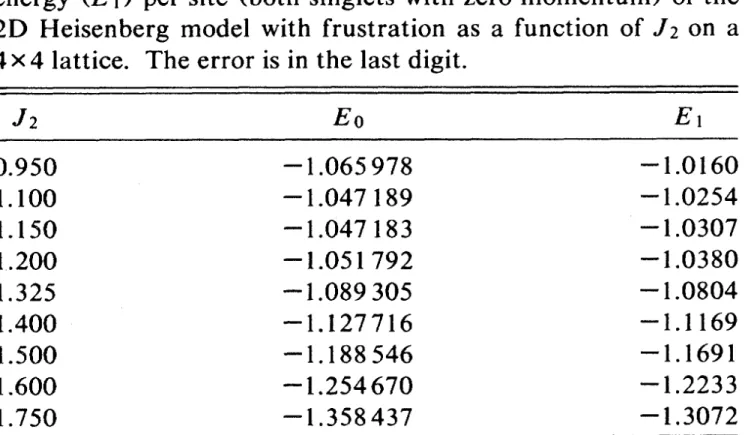
TABLE
I.
Ground-state energy(Ep)
and first excited-state energy(E~)
per site (both singlets with zero momentum)of
the2D Heisenberg model with frustration as a function
of J2
on a4X41attice.
The error is in the last digit.ordered
(Neel)
disordered
(spin liquid?)
ordered
(¹el
ineach
sublattice)
FIG.
4.
(a)
Ground-state energy(Eo)
and first excited-stateenergy
(E~)
(per site) on a4&4
lattice as a functionof
Jz
near the degeneracy region. Also shown is the second excited-stateenergy
(Ez).
The three states are singlets withk=(0, 0).
For
comparison, we also show the triplet
(ET)
and singlet(Es)
states
of
Fig.
2.(b)
Possible phase diagramof
the Heisenbergmodel with frustration in the thermodynamic limit.
0.
950
1.100
1.150
1.200
1.3251.
400
1.500
1.
600
1.750
Ep—
1.065
978
—
1.047 189
—
1.047 183
—
1.051
792
—
1.
089
305
—
1.
127716
—
1.
188 546—
1.
254670
—
1.
358437
—
1.
0160
—
1.
0254
—
1.0307
—
1.
0380
—
1.
0804
—
1.
1169
—
1.1691
—
1.2233
—
1.3072
J
1-J2 Heisenberg model, Ns=4×4,J1
=2.0
E. Dagotto and A. Moreo, PRB (R) 39 , 4744
(1989)
例題4: Kitaev model
1 0 0 1 0 5 1 2 0 13 1 6 0 4 0 2 1 5 1 3 0 12 0 6 1 13 1 7 0 10 0 14 1 11 1 15 3 2 2 3 2 1 3 4 2 15 3 8 2 0 2 4 3 1 3 5 2 14 2 8 3 15 3 9 2 6 2 16 3 7 3 17 5 4 4 5 4 3 5 0 4 17 5 10 4 2 4 0 5 3 5 1 4 16 4 10 5 17 5 11 4 8 4 12 5 9 5 13 7 6 6 7 6 11 7 8 6 1 7 12 6 10 6 8 7 11 7 9 6 0 6 12 7 1 7 13 6 16 6 2 7 17 7 3 9 8 8 9 8 7 9 10 8 3 9 14 8 6 8 10 9 7 9 11 8 2 8 14 9 3 9 15 8 12 8 4 9 13 9 5 11 10 10 11 10 9 11 6 10 5 11 16 10 8 10 6 11 9 11 7 10 4 10 16 11 5 11 17 10 14 10 0 11 15 11 1 13 12 12 13 12 17 13 14 12 7 13 0 12 16 12 14 13 17 13 15 12 6 12 0 13 7 13 1 12 4 12 8 13 5 13 9 15 14 14 15 14 13 15 16 14 9 15 2 14 12 14 16 15 13 15 17 14 8 14 2 15 9 15 3 14 0 14 10 15 1 15 11 17 16 16 17 16 15 17 12 16 11 17 4 16 14 16 12 17 15 17 13 16 10 16 4 17 11 17 5 16 2 16 6 17 3 17 7is impossible, even if we introduce new terms in the Hamiltonian. On the other hand, the eight copies of each phase (corresponding to different sign combinations of Jx, Jy, Jz) have
the same translational properties. It is unknown whether the eight copies of the gapless phase are algebraically different.
We now consider the zeros of the spectrum that exist in the gapless phase. The momen-tum q is defined modulo the reciprocal lattice, i.e., it belongs to a torus. We represent the momentum space by the parallelogram spanned by (q1, q2)—the basis dual to (n1, n2). In
the symmetric case (Jx= Jy= Jz) the zeros of the spectrum are given by
ð34Þ If |Jx| and |Jy| decrease while |Jz| remains constant, q* and #q* move toward each other
(within the parallelogram) until they fuse and disappear. This happens when |Jx| + |Jy| = |Jz|. The points q*and #q*can also effectively fuse at opposite sides of the
par-allelogram. (Note that the equation q*= #q*has three nonzero solutions on the torus.)
At the points ±q*the spectrum has conic singularities (assuming that q*„ #q*)
ð35Þ
7. Properties of the gapped phases
In a gapped phase, spin correlations decay exponentially with distance, therefore spa-tially separated quasiparticles cannot interact directly. That is, a small displacement or another local action on one particle does not influence the other. However, the particles
Jx= =0Jz Jy= =0Jz =1, Jx Jy=1, =1, Jz Jx= =0Jy gapless gapped Az Ax Ay B
Fig. 5. Phase diagram of the model. The triangle is the section of the positive octant (Jx, Jy, JzP 0) by the plane
Jx+ Jy+ Jz= 1. The diagrams for the other octants are similar.
20 A. Kitaev / Annals of Physics 321 (2006) 2–111
Annals of Physics 321, 2-111 (2016)
3方向のそれぞれが
Jx,Jy,Jzで相互作用
相図
可解模型→スピン液体
H =
J
xX
x bondS
ixS
jxJ
yX
y bondS
iyS
jyJ
zX
z bondS
izS
jzlattice.gpで描画可能
例題4: Kitaev model
1. Lanczosでエネルギーを計算 (サイズ18サイト位)
2. TPQで比熱を計算: マヨラナ粒子の兆候がみえるか?
3. (発展)次近接のスピン相関が厳密に0を確認
4. (発展)ハイゼンベルク項をたすとどうなるか?
5. (発展)磁場をかけて磁化の温度依存性から帯磁率が計算可能
W = 3 L = 3 model = "SpinGC" method = "Lanczos" lattice = "Honeycomb" J0x = -1.0 J0y = 0.0 J0z = 0.0 J1x = 0.0 J1y = -1.0 J1z = 0.0 J2x = 0.0 J2y = 0.0 J2z = -1.0H =
J
xX
x bondS
ixS
jxJ
yX
y bondS
iyS
jyJ
zX
z bondS
izS
jz例題5: Hubbard chain
H =
t
X
hi,ji
(c
†
i
c
j
+ h.c.) + U
X
i
n
i
"
n
i
#
L = 8
model = "FermionHubbard"
method = "Lanczos"
lattice = "chain"
t = 1.0
U = 8.0
nelec = 8
2Sz = 0
1. Lanczosでエネルギー・二重占有度を計算 (サイズ8サイト位)
2. TPQで比熱・二重占有度を計算:
3. (発展) 全対角化でアンサンブル平均を計算してTPQと比較
例題5: Hubbard chain (有限温度計算)
FullDiag, TPQ, Lanczosの比較
Hubbard model, L=8, U/t=8, half filling, S
z=0
-0.5
0
0.5
1
1.5
2
2.5
0
0.05
0.1
0.15
0.2
0.25
10
-210
-110
010
110
210
-210
-110
010
110
2D
/N
s
E
/N
s
TPQ
FullDiag
Lanczos
TPQ
FullDiag
Lanczos
T/t
T/t
3つの手法は互いに一致
その他の例
HPhi/samples/Standard/
に
Hubbard模型、Heisenberg模型、Kitaev模型、近藤格子模型
の
Standard modeのStdFace.defがあります。
StdFace.defを適宜変えて遊んでみてください。
注意:
-サイズは大きくし過ぎないこと
(PCだとspin 1/2で24site, Hubbardで12サイトくらいが限界)
-Lanczosはサイズが小さいと不安定です
(数千次元以上を推奨)
-TPQはサイズが小さいとうまくいきません
(数千次元以上を推奨)
物性研スパコンを使ってみよう!
物性研システムB (sekirei)
fat node: 1node (40 cores) 1TBのメモリ、
2nodesまで使用可 →
2TB
cpu node: 1node (24cores) 120GBのメモリ,
144nodesまで使用可 →
17TB
潤沢なメモリ: spin 1/2 36 sites, Hubbard 18 sitesまでなら
比較的簡単に計算可能 (5-10年程度前の最先端の計算)
TPQ法を使えば有限温度計算も可能!
お試しクラス(A) : 随時受付(100ポイント以下)
通常クラス(B,C,E): 年2回(6月,12月)受付
物性研スパコンを使ってみよう!
物性研システムB (sekirei)にはインストール済み
以下のようなスクリプトをサブミットするだけで、
大規模並列計算が可能
#!/bin/sh
#QSUB -queue F144cpu #QSUB -node 128 #QSUB -mpi 128 #QSUB -omp 24 #QSUB -place pack #QSUB -over false
#PBS -l walltime=24:00:00 #PBS -N HPhi
cd ${PBS_O_WORKDIR}
source /home/issp/materiapps/HPhi/HPhivars.sh