English Ability and Language Attitudes
ln
」
apan and Jordan
―――― A COmparative Study of COntextual Variables
―
Kip A. CATES and KazukO M.CATESキ
(Received 30 May 1986)Abstract
Pcople who are familiar lvith both Japan and 」ordan often comlnent on the differences in English speaking ability and language attitudes in the t vo countries lt is generally felt that Jordanian Arabs have a much higher degree of fluency in spoken English than 」apanese whereas Japanese sometimes seem to do better in lltritten tests 、vhich stress grammatical accuracy,
This study attempts to examine the sociolinguistic environment of each cOuntry in order to isolate those contextual factors which are responsible for these perceived differences in English speaking ability. The analysis is carried out using Stern's1983 model of contextual factors in language teaching, lvhich divides the envirOnmental context into 6 separate dimen・ sions:education,hng stics,sodetノculture,geography,hstorノ pOli cs,and economics/
technology.
In the conclusion, it is suggested that some features of Jordan's English language situation may be relevant in considering ho、 v to improve the effectiveness of English ianguage education
in 」apan.
Introduction
ln this paper, 、ve intend to compare in general terms the English education system
and sociolinguistic situation of Japan and 」ordan, with a vic、 v to identifying those envi‐
ronmental factOrs lvhich have shaped the present English language situation in each
country.
│ヽ「hy compare educational systems and language environments in different countries?
Stern(1983)responds as fonows:
“For language teachers, the study of education from150 Kip A.CATES・ Kaz口
ko M.CATES
an international and comparative point of vielv...is of particular ilnportance because of the international nature of language educationi' Language education is not something
confined i!二St tO one's o、vn country, but an educational priority pursued on an international
scale by virtually ali nations. Rather than each country closing its dooF tO pursue its
o、vn programs in the dark, lvhat is needed is sharing of experience between all nations
for the improvement of language education worldwide.
COmparative education has developed largely in the 20th century, notably with the
founding of the international Bureau of Education in the 1920's and with the setting up
of UNESCO's lnstitute for Education in Hamburg in 1954. The most important work has
been done by the IEA(International Association for the Evaluation of Educational Achieve‐
mentl, a grOup of empirical researchers formed in the 1960's who have carried out
international comparative studies on mathematics(Husen 1967),and other school subjects
(Walker 1976;Purves&Levine 1975)。
The international comparative study of foreign language education and language environ‐
ments is still in the beginning stages, however. AInong the felv studies completed are
two studies on children (Stern 1967; 1969), one on fOreign language teaching in the USSR(Lewis 1972)and a survey on language teachng in European schools(Halis 1970).
As yet, the most ambitious study has been done by an II:A tean which investigated the teaching of English and French as foreign languages in 15 different countries(Carr011
1975;Lewis&Massad 1975).
This paper does not presume to be as ambitious as any of the above studies, Our
goals hcre are 4‐ fold:
(1)to describe briefly the reported differences in English language ability and language
attitudes which seem to exist in 」apan and Jordan
(2)to cxamine the differences in the English ianguage education systems of 」apan
and Jordan
(3)to cxplore the social and contextual variables which have shaped the attitudes
and experience of」 apanese and Jordanians as regards language, English learning and foreign contact
(4)to discuss the implications of our study for imprO ng the effectiveness of English
language education in 」apan
English Ability and Language Attitudes in Japan and 」ordan 151 A COmparative Study of Contextual Variables
、vith brOad generalizations than with complex details, Additionally, some of our obser‐ vations will have to be rather subieCtiVe. WVe must therefore stress that this study is
meant only as a preli■ linary enquiry, not as a deanitive survey.
PART I DIFFERENTIAL ENGLISH ABILITIES AND ATTITUDES
IN JAPAN AND JORDAN
Japanese people 、vho have lived in 」ordan and Jordanian people who have lived in
Japan generally agree that:
(a)Jordanians seem to be more fluent
(b)Japanese sometimes seem to have
vocabulary than 」ordaniansThese perceived differences seenl, then, to concern the contrast between fluency
and accuracy. Examples are often cited to illustrate these differences. 」ordanians
with only a very basic knowledge Of Enghsh, for example, will actively speak in order
to communicate their ideas, exploiting their limited vocabulary tO the full. Even though their speech may be full of gross errors of granlmar, they lvill still be able to deal in
a relaxed and competent inanner、 vith foreign native speakers, In contrast, many Japanese
will often have great difficulty in putting words together to express their thoughts, even
though they may have an encyclopedic knowledge of vocabulary and gra■ llnar. They
tend also to have difficulty communicating face‐ to‐face with native speakers of English,
often remaining silent or responding hesitantly. In formal tests, however, they wi1l often
show a high degrec of formal English knowledge.
Our experiences also confirm the existence of these differences. These experiences
consist of:
(1)several years each teachng post‐secondary English in」 apan, and almost a decade
of observing」
apanese people cope(or not cope)in English in North America,
Britain, Europe, the Middle East, Asia and the Soviet Union
(2)2 years for both of us teaching English at a national university in Jordan, and
experience observing」 ordanians speak English in Jordan, Britain, the Soviet Union
and 」apan
lt is felt, then, that 」apan tends to produce language learners with a high degrec
at speaking English than 」apanese
152 Kip A,CATES・ Kazuko M CATES
of formal accuracy lvhile 」Ordan prOduces ianguage learners Ⅵ′ith a high degrec Of oral
fluency. ヽVhile there has been much debate regarding the correct balance between fluency
and accuracy in language teaching(e.g, Brumfit&」
Ohnson 1979), what is of interest to us is the striking difference reported in oral fluency in the two countries.Byrne(1976)defines fluency as“ the abinty tO express oneself intelligibly, reasonably
accurately and withOut unduc hesitationi' Levenston(1975)defines it more broadly as
“the ability tO function in face‐ to‐face situationsI' while cohen(1980)considers fluency as just one dimension of pragmatic speaking ability.
If it is felt that Jordanian speakers tend to be mOre fluent than 」apanese, just what
does this mean in concrete terms? Some examples should suffice.
In shOpping areas in Japan, foreigners often hear cries of “Irasshailnase" with the
occasional timid“ Hellor Or whispered“ GaijinT In the markets Of」
ordan and the Arab
WIiddle East, one is faced with a great deal more English: “
What wOuld you like to
buy, Mister?",“
Come into my shop and have sOme tear,“
come and 100k. Looking isfree. Are yOu interested in carpets?"
A=nong people in the tourist trade in 」apan, in hotels, gift shOps, travel bureaus, ctc., a small but increasing number of people can speak silnple, halting yet effective English. In Jordan, virtually all peOple in the tourist trade llrill speak English, and
many will be functionally bilingual in Arabic and English.
Local Japanese shopkeepers are usually friendly and talkative, but very fe、 v are able to converse much in English. A visit to the butcher Or baker in JOrdan, hollrever, can
easily lead into a pleasant conversation in good English on one's fanlily, inflation, Islam
or the future Of the PLO.
In government offices, business, in universities and other professiOnal institutions,
one finds silnilar differences, Some Japanese will speak excellent English, but many
、vill speak very little, while in 」ordan virtually everyone 、vill speak sOme degrec of
relaxed, fluent English.
It is generally ackno、 vledged, then, that」 ordan has attained a level of spoken English
fluency 、vhich does not as yet exist in Japan. In order to find the reasons 、
vhy, we
English Ability and Language Attitudes in Japan and 」ordan 153 A COmparative Study Of COntextual Variables
PART II CONTEXT ANALYSIS・
A THEORETICAL MODEL
“In language teaching we have t9 operate with 4 key concepts: language, learning,
teaching and contexど '(Stern 1983). These separate elements make up the 4 dimensions
of the language learning/1anguage teaching en ronment.
The ilnportance of context cannot be overstated, Stern's general mode1 0f language educatiOn rightly places context as a pervasive feature surrounding language, learning
and teaching(I「igure l). WVhereas language, learning and teaching have their fOundations in linguistics, psycho10gy and education, we derive our understanding Of cOntext from the
social sciences, specifically sociO10gy, anthropo10gy and sOciolinguistics.
Leve1 3: Practice Leve1 2: Interlevel Level l: FoundatiOns
Figure l.S'9T42'S ar。 ,9′ 6げ Lα昭 傷皓 9 EEacαttο紀 (1983)
FOr a proper understanding of differences in English ability, then, 、ve should not
concern ourselves solely lllith the classroOm. What is needed is a model that will cover
the ma,Or cOntextual variables for Japan and Jordan, Only by exantining all relevant
factOrs of the envirOnment can 、ve pinpoint those elements that have brought about the
differences in language ability and attitude in the two countries。
METHODOLOGY
ObieCtiVes COntent Procedures Materials Evaluation of outcOmesORGANIZATION
Planning and administration
Pl・imary
SecOndary ngher educatiOn Tcacher education Adult and infOrmal
EDUCATIONAL LINGUISTICS
THEORY AND RESEARCH
HistOry of language teaching Linguistics Sociology, sociolinguistics, and anthrOpology Psychology and PsychOlinguistics
154 Kip A CATES・ Kazuko M.CATES
Stern's Model of Contextual Factors
For our study of contextual variables, the most relevant model is probably that
by Stern(1983)(Figure 2). Ths is actually a combination of two separate models,
one by Spolsky(1974)designed for analysill‐ g the contexts of bilingual education, andone by Mackey(1970)which details the different social levels relevant to language
education. Though not perfect, this model should do 、vell enOugh for our general
purposes. EDUCAT10NAL Figure 2.Sテ9η
`肋
「ο'9J9/Cο
ηι9″ιttαJ FαcとοTs 力 Lαηgttαg9 E'acαttοη (adapted)The interior of the model represents the 5 1evels lvithin lvhich foreign language
education occurs, In the ■liddle, 、ve start 、vith the ■licro‐ level of the language teaching
situation, slo、vly moving outllrards through the school envirOnment and home, until llle
reach the regional and national level. To illustrate the model, let us give an example
dealing only with the geographic dilnension.
LE7EL
l. Language Tcaching Situation 2. School EnvirOnment
EX4″
PLE
A university class in English reading Tottori University
GEOGRAPHIC
●
English Ability and Language Attitudes in Japan and 」ordan 155 A Comparative Study of Contextual Variables
3. Home Environment&Neighbourhood Home: villages and towns in Tottori,
Shimane, Okayama, other areas
NeighbourhOod: Koyama‐ cho
4. Region Tottori Prefecture, San'in District
5. National and lnternational Setting National: 」apanlnternationali North‐east Asia
Our example sho、 vs only the geographic dilnension. Ho、 vever, this is only onc of
the 6 dilnensions which influence language ability and attitudes, and a11 6 are active at each of the above 5 1evels. These 6 dimensions can be further sub‐ divided roughly as follows:
DrarENsroN
r/PORTANT SJB‐
FACTθ
RS
I EDUCATIONAL (1)Methodology
(2)Organizational aspects
ll LINGUISTIC (1)Structural similarity of native &
target language
(2)Language en
ronmentⅢ
80CIO‐
CULTURAL (1)Religious attitudes
(2)Cultural values
(3) SOcial structureⅣ
GEOGRAPHIC (1)Degrec of geographical isolation
(2)Distance from the foreign tanguage community
V HISTORICAL/POLITICAL (1)History of foreign contacts
(2)HistOry Of foreignlanguage education
(3)Pontical factors affecting the
foreign ianguage Ⅵ
ECONOMIυ
TECHNOLOGICAL (1)Economic structure,
(2)Level of development
156 Kip A.CATES・
Kazuko M.CATES
particular sociolinguistic situation, not all dimensions may be operative. These 6 dilnensions should therefore be thought of as a checklist of possible contextual factors affecting language ability and attitudes, rather than as a list of features that must always be operative in every case.
PART IⅡ
JAPAN AND JORDAN‐ AN ANALYSIS OF CONTEXTUAL VARIABLES
I THE EDUCAT10NAL DIMENSION
To begin our analysis, let us start with a comparison of the English language edu‐
cation syste s of Japan and 」ordan, Here we will again follo、 v Stern, by dividing this
into two aspectsi organization(referring to the administration and planning of English education at the variOus school levels)and methodology(dealing with obiectiVes,teaching procedures, content, materials and evaluation).
Organizatio■ ‐
Japan
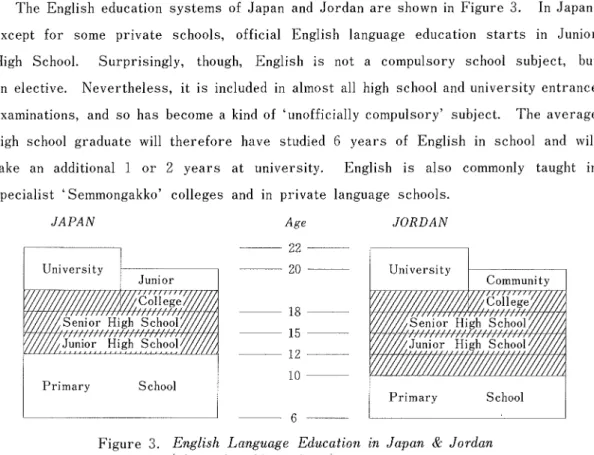
The English education systems of」 apan and Jordan are sho、 vn in Figure 3, In Japan,
except for some private schools, official English language education starts in 」unior
High School. Surprisingly, though, English is not a compulsory school subject, but
an electiveo Nevertheless, it is included in almost all high school and university entrance exanainations, and so has become a kind of `unofficially compulsory' subject. The average
high school graduate will therefore have studied 6 years of English in school and will
take an additional l or 2 years at university. English is also conimonly taught in
specialist `Senimongakko' colleges and in private language schools.
yュ4島4Ⅳ 4g9 -―――――
22
-――――――- 20 -――――――18
-――――――15
--12-
10-―――――――- 6 -――――――― JORつ4Ⅳ
Figure 3.EOg′Jdん Lα聖即αg9 EJttcα ιJοη カ デα
ptr2&ノ
οTJαη(shown by Oblique lines)
Since the 1981 curriculum reform, only three hours per 、veek have been allotted
enior Hitth SchOol
Primary School
English Ability and Language Attitudes in Japan and Jordan 157 A COmparative Study of COntextual Variables
English in juniOr high schools. Many people feel this is insufficient, and there are now
some movements demanding more English instruction time(Nihon Kyδ iku Nenkan 1985).
ヽヽ「hat is sacrificed with this reductiOn of teaching tilne is training in listening and sPcaking
skills which are not directly tested on the entrance exa■ linations. Since this schedule is felt tO be inadequate even for teaching reading and writing, many schools also give supplementary lessons before Or after school, or during holidays.
In seniOr high schools, English is normally taught for 4 or 5 hours per lveek. The
average class size is about 45 for bOth juniOr and seniOr high schOOIs, It is increasingly
conamon to divide students into class according to proficiency.
In universitics, all students are required to take English as part of their general
education, In most cases, these courses are independent from each other, and there
is little program coordination, which tends to reduce their effectiveness.
Organizatio■ ‐
Jordan
ln 」ordan, English is officially a compulsory subiect, English is first taught in the
5th grade of elementary school, two years earlier than in Japan, and continues to be
an il■portant subject throughout secOndary school, Compulsory education lasts until the end of iunior high school at age 15, by which time students have had 5 years of English. Fewer students in Jordan cOntinue on to senior high school compared with 」apan (Japan‐
94%, Jordan‐ an estimated 70%). SeniOr high school graduates will have done 8 years of English study in all. In secondary school, students have 3 to 4 classes of Enghsh
a 、veck, cach lasting rOughly 45 ■linutes, Ivith a class size of about 40.
At the university level, English is also a required subieCt Whose importance differs according to the student's university and faculty. 」ordan has 3 national universities,
each of lvhich cOunts both English and Arabic as official languages of instruction, although
in practice only one of the three makes extensive usc of English in teaching. The reasons for using English are (1) because many Jordanian prOfessors learned their SubieCtS in English abroad in the UK and US, and thus feel more comfortable teaching
in the language they studied in;(2)because in certain technical fields only English text‐
books are available as yet, with Arabic translations now being preparedi and(3)bccause
foreign teachers are hired in most faculties to teach specialist subjects in English, though it is hoped to eventually replace these with qualified 」ordanian staff.
158 KiP A CATES・ Kazuko M.CATES
Methodology‐
Japan & Jordan
ObieCt
es ln the`Course of Study'issued by the」
apanese Ministry of Education,the overall obiectiVes for foreign language study are given as being “to develop students'
ability to understand a foreign language and express themselves in it, to deepen their interest in a language, and to understand the_daily life and way of thinking of foreign
people"(1978;English translation 1983). The obiectiVes of English language education
are further specified as being “to develop students' ability Of hearing, speaking, reading
and writing in Englishi' Although stress on a balance of the 4 skills is part of the
ObieCtiVes, in reality a lot of time and effort is spent on preparation for entrance exanl‐ inations, so that oral‐ aural skills tend to be some、 vhat neglected.
The obiectiVes Of English language teaching in Jordan follolv roughly the same lines as those in 」apan. Emphasis is placed on developing a general English language ability
leading to all‐ round competence in the 4 skills, As in 」apan, actual classroom practice tends to focus more on reading, 、vriting and granlmar,
Procedures, Content and Materials ln Japanese schools, Enghsh is taught mainly
through the traditional granlmar‐ translation method. AIthOugh most high school teachers
have access to audio‐ visual equipment, it is generally left to the individual teacher to
decide whether to use this or not, Since World War Ⅱ, the English taught in schools
in 」apan has been American Enghsh. In iuniOr high schools, an English reader is used
which introduces the way of life in Western countries. In senior high school, a granlmar book is added to this. It is also conlmon for students to study materials prepared for
the entrance exa■linations.
」ordan has been under the influencc of British education, so that British English is normally taught in schools. In terms of audio‐ visual equipment, 」ordanian schools are
not as fortunate as 」apan. Textbooks are standardized and consist of 6 parts: reading comprehension, vocabulary, granainar exercises, dictation, composition and discussion, In addition, reading skills are taught lvith an anthology reader and a short novel such
as George Orwell's `Animal Farm:
The chief difference between」 apan and Jordan concerns method. In Jordanian schools, much less emphasis is placed on English translation, partly since this is not tested on
the graduation exaH nation. A more important difference concerns the language of instru‐
English Ability and Language Attitudes in 」apan and Jordan 159 A COmparative Study of Contextual Variables
dominantly」apanese, in Jordan a high proportion of school teachers use English to at
least some extent in the classroom. Though a few will teach only in Arabic, many will
use both languages in class, and some will use mainly English, reser ng Arabic only
for supplementary explanation.
Differences also exist at university level. In 」ordan, university English is taught within the franelvork of a coordinated program 、vith specific ailns while in」 apan English at the `ky5y6' general education level is taught in separate courses by independent prO_ fessors. University level English in Japan tends to focus largely on reading and trans‐
lation, l17ith much of the content being literature. In 」ordan, general compulsory English
courses have two main thrusts. One is general English ability(EFL), which in」 apan
is often left to the fe、v foreign teachers. The other focus is ESP, English for Specific Purposes, IThere acade■ lic and technical English is taught to students as a language
skill necessary for their university specializations. I】 SP English is taught both at the general level(e.g. `English for Science'). or at mOre specialized levels(e.g. `English
for Engineering' or`English for Medicineり
, Little ESP teaching seems to exist in
Japan at the university level.
Evaluatio■ In both Japan and 」ordan, the evaluation of English education in schools
is done through formal 、vritten exa■ nations. In both countries, thesc exans are a
crucial factor in deter■lining students' future careers, though in Jordan related social
problems such as bullying and suicide do not seem to occur, Whereas in 」apan the
key exa■lination is the university entrance exanl, in」 ordan it is the high school graduation
exanination, called the `Tawiihit WhiCh decides whether a student can enter university
or not,
Interesdngly, a 」ordanian student's faculty is decided not by his own preference, but also by his Tawjihi score. Each faculty requires a minimum score for admission, with 95 for Medicine, 90 for Engineering and 82 for English, ctc. However, a student
who wants to study English literature as his maior may be forced by his family to take the higher status Medicine or Engineering if his Tawiihi SCOre is high.
Our brief survey of the education system in each country shows some siinilarities,
The organization of Enghsh education seems roughly the same, as are obiectiVes. Both
societies place great value on a single examination in deciding students' future status and careers. Both examinations tend to neglect ora1/aural abinties.
160 Kip A.CATES,Kazuko M.CATES
Important differences also exist, notably 」ordan's earlier start 、vith English, greater
use of English in」
ordanian classroom, and EFL/ESP teaching at university. Another
great difference not yet mentioned is overseas study, which will be taken up under the economiO/technological dimension.On the whOle, then, we have found sOme‐ factOrs in the educatiOn system 、vhich help
account for the differences in English ability and attitudes in 」
ordan and Japan. By
themselves, however, these do not seem to explain such wide discrepancies in English
speaking as we described earlier. We must therefore now turn to contextual variables
outside the education systena, starting 、vith the linguistic dilnension.
I THE LINGUISTIC DIMENS10N
(1)Structural Similarity of Native Language to English
Contrastive analysis as first put forward by Lado (1957) discussed the concept of
`degree of difficulty' of a foreign ianguage based On the `closeness' or degree of struc‐
tural sinlilarity bet、veen the learner's native language and the foreign language. If the two languages are silnilar in structure, there should be `transfer' and learning should
be facilitated. If quite different, then there is `interference' 、vith learning hindered to
some extent.
We cannot do a thOrOugh contrastive Enghsh in this short paper. One shOrt
however, Qtr?sιテο2 L4Ⅳ
G1/4GE Vο
T,English where
German lV。
French od
Spanish とD6nde Arabic `aynaRussian gde
analysis for either Japanese/English or Arabic/ example of syntax should suggest the situation,
Cοpttα iS ist est esta ″ ″ 4Tttc′¢ the das le el al ″ Pο′テιθ CοptB′α desu LJ磁部,sι,c SォT2cιαT¢ N9閉 book? Buch? livre? libro? kitab? kniga? Qα9sオサοη arαTん9T ka? To,,c Q2?δ 歩 'ο ″ 氏S22 arαTん¢T ,1たοTJ
Japanesc hOn wa dOkO
English Ability and Language Attitudes in 」apan and Jordan 161 A COmparative Study of Contextual Variables
In this example, the structural silnilarity between English, French, German and
Spanish is striking and indicates a low degree of learning difficulty according to our
contrast c hypothesis. Arabic also shOws a close similarity to English, closer even
than Russian which is an lndo‐ EurOpean language like English, although Arabic belongs
to the Se■ litic language fan ly. 」apanese, by contrast, stands out ilnmediately as a language with a very different structure. Though we can't of course generalize frOm one isolated example, a contrastive study of Arabic and 」apanese 、vould show that in
terms of syntax at least Arabic is `closer' to English than 」apanese. According to the
contrast c hypothesis,ths would indicate more difficulty for Japanese in learning English
than for JOrdanian learners, thus supporting Reischauer(1978)who states that in the English language gane, “the cards are largely stacked against the Japanesei'
The theory of contrastive analysis, however, has generated a great deal or debate,
with conflicting claims made for its validity(Lado 1957; Politzer 1968)and counter claims playing down its importance(Ritchie 1967; Richards 1971,Gradman 1971). Stern
(1983)states``hnguistic similarity is no absolute guarantee that the second language will be easily learni'while some researchers feel the nat c language is not at all a critical
factor in language learning(Carr。 111975).
The linguistic structure of Japanese ηey have a part in English learning difficulty,
but other linguistic factors also play an ilnportant role.
(2) Language Enviromment
The language environment of a society has a serious effect on foreign language learning. Here there are 4 features 、ve would like to look at: linguistic membership,
linguistic homogeneity, social bilingualism and available language resources,
Linguistic Membership
Every language community is like a club.The」
apanese language club is large(120millon members)but quite isolated,consisting of one nation,」 apan,an outpost in Brazil, and small pockets in Ne、 v York, California, Dusseldorf, ctc. The Arabic language club to which Jordan belongs is smaller than the」 apanese club(100 million speakers), but is spread out over 19 different Arab nations plus parts of lra4, the USSR and
sub‐ Saharan Africa. If we consider Arabic's role as the language of lslanl, then our
club membership rises to 500 ■lillion, including such countries as Turkey, India, China
162 Kip A.CATES・ Kazuko M.CATES
more international than Japan, a factor which may influence attitudes to、 vards fOreign people and foreign languages,
Linguistic Homogeneity
BOth 」apan and Jordan exhibit high degrees of linguistic homogeneity, with both
countries having over 99% of their populations speaking the native language. This kind
of homogeneity, however, can lead to an acceptance of universal unilinguality and may
cause psychological resistance to foreign language learning(Stern). Social Bilingualism
Though both
」apan and Jordan are linguistically homogeneous, there does exist adifference in the extent of social bilingualisnl existing in each country. Reischauer
states that the number of 」apanese who speak foreign languages is quite small, and
describes the Japanese involved in international bureaucracy, business and science as
having only `■linilnally adequate' foreign language skills. Since 1978, 、vhen Reischauer was writing, the situation has undoubtedly improved somewhat, but the number of
people who could be described as functionally bilingual in English and 」apanese must be
extremely low.
In Jordan, however, among the urban educated classes (and a number of the less
well educated), English‐ Arabic b ngualism is accepted as a common fact of hfeo Some
concrete examples of this 、vere mentioned in Part Io Some reasons for this have to
do with our next topic, available resources.
English Language Resources in the Community
(a) Opportunities to Use English: Resident English・
Speaking Foreigners
Figure 5 below shows the comparative statistics for English speakers resident in the
tlvo countries.
JAPAN: TOtal populatiOn l17,884,000(1981) 」ORDAN: Total population 2,300,000 (■982)
!艶
Й
稔
霧
1諺
9%
髄 炉 驚 卜形
USA UK Philippincs 3,000 Germany 595 Turkey 200? Other.・5 2,000? 1'8!8 )・%
25% Tota1 55,57■ .047ワろ Tota1 8,245 .36ワろ Figure 5. 五れgれdん。s29αんJttg■9s,,9免ιs 加I彎
949 αη'デ
οT'αηSο,Tc9s 」apan: Nihon‐ Sono sugata to kokoro
English Ability and Language Attitudes in 」apan and Jordan 163 A COmparative Study of COntextual Variables
lt lnust be stressed that these statistics are very rough. Nevertheless, 」ordan does seem to have a cOnsiderably higher population of foreign residents propOrtionally than
」apan, even though the actual numbers in both cases are quite small.
Another relevant difference concerns the distribution of these foreign English speakers.
Both cOuntries have foreigners 、vorking in education and business. 」apan has in addition
a large population of A,nerican nlilitary in various bases, but these have only local
contact and no national influence.
」ordan, ho、vever, has a quite interesting pattern of distribution. Because lslanlic
tradition frowns upon single Arab wOmen ■xing with men in public, certain professiOns
have had to import and employ foreign
、vomen. Thus, many 」ordanian nurses and
waitresses are Filipino girls, maids are frOm Sri Lanka, and airplane stewardesses are often European or American lvomen. Al1 0f these groups speak English but little or no Arabico Jordanian Arabs flying on the 」ordanian national airlinc are therefore sometiinesforced tO use English. It is hard to iinagine such a situation in 」apan 、
vhere JAL
stewardesses ltrould tell 」apanese passengers, “Sorry, you'1l have to speak English. I
don't know any 」apanesel'
(b)Role Models
To do anything 、vell, it is helpfui to have good role models 、vho can be iinitated. The
iェnportance of this in the language environment is stressed by Dulay, Burt & Krashen
(1982). Figure 6 below shOws a cOmparison of English‐ speaking rOle models at various
social levels.
ROYALTY Jordan: King Hussein and CrOlvn Prince Hassan educated in England. Both fluent in English Qucen Noor bOrn and raised in US. Royal family Often shOwn speaking English publicly in media. 」apanI Prince Hiro educated at OxfOrd. Royal family rarely shown
speaking English publicly in media.
GOVERNMENT
Jordan: Prime Minister and gOvernment officials virtually all fluent in Enghsh. OccasiOnally shown speaking English in media.Japan: Variable English ability amOng government Officials and POliticians. Very few functiOnally fluent. Rarely shOwn speaking English.
MEDIA Jordan: PcOple in news and entertainment mostly fluent, sOmetimes Shown.
」apan: SInall but grOwing number Of】 ]nglish speaking newscasters, actors, musicians etc shO、 vn using English.
SCHOOLS
Jordant h/10st teachers Japani Small numberhave a functiOnal English speaking ability.
of teachers with functional English speaking ability.
FAMILY Jordani MOst families
」apani Small number have One or more English‐ speaking members.of families with English‐ speaking members.
164 Kip A.CATES・
Kazuko M.CATES
From the information above, Jordan seems to have a very rich language environment
in terms of English‐ speaking role models, From the level of the fa■ lily to that of the
government, public figures seem to have both a good English ability and are visible
speaking English in the media and elsewhere. 」ordanian learners thus have only tO
look arOund to see successful examples of people cOnllnunicating smoothly and naturally in English 、vith foreigners. Japan, by contrast, does not as yet have this kind of language environment. Even where good speakers of English exist, they scem not to
be often shown speaking English in public.
(C)Media
」ust as an environment can be rich or poor in terms of role models, so also can it be rich or poor in foreign_language media resources. Figure 7 below details the general
situation in Jordan and 」apan.
English Newspapers 」
ORD4/V
l daily paper l 、veekly paper力
4B4N
4 daily pdpers several llreekly papersEnglish TV 1
5
foreign language channel
-6 hours English
programming nightly language teaching prOg.
1
No separate foreign channel Occasional English programming on
NHK or with bilingual broadcasting NHK language teaching prOgrams
English Radio BBC available
The FM station is in Eng.
FEN American Forces Radio
BBC available
English Cinema English movies have original soundtrack ―― not dubbed Few English mo esi cinema
going not popular
English mo es have original soundtrack ―― not dubbed Many English mo es: cinema going
fairly popular
Figure 7. 2og′Jsん 二αηg"αg9 ″9,Jα Jη 」oTJα2 2p' Ittα η
Both countries have a variety of media in English, though patterned slighdy
differently. The biggest difference is with television, 、vhere of the two 」
ordanian TV
channels, one is largely in English, showing 5‐ 6 hours of AInerican, British and local Enghsh prOgranl■ling each night. 」ordanian learners wanting exposure to Enghsh haveOnly tO turn on their TV sets tO get several hours daily of l e English. Although
」apan does have some English language progranllning, it is proportionately much less
English Ability and Language Attitudes in 」apan and Jordan A COmparative Study Of COntextual VariaЫ es
English brOadcasting・
Our brief survey of the language environment has highlighted several distinct differ‐
ences in Japan and 」ordano Let us now move on to look at the effect of social and
cultural variables in deter■lining language ability and attitudes.
IH THE SOCIO‐
CULTURAL DIMENSION
(1)Religious Attitudes
“AHah akbar. la illah‐
a ila Allaho Mohammad ras'ul Allah" God is most great.
There is no God but God, Mohammad is the messenger of God. This simple statement
is the basis of lslana and the religious foundation of all Arab and nonⅢArab Muslim
countries, It is written on the national flag of Saudi Arabia, appears on computer
printouts and is broadcast 5 times a day from mosques throughout the lsla■ lic world.
Our students in 」ordan even insisted on printing it on the blackboard and on their
homework exercises. Together with the Ramadan month of fasting, this slogan symbol‐
izes the all‐ pervasive influencc of religion in the Arab 、vorld, in marked contrast to
the comparatively weak influence of religiOn in Japan.
What does religion have to do lvith language ability and attitudes? Let us discuss some aspects of this as it relates to Japan and 」ordan.
Rchgious Attitudes to Language Like Christianity, Islam is a religion in which the
`word of God' was revealed to man, spread by word Of mouth from person to person
in a largely illiterate society, was memorized, recited and discussed by co■1lnon people,then llTas finally written down into a holy book. In the case of lslana, Allah‐ the one
truc God‐ dictated the contents of the Koran to Mchanll■
ad in Arabic, thus making
Arabic a hOly language, All Of these facts led to a high degrec of oral memory and to sharp skills of debate among the Arab people.」apan, in contrast, has never had one single holy book. No Shinto Gods dictated
iong sacred rules in Japanese to Honshu farmers from behind rocks or trees. Though
Buddhism brought some holy llrritings to 」apan, memorizing and reciting were left iargely
to the priests, while public debate on religion lvas discouraged by decrees such as Prince
166 KiP A.CATES・
KazukO M,CATES
Religious attitudes to English naturally differ in the t、 vo countries, In Jordan, English is considered an important tool for development and international communication
but is not holy like Arabic. A fe、 v Arabs even feel English is a threat, conveying as
it does anti‐ Isianlic Western ideas such as ilnmodest sexual relations, materialisnl, lax morals, etc. Accordingly, much debate in 」ordan is now going on over the appropriate role of English in education, In 」apan, no such religious conflict now exists, thOugh
such debates did occur in the Meiji Period when English was seen as the language of
Christianity.
Religious Attitudes tO Lcarning and Tcaching We often tend to forget that modern
education originated mainly for the study of religion, The great European universities were originally Christian theological colleges, for example, while in the Arab world
education originally meant the study of the Koran, and education in the old 」apanesc
`terakoya' dealt with buddhist precepts. In both 」apan and Jordan, therefore, great
respect has been accorded to education, and both countries have a religious‐ based tradi‐
tion of respect for teachers which is sadly lacking in the West. This, ho、 vever, has led to the present teacher‐ centred education system and may tend to hinder student independence. Though both 」apan and Jordan stress 、vritten learning and memorization, due partly to religious tradition, 」ordan's tradition of oral memory and recitation may
have given her a better base for acquisition of oral sk,1ls. In any case, it is conlmon for students in both countries to come to the teacher iuSt before a test to ask “
What
do we have to memorize?"
Religious Attitudes to Foreign People lt is postulated by Samson(1950)that Shinto
polytheisnl made it possible for 」apan to accept other religions and other cultures more easily than an uncomproュ sing monotheism ■light have. Thus, teaching English in Japan
has not confronted the religious resistance that exists to some extent in lslanlic countries
like Jordan and Saudi Arabia.
(2)Cultural values
Culture as an anthropological term covers the 、vhole life and civilization of a people.
Therefore, in comparing cultural values, we 、vi11 lilnit ourselves to a fe、v points which seenl most relevant to language ability and attitudes,
Attitudes to Speech and Silence
English Ability and Language Attitudes in 」apan and Jordan A Comparative Study of Contextual Variables
remarks on the 」apanese suspicion of verbal skilis and confidence in `haragei' and non‐
verbal understanding. Cates and Takagi(1980)describe」
apanese culture as a culture of empathy, stressing meaningful silence and implicit understanding, in contrast with theWestern `civilization of the dialoguet
」ordan, hoLvever, as an Arab nation, shares in the great verbal heritage of the
Arabs,Mansfield(1980)describes in detail the Arab love of into cating rhetoric and
the negative valuc of silence‐ Arab values that go back to the pre‐ Islanlic period.
Attitudes to Self‐
Expression and Reaso■
ingReischauer notes in 」apanese culture a strong aversion to open displays of feeling and opinions, linked to the value placed on social harmony and the dislike of open con‐ frontation. Rcasoning is conducted through suggestion and inference, and ambiguity is
common(Shigeta; Doi in Condon 1974).
Arabs have no such inhibitions, placing a high valuc on self‐ expression, argument
and eloquent analytical debate. Sinlilarly, self praise, rather than quiet modesty, is
highly valued.
Formality, Conformity and Self‐
Consciousness
」apanese society is said to be a society of rules, what Hall(1976)calls a `high‐
context' culture, with great importance attached to meticulous observance of procedure.
Everything, whether tea ceremony or tennis llrear, has its own rules, and everything
must be done tiust SO:Non‐ conformity leads to censure, while conformity often produces
a self‐ consciousness about not doing things correctly. This leads to `tonguc‐ tied perfectionism' and thus interferes lvith language learning.
Arab culture is also some、vhat formalistic and confor■ list, but not nearly to the sane extent, andヽvithout such extreme self‐ consciousness. 」ordanians have no hesitation
or inhibitions about speaking a foreign language, and tend to focus more on conllnuni‐ cation than on the granlmatical accuracy of their sentences.
Attitudes to Foreigners
Japanese concepts of `uchi' and `soto' are said to discourage casual contacts, Nakane (in CondOn 1974)ddds that contact with foreigners is often avoided due to a nervousness
and ignorance about holv to act. 」apanese feelings of privacy also inhibit relations
、vith foreigners。
168 Kip A.CATES・
Kazuko M.CATES
Bedouin. The desert is an inhospitable place, where generOsity and hospitality towards
strangers are highly valued. Thus, where in 」apan it is unusual to invite strangers
to one's home, in 」ordan it is an honour, a duty and a blessing. There is an Arab
custom whereby strangers must be given rOonl, board and full hospitality for 3 days before a host can ask their business. Foreigners in Jordan are regularly invited to Arab homes, and opportunities for meeting foreigners and speaking to foreigners and
speaking foreign languages are not avoided but are actively sought out.
Attitudes to Learning
Both societies place a high valuc on education, both traditionally and for acquiring social status, Reischauer feels learning in 」apan is an intuitive process, based on
trans■lission of skills frOna master to disciple through example and inlitation. The nature
of Japan's kanji writing system he also feels contributes to a tendency to、 vards rote
learning and a visual 、vritten orientation.
Arab society vic、vs learning as a process involving analysis and verbal explanation. Rote learning is also important, but 、vill be oral as well as written.
Cultural Uniqueness and Assimilatio■
of Foreign Concepts
Reischauer asserts that the 」apanesc have a special sense of distinctiveness as a
nation, which constitutes a barrier to international conlmunication. 」apanesc 、vho learn
foreign languages are sometiines iooked do、 vn on and called names such as `eigo‐ yai since it is felt such foreign kno、 vledge will dilute their `Japanese‐
ness: ThOugh
」ordanian Arabs wOuld also insist on their uniqueness, no such problem exists,Another difference concerns assilnilation of borrollled concepts, In」 apan, borrowed goods, ideas and words are `」apanizedI English words like `se、 ving machine' are thus
katakana‐
ized, abbreviated and sometimes changed in meaning to become words like
`mishinl which cause interference when speaking English. 」ordanian Arabs will at times sprinkle their Arabic 、vith English, but 、vithout this kind of distortion.Wc have discussed just a fevr of the Jordanian and 」apanese values which affect
language ability and attitudes. It seems clear, however, that 」ordan, Lvith its stress on verbal skiIIs, articulate self‐ expression, unselfconscious individualism and pro‐ foreign
English Ability and Language Attitudes in 」apan and JOrdan A COmparative Study of Contextual Variables
(3)Social Structure
Language ability and attitudes are often influenced by the social structure of a conト
munity. Figure 8 below gives a rough breakdolvn of Japanese and Jordanian society in
terms of ethnic Origin, rengion, age and social class.
ETHNIC COMPOSITION
RELIGION
AGE
SOCIAL CLASS
JAPAN
120 million Japanese 99。4ワろKOrean O.5%
Chinese .05%
Ainu .002%
Others .048%
Buddhist 81%Shinto 79%
Christian O,8% under 15 15 - 64 % % % “liddle class" 90%JORDAN
2.5 million Jordanian 45ワろ Palestinian 54% Circassian ,01%Others .09%
Muslin 93%
Christian 7% under 15 47ワち15-64 50%
over 65 3ワろUrban 47%
Rura1 46%
BedOuin 7% Figure 8. SοcJαどSttαテゅcαと 'Oη 沈 デαραηαηJ」
oT,αη SοttTc9s Encyclopedia Britannica Micropedia(1979)MEED/Nihon‐
Sono sugata to kokorOWe have already nentioned the ethnic homogeneity of both countries, llrith 」apan
being 999/。 Japanese and 」
ordan 99% Arab. In Jordan, however less than 1/2 of the
population is native 」ordanian, with Palestinians making up roughly 54%, 440,000 of、
vhom
are classed as official refugees. This fact has forced 」ordan to become internationally‐minded tO a greater degree.
Religion 、
ve have discussed already. The AGE column shows
」ordan to have almost 1/2 of its pOpulation under age 15, reflecting the high birth‐ rate in the Arab worid,where fa■lilies of 10 and 15 children aFe nOt uncommon.
More relevant for us is Japan's `■liddle class consciousness; frequently cited by
opinion polls. 」ordan, by contrast, has 3 rather distinct social groupsi the urbanized city people, the rural village farmers, and the nOmadic bedouin of the desert, Social
class has been cited as an important factor in language learning. Bernstein(1964; 1971)and Burstall(1974)state that chidren of higher social classes possess a more
articulate and `elaborated' language ability than iolver class children, and that this affects bOth native and foreign language learning and use, Our previous discussion of
170 Kip A.CATES・
Kazuko M.CATES
」ordan,though,class does seem to play a role in English ab』 ity,since bdingual Arabic/
English ability seems most prevalent in urban areas among the educated classes and
least among the Bedouin.
IV THE GEOGRAPHIC DIMENS10N
Various scholars have noted the influence of geography on
Saville‐ Troike 1982). Geographical location plays an important foreign cultural and linguistic influences a nation is exposed to.
exanine t、 vo sub‐ factors. ′
(1) Geographical lsolatio■
A look at the maps in Figures 9 and 10 sho、 vs the locations
language(Trudgi11 1974;
role in deter■ lining what
Here we would like to
of Japan and Jordan.
Figure 9. Lοcα
ι
テ
ο
免
9/プ叩α
η
α
η
'デ
OT'α
免
Figure 10. ノοT,α tt αηE ιん9 ″J'J′9 EαdιIt has often been stated that a critical factor in 」apan's tinguistic and cultural development has been its distance from the Asian mainland‐ neither too far, 、vhich n ght
have led to total isolation, nor too near, ヽvhich nlight have led to constant ■lilitary
conquest and occupation. 」apan's distance fronl Asia permitted occasional contact, but
also a1lo、ved it the luxury of developing on its own unmolested.
In contrast to this, Jordan's location has given it a very vuinerable accessibility and
high exposure to foreign influences, lying as it does at the crOssroads of the African
and Eurasian land masses. As Goldschmidt(1983)says,
“Rarely in the past 4 thousand♂ 轟越 …
鯨屯
h嗣Ч
嘔
,IF孟命
I_懲 π
ttm禅
English Ability and Language Attitudes in 」apan and Jordan 171 A COmparative Study of Contextual Variables
years have the peoples of the liddle East known any respite from outside pressures or influences. (Instead they)have often known foreign conquest, outside domination,
and a cOntinuing exchange of people, goods and ideas with both the East and the WVesti' FOreign consciousness in 」apan, a border‐ less island country, is thus naturally quite different from that of 」ordano This applies not only to such phenomena as borders but
permeates all aspects of individual and social consciousness. Media is but one example‐
、vhereas in 」apan one can only lvatch Japanese TV, in Jordan it is possible to watch 2
」ordanian channels, Syrian TV, Israeli TV and even Lebanese TV.
(2)Distance from English‐ speaking Counthes
Neither of Jordan's or 」apan's ilnmediate neighbours are native English‐ speaking
countries, the nearest being Britain and the US/Canada respectively. Both countries
therefore experience roughly silnilar conditions of geographical distance from English‐ speaking nations. As Stern and others have pointed out, ho、 vever, geographical distance
is no longer the barrier that it was in the past, due to the development of modern
conllnunications and transportation. There is also the influence of historically‐ conditioned social perceptions, Hong Kong, for example, is geographically quite distant frOm Britain. [Lstorical and political factors, ho、vever, have brought about a perceived closeness to
Britain 、vhich accounts for the 、videspread usage of English there, Given the po、 ver of
histOry and politics to overcome geography, it is appropriate for us now to turn and
exanline this dilnension of Stern's model.
V THE HISTORICAL‐ POLITICAL DIMENS10N
Geography is the board upon which the game of history is played. Geography sets
do、vn the terrain and the conditions. History deternlines ho、 v these are exploited, lvhether the barriers serve to isolate, or how and 、vhen they are overcome.
The interplay of these two factors, history and geography, deternlines the character
of cultural conll■unities and their attitudes to other linguistic groups. Let us briefly
sec ho■7 history has influenced linguistic ability and attitudes in 」ordan and Japan.
(1)HiStory of Foreign Contacts
JORDAN
172 Kip A,CATES・
Kazuko M.CATES
and language can be sunlmarized briefly as follows:
(a)Long History of Foreign Domination
“」ordan has often been invaded or has been a passageway for arnlies on their way to somewhere else. Each civilization hasleft its traceぎ
'(MEED 1983).」
apan, fOr better or worse, has been spared this, due to its different geographical situation. Figurc ll below shows this difference strikingiy.」
ORDAN― FOREIGN DOMINATION
JAPAN― FOREIGN DOMINATION
Canaanites Babylonians CrusadersHyksos Pcrsians Mamlukes
Egyptians Greeks Ottoman Turks Hittites Romans British Hebrews Byzantines
Assyrians lslamic Arabs
Early migrations & invasions United States
Figure ll.Fο
TcJ♂τ CοηιαcιdォんTοagん Dοη,ηαιJοη&θ
cttψαιテοηln both countries, the most recent cases of do■lination were by English‐ speaking
nations. British control in 」ordan 4ras not only much ionger than Japan's occupation
(Britain_25 years;〔JS‐7 years)but was also of a different character. Where 」apan
、vas occupied by an enemy country after a long war, an occupation which left Japan
with a strong pro‐ American character, 」ordan 、vas not occupied solely in a ■lilitary
sense, but was rather entrusted as a mandate state to Britain, whose task it was to
guide Jordan to independence. 」ordan's long contact 、vith Britain allo、ved her to acquire
some knowledge of the West and of the English language.
(b)Long History of lnternational Trade
」ordan's favourable position at the crossroads of ancient and modern trade routes has given it long exposure to foreignlanguages and cultures,
(C)Internationalizing I■
fluence of lslam
」ordan's conversion to lstam in 636 ADhad several important results. First, the local population became part of the expanding
Arab empire, thus acquiring a nelv cosmopolitanism. Secondly, the people absorbed
Mohanlmad's beliefs in cross‐ cultural tolerance. Thirdly, the evangelizing nature of lslam prOmoted the development of foreign language skills and contact with foreigners.
(d)Th、
Crusades These first direct contacts withヽヽ「estern Europeans were neg‐English Ability and Language Attitudes in 」apan and Jordan A COmparative Study of COntextual Variables
years, these campaigns brought rough Christian arnlies from Europe lvho fought lslan c Arabs, Byzantine Christians and each Other fOr reasons of religious zcal and Political
avarice.
(e) Cultural lsOlatio■ During the 400‐
Year Ottoman Turkish Occupation Abu
」aber(MEED 1983)describes this period lasting from 1516 to 1916 by stating, “Jordan
became a stagnant backwater.… and iOst tOuch with the outside worldl' This naturany
led to a loss of language skills and international consciousness.
(f)The Arab Revolt and British Domination With the assistance of the British,
through men hke T.E.Lawrence, the Arabs ended their iong Turkish subjugation and
suddenly found themselves facing a modern world. Like 」apan earlier, a great drive
to catch up with lhe Superior West began. Mixed feelings were Felt towards the British,
、vho assisted lllith econo■ lic progress but alsO kept」 ordan under colonial rule and solved the seeds fOr future conflict by allowing 」c、vish inlinigration into Arab Palestine.
(g) Independence, Confhct and Refugees
」Ordan became independent in 1946 andt、vo years iater the British withdrew frOm Palestine, a1lolving the superior lsraeli forces
to defeat the 、veak Arab arnlies and drive 500,000 Palestinian refugees into Jordan.
The 6‐Day War brOught a second lsraeli victory, and the capture and illegal occupation
of the West Banko Since then, the issuc of peace in the liddle East, coping with a
large refugee population, and protecting the Palestinians' rights have forced 」ordan to
become dependent on international aid and involve itself in international diplomacy, which
have been strong motivating factors in English ianguage learning.
JAPAN
Reischauer cites the following historical events 、vhich have helped to form Japanese
language abilities and attitudes,
MS Tθ
RICスL E7ENT
(a) Cultural borrowing from China(Kofun and Nara PeriOds)
RES1/LT
i) respect for foreign superiority
‖) translation as basis of language
study
il)CuStOm Of Japani』 ng foreign ideas/
words
i) inCreased international contact cre‐
174 Kip A.CATES・
Kazuko M.CATES
(13th‐16th centuries) ated need for foreign language skills
(c)First European contacts and the i)increased international awareness
Christian century(1542‐1636) ii)deve10pment of foreign language
skills
(d)Self‐
imposed lsolation i)loss of international contact/aware_
(sakoku 1636‐ 1853) ness
ii)foreign ianguage study=translation
(e) Opening of
」apan and the Meiji i) shame at forced opening and at
Restoration(1853‐
1912)
」apan'S underdeveloped state became motivation to `catch up' 、vith Westusing English
ii)great international awareness/in‐
terest
(f)20th Century lmperialism and World i)development of anti‐
English atti‐ llrar Ⅱtudes
il)'raised awareness of Asia through
l lvar
(g)Occupation and Post‐
lVar Recovery I)pro‐
American attitudesii) raised international a、
vareness by
trade
‖
i)English &foreign languages pro‐
moted
Looking back over the histories of 」apan and Jordan, 、ve can see both silnilarities
and differences. Both countries had a long period of isolation follo、
ved by a sudden
confrontation lvith the developed West, For both, English has been a means for nationaldevelopment. However, Jordan's longer history of foreign contacts and long British
donlinancc have given her different language attitudes and abilities than Japan, 、vith her lirnited foreign contact and long tradition of translation.
(2)HistOry of English Language Educatio■
English Ability and Language Attitudes in 」apan and Jordan 175 A COmparative Study Of COntextual Variables
co■ling of Palestinian refugees in 1948, a grOwing alvareness of 」ordan's development
needs, and the assumption of the throne by British‐ educated King Hussein, English took
on a ne、v il■portance and English ianguage education 、vas extended through the school system. Because of inadequate educational facilities, however, many」 ordanian students
、vere forced to go abrOad for education, often choosing the US or Britain. This old
`traditiOn' of overseas education continues even today and has profoundly influenced
English abilities and attitudes in 」ordan.
Japan has had a much ionger experience with English education, starting in 1860
with translation studies at the Tokugawa`BanshO Shirabe DttkorO: The Meiji era brought
an Enghsh boom,
、vith universities teaching English, foreign teachers hired and English as a 9 hOur‐ a‐ week compulsory school subieCt. Pre‐ war nationalism produced anti‐English attitudes, but progress continued after the war with the intrOduction of the
Michigan method and increased hiring of foreign teachers.
Despite Japan's longer history of English education, 」
apanese do not seem to be
better at speaking English, 、vhich sho、vs the importance of other contextual variables.
(3)PolitiCal Factors
Japan and
」ordan both face political pressures which necessitate an internationaloutlook and a knolvledge Of English. Jordan's role in the Arab‐ Iきraeli dispute requires
English ability for international diplomacy, specifically 、vith Britain and the US. For
」apan, the ma,or pOlitical reasons for needing English are(1)for trade issues,(ii)for
dealing with its benefactor, r al and critic, the US and( i)for dealing with its inter‐ national responsibilities in the 、vorld conlmunity. For both countries, then, political
motivation for learning English is high.
VI THE ECONOMIC‐
TECHNOLOGICAL DIMENSION
(1)Eco■ omic Structure
The econonlies of 」
ordan and Japan make both
world but in different ways. MEED(1983)notes
handicaps lvhich affect her language needs.§ Few natural resources‐ 」ordan is a desert § The Arab‐ Israch l1/ars‐ 500,000 refugees,
countries dependent on the outside
that 」ordan suffers from 3 serious
kingdona, not a Fich Arab oil state
176 Kip A.CATES・
KazukO M.CATES
§ Export of manpOlver‐ 1/6 of 」Ordanlan 、vOrkers are 、vorking abroad
The first two factOrs are partly responsible for the last one. Limited domestic iOb
possibilities in 」ordan force 250,000 、vOrkers abroad, mainly to the rich Arab oil states.
This is 1/6 of the tOtal population, equivalent to 20 million」 apanese working overseas.
Naturally, the money they send hOme to 」Ordan is one of the nain sources of national
incom9. NOt Only does this make 」ordan highly international, with virtually every fanllly
having someone working abroad, but it also is a critical motivating factor for learning English, since English ability and high educational skills are partly what」 ordanians are
hired for.
」apan has no nlilitary conflicts Or ■grant labour, but does have a lack of natural
resources which have forced her tO 100k Overseas. As a manufacturing and trading nation she is fOrced tO acquire enough language ability to acquire ra、 v materials from around
the wOrld, scll and service her prOducts abroad, and keep up to date with international technological developments. As in 」ordan, ccOnomic forces require ability in English.
(2)Level of Development
Foreign languages are needed for econonlic deve10pment and for acquiring technology frona nore developed countries. Figure 12 belo、v suggests the situation in both nations.
JORDAN
」APAN
Literacy (1971) DOctOrs (1970)TV (1971)
Telephone (1971)GNP (1970)
46%
l per 3,810 l per 46 l per 76 3 250 per capita 100ワろ l per 893 l per 4.3 l per 4 $1,920 per capita Figure 12, Sοη9カガ
,cαι
テ
ο
η
sてザ
Sοcttα′
D9υ9′ο
ρ陶
9ηι焼 ♂
,pαη
&ブ
ο
T,αη
SοαTc9 Encyciopedia Britannica Micropedia(1979)
Because of its IOwer level of development, Jordan has a great need for English since: S i=nported technicians and scientific persOnnel are largely Enghsh speakers
§ foreign technical books and materials are largely in English
§ Inilitary training is carried out partly in English‐ speaking cOuntries
§ lattge numbers of students go overseas to developed nations for study, many to
English Ability anl Language Attitudes in」 apan and Jordan 177 A C6mparative Study of COntextual Variables
This last factor is a critical one in explaining Jordan's English ability and attitudes,
Jordan's3u
vers■ies can at present only take in 1/4 of her students.This means
that 75% of 」ordanian students are forced to go abroad for their higher education, a
large prOportion to the US and Britain, so that foreign language skills are vital for
acadenlic and social success, Returning graduates are ad■ lired for their lvorldly expe‐ rience, ne、v qualificatiOns and foreign language skills in 」ordan, in contrast to Japan lvhere graduates returning from overseas often face discrintination in the iob market
and are sometilnes thought to have lost sOme of their `JapaneseⅢ nessI
Related to Overseas study is international marriage. While sOme 」apanese students
overseas marry and bring home fOreign sp9uses, in 」ordan a large proportion does, so
that American, German, French and Russian lvives can be found even in small villages.
Since Arab men marrying abroad do not have tO pay the huge `bride payment' expected
lvhen marrying Arab giris, this international marriage may not be solely for rOmance.
Some Arab states have even prohibited international marriages because too many local
Arab giris wOre being left unmarried. Since t、 vo of King Hussein's four consecutive
marriages were international, this reaction has not occurred in Jordan.
VⅡ
SUMMARY AND CONCLUS10N
Since Our analysis has ranged widely frOm culture and ecOnonlics to geography and
educatiOn, it a ght be best to sunlmarize lvhat seen to be the main environmental vari‐
ables affecting English ability and language attitudes in Japan and Jordan. This 、ve have
done below in chart fOrm。
DrVENSrθ
N
EDUCAT10NAL
Organization
Methodo10gy
ノ
4P4Ⅳ
§
6 years school Enghsh
§ 1‐2 years at university
§ genera1 4‐ skil1 0bieCtiVes
S translatiOn emphasized
ゴθ
RD4Ⅳ
8 years school English
l‐2 years at university
genera1 4‐ sk11l obieCtiVes
translatibn nOt empha‐ slzed teaching in English&Ar_
§
§
§
§
178 Kip A.CATES・ Kazuko M.CATES
nese at all levels abic:some univ. lectures
in Enghsh
§ exams neglect oral skills S exams negiect oral skins § little un
ersity EFL/
§university mostly EFL/
ESP ESP
LINGUISTIC
Structure
§ Jap‐ Eng extremely differ‐§ Arabic‐English quite sim‐
ent ilar
Language S linguisticaHy hOmogencOus
§
hnguisticany homogeneousenvironment
§ httle sOcial bilinguahsm §
much sOcial bilingualism§
few English role models §
many English role modelsS some spOken Enghsh in
§
much spOken Enghsh in
media media
SOCIO‐
CULTURAL
Religion
§
verbal skills nOt stressed§
verbal skilis encouraged§
respect fOr teachers S respect for teachers§
nO hOstility towards En‐§
some hOstinty towards
glish English
Cultural Values §
silence valued
§
verbal skills valued§
feelingyopiniOns suppress‐§
feelingyopinions express―§
ambiguitノsuggesion val‐§
directnesyanalysis valuedued
§
formalitノselfconscious‐§
little selfcOnsciousnessness
§
foreign cOntact avoided§
foreign contact valuedSocial structure S `middle class' attitudes § wide variety of social
classes§
study abrOad a disadvant‐§
study abroad a big advanGEOGRAPHIC
English Ability and Language Attitudes in 」apan and Jordan 179 A COmparative Study Of COntextual Variables
bility
Distance frOm § 10ng distance away §
10ng distance awayEnglish natiOns
HISTORICAL‐
POLITICAL
FOreign contact S hmited cOntact histOri_ §
extensive contact histori_cally cally
S cOntact through transla‐
§
cOntact through spOkention language
S 7 ycar US Occupation
§
25 year British contrOl§
200 years isOlation§
400 ycars isOlationEnglish educatiOn S IOng histOry of Eng edu‐
§
shOrt histOry of Eng ed‐, cation ucatiOn
Pohtical factOrs
§great need for Enghsh
§great need for Enghsh
for trade and dip10macy for trade and dip10macyECONOMIC‐
TECHNOLOGICAL
EconO■ lic structure §
few resOurces/need for
§ fe、v resOurces/need for
trade trade
§ nO expOrt labOur §
export labor needs En_
glish
Deve10pment level
§■O critical need Of En_ S critical need Of English
glish fOr deve10pment for development
S sufficient funds&facih_
§75% Of students must
ties for dOmestic educa‐ study Overseastion
ヽ
Ve began our study
、vith the intention of isolating the contextual variables which would explain the perceived differences in spoken English ability in Japan and 」ordan.From our sunamary chart abOve, the key features which help to explain the greater
English‐ speaking ability of Jordanians seem to be:
(1)2 extra years of schOOI English, and extensive use of English btt」 Ordanian teach‐
ers in the classroom
180 Kip A.CATES・
KazukO M.CATES
of some university courses in English
(3)the structural similarities between English and Arabic
(4)」 ordan's rich language environment, with its urban English bilingualism, many
Enghsh‐ speaking role models and high exposure to spoken English on TV (5)the infhence of lslam on developing oral memory and oral skills
(6) 」ordanian cultural values 、vhich respect verbal skills, self expression, analytic logic, unselfconsciousness, foreign contact and foreign language skills
(7)」ordan's geographical accessibility and its resulting cosmopolitan attitudes (8) 」ordan's long history of direct foreign contact, including 25 years of British
control
(9)Jordan's economic structure which necessitates English ability for its export
labourers and requires large‐ scale overseas study, largely in the tJK and tJS (10 」ordan's need of English skills for economic and technological development
After Our lengthy survey of English in 」
apan and Jordan, we have discovered some
factors which may account for Jordan's high level of spoken English. What implicationsdo these factors have which ■light help to ilnprove the effectiveness of English language education in 」apan?
There is an old Christian prayer which goes like this:
Lord, give me the strength to change lvhat can be changed, the courage to
accept what can't be changed, and the wisdom to kno、 v the difference.
It is easy to see what can't be changed in 」apan, We cannot re、vrite Japanesc history,
alter its geography or change the structure of 」apanese syntax. A close look at the
above key features in Jordan, holvever, does suggest a felv points lvhich could lead to more effective English education and increased spoken English skills in 」apan. Let us
phrase these points as general suggestions:
(1)Encourage」
apanese teachers to use English as much as possible as the language of instruction in secondary schools and in universities(2)Consider g
ing equal weight to EFL/ESP prOgrans to match the importance
g en to English hnguistics and hterature at universities
(3)Consider the estabhshment of an English lecture series, or of entire courses in