Weighing and Analysis in the Laboratory
February 2014
13
News
Lab
Analytical solutions in the laboratory
2014
年
2
月
正確な
pH
値は、農薬の乳化剤として使用される界面活性剤の最高
の品質と性能を確保するために欠かせないパラメータです。基準とな
る
pH
規制
UNI 24003
(
AS™
-
E70
)
では、誤差はほとんど許容され
ていません。Rhodia
社
は、正確で安全な分析を実現するため、
メトラー・トレドの
SevenExcellence S400
と
InLabRoutine Pro
セン
サを使用しています。
Rhodia 社は特殊化学企業で、ソル
ベイ化学グループの傘下です。イ
タリアを拠点に1950 年代に事業を
開始しました。現在、同社は農薬
の乳化剤として使用される広範
な界面活性剤の供給において最
大手の企業となっています。
安定性と濁度を管理下に
適切な pH 値は、界面活性剤の品
質と効果を保証するために不可
欠です。特に pH は、界面活性剤に
よって形成されるエマルジョンの
安定性や、最終製品の色や濁度
に重大な影響を及ぼします。
不適切な pH 値の場合、エマルシ
ョンの相が分離する原因となる
ことがあり、また最終製品の色が
変化したり (退色)、濁度が変化し
たり(無機塩の分離)して、品質に
悪影響を与えます。
界面活性剤が Rhodia 社のラボに
到着すると、オペレータはただち
にその pH をチェックし、溶液の乳
化力を検証する前に pH を補正し
ます。Rhodia 社はこれらの pH 測
定を、UNI 24003 基準 (AS
™
- E70) に
従って行っており、± 0.2 pH の精
度の確保が求められています。測
定範囲は通常、pH5~7 のため、
pH4.00~10.00 の標準液で 校正が
行われています。
農業用界面活性剤の
pH
値を簡単に測定
Publisher
Mettler-Toledo AG
Laboratory Division
Im Langacher
CH-8606 Greifensee, Switzerland
Production
LAB Division Marketing
Global MarCom Switzerland
www.mt.com/lab-segmentnews
Subject to technical changes.
© Mettler-Toledo AG 02/14
Printed in Singapore.
pH Measurement
実績のある機器インター
フェイス
Rhodia
社は、InLab Routine センサ
搭載の SevenMulti メータと外付
け NTC30K 温度センサを数年に
わたり使用してきました。その
パフォーマンスに満足されてい
ることから、新製品の pH メータ
SevenExcellence でラボの設備を新
しくすることにしました。
ラボの 技 術 者は特に、新しい
One Click
®
ユーザーインターフェイ
スを高く評価しています。「当ラ
ボではすでに、Excellence T50 滴定
装置を使っていますが、同じイン
ターフェイスを使えるので、新し
い SevenExcellence をすぐに設置し
て使い始めることができます」
トレーサビリティ
SevenExcellence
は、校正や測定
手順を PDF 形式で直接 USB メモ
リに保存することが可能です。
「この方法で、データが完全に
追跡可能になり、結果のデータ
ベースを簡単に作成することがで
きるようになりました」と、同社
の品質管理マネージャは説明し
ます。
Rhodia
社はメトラー・トレドの最
先端の pH 測定ソリューションに
よって、最高品質の界面活性剤を
提供しています。
Text: Konrad Sägesser
Marketing Manager pH Lab
www.mt.com/sevenexcellence
Rhodia
社ラボでの
SevenExcellence
を用いた界面活性剤の
pH
測定
乳化剤は、通常では混合が困
難な
2
つ以上の液体の混合
物を乳化作用により混合する
ものです。「界面活性物質」、
つまり界面活性剤も乳化剤の
一種です。
メトラー・トレドの新しい分析天びん
XPE
/
XSE
シリーズは、さまざま
なインテリジェント機能を搭載。簡単でエラーのない確実な計量を実
現します。これまでの
Excellence
分析天びんの計量性能に加え、各
種規制への対応や作業のセキュリティを高めるための機能や特徴を
追加しています。
各 社のラボでは、規制への準
拠、総合設備効率の向上、利益
幅の増加などに対するプレッシャ
ーが増しています。そこで、私たち
は最終結果の正確性を確保し、
規制遵守を確実に行える分析天
びんを設計しました。
緑のライトが天びんの適正状態
を通知
天びんのターミナルに搭載され
た
StatusLight
™
は、ライトの色で、
天びんが安全に計量作業を開始
できるかを直感的に知らせます。
ライトが緑色であれば、天びんが
水平で正しく機能し、すべての校
静電気防止ソリューション
静 電 気 が 検 出 さ れ る と 、
StaticDetect
™
で計量エラーの程度
が測定されます。ユーザー定義の
限度を超えると、正確な結果を
得るための静電気防止対策を講
じるよう警告が表示されます。
RFID
ソリューション
RFID スマートタグ天びんで入力し
た 滴 定 サ ン プ ル 情 報 を メト
ラー・トレドの滴定オートサン
プラーに安全に転送できます。
また、EasyScan
™
は RFID タグ
付きピペットの点検と校正の日
付 を 確 認 す る こと が で き ま
てピペットチェックを 実 行 す
ると自動 的に更 新されます。
ペーパーレスへの移行
LabX
®
ソフトウェアによりプロセ
スセキュリティに関する最高レベ
ルの要件が満たされます。中央
データベースにすべてのデータを
安全に保存する LabX
®
は、ペー
パーレスなラボの実現を全面的
にサポートします。
Text: Simon Taylor
Product Manager Analytical Balances
}
www.mt.com/green-light
「心配のない計量」を
M
et
ho
d L
ib
ra
ry
いつも手の届くところに
便利で簡単な方法で、メソッ
ドを検索、ダウンロード、保存
できます。デジタルメソッドラ
イブラリは、どのようなデジタ
ル機器からでもいつでもアク
セスできます。本のページを
延々とめくる必要はもうありま
せん。
60 年以上にわたって
スイスのエンジニア、Erhard
Mettler
博士が 1945 年に単一計
量皿の置換天びんを発明して
以来、知識を蓄えてきました。そ
れ以来、メトラー・トレドは多く
の精密機器を開発し、検証して
きました。この豊富な知識を無
料でご活用ください。
2000 を超えるメソッド
熱 分 析 装 置 、水 分 計 向 け の
2000
を超えるメソッドをご用意
しています。検 索オプション
で、適切なメソッドを短時間で
見つけることができます。
新しいメソッドを設定されますか?
メトラー・トレドがお手伝いします
新しい測定メソッドを機器に初めて設定する場合、正し
いやり方をご存知なければ、なかなかうまくいきません。
メトラー・トレドは、長年、幅広い業界アプリケーション向
けの機器のメソッドに関する豊富なノウハウを集積してき
ました。この豊富な知識をクリックひとつで入手できます。
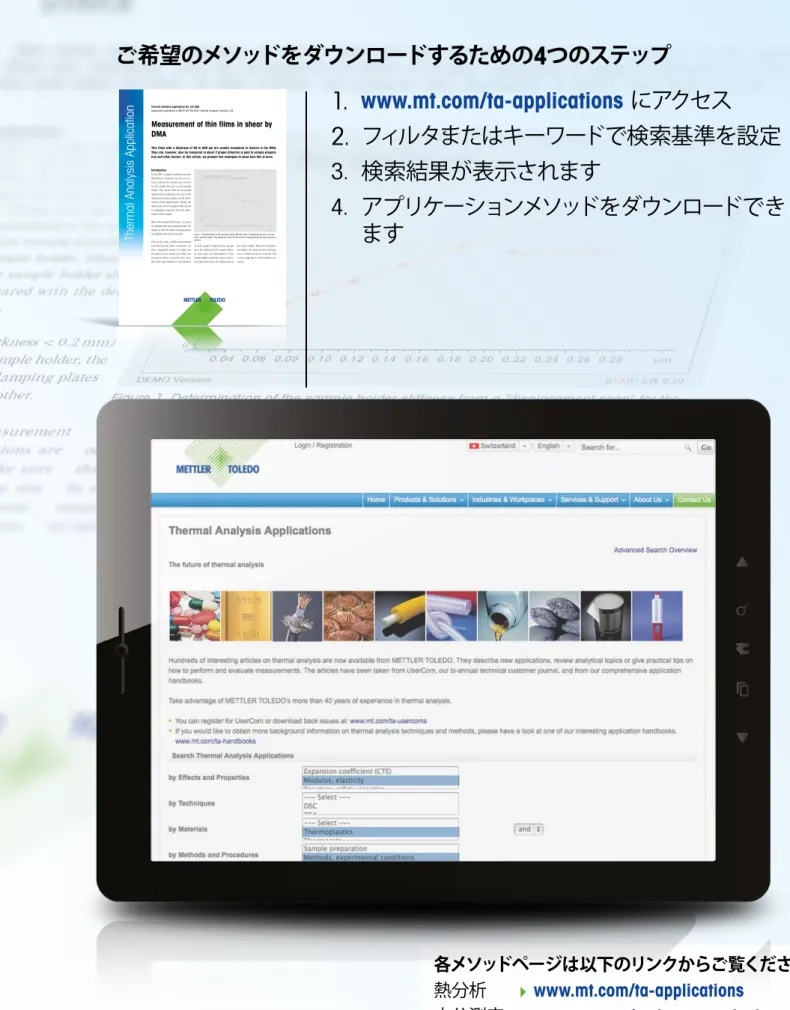
ご希望のメソッドをダウンロードするための
4
つのステップ
各メソッドページは以下のリンクからご覧ください。
熱分析
www.mt.com/ta-applications
水分測定
www.mt.com/moisture-methods
1.
www.mt.com/ta-applications
にアクセス
2.
フィルタまたはキーワードで検索基準を設定
3.
検索結果が表示されます
4.
アプリケーションメソッドをダウンロードでき
ます
Thermal Analysis Application No. UC 293
Application published in METTLER TOLEDO Thermal Analysis UserCom 29
Th
er
ma
l A
na
ly
si
s A
pp
lic
at
ion
Measurement of thin films in shear by
DMA
Introduction
In the DMA, a sample undergoes periodic deformation. However, the force neces-sary to deform the sample acts not only on the sample but also on the sample holder. This means that the measured displacement amplitude is the sum of the deformation of the sample and the defor-mation of the sample holder. Ideally, the deformation of the sample holder should be negligible compared with the defor-mation of the sample. When thin samples (thickness < 0.2 mm) are loaded in the shear sample holder, the danger is that the shear clamping plates tilt slightly and touch each other. The results from a DMA measurement performed under these conditions are then completely wrong. To make sure the plates do not touch each other, one intuitively tends to measure thin sam-ples with large diameters. The stiffness
of such samples might then be greater than the stiffness of the sample holder. In such cases, the deformation of the sample holder contributes more to the to-tal deformation than the deformation of
the actual sample. When the modulus is calculated, the measured total deforma-tion or stiffness must be corrected. This is done using the so-called stiffness cor-rection.
Thin films with a thickness of 50 to 200 µm are usually measured in tension in the DMA. They can, however, also be measured in shear if proper attention is paid to sample prepara-tion and other factors. In this article, we present two examples to show how this is done.
Figure 1. Determination of the sample holder stiffness from a “displacement scan” for the shear sample holder. The alignment insert for the small clamping assembly was used as a sample.
Thermal Analysis Application No. UC 293
Application published in METTLER TOLEDO Thermal Analysis UserCom 29
Th
erma
l A
na
lys
is A
pp
lic
ation
Measurement of thin films in shear by
DMA
Introduction
In the DMA, a sample undergoes periodic deformation. However, the force neces-sary to deform the sample acts not only on the sample but also on the sample holder. This means that the measured displacement amplitude is the sum of the deformation of the sample and the defor-mation of the sample holder. Ideally, the deformation of the sample holder should be negligible compared with the defor-mation of the sample. When thin samples (thickness < 0.2 mm) are loaded in the shear sample holder, the danger is that the shear clamping plates tilt slightly and touch each other. The results from a DMA measurement performed under these conditions are then completely wrong. To make sure the plates do not touch each other, one intuitively tends to measure thin sam-ples with large diameters. The stiffness
of such samples might then be greater than the stiffness of the sample holder. In such cases, the deformation of the sample holder contributes more to the to-tal deformation than the deformation of
the actual sample. When the modulus is calculated, the measured total deforma-tion or stiffness must be corrected. This is done using the so-called stiffness cor-rection.
Thin films with a thickness of 50 to 200 µm are usually measured in tension in the DMA. They can, however, also be measured in shear if proper attention is paid to sample prepara-tion and other factors. In this article, we present two examples to show how this is done.
Figure 1. Determination of the sample holder stiffness from a “displacement scan” for the shear sample holder. The alignment insert for the small clamping assembly was used as a sample.