Title
Generation of a replication-competent simian-human
immunodeficiency virus, the neutralization sensitivity of which can be enhanced in the presence of a small-molecule CD4 mimic( Dissertation_全文 )
Author(s) Otsuki, Hiroyuki
Citation Kyoto University (京都大学)
Issue Date 2014-03-24
URL http://dx.doi.org/10.14989/doctor.k18186
Right
許諾条件により本文は2014-09-12に公開; This is an author manuscript that has been accepted for publication in Journal of General Virology, copyright Society for General Microbiology, but has not been copy-edited, formatted or proofed. Cite this article as appearing in Journal of General Virology. This version of the manuscript may not be duplicated or reproduced, other than for personal use or within the rule of ‘Fair Use of Copyrighted Materials’ (section 17, Title 17, US Code), without permission from the copyright owner, Society for General Microbiology. The Society for General Microbiology disclaims any responsibility or liability for errors or omissions in this version of the manuscript or in any version derived from it by any other parties. The final copy-edited, published article, which is the version of record, can be found at
http://vir.sgmjournals.org, and is freely available without a subscription.
Type Thesis or Dissertation
This is an author manuscript that has been accepted for publication in Journal of General Virology, copyright Society for General Microbiology, but has not been copy-edited, formatted or proofed. Cite this article as appearing in Journal of General Virology. This version of the manuscript may not be duplicated or reproduced, other than for personal use or within the rule of ‘Fair Use of Copyrighted Materials’ (section 17, Title 17, US Code), without permission from the copyright owner, Society for General Microbiology. The Society for General Microbiology disclaims any responsibility or liability for errors or omissions in this version of the manuscript or in any version derived from it by any other parties. The final copy-edited, published article, which is the version of record, can be found at http://vir.sgmjournals.org, and is freely available without a subscription.
Title page
1 2
• Generation of a replication-competent simian–human immunodeficiency virus,
3
the neutralisation sensitivity of which can be enhanced in the presence of a
4
small molecule CD4 mimic
5 6
• The Contents Category for the paper, Short communications
7 8
• Short running title: SHIV with conditional neutralisation sensitivity
9 10
• The names of the authors, Hiroyuki Otsuki1, Tomoyuki Miura1, Chie
11
Hashimoto2, Tetsuo Narumi2, Hirokazu Tamamura2, Kazuhisa Yoshimura3,
12
Shuzo Matsushita4, and Tatsuhiko Igarashi1#
13 14
• The name and address of the laboratories where the work was done,
15
1Laboratory of Primate Model, Experimental Research Center for Infectious 16
Diseases, Institute for Virus Research, Kyoto University, Kyoto 606-8507, Japan, 17
2Department of Medicinal Chemistry, Institute of Biomaterials and Bioengineering,
18
Tokyo Medical and Dental University, Tokyo 101-0062, Japan, 3AIDS Research
19
Center, National Institute of Infectious Diseases, Tokyo 162-8640, Japan,
20
4Division of Clinical Retrovirology and Infectious Diseases, Center for AIDS 21
Research, Kumamoto University, Kumamoto 860-0811, Japan
22 23
• An email address and telephone and fax numbers for the corresponding author,
24 [email protected], E-mail 25 81 75 751 3982, Phone 26 81 75 761 9335, Fax 27 28
• The word count of the summary and the main text,
29
Summary, 143 words
30
Main text, 2451 words
Summary
33
Simian-human immunodeficiency virus (SHIV) carrying the envelope from the clade B 34
clinical HIV-1 isolate HIV-1 MNA, designated SHIV MNA, was generated through 35
intracellular homologous recombination. SHIV MNA inherited biological properties 36
from the parental HIV-1, including CCR5 co-receptor preference, resistance to 37
neutralisation by the anti-V3 loop monoclonal antibody KD-247, and loss of resistance 38
in the presence of the CD4-mimic small molecule YYA-021. SHIV MNA showed 39
productive replication in rhesus macaque peripheral blood mononuclear cells. 40
Experimental infection of a rhesus macaque with SHIV MNA caused a transient but 41
high titre of plasma viral RNA and a moderate antibody response. Immunoglobulin in 42
the plasma at 24 weeks post-infection was capable of neutralising SHIV MNA in the 43
presence but not in the absence of YYA-021. 44
SHIV MNA could serve a model for development of novel therapeutic interventions 45
based on CD4-mimic-mediated conversion of Env susceptible to antibody neutralisation. 46
Text
47
Control of primate lentiviral infection by antibodies directed against viral envelope 48
protein is theoretically feasible. This was confirmed by the successful protection of 49
macaque monkeys from challenge inoculation with simian-human immunodeficiency 50
virus (SHIV) carrying an envelope protein (Env). Env was derived from a laboratory 51
strain of human immunodeficiency virus type 1 (HIV-1) through the passive 52
immunisation of neutralising monoclonal antibodies directed against HIV-1 (Mascola et 53
al., 2000; Nishimura et al., 2003). This neutralisation is consistent with the results
54
normally seen in cell culture systems. 55
Clinical isolates of HIV-1, which have not been subjected to extensive passage in 56
T-cell lines, on the other hand, are generally resistant to antibody-mediated 57
neutralisation (Moore et al., 1995). It has been shown that virus in infected individuals 58
is under selective pressure to develop a variety of means to evade attack by neutralising 59
antibodies, including sequence variation, glycosylation, tertiary structural shielding 60
formed by the Env trimer, and the rapid kinetics of conformational changes of Env, 61
which affect fusion between the viral envelope and the plasma membrane of target cells 62
(Kong & Sattentau, 2012). Although four major neutralising epitopes have been 63
identified in the HIV-1 Env; i.e. the V1/V2 loop, the glycan-V3 site and CD4-binding 64
site of gp120, and the membrane-proximal external region (MPER) of gp41, few reports 65
of antibodies directed against these epitopes capable of neutralising a broad range of 66
isolates have been published, for reasons that are as yet unclear (Kwong & Mascola, 67
2012). High titres of antibodies directed against the V3 loop are elicited in individuals 68
during the early phase of HIV-1 infection, but these are incapable of neutralising the 69
virus because the epitope in functional Env trimer is likely shielded from the antibody 70
(Davis et al., 2009b). Therefore, it is necessary to develop a means of rendering these 71
epitopes accessible to the antibodies, to make antibody-mediated suppression of HIV-1 72
a valid therapeutic option. 73
It has been reported that neutralisation mediated by antibodies directed against the 74
V3 loop (Lusso et al., 2005) or CD4-induced epitope (CD4i) (Thali et al., 1993) can be 75
enhanced in the presence of soluble CD4 (sCD4). It is known that the interaction of Env 76
with sCD4 drives a conformational change of the viral protein and makes the 77
cryptic/occult epitopes accessible to these antibodies (Wyatt et al., 1998). Small 78
molecules that emulate sCD4 for its interaction and subsequent induction of 79
conformational change of Env may be employed to intensify antibody-mediated 80
interventions against HIV-1 infection. Compounds with the above-mentioned 81
properties; i.e. NBD-556 and NBD-557, have been reported previously (Zhao et al., 82
2005). NBD-556 has been shown in cell culture to interact with the CD4-binding pocket 83
to induce a conformational change in gp120 (Madani et al., 2008) and enhance exposure 84
of the Env of primary HIV-1 isolates to neutralising epitopes (Yoshimura et al., 2010). 85
The present study was performed to evaluate small molecule CD4-mimic-based 86
enhancement of antibody-mediated virus neutralisation, in the context of virus infection 87
in vivo. The simian-human immunodeficiency virus (SHIV)/macaque monkey model of
88
AIDS is particularly suitable for such studies, as SHIV carries the HIV-1 Env and the 89
neutralisation sensitivity of SHIV is comparable to that of the parental HIV-1 (Shibata 90
& Adachi, 1992). 91
As NBD-556, unlike sCD4, inhibits infection with select HIV-1 isolates (Yoshimura 92
et al., 2010), we generated a new SHIV strain carrying Env, the sensitivity of which to
93
antibody-mediated neutralisation is enhanced in the presence of a CD4 mimic. An 94
HIV-1 isolate, MNA, previously designated primary isolate HIV-1 Pt.3, was used as the 95
source of Env, as the viral protein has been reported to interact with NBD-556 96
(Yoshimura et al., 2010). While the virus belongs to a distinct subset of HIV-1 isolates, 97
as mentioned above, it has also been reported to utilise the CCR5 molecule to gain entry 98
into target cells, a property that is shared by the majority of HIV-1 strains (Yoshimura 99
et al., 2010). A monoclonal antibody directed against the tip of the V3 loop (GPGR),
100
KD-247 (Eda et al., 2006), was employed to assess this concept, as HIV-1 MNA was 101
resistant to KD-247-mediated neutralisation, despite carrying the exact epitope 102
sequence in the tip of V3 loop, and was converted to being sensitive to the antibody by 103
NBD-556 in a dose-dependent manner (Yoshimura et al., 2010). 104
First, we reproduced the results of Yoshimura et al. using a neutralisation assay 105
employing TZM-bl cells (Platt et al., 1998), obtained from the NIH AIDS Reagent 106
program (Fig. S1). The virus was resistant to KD-247, as described previously, and 107
required almost 50 µg/mL of the antibody to achieve 50% neutralisation in our assay. 108
The observed resistance was abrogated in the presence of 2 µM of NBD-556. However, 109
50% neutralisation was achieved in the presence of ~0.1 µg/mL of KD-247, 110
corresponding to 1/500 of the amount of the antibody to achieve the same degree of 111
neutralisation in the absence of the CD4 mimic. 112
With reproduction of the properties of HIV-1 MNA Env, we generated an SHIV 113
strain carrying Env through intracellular homologous recombination, as described 114
previously (Fujita et al., 2013) with minor modifications (Fig. S2). DNA fragments 115
representing the 5' and 3' ends of the SHIV genome (fragments I and II, respectively) 116
were amplified by PCR from the proviral DNA plasmid SHIV KS661. A DNA 117
fragment containing env (fragment III) was amplified from complementary DNA 118
(cDNA) of the HIV-1 MNA genome, which was prepared from virus particles 119
(virion-associated RNA) in the culture supernatant of PM1/CCR5 cells (Yusa et al., 120
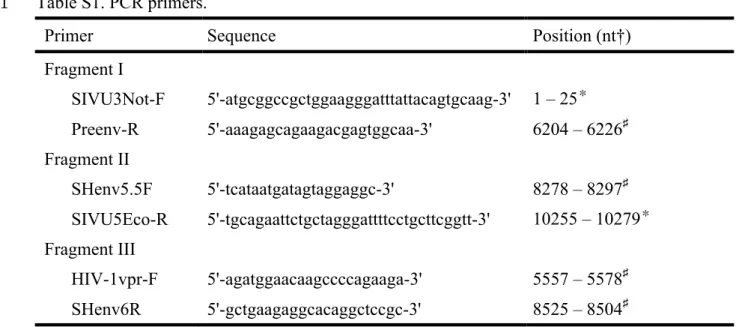
2005) infected with the virus. The PCR primers used are listed in Table S1. Using a 121
FuGENE HD transfection reagent, lipofection was performed on the C8166-CCR5 cells 122
(Shimizu et al., 2006) to co-transfect them with 0.2 µg of DNA. A cytopathic effect 123
presumably caused by the emerged recombinant virus was observed on day 13 124
post-transfection. The emerged virus, designated SHIV MNA, carried the entire gp120 125
and three quarters of gp41 from HIV-1 MNA Env (Fig. 1a). The rest of Env was from 126
SHIV KS661, the Env of which was derived from HIV-1 89.6 (Shinohara et al., 1999). 127
The CD4 binding site, and the regions and elements that reportedly interact with 128
NBD-556 (Madani et al., 2008; Yoshimura et al., 2010), are preserved in SHIV MNA 129
Env (Fig. S3). The virus was replication-competent in PM1/CCR5 cells (data not 130
shown). 131
As HIV-1 MNA was suggested to be a CCR5-utilising virus, we were intrigued 132
whether SHIV MNA inherited the trait from the parental virus. We subjected SHIV 133
MNA and the parental HIV-1 MNA to co-receptor usage assay as described previously 134
(Nishimura et al., 2010), with minor modifications (Fig. S4). As expected, SHIV MNA 135
was shown to utilise CCR5 as an entry co-receptor. 136
We next assessed the neutralisation profiles of SHIV MNA in comparison with the 137
parental HIV-1 MNA, as described previously (Li et al., 2005; Wei et al., 2002). Both 138
SHIV MNA and HIV-1 MNA showed essentially no neutralisation by KD-247 up to 25 139
µg/mL and 50% neutralisation was achieved at 50 µg/mL (Fig. 1b). As the CD4 mimic, 140
we employed YYA-021, a compound generated and characterised through studies 141
concerning the structure-activity relationships of small molecules (Narumi et al., 2013; 142
Narumi et al., 2011; Narumi et al., 2010; Yamada et al., 2010). The compound was 143
shown to be slightly less potent but to exhibit substantially lower toxicity than 144
NBD-556, and was therefore a suitable choice for our purposes in future studies in 145
animal models. SHIV MNA was resistant to neutralisation by YYA-021 at all 146
concentrations examined, except 25 and 50 µM, and showed a neutralisation profile 147
almost identical to that of HIV-1 MNA (Fig. 1c). To further characterise the biological 148
properties of SHIV MNA Env, a set of entry assays was conducted (Fig. S5). The env 149
genes cloned from SHIV MNA and HIV-1 MNA, were utilised to generate 150
pseudo-typed viruses. These pseudotypes were inoculated into TZM-bl cells in the 151
presence of increasing amounts of NBD-556, YYA-021 or soluble CD4. A control 152
group was derived from another virus preparation pseudotyped with A-MLV Env 153
(Landau et al., 1991). When the efficiency of entry was defined by intracellular 154
luciferase activities, virtually no difference was observed between Envs of SHIV MNA 155
and the parental HIV-1. Thus SHIV MNA Env replicated in C8166-CCR5 cells retained 156
sensitivity to small molecule CD4 mimics and soluble CD4 comparable to that of 157
HIV-1 MNA. 158
We next examined whether the synergistic neutralisation of HIV-1 MNA by 159
KD-247 antibody in the presence of NBD-556 (Yoshimura et al., 2010) would be 160
reproduced when CD4 mimic was substituted by YYA-021. The synergistic 161
neutralisation effect of KD-247 and YYA-021 was reproduced in our experiments (Fig. 162
1d). At 50 µg/mL, KD-247 barely achieved 50% neutralisation of HIV-1 MNA but 163
resulted in 50% neutralisation at < 0.05 µg/mL in the presence of 20 µM of YYA-021. 164
Finally, to examine whether these two agents neutralise SHIV MNA in the same 165
manner as the parental HIV-1, we conducted a neutralisation assay with KD-247 in the 166
presence of increasing amounts of YYA-021 (0, 5, 10, 20 and 40 µM) (Fig. 1e). The 167
neutralisation curve of KD-247 against SHIV MNA showed an upward shift as the 168
concentration of YYA-021 increased (Fig. 1e), similar to the observations with HIV-1 169
(Fig. 1d), indicating augmentation of neutralisation, and complete neutralisation of both 170
viruses was achieved at 20 µM YYA-021 (Fig. 1d and e). Based on these results, we 171
concluded that the neutralisation profile of SHIV MNA was comparable to that of 172
HIV-1 MNA. 173
Reproduction of the neutralisation characteristics of HIV-1 MNA in the newly 174
generated SHIV prompted us to assess the ability of SHIV MNA to replicate in monkey 175
cells. SHIV MNA, along with SIV239 and SHIV KS661, were normalised with 176
infectious titres and inoculated into rhesus macaque peripheral blood mononuclear cell 177
(PBMC) preparations from four animals, as described previously (Fujita et al., 2013) 178
(Fig. 2a). SHIV KS661, a CXCR4-utilising virus, replicated to the highest titres of all 179
the viruses in all PBMC preparations. Compared to SHIV KS661, SIV239 replicated to 180
lower titres. Under these experimental conditions, SHIV MNA showed productive 181
replication in the cells with similar replication kinetics and peak titres to SIV239. Based 182
on these results, we concluded that SHIV MNA was replication-competent in primary 183
monkey lymphocytes. 184
Productive replication of SHIV MNA in monkey PBMC justified experimental 185
infection of the virus in vivo. We inoculated 1.75×10⁵ TCID50 of SHIV MNA
186
intravenously into a rhesus macaque and monitored plasma viral RNA burden and 187
circulating CD4+ T-lymphocyte levels. Plasma viral RNA burden reached a peak of
188
5.6×10⁶ copies/mL at 1 week post-infection (wpi), and declined rapidly thereafter 189
reaching low levels of detection at 7 wpi (around 2.8×10² copies/mL). Circulating CD4+ 190
T-cell numbers showed a transient decrease around 1 wpi, rebounded around 3 wpi and 191
stabilised around 70% of the pre-infection level from 4 wpi. During the period of 192
observation, the animal developed no obvious clinical manifestations related to 193
lentivirus infection. 194
As SHIV MNA replicated in vivo without depleting helper T-cells, it was expected 195
that the animal mounted an anti-viral immune reaction. The production of antibody 196
directed against Env was assessed by western immunoblotting, as described previously 197
(Igarashi et al., 1999). Purified Env protein (Advanced Biotechnologies Inc. Md. 198
U.S.A.) was used as the antigen (Fig. 3a). Anti-Env antibody was detected at 3 wpi and 199
the level of antibody—judged by the intensity of the band—increased gradually with 200
time. 201
We next examined whether the animal generated neutralising antibodies against 202
SHIV MNA. Because plasma samples from this specimen exhibited high background 203
activity, immunoglobulin G (IgG) was purified from these samples collected on day 0 204
and in week 24 post-infection using protein G spin columns (GE healthcare Japan. 205
Tokyo. Japan). While the IgG from day 0 exhibited no neutralising activity (Fig. 3b), as 206
expected, the immunoglobulin collected at 24 wpi neutralised SHIV MNA, although a 207
concentration > 100 µg/mL was required to suppress replication of 100 TCID50 of the
208
input virus (Fig. 3c). 209
We examined whether the observed marginal neutralisation by the antibody could be 210
enhanced by the presence of YYA-021. Upon addition of YYA-021 in the assay system, 211
SHIV MNA became sensitive to IgG obtained at 24 wpi (Fig. 3c), while no 212
enhancement was identified from day 0 (Fig. 3b). 213
In this study, we generated a replication-competent SHIV MNA strain carrying an 214
Env resistant to the monoclonal neutralising antibody KD-247 but conditionally 215
sensitive in the presence of the CD4 mimic YYA-021. As the observed neutralisation 216
characteristics were identical to those of HIV-1 MNA, which contributed the majority 217
of the Env sequence to the chimera, the utility of the CD4 mimic as a means of 218
enhancing antibody-mediated virus neutralisation should be assessed in the context of 219
infection in vivo. This concept could be tested during the acute phase of SHIV MNA 220
infection, during which the virus undergoes substantial replication. To examine the 221
feasibility of CD4-mimic-mediated enhancement of virus neutralisation in the context 222
of chronic infection, the conditions under which this type of intervention should be 223
applied to HIV-1-infected patients in a clinical setting, the virus must be modified to 224
sustain productive replication for a longer period. SHIV MNA in the present form does 225
not fulfil this requirement. It is possible that animal-to-animal passage could increase 226
the fitness of the virus in monkeys. 227
This study demonstrated that a CD4 mimic could modulate viral Env protein to be 228
more susceptible to neutralisation by less potent antibodies generated in the context of 229
infection. During the early phase of infection, patients mount high titres of 230
non-neutralising antibodies directed against the V3 loop (Davis et al., 2009a). Patients 231
with HIV-1 clade C generate anti-Env antibodies, including anti-CD4i antibodies, with 232
poor neutralising activity against recent infection (Gray et al., 2007). It is possible that 233
the CD4 mimic YYA-021 causes a conformational change in SHIV MNA Env, which 234
renders sequestered epitope(s) accessible to potentially neutralising IgG, such as the V3 235
loop and CD4i. 236
The current study extended the previous study by Yoshimura et al. and used HIV-1 237
MNA belonging to clade B to generate a new SHIV strain carrying Env. The 238
neutralisation sensitivity of this strain is characteristically augmented in the presence of 239
a small molecule CD4 mimic. Similar observations by Decker et al. show that 240
infections of a wide range of HIV-1 strains of multiple clades or circulating 241
recombinant forms elicits high titres of anti-CD4i antibodies, These anti-CD4i 242
antibodies neutralise viruses as divergent as HIV-2 in the presence of soluble CD4 243
(Decker et al., 2005). Taking these observations into account, small molecule CD4 244
mimics such as YYA-021 could potentially enhance the neutralisation activity of the 245
antibodies directed against autologous viruses belonging not only to clade B but also to 246
multiple HIV-1 strains of various clades, and possibly even HIV-2. Our results pave the 247
way for a novel therapeutic intervention based on administration of CD4 mimics to 248
patients with HIV to facilitate control of the virus by their own antibodies. 249
Acknowledgements
250
Thanks should be given to: Drs. Julie Strizki and Paul Zavodny of the Schering-Plough 251
Research Institute, Kenilworth, NJ. U.S.A. for providing AD101; the NIH AIDS 252
Research & Reference Reagent Program for providing TZM-bl cells, SV-A-MLV-env, 253
4G10 and soluble CD4; the Chemo-Sero-Therapeutic Research Institute (Kaketsuken) 254
for providing MAb KD-247; former and current members of the Igarashi laboratory for 255
discussion and support. This work was supported by a Research on HIV/AIDS grant 256
(H22-AIDS Research-007 and H24-AIDS Research-008) from The Ministry of Health, 257
Labor and Welfare of Japan and by a Grant-in-Aid for Scientific Research (B) 258
(23300156) from the Japan Society for the Promotion of Science. 259
References
260
Davis, K. L., Bibollet-Ruche, F., Li, H., Decker, J. M., Kutsch, O., Morris, L.,
261
Salomon, A., Pinter, A., Hoxie, J. A., Hahn, B. H., Kwong, P. D. & Shaw, G. M.
262
(2009a). Human immunodeficiency virus type 2 (HIV-2)/HIV-1 envelope chimeras
263
detect high titers of broadly reactive HIV-1 V3-specific antibodies in human plasma. 264
Journal of virology 83, 1240-1259.
265
Davis, K. L., Gray, E. S., Moore, P. L., Decker, J. M., Salomon, A., Montefiori, D.
266
C., Graham, B. S., Keefer, M. C., Pinter, A., Morris, L., Hahn, B. H. & Shaw, G.
267
M. (2009b). High titer HIV-1 V3-specific antibodies with broad reactivity but low
268
neutralizing potency in acute infection and following vaccination. Virology 387, 269
414-426. 270
Decker, J. M., Bibollet-Ruche, F., Wei, X., Wang, S., Levy, D. N., Wang, W.,
271
Delaporte, E., Peeters, M., Derdeyn, C. A., Allen, S., Hunter, E., Saag, M. S.,
272
Hoxie, J. A., Hahn, B. H., Kwong, P. D., Robinson, J. E. & Shaw, G. M. (2005).
273
Antigenic conservation and immunogenicity of the HIV coreceptor binding site. The 274
Journal of experimental medicine 201, 1407-1419.
275
Donzella, G. A., Schols, D., Lin, S. W., Este, J. A., Nagashima, K. A., Maddon, P. J.,
276
Allaway, G. P., Sakmar, T. P., Henson, G., De Clercq, E. & Moore, J. P. (1998).
277
AMD3100, a small molecule inhibitor of HIV-1 entry via the CXCR4 co-receptor. 278
Nature medicine 4, 72-77.
279
Eda, Y., Takizawa, M., Murakami, T., Maeda, H., Kimachi, K., Yonemura, H.,
280
Koyanagi, S., Shiosaki, K., Higuchi, H., Makizumi, K., Nakashima, T., Osatomi,
281
K., Tokiyoshi, S., Matsushita, S., Yamamoto, N. & Honda, M. (2006). Sequential
282
immunization with V3 peptides from primary human immunodeficiency virus type 1 283
produces cross-neutralizing antibodies against primary isolates with a matching 284
narrow-neutralization sequence motif. Journal of virology 80, 5552-5562. 285
Fujita, Y., Otsuki, H., Watanabe, Y., Yasui, M., Kobayashi, T., Miura, T. &
286
Igarashi, T. (2013). Generation of a replication-competent chimeric simian-human
287
immunodeficiency virus carrying env from subtype C clinical isolate through 288
intracellular homologous recombination. Virology 436, 100-111. 289
C., Morris, L. & Team, C. S. (2007). Neutralizing antibody responses in acute
292
human immunodeficiency virus type 1 subtype C infection. Journal of virology 81, 293
6187-6196. 294
Igarashi, T., Endo, Y., Englund, G., Sadjadpour, R., Matano, T., Buckler, C.,
295
Buckler-White, A., Plishka, R., Theodore, T., Shibata, R. & Martin, M. (1999).
296
Emergence of a highly pathogenic simian/human immunodeficiency virus in a rhesus 297
macaque treated with anti-CD8 mAb during a primary infection with a 298
nonpathogenic virus. Proceedings of the National Academy of Sciences of the United 299
States of America 96, 14049-14054.
300
Kong, L. & Sattentau, Q. J. (2012). Antigenicity and Immunogenicity in HIV-1
301
Antibody-Based Vaccine Design. J AIDS Clin Res S8, 3. 302
Kwong, P. D. & Mascola, J. R. (2012). Human antibodies that neutralize HIV-1:
303
identification, structures, and B cell ontogenies. Immunity 37, 412-425. 304
Landau, N. R., Page, K. A. & Littman, D. R. (1991). Pseudotyping with human T-cell
305
leukemia virus type I broadens the human immunodeficiency virus host range. 306
Journal of virology 65, 162-169.
307
Li, M., Gao, F., Mascola, J. R., Stamatatos, L., Polonis, V. R., Koutsoukos, M.,
308
Voss, G., Goepfert, P., Gilbert, P., Greene, K. M., Bilska, M., Kothe, D. L.,
309
Salazar-Gonzalez, J. F., Wei, X., Decker, J. M., Hahn, B. H. & Montefiori, D. C.
310
(2005). Human immunodeficiency virus type 1 env clones from acute and early
311
subtype B infections for standardized assessments of vaccine-elicited neutralizing 312
antibodies. Journal of virology 79, 10108-10125. 313
Lusso, P., Earl, P. L., Sironi, F., Santoro, F., Ripamonti, C., Scarlatti, G., Longhi,
314
R., Berger, E. A. & Burastero, S. E. (2005). Cryptic nature of a conserved,
315
CD4-inducible V3 loop neutralization epitope in the native envelope glycoprotein 316
oligomer of CCR5-restricted, but not CXCR4-using, primary human 317
immunodeficiency virus type 1 strains. Journal of virology 79, 6957-6968. 318
Madani, N., Schon, A., Princiotto, A. M., Lalonde, J. M., Courter, J. R., Soeta, T.,
319
Ng, D., Wang, L., Brower, E. T., Xiang, S. H., Kwon, Y. D., Huang, C. C., Wyatt,
320
R., Kwong, P. D., Freire, E., Smith, A. B., 3rd & Sodroski, J. (2008).
321
Small-molecule CD4 mimics interact with a highly conserved pocket on HIV-1 322
C. E., Beary, H., Hayes, D., Frankel, S. S., Birx, D. L. & Lewis, M. G. (2000).
325
Protection of macaques against vaginal transmission of a pathogenic HIV-1/SIV 326
chimeric virus by passive infusion of neutralizing antibodies. Nature medicine 6, 327
207-210. 328
Moore, J. P., Cao, Y., Qing, L., Sattentau, Q. J., Pyati, J., Koduri, R., Robinson, J.,
329
Barbas, C. F., 3rd, Burton, D. R. & Ho, D. D. (1995). Primary isolates of human
330
immunodeficiency virus type 1 are relatively resistant to neutralization by 331
monoclonal antibodies to gp120, and their neutralization is not predicted by studies 332
with monomeric gp120. Journal of virology 69, 101-109. 333
Narumi, T., Arai, H., Yoshimura, K., Harada, S., Hirota, Y., Ohashi, N.,
334
Hashimoto, C., Nomura, W., Matsushita, S. & Tamamura, H. (2013). CD4
335
mimics as HIV entry inhibitors: lead optimization studies of the aromatic 336
substituents. Bioorganic & medicinal chemistry 21, 2518-2526. 337
Narumi, T., Arai, H., Yoshimura, K., Harada, S., Nomura, W., Matsushita, S. &
338
Tamamura, H. (2011). Small molecular CD4 mimics as HIV entry inhibitors.
339
Bioorganic & medicinal chemistry 19, 6735-6742.
340
Narumi, T., Ochiai, C., Yoshimura, K., Harada, S., Tanaka, T., Nomura, W., Arai,
341
H., Ozaki, T., Ohashi, N., Matsushita, S. & Tamamura, H. (2010). CD4 mimics
342
targeting the HIV entry mechanism and their hybrid molecules with a CXCR4 343
antagonist. Bioorganic & medicinal chemistry letters 20, 5853-5858. 344
Nishimura, Y., Igarashi, T., Haigwood, N. L., Sadjadpour, R., Donau, O. K.,
345
Buckler, C., Plishka, R. J., Buckler-White, A. & Martin, M. A. (2003). Transfer
346
of neutralizing IgG to macaques 6 h but not 24 h after SHIV infection confers 347
sterilizing protection: implications for HIV-1 vaccine development. Proceedings of 348
the National Academy of Sciences of the United States of America 100, 15131-15136.
349
Nishimura, Y., Shingai, M., Willey, R., Sadjadpour, R., Lee, W. R., Brown, C. R.,
350
Brenchley, J. M., Buckler-White, A., Petros, R., Eckhaus, M., Hoffman, V.,
351
Igarashi, T. & Martin, M. A. (2010). Generation of the pathogenic R5-tropic
352
simian/human immunodeficiency virus SHIVAD8 by serial passaging in rhesus 353
macaques. Journal of virology 84, 4769-4781. 354
Platt, E. J., Wehrly, K., Kuhmann, S. E., Chesebro, B. & Kabat, D. (1998). Effects
2855-2864. 358
Shibata, R. & Adachi, A. (1992). SIV/HIV recombinants and their use in studying
359
biological properties. AIDS research and human retroviruses 8, 403-409. 360
Shimizu, Y., Okoba, M., Yamazaki, N., Goto, Y., Miura, T., Hayami, M., Hoshino,
361
H. & Haga, T. (2006). Construction and in vitro characterization of a chimeric
362
simian and human immunodeficiency virus with the RANTES gene. Microbes and 363
infection / Institut Pasteur 8, 105-113.
364
Shinohara, K., Sakai, K., Ando, S., Ami, Y., Yoshino, N., Takahashi, E., Someya,
365
K., Suzaki, Y., Nakasone, T., Sasaki, Y., Kaizu, M., Lu, Y. & Honda, M. (1999).
366
A highly pathogenic simian/human immunodeficiency virus with genetic changes in 367
cynomolgus monkey. The Journal of general virology 80 ( Pt 5), 1231-1240. 368
Thali, M., Moore, J. P., Furman, C., Charles, M., Ho, D. D., Robinson, J. &
369
Sodroski, J. (1993). Characterization of conserved human immunodeficiency virus
370
type 1 gp120 neutralization epitopes exposed upon gp120-CD4 binding. Journal of 371
virology 67, 3978-3988.
372
Trkola, A., Kuhmann, S. E., Strizki, J. M., Maxwell, E., Ketas, T., Morgan, T.,
373
Pugach, P., Xu, S., Wojcik, L., Tagat, J., Palani, A., Shapiro, S., Clader, J. W.,
374
McCombie, S., Reyes, G. R., Baroudy, B. M. & Moore, J. P. (2002). HIV-1
375
escape from a small molecule, CCR5-specific entry inhibitor does not involve 376
CXCR4 use. Proceedings of the National Academy of Sciences of the United States 377
of America 99, 395-400.
378
von Brunn, A., Brand, M., Reichhuber, C., Morys-Wortmann, C., Deinhardt, F. &
379
Schodel, F. (1993). Principal neutralizing domain of HIV-1 is highly immunogenic
380
when expressed on the surface of hepatitis B core particles. Vaccine 11, 817-824. 381
Wei, X., Decker, J. M., Liu, H., Zhang, Z., Arani, R. B., Kilby, J. M., Saag, M. S.,
382
Wu, X., Shaw, G. M. & Kappes, J. C. (2002). Emergence of Resistant Human
383
Immunodeficiency Virus Type 1 in Patients Receiving Fusion Inhibitor (T-20) 384
Monotherapy. Antimicrobial Agents and Chemotherapy 46, 1896-1905. 385
Wyatt, R., Kwong, P. D., Desjardins, E., Sweet, R. W., Robinson, J., Hendrickson,
386
W. A. & Sodroski, J. G. (1998). The antigenic structure of the HIV gp120 envelope
387
glycoprotein. Nature 393, 705-711. 388
targeting the mechanism of HIV entry. Bioorganic & medicinal chemistry letters 20, 391
354-358. 392
Yoshimura, K., Harada, S., Shibata, J., Hatada, M., Yamada, Y., Ochiai, C.,
393
Tamamura, H. & Matsushita, S. (2010). Enhanced exposure of human
394
immunodeficiency virus type 1 primary isolate neutralization epitopes through 395
binding of CD4 mimetic compounds. Journal of virology 84, 7558-7568. 396
Yusa, K., Maeda, Y., Fujioka, A., Monde, K. & Harada, S. (2005). Isolation of
397
TAK-779-resistant HIV-1 from an R5 HIV-1 GP120 V3 loop library. The Journal of 398
biological chemistry 280, 30083-30090.
399
Zhao, Q., Ma, L., Jiang, S., Lu, H., Liu, S., He, Y., Strick, N., Neamati, N. &
400
Debnath, A. K. (2005). Identification of 401
N-phenyl-N'-(2,2,6,6-tetramethyl-piperidin-4-yl)-oxalamides as a new class of 402
HIV-1 entry inhibitors that prevent gp120 binding to CD4. Virology 339, 213-225. 403
404 405 406
Figure legends
406
Figure 1. Genomic organisation (a) and neutralisation sensitivity (b – e) of SHIV 407
MNA. 408
(a) Grey boxes represent genes derived from SIV239, open boxes those from HIV-1 409
89.6 and filled dark grey boxes those from HIV-1 MNA. (b – e) Percentage 410
neutralisation was calculated as follows: % neutralisation = 100 × {1 − (RLU.N − 411
RLU.B)/(RLU.V − RLU.B)}. RLU, relative luciferase units; RLU.N, RLU in wells with 412
cells, virus and KD-247 and/or YYA-021; RLU.V, RLU in wells with cells and virus; 413
RLU.B, RLU in wells with cells. 414
415
Figure 2. Replication of SHIV MNA in rhesus macaque PBMCs (a) and in vivo (b). 416
(a) Multiplicity of infection was adjusted to 0.01 (TCID50/cell). (b) Experimental
417
infection of a rhesus macaque with SHIV MNA. SHIV MNA (1.75×10⁵ TCID
50) was
418
intravenously inoculated into a rhesus macaque, and the plasma viral RNA burden 419
(filled circles) and circulating CD4+ T-lymphocytes (open triangles) were monitored. 420
(a) The anti-HIV-1 gp120 antibody response was assessed by immunoblotting with 423
plasma samples collected at the indicated times. An anti-HIV-1 V3 monoclonal 424
antibody 4G10 ascites (1:100) (von Brunn et al., 1993), obtained from the NIH AIDS 425
Reagent program, was used as a positive control (lane anti-V3). (b and c) Neutralisation 426
of SHIV MNA with IgG purified from plasma of the infected rhesus macaque (day 0 427
and 24 wpi) with/without YYA-021 (20 µM). 428
Table S1. PCR primers. 1
Primer Sequence Position (nt†)
Fragment I SIVU3Not-F 5'-atgcggccgctggaagggatttattacagtgcaag-3' 1 – 25 Preenv-R 5'-aaagagcagaagacgagtggcaa-3' 6204 – 6226♯ Fragment II SHenv5.5F 5'-tcataatgatagtaggaggc-3' 8278 – 8297♯ SIVU5Eco-R 5'-tgcagaattctgctagggattttcctgcttcggtt-3' 10255 – 10279 Fragment III HIV-1vpr-F 5'-agatggaacaagccccagaaga-3' 5557 – 5578♯ SHenv6R 5'-gctgaagaggcacaggctccgc-3' 8525 – 8504♯ †, Nucleotide positions of PCR primers were numbered relative to the SIV239 (*, 2
GenBank Accession No. M33262) or HXB2 (#, GenBank Accession No. K03455) 3
genome sequences. 4
Figure S1. Enhanced neutralisation of HIV-1 MNA by KD-247 in the presence of 5
NBD-556. 6
100 TCID50 of HIV-1 MNA was pre-incubated with increasing amounts of KD-247
7
with/without 2 µM of NBD-556 at 37°C for 60 min, followed by inoculation into 5×10³ 8
TZM-bl cells. The cells were lysed at 48 h post-infection and luciferase activity was 9
measured. The percentage of neutralisation was measured as RLU reduction relative to 10
virus control wells. 11
12
Figure S2. Genomic organisation of SHIV KS661 and HIV-1 MNA and PCR fragments 13
employed for preparation of DNA fragments for generation of SHIV MNA. 14
Colour-coded boxes represent genes derived from the following viruses: grey boxes, 15
SIV239; open boxes, HIV-1 89.6; grey boxes, HIV-1 MNA. SHIV KS661 carries tat, 16
rev, vpu, and env genes from subtype B HIV-1 89.6. Broad lines represent PCR
17
fragments that were amplified using the primers indicated by arrows (A – F). 18
Figure S3. Deduced amino acid sequence alignment of Env from HIV-1 MNA, SHIV 20
MNA, and SHIV KS661. 21
(*) =Amino acids that form part of the CD4 binding site. 22
(†) = Regions/elements that are reported to interact with NBD-556 (Madani et al., 2008; 23
Yoshimura et al., 2010). 24
Parts of SHIV MNA Env, that were putatively derived from HIV-1 MNA or SHIV 25
KS661 are respectively color-coded as grey or black. 26
27
Figure S4. Co-receptor preference of SHIV MNA. 28
SHIV MNA, along with controls for CCR5-tropic (SIV239) and CXCR4-tropic (HIV-1 29
NL4-3) and the parental HIV-1 MNA, were inoculated into TZM-bl cells in the 30
presence of increasing amounts of AD101 (Trkola et al., 2002), provided by Dr. J. 31
Strizki, Schering Plough Research Institute, Kenilworth, NJ, and/or AMD3100 32
(Sigma-Aldrich, St. Louis, MO) (Donzella et al., 1998). 33
Figure S5. Sensitivity of Env proteins from HIV-1 MNA and SHIV MNA to soluble 35
CD4 and small-molecule CD4 mimics. 36
Pseudotyped viruses carrying Env from SHIV MNA or HIV-1 MNA were normalised 37
by infectious titre at 100 TCID50 and inoculated to TZM-bl cells in the presence of
38
increasing amounts of NBD-556, YYA-021 or soluble CD4. A pseudotyped virus 39
bearing A-MLV Env is acting as the negative control. 40