215
Discrete
variable methods with variable coefficients for ODEs常$\text{微分方程式における変系数}$離散変数法
秋田県立大学\cdot システム科学R術学部 小澤一文(Kazufumi Ozawa)
Faculty ofSystems Science and Technology, Akita Prefectural University
1
Introduction
A special class ofdiscrete variable methods which is intended to integrate exactly the IVPs with
a
known solution is derived. This class of the methods, which have variablecoefficients, is designed
to integrate the ODE exactly only for the
case
that the solution isa
given elementary function,such
as
trigonometricor
exponential function. These methodsare
expected to be efficienteven
for the
case
that the solution is slightly perturbed from the objective functions. A classicalexample of this class ofthe methods is the trigonometric linear multistep method ofAdams type
by Gautschi[5]. This method is designed to be exact, if the solutions are trigonometricfunctions
with a known frequency.
The other examples ofthis class ofmethods derived
so
far are:1. St\"ormer and Cowell type trigonometric methods [5], [17].
2. Nystr\"om type trigonometric methods [9].
3. Exponentially fitted linear multistep method[2], [18].
4. Linear multistep method for mixed polynomials [19].
5. Runge-Kutta(-Nystr\"om) type trigonometric methods[10], [15].
6. Runge-Kutta-Nystr\"om method for mixed polynomials[3].
Tounify the approachesusedtoderive the trigonometric and exponential $\mathrm{R}\mathrm{u}\mathrm{n}\mathrm{g}\mathrm{e}-\mathrm{I}\acute{\mathrm{c}}$utta(-Nystr\"om)
methods, Ozawa[11], [12] has established
a
technique to adapt the methods to any desiredfunc-tions (not necessary elementary functions), and has given the condition that the coefficients of
such methods exist. He has also established the order conditions for the methods to have order$p$.
The purpose of this work is to develop
a
computationally cheap Runge-Kutta method whichare
exact fora
given set offunctions, by using thesame
technique introduced inOzawa
[11], [12].2
Functionally
fitted
Runge-Kutta method
Consider the initialvalue problem
$y’(t)=f(y(t))$, $y(0)=y_{0}$, $t\in[0, T]$, (1)
and the $s$-stage Runge-Kutta method
$\mathrm{Y}\{\begin{array}{l}y_{n+1}=y_{n}+h\sum_{\dot{t}=1}^{s}b_{i}f(\mathrm{Y}_{i})\mathrm{Y}_{}=y_{n}+h\sum_{j=1}^{s}a_{\dot{l},j}f(\mathrm{Y}_{j})\end{array}$
$i=1$,$\ldots$
,
$s$,for solving the problem (1), where $h$ is
a
step-size, and $y_{n}$ isa
numerical approximation to thesolution $y(t)$ at $t=nh.$ Almost all Runge-Kutta methods are designed to be exact when the
solution$y(t)$
are
polynomialsofa
given degreeor
less. Inour approach, however, the Runge-Kuttamethod is designed to be exact not necessary for polynomials but for the linear combinations of
predetermined functions $\{\Phi_{m}(t)\}_{m=1}^{s}$. We call the functions $\{\Phi_{m}(t)\}_{m=1}^{s}$ the basis functions, and
call the resulting Runge-Kutta method
a
functionallyfitted
Runge-Kutta (FRK) method.Here
we
showa
procedure to determine the coefficients ofthe FRK. First ofall, we determinea
set of basis functions $\{\Phi_{m}(t)\}_{m=1}^{s}$, taking into account the informationon
the equationor
thesolution. Next,
we
give the sparsity patternof
the Butcher array $A=(a_{t,j})$;we
consider only thecase
that the abscissae $c_{i}$’sare
constant anddifferent
from each other. In accordance with thesparsity pattern, and with the other requirements (if exist),
we
setsome
values (usually 0) to thespecified elementsofthe array. Here
we
denote by $A_{i}$ $(i=1, \ldots, s+1)$ theset ofsubscripts of thesespecified elements in the ith
row.
Finally, to determine the remainingcoefficients $a_{i,j}(i\in A\backslash A_{i})$,where $A\equiv\{1,2, \ldots, s\}$,
we
choose $(s-|A_{i}|)$ different functions from the set of $!_{m}(t)$’s, and solvethe following simultaneous equation:
$\sum_{j\in A\backslash A_{j}}a_{i,j}\Phi_{m}’(t+c_{j}h)=\frac{\Phi_{m}(t+c_{i}h)-\Phi_{m}(t)}{h}-\sum_{j\in A_{i}}a_{:}$
,,
$\cdot\Phi_{m}’(t+c_{j}h)$,(2)
$m\in F_{i}(i=1, \ldots, s+1)$,
where
we use
the convention $a_{s+}l,j$ $=b_{j}$, and
denote by $F_{i}\subseteq A$ the set of the subscriptsof
thebasis functions $\Phi_{m}(t)$ used in (2). For the uniqueness of the coefficients $a_{i,j}$ and $b_{j)}$
we assume
$|\mathrm{F}.|$ $=s-|4,|$, that is, the number of the unknowns is equal to that ofthe equations for each $i$
.
For example, suppose
we
would like to designa
three-stage explicit FRK method, then afterchoosing $\mathrm{D}_{1}(t)$, $\mathrm{I}_{2}(t)$ and $!_{3}(t)$,
we
must take $a_{1,1}=a_{1,2}=a_{1,3}=0$, $a_{2,2}=a_{2,3}=0$, and$a_{3,3}=0,$
so
that$A_{1}=\{1,2,3\}$, $A_{2}=\{2,3\}$
,
$A_{3}=\{3\}$, $A_{4}=\phi$,$\mathrm{t}_{1}=\phi$, $\mathrm{r}_{2}=\{1\}$, $’ 3=\{1,2\}$, $\mathrm{r}4$ $=\{1,2,3\}$,
and solve the simultaneous equations:
$a_{2,1} \varphi_{1}(t)=\frac{\Phi_{1}(t+c_{2}h)-\Phi_{1}(t)}{h}$
,
$a_{3,1}7m(t)+a_{3,2} \varphi_{m}(t+c_{2}h)=\frac{\Phi_{m}(t+c_{3}h)-\Phi_{m}(t)}{h}$, $m=1,2$,
$b_{1}f_{m}(e \mathit{5})+b_{2}\varphi_{m}(t+c_{2}h)+b_{3}\varphi_{m}(t+c_{3}h)=\frac{\Phi_{m}(t+h)-\Phi_{m}(t)}{h}$ , $m=1,2,3$,
where $\varphi_{m}(t)=\Phi_{m}’(t)$. Note that any choices
are
possible for the sets $F_{2}$ and $7_{3}$ , only if theconditions $|$$72|=1$ and $|" 3|=2$
are
satisfied. The method obtained in this example is exact forany constant multiple of $!_{1}(t)$
.
In general, the methodobtained
by (2) is exact for the elementsofthe linear spacespanned by the $\Phi_{m}(t)$, for $m \in\bigcap_{i=1}^{s+1}$ F., since each stage value $\mathrm{Y}_{i}$ is exact for
linear combinations of $\Phi_{m}(t)$’s for $m\in F_{\dot{l}}$.
The coefficients $a_{\dot{l},j}$ and $b_{i}$ determined in this way depend, in general, not only
on
$h$, but also
on
$t$.
We shall consider, however, thecase
that thesecoefficients
depend onlyon
$h$; if the basisfunctions
$m(t)
are
polynomials, exponentialsor
sinusoidal
functions, then this is the case,as we
217
In [11] and [12], $A_{i}=\phi$ and $\mathcal{F}_{i}=A$ for all $i$, that is, there exist $s$ unknowns in each of the
simultaneous equations, and all the functions $I)_{m}(t)$ $(m=1, \ldots, s)$ are used to determine these
coefficients. Therefore, the resulting method is necessarily
a
fully implicitone.
For this case,Ozawa
[11] has shown that thecoefficients
given by (2)are
unique for all $h$ and $t\in[0, T]$, if theWronskian matrix associated with $\varphi_{m}(t)=\Phi_{m}’(t)$
$W(t)\equiv(\begin{array}{ll}\varphi_{1}^{(1)}(t)\varphi_{1}(t) \varphi_{\mathrm{S}}^{(1)}(t)\varphi_{s}(t)\vdots \vdots\varphi_{1}^{(s-1)}(t) \varphi_{s}^{(s-1)}(t)\end{array}).$
, (3)
is nonsingular. Moreover these coefficients
are
analytic, if all of the functions $\{\Phi_{m}(t)\}_{m=1}^{\theta}$are
analytic on $[0, T]$. Here
we
extend the result to ageneralcase as
follows:LEMMA 1 Assume that
we
are
givendifferent
constants $d_{j}$ $(j=1, \ldots, r)$ anddifferent
analyticfunctions
$\psi_{m}(t)(m=1, \ldots, r)$.
Let $\alpha(h)$ be analyticfunction
at $h=0.$Then
for
the given $d_{k}$and$d_{l}$ (not necessarily different), the simultaneous equation
$\sum_{j=1}^{r}\alpha_{j}(h)\psi_{m}(d_{j}h)=\frac{\Psi_{m}(d_{k}h)-\Psi_{m}(0)}{h}$ - $\alpha(hEm(d_{\mathrm{t}} h)$, $m=1$,$\ldots$ ,$r$, (4)
$\Psi_{m}(t)=\int\psi_{m}(t)\mathrm{d}t$
has unique analytic solutions $\alpha_{j}(h)(j=1, \ldots, r)$,
if
the Wronskian matrix associated with $\mathrm{q}_{m}(t)$$W_{\psi}(t)\equiv(\begin{array}{ll}\psi_{1}^{(1)}(t)\psi_{1}(t) \psi_{\prime}^{(1)}(t)\psi_{r}(t)\vdots \vdots\psi_{1}^{(r-1)}(t) \psi_{r}^{(r-1)}(t)\end{array})$ (5)
is nonsingular.
Although this lemma corresponds to the
case
that $|\mathrm{A}|$ $=1$ in (2), it is straightforward matter toextend the result to the general
case
that $|4_{i}|\geq 1.$3
Local
truncation
error
of FRK method
In general, the numerical results given by the FRK will have truncation errors, except for the
cases
that the method is fitted to the problem (1) completely. Therefore,we
must evaluate theerrors
by using “orderof
accuracy.”The
definition of
themeasure
for
theFRK is
thesame as
isused for conventional methods. That is, ifthe numerical solution by the FRK
satisfies
$y_{1}-y(h)=\mathrm{O}(h^{p+1})$, $y(0)=y_{0}$, $harrow 0,$
for any sufficiently smooth solution $y(t)$
,
thenwe
shall call the integer $p$ the orderof
accuracyof
the FRK. However, unlike the conventional case,
we
must consider theerrors
inthe situation thatTo analyze the local truncation
error
ofthe $\mathrm{F}\mathrm{R}\mathrm{K}$, letus
introduce the following quantities: $B(q) \equiv\sum_{i}b_{i}c_{i}^{q-1}-\frac{1}{q}$, (6) $C_{i}(q) \equiv\sum_{j}a_{i,j}c_{j}^{q-1}-\frac{c_{i}^{q}}{q}$, $\mathrm{i}$ $=1$, $\ldots$,$s$, (7) $D(q) \equiv\sum_{}b_{i}C_{i}(q)$, (8) where $a_{\mathrm{j}:)}$a
$\mathrm{n}\mathrm{d}$ $b_{j}$
are
the coefficients generated by (2).In [11] and [12], for the
case
$A_{i}=\phi$, Ozawa has shown$B(q)=\mathrm{O}(h^{s+1-q})$, $q=1$,$\ldots$ ,$s$
,
$C_{\dot{l}}(q)=\mathrm{O}(h^{s+1-q})$, $q=1,$
. .
.
,$s$, $i=1,$.
. .
,$s$.
For
the present case, thisresult
is straightforwardlyextended
to$B(q)=\mathrm{O}(h^{r_{s+1}+1-q})$
,
$7^{=1}$,
$\ldots$,$r_{s+1}$,(9)
$C_{i}(q)=\mathrm{O}(h^{r.+1-q}.)$, $q=1$,$\ldots$,$r_{:}$,
$\mathrm{i}$ $=1$
,
$\ldots$,$s$
.
where we set $r=:|$$\mathrm{F}\mathrm{J}$ $(i=1,2, \ldots , s+1)$
.
We express theerrors
at the stages and step by using$B(q)$ and $C_{i}(q)$. First
we
consider theresiduals at the stages and step. Let $y(t)$ beany sufficientlysmooth function (not necessary the solution of (1)), then
$R \equiv y(0)+h\sum_{1}$
.
$b_{i}y’(c_{i}h)-y(h)= \sum_{q\geq 1}\frac{h^{q}B(q)}{(q-1)!}(y’(0))^{(q-1)}$,
(10)
$R_{i} \equiv y(0)+h\sum_{j}a_{i,j}y’(c_{j}h)-y(c_{i}h)=\sum_{q\geq 1}\frac{h^{q}C_{i}(q)}{(q-1)!}(y’(0))^{(q-1)}$.
Note that if$y(t)=\Phi_{m}(t)$ these residuals vanish, that is,
$\sum_{q\geq 1}\frac{h^{q}B(q)}{(q-1)!}(\varphi_{m}(0))^{(q-1)}=0,$ $m\in F_{s+1}$,
(10)
$\sum_{q\geq 1}(q-\mathrm{i}(\varphi_{m}(0))^{(q-1)}=0h^{q}C(q)1)!$’ $m\in \mathcal{F}_{i}$.
On the other hand, if $\Phi_{m}(t)$
are
polynomials ofsome
degree or less, then $B(q)$ and $C_{i}(q)$ vanishfor the first several $\mathrm{g}$
’
$\mathrm{s}$, and $\varphi_{m}^{(q-1)}(t)=0$ for the other higher $q$
’$\mathrm{s}$
.
From (9) and (10)we
have$R=\mathrm{O}(h^{f+1})$, $R_{i}=\mathrm{O}(h^{\rho+1})$, (12)
where
$\rho^{=\mathrm{m}_{l}}!^{\mathrm{n}\{r\dot,\}}..$
,
$r=r_{s+)}$.
21)
Let $y(t)$ be the solution of $y’(t)=f(y(t))$, then the
errors
at the stagesare
given by$e_{i} \equiv \mathrm{Y}_{i}-y(c_{i}h)=y_{0}+h\sum_{j}a_{i,j}f(\mathrm{Y}_{j})-(y_{0}+h\sum_{j}a_{i,j}y’(c_{j}h)-R_{i})$
$=hf_{y} \sum_{j}a_{i}$,j $(e_{j}+\mathrm{O}(e_{j}^{2}))+R_{i}$,
therefore
$e_{i}=(1-a_{\dot{\iota},:}h7_{y})^{-1}((hf_{y}) \sum_{j\neq i}a_{i}$,j $(e_{j}+\mathrm{O}(e_{j}^{2}))+R_{:})=\mathrm{O}(h^{\rho+1})$.
For the
error
at the step,we
have$E \equiv y_{1}-y(h)=y_{0}+h\sum_{i}b_{i}f(\mathrm{Y}_{i})-(y_{0}+h\sum_{i}b\dot,y’(c_{i}h)-R)$
(13)
$=hf_{y}L$$b_{i}$ $(\mathrm{Y}_{\dot{1}} -y(c_{\dot{2}}h)+\mathrm{O}(e_{\dot{l}}^{2}))+R.$ $i$
Before evaluating $E$,
we
must evaluate the two quantities$\sum_{\dot{l}}b_{i}\mathrm{Y}_{\mathrm{t}}=\sum_{i}b_{t}y_{0}+h\sum_{i,j}b_{i}a_{i}$,
$jf(\mathrm{Y}_{j})$,
$\sum_{i}b_{\dot{l}}y(c_{\dot{l}}h)=\sum_{i}b_{i}y_{0}+h\sum_{i,j}b_{j}a_{i,j}y’(c_{j}h)-T_{:}$
where
we
put$T= \sum_{i}b_{\dot{\iota}}R_{i}=\sum_{q\geq 1}\frac{h^{q}D(q)}{(q-1)!}(y’(0))^{(q-1)}$ . (14)
For the order of$T$, if we
assume
$T=\mathrm{O}(h^{\tau+1})$, (15)
then from (12) we have
$\mathcal{T}\geq\rho=\mathrm{m}_{l}!^{\mathrm{n}\{r_{i}\}}$
. .
Thus
$E=(hf_{y}) \sum_{i,j}b_{i}a_{i,j}(f(\mathrm{Y}_{j})-y’(c_{j}h))+(hf_{y})$$T+R+\mathrm{O}(h^{2p+3})$
$=(hf_{y})^{2} \sum_{\dot{\iota},j}b_{:}a_{\dot{\mathrm{a}},j}e_{j}+(hf_{y})T+R+\mathrm{O}(h^{2\rho+3})$
.
If the order of$\sum_{:,j}b,\cdot$$a_{i,j}e_{\mathrm{j}}$ is that ofthe minimumof$e_{j}$’s, then
we
have$E=\mathrm{O}(h^{p+1})$,
where
$p= \min\{\rho+2, \tau+1, r\}$ . (16)
4
Th
$\mathrm{r}\mathrm{e}\mathrm{e}$-stage
FESDIRK
method
Let
us
consider the three-stage Runge-Kutta method given by the Butcher array00
$c_{2}$ $a_{2}$,
1 $\alpha$
( 17)
$c_{3}$ $a_{3,1}$ $a_{3,2}$ $\alpha$
$b_{1}$ $b_{2}$ $b_{3}$
Usuallythe methodsofthis type
are
called explicitSDIRK(ESDIRK) method when thecoefficientsare
constant, andwe
shall call it fwictionallyfitted
ESDIRK
(FESDITIK) method, ifthe methodis FRK.
For the
FESDIRK
given by (17),we
set$A_{1}=\{1,2,3\}$, $A_{2}=\{3\}$, $A_{3}=\{3\}$
,
$A_{4}=$ $\mathrm{E}$,$F_{1}=\phi$, $\mathrm{F}_{2}=\{1,2\}$, 2$3\{1,2\}$$=$ , $\mathrm{F}_{4}=\{1,2,3\}$
.
Notethat the$\alpha$ inthe
third row
ofthe array is just thevaluethat has been obtained in the secondrow
so
that $|$’a
$|=2.$ The simultaneous equations to be solved for these coefficientsare
$a_{2,1} \varphi_{m}(0)+\alpha\varphi_{m}(c_{2}h)=\frac{\Phi_{m}(c_{2}h)-\Phi_{m}(0)}{h}$, $m\in F2’$
$a_{3,1\mathrm{J}m}’(0)+a_{3,2}$ $/_{m}$’ $($’ $h)= \frac{\Phi_{m}(c_{3}h)-\Phi_{m}(0)}{h}-\alpha\varphi_{m}(c_{3}h)$, $m\in F_{3}$, (18) $b_{1} \varphi_{m}(0)+b_{2}\varphi_{m}(c_{2}h)+b_{3}\mathrm{p}_{m}(c_{3}h)=\frac{\Phi_{m}(h)-\Phi_{m}(0)}{h}$
,
$m\in$ $F_{4}$,where
we assume
that the Wronskian matrix$W(t)=(_{\varphi_{1}^{(2)}(t)}^{\varphi_{1}(t)}\varphi_{1}^{(1)}(t)$ $\varphi_{2}^{(1)}(t)\varphi_{2}^{(2)}(t)\varphi_{2}(t)$ $\varphi_{3}^{(1)}(t))\varphi_{3}^{(2)}(t)\varphi_{3}(t)$ (19)
is nonsingular at $t=0.$ From the construction, it follows that the method is exact when the
solution satisfies $y(t)\in$ span$\{\Phi_{1}(t), \Phi_{2}(t)\}$
.
For this case,we
have$r_{2}=r_{3}=2,$ $r_{4}=3,$ $\rho=2,$ $\tau\geq 2,$ and $B(q)= \sum_{=\dot{l}1,3’}^{3}b_{:}c^{q-1},\cdot-\frac{1}{q}=\mathrm{O}(h^{4-q})$, $q=1,2,3$
,
(20) $C_{\dot{l}}(q)= \sum_{j=1}a_{i,j}c_{j}^{q-1}-\frac{c_{t}^{q}}{q}$ . $=\mathrm{O}(h^{3-q})$, $q=1,2$,which leads to $p=3$ from (16).
When $harrow 0,$
FESDIRK
approachesa
constant coefficient method, which hasa
key role inlater considerations. Let $a_{i,j}^{(0)}$ and $b_{i}^{(0)}$ be the constant terms ofthe power series expansions of
221
and $b_{i}$, respectively. Then relation (20)
means
that$\sum_{i=1}^{3}b_{i}^{(0)}c_{i}^{q-1}=\frac{1}{q}$, $q=1,2,3$, (21)
$\sum_{j=1}^{i}a_{i,j}^{(0)}c_{j}^{q-1}=\frac{c_{i}^{q}}{q}$, $q=1,2$. (22)
The relations (21) and (22), which
are
the s0-called simplifying assumptions [1], determine $a_{i,j}^{(0)}$and $b_{i}^{(0)}$ uniquely
as
functions of$c_{2}$
.
The resultsare:
$\{\begin{array}{l}a_{2,1}^{(0)}=\frac{c_{2}}{2},a_{2,2}^{(0)}=\frac{c_{2}}{2}(=\alpha)a_{3,1}^{(0)}=-\frac{36c_{2}^{4}-120c_{2}^{3}+134c_{2}^{2}-60c_{2}+9}{8c_{2}(3c_{2}-2)^{2}}a_{3,2}^{(0)}=-\frac{24c_{2}^{3}-50c_{2}^{2}+36c_{2}-9}{8c_{2}(3c_{2}-2)^{2}}\sim,a_{3,3}^{(0)}=\alpha b_{1}^{(0)}=\frac{6c_{2}^{2}-6c_{2}+1}{6\mathrm{c}_{2}(4c_{2}-3)}b_{2}^{(0)}=\frac{1}{6c_{2}(6c_{2}^{2}-8c_{2}+3)}b_{3}^{(0)}=\frac{2(3c_{2}-2)^{2}}{3(4c_{2}-3)(6c_{2}^{2}-8c_{2}+3)}\end{array}$
Note that $a_{i,j}^{(0)}$ and $b_{i}^{(0)}$
are
independent of the choice of$\Phi_{m}(t)$.5
Fourth order
FESDIRK method
We have obtained
a
three-stageFESDIRK
method and have shown that the method is of order3. To raise
the orderof
the method up to 4we assume
two conditions.The first condition is
$\int_{0}^{1}t^{q-1}t(t-c_{2})(t-c_{3})\mathrm{d}t\{$$=0,$ $q=1,$
$\neq 0,$ $q\geq 2.$
In [14], the
case
that the integral equals to 0even
for $q\geq 2$ isconsidered.
From this assumptionwe
have$c_{3}= \frac{4c_{2}-3}{2(3c_{2}-2)}$. (23)
By assuming (23), we have from [11]
so
that $r=4$ in (12), andwe
have, instead of (21),$\sum_{i=1}^{3}b_{i}^{(0)}c\mathit{7}^{-1}=\frac{1}{q}$, $q=1,$ . . ., 4, (25)
which is the constant term of $B(q)$
.
The
second
assumption is$\sum_{i}b_{i}^{(0)}a!_{j}^{0)}.,=b_{j}^{(0)}(1-c_{j})$, $7=1,2,3$
.
(26)It has been shown that this
condition
together with (22) and (25) isa
sufficient condition for themethod $(a_{i,j}^{(0)}, b_{i}^{(0)}, c_{\dot{l}})$ to be of order 4 (see [1],[6]).
Next lemma shows that conditions (22), (25) and (26) guarantee $\tau=3$ in (15).
LEMMA 2
If
conditions (22), (25) and (26) hold, then$D(q)=\mathrm{O}(h^{4-q})$, $q=1,2,3$,
so
that$\tau=3$ in (15).Proof.
The detail of the proofis shown in [14].1
Since $r=4$ has already been established, and $\tau=3$ has been proved by the above lemma, it
is clear from (16) that $p=4.$ Thus
we
have the following theorem:THEOREM 1
If
the abscissae $c_{2}$ and $c_{3}$ satisfy the two conditions (23) and (26), then FESDIRKwith the
coefficients
given by (2) isof
order4.
Hereafter
we
call the $(\mathrm{F})\mathrm{E}\mathrm{S}\mathrm{D}\mathrm{I}\mathrm{R}\mathrm{K}$obtainednow
$(\mathrm{F})\mathrm{E}\mathrm{S}\mathrm{D}\mathrm{I}\mathrm{R}\mathrm{K}4$.
Nextwe
must obtain thevalues of$c_{2}$ for which condition (26) is valid. Let $d_{j}$ $\mathrm{b}\mathrm{e}$
$d_{j}= \sum_{\dot{l}}b_{\dot{1}}^{(0)}a!^{0}$,
$\mathit{3}-/\mathrm{S}^{0)}$ $(1-c_{j})$
,
$\mathrm{y}$ $=1,2,3$,then from (21) and (22)
we
have$\sum_{j}d_{j}c_{j}^{q-1}=\sum_{i,j}b_{\dot{\iota}}^{(0)}a:\mathrm{o})$$c_{j}^{q-1}- \sum_{j}b_{j}^{(0)}(1-c_{j})c_{j}^{q-1}$
$= \frac{1}{q}\sum_{}b!^{0)}.c_{\dot{1}}^{q}-\frac{1}{q}+\frac{1}{q+1}=0,$ for $q=1,2$,
that is,
$d_{1}+$ $d_{2}+$ $d_{3}=0,$
223
This
means
that if we force one of $d_{i}$’s to be 0, then the remainders become 0, provided that$0<c_{2}\neq c_{i3}$. Thus we put, for example,
$d_{1}=- \frac{(3c_{2}-1)(3c_{2}-2)(c_{2}-1)}{6c_{2}(4c_{2}-3)}=0,$
which leads to
$c_{2}= \frac{1}{3}$, $\frac{2}{3}$, 1.
Amongthese solutions, $c_{2}=2/3$ is not allowed because of(23),
so
thatwe
consider the remainingtwo solutions. Comparing the stability regions of the ESDIRK4’s with $c_{2}=1/3$ and $c_{2}=1,$ and
the classical Runge-Kutta method (RK4), we find that the ESDIRK4 with $c_{2}=1/3$ is preferable
to the ESDIRK4 with $c_{2}=1$(see [14]). Therefore we take $c_{2}=1/3$ also for FESDIRK4, since it
is expected that FESDIRK has approximately the
same
properties as those of ESDIRK, when $h$is small. Hereafter,
we
simply denote the methodsESDIRK4
and FESDIRK4 with $c_{2}=1/3,$ byESDIRK4
and FESDIRK4, respectively.6
Numerical
example
To
see
how wellFESDIRK4
is fitted to the special problems for whichwe can
find the basisfunctions successfully, and whether
or
not the globalerror
ofthe method behaves like $\mathrm{O}(h^{4})$ forgeneral problems,
we
shall presentsome
numerical examples. Herewe
solve the following threeproblems:
Airy equation
Constant
coefficient linear equationThe solution of the Airy equation oscillates with varying “frequency.” The solution of the linear
equation consists of the two components: rapidly damped oscillatory component and decaying
exponential component. To generate the coefficients of FESDIRK4,
we
use
sinusoidal bases for theAiry equation, and exponential bases for the linear equation. In these experiments,
we
measure
the
errors
by the Euclideannorms.
All the computationsare
performed by the IEEE doubleprecision arithmetic.
Airy equation
Consider the Airy equation
$y’(t)-ty(t)=0,$ (27)
with the initial condition
$y(-50)=$ Ai(-50)+0.5Bi (-50) $=-2.304564997\cdot$
.
.
$\mathrm{x}10^{-1}$,
$y’(-50)=\mathrm{A}\mathrm{i}’(-50)$ $+0.5\mathrm{B}\mathrm{i}’(-50)$ $=$
3.963089871
$\cdots\cross 10^{-1}$,where
Ai
(t) and Bi(t)are
Airy’s Ai and Bi functions,which
are
linearly independent solutions ofEq. (27) (see [8]). The exact solution ofthe problem is
For this problem, the
basis
functions$\Phi_{1}(t)=t,$ $\Phi_{2}(t)=\cos(\omega t)$, $\Phi_{3}(t)=\sin(\omega t)$, (28)
will be appropriate. For this choice of functions, Wronskian matrix (19) is nonsingular if$\omega$ $\neq 0.$
In [14], the coefficients derived by using the
functions are
shown together with their power seriesexpansions in $h$; when $h$ is small, it is advantageous to
use
the expansions rather than the closedforms to avoid the cancellations. We integrate the equation from $t=-50$ to 0, by changing the
angular frequency $\omega$ by the $\mathrm{f}_{01}\cdot \mathrm{m}\mathrm{u}1\mathrm{a}$
$\omega$ $=\sqrt{-t}$,
at every integer point $t=-50,$ -49, . . .. Although the two methods
are
of thesame
order, theerror ofFESDIRK4 is compared favourably with that of ESDIRK4 in Fig. 1.
0
$\backslash \backslash \backslash \backslash$
.1 $\backslash \backslash$ $\backslash \backslash$ $\backslash \backslash$ -$\backslash \backslash$ .0 $\backslash \backslash$ $\backslash \backslash$ $\backslash \backslash$ $\backslash \backslash$
$\backslash \backslash \backslash \backslash$
0
2 4 10 $\iota 2$
$-\log 2$$\mathrm{h}$
Fig. 1. Errors $E$ of
FESDIRK4
(solid) andESDIRK4
(dashed)versus
step-size $h$for
Airy equation (27).Constant coefficient linear
equation
The third problem to be considered is the linear homogeneous equation
$y’(t)-Py(t)=0,$ $y(0)=(1,0,0,0)^{\mathrm{T}}$
,
(29)where
$P=(\begin{array}{llll}00 1 101-96-\mathrm{l} -97 6-98 0 -99 -96-1 0 -1 -\mathrm{l}02\end{array})$
The exact
solution of
the problem is given by225
This solution consists of fast and slow modes. If
a
small step-size which damps out the fastmode is used, then sooner or later the slow mode will dominate the entire solution. Hence) it is
advantageous to fit the method to the slow mode rather than the fast mode, when the method is
stable. For this reason, we use moderately small step-size and choose thefollowingbasisfunctions:
$\mathrm{I}_{1}(t)=t,$ $\Phi_{2}(t)=$ $\exp(-t)$, $\Phi_{3}(t)=t\exp(-t)$. (30)
The coefficients derived from the functions (30)
are
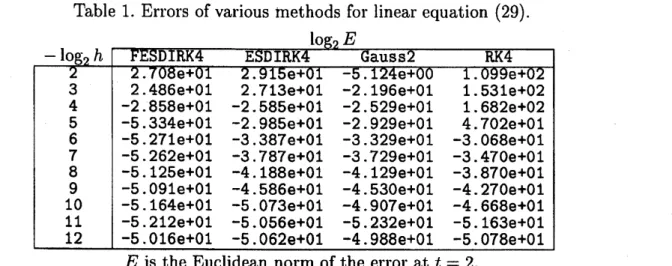
shown in [14]. We integrate the equationfrom $t=0$ to 2 by the FESDIRK4, and compare the error with those of the three fourth-0rder
Runge-Kutta methods: ESDIRK4, the tw0-stage Gauss(Gauss2) and the classical Runge-Kutta
(RK4) methods. The results
are
shown in Table 1.Table 1.
Errors
of variousmethods
for linearequation (29).$\ovalbox{\tt\small REJECT}^{\mathrm{R}\mathrm{K}\mathrm{R}\mathrm{K}}$
$t$
It
can
beenseen
that, although FESDIRK4 is less stable than the tw0-stage GaussRunge-Kuttamethodfor larger step-sizes, this method isfitted to the solution completelyfor moderately
small step-sizes; the values of order $-5.0\mathrm{e}+01$
or
less in the second column of Table 1 are dueto the accumulations of round-0ff errors, since the machine epsilon of the arithmetic is $2^{-53}$. On
the other hand, although the other methods are not fitted to this problem completely, the
errors
decrease steadily at the rate of $\mathrm{O}(h^{4})$,
as
expected.References
[$1_{\rfloor}^{\rceil}$ J. Butcher, The
Numerical
Analysisof
OrdinaryDifferential
Equations, Wiley,1987.
[2]
J.R.
Cash,A
noteon
the exponential fittingof
blended, extended linear multistep methods,BIT 21 (1981),
450-454.
[3] J.P. Coleman and S.C. Duxbury, Mixed collocation methods for y” $=f(x,$y), J. Comput.
Appl. Math. 126 (2000), 47-75.
[4] J.M. Franco, Embedded pairs ofexplicit ARKN methods forthe numerical integration of
per-turbed oscillators, Proceedings ofthe 2002 Conference
on
Computational and MathematicalMethods
on
Science and Engineering CMMSE-2002, (Sep. 2002, at Alicante Spain), Vol1.92-101.
[5] W. Gautschi, Numerical integration ofordinarydifferential equations based
on
trigonometric[6] E. Hairer,
S.P.
Norsett
andG.
Wanner, Solving OrdinaryDifferential
Equations I,Springer-Verlag,
Second
Revised Edition, 1992.[7] T.E. Hull, W.H. Enright, B.M. Fellen and A.E. Sedgwick, Comparing numerical methods for
ordinary differential equations, SIAM J. Numer. Anal., 9 (1972),603-637.
[8] N.N. Lebedev, Special Functions
&
Their Applications (Translated&
edited by R.A.Silver-man), Dover Publications, Inc. 1972.
[9] B. Neta and C.H. Ford, Families of methods for ordinary differential equations based
on
trigonometric polynomials, J. Computational and Applied Mathematics 10(1984),
33-38.
[10] K. Ozawa, A four-stage implicit Runge-Kutta-Nystr\"om method with variable
coefficients
forsolving periodic initial
value
problems, Japan Journal ofIndustrial
and Applied Mathematics,16 (1999),
25-46.
[11] K. Ozawa, Functional fitting Runge-Kutta method with variable coefficients, Japan Journal
of Industrial and Applied Mathematics 18 (2001),105-128.
[12] K. Ozawa, Functional fitting Runge-Kutta-Nystr\"om methodwithvariablecoefficients, Japan
Journal ofIndustrial and Applied Mathematics 19 (2002),55-85.
[13] K. Ozawa, Functionallyfitted linear multistepmethod, Proceedingsof the2002 Conference on
Computational and Mathematical Methods
on
Science and Engineering CMMSE-2002, (Sep.2002, at Alicante Spain), VoI I. 271-280.
[14] K. Ozawa, A functionally fitted three-stage explicit singly diagonally implicit Runge-Kutta
method, preprint.
[15] B. Paternoster, Runge-I<utta-Nystr\"om methods for ODEs with periodic solutions based
on
trigonometric polynomials, Applied Numerical Mathematics 28 (1998),
401-412.
[16] $\mathrm{F}.\mathrm{L}.\mathrm{S}\mathrm{h}\mathrm{a}\mathrm{m}\mathrm{p}\mathrm{i}\mathrm{n}\mathrm{e}\mathrm{l}994.$’ Numerical Solution
of
OrdinaryDifferential
Equations, Chapman
&
Hall,[17] E. Stiefel and D.G. Bettis, Stabilization of Cowell’s method, Numer. Math. 13 (1969),
154-175.
[18] T.E. Simos, A fourth algebraic order exponentially-fitted Runge-Kutta method for the
nu-merical solution
of
the Schr\"odinger equation, IMA J. Numer. Anal. 21 (2001), 919-931.[19] J. Vanthournout, H. De Meyer and
G.
Vanden Berghe, Multistep Methods for OrdinaryDifferential
Equations Basedon
Algebraic and First Order Trigonometric Polynomials,Com-putational Ordinary Differential Equations (Ed. J.R. Cash and I. Gladwell), 1992,
61-71.
[20] G. Vanden Berghe, H. De Meyer, M. Van Daele and T. Van Hecke, Exponentially-fitted
Runge-Kutta methods, Journal of Computational and Applied Mathematics, 125 (2001),
107-115.
[21] P.J. Van Der Houwen and B.P. Sommeijer, Diagonally implicit Runge-Kutta-Nystr\"ommethod
ods for oscillatory problems, SIAM J. Numer. Anal. 26 (1989),
414-429.
[22] E.T. Whittaker and
G.N.
Watson, ACourse
of
ModernAnalysis, Cambridge University Press,1973.
[8] N.N. Lebedev, Special Functions
&Their
Applicatio\uparrow ls (Translated&edited by R.A.Silver-man), Dover Publications, Inc. 1972.
[9] B. Neta and C.H. Ford, Families of methods for ordinary differential equations based
on
trigonometric polynomials, J. Computational and Applied Mathematics 10(1984),
33-38.
[10] K. Ozawa, Afour-stage implicit Runge-Kutta-Nystr\"om method with variable
coefficients
forsolving periodic initial
value
problems, Japan Journal ofIndustrial
and Applied Mathematics,16 (1999),
25-46.
[11] K. Ozawa, Functional fitting Runge-Kutta method with variable coefficients, Japan Journal
of Industrial and Applied Mathematics 18 (2001),105-128.
[12] K. Ozawa, Functional fitting Runge-Kutta-Nystr\"om methodwithvariablecoefficients, Japan
Journal ofIndustrial and Applied Mathematics 19 (2002),55-85.
[13] K. Ozawa, Functionallyfitted linear multistepmethod, Proceedingsof the2002 Conference on
Computational and Mathematical Methods
on
Science and Engineering CMMSE-2002, (Sep.2002, at Alicante Spain), VoI I. 271-280.
[14] K. Ozawa, Afunctionally fitted three-stage explicit singly diagonally implicit $\mathrm{R}\mathrm{u}\mathrm{n}\mathrm{g}\mathrm{e}-\mathrm{I}\acute{\backslash }\mathrm{u}\mathrm{t}\mathrm{t}\mathrm{a}$
method, preprint.
[15] B. Paternoster, Runge-I<utta-Nystr\"om methods for ODEs with periodic solutions based
on
trigonometric polynomials, Applied Numerical Mathematics 28 (1998),
401-412.
[16] F.L. Shampine, Numerical Solution
of
OrdinaryDifferential
$Equatior|s$, Chapman&Hall,
1994.
[17] E. Stiefel and D.G. Bettis, Stabilization of Cowell’s method, Numer. Math. 13 (1969),
154-175.
[18] T.E. Simos, Afourth algebraic order exponentially-fitted Runge-Kutta method for the
nu-merical solution
of
the Schr\"odinger equation, IMA J. Numer. Anal. 21 (2001), 919-931.[19] J. Vanthournout, H. De Meyer and
G.
Vanden Berghe, Multistep Methods for OrdinaryDifferential
Equations Basedon
Algebraic and First Order Trigonometric Polynomials,Com-putational Ordinary Differential Equations (Ed. J.R. Cash and I. Gladwell), 1992,
61-71.
[20] G. Vanden Berghe, H. De Meyer, M. Van Daele and T. Van Hecke, Exponentially-fitted
Runge-Kutta methods, Journal of Computational and Applied Mathematics, 125 (2001),
107-115,
[21] P.J. Van Der Houwen and B.P. Sommeijer, Diagonally implicit Runge-Kutta-Nystr\"om
method
ods for oscillatory problems, SIAM J. Numer. Anal. 26 (1989),
414-429.
$[2\underline{?}]\mathrm{E}.\mathrm{T}$