Team Teaching for English as a Second Language:
A Comprehensive Analysis in Miyazu, Japan
The University of Fukuchiyama, Eric Hawkinson
U.S. Department of Defence Education Division, DeAngelo Galang
Mills High School, Akiko Soda
Abstract
Most public schools in Japan employ a teaching method in English language classes known as team teaching. Team teaching involves two teachers working together to conduct a class; usually one member of this team is a native English speaker and the other is a certified teacher in Japan. In this study, researchers examine a school district in Miyazu, Japan and analyze the team teaching environment. A district-wide analysis was conducted that included interviews, student and teacher surveys, classroom observations, and policy reviews. The Board of Education (BOE) in Miyazu became a partner in this study, the Miyazu BOE asked for possible solutions and ideas on how to improve the effectiveness of team teaching. This report summarizes the team teaching environment in the Miyazu school district, lists all data collected to analyze team teaching environments, and analyzes of that information from the viewpoint of different stakeholders. The study concludes with a list of possible interventions that seeks to help the Miyazu BOE reach its goals for team teaching and improve English education in the Miyazu school district.
Keywords: Team Teaching, TESOL, Needs Analysis, Learner Analysis, Learning Environment Analysis
1. Introduction to the Challenge
Japan is falling behind other Asian countries in English education (Aoki 2011). Japan currently ranks near the bottom among its Asian neighbors despite a rigorous English education curriculum that now starts in elementary school. One of the said reasons for the slow improvement of English fluency is the lack of opportunity for Japanese students to interact with native speakers of English. As a result the Japanese ministry of education, culture, science, and technology (MEXT) has implemented programs to bring teachers and students from English speaking countries to Japan. One popular idea employed in schools for English education is team teaching. Team teaching happens when a certified Japanese teacher of English is paired with a native English speaker to teach English classes in tandem at public and private schools at all levels across the country. The idea is to have the students benefit from the teaching experience of a trained Japanese educator as well as gain practical experience using the language from a native speaker. Unfortunately team teaching roles, procedures, and concepts vary across schools, grade levels, and even can vary from teacher to teacher. There are also cultural, organizational and policy issues that can affect how well the two teachers work together. Lastly, the goal of team teaching itself is debatable by the various stakeholders involved as teachers, policy makers and students all have different ideas about what team teaching is intended to accomplish. In this paper we seek to address these challenges with a comprehensive analysis of a particular school district using team teaching for English education.
The Miyazu Board of Education (BOE) manages all elementary and junior high public schools as well as social welfare and public education programs in the city of Miyazu, Japan. The district of schools consists of two preschools, seven elementary schools and three junior high schools.
Miyazu is located next to the Sea of Japan in northern Kyoto prefecture. Studying English language is a major graduation requirement for the students. Each school has at least one designated English teacher, also called a Japanese Teacher of English (JTE). The Miyazu BOE is responsible for two native speakers of English who act as Assistant Language Teachers (ALT) to the JTE. The Miyazu BOE would like to see the JTE and ALT team teach together to help students reach the objectives of the English Teaching curriculum. Our efforts are focused on a needs assessment from all three stakeholders; the JTEs, ALTs, and students in order to improve team teaching.
1.1 Examination Culture
In Japan, the junior high school education system is of course different than that in the United States. Six years of elementary school and three years of junior high school are part of a compulsory education. Students have to take an entrance exam to get into high school and more than 97% are going to HS. Although it is easy to get into high school, the exam system puts pressure on junior high students to do well on entrance exams that are required to get in more prestigious high schools. The better the high school, the better the chance of doing well enough on university entrance exams to go to a prestigious university. To enter a name brand university in Japan greatly raises the chances of getting hired by a good company. So the stakes for testing are felt early and felt hard for young students in Japan; as they understand that early lapses in progress can be very difficult to recover from, if at all. This puts pressure on both teachers and students to prepare for English exams, and thus can focus on reading and grammar. This has an influence on the relationship between ALTs and JTEs as these pressures are not felt equally and can help to diverge teaching priorities in the classroom.
1.2 English Education in Japan
The Ministry of Education, Culture, Sports, Science and Technology in Japan (MEXT) is aggressively situating its population for globalization by teaching English in light of the recent announcement of Tokyo, Japan hosting the Olympics in 2020. MEXT is administering an English Education Reform that seeks to do two things: have students communicate fluently to English speakers by the time they are in upper high school and increase the professional development of teachers at all levels. The plan is already in effect.
2. Initial Conditions
2.1 Key Stakeholders
This project involved a number of key stakeholders. They are as follows: ● JTEs
● ALTs
● elementary and junior high students are who receive team teaching instruction ● school administrators
● The Miyazu BOE
2.2 Defined Outcomes
The Miyazu BOE had two requests: 1) gather data from the stakeholders in order to determine the actual state of team teaching and 2) propose recommendations to reach or maintain the desired level of team teaching as designated by the Miyazu BOE. Before determining our plan of action we first met with a supervisor at the Miyazu BOE to gather information on what was expected from the study. The BOE supervisor identified two main points of emphasis for team teaching:
● Enhance English competence and communication ● Spark curiosity in world languages and cultures
After gaining this knowledge on the purpose of team teaching, we began determining what
approach we would take to collect the necessary data. The BOE allowed us to collect data from the key stakeholders. We planned to extract data from the identified stakeholders through
interviews and surveys in order to identify the actual state of team teaching. Our plan of action required us to gather data from the stakeholders, analyze the data, create a product based on the needs assessment if needed, and present it to the Miyazu BOE.
2.2 Impact of the Literature and Course Materials
As our team continued with this project, we gathered articles that were germane to our topic. These articles directly dealt with team teaching in Japan and informed us of our decision making. The Japan Times article, “When it Comes to Discipline in Class, Leave it to the Locals”, was a critical document to describe the current state of team teaching for an Assistant Language Teacher in Japan today. This newspaper article provided insight into some of the issues and opportunities for improvement that we might find in our analysis. Also the article titled, “Teachers Add Up Days of Overtime” from Japan Times, shed light on the amount of unpaid overtime public school teachers work in Japan. In a poll of elementary and junior high teachers, they claim they spend 95.5 hours a month in overtime. They mostly spend their time after class at school as social committee sponsors. The article also describes the unhealthy work life balance that Japan is known for. “Team Teaching Styles Utilized In Japan: Do They Really Work?” provided a skeptic's view to the reality of conducting team teaching citing the need for soft skills and the lack of adequate resources. The document also provided a first hand account of working as an ALT and team teaching with a JTE. The article also stated that most research based on team teaching is quantitative rather than qualitative and further research is needed.
When creating our surveys we were aware we would not be able to get useful data on the
students’ current English Language ability for a variety of reasons. Therefore we had to probe for student and teacher perception about team teaching. We could not base a solution solely on this quantitative data. According to Ruth & Mayer (2011) “there is little correspondence between learner perceptions of lesson effectiveness and actual instructional value. In short, liking is not the same as learning (p. 317). This informed us that we should not ultimately determine our recommendations on the likes of the stakeholders.
When we began searching for recommendations on how to improve team teaching we found the
work of Benoit, R. & Haugh, B (2001) to be very beneficial. We created a checklist of tasks and roles the two team teachers would be responsible for from this research.
3. Approach
To conduct an analysis into the current status of the team teaching environment in Miyazu, we interviewed the supervising school board official and the two assistant language teachers. We also conducted student and Japanese teacher surveys at all schools in the district.
● (Teaching Experience) ALTs are the primary instructors teaching English at elementary schools. The ALT teaches for about half of the class time when he/she is in class at junior high schools. But both of the ALTs working in the district did not major in education nor had any teaching experience until they came to Japan.
● (Orientation) The ALTs had an introductory orientation in Tokyo and then another regional orientation in Kyoto, which is the region Miyazu is in. No special orientation was given at the school district or at each school. As for team teaching, they practiced creating a self-introduction lesson and a short sample lesson at the regional orientation. ● (Lesson Preparation) Both did not receive any specific training about creating lessons.
The ALT working at the junior high schools worked with other ALTs and received some advice from JTEs after each lesson but did not have much collaboration with them. ● (Teaching Goals) Team teaching goals in the curriculum were not clear at any school or
grade level.
●
(Feedback) They expected to have more effective feedback about their teaching lessons.
4. Findings
4.1 Survey Findings
do many kinds of online data collection and analysis including market research, customer satisfaction and loyalty, product and concept testing, employee evaluations and website feedback.(“Qualtrics,” 2014). We created the survey first in English and then translated it into Japanese. The teacher surveys in Japanese were distributed online using embedded links in emails from the district office to all 6th grade elementary and 3rd grade junior high school English teachers in the school district in March and in April 2014. . Teachers answered at their own convenience. Twelve out of 18 teachers completed the survey. The student surveys were distributed as paper documents to all 6th grade elementary students and 3rd grade junior high school students by their classroom teachers in March 2014. Two hundred thirty four out of 369 students participated in the survey. After we received their answer sheets, we manually put their answers in Japanese to the correspondent answers in English into a database using Qualtrics.
4.1.1 Teacher Survey:
The purpose of teacher survey was to evaluate team teaching process and to find how students engage in team teaching. The survey was grouped in five categories. Most questions were given as multiple choices
Professional development of team teaching in English.
● 60% of teachers have attended conference or workshop about team teaching before but 94% feel they need to have more training for team teaching.
● 47% thought that workshop on activities for students will benefit student learning the most.
Planning for team teaching
● JTEs plan with ALTs for team teaching before or between classes at school by face to face. Only about 30% send emails to contact ALTs.
● 70% used their planning time to discuss activities in class. 64% think the amount of planning is sufficient for team teaching lessons. As for their team teaching role, 58% of Elementary School teachers reported that the ALT is the main teacher. This conflicts with the ALTs comments during their interview as the ALT thinks she is the main teacher nearly 100% of the time. 73% of Elementary teachers were satisfied with effectiveness of team teaching to achieve objectives of their English curriculum while only 15% of Junior high teachers were satisfied.
● 60% of the respondents expect the ALT to lead the class. Teachers also expect ALTs to have communication skills. They also expect ALTs to teach speaking and listening skills as well as raise awareness about other cultures.
4.1.2 Materials
Half of all responding JTEs think the current textbook for their team teaching is sufficient but
digital materials are also beneficial.
We created a fill in the bubble survey for the students that consisted of questions on a likert scale to gauge their perception of team teaching and see how they were acquiring English as second language. The surveys required approval from the Miyazu Board of Education before distribution. Our team created the paper survey to deliver to the students. Once the students completed the surveys we scanned them into a digital PDF for easy distribution and input into Qualtrics by our team.
We consulted our client about the process of our survey and followed her feedback, especially about the Japanese terminology used in the surveys. As our target is located in Japan, we faced several challenges.
Language- we needed to translate all survey materials into Japanese. It took longer than we expected to create the survey. Some expressions could not be translated directly. We tried not to change its original content but to modify expressions so teachers of Japanese could understand well.
School schedule- since Japanese schools have a different school calendar from the US, the time span for collecting data took longer than expected. This was the main reason we elected to extended the time to collect data.
Low response from teachers- Since not all teachers have their own computer and there was limited access to the online survey, low response rate, especially from junior high school teachers
and thus might not give useful results but we think that response from elementary school teachers were well demonstrated their opinions about team teaching.
Access to Technology- since students did not have access to the computer, first we had to give a paper survey and had to input their responses into Qualtrics manually which was very time consuming.
4.1.3 Student Survey
During our interviews with the district supervisor, she stated that her main wish was that team
teaching lessons were effective in the following concerns: ● Motivate student interest in English and other cultures ● Improve student English ability
Using all the data we collected, an analysis was done to see how these goals for team teaching
are being met. The first question was easier to address in our line of questioning and in the data we collected as it only addresses how the team teaching lessons are perceived and how much students enjoy and look forward to team teaching lessons. This is an easier question to quantify as it only an emphasis on the student reaction. Thus on Kirkpatrick’s evaluation model this would only be the lowest level of evaluation and therefore perhaps the most simple to measure (Kirkpatrick, 1974).
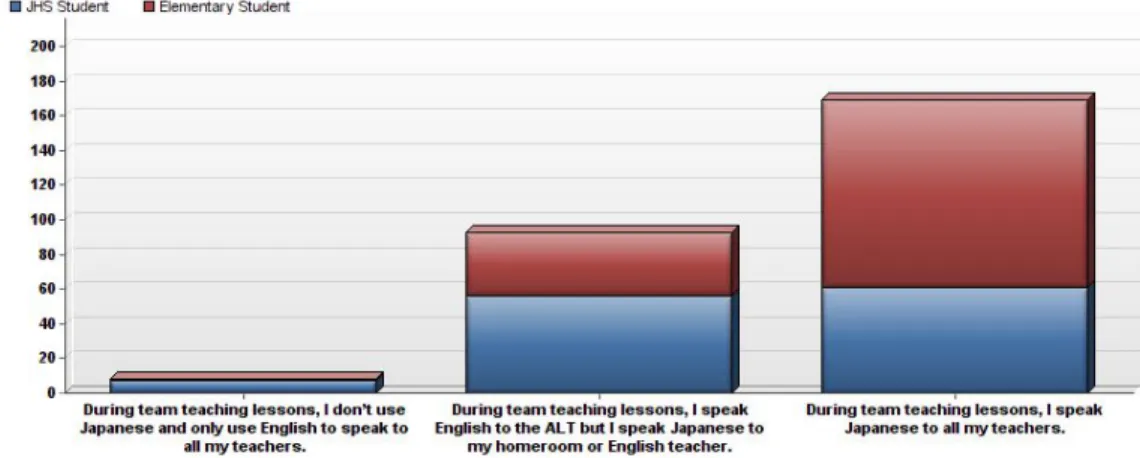
Looking at the student surveys at all levels the largest group of students reported that they use Japanese during team teaching lessons. At the junior high level there was a significant increase in the number of students speaking English to the ALT but Japanese to the JTE. It is unclear, however if this is due to a lack of motivation, ability, or both.
Figure 1. In class language usage of students
Since increasing motivation to communicate in English is a main goal for team teaching set out by the board of education. It would seem that team teaching is not getting desirable outcomes. To look a bit deeper the next figure shows how the same results are slpit between elementary and junior high school students.
Figure 2. English usage in team teaching lessons by level
This table shows that students are speaking much more English during team teaching lessons to the teachers and especially to the ALT. In both levels students report that they don’t speak English to their homeroom or English teachers during team teaching lessons.
During the interviews with the district supervisor and ALTs it was reported that the teachers in Elementary schools are mostly new to teaching English as the policy to teach English in elementary schools is also young.
When the students were asked if they looked forward to team teaching lessons they had slightly mixed responses.
Table 1. Student attitudes toward team teaching lessons Question Responses Total Mean
I look forward to English classes taught by both my
homeroom teacher and the ALT. 271 2.35 I want to find out more about the ALT’s culture and
country 271 2.30
My participation in team teaching lessons relates to
my final grade 257 2.68
I can get help from ALT to practice or study English
when I have questions. 269 2.48
I can get help from my homeroom or English teacher to practice or study English when I have
questions. 270 2.17
During team teaching lessons, my homeroom or English teacher and the ALT create an enjoyable and interesting atmosphere. (JHS ONLY)
124 2.27
I enjoy studying English in team teaching
classrooms (Elementary ONLY) 146 2.04
Team teaching lessons are easy to understand. 271 2.33 Team teaching lessons help me prepare for
entrance exams. (JHS ONLY) 125 2.70
These responses show an overall trend for students to like and look forward to team teaching
lessons. Looking deeper to see if these trends differed between elementary and junior high school students.
On a scale from 1(Strongly Agree) to 5(Strongly Disagree) and 1 being most favorable the
results are as follows for the question: I look forward to English classes taught by both my homeroom teacher and the ALT.
Table 2. Student anticipation for team teaching classes Grade Min Max Mean Variance n responses
JHS 1 5 2.46 1.28 1.13 125
Elementary 1 5 2.26 1.08 1.04 146
On the same scale from 1(Strongly Agree) to 5(Strongly Disagree) and 1 being most favorable
the results are as follows for the question: I want to find out more about the ALT’s culture and country.
Table 3. Student motivation for further self study Grade Min Max Mean Variance n responses
JHS 1 5 2.3 1.1 1.05 125
Elementary 1 5 2.29 1.2 1.1 146
These results show that on the whole students only slightly agree that they look forward to team teaching lessons and want to learn more about other cultures and more slightly still for elementary students. This shows that there is room for improvement for teachers as a team to motivate students for learning.
The next question involving the issue of student learning is a bit more complicated to address. Using the same evaluation model from Kirkpatrick the level of evaluation turns from level 1 to level 2 as we are needing to measure how well students are gaining English ability from team teaching lessons. From the data collected in our surveys and interviews we did not get access to English proficiency scores or grades due to privacy issues and even so they might not be useful as they evaluated the student from their English ability as a whole and not from what was learned during team teaching lessons. From our interviews with the district supervisor there would not be any data from the elementary schools as English is not a required mark when teachers report student progress on a trimester basis.
To attempt to draw a picture of how might student ability from team teaching lessons be measured, we asked the students in junior high schools to report on how they felt the content taught in team teaching lessons was reflected in their test scores and grades. Using a scale from 1 (Strongly Agree) to 5 (Strongly Disagree), junior high school students responded to the following four statements:
1. I can practice what I learned in team teaching lessons during regular English classes. 2. My homeroom or English teacher uses what we learned in team teaching lessons in
regular English classes.
3. Things we learn in team teaching lessons appear on quizzes and tests.
4. Things we learn in team teaching lessons appear in homework assignments I am given.
Table 4. Perceived Evaluation of Team Teaching Content by Junior High School Students Question min max mean variance n responses
1 1 5 2.62 .91 .96 125
2 1 5 2.72 1.0 1.0 126
3 1 5 2.9 1.34 1.16 126
4 1 5 3.26 1.46 1.21 126
This shows that junior high school students in the district do not see a large connection between what they are learning during team teaching lessons and what they are tested and evaluated on. This could be due to many factors. It is harder to evaluate communication abilities and also more time consuming. It could be that team teaching lessons are not
correlating well with the overall curriculum. It also could be that team teaching lessons are seen as supplementary lessons and do not need proper assessment. Either way it could have an
effect on student motivation during team teaching lessons as they know they will not be tested on the material.
Another possible indication that students might like to see more integration between team teaching lessons and English classes for junior high school students is the activities done versus the activities wanted in team teaching classes. When asked about what activities they were doing during team teaching lessons the top three responses were games, role play, and reading. But when asked what they would like to see more of, the top responses were games, tests and quizzes, and music. It may seem anti-intuitive that students want to take a test during team teaching lessons but it could mean that the students would like some higher form of feedback as they see from the English classes outside of team teaching lessons. Elementary students also wanted to see more testing for team teaching lessons.
When asking the teachers if they were satisfied with their ability to use team teaching lessons to meet or relate to the overall curriculum objective, all teachers reported unsatisfactory. So there is some indication that both students and teachers find a disconnect from team teaching lessons and the rest of their English studies.
5. Proposed Interventions
The data collected from all sources give a clear picture of some of the core issues facing team teaching in Miyazu, but also raises new and deeper questions. We feel however that there is enough data to put together a set of items that may help the state of team teaching.
5.1 Intervention Goals
The Miyazu Board of Education wants team teaching to motivate students to speak and learn English. They want to raise curiosity about language, cultures and the world. They ultimately want all the students in the district to have functional English communication skills. According to data from students, students look forward to team teaching lessons but don’t take the opportunity to practice speaking English. They don’t know how content taught in team teaching lessons relates to their overall grades or assessment. So it seems that team teaching lessons are fun but it is unclear how they helping students raise their abilities. But it seems that the overall goals of the board of education are not being met.
5.2 Lesson Preparation
Perhaps the planning and preparation of lessons and overall curriculum is needed to help assess the impact of team teaching lessons on English ability and motivation. About 64% of teachers reported that the amount of planning is sufficient for team teaching. But for junior high school teachers there were few respondents that reported satisfaction with team teaching lessons. Elementary teachers were the opposite and were very satisfied. This may be in part due to the need of JHS teachers to have students meet national standards and feel they must push through material faster than allows for practical usage. This is supported in how roles are played out in elementary and JHS for team teaching. In elementary the ALT is taking ownership of lessons and content selection/delivery. The English teacher is taking that role in JHS. In both cases how and when planning takes places is more dependant on the teacher than the level.
5.3 Learning Content
Students are enjoying classes and report that the content is close to what they would like to be learning and what activities they’d like to be doing. They want to practice listening to the ALT or music, play games, and read. This is close to what is actually happening during team teaching lessons with the exception of reading. Teachers may think that reading can be done without an ALT present and it is more important to use that time to practice practical communicative skills. Elementary teachers would like more ideas for games and activities during lessons, but since they leave that planning up to the ALT it seems there is little chance or reason to learn new activities. This is a seemingly disconnect in the reporting’s of the teachers.
Flipped Onboarding Program for ALTs
the trainees could access the instruction online and practice what they learned onsite (Flipped Classroom). In this case the ALTs could watch instructional videos that depict model lessons done in team teaching. When they arrived at the team teaching workshop they would then practice those scenarios or ask more questions about team teaching. This could help ease the anxiousness of the ALTs before they arrived in Japan and provide maximum repetitions of guided practice with team teaching at the workshop.
5.4 Interventions
5.4.1 Local Level Orientation/Workshop for Team Teaching
ALTs are given orientation on a national level and JTEs are given at least some instruction on team teaching. The issue is how that training is relating to the situation in Miyazu. ALTs are told to expect a wide range of work tasks and environments but the ALTs showed up to schools on the first day and had little idea what exactly was expected of them or anything about the team teaching environment that is particular to that school. Teachers hold expectations of ALTs based on previous working relationships with ALTs. So ALTs are going into new and different environments in each school and need orientation and JTEs are seeing a new ALT from a completely different set of cultural, social, and set of work experiences than before and need to orientate to the new teacher.
5.4.2 Local Orientation
We suggest a two-step training program to help team teachers orient to teaching environments in Miyazu. The first step is a short team building workshop run by the board of education. This could be facilitated by a senior JTE or ALT but we recommend that it is facilitated by someone in the district office or a third party. The workshop with consist of the following learning objectives.
Acclimate new ALTs to the Miyazu school district Introduce JTEs and ALTs
Apply the basic concepts of team teaching
Exchange avenues of communication between stakeholders Articulate roles in each team teaching environment
Build an atmosphere of cooperation around the districts stated goals for team teaching
The second step of orientation employs informal learning techniques. Prior to an ALTs first team teaching session he/she will shadow a JTE for a day of work at one of the schools. ALTs reported that they do not know how they could be of more help to the busy JTEs, so simple observation of a typical workday followed by cooperative reflection will help prepare ALTs to do just that.
Because JTEs and ALTs arrive at their jobs at different times of the year, it may also be useful to create some web based training materials that could substitute the workshop in the case that teachers are not able to attend as it may only be feasible to be held once or twice a year due to schedules. Materials from the workshop could be placed on a website equipped with a CMS/LMS like Wordpress or Moodle. The city could also add information about it on their public web servers but the current systems and security policy surrounding those systems greatly restricts the contents and interactivity on them. So materials may have to be hosted separately and require an additional budget.
5.4.3 Adoption of Common Collaborate Tools
Most planning is happening face to face and that in most cases means lessons are being planned or discussed the day of, or even just prior to the lesson. There was also great variety on the part of the JTEs when asked when they are available for planning lessons. That is why there is a need for some uniform in the process of planning lessons. This could be something as simple as FAX template job aids that ALTs and JTEs send to each other on an agreed upon time prior to the lesson, or more perhaps a website or mobile application where ALTs and JTEs can share schedules, contact information, and lesson ideas.
share lesson plans. This would reduce the back and forth sharing of documents if it was done by email, fax, or a handwritten note. A standard form or checklist would increase the communication between the ALTs and JTEs. This would further require an analysis on basic computer skills and resources.
A prototype for task expectation can be found in the appendix. This document asks to identify who is the ALT or JTE, what is the objective of the lesson, and what is the corresponding page number of the textbook. Then there is a table of task and roles that each person is to check off. These roles were derived from the journal article by Benoit and Haugh, (2001). After the lesson the JTE is to answer two questions for feedback: What worked well for the lesson? and What could be improved in the lesson? After that the JTE is to give the document to the ALT to answer the same two questions and give it back to the JTE. This increases the communication of the JTE and ALT before and after the lesson. The checklist also provides a quick and easy formative assessment tool of the lesson. The idea is to have the completion time of this document under three minutes because both parties have multiple lessons in one day. An analysis of the best exchange method would have to be conducted to streamline the process. Some possible solutions are to have the document hosted in a cloud storage system, a website, a clickable email form, or handwritten. Also, multiple rounds of iterations could be needed to perfect the document to suit the needs of the teachers. For example the JTE in the elementary level might need some of it translated to Japanese or there might be roles or tasks that better suit the needs of junior high JTEs.
In addition to tools to raise efficiently at work, a list of online resources for team teachers that facilitate the exchange of ideas and materials will be introduced. One of those resources is TeamTeachers.com. It is a website and social media network that allows teachers in team teaching to exchange information and materials and offers ways to network and support professional development. It is the hope that members from different districts can share their experiences and give peer support for issues related to team teaching.
5.4.4 Policy and Curriculum Changes to Reflect Higher Uniformity with Team Teaching
There was a discrepancy found between what is taught in team teaching and what is assessed and given feedback on. On the elementary level it is unclear that there is even a set English curriculum followed. The ALTs and JTEs need a policy that forces more cross usage between team teaching content and what they are assessed on. In Japanese tradition we propose a multi-tiered method to making the policy changes. The first step would be where ALTs and JTEs would both assess a test group or class of students and consult on how they arrived at that judgment, compare differences, and discuss possible changes. The proposed changes would then be submitted for review to school and district officers. This could repeat until all stakeholders have found a new assessment solution that includes content from lessons in and out of team teaching sessions.
References
Airasian, P. W., Cruikshank, K. A., Mayer, R. E., Pintrich, P. R., Raths, J., & Wittrock, M. C. (2001). A taxonomy for learning, teaching, and assessing: A revision of Bloom's Taxonomy of Educational Objectives. Anderson LW and Krathwohl DR. New York: Addison Wesley Longmann.
Allen, M. (2012). Leaving ADDIE for SAM: An agile model for developing the best learning experiences. American Society for Training and Development.
Benoit, R. & Haugh, B. (2001). Team Teaching Tips for Foreign Language Teachers. The Internet TESL Journal, 12. Retrieved April 14, 2014, from
http://iteslj.org/Techniques/Benoit-TeamTeaching.html
Carley, H. (2013).Team teaching styles utilized in japan: do they really work?. Journal of International Education Research, 9 (3). Retrieved from
http://journals.cluteonline.com/index.php/JIER/article/view/7882
Guidelines for Consumers and Designers of Multimedia Learning (Essential Knowledge Resource)
Cooperrider, D., & Whitney, D. D. (2005). Appreciative inquiry: A positive revolution in change. Berrett-Koehler Publishers.
English Education Reform Plan corresponding to Globalization. (n.d.). Retrieved from
http://www.mext.go.jp/english/topics/1343591.htm
Keller, J. M. (2010). Motivational design for learning and performance. Springer. Flipped Classroom. (n.d.). Flipped Classroom . Retrieved April 29, 2014, from
http://www.knewton.com/flipped-classroom/
Kirkpatrick, D. L., & Brodwell, M. (1974). Evaluation of training. CREDR Corporation.
Kolb, D. A. (1984). Experiential learning: Experience as the source of learning and development (Vol. 1). Englewood Cliffs, NJ: Prentice-Hall.
La Fasto, F., & Larson, C. (2001). When teams work best. Thousand Oaks, CA: Sage. Mager, R. F., & Peatt, N. (1962). Preparing instructional objectives (Vol. 962). Belmont, CA:
Fearon Publishers.
Morrison, G. R., Ross, S. M., Kemp, J. E., & Kalman, H. (2010). Designing effective instruction. John Wiley & Sons.
Qualtrics - Wikipedia, the free encyclopedia. (n.d.). . Retrieved April 24, 2014, from
http://en.wikipedia.org/wiki/Qualtrics
Schell, J. (2008). The Art of Game Design: A book of lenses. CRC Press.
Skinner, B. F. (1978). Reflections on behaviorism and society. Englewood Cliffs: Prentice-Hall. Smith, R. M. (2009). Conquering the content: A step-by-step guide to online course design (Vol.
25). John Wiley & Sons.
Straub, D., Keil, E., Brenner, W. Testing the technology acceptance model across cultures: A three country study. Information & Management. 2007.
St. Michel, P., (2013, October 27). When it comes to discipline in class leave it to the locals. Japan Times, Retrieved from
http://www.japantimes.co.jp/community/2013/10/27/general/when-it-comes-to-discipline-in-class-leave-it-to-the-locals/#.U1pfH175Qry
Teachers add up days of overtime (2013, October 26). Japan Times, Retrieved from
http://www.japantimes.co.jp/opinion/2013/10/26/editorials/teachers-add-up-days-of-overtime /#.U1pjZF75Qrw
Van Tiem, D. M., Moseley, J. L., & Dessinger, J. C. (2000). Fundamentals of performance technology: a guide to improving people process and performance.
Zichermann, G., & Cunningham, C. (2011). Gamification by design: Implementing game mechanics in web and mobile apps. " O'Reilly Media, Inc.".