Corresponding author: Naoki Kunugita 2-3-6 Minami, Wako, Saitama 351-0197, Japan.
Tel. +81-48-458-6267; Fax +81-48-458-6270; Email: [email protected]
Tokyo Electric Power Company Fukushima Dai-ichi
Nuclear Power Plant accident and public health
Naoki Kunugita, Tsutomu Shimura, Hiroshi Terada, Ichiro Yamaguchi
Department of Environmental Health, National Institute of Public Health
< Review >
Abstract
Off the Pacific coast of Tohoku Earthquake and subsequent Fukushima nuclear accident attacked Japan on March 11, 2011. The complex disaster with an earthquake, tsunami and nuclear disaster severely damaged and destroyed human life, properties, natural resources and the environment. Mandatory evacuation was ordered after the accident, and loss of the cooling system for safety of the public from the nuclear reactor in the Fukushima Dai-ichi Nuclear Power Plant. This order disturbed the usual daily life of the Fukushima residents and caused an inconvenient situation for a long-time due to the lack of a link to their local community. We tried to discuss various issues regarding the public health activities in response to the Fukushima disaster in this special issue as follows.
Countermeasures: 1) emergency response to the natural disaster, to mitigate the radiation exposure due to the nuclear accident, 2) medium- to long-term support for secondary health risks and 3) educational activities of radiation health risks on humans and care of mental health issues due to anxiety of radiation exposure. All were implemented by various efforts with the cooperation among national and local politicians, residents, suppliers, distributors and so on. The World Health Organization (WHO), the United Nations Scientific Committee on the Effects of Atomic Radiation (UNSCEAR), and the International Atomic Energy Agency (IAEA) consulted on the response to the Fukushima situations. Although the Fukushima accident was the second worst nuclear accident in the history of nuclear power generation, radiation doses are limited among Fukushima residents and emergency responders who were apparently not exposed to radiation doses higher than the threshold for induction of acute radiation syndromes. In order to control food contamination, provisional regulation values (PRV) were set during radiological emergency situations. Food monitoring and restriction were conducted to protect internal radiation exposure from contaminated food. The Fukushima Health Management Survey was carried out to take care of and to support the health of the Fukushima residents. As a part of this survey, some issues regarding thyroid monitoring and a medium- to long-term secondary health risks still remained. Furthermore, we mention disaster management laws and systems, and the role of the emergency management cycle according to each phase.
With all these matters in mind, we overview the Fukushima accident as a brief introduction to this special issue.
keywords: Fukushima Dai-ichi Nuclear Power Plant accident, radiation protection, public health, disaster
countermeasures
(accepted for publication, 15th January 2018)
I
.Overview of the Fukushima Nuclear
accident
1. A complex disaster with an earthquake, tsunami, and nuclear power plant accident
A severe natural disaster (Off the Pacific coast of Tohoku Earthquake) occurred in Japan on March 11, 2011. Following the magnitude-9.0 earthquake, damaging tsunami waves struck the Pacific coast of Japan including the Fukushima nuclear power plant (FNPP). As a result of this complex disaster with an earthquake, tsunami, and nuclear accident, we lost precious human lives (15,894 people and 2,546 people missing) [1]. In the event of a release of radioactive materials into the atmosphere from a damaged nuclear power plant, radionuclides may be widely dispersed leading to contamination of a variety of materials in the environment (Figure 1) [2]. Human bodies may be exposed to radioactive elements via two major routes. One is “External exposure” which is exposure to radiation released by radioactive materials from outside of the body. The other is “Internal exposure” which is exposure through the intake of air, water, food, and other substances containing radioactive materials into the body by inhalation, oral intake, dermal absorption, and wound penetration. A radioactive plume contains radioactive noble gases and particles, such as Iodine-131 (I-131) and Cesium-137 (Cs-137) [3]. The radioactive noble gas (krypton and xenon) did not fall on the ground but incorporated into human body via inhalation. On the other hand, I-131 and Cs-137 particles fell out onto the ground surface, leading to environmental
contamination and external exposure to humans in the track of the radioactive plumes. Furthermore, these radioactive materials may contaminate water and various foods via the food chain. In the Chernobyl accident, no action on restricting contaminated foods was imposed in the early period. Highly radioactive internal exposure was found among children who drank contaminated milk with I-131. The World Health Organization (WHO) reported that there were about 6,000 cases of thyroid cancer, including 20 fatal cases due to internal exposure of iodine at 20 years after this accident [4]. Based on these experiences, food and drinking water monitoring and supply protection actions were taken immediately after the Fukushima accident.
2. Dose rate change following the accident
Fi g u re 2 s h o w s t h e c h ro n o l o g i c a l c h a n g e s i n environmental radiation dose rates in Fukushima, Iwaki, and Tokyo. A tremendous amount of radioactive material was mainly discharged into the air from March 12 to March 15, 2011. The Nuclear and Industrial Safety Agency of Japan (NISA) reported that 1.6×10¹⁷Bq of I-131 and 1.5
×1016Bq of Cs-137 were released into the environment during the Fukushima event [3]. They spread to the southwest and northwest directions from the FNPP according to the monitoring data of air dose rates [2]. Air dose rates suddenly increased about 20 μSv/h following the Fukushima accident and peaked in mid-march in Fukushima-city located on about 60km north-west from the FNPP. Thereafter, it gradually decreased. On the other hand, in Iwaki city located on 43 km south-west and nearer than Fukushima
Fig. 1 Situation of radioactive substances in the environment and health risk after nuclear disaster
Radioactivity in seafood Inhalation Intake of Contaminated Food Radioactive Plume
Fallout
Food Chain Internal Irradiation Radioactive Materials Nuclear Power Plant Accident Environmental Contamination External Irradiation People in Contaminated Area ・Biological monitoring(Urine, Blood, Breast milk)
・WBC; Whole-body counter
Radioactivity in spinach
city, the dose rate was lower than that in Fukushima city because of the lower concentration of contaminated soil. Thus, air dose rate is proportional to the contamination levels of soil. Radiation dose rate in Tokyo in March 2011 was slightly increased compared to that before the accident, which is indicated on box in Figure 2. After the middle of April 2011, the dose rate was restored to a background level in Tokyo.
II
.Governmental actions in response to the
nuclear disaster
1. Countermeasures for Fukushima nuclear power plant (FNPP) accident
Countermeasures for FNPP accident have been arranged by the time course after the declaration of a nuclear emergency situation. The cabinet response office was immediately established after the earthquake. The Ministry of Health, Labour and Welfare (MHLW) issued an order to stand by to the Disaster Medical Assistance teams (DMAT). Japan declared a nuclear emergency after the failure of the cooling system at the damaged reactors at 19:03 on March 11. The Japanese government issued an evacuation order to the inhabitants around the nuclear power plant. The radius of the evacuation zone extended from 3 km to 20 km within about 24 hours after the breakout of the reactor accident and the number of evacuees eventually reached 177,000 (Figure 3). During evacuation, many efforts were conducted to survey residents and monitor radionuclide levels in the atmosphere, foods, farmland, and water. Unfortunately, a serious concern about the evacuation of hospitalized
patients was reported [5,6]. Some elderly hospital patients died during their transportation. Details were well documented in this special issue by Tsubokura [7].
The Central Nuclear Emergency Response Headquarters (NERHQ) instructed that stable iodine (potassium iodine:KI) should be administered to the evacuees younger than 40 years old on March 16 to protect the thyroid from radioiodine uptake by the Nuclear Safety Commission. In fact, this order did not fully reach most of the local governments and most people in the affected area did not take KI due to the disordered situation of the complex disaster. Yasui has clearly summarized governmental action for emergency workers in response to the nuclear disaster in the book and this issue [8,9].
2. The impact of food contamination due to the Fukushima Accident
In order to mitigate internal radiation exposure due to intake of contaminated food, MHLW made an effort to control the food supply. Terada described provisional regulation values (PRVs) in food and explained the impact of food contamination in the Fukushima accident by using food monitoring data [10]. PRVs are set based on past disasters including Chernobyl nuclear power plant and others [11]. Food with radioactivity levels exceeding these values should not be consumed and distributed in the market. The figures on the PRVs are based on 50 mSv/year of thyroid equivalent dose for radioactive iodine, and on 5 mSv/year of the effective dose for radioactive cesium [12]. These PRVs are set very conservatively. There should be no health concerns even if some food was consumed for a brief period
Fig. 2 Chronological changes in environmental radiation dose rates 0 5 10 15 20 25 3/ 14 3/ 29 4/ 13 4/ 28 5/ 13 5/ 28 6/ 12 6/ 27 7/ 12 7/ 27 8/ 11 8/ 26 Max. Min. μSv/hour Fukushima Dai-ichi Nuclear Power Plant
Fukushima
61km
Usual Value Band:0.037~0.046μSv/h 0.0 0.1 0.2 0.3 3/ 14 3/ 20 3/ 26 4/1 4/7 4/13 4/ 19 4/ 25 5/1 5/7 5/13 5/ 19 5/ 25 5/ 31 6/6 6/12 6/ 18 6/ 24 6/ 30 7/6 7/12 7/ 18 7/ 24 7/ 30 8/5 8/11 8/ 17 8/ 23 8/ 29 Max. Min. μSv/hourTokyo
230km
0 5 10 15 20 25 3/ 14 3/ 29 4/ 13 4/ 28 5/ 13 5/ 28 6/ 12 6/ 27 7/ 12 7/ 27 8/ 11 8/ 26 Max. Min. μSv/hourIwaki
43km
Box indicates natural background level of radiation dose rate
before the ban was implemented. The MHLW collates the results of testing and emergency monitoring conducted by the local governments on radioactive materials in food and publishes these results on the website (http://www.mhlw. go.jp/english/topics/2011eq/index_food_radioactive.html).
We are always exposed to natural radiation including cosmic rays from outer space; terrestrial radiation from natural radioactive materials in the ground; ingested radioactivity, principally potassium-40 and polonium-210 in foods; and inhaled radioactivity, mainly radon. So, the global average annual effective dose from natural background is 2.4 mSv [13]. In Japan, the average annual effective dose is lower than the global average, at around 2.1 mSv [14]. According to surveillance data of foodstuff after the Fukushima accident, the median total committed effective
dose was estimated to be 0.1 mSv [12]. Fortunately, internal exposures from the contaminated food due to the Fukushima accident were small (Figure 4).
3. Thyroid monitoring for children
The risk of thyroid cancer by taking in radioiodine released from the Fukushima accident was the major concern for the public in the early stage, because we know that there was an increase in pediatric thyroid cancer after the Chernobyl accident [15-17]. The Local Nuclear Emergency Response Headquarters performed a simplified survey for thyroid internal exposure in Iwaki City, Kawamata Town and Iitate Village from March 24 to 30 in 2011 on 1,149 children. The survey results of all of the people except 66 people, for whom results of the survey were unable to be generated appropriately due to a higher background, were below 0.2 μSv/h as a screening level, which thyroid equivalent dose to 100 mSv for one-year-old children [18,19]. Takahashi discussed this important issue regarding thyroid monitoring during childhood [20].
4. Survey of mother's milk
Since many mothers were worried about breastfeeding to grow their infants, the MHLW planned to measure radioactive concentrations in mother's milk. We measured I-131 levels in 126 breast milk samples from 119 volunteer lactating women residing within 250 km of the FNPP, between April 24 and May 31, 2011. Seven of the 23 women who were tested in April secreted a detectable
3km; 6,000 10km; 51,000 Evacuation zone 20km; 177,000 Shelter zone Date Public health measures 11‐Mar PM2:46 The earthquake occurred 11‐Mar PM2:50 The Cabinet Response Office was established 11‐Mar PM3:04 MHLW issued an order to stand by to the DMAT 11‐Mar PM3:14 The Headquarters for Emergency Disaster Control of government was established 11‐Mar PM7:03 Declaration of a nuclear emergency situation 11‐Mar PM9:23 Evacuation of residents: 3km radius from NPP 12‐Mar AM5:44 Evacuation of residents: 10km radius from NPP 12‐Mar PM6:25 Evacuation of residents: 20km radius from NPP 13‐Mar Start radioactivity surveillance
15‐Mar Indoor evacuations: within 20 to 30km from NPP Medical transport: within 20 to 30km from NPP 16‐Mar KI administration
18‐Mar Health counseling
21‐Mar Completed medical transport: 700 in patients (6 hospitals) MHLW: Ministry of Health, Labour and Welfare
DMAT: Disaster Medical Assistance Team NPP: Fukushima Dai‐ichi Nuclear Power Plant
Fig. 3 Initial actions following the Fukushima Dai-ichi Nuclear Power Plant accident
Average annual radiation exposure (mSv/year )
Estimated effective dose from radionuclides in food by this accident
Radon Radon Food Food Terrestrial Terrestrial Cosmetic rays Cosmetic rays 0.0 0.5 1.0 1.5 2.0 2.5 3.0
World average Japan
Fig. 4 Natural background radiation and estimated effective dose from radionuclides in food by this accident
level of I-131 in their breast milk [21]. Furthermore, Cs-134 and Cs-137 contents were determined in 10 placentas from 10 women who gave birth to term singleton infants during the period between October 2011 and August 2012 using high-purity germanium detectors for gamma ray spectrometry [22]. Degree of contamination of the placenta with radioactive Cs was lower even in women who resided within 50 km of FNPP compared to Japanese and Canadian placentas in the mid-1960s after repeated nuclear tests and in northern Italian placentas from 1986–1987 after the Chernobyl power plant accident. Actually, this low concentration of radiocesium will not cause any detectable risk for babies, because about 60 Bq/kg of radiopotassium, naturally exists in their bodies. We reached the following conclusions based on this survey: 1) Measures are being taken to deal with radioactive materials, with evacuation orders and food intake restrictions being issued, so even if radioactive materials from the air, water, or food intake pass into breast milk, it is thought that this will not affect the health of infants. 2) Since breast milk is nutritious and has other advantages, breast-feeding mothers are advised not to worry too much. There is no problem with continuing to lead normal lives. Mothers with their breast milk containing some radioactive materials were reexamined later, and no radioactive materials except natural radioactive materials were found in the breast milk during the 2nd test.
III
. Dose estimation and assessments of
health risks due to the Fukushima
accident by International Organizations
Initially, WHO conservatively assessed health risks of residents due to radiation exposure of the FNPP by September 2011 in the first one year after the Fukushima accident in order to avoid underestimation of radiation risks. This report concluded that increases in diseases due to radiation released as a result of the latest nuclear accident is undetectable, and risk increases are ignorable in Japan except for some areas in Fukushima Prefecture, as well as in neighboring counties [23]. UNSCEAR tried to assess health risks as realistically as possible by taking the accumulation of scientific knowledge into consideration in the second year after the accident. UNSCEAR says that radiation doses are small and it is hardly likely to identify any health effects of radiation among the Japanese people in the future [24]. However, both reports still contain uncertainties regarding dose assessment due to the limitations in actual data. UNSCERA continues to revise the assessment when sufficient information was obtained [25,26].
IV
.Risk communication
Risk communication is considered an important issue not only in the emergency phases but also in the recovery phases [27]. In this issue, Shineha points out the perturbation of relationship between the government and public by the power of social media during the early emergency situation. He focused on science communication which was not solely examining the scientific contents, but also the social contexts of science and technology [28]. Yamaguchi also introduced the good practice of the establishment of local community engagement in Date city [29]. Many efforts have contributed to the smooth actions to resolve various problems. The stakeholder involvement provided a good opportunity for networking to work together in resolving the outstanding communication challenges. Public health nurses are believed to contribute to the support of the health of the local community. They work together with administrative officers and radiation specialist to address problematic issues. In conclusion, we would like to mention the risk communication based on scientific knowledge is significantly important to reduce the sense of resident’s uncertainty and fears.
V
. Disaster management laws and systems,
and the emergency management cycle
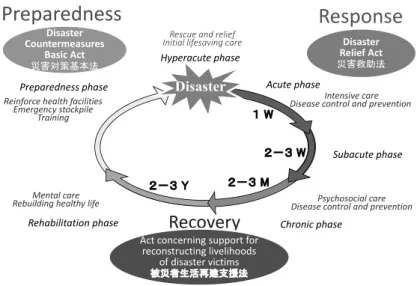
Natural disasters cause a great loss of people's lives and properties in Japan every year. In order to protect national land and the public, disaster management laws and systems were developed for promoting national land conservation and progressing society's capabilities (Figure 5) [30]. The disaster management system has been continuously reviewed and revised following the lessons learned from large-scale disasters. Initially, the Disaster Relief Act was implemented at 1947 after the Nankai earthquake to protect disaster affected people and maintain social order by the national government in cooperation with local public corporations, the Japan Red-Cross and other organizations, and the general public, at the time of disaster, by providing emergency relief. The cost for emergency response to assist the affected people is subjected to the local and national governments. The Disaster Countermeasures Basic Act has constantly been reviewed and amended since its first enactment in 1961. This act provides the basic idea of disaster countermeasures including organization of disaster management administration, and planning system: development and promotion of systematic disaster management measures, promotion of disaster countermeasures, protection of affected people and their livelihood, financial measures, and state of
disaster emergency. The Act concerning the support for reconstructing livelihoods of disaster victims was enacted in 1998 following the Great Hanshin-Awaji Earthquake. The Headquarters for Reconstruction of the Hanshin-Awaji Area (headed by the Prime Minister) was established to conduct reconstruction in disaster affected areas in a planned manner; to rebuild disaster victim’s abilities to live autonomously; to provide disaster-affected people with shelter, and to revitalize the local economy.
Health crisis management is responsible for the hazardous environments and health, and strengthening p u b l i c h e a l t h e m e rg e n c y re s p o n s e . E m e rg e n c y management response is considered to be divided into three phases: response, recovery, and preparedness (Figure 5). In the event of a disaster (acute emergency response phase), disaster and damage information is quickly collected and shared by secure communications to carry out effective emergency activities such as emergency rescue and medical operations. The Disaster Medical Assistance Teams (DMATs) are dispatched to provide wide-area medical services. These teams transport severely injured persons via Self-Defense Forces vehicles and aircrafts to hospitals outside the disaster stricken zone. In recovering and reconstructing from disasters (recovery phase), the aim is not merely to restore public buildings to their original state. In order to improve the disaster resilience of the community and to reduce disaster damages, there must be close cooperation among stakeholders such as residents, politicians, scientists and workers, to build momentum for a nationwide movement. In particular, public health workers collaborated with volunteers and helped to identify health problems among affected people. In the preparedness phase, the Basic Disaster Management Plan
is a comprehensive and long-term disaster management plan forming a foundation for the Disaster Management Operations Plan and Local Disaster Management Plan Disaster Countermeasures. A Disaster Management System is established against various disasters such as an earthquake, tsunami, land-slide, large-scale floods, volcano, and blizzard. Essential actions to prepare for the future disaster are disaster reduction drills and exercises, and human resources development for local public officers who are engaged in services for disaster management. There are links among each phase which we described above. Emergency management forms a cycle, rather than a linear pathway, performing the same process over again from the beginning at the end of each go-round.
Acknowledgements
The authors would like to thank Prof. Erik Robert Svendsen, PhD, Department of Public Health Sciences, Medical University of South Carolina for English editing and careful review of the manuscript. This work was supported by Industrial Disease Clinical Research Grants (#150803-02) from the Japanese Ministry of Health, Labour, and Welfare.
Conflict of Interests
The authors declare that there is no conflict of interests regarding the publication of this article.
References
[1] National Police Agency. Disaster situation and police 2-3 W 1 W 2-3 M 2-3 Y
Disaster
Acute phase Subacute phase Chronic phase Rehabilitation phase Preparedness phase Disaster Relief Act 災害救助法 Disaster 災害対策基本法 Disaster Countermeasures Basic Act 災害対策基本法 Rescue and relief Initial lifesaving care Intensive care Disease control and prevention Psychosocial care Disease control and prevention Mental care Rebuilding healthy life Reinforce health facilities Emergency stockpile Training Hyperacute phasePreparedness
Response
Recovery
Act concerning support for Act concerning support for reconstructing livelihoods of disaster victims 被災者生活再建支援法actions regarding off the Pacific coast of Tohoku, an Earthquake. 2017.12.8. https://www.npa.go.jp/news/ other/earthquake2011/pdf/higaijokyo.pdf (accessed 2018-01-10) [in Japanese].
[2] Ministry of Education, Culture, Sports, Science and Technology (MEXT). Results of Airborne Monitoring by the Ministry of Education, Culture, Sports, Science and Technology and the U.S. Department of Energy. 2011.3.6. http://www.mext.go.jp/component/english/__ icsFiles/afieldfile/2011/05/10/1304797_0506.pdf (accessed 2018-01-10)
[3] International Atomic Energy Agency (IAEA). Evaluation of the amount released into the atmosphere from the NPS, Additional Report of Japanese Government to the International Atomic Energy Agency: The Accident at TEPCO's Fukushima Nuclear Power Stations (second report). 2011.9.12. http://www. iaea.org/newscenter/focus/fukushima/japan-report2/ (accessed 2018-01-10)
[4] World Health Organization (WHO). Heath effects of the Chernobyl accident and special health care programmes. Report of the UN Chernobyl forum expert group "health". 2006. http://whqlibdoc.who. int/publications/2006/9241594179_eng.pdf (accessed 2018-01-10)
[5] Tanigawa K, Hosoi Y, Hirohashi N, Iwasaki Y, Kamiya K. Loss of life after evacuation: lessons learned from the Fukushima accident. Lancet. 2012;379:889-891. [6] Nomura S, Gilmour S, Tsubokura M, Yoneoka D,
Sugimoto A, Oikawa T, et al. Mortality risk amongst nursing home residents evacuated after the Fukushima nuclear accident: a retrospective cohort study. PLoS One. 2013;8:e60192.
[7] Tsubokura M. Secondary health problems associated with the Fukushima Daiichi nuclear accident, based on the experiences of Soma and Minamisoma Cities. Journal of National Institute of Public Health. 2018;67(1):71-83.
[8] Yasui S. Radiation Protection for Fukushima 50: Lessons Learned From Fukushima Nuclear Disaster. South Caroline, USA: CreateSpace Independent Publishing Platform; 2017.
[9] Yasui S. A Review: Lessons Learned from Radiation Protection for Emergency Response and Remediation/ Decontamination Work relating to the Fukushima Daiich Nuclear Power Plant Accident in 2011. Journal of National Institute of Public Health. 2018;67(1):84-92.
[10] Terada H, Yamaguchi I, Shimura T, Svendsen ER, Kunugita N. Regulation values and current situation of radioactive materials in food, Journal of National
Institute of Public Health. 2018;67(1):21-33.
[11] Nuclear Safety Commission (NSC). Derived intervention levels for food control. 1998. 3. 6. http://www.mhlw.go.jp/stf/shingi/2r98520000018iyb-att/2r98520000018k4m.pdf (accessed 2018-01-10) [in Japanese])
[12] Yamaguchi I, Terada H, Kunugita N, Takahashi K. Dose estimation from food intake due to the Fukushima Daiichi nuclear power plant accident. J. Natl. Inst. Public Health. 2013;62:138-143.
[13] UNSCEAR. Sources of ionizing radiation, UNSCEAR 2008 REPORT. 2008. http://www.unscear.org/unscear/ en/publications/2008_1.html (accessed 2018-01-10) [14] Nuclear Safety Research Association (NSRA).
Radiation at living environment. Calculation of doseage of radio-activity afflicting Japanese peoples. 2011:155. [15] Cardis E, Howe G, Ron E, Bebeshko V, Bogdanova
T, Bouville A, et al. Cancer consequences of the Chernobyl accident: 20 years on. J Radiol Prot. 2006;26:127-140.
[16] Baverstock K, Williams D. The Chernobyl accident 20 years on: an assessment of the health consequences and the international response. Environ Health Perspect. 2006;114:1312-1317.
[17] UNSCEAR. Sources and Effects of ionizing radiation, UNSCEAR 2000 REPORT. 2000;2.
http://www.unscear.org/unscear/en/publications/2000_2. html (accessed 2018-01-10)
[18] Hosoda M, Tokonami S, Akiba S, Kurihara O, Sorimachi A, Ishikawa T, et al. Estimation of internal exposure of the thyroid to (131)I on the basis of (134) Cs accumulated in the body among evacuees of the Fukushima Daiichi Nuclear Power Station accident. Environ Int. 2013;61:73-76.
[19] Tokonami S, Hosoda M, Akiba S, Sorimachi A, Kashiwakura I, Balonov M. Thyroid doses for evacuees from the Fukushima nuclear accident. Sci Rep. 2012;2:507. doi: 10.1038/srep00507.
[20] Takahashi H. The results of the first-round thyroid examination of the Fukushima Health Management Survey. Journal of National Institute of Public Health. 2018;67(1):42-49.
[21] Unno N, Minakami H, Kubo T, Fujimori K, Ishiwata I, Terada H, et al. Effect of the Fukushima nuclear power plant accident on radioiodine (131I) content in human breast milk. Journal of Obstetrics and Gynaecology Research. 2012;38:772-779.
[22] Suzuki M, Terada H, Unno N, Yamaguchi I, Kunugita N, Minakami H. Radioactive cesium (134 and Cs-137) content in human placenta after the Fukushima nuclear power plant accident. Journal of Obstetrics and
Gynaecology Research. 2013;39:1406-1410.
[23] World Health Organization (WHO). Preliminary dose estimation from the nuclear accident after t h e 2 0 1 1 G re a t E a s t J a p a n e a r t h q u a ke a n d tsunami 2012. http://apps.who.int/iris/bitstre am/10665/44877/1/9789241503662_eng.pdf (accessed 2018-01-10)
[24] UNSCEAR. Sources, effects and risks of ionizing radiation, UNSCEAR 2013 Report. Volume I: SCIENTIFIC ANNEX A: Levels and effects of radiation exposure due to the nuclear accident after the 2011 great east-Japan earthquake and tsunami. (New York: United Nations). 2013. http://www.unscear. org/docs/publications/2013/UNSCEAR_2013_Report_ Vol.I.pdf (accessed 2018-01-10)
[25] UNSCEAR. Developments since the 2013 UNSCEAR Report on the Levels and Effects of Radiation Exposure due to the Nuclear Accident Following the Great East-Japan Earthquake and Tsunami. A 2015 white paper to guide the Scientific Committee’s future programme of work. (New York: United Nations). 2015.
http://www.unscear.org/docs/publications/2015/ UNSCEAR_WP_2015.pdf (accessed 2018-01-10) [26] UNSCEAR. Developments since the 2013 UNSCEAR
Report on the Levels and Effects of Radiation
Exposure due to the Nuclear Accident Following the Great East-Japan Earthquake and Tsunami. A 2017 white paper to guide the Scientific Committee’s future programme of work. (New York: United Nations). 2017.
http://www.unscear.org/docs/publications/2017/ UNSCEAR_WP_2017.pdf (accessed 2018-01-10) [27] International Atomic Energy Agency (IAEA).
Enhancing transparency and communication effectiveness in the event of nuclear or radiological emergency. IAEA REPORT. 2012.6.
http://www-pub.iaea.org/MTCD/Publications/PDF/ IEM-2_web.pdf (accessed 2018-01-10)
[28] Shineha R, Tanaka M. History and lessons of science communication: implications from and for the 3.11 triple disasters, Journal of National Institute of Public Health. 2018;67(1):103-114.
[29] Yamaguchi I, Shimura T, Terada H, Svendsen ER, Kunugita N. Lessons learned from radiation risk communication activities regarding the Fukushima nuclear accident. Journal of National Institute of Public Health. 2018;67(1):93-102.
[30] Cabinet Office, Government of Japan. Disaster management in Japan. 2015. 5. http://www.bousai. go.jp/1info/pdf/saigaipamphlet_je.pdf (accessed 2018-01-10)