第 54 卷第 6 期
2019
年 12 月
JOURNAL OF SOUTHWEST JIAOTONG UNIVERSITY
Vol. 54 No. 6
Dec. 2019
ISSN: 0258-2724 DOI:10.35741/issn.0258-2724.54.6.61
Computer and Information Science
D
ESIGN AND
I
MPLEMENTATION OF A
S
MART
I
NTEGRATED
F
RAMEWORK TO
M
ONITOR AND
C
ONTROL THE
S
MART
C
ITY USING
THE
I
NTERNET OF
T
HINGS
Haider M. Al-Mashhadia,*, Kareem R. Hassanb
a
Department of Information Systems, College of Information Technology, University of Basrah, Iraq, [email protected]
bDepartment of Computer Science, College of Information Technology, University of Basrah, Iraq,
Abstract
The Internet of Things (IoT) is a system that can integrate easily a huge number of various heterogeneous end devices to collect and transfer data from various types of environments. This data can be accessed, processed, analyzed, monitored or controled on this environment to provide digital service that results in less cost and optimization of these operations. This paper presents an IoT framework that includes four sub-frameworks that can control fire, gas, robbery detection system, a home device controlling system and electrical meter system, to support the smart city model. The system can detect the fire or gas leakage in the building, then it sends an alert message to the owner of the building and to the fire-fighting station. In case of robbery the system sends an alarm to the police station. In addition to the device control by turning them on or off remotely, it measures the electrical power consumed by the building and sends this information to the electricity company to issue the appropriate invoice and to the building owner to adjust the amount of power consumed. The service consists of two parts: hardware and software that can use the WSN, cloud services, MQTT protocol and DBMS to collect, process and store data, transfer messages and alarms.
Keywords: Cloud computing, Microcontroller, message queuing telemetry transport (MQTT), Smart City, Wireless sensor networks (WSN). 摘要 物联网(IoT)是一个可以轻松集成大量各种异构终端设备以从各种类型的环境收集和传输数据的系统。可 以在此环境上访问,处理,分析,监视或控制此数据,以提供数字服务,从而降低成本并优化这些操作。 本文提出了一个物联网框架,该框架包括四个子框架,可以控制火,气,抢劫检测系统,家用设备控制系 统和电表系统,以支持智能城市模型。该系统可以检测到建筑物中的火灾或煤气泄漏,然后将警报消息发 送到建筑物的所有者和消防站。如果发生抢劫,系统会向警察局发送警报。除了通过远程打开或关闭设备 控制之外,它还可以测量建筑物消耗的电能,并将此信息发送给电力公司以发出适当的发票,并发送给建 筑物所有者以调整消耗的电量。该服务包括两部分:可以使用 WSN 的硬件和软件,云服务,MQTT 协议和 DBMS 来收集,处理和存储数据,传输消息和警报。 关键词: 云计算,微控制器,消息队列遥测传输(MQTT),智能城市,无线传感器网络(WSN)
I. I
NTRODUCTIONThe population density of the world is rising very fast inside the urban environments, according to the need to facilitate the requirements of the citizen’s life in these environments. Many services and platforms have been established to fit these requirements. This resulted in the development of the digital devices like sensors, control devices (actuators), smart appliances, smart phones that enable to achieve commercial benefits of the Internet of Things (IoT) and facilitate the human beings’ life, by interconnecting all devices and establishing communication between these devices through the Internet [1]. The old techniques do not have any ability to merge these digital devices. Also, it is very important to collect the daily management information on performance and the future design of the city, for example, information on public transport system, like, real time location and exploitation of the resources, the status of car parking spaces, the status of road traffic, and so on. This information should be collected in periodic time, this needs many techniques which have been employed to deal with each case. The desired techniques must include a wide range and levels to deal with all layers of communications. In [2] the authors proposed one of techniques to this case.
There are three layers in the IoT, the sensing “Perception” layer, the communication “Network” layer and the services of the “Application” layer. These layers are shown in Figure 1. The sensing layer contains a collection of nodes that can be used for monitoring, sensing, data collection and information swapping with other objects over the Internet. The perception layer can be exemplified by Radio Frequency Identification (RFID), temperature sensors, cameras and Global Positioning Systems (GPS). The network layer is responsible for transmitting the data gathered from the sensing layer to the application layer, the network layer deals with the devices which have limited capabilities, network limitation and the application limitation. The IoT framework may deal with different types of communication techniques from short-range systems like Bluetooth or ZigBee devices that can transfer the sensing data of a very short range to the base station [3].
Another way to transmit data from the sensing layer to the application layer is by using the Internet like WiFi, and Power Line Communication (PLC), cell phone techniques like 2G, 3G, 4G and 5G. These techniques can transmit the data to a long range distance depending on the required application such as
smart home, smart city, power system monitoring, and infrastructure monitoring like streets, highways, tunnels, bridges and so on. The application layer aims at receiving and processing the sensing data from the lower layers [4] depending on the type of application to fulfil the requirements of the application, to increase the optimization of the resources usage and to decrease the costs.
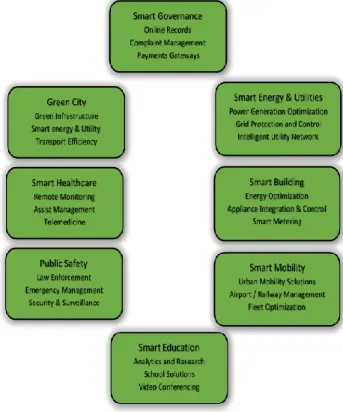
Figure 1. The IoT layers and Components The IoT can be used in the smart city to monitor and control the things of homes, buildings, street jams, and power transformation grid, etc. Smart cities exploit different kinds of electronic devices like cameras in security system, sensors in monitoring infrastructure systems and so on [5]. Thus, Figure 2 shows some of the main branches likely to be applied for smart cities in 2020 [6].
Figure 2. The important branches of smart cities. WiFi, GSM Perception Layer Things with sensors Network Layer LAN and the
Internet Application Layer Services Local Storage User, analysis and processing Cloud Storage Components Specifications Communication Distributed generation Environmental improvement Social welfare improvement efficient improvemnt Reliability and sustainability improvement Energy efficient improvement Smart cities
Things in the IoT can be grouped depending to their location and evaluated by using analyzing applications. Sensors are used to aggregate specific data that can be used in specific applications like surveillance of each bicyclist, vehicle, and car park and so on. There are many ranges of services that can be used in IoT to facilitate the monitoring and controlling systems in infrastructure and monitoring the pollution of air, water and noise, the movement of vehicles, and surveillance applications [7].
Figure 3. The IoT usage.
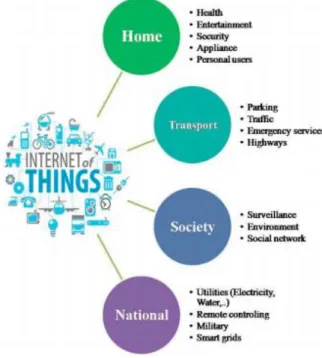
The Internet provides a powerful environment to connect persons and things and by rely on this infrastructure to develop IoT techniques. In 2011 the size of things that linked to the internet were exceeded the size of population. Figure 3 illustrates the correlation among the different objects based on the IoT [8].
As a result, the IoT can be enhance the cities and effect the life level of the citizens in it by establishing cost-effective regional services, supporting public transformation, processing traffic crowding, health care management. Besides, it can play a very important part in national level regarding with policy making (e.g. reduction of electrical power consuming and pollution), surveillance systems, and desired infrastructures. Therefore, it appends to the framework high performance, decrees cost and maximizing secure implementation through energy preservation principals, economic and reliability level [7].
This project consists of many techniques and units to monitor and control the buildings to
make a core for smart cities. These techniques and units include Fire detection, Motion detection, Devices monitoring and controlling, and Electricity Meter all these techniques connect to the Internet and can be followed up using computer application or mobile application remotely. The first technique is fire and gas leakages detection to sensing the fire and to send real time alarm to the fire-fighting center and the building floor water spray to extinguish the fire. By using fire sensor with microcontroller and communication unit to connect to the fire-fighting center server and to guide the fire fighter to the fire and stop it. At the same time sensing the gas leak and issue an alarm to caution the persons in that place. The second technique is the motion detection to monitor the building from any intruder or any possible robbery and issue an alarm. The third technique is to control on saving the energy for the devices that operates in building like lights, fans, refrigerators, and any kind of electricity devices must be taken into consideration to saving the energy. By exploiting the concept of IOT that can provide the ability to connect the building devices with the internet for monitoring and controlling the devices by using an application runs in a computer or mobile to access to these devices remotely and making it on or off. And finally, the fourth technique is the electricity meter to measure the amount of consuming energy for the building. The measures will be taken every amount of time and sending them to the electricity company to issue the bills and to calculate the amount of energy that can be consumed from every building. The project is very necessary in smart cities field to monitor and control the buildings and environment to save the energy and to enhance the living environment by making everything in this building working automatically and can be monitored and controlled remotely.
II.
R
ELATEDW
ORKSThe IoT has been generally utilized for fire detection by utilizing remote sensor network. The system proposed in [9] utilized Zigbee-based remote sensors for flame recognition in woods. They utilized temperature sensors and a CC2430 contribute their equipment plan to sense the force of fire in backwoods and organizing hubs, respectively. A method for flame discovery in mines by utilizing remote sensor systems called WMSS was proposed in [10]. For deciding the risky factor in the mines, they utilized gas sensors and composed a remote sensor arrange which
gathers and investigates the gas level in mines. The authors of [11] utilized the wireless sensor with low-power for online environment observation. In [12] the authors analyzed the plan and execution of a VOC checking framework in view of a ZigBee remote sensor arrange. In [13] the author proposed a method to enhance the network throughput by mitigate the effect of hotspot on network lifetime. A simulation method was proposed in [14] using Fire Dynamics Simulator to design a simulation method which use WSN to detect any change in environment that may cause by fire. It was proposed in [15] to use Bluetooth as a communication mean for home automation using FPGA. Bluetooth is used to send data through a short-range distance, the Bluetooth cannot be used for long range distance, so it is not efficient. An equipment model was planned to give an effective administration of electrical power at homes, which checks power utilization and controls the electric power utilized with the request reaction method utilizing ZigBee model and GSM technique [16]. A framework was introduced in [17] that utilized electronic three stage four wire power meter, all power estimations are taken in the computerized area. These readings are transmitted to the versatile of client by means of remote GSM innovation. Client can have the updates of electric vitality utilization information on his versatile. Controller is utilized for controlling all elements of meter.
III. U
SINGI
OT
INS
MARTC
ITIESIot uses many standard protocols for communication to establish a broadband network. The term IoT is composed of two concepts: "Internet" and "Things", where "Internet" is the network of interconnected networks around the wide world that depends on a standard communication protocol (TCP/IP). "Things" refers to an object that can be a device, vehicle, buildings and so on that can have a unique identification to connect to the Internet [18, 19].
IoT needs up to millions of sensors, so the cost of cabling these sensors to compose a sensor network will be very expensive operation. Therefore, the communication method between these sensors must be cheap, is not affected by location or distance, nature of environment and consumes low power, and for this reason can use a wireless sensor networks that can be embedded in devices or spread in harsh environment to monitor and control on it. There are different types of networks. These networks can be classified by area and distance as follows [7]:
1. Home Area Networks (HAN): these networks have short-area models like, ZigBee, Bluetooth, Dash7, and Wi-Fi, that can be used for monitoring and control the environment at home.
2. Wide Area Networks (WAN): can connect networks through a wide geographical area and provide a link between customers and remote services. This type of networks requires fiber cable or wireless broadband communication like 3G and LTE.
3. Field Area Networks, which are utilized for association amongst clients and substations.
A. Radio-Frequency Identification (RFID)
RFID has a very important role in the IoT because it widely used in monitoring and tracking systems. This equipment consists of two parts which are RFID readers and RFID tags. The RFID defines the identity of the things and makes access to digital services more secure; it can be used in different applications like tracking and localization of persons and objects, smart grids, health care applications and vehicles parking. B. Near Field Communication (NFC)
NFC can be utilized for bidirectional small range, particularly in cutting edge cell phones. The range of NFC is very limited, a centimeter area. There are many applications that utilized NFC, one of them is using PDAs with NFC as a bank card. For instance, bank card, ID card and general transportation card. NFC is bidirectional, so it is applied to exchange data between machines, intelligent nodes, and reports [4]. By putting NFC at a fundamental place at the appropriate place in house and outfitting an interface with the central controller, it is possible to modify the situation of items by testing the zone. For example, open the door when the customer gets back home.
C. Low Rate Wireless Personal Area Network (LWPAN)
LWPAN is among short-broaden radio advancement that moves in a large scope area up to 10– 15 km. The power usage of this technique is an extraordinarily low level and battery lifetime is about 10 years [2]. As showed by the IEEE 802.15.4 standard, it gives minimal effort and low-rate change for sensor frameworks. It has the most lessened two layers of conventions including physical and medium access level, other than upper layers conventions including 6LoWPAN and ZigBee [20].
D. 6LoWPAN
The 6LoWPAN standard is used the IPv6 addressing protocol. IPv6 replaced the IPv4 because it has a long range of addresses more than IPv4 because Ipv4 is limited range of addresses and cannot cover all hosts that connected to the Internet. IPv6 has 128 bit long with more security mandatory option and low consumption power that can be more suitable for IoT [21].
E. ZigBee
ZigBee has low-power and simple remote communication technique [4]. It is used on the IEEE 802.15.4 standard and is proper for setting up remote individual region systems (WPAN, for example, home computerization, medical services and other low-vitality, low-data transfer capacity. Can be utilizes as a part of utilizations like remote home devices switches, remote electrical meters, and movement administration frameworks. ZigBee is appropriate for short distance, scope of city area and supporting billions of gadgets. With the ZigBee-based system, an instrument for transmission of IPv6 bundles is determined. To apply ZigBee, extra gear for the most part is required including a facilitator, switch and ZigBee end-gadgets.
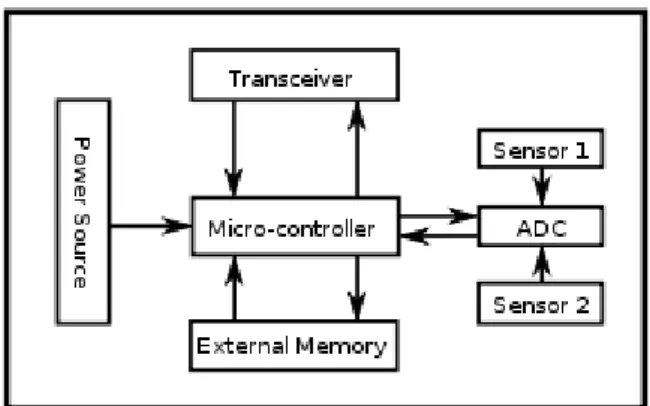
F. Wireless Sensor Networks (WSNs) WSNs can access and collect various types of data from various types of environments. These data help in different applications like medicinal services, as well as government and environmental applications [22]. In addition, WSNs can be integrated with RFIDs to get more benefits, for instance, grabbing data to distinguish the position of people and things, temperatures, development and so on. A WSN includes remote sensor gadgets with a radio handset, a straightforward analogue-to-digital converter (ADC), diverse sensors, memory and a power supply [4].
The particular parts of a remote sensor gadget are shown in Figure 4. As indicated by remote sensor gadget, it joins diverse sorts of sensors which measure data in basic game plan which are changed over to cutting edge data through an ADC. Finally, data are transferred by a radio interface. The whole parts of this rigging supported and provided with a power supply.
WSN includes very small low-cost, low energy sensor device which can be distributed in any ambience to collect data about this environment for a few years. WSN suffers from constraints that makes its work don’t reach its
goal perfectly like battery life. If the battery fails, it is very difficult to replace it especially if millions of sensors are used in smart city, so it must design a new feasible protocol to manage the power in WSN like solar panels.
Figure 4. Wireless sensor node architecture.
G. Dash7
Dash7 is a best standard for WSNs used as a piece of wide zone and low power detecting administrations, for instance, building checking and controlling. It can be utilized for kilometer-separate range and works at 433 MHz. It justifies seeing that Dash has more attractive in military application especially substation improvement. Dash7 can be used in many applications like risky material watching, distribution center focus and smart meter [23].
H. 3G and Long-Term Evolution (LTE) 3G and LTE are conventions for remote communication for mobiles and information stations. According to changing and improvement of remote communication systems, LTE and 3G that are used everywhere, even in third world countries. This development is for broadband accessibility and was not proposed for short range operation. Thus, it is associated for WANs which require longer distance ranges. Everything considered, there are a couple of constraints to their use. High data cost since giving this organization by the expert associations, and weakness to use them for correspondence among billion devices are a bit of the issues of these organizations [7].
I. Smart Cities frameworks and Standards
The connection of the physical and IT structure builds up a machine-to-machine (M2M) association for smart city which can support the new properties of network applications in smart cities framework. These frameworks can be used to make a base station between heterogeneous
WSN technology and service providers. In addition, these frameworks help shaping the IoT by joining true sensors and communication systems. One of these stages that is being utilized generally is open MTC adopted from the most recent ETSI standards for the smartM2M protocol. The point of the open MTC service is to give a consistent middleware framework to M2M services and execution of the smart city [24].
As presented before, the principle models for savvy urban communities are provided by IEEE 802.15 which is for WPANs. These models comprise various parts as follows [25]:
Bluetooth,
Coexistence,
Low and High rate WPAN,
Mesh networking,
Body area networks,
Visible light communication,
Peer aware communication,
Key management protocol,
Layer 2 routing,
Wireless next generation standing committee.
IV.
S
MART CITIES AND THEI
OT
APPLICATIONSThe IoT should be on the web to make the information accessible, and utilizing the web to join diverse heterogeneous machines. Thus, to make these information accessible, each present hub should be on line through utilizing the Internet. The clarification for this is urban networks consolidate sensor frameworks and relationship of smart machines to the web is fundamental to remotely observing their surroundings, for instance, control use checking to upgrade the power usage, light organization, air circulation and cooling framework organization. To get this point, sensors can be dispersion out at various territories to gather and send data for use to enhance these conditions [26]. Figure 5 demonstrates the genuine uses of the IoT for a smart city.
V. C
LOUD ANDI
OT
C
OMMUNICATIONP
ROTOCOLSConstant developments in equipment, programming and communication protocols in the most recent decade have prompt the extension of the Internet of Things (IoT) with the quantity of associated devices developing continuously [27] [26]. The colossal measure of information produced by these devices require to locate a
legitimate framework design ready to both process and store every one of the information.
Figure 5. The IoT Applications in the Smart City. While cloud-based structures are utilized now for collecting, storing and processing the information of IoT, the new world view is imagined to scale and advance the IoT foundations [29]. Cases of the cloud-based IoT arrangements have been proposed in [30], [31], [32] and a point by point examination of properties for IoT cloud suppliers has been directed in [33]. These examinations have demonstrated that distributed computing can possibly fulfil numerous IoT prerequisites, for example, checking of services, intense handling of sensor information streams and visualization tasks.
There are many protocols that can be used for cloud communication include:
HTTP Hyper Text Transport Protocol [34].
DDS Data Distribution Service [3353].
AMQP Advanced Message Queuing Protocol [36].
CoAP Constrained Application Protocol [37].
MQTT Message Queue Telemetry Transport Protocol [38].
XMPP Extensible Messaging and Presence Protocol [39].
VI.
T
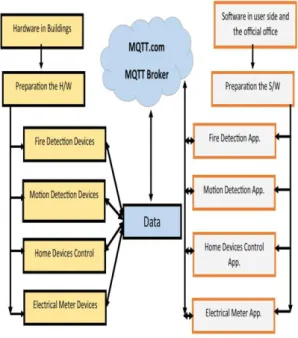
HE PROPOSED FRAMEWORK The framework proposed four sub-frameworks, fire detection frame work, motion detection framework, electrical meter framework and device control framework. Each sub-framework includes two parts hardware and software to monitor and control on the buildings in smart city. Each sub-framework has devices with sensors to monitor the specific function required in the buildings beside a PC program (database) and mobile application to register and alarm each change that can happen during a period of time, this change may trigger alarm to inform the user or the responsible government section to take an action to adjust this situation.The entire framework is shown in Figure 6.
Figure 6. The architecture of smart city framework. A. Fire Detection framework
Fire detection framework consists of two parts, the hardware and software. The hardware is a device consisting of a set of sensors that are connected to a controller (NODEMCU). Figure 7 shows the devices and a package of the fire detection system. The controller is connected to the Internet by the cloud (www.cloudmqtt.com), where it sends alerts to the owner of home or buildings and alarm to the fire department to take an appropriate action. These notifications are received by the mobile application of the owner and the computer application on the fire- fighting station.
The Java language has been used to build the application of the private computer in the fire- fighting station that can be connected with the fire detection devices through the cloud. Because
of the strength and flexibility of Java language, databases of type (MySQL) have been used to store the data for fire detection devices.
Fig. 7 Fire detection model.
The application is listening to all devices. Where a notification is made with the information of the device that sends a fire warning (for each device " ID " its own) through which the device is identified and information. When a notification is received from a device, the program retrieves the device information from the database and display a Notice on the interface with a sound to alert for notice. Figure 8 illustrates the application work.
Figure. 8 The fire detection application In addition, the notification feature has been added to the phone application where notification of the application is connected to the device that enables the owner to monitor the building where he/she out of building.
B. Motion Detection Framework
The owner of building can make this sub-framework on or off by using the application of the mobile by sending a message to the motion detection device to tell it to work if the owner out of building or at night to protect the building from any strangers. Where the device senses the movement at the location of the device. It sends a warning to the cloud (www.cloudmqtt.com), and this warning is received by the mobile application of the owner and the application of the computer in police station. The benefit of this program is to
notify the user of theft in the event of leaving the house or building. Figure 9 shows the device and figure 10 shows the application software.
Figure 9. The motion detection devices.
Figure 10. Motion detection application. C. Electrical Meter Framework
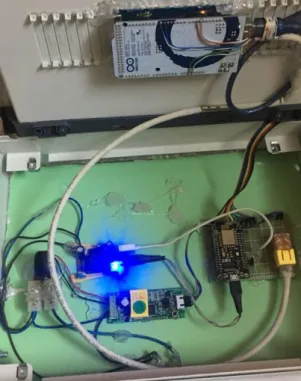
One of the most important sub-framework of the research is the intelligent electrical meter system, where the sensors measure (voltage, current, active power, energy) by a device (AC digital display Multifunction Meter) and send the collected information to the controller station application in electrical company, the controller displays in the screen attached to it and send to the mobile application and the application of the computer. Figure 11 illustrates the device and the screen display for the sensing data of electrical meter.
The Java application is also used to build the application of Electrical Meter. Using MySQL database to store data with building information, the application is listening to all devices, which displays the electricity information of the buildings (volts, current, power, etc..) sent by the device, and this information is received by company application and the owner phone to view it and can regulate the amount of electricity power used by the owner or building. Figure 12 illustrates the electrical meter application that issued by electricity company to measure the consumed power for each building in the city.
Figure 11: The electrical meter system.
.
Figure 12. The electrical meter application. D. Control on the building devices
The devices in the buildings are controlled by using the mobile application, which is operated and turned off via the Internet according to the following scheme that is illustrated in Figure 13:
E. The Mobile Application
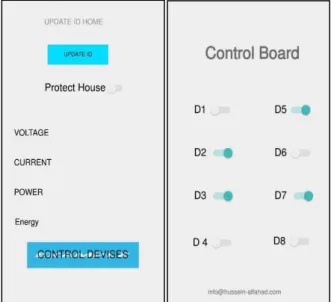
The phone application displays the information of the building and the notifications of devices linked with. In addition to the operation and extinguishing of the devices located in the building. Figure 14 shows the mobile application:
Figure 14. The mobile application.
VII. C
ONCLUSIONSCurrently, energy saving is one of the most important issues, because the energy is very costly and it is the worth of the country. The resources must be saved by reducing the working hours of the home devices. Smart energy in buildings is a vital field of the Internet of Things (IoT). Buildings consider important things of the smart grids; their energy consumption is important for the earth and worldwide maintainability. As indicated in a general overview, in the United States, buildings are in charge of around 38% of the aggregate carbon dioxide emanations; 71% of the aggregate electrical vitality utilization; 39% of the aggregate energy usage; 12% of water utilization; and 40% of non-industrial waste. Meanwhile, cost of conventional petroleum products is rising and its negative effects on the planet atmosphere and environment make it imperative for us to enhance the power effectiveness in the client side of smart networks of different buildings. In addition, the security of building is another important issue that can be considered to monitor and control on building against thefts and fires or gas leakages. Also, monitoring the amount of energy consumption is a very important issue, these measures must be taken directly by the electricity company for every building to evaluate the daily, monthly and yearly consumed energy. By exploiting the concept of the IOT that
can provide the ability to connect the building devices and environment with the Internet and for monitoring and controlling the devices by using application runs in computer or mobile to access to these devices and environment remotely.
This work consists of many techniques and units to monitor and control the buildings to make a core for smart cities. These techniques and units include Fire detection, Motion detection, Device monitoring and controlling, and Electricity metering; all these techniques are connected to the Internet and can be followed up using computer application or mobile application remotely. The first technique is fire and gas leakage detection which operates by sensing the fire and sending real time alarm to the fire-fighting center and by spraying the building floor with water to extinguish the fire, and also by using fire sensor with microcontroller and communication unit to connect to the fire-fighting center server and to guide the fire fighters to the fire and stop it. At the same time, it can sense the gas leak and send an alarm to caution the persons in that place. The second technique is the motion detection to monitor the building from any intruder or any possible robbery and send an alarm signal. The third technique is to control over energy saving for the devices that operate in buildings like lights, fans, refrigerators; any kind of electricity devices must be taken into consideration to save energy. By exploiting the concept of the IOT that can provide the ability to connect the building devices with the Internet for monitoring and controlling the devices by using application run in computer or mobile to get access to these devices remotely and turn them on or off. And finally, the fourth technique is the electricity meter to measure the amount of energy consumed for the building. The energy measurements will be taken every amount of time and sent to the electricity company to issue the bills and to calculate the amount of energy consumed in every building. The project is very necessary in smart cities field to monitor and control the buildings and environment to save the energy and to enhance the living environment by making everything in this building work automatically through remote monitoring and control.
R
EFERENCES[1] RATHORE, M.M., AHMAD, A., PAUL, A., & RHO, S. (2016) Urban planning and building smart cities based on the Internet of Things using Big Data analytics. Computer
Networks, 101, pp. 63-80,
[2] ZHU, C., LEUNG, V.C.M., SHU, L., & NGAI, E.C.H. (2015) Green Internet of Things for Smart World. IEEE Access, 3, pp. 2151–2162.
[3] JARADAT, M., JARRAH, M., BOUSSELHAM, A., JARARWEH, Y., AL-AYYOUB, M. (2015) The Internet of Energy: Smart Sensor Networks and Big Data Management for Smart Grid. Procedia
Computer Science, 56, pp. 592–597,
doi: 10.1016/j.procs.2015.07.250
[4] HANCKE, G., SILVA, B., HANCKE, G., Jr. (2012) The Role of Advanced Sensing in Smart Cities. Sensors, 13, 393–425.
[5] KYRIAZIS, D., VARVARIGOU, T., WHITE, D., ROSSI, A., & COOPER, J., (2013) Sustainable smart city IoT applications: Heat and electricity management amp; Eco-conscious cruise control for public transportation. Proceedings of the 2013 IEEE 14th International Symposium on “A World of Wireless, Mobile and Multimedia Networks” (WoWMoM), Madrid, Spain, 4–7 June 2013; pp. 1–5.
[6] FROST & SULLIVAN (2013) Strategic Opportunity Analysis of the Global Smart City Market. Available online:
https://dsimg.ubm-us.net/envelope/153353/295862/1391029790_ strategic_opportunity.pdf (accessed on 19 May 2018).
[7] TALARI, S., SHAFIE-KHAH, M., SIANO, P., LOIA, V., TOMMASETTI, A., & CATALÃO, J.P. (2017) A Review of Smart Cities Based on the Internet of Things Concept. Energies, 10, 421; doi:10.3390/en10040421.
[8] GUBBI, J., BUYYA, R., MARUSIC, S., PALANISWAMI, M. (2013) Internet of Things (IoT): A vision, architectural elements, and future directions. Future Generation Computer Systems, 29, pp.1645–1660.
[9] CHIWEWE, T.M., MBUYA, C.F., & HANCKE, G.P. (2015) Using cognitive radio for interference-resistant industrial wireless sensor networks: An overview. IEEE Transactions on Industrial Informatics, 11(6),
pp. 1466–1481, doi:
10.1109/TII.2015.2491267.
[10] SILVA, B., FISHER, R.M., KUMAR, A., & HANCKE, G.P. (2015) Experimental link quality characterization of wireless sensor networks for underground monitoring. IEEE
Transactions on Industrial Informatics, 11(5),
pp. 1099–1110, doi:
10.1109/TII.2015.2471263.
[11] FOLEA, S.C. & MOIS, G. (2015) A Low-Power Wireless Sensor for Online Ambient Monitoring. IEEE Sensors Journal, 15(2), pp. 742–749.
[12] CHANGHAI, P., KUN, Q. & CHENYANG, W. (2015) Design and Application of a VOC- Monitoring System Based on a ZigBee Wireless Sensor Network. IEEE Sensors Journal, 15(4), pp. 2255–2268.
[13] REHMAN, A., DIN, S.; PAUL, A., & AHMAD, W. (2017) An Algorithm for Alleviating the Effect of Hotspot on Throughput in Wireless Sensor Networks. Proceedings of the IEEE 42nd Conference on Local Computer Networks Workshops (LCN Workshops), Singapore, 9–12 October 2017; pp. 170–174.
[14] SAEED, F., PAUL, A., REHMAN, A., HONG, W.H., & SEO, H. (2018) IoT-Based Intelligent Modeling of Smart Home Environment for Fire Prevention and Safety. Journal of Sensor and Actuator Networks, 7(11), pp. 1-16, doi: 10.3390/jsan7010011. [15] KRISHNA, B.M. & NAYAK, V.N. &
REDDY, K.R. & RAKESH, B. & KUMAR, P. & SANDHYA, N. (2015) Bluetooth Based Wireless Home Automation System Using FPGA. Journal of Theoretical and Applied Information Technology, 77(3), pp. 411-420. [16] CHARLY, A. REDDY, J. & ASHOK, S.
(2014) Development of inbuilt Energy Management Controller for Smart meter. Proceedings of the 2014 IEEE International Conference on Advanced Communications,
Control and Computing Technologies,
Ramanathapuram, pp. 371-375, doi: 10.1109/ICACCCT.2014.7019466
[17] AROTE, S., MULAY G.N., & KHAPARDE, A. (2016) Design and Implementation of Smart Three Phase Energy Meter. Proceedings of the IEEE International Conference on Smart Grid and Clean Energy
Technologies, pp.44-49, doi:
10.1109/ICSGCE.2016.7876023
[18] ATZORI, L., IERA, A., & MORABITO, G., (2010) The Internet of Things: A survey. Computer Networks, 54, pp. 2787–2805. [19] European Commission, Information Society
and Media (2008) Internet of Things in 2020: Roadmap for the Future. Workshop Report.
Available online: https://docbox.etsi.org/erm/Open/CERP%202 0080609-10/Internet-of-Things_in_2020_EC-EPoSS_Workshop_Report_2008_v1-1.pdf (accessed on 9 June 2018).
[20] RAWAT, P., SINGH, K.D., CHAOUCHI, H., BONNIN, J.M. (2014) Wireless sensor networks: A survey on recent developments and potential synergies, Journal of
Supercomputing, 68(1), pp. 1-48,
doi: 10.1007/s11227-013-1021-9.
[21] ZANELLA, A., BUI, N., CASTELLANI, A., VANGELISTA, L., & ZORZI, M. (2014) Internet of Things for Smart Cities”, IEEE Internet of Things Journal, 1, pp. 22–32. [22] ALAMRI, A., ANSARI, W.S., HASSAN,
M.M., HOSSAIN, M.S., ALELAIWI, A., & HOSSAIN, M.A. (2013) A Survey on Sensor-Cloud: Architecture, Applications, and Approaches. International Journal of Distributed Sensor Networks, 9(2), Article ID 917923, pp. 1-18, doi: 10.1155/2013/917923 [23] VERMESAN, O., & FRIESS, P. (Eds.)
(2014) Internet of Things Applications – From
Research and Innovation to Market
Deployment. The River Publisher Series in Communication: Delft, The Netherlands; pp. 287–313.
[24] ELMANGOUSH, A., AL-HAZMI, A., MAGEDANZ, T., SCHUCH, W., NGUYEN, T., & VENTURA, N. (2015) Towards Unified Smart City Communication Platforms. Proceedings of the Workshop on Research in Information Systems and Technologies, Chillán, Chile, 16 October 2015. Available online: https://pdfs.semanticscholar.org/7128/4d4cc9 5ebcba227c8154a34792db01c14a21.pdf?_ga= 2.3259059.22915786.1582211436-371137892.1579623886 (accessed on 10 June 2018).
[25] Wireless Personal Area Networks (WPANs) Bluetooth, ZigBee. Available online: https://cs.wmich.edu/~alfuqaha/Fall09/cs6030 /lectures/WPAN.pdf (accessed on 10 June 2018).
[26] BOTTA, A., de DONATO, W., PERSICO, V., & PESCAPÉ, A. (2016) Integration of Cloud computing and Internet of Things: A survey. Future Generation Computer Systems,
56, pp. 684–700, doi:
10.1016/j.future.2015.09.021.
[27] HAHM, O., BACCELLI, E., PETERSEN, H. & TSIFTES, N. (2016) Operating Systems for Low-End Devices in the Internet of Things: A Survey. IEEE Internet of Things Journal 3(5), pp. 720–734.
[28] XU, Y. MAHENDRAN, V., GUO, W. & RADHAKRISHNAN, S. (2017) Fairness in fog networks: Achieving fair throughput performance in MQTT-based IoTs. Proceedings of the 14th IEEE Annual
Consumer Communications Networking
Conference (CCNC), pp. 191–196.
[29] SETHI, P. & SARANGI, S.R. (2017) Internet of Things: Architectures, Protocols, and Applications. Journal of Electrical and Computer Engineering, 2017, pp. 1–25, doi: 10.1155/2017/9324035.
[30] BOTTA, A., de DONATO, W., PERSICO, V., & PESCAPÉ, A. (2014) On the Integration of Cloud Computing and Internet of Things. Proceedings of the 2014 International Conference on Future Internet of Things and Cloud (FICLOUD ’14), pp. 23– 30.
[31] HUO, C., CHIEN, T.C. & CHOU, P.H. (2014) Middleware for IoT-Cloud Integration Across Application Domains. IEEE Design Test, 31(3), pp. 21–31.
[32] FORTINO, G. GUERRIERI, A. RUSSO, W. & SAVAGLIO, C. (2014) Integration of agent-based and Cloud Computing for the smart objects-oriented IoT. Proceedings of the 2014 IEEE 18th International Conference on Computer Supported Cooperative Work in Design (CSCWD), pp. 493–498.
[33] PFLANZNER, T. & KERTESZ, A. (2016) A survey of IoT cloud providers”, Proceedings of the 39th International
Convention on Information and
Communication Technology, Electronics and Microelectronics (MIPRO), pp.730–735. [34] SEVERANCE, C. & ROY, T. (2015)
Fielding: Understanding the REST Style. Computer, 48(6), pp. 7–9.
[35] FARABAUGH, G.,
PARDO-CASTELLOTE, G. & WARREN, R. (2005) An Introduction to DDS and Data-Centric
Communications. Real-Time Innovations
August.
[36] FERNANDES, J.L., LOPES, I.C., RODRIGUES, J.J.P.C. & ULLAH, S. (2013) Performance evaluation of RESTful web services and AMQP protocol. Proceedings of
the 2013 Fifth International Conference on Ubiquitous and Future Networks (ICUFN), pp. 810-815, doi: 10.1109/ICUFN.2013.6614932
[37] BORMANN, C. LEMAY, S.
TSCHOFENIG, H. HARTKE, K., SILVERAJAN, B. & RAYMOR, B. (2018) CoAP (Constrained Application Protocol) over TCP, TLS, and WebSockets. RFC 8323. RFC Editor.
[38] BANKS, A., & GUPTA, R. (Eds.) (2014) MQTT Version 3.1.1. OASIS Committee Specification Draft 02 / Public Review Draft
02. Available online:
http://docs.oasisopen.org/mqtt/mqtt/v3.1.1/mq tt-v3.1.1.html.
[39] HORNSBY, A. & WALSH, R. (2010) From instant messaging to cloud computing, an XMPP review. Proceedings of the IEEE
International Symposium on Consumer
Electronics (ISCE 2010), Braunschweig,
Germany, pp. 1–6, doi: 10.1109/ISCE.2010.5523293.
参考文:
[1] RATHORE,MM,AHMAD,A.,PAUL ,A。和 RHO,S。(2016),城市规划和 使用大数据分析基于物联网建设智慧城市 。计算机网络,101,第 63-80 页,doi: 10.1016 / j.comnet.2015.12.023。 [2]朱超,梁振华,舒升和 NGAI,E.C.H。 ( 2015)智慧世界的绿色物联网。 IEEE 访问 , 3,第 2151–2162 页。 [3] JARADAT , M. , JARRAH , M. , BOUSSELHAM,A.,JARARWEH,Y., 和 AL-AYYOUB,M。(2015)能源互联 网:智能电网和智能电网的大数据管理。 Procedia计算机科学,,56,第 592-597 页 ,doi:10.1016 / j.procs.2015.07.250 [4] HANCKE,G.,SILVA,B.,和 HANCKE ,G.,Jr。(2012 年),《先进传感技术 在智慧城市中的作用》。传感器,13,第 393–425页。 [5] KYRIAZIS, D. , VARVARIGOU , T. , WHITE, D. , ROSSI , A 。 和 , 以 及 COOPER,J。,(2013 年),《可持续智 慧城市物联网应用:供热和电力管理放大 器;用于公共交通的环保巡航控制系统。 2013年第 14 届“无线,移动和多媒体网络 的世界”国际研讨会(WoWMoM)的会议 记录,2013 年 6 月 4 日至 7 日,西班牙马 德里;第 1-5 页。 [6] FROST 和 SULLIVAN(2013)全球智慧 城市市场的战略机会分析。可在线获取: https://dsimg.ubm-us.net/envelope/153353/295862/1391029790_ strategic_opportunity.pdf(于 2018 年 5 月 19日访问)。 [7] TALARI, S. , SHAFIE-KHAH , M. , SIANO,P.,LOIA,V.,TOMMASETTI ,A。和 CATALÃO,J.P。(2017),《 基于物联网概念的智慧城市回顾》。能量 ,10,421; doi:10.3390/en10040421。 [8] GUBBI,J.,BUYYA,R.,MARUSIC, S.,和 PALANISWAMI,M.(2013)物联 网(IoT):愿景,建筑元素和未来方向。 《下一代计算机系统》,29,第 1645-1660 页。 [9] CHIWEWE, T.M., MBUYA, C.F., 和 HANCKE,G.P。(2015)将认知无线电 用于抗干扰的工业无线传感器网络:概述 。 IEEE 工业信息学交易,,11(6),第 1466–1481 页 , doi : 10.1109/TII.2015.2491267。 [10] SILVA,B., FISHER,R.M.,KUMAR, A。和 HANCKE,G.P。 (2015)用于地 下监测的无线传感器网络的实验链路质量 表征。 IEEE 工业信息学交易,,11(5) , 第 1099-1110 页 , doi : 10.1109/TII.2015.2471263。 [11] FOLEA,S.C。和 MOIS,G。(2015) 一种用于在线环境监测的低功耗无线传感 器。 IEEE 传感器杂志,15(2),第 742– 749页。[12] CHANGHAI , P. , KUN , Q. 和 CHENYANG,W.(2015)基于 ZigBee 无 线传感器网络的 VOC 监控系统的设计和应 用 。 IEEE 传 感 器 杂 志 , 15 ( 4 ) , 第 2255-2268页。 [13] REHMAN,A.,DIN,S., PAUL,A. 和 AHMAD,W.(2017)一种减轻热点对无 线传感器网络吞吐量的影响的算法。 2017 年 10 月 9 日至 12 日在新加坡举行的 IEEE 第 42 届本地计算机网络会议研讨会论文集 (LCN 研讨会); 第 170–174 页。 [14] SAEED,F.,PAUL,A.,REHMAN,A. ,HONG,W.H.和 SEO,H.(2018)基于 物联网的智能家居环境智能建模,用于防 火和安全。传感器与执行器网络学报,7( 11),1-16 页,doi:10.3390 / jsan7010011 。 [15] KRISHNA , B.M., NAYAK , V.N., REDDY,K.R., RAKESH,B., KUMAR,
P. 和 SANDHYA,N.(2015)使用 FPGA
的基于蓝牙的无线家庭自动化系统。理论 与应用信息技术杂志,77(3),第 411-420页。
[16] CHARLY,A., REDDY,J. 和 ASHOK, S.(2014)开发用于智能电表的内置能源 管理控制器。 2014 年 IEEE 高级通信,控 制和计算技术国际会议论文集,第 371-375 页,doi:10.1109/ICACCCT.2014.7019466 [17] AROTE , S. , MULAY, G.N. 和 KHAPARDE,A.(2016)智能三相电表的 设计和实现。 IEEE 国际智能电网和清洁能 源技术会议论文集,第 44-49 页,doi: 10.1109/ICSGCE.2016.7876023 [18] ATZORI,L.,IERA,A.和 GORABITO ,G。,(2010 年),《物联网:调查》 。计算机网络,第 54 页,第 2787-2805 页 。 [19] 欧盟委员会,信息社会和媒体(2008) 2020 年的物联网:未来路线图。研讨会报 告 。 在 线 可 用 : https://docbox.etsi.org/erm/Open/CERP%202 0080609-10/Internet-of-Things_in_2020_EC-EPoSS_Workshop_Report_2008_v1-1.pdf ( 于 2018 年 6 月 9 日访问)。 [20] RAWAT,P.,SINGH,K.D.,Chaouchi ,H.,和 BONNIN,J.M.(2014)无线传 感器网络:最新发展和潜在协同作用的调 查,《超级计算杂志》,68(1),第 1-48 页,doi:10.1007/s11227-013-1021-9 [21] ZANELLA , A. , BUI , N. , CASTELLANI,A.,VANGELISTA,L. 和 ZORZI,M.(2014)智慧城市的物联网” ,IEEE 物联网杂志,1,第 22-32 页。 [22] ALAMRI , A. , ANSARI , W.S. , HASSAN, M.M. , HOSSAIN , M.S. , ALELAIWI,A。和 HOSSAIN,MA。( 2013 年),关于传感器云的调查:体系结 构,应用程序和方法。国际分布式传感器 网络杂志,9(2),文章 ID 917923,第 1-18页,doi:10.1155/2013/917923 [23] VERMESAN,O. 和 FRIESS,P.(编辑 )(2014)物联网应用–从研究和创新到市 场部署。传播中的河流出版者系列:荷兰 代尔夫特;第 287–313 页。 [24] ELMANGOUSH,A.,AL-HAZMI,A., MAGEDANZ , T. , SCHUCH , W. , NGUYEN,T。和 VENTURA,N。(2015 ),迈向统一智能城市通信平台。信息系 统和技术研究研讨会的会议记录,智利奇 兰,2015 年 10 月 16 日。在线提供:https : //pdfs.semanticscholar.org/7128/4d4cc95ebcb a227c8154a34792db01c14a21.pdf ? _ga = 2.3259059.22915786.1582211436-371137892.1579623886( 于 10 月 访 问 ) 2018年 6 月)。
[25]无线个人区域网(WPAN)蓝牙,ZigBee 。 可 在 线 获 取 : https://cs.wmich.edu/~alfuqaha/Fall09/cs6030 /lectures/WPAN.pdf(于 2018 年 6 月 10 日 访问)。 [26] BOTTA, A. , de DONATO , W. , PERSICO,V。和 PESCAPÉ,A。(2016 年),云计算与物联网的集成:一项调查 。下一代计算机系统,56,第 684-700 页 ,doi:10.1016/j.future.2015.09.021。 [27] HAHM , O. , BACCELLI , E. , PETERSEN,H. 和 TSIFTES,N。(2016 )物联网中低端设备的操作系统:一项调 查。 IEEE 物联网杂志 3(5),第 720–734 页。 [28] XU,Y. MAHENDRAN,V.,GUO,W. 和 RADHAKRISHNAN,S.(2017)雾网 络的公平性:在基于 MQTT 的物联网中实 现公平的吞吐量性能。14 IEEE 年度消费者 通信网络会议(CCNC),第 191-196 页。 [29] SETHI,P. 和 SARANGI,S.R. (2017) 物联网:体系结构,协议和应用程序。电 气与计算机工程学报,2017,第 1–25 页, doi:10.1155/2017/9324035。 [30] BOTTA, A. , de DONATO , W. , PERSICO,V。和 PESCAPÉ,A。(2014 ),关于云计算与物联网的集成。 2014 年 国际未来物联网与云会议(FICLOUD ’14 )会议论文集,第 23–30 页。
[31] HUO C.,CHIEN,T.C。 和 CHOU,P.H. (2014)用于跨应用程序域的 IoT-云集成 的中间件。 IEEE 设计测试,第 31(3), 第 21–31 页。
[32] FORTINO,G., GUERRIERI,A. RUSSO ,W. 和 SAVAGLIO,C.(2014)集成基 于代理和云计算的面向智能对象的物联网 。 2014 年 IEEE 第 18 届计算机支持设计中 的协作工作国际会议论文集,第 493-498 页。 [33] PFLANZNER, T. 和 KERTESZ , A. ( 2016),《物联网云提供商的调查》,第 39 届国际信息和通信技术,电子和微电子 公约(MIPRO)会议论文集,第 730-735 页。 [34] SEVERANCE,C.和 ROY,T.(2015)探 究:了解 REST 风格。计算机,48(6), 第 7–9 页。 [35] G. FARABAUGH , G 。 PARDO-CASTELLOTE 和 R. WARREN( 2005 ) DDS 和以数据为中心的通信简介。实时创 新 8 月。
[36] FERNANDES, J.L. , LOPES , I.C. , RODRIGUES,J.J.P.C. 和 ULLAH,S.( 2013)RESTful Web 服务和 AMQP 协议的 性能评估。 2013 年第五届无处不在和未来 网络国际会议论文集,第 810-815 页,doi :10.1109/ICUFN.2013.6614932 [37] BORMANN , C. LEMAY , S. TSCHOFENIG , H.HARTKE , K. , SILVERAJAN,B.和 RAYMOR,B.(2018 )通过 TCP,TLS 和 WebSocket 的 CoAP (受限应用协议)。 RFC8323。RFC 编辑 器。
[38] BANKS,A.和 GUPTA,R.(编辑)(
2014)MQTT 版本 3.1.1。 OASIS 委员会规 范草案 02 /公共评审草案 02。可在线获得 : http : //docs.oasisopen.org/mqtt/mqtt/v3.1.1/mqtt-v3.1.1.html。 [39] HORNSBY,A. 和 WALSH,R.(2010) 从即时消息传递到云计算,XMPP 评论。 IEEE 消费电子国际研讨会论文集(ISCE 2010),德国不伦瑞克,第 1-6 页,doi: 10.1109/ISCE.2010.5523293。