Thackeray in London, 1837-47 : From Bohemian
to Gentleman
journal or
publication title
Jimbun ronkyu : humanities review
volume
68
number
3
page range
43-62
year
2018-12-10
Thackeray in London, 1837-47 :
From Bohemian to Gentleman
Kazuo Y
OKOUCHI1. Introduction
In March 1837, William Makepeace Thackeray (1811-63) put an end to his bohemian years in Paris and returned to London with his wife to settle in his parents’ home at Albion Street, Paddington. When leaving Paris, he left behind the two privileges he had cherished so far : the freedom of a bachelor and the passion of an artist. Now with his newly-wed wife, he took on himself the responsibility of a husband and sought his new calling in journalism, and during the next decade he supported himself and his family by writing profusely for several newspapers and magazines before he made fame and fortune by Vanity Fair in 1847. He produced in the intervening years not only reviews, essays and burlesques but also such impotant works of fiction as Catherine (1839-40), The
Hogarty Diamond (1841) and Barry Lyndon (1844), and yet the future
literary lion was still yoked to relative obscurity and poverty―another years of bohemian life, if one might call it so.
Despite their productive and promising aspects, however, these formative years of the novelist have been slighted, if not ignored, in critical studies. Of course, his biographers have generally spared one or two chapters for the period between his marriage and his success by
Vanity Fair, and critics have often offered analyses of his diverse writings
in this period, but the social, cultural, and literary context that formed the novelist has not been fully examined in critical terms. Among the recent scholars, John Carey and Edgar E. Harden are notable for their focus on the writer’s early fictions preceding Vanity Fair, while Peter L. Shillingsburg and Richard Pearson provide useful information about his journalistic years. But Carey and Harden are so closely focused on the fictional texts and Shillingsburg and Pearson so minutely concerned with the publishing business that they fail to grasp the living relationship between the writer’s life and work. My assumption is that Thackeray’s hardships in his formative years had a great impact on his major fictions, especially in the development of his lifelong theme of bohemianism. In fact, the years between 1837 and 1847 are the period in which Thackeray was bohemian and writer at once. Before 1837, he might have been a bohemian, but was not yet a professional writer ; after 1847, he was an established writer but no longer a genuine bohemian so that his accounts of bohemia were always retrospective and nostalgic. It was in the intervening years that he could move freely between his actual life in bohemia and his fictional accounts of it. Although the bohemian theme did not appear overtly in this period, in which the concept of bohemia was not yet established, its incipient forms were arguably taking place. It is our final aim to observe how the bohemian theme took form in Thackeray’s early fictions, but as the space is limited let it suffice in this paper to outline how he could have found himself in the emerging culture of London’s bohemianism.
2. London’s Art World in the 1830s
As I suggested in “Thackeray in Paris, 1829-37 : The Bohemian Years” (2018), drawing mainly on Jerrold Seigel’s study, the original culture of bohemianism was “a distinct phenomenon that emerged in post-revolutionary Paris around 1830” (77), however different variations might have followed it since then in different cities and times. My point was that Thackeray witnessed the original culture of bohemianism while he stayed in the Paris of the 1830s as a young artist and journalist. The term of
bohemian had not been established yet, more than a decade before Henri
Murger gave it a popular currency by Scène de la vie de bohème (1847-49), and Thackeray was probably not conscious of having witnessed a distinct culture in Paris. But it is worth noting that he came to mention repeatedly Paris’s beneficent atmosphere for young artists after he returned to London, actually visiting the French capital time after time as if he were having an affair with the city. It is no wonder that in the less beneficent environment of London he missed the “easiest, merriest, dirtiest” life of artists in Paris (OT 2, 43)(1), and thus started his search for its lesser counterpart in the English capital.
London, of course, did not lack her young artists or would-be artists. In the late 1830s when Thackeray returned from Paris, London’s art world was undergoing a slow but significant change in the wave of industrialization and romanticism. The old patronage system, in which the landed gentry protected and encouraged their select artists and the artists in return painted their portraits and decorated their estates, had survived ; but, according to James Hamilton, the early nineteenth century saw the emergence of a new type of patrons from the successful middle
45 Thackeray in London, 1837-47 : From Bohemian to Gentleman
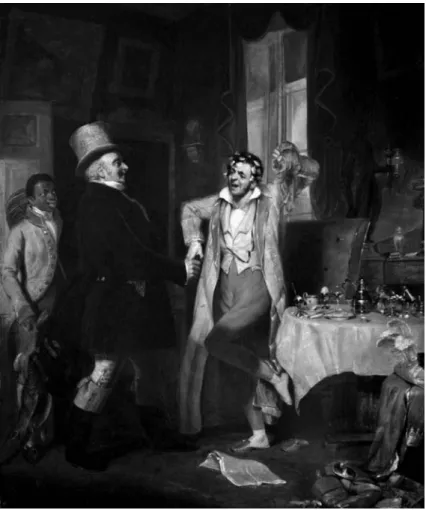
classes who needed to authorize and display their status with the rich collection of art works, domestic and foreign (30-76). The new demand quickened the market, in which the dealers became increasingly influential between artist and consumer. The market price of each artist was mainly determined by their success at the exhibition of the Royal Academy, which since its foundation in 1769 had dominated the art world in Britain along with its rival society, the British Institution.(2) The Academy also had a schooling function, and the elected students competed with each other to make success without becoming apprentice to old masters as of old. While it encouraged competition, the Academy did not lack its support system, granting benefits to its sick or destitute members, but left unaided the enormous body of artists outside the membership.(3) Those artists who failed in entering the Academy or disapproved its principles had to seek other means of making their names, for example, at other institutions and societies, or through private exhibitions and connections. One of such was Benjamin Robert Haydon (1786-1846), a great historical painter who rebelled against the Academy and ended by committing suicide in poverty. His little known masterpiece, Unexpected
Visitor (Figure 1 ; date unknown), conveys the pride and embarrassment
of a destitute artist suddenly visited by his wealthy middle-class patron. However slovenly and upset he looks in his barely respectable studio-residence, the man in focus retains something of his dignity as a romantic artist―and as a proto-bohemian.
Besides the support of the societies such as the Royal Academy and the British Institution, there was another important means for artists to make his living, and that was according to Thomas M. Bayer and John R. Page the business of reproductive printing : “Images produced at low costs and in large numbers provided artists and print sellers with the ideal
mass market product” (85) since the eighteenth century, and in the early nineteenth century “The huge undetakings of the leading art dealing / publishing entrepreneurs of the period . . . offered contemporary English painters an attractive income possibility and set the stage for other enterprising middlemen to try similar, smaller ventures” (90). It is in this cultural context that Thackeray launced his art criticism on returning to
Figure 1 Benjamin Robert Haydon, Unexpected Visitor
47 Thackeray in London, 1837-47 : From Bohemian to Gentleman
London. “A foreigner, if he is anxious to know what is the state of art in England,” begins his 1838 essay, “The Annuals,” “will naturally enough turn to the printbooks which appear annually at this season” (OT 2, 349). Thackeray’s view of these publications is, however, not a favourable one. They came to issue, owing to the improved technology, “thousands of beautiful pictures where only tens could be printed before,” and the consequence was that “with all these facilities the public has acquired such a taste for art as is far worse than regular barbarism” (OT 2, 349). His point is that the conspiracy between the printers, the publishers, and the public, came to value the formalized or idealized concept of beauty at the expense of nature. “Artists won’t copy from nature’s women, or the public won’t but the copies, which is the same thing ; for bread is more sacred even than art, and the poor artist here is led, and does not lead, astray” (OT 2, 350). In another essay on art printings, “A Word on the Annual,” published for Fraser’s Magazine in the previous year, he developed an argument to the same effect, saying that those printing books “tend to encourage bad taste in the public, bad engraving, and worse printing” (OT 2, 337). He is not blaming the artists, for “the poor painter is only the publisher’s slave ; to live, he must not follow the bent of his own genius, but cater, as best he may, for the public inclination” so that “his art is little better than a kind of prostitution” (OT 2, 338). Here Thackeray gives us a glimpse of the hardships many obscure artists endured in and outside the assistance of the Academy.
It is not easy to imagine how the young artists actually lived and worked, but Richard Redgrave’s memoir may cast some light. Born in Pimlico, London, in 1804, he entered the Royal Academy at the age of 21. In later years, he recollects his school days as follows :
Our student days at the Royal Academy were pleasant enough in their way. After the school were [sic] over, we used to assemble at each other’s rooms to drink ale-grog or egg-flip, and to discuss our art and its difficulties. Sometimes we sat to one aother as models for our pictures ; sometimes we sketched ; and sometimes, but rarely, we had a game of cards. We most frequently talked and joked, and many a merry meeting we had, numbering some among us who were afterwards eminent, and some who died without their fame. Practical jokes were not objected to, nor at times the most severe and searching criticism of one another’s works. (27-28)
But his memory is not always happy.
I and my fellow-students (many have since proved themselves men of talent) then had little hope of selling our pictures, and those who had no independent means had to submit to many privations in the study of their profession. They eked out their incomes by designing for silversmiths, by painting an occasional portrait, or by drawings for woodcuts. They put up with hard fare with a light heart, and were a thoughtless, jovial crew. How well I remember George Smith’s
ménage! He had a front room on the first floor of a house in Titchfield
street, with a small closet at the head of the stairs which held his bed. In this he slept with the door open, to obtain air and light. The back room was occupied by another tenant (Butler, a sculptor) ; indeed, the whole house was let out room by room and floor by floor. The landlord, who was a shoemaker named Hall, kept his wife and his trade together in the front parlour. In the back, commanding the small yard, was the washerwoman of the establishment, with her
49 Thackeray in London, 1837-47 : From Bohemian to Gentleman
husband, a semi-paralytic pauper, whom she gradually dried to death with her ironing-stove, and who eked out his living during the process of sitting as a cheap mode. (34-35)
This Smith, as Redgrave goes on to recollect, was seized with inflammation in his bad living condition and, though he got over it once, soon contracted the old disease again and died “in the flower of his age” (36). Redgrave’s memoir focusing on the bright and dark sides of his fellow artists’ life testifies to London’s counterpart of Paris’s bohemian life that Murger depicted in his fiction.
3. London’s Literary World in the 1830s
If we turn to literature, we are to see a no less interesting scene. In general understanding, the period between Sir Walter Scott’s death in 1832 and Charles Dickens’s advent in 1837 was a sort of interregnum in which literary production became flat. Indeed, no single poet or novelist comparable with the great romantics was present, but the public thirst for reading material did not wane but had to be satisfied. According to Kathryn Chittick, two peculiar forms particularly answered this demand : periodical literature and fashionable fiction (39). As she argues, when the Napoleonic wars were over the British public began to “look round itself,” which meant “a gradual intensification of the focus on government and London” that came to a climax with the Reform Bill of 1832 (40-41). While the fashionable novels appeased the middle-class interest in and enmity to aristocracy, the periodicals that thrived in the 1820s developed debates on London’s political and cultural scenes that changed every moment. From the Whig Edinburgh Review to the Tory Quarterly Review, including
numerous less important titles, the periodicals contained not only political arguments but also book reviews, literary essays, short or long fictions, and poems so that variously talented writers gathered round the publishing houses to fill their monthly or quarterly pages.
Thomas Miller’s novel, Godfrey Malvern (1842), a story of a young poet’s progress and failure in society written in the manner of Bildungsroman before Thackeray and Dickens, reveals the realistic situation in which the young writers in the 1830s found themselves. The eponymous hero distinguishes himself in poetry, only to discover that “fame is more easily obtained than wealth” (88)―
There are, in London, a great number of literary men, whose names are almost wholly unknown to the public. Such are the writers who contribute to cheap periodicals, and now and then, get an article inserted into the magazines, too often without their name being affixed to it. Thus their talents become buried. They have issued no distinct work on which to base their reputation, and consequently can demand no price in the market ; yet any of these men are excellent writers. When they have written an article, it must instantly be converted into money ; and if they do not obtain their own price for it they are compelled to take what is offered, for they cannot afford to wait until the editors of the higher order of periodicals can decide upon its merits. Thus the article, however good it may be, is often literally pawned, for they get a pound or two advanced upon it from some quarter where it is certain of insertion ; and obtain the remainder when the periodical appears, or when the proof is corrected, and it is ascertained what number of pages the article makes. These are the most unfortunate class of all authors ; a friend,
51 Thackeray in London, 1837-47 : From Bohemian to Gentleman
or a kind publisher, sometimes is found to supply their wants, until they have written a complete work, and then their abilities are acknowledged : they enter the ‘ring’ as it is called, obtain fame, and eventually, if they are fortunate, just save themselves from this daily state of starvation. (93-94)
The gathering of obscure writers round the publishing houses was not a new phenomenon in Britain. Since the public sphere allowed lively discussions and the publishing industry thrived enough to give chance to a wide range of aspirants, the large body of writers who were not always talented swarmed into Grub Street and then into Fleet Street where the publishing houses ranged. Vic Gatrell attributes the title of “the first bohemians” to these literary hacks in the Augustan age, and not without reason. Thackeray himself revealed a great deal of interest in the Augustan society of poets and writers as a proto-bohemia, and that was, I suspect, one of the reasons that he chose this period for the stage of Henry
Esmond (1852). But, putting aside these anachronisms, critics seem to
agree that William Maginn (1794-1842) was the first to deserve the title of a literary bohemian in English context, and he emerged from the culture of periodical magazines in the 1810s and 1820s.
Born to an Ascendant family at Cork, Ireland, Maginn was to inherit much from the Irish literary tradition. At 24, he crossed the channell to join Blackwood’s Magazine at Edinburgh, and started his literary career as a miscellaneous writer, ranging from parody poems to political articles, before he was involved with the new project of the magazine : Noctes
Ambrosianae. Although Noctes was originated by his partner, John
Gibson Lockhart, Maginn’s contribution to it was so enormous that the project was often associated with him (Latané 37-39), and the project
proved to be a real innovation in the history of periodicals. To quote Mark Parker, “The ‘Noctes’ were presented as a transcript of an evening’s talk and song―as well as a record of some truly epic drinking and eating―at a local Edinburgh tavern, Ambrose’s. Occasional visitors, drawn from a variety of real and literary venues appear as well” (111). In short, it reproduced a drinking bout on the printed pages as a sort of forum that was truly open to polyphony. Parker continues to argue for its significance :
Finally, the dialogic form of the “Noctes” offers singular possibilities for critical discourse. Blackwood’s had, from its inauguration, published contradictory articles on various literary figures. . . .
Blackwood’s often presented competing views only to settle them with
a culminating article, and some political issues were debated through letters to North and largely left open. But the “Noctes” carry this tendency further, and, in doing so, give it a new efficiency. In the hands of the writers of the “Noctes,” this adversarial tendency becomes a complex and highly self-conscious way of exploring a literary work. (115)
While Parker tends to emphasize the literary value of this project, the real Maginn might have been a mere sociable drinker―or at least “a writer of Bohemian habits and astounding versatility,” as Patrick Leary calls him (14). Leary, in his study of the Punch brotherhood as Victorian England’s literary bohemians, evaluates the role Maginn played in importing the bohemian spirit of Blackwood’s into English journalism― first through Fraser’s Magazine which he founded in 1830 and finally onto
Punch which he joined shortly before his death (14). These literary
53 Thackeray in London, 1837-47 : From Bohemian to Gentleman
magazines owed much of their success to the friendly editorial boards which Maginn supervised and activated with his bohemian disposition.
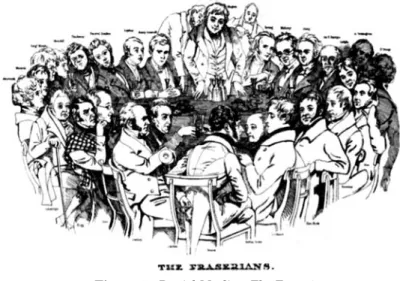
The friendly atmosphere of the Fraser’s set is depicted by Daniel Maclise who contributed a drawing for Maginn’s Fraser’s article, “The Fraserians,” published as the report of a roundtable discussion held at the beginning of 1835 (see Figure 2). Although the name for each member was not given in the original, most of the members were identified in William Bates’s reproduction in The Maclise Portrait Gallery of Illustrious Literary
Characters with Memoirs (1883). According to Bates, the man standing at
the centre top and presiding the party is Maginn, the man sitting opposite to him at the centre bottom is Mr Fraser, either Hugh or James, and the twenty-five literary figures surrounding the round table are also identified, including such prominent figures as Coleridge, Southey, Hogg, Lockhart, Ainsworth, Hook, and Carlyle. Thomas Carlyle had just finished the serialization of Sartor Resartus in Fraser’s between 1833 and 1834, and on this evening had much to say as the translator of German literature in the discussion about Goethe. Obviously from a far higher social position than the so-called bohemians, the personell of the round table is enough to suggest an intelligent circle for developing friendships and exchanging ideas. What surprises us, however, is the unexpected yet unmistakable presence of young Thackeray, fifth from the left top, with his characteristic eyeglasses dangling on his face. Thackeray in this period was more intent on painting in Paris, and had not published his known articles in Fraser’s, but his connection with Maginn and the Fraser’s set dates back to the early 1830s. D. J. Taylor points out that Thackeray was corresponding with James Fraser as early as in 1831, ordering copies of
Fraser’s and submitting a poem for publication, and made the acquaintance of Maginn in 1832 and soon took to him. Curiously,
Thackeray even lent Maginn £500 to help him with his business. In return, Maginn introduced his young friend to London’s literary world and offered his assistance when the latter launched his editing business (Taylor 93 ; and also Ray 160). His early entry into the Fraser’s set proved enormously beneficial as his talent otherwise could have been easily buried away. Maginn died in 1842 in destitution without seeing his disciple’s great success with Vanity Fair, but it was indubitably in his bohemian circle that the young Thackeray trained himself to become a professional writer.
4. Thackeray’s Second Bachelorhood
It was in this cultural context that Thackeray found himself on settling in London after long years of sojourn in Paris. The man of his unproven talent and without independent means could easily fall into oblivion,
Figure 2 Daniel Maclise, The Fraserians
55 Thackeray in London, 1837-47 : From Bohemian to Gentleman
either in art or literature. But the two professions unfold themselves before him in contrastive perspectives. On one hand, Thackeray came to hold a pessimistic view on artistic profession. In “On Men and Picture,” which he published in Fraser’s in 1841, he relates an anecdote of his association with an unhappy artist. When he first met him in Paris in 1832, the latter was intently copying Correggio. Although the writer held a doubt about the artist’s vain effort, he dared not mention it, and the artist continued to work strenuously and stoically. He rose early of mornings and worked all day without any recreation ; he had coarse meals and drank water, casting scornful eyes at the luxurious people ; and after ten years of hard work and no pleasures, he proved himself to be none the better. When the writer met him again at the Academy, the artist surprised him with his “lean, long, ragged, fantastical-looking personage” (OT 2, 546), and asked about his profession answered, “Tit, my boy, . . . you may see that the arts have not fattened me as yet” (OT 2, 546). Thackeray’s portrait of this failed artist is relentless, if not without sympathy. Two years later, in 1843, he sent a letter to some unidentified artist, probably in reply to a request for his advice, giving him a discouraging answer : “The market at Paris is stocked by thousands of artists . . . and copies of drawings are done so plentifully and by such clever fellows, that you might go round all the Drawing-shops and not sell one,” and “A friend of mine who copied with amazing dexterity made the attempt and could not get a two franc piece for the best of his performances” (Letters 2, 114-15). He knew too well the hardships the obscure artists had to endure to give a false encouragement to the young pursuer of art, and behind his bitter remark lies, of course, his own failure in the profession of art.
With literary profession, on the other hand, Thackeray was less
pessimistic. More precisely, with the editorship of the Constitutional on his hand, he had too much business to do to indulge in melancholic meditations. In April, 1837, a month after his settlement in London, he received a sudden visit from Mary Anne Thackeray and was invited to “a grand repast,” upon which he commented in his letter to John Ritchie : “These are the only gaieties of wh
. I have been guilty since we came to London―for most of my hours are spent in Fleet Street, in the cause of the Constitutional” (Letters 1, 344). A couple of years later, when he had already given up The Constitutional and was writing mainly for Fraser’s, he was no less busily occupied :
We have led a tolerably sober and regular life, always up before nine breakfast over by ten books books books all day until might when to my great consolation FitzGerald has been here to smoke a seger [sic] and keep me company until one or so. Otherwise like affectionate people Mrs
. Thack and I fall asleep straightway after dinner―and no bad amusement either.
We have seen nothing and no one : I once to the play where I was very much bored by Bulwer’s new piece : and yesterday, after working here from ten o’clock until 10 with 1/2 an hour’s dinner fancy that, I indulged in a smoking match until 2 wh
. did the greatest possible good. This is interesting news, isn’t it? (Letters 1, 393-94)
If we have to discount this confession of sobriety, which he sent to his mother, it nonetheless evokes the image not of a self-indulgent bohemian but of a self-restrained businessman―I say, not without traces of his bohemian past in the form of reserved indulgence in friendship, theatre-going, and smoking. But on the whole Thackeray in the late 1830s and
57 Thackeray in London, 1837-47 : From Bohemian to Gentleman
the early 1840s seemed to be on the right track due to the regular means he obtained at Fraser’s through the success of The Yellowplush Papers. While he was still in the company of hangers-on at the publisher’s houses and in the sometimes easy society of Maginn and the Fraserians, his constant output of increasingly important works and his rapid growth in reputation gradually enabled him to despise the lower sort of his profession and to seek higher society. From the beginning, he stood out from the rest for his gentlemanly origin and for his educational background he had formed before he strayed into the path of art. It was quite natural that after sowing his wild oats he should recover himself to follow the right course. In a way, as he turned the age of thirty, he outgrew a bohemian to become a gentleman.
Thackeray’s social behaviours in this period, which probably come from his class identity as much as from his social ambition, can be seen in his frequent change of abode. After he took his wife from Paris to live with his mother at Albion Street, Paddington, he changed his abode four times during the next decade. First, as his mother moved to Paris to live with her husband, the young Thackerays had to find a reasonable house to live in by themselves, and 13 Great Coram Street, Bloomsbury, to which they moved in 1838, proved a convenient place, with the Russell Institution and the British Museum libraries nearby and within a walking distance from Fleet Street and Regent Street where his business took place. His household happiness, however, did not last. In 1840, his wife’s insanity was revealed and Thackeray had to place her at proper care, first in France and later in England. In the meantime, Thackeray’s fame grew and his stable income allowed him to pursue a gentlemanlike lifestyle. With the publication of The Irish Sketch Book in 1843, he vacated his house at Great Coram Street, and after the interval of eight months took
rooms at 27 Jermyn Street, St James. In 1845, he moved to 88 St James Street within the same area, and there he began to write Vanity Fair. He stayed there until the first installment of The Snobs of England (later retitled The Book of Snobs) appeared from Punch in 1846. By this time, he had come to desire more quietude than convenience, and sought his new abode in Kensington, still a rural suburb at that time, where he lived with his daughters at 13 Young Street for eight years, at 36 Onslow Square for the next eight years, and at 2 Palace Green for his last year before his death.
Of these house movings, his movement to the St James area is particularly suggestive. No doubt, one of the reasons that he chose this area was his growing interest in fashionable life that was spent around St James’s Palace, St James’s Park and Hyde Park, and a row of great houses and gentlemen’s clubs that ranged Pall Mall Street which penetrated the area. “Pall Mall is the great social Exchange of London now,” says he later in The Four Georges (1860), “―the mart of news, of politics, of scandal, of rumour―the English forum, so to speak, where men discuss the last dispatch from the Cremea, the last speech of Lord Derby, the next move of Lord John. And, now and then, to a few antiquarians, whose thoughts are with the past rather than with the present, it is a memorial of old times and old people, and Pall Mall is our Palmyra” (OT 13, 753). In his early fictions, Thackeray tended to focus on the lower middle classes or the shabby genteels, but with The Snobs of England and Vanity Fair on which he was engaged at his St James homes he grew into the chronicler of the upper middle to upper classes, and set many of his actions in the St James and Mayfair areas. During this period of his second “bachelor life”―due to his wife’s stay away from home in need of medical care―he settled into his new routine ; according to Gordon N.
59 Thackeray in London, 1837-47 : From Bohemian to Gentleman
Ray, getting up about ten, working and dawdling during the Victorian long morning, going out for dinner in the afternoon as an invited guest or at a club, sometimes keeping company there till late at night and sometimes extending his journey to the theatre or ball, and rarely coming home before one or two in the morning (280-81). “I could not go on with this,” declares he in his letter to his mother, “unless I had the fun in the evening, and the quantum of wine” (Letters 2, 101). Thackeray’s social life by this time was more like that of a gentleman than of a destitute artist. Indeed, this kind of lifestyle flowed into his depiction of what would be later mythified and imitated as Thackerayan bohemia. Yet if one liked to call it by the name of bohemian, the word would require a redefinition.
5. Conclusion
The decade between his first settlement with his wife in London and his great success with Vanity Fair was the period of transformation for Thackeray during which the young artist failed in pencil and unaccomplished in pen survived London’s relentless world of art and letters to become the literary lion of the town. While he worked out one after another important work of fiction, as well as numerous reviews, criticisms, and travel essays in the meantime, and steadily walked up the steps towards success, he had to associate with the lowest order of his profession and see at least one of his fellow artists die in failure and poverty. Those who read his fictions produced in this period will find each work charged with an enormous amount of energies aspiring for wealth and success, but they will also recognize without failure the social force of punishment and ruin that threatens those aspirants. In the stories in which these two forces―one going upward and the other downward―
crisscrossing and sometimes conflicting each other, one might be tempted to read a reflection of the author’s precarious status as a bohemian writer ; this particular kind of tension is, I presume, something not to be found in his mature works. It would be necessary as our next step to examine how this particular kind of tension informs each of his works in this period, but the space does not allow us to do so in the present paper.
Notes
⑴ From “On the French School of Painting” collected in The Paris Sketch Book (1840). All quotations from Thackeray’s works hereafter are from The Oxford Thackeray (OT ), and after each quotation are indicated the volume and the page numbers.
⑵ About the functions of dealers and the Royal Academy in the art market in the eighteenth and nineteenth centuries in Britain, see Bayer and Page, especially chapters 5 and 6 (81-117).
⑶ Hamilton 85-87.
Works Cited
Bayer, Thomas M., and John R. Page. The Development of the Art Market in
England : Money as Muse, 1730-1900. London : Pickering & Chatto, 2011.
Print.
Carey, John. Thackeray : Prodigal Genius. London : Faber, 1977. Print.
Chittick, Kathryn. Dickens and the 1830s. Cambridge : Cabridge UP, 1990. Print. Gatrell, Vic. The First Bohemians : Life and Art in London’s Golden Age.
London : Allen Lane, 2013. Print.
Hamilton, James. A Strange Business : Making Art and Money in
Nineteenth-Century Britain. London : Atlantic, 2014. Print.
Harden, Edgar F. Thackeray the Writer : From Journalism to Vanity Fair. Houndmills : Macmillan, 1998. Print.
Haydon, Benjamin Robert. Unexpected Visitor. N.d. Oil on canvas. Plymouth City Council. Art UK. Web. 16 Oct. 2018.
Latané, David E. William Maginn and the British Press : A Critical Biography. Farnham : Ashgate, 2013. Print.
Leary, Patrick. The Punch Brotherhood : Table Talk and Print Culture in Mid-61 Thackeray in London, 1837-47 : From Bohemian to Gentleman
Victorian London. London : British Library, 2010. Print.
Maclise, Daniel. The Fraserians. 1835. Drawing. The Maclise Portrait Gallery of
Illustrious Literary Characters with Memoirs. Ed. William Bates. London :
Chatto & Windus, 1883. Frontispiece. Web. 10 July 2018.
Miller, Thomas. Godfrey Malvern. London : Ward & Lock, N.d. [1842]. Print. Parker, Mark. Literary Magazines and British Romanticism. Cambridge :
Cambridge UP, 2000. Print.
Pearson, Richard. W. M. Thackeray and the Mediated Text : Writing for Periodicals in the Mid-Nineteenth Century. Aldershot : Ashgate, 2000. Print.
Ray, Gordon N. Thackeray : The Uses of Adversity 1811-1846. New York :
Octagon, 1972. Print.
Redgrave, F. M. Richard Redgrave, C. B., R. A. : A Memoir Compiled from His
Diary. London : Cassell, 1891. Print.
Shillingsburg, Peter L. Pegasus in Harness : Victorian Publishing and W. M.
Thackeray. Charlottesville : UP of Virginia, 1992. Print.
Taylor, D. J. Thackeray. London : Vintage, 2011. Print.
Thackeray, William Makepeace. Henry Esmond, The English Humourists, The
Four Georges. Ed. George Saintsbury. London : Oxford UP, 1908. Print. The
Oxford Thackeray 13.
───. The Letters and Private Papers of William Makepeace Thackeray. Ed. Gordon N. Ray. 4 vols. Cambridge, MA : Harvard UP, 1946. Print.
───. The Paris Sketch Book and Art Criticisms. Ed. George Saintsbury. London : Oxford UP, 1908. Print. The Oxford Thackeray 2.
Yokouchi, Kazuo. “Thackeray in Paris, 1829-37 : The Bohemian Years.”
Jinbunronkyu 67.4 (2018) : 77-97. Print.
──文学部教授── 62 Thackeray in London, 1837-47 : From Bohemian to Gentleman