Individuality of Locomotion Habits in the
Small Abalone Sulculus aquatilis (Reeve)
著者
NAKAMURA Kaworu
journal or
publication title
鹿児島大学水産学部紀要=Memoirs of Faculty of
Fisheries Kagoshima University
volume
57
page range
19-23
別言語のタイトル
トコブシの行動習性の個体性
ോఱڠକॲڠ໐କॲ٬ဢȪLab. of Comparative Physiology, Faculty of Fisheries, Kagoshima University, Kagoshima 9:1-1167, Japanȫ
Individuality of Locomotion Habits in the Small Abalone
Sulculus aquatilis (Reeve)
ȁHitherto, homing behaviour in marine invertebrates has primarily been recorded in intertidal gastropods, particularly in limpets and chitons in which this behaviour has been extensively reported. These studies have examined aspects related to the timing, distance, direction, and speed of movements associated with the return of these organisms to their original habitats. Limpets usually take a trip and home during the high tide, retracing their return using a track close to that used when migrating outward, but with scarcely any overlap. Consequently, the path followed each trip broadly describes an extremely elongated and narrow loop on tracing paper2-4).
While abalone also exhibit this homing behaviour, their nocturnal habits and distribution below the tidal zone have limited the number of studies on this aspect of their behaviour. Crofts (1929) fi rst described the exceptional homing ability of the ormer, Haliotis tuberculata (Linnaeus)4). Subsequent fi eld and laboratory investigations sometimes reported homing in several Japanese species including the disc abalone, Nordotis
discus (Reeve), previously named Haliotis (Nordotis) discus
(Reeve); the ezo abalone, Nordotis discus hannai (Ino),
previously named Haliotis (N.) discus hannai (Ino); the megai abalone, Nordotis gigantea (Gmelin), previously named
Haliotis sieboldii (Reeve); and the madaka abalone, Nordotis
(H.) madaka H(Habe), previously named H. gigantea (Reeve)5-9).
This was initially recognized in fi eld observations of the ezo and megai abalone in rocky shores where locomotion was classifi ed as “moving”, “staying” and “homing” 6). In the ezo abalone, one individual in six exhibited homing after moving 2.5 m. However, in the megai abalone homing was not observed in three individuals6). In other fi eld studies of the madaka abalone, one individual in 14 animals was observed to undertake a homing trip after moving a distance of 2.5 m8).
The small abalone, Sulculus aquatilis (Reeve), previously named H. diversicolor supertexta (Lischke), is also benthic and inhabits littoral rocks below the tidal zone5,9). It leaves the shelter of caves or crevices after sunset and creeps or forages along the rocky substratum. The movements were especially active between sunset and midnight10). Furthermore, the previous experiment revealed that continuous monitoring was necessary for recording exactly a locomotion track of
Abstract
An ethological study was undertaken to characterize individual locomotion habits of the small abalone, Sulculus aquatilis (Reeve). Nocturnal locomotion in an indoor tank was observed under red light in darkness. Animals were individually placed on the center of the aquarium and movements of each animal were continuously monitored for 10 min. Observations of each of the 17 animals were repeated 30-35 times over a two to three month period. Locomotion habits of each animal consisted of three behaviour types: moving, returning and stationary. Appearance frequencies of them indicated the presence of the individuality of locomotion habits in the abalone.
Kaworu Nakamura
20 Mem. Fac. Fish. Kagoshima Univ., 57, (2008)
the animal since the track left on the substratum was faint or invisible11). Their observations in indoor and outdoor tanks showed that approximately 24% of the small abalone returned to substitute homes before sunrise10).
Since the homing behaviour of the small abalone ensures that they remain within a particular area, it is important for fi sheries management as evaluations of the diffusion rate in fi sheries can be accurately determined after transplantation or seed release. Consequently, an ethological study of the small abalone was conducted to characterize both individual locomotion habits and compile the locomotion activity as the cohort level, with particular emphasis on return or homing behaviour. Given the diffi culties associated with observing the small abalone in the natural environment, experimental animals were maintained under simplifi ed conditions to facilitate experimental observations and analysis in the present study.
Materials and Methods
After considering the natural temperature range of the species, experiments were conducted from 19 May to 4 August 2006, from 13 August to 10 November 2006, and from 19 July to 25 October 2007 in a dark room at the Faculty of Fisheries, Kagoshima University.
Experimental animals were sub-adults or adults of the small abalone, Sulculus aquatilis, and were obtained from a live fi sh retailer on Tanegashima Island where the fi shery of this species has been well established. In the fi rst year, the number and shell size of specimens were 9 and 57.5 ± 5.6 mm, and 10 and 61.1 ± 3.5 mm, respectively. In the second year, 15 individuals measuring 54.8 ± 3.8 mm were used. Specimens were numbered on the shell and accommodated in one cubic net cage (3 mm mesh size) that was put in a 60 L laboratory tank maintained at 22.0 ͠ and fi ltered water. Animals were fed dried brown seaweed, Laminaria japonica (Areschoug).
The smooth bottom of a cylindrical and vinyl chloride tank measuring 1m (D) x 0.3 m (H) was used as the substratum for the experiment. This size of the tank corresponded to the critical distance of abalone homing10) and was appropriate to individual observations of homing behaviour by experimental animals. An acrylic plate of 0.5 mm thick and 7 cm (D) disc was placed in the center of the tank fl oor. The plate served as the starting point for locomotion and was removed immediately after the animal left the plate to negate the
infl uence that it might have on subsequent locomotion of the animal through either physical or chemical cues. A 40 W red lamp was positioned 1 m above the tank and was suspended from the ceiling. The intensity of light could be controlled using a rheostat and was maintained at 0.5 to 1.0 lx at the level of the surface of the tank water.
These settings prevented any guides to the return behaviour, whose guides could be interpreted by the abalone as environmental cues, either through sight or tactility. In other words, the simplicity of the experimental design minimized any possible infl uence of external stimuli that could be interpreted as exocentric coding12), as well as being conductive to accurate tracing and mapping of abalone locomotion.
The water level of the tank was adjusted to approximately 10 cm immediately before sunset and the animal was placed on the central plate in still water. In instances where the temperature of the seawater was markedly different from that of the tank in which the stock were maintained, then the tank water was either heated or cooled using a thermostat before initiating the experiment.
In most cases, experimental animals were monitored for 10 min before the experiment was terminated, the specimen replaced, and the experiment was repeated. In addition, the experiment was terminated when any of the following occurred within 10 min: 1) the animal returned to the starting point, 2) the animal reached the tank wall and moved along the circumference and 3) the animal stayed on or moved within or on the confi nes of the central plate. In some cases, the returning animals were monitored for more than 10 min.
Nocturnal experiments were conducted at one- to three-day intervals. All experiments were terminated before 22:30 when the activity of the small abalone has decreased 10). Until this time, all of the stock animals were tested randomly, with all animals handled under red light in dark conditions. The bottom of the tank was brushed with a sponge before setting the next experiment.
During the experiment, the path followed by the experimental animal was recorded as a locomotion locus at a 1/10 reduction on graph paper under red light from a 0.75 W pencil-type fl ashlight. At the end of every experiment, the experimental animal was carefully removed with a blunt knife and placed into the stock aquarium until the next experiment.
The locomotion loci of each animal were classifi ed as moving, returning and stationary behaviour types. After counting the appearance frequency of these behaviour types,
the individuality of locomotion habits was examined using the chi-square test for independence and a multiple contingency table. Furthermore, a ratio of each behaviour type compared to the sum of the three behaviour types was calculated for each individual as a relative appearance frequency. The relative appearance frequencies of the three behaviour types were compiled to produce a composition pattern of the locomotion habits for each individual. Ethological categorization of the small abalone was then attempted by analyzing these patterns.
Results
During the experiments, water temperature of the experimental tank ranged from 21.6 to 24.0 ͠ , which appeared to be optimum for the species examined in the present study. However, the number of animals decreased over time, and survival rates 67, 70 and 27 % were observed after 78, 90 and 96 days, respectively. Survival rates thus differed markedly over the two years of the study despite employing similar rearing conditions. The small abalone belonging to the third cohort appeared particularly weak as determined by their low feeding activity in the stock tank.
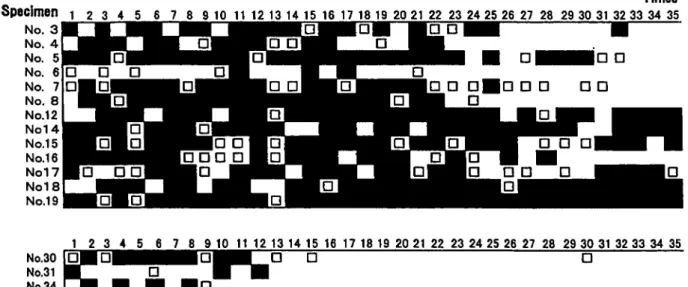
Data for the appearance frequency of the locomotion type observed in the fi rst and second experiments are shown in Fig. 1 and Table 1, and were obtained from six (No. 3, 4, 5, 6, 7 and 8) and seven (No. 12, 14, 15, 16, 17, 18 and 19) individuals, respectively. Generally, the moving behaviour was most frequently observed, followed by the stationary
and returning behaviours, respectively; however, this order was observed to differ in some individuals. In addition, even when exhibiting the same order, the appearance frequency of each behaviour type was markedly different (Table 1). The
Fig. 1. Distributions of the locomotion behaviour types of each abalone during 30 or 35 observations. Upper column, fi rst and second experiments;
lower column, third experiment. Black space, moving type; square frame, returning type; white space, stationary type.
Table 1 Appearance frequencies of the locomotion behaviour types of the small abalone in the fi rst and second year experiments
Specimen Locomotion behaviour types No. Moving Returning Stationary First year 3 17 4 11 4 12 4 16 5 25 5 2 6 3 5 24 7 16 14 2 8 19 3 10 12 27 2 6 14 26 2 7 15 23 10 2 16 17 7 11 17 17 10 8 18 27 2 6 19 32 3 0 Second year 30 9 6 15 31 1 1 28 34 4 1 25 35 10 1 19
22 Mem. Fac. Fish. Kagoshima Univ., 57, (2008)
chi-square test stated that individuals of the small abalone would have different composition patterns of locomotion habits (p<0.05).
For the third experiment, data were obtained from four individuals (No. 30, 31, 34 and 35). During the latter half of the experimental period, most of the abalone did not exhibit any locomotion and most remained on the central plate (Fig. 1). Consequently, the stationary behaviour was most frequently observed, followed in order by the moving and returning behaviour types (Table 1). These results were not statistically an ideal situation. Because of excess presences of the theoretical frequencies less than fi ve, restrictions on the use of the chi-square test should have been applied to this analysis.
T h e l o c o m o t i o n h a b i t s o f i n d i v i d u a l a n i m a l s a r e summarized in Fig. 2. The animals were classifi ed into four typed habits, three of which had the high relative appearance frequencies for the moving and stationary behaviours (Fig. 2a), moving only (Fig. 2b) or moving and returning (Fig. 2c). The remained group was characterized as having the low relative appearance frequency for moving (Fig. 2d). The high relative appearance frequency for the stationary behaviour was accompanied by low values for moving and returning (Fig. 2d). These fi ndings could be proved to categorize abalone habits according to their locomotion behaviours.
The mean relative appearance frequencies for the return behaviour type were 16.3 ± 11.4 and 7.5 ± 8.4 % in the fi rst and second years, increasing to 23.8 ± 17.1 and 29.8 ± 18.6 % if the stationary behaviour was excluded from the total. Patterns of the return track within 0.5 m distance usually described a smooth and swelled loop. The similar type was already recognized in the previous study10). In addition, extended trips over 0.5 m were also observed, which described a transient creeping along the partial circumference before taking a return route.
Discussion
Previous observations of moving abalone revealed that only 24 % were observed to exhibit homing10). This value appears to be consistent with that observed in the present study. In the present study, behavioural frequency was obtained for individuals from observations repeated 30 to 35 times. Given that the experimental period spanned two to three months, the behavioural patterns observed appear to accurately refl ect the relative appearance frequency patterns of individual locomotion habits. Few reports have been published to date
describing invertebrate behaviour at the level of the individual or group for a single species.
The return locus of the small abalone showed commonly a simply swelled loop whose ends link at the starting site10). Namely the return truck did not contact the outward truck. The differences in the loci of these trips that have been
Fig. 2. Categorization of the abalone locomotion habits based on the
relative appearance frequency of the locomotion behaviour types. Mv, moving type; Rn, returning type; Sy, stationary type. The number added on the right means the specimen number.
observed between different species may be due to differences in experimental settings. In the disc abalone, an individual was observed to depart and return using a similar route when moving between the home and forage site 2 m away in a rectangular tank; this locus described an elongated and narrow loop. In the megai abalone, a locus described a short and narrow loop measuring approximately 0.5 m between the starting point and forage site5).
In another abalone, the ezo abalone, the specimen undertook an extraordinarily long path, circumventing the wall of a rectangular tank (2.5 m x 3.5 m) twice before returning to the starting point at the corner of the tank. In this case, a substitute home for abalone was not placed on the tank fl oor7). Similar extended trips were also observed in the small abalone examined in the present study. In this case, the animal returned after long moving along the peripheral circumference of the experimental tank.
Field investigations of seed production and release of Japanese abalone, including the present species, showed that sub-adult or juvenile individuals do not disperse, but remained near the release site of the fi shery13-15). The dispersal rate of abalone was generally low, i. e. within a 3 or 5 m radius from the release site 3 months after the juveniles were released13,14).
Compared to limpets, which demonstrated return frequencies of approximately 25 to 98 %, the return frequencies for the small abalone appear relatively low16-18). However, in the common limpet, Patella vulgata (Linneus), homing was not commonly observed on the surface of a cliff, since the animals changed their home more often on fl at surfaces compared uneven surfaces19). Similarly in the limpets, P. vulgata and P.
depressa (Pennant), no evidence for homing was observed on
a smooth concrete breakwater20).
These results in the gastropod species that creeps similarly on rocky substratum are suggestive of some inhibitory intervention to the abalone return by the fl at and smooth substratum in the experimental condition. The return or homing behaviour may have yielded the low dispersal rate of juvenile abalone after releasing to uneven grounds in the wild.
References
1) Abe, N.(1940). The homing, spawning and other habits of a limpet, Siphonaria japonica Donovan. Sci. Rep. Tohoku Imp.
Univ. Sendai, 15: 59-95.
2) Hartnoll, R. G. and J. R. Wright (1977). Forage movements and homing in the limpet Patella vulgata L. Anim. Behav., 25: 806-810.
3) Santina, P.D. (1994). Homing pattern, activity area and trail following of the high shore Mediterranean limpets Patella rustica L (Mollusca Gastropoda). Ethol. Ecol. Evol., 6: 65-73.
4) Crofts, D. (1929). Haliotis. Proceedings of Liverpool Biological Society, Liverpool, 174pp.
5) Uno, Y. (1967). Abalone. In “Fish Culture”(ed. by Kawamoto, K.), Koseisya Koseikaku, Tokyo, pp.648-656 (in Japanese).
6) Momma, H. and R. Sato (1969). The locomotion behavior of the disc abalone, Haliotis discus hannai Ino, and the Siebold’s abalone, Haliotis sieboldi Reeve, in the fi shing grounds. Tohoku J.
Agri. Res., 20: 150-157.
7) Momma, H. and R. Sato (1970). The locomotion behavior of the disc abalone, Haliotis discus hannai Ino, in a tank. Tohoku J.
Agri. Res., 21: 20-25.
8) Okamoto, M. (1991). Behaviour of giant abalone Haliotis
madaka at 30m depth of an artifi cial fi sh reef. Bull. Jpn. Soc. Sci. Fish., 57: 579-584 (in Japanese).
9) Okutani, T. (1996). An Illustrated Book of the World Molluscan, Sekai-Bunka-Sya, Tokyo, 400pp. (in Japanese).
10) Nakamura, K. and M.V. Archdale (2001). Activity patterns of abalone under experimental conditions. Aquac. Res., 32: 169-179.
11) Nakamura, K. and T. Soh (1997). Mechanical memory hypothesized in the homing abalone Haliotis diversicolor
supertexta under experimental conditions. Fisheries Sci., 63:
854-861.
12) Benhamou, S, J.P. Sauve and P. Bovet (1990). Spatial memory in large scale movements: Effi ciency and limitation of the egocentric coding process. J. Theor. Biol., 145:1-12.
13) Ogata, T., M. Kanamaru and K.Ookubo (1979). Seed releasing of abalone. Annual Report of Fisheries Research in Miyazaki Prefecture, Miyazaki Prefecture Offi ce, Miyazaki, pp.261-277 (in Japanese).
14) Kojima, H. and Y. Nakahisa (1982). Releasing investigation of tokobushi. Annual Report of Fisheries Research Institute of Tokushima Prefecture, Tokushima Prefecture Offi ce, Tokushima, pp.71-73 (in Japanese).
15) Anonymous (1992). Field sampling. Report on Investigation and Estimation of Early Reduction in Seed Releasing of Abalone, Nippon Saibai Gyogyou Kyoukai, Tokyo, pp.146-159 (in Japanese).
16) Galbraith, R. T. (1965). Homing behaviour in the limpets Acmaea
digitalis and Lottia gigantean. Am. Midl. Nat., 74: 245-246.
17) Miller, A. C. (1968). Orientation and movement of the limpet
Acmaea digitalis on vertical rock surfaces. Veliger, 11,Suppl.:
30-44.
18) Haven, S. B. (1971). Niche differences in the intertidal limpets
Acmaea scabra and Acmaea digitalis (Gastropoda) in Central
California. Veliger, 13: 231-248.
19) Orton, J. H. (1929). Observations on Patella vulgata (L.). III. Habitat and habits. J. Mar. Biol. Ass. UK., 16: 277-288.
20) Lewis, J. R. (1954). Observations on a high level population of limpets. J. Anim. Ecol., 23: 85-100.