Drip-Formation of the Thawed Fish Flesh
著者
OHTA Fuyuo, NISHIMOTO Jun-ichi
journal or
publication title
鹿児島大学水産学部紀要=Memoirs of Faculty of
Fisheries Kagoshima University
volume
12
number
1
page range
14-19
別言語のタイトル
解凍魚肉のドリップ生成に対する重合燐酸塩の抑制
作用
URL
http://hdl.handle.net/10232/14350
Preventive Effect of Polyphosphate on the
Drip-Formation of the Thawed Fish Flesh
Fuyuo Ohta and Jun-ichi Nishimoto
Abstract
The preventive effects of polyphosphate and sodium chloride upon the drip-forma tion of the thawed fish flesh were ascertained by measuring the free- and centrifuge drip; and then the property enabling these salts to be preventive against the dripping was investigated chiefly.
The amount of the centrifuge drip was lesser when the pH value of flesh was under alkaline side. Both metal chelating agents and viscous matters were effective in
preventing the dripping. Against insolubilization of salt-soluble protein, polyphosphate revealed protective; while sodium chloride, obviously accelerative.
Then, alkalinity and viscosity of polyphosphate, and its actions both in chelating
metal and in stabilizing protein are considered to be participated collectively in the
preventive effect of phosphate on the dripping. And the drip-formation is not to be
considered resulting from the denaturation of protein alone.
One of the undesirable phenomena of frozen stored fish is the drip-formation
on thawing. As to the origin of these drips, there are a variety of opinions,
but it has not yet been made fully clear so far. And as a means of prevent ing the dripping, the method of dipping fish in buffer solution or in brine prior
to freezing, has been suggested, and each of which or mixing both of which has been confirmed effective.1-"0 However, brine is not considered necessarily appropriate since it is known to facilitate the oxidative deterioration of lipids
in frozen stored fish muscle.5-6)
Upon this, the authors applied polymeric phosphates to the prevention of
dripping of thawed fish, as phosphates have recently come widely used as water-holding agent and have been testified to have anti-oxidative property for lipids.7,8' And tripolyphosphate was found to be very effective, being equal to the effect of sodium chloride. Accordingly, in the present experiment, the pro
perty enabling tripolyphosphate to be effective in the prevention of dripping-was chiefly investigated and simultaneously the relation of drip formation with denaturation of protein was studied comparing the stabilizing effect upon pro
tein with that of brine.
Materials and Methods
Preparation of samples
Mackerel was chiefly used as the sample. The normal muscle was taken and minced to be mingled with aqueous solution of given substances and made in block of fixed size with the weight of 10 g. Dilute sodium hydroxide or hydrochloric acid was used for adjusting the pH value of flesh. A control sample in each experiment was prepared by the addition of water. Then it was taken in a vessel covered with plastic cloth and stored in a cold room at —10'C. Taking it out for a fixed period later, it was submitted to the
measure-ment of centrifuge drip or of protein content.
.,
3.3 cm
Measurement of centrifuge dripThe frozen sample was put into a drip tube as
shown in Fig. 1 and centrifugcd accurately at the
speed of 1000 rpm 20 min at 5-10°C after thawing
(at 13-15°C, 2hr).
The separated juice was decided
to be the centrifuge drip, the drip % being express
ed by the number of ml of drip per 100g fllesh.
Determination of protein
Salt-soluble protein was measured by the Biu
ret method after extracting from the thawed flesh
with 0.6 M pottasium chloride of pH 7.5. The extract
was diluted 8 times with cold water and stood at
0'C overnight.
The precipitate obtained was meas
ured as actomyosin.
Results and Disccussion
Effects of polymeric phosphates and sodium chloride on the prevention of drip
Several polymeric phosphates and. sodium chloride were examined for the
effect to prevent drip.
Results obtained are as shown in Fig. 2.
Fig. 1. Centrifuge tube for
measurement of drip. Fig. 2. Additives Control (water) Nad Na-HMP Na-TPP Na-PP
Thaw drip of flesh block stored (ml /100g) at -5°C 20 30 40 =*= s=tt at -20*C 0 20 30 40 — X - . 1-=H= c * 5=8= i i 30 days , 60 days Na-HMP: Na-Hexamethylphosphate Na-TPP : Na-Tripolyphosphate Na-PP : Na-Pyrophosphate
Effect of addition of polymeric phosphates and sodium chloride on
centrifuge drip of thawed mackerel flesh.
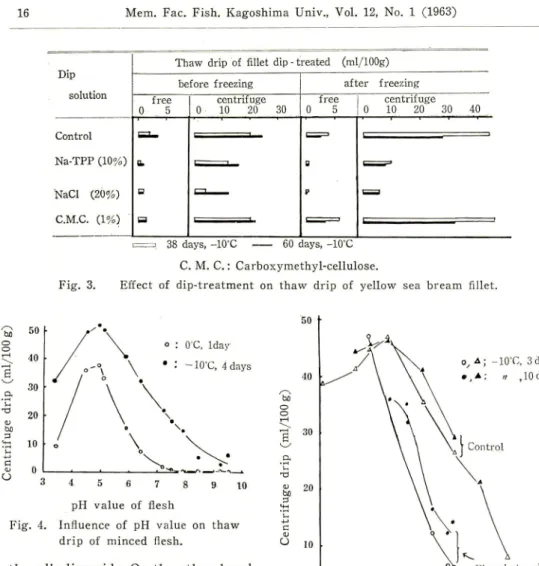
All of the added salts were preventive for dripping.
Among phosphates,
tripolyphosphate showed the most preventive effect, its effect being almost equal
to that of sodium chloride.
This can be distinctly seen in Fig. 3 where the effects of dipping fillet of
yellow sea bream in solution of these salts before and after freezing are illus
trated.
Therefore, the property enabled tripolyphosphate to prevent drip was
investigated in the following experiments.
The relation of drip quantity with pH value of flesh
It has been already known that the water-holding capacity of flesh is
influenced by pH value of flesh.9- 10> The drip quantity too is in connection with
pH value, as shown in Fig. 4. When pH value was about 5.0, the drip quantity
was the largest, while it was rather small at other values, especially lesser on
Dip
solution
Thaw drip of fillet dip - treated (ml/lOOg)
before freezing after freezing free 0 5 centrifuge 0 10 20 30 free 0 5 centrifuge 0 10 20 30 40 Control Na-TPP (10%) NaCl (20%) C.M.C. (1%) Fig. 3.
i—n 38 days, -10'C 60 days, -10'C
C. M. C.: Carboxymethyl-cellulose.
Effect of dip-treatment on thaw drip of yellow sea bream fillet.
^3 bo 50 •
/' \
\ ° : O'C, ldav 10 r v \ • : -10*C, 4 days 30 20 10 o/
\
\
\
(1S. . !V
3 4 5 6 7 8 pH value of flesh •£Fig. 4. Influence of pH value on thaw c
drip of minced flesh. O
the alkaline side. On the other hand,
polyphosphate revealed slightly al kaline. Accordingly the alkalinity of phosphate is conceived to be con-tributive to its own preventive capa city of dripping.
However, as obvious in Fig. 5, by merely making, with dilute alkali,
the pH value of flesh equal to that of flesh mixed with phosphate, such effect as that of phosphate could not be obtained. Therefore the preventive capacity of phosphate cannot be ascribed to its own alkaline property alone.
Effects of chelating agents upon the drip quantity
Polyphosphate is known to have chelating action against metal. Upon this, in order to examine the relation of this action with the preventive activity, the effect of ethylenediamine tetra-acetate (EDTA) most widely known as a chelating agent was compared with that of phosphate, the result of which is as shown in Fig.
6. Di-sodium EDTA being acidic salt, its preventive effect could not be observ
ed, while as for tetra-sodium salt, the preventive effect was observed distinctly.
10 50 -o, A; -10*C, 3days •, A; ,; JO days ontrol 4 5 6 7 pH value of flesh
Fig. 5. Thaw drip of minced mackerel flesh
with and without tripolyphosphate at different pH values.
But its degree was seen far lower than that of phosphate. Therefore it might well be conceived that contribution of a chelating action of phosphate to its
preventive capacity is rather weak, which can be surmised by comparing its
effect with that in the flesh mixed with calcium chloride.
Additives
( % /flesh)
pH of | Centrifuge drip (ml/lOOg) I flesh i 0 10 20 30 40 Mackerel Control Na-TPP (0.3) „ (0.7) NarEDTA (0.3) (0.7) CaCl. CaCl,, (0.3) (0.7) (0.3),Na-TFP (0.7) (0.7), * (0.3) (0.3),Na.-EDTA(0.7) (0.7), # (0.3) 5.7 5.91 6.12 5.5 5.3 5.6 5.4 6.0 5.75 5.24 5.2 Cachucho Control Na-TPP (0.3) (0.7) Na.-EDTA (0.3) (0.7) CaCl.. CaCl: (0.3) (0.7) (0.3),Na-TPP (0.7), // (0.3),Na,-EDTA(0.7) (0.7), // (0.3) (0.7) (0.3) 6.S 7.0 6.84 6.85 6.6 6.63 6.85 6.5 6.52 6.4
unfrozen, frozen 5 days —I0°C
Fig. 6. Influence of EDTA & TPP on centrifuge drip of unfrozen, and defrosed fish flesh.
Effects of viscous matters upon the drip quantity
In order to examine the rela
tion of viscosity of phosphate with its preventive effect of dripping, several kinds of vis cous matters were compared in regard to the effects, the result of which is as shown in Fig. 7, where preventive capacity of gelatin, glycerin, propylene-gly col was respectively seen to be lower than that of phosphate,
Additives (?'.) Control Na-TPP Starch C.M.C. Gelatin Glycerin Propylene i (1.0) (0.1) (1.0) (") lycol(//)
Centrifuge drip (mi /100g)
0 10 20
1 4 days, -10°C —— 12 days, -1G°C
Fig. 7. Influence of addition of viscous matters on thaw drip of mackerel flesh.
while as to viscosity of those, each was rather higher than that of phosphate. Accordingly viscosity is not to be considered a significant factor of the con
trolling capacity of phosphate.
The relation of preventive effect of dripping with the stabilization of protein
As a main cause of dripping, denaturation of protein has hitherto been
mentioned. Then, it was examined whether the prevention of dripping by
phosphate is due to the action to stabilize protein, the result of which is illustrated in Fig. 8, where phosphate is seen provided with the capacity to
stabilize protein.
Therefore this action might well be considered performing
a part of contribution as the preventive capacity of dripping.
3 \ ^ s 0 w V oi u U) Ph bo 3 o Fig.
Control TPP NaCl MgCl2 CaCl2
0 30 60 0 30 m 0 30 60 JO 60 0 30 60
Storage time in days (—HFC)
Effect of addition of salts on thaw drip and protein denaturation of
frozen-stored mackerel flesh.
However, what is worthy of special note is that the results of comparative experiments of chlorides were entirely opposite to those obtained in the case of phosphate, that is, chloride performed rather significant counter action against the stabilization of protein, "while it was remarkably effective in the prevention of drip, and magnesium chloride revealed the similar tendency.
These facts seem to indicate that there exists utter difference between the
mechanisms of prevention of drip by phosphate and by salt, leaving a problem to be solved concerning opinion that the cause of dripping should be ascribed to the denaturation of protein.
Conclusion
Polymeric phosphates, particularly tripolyphosphate is applicable as a preven
tive agent of drip of thawed fish.
Alkalinity and viscosity of polyphosphate,
and its actions both in chelating metal and in stabilizing protein are supposed
collectively contributable to the preventive effect of polyphosphate on dripping.
Acknowledgement
Thanks are given to Mr. A. Iwasaki and Mr. K. Suita for their assistance
in the experimental work.
References
1) Taylop, H. F. (1932) : Ind. Eng. Chem., 24, 679-682.
2) Tressler, K. K. and W. T. Murray (1932) : Fish. Gaz., 49, 24-26.
3) Tarr, H. L. A. (1942) : /. Fish. Res. Bd. Canada, 5, 411-423.
4) Tanikawa, E. , T. Miura and M. Akiba (1953): Refrigeration, 28, 294-304 (in Japanese).
5) Kizuka, S. (1959) : Conner J., 38 (8), 42-51 (in Japanese).
6) Zipser, Merelynn W., and Betty M. Watts (1961): Food Techno!., 15, 318-321. 7) Tarr, H. L. A. (1944) : Nature, 154, 824-826.
8) (1948) : J. Fish. Res. Bd. Canada, 7, 137-154, 237-247.
9) Banks, A. (1952) : Dept. Ind. Res., Food Invest. Spec. Rep., No. 55.