博 士 論 文
PERFORMANCE-BASED REDEVELOPMENT OF WATERFRONT SPACE IN
URBAN CORE AREAS OF CHINESE CITIES
2021 年 3 月
王 渊
I
Performance-based Redevelopment of Waterfront Space in Urban
Core Areas of Chinese Cities
ABSTRACT
Waterfront landscape space is an integral part of the integrated metropolitan area. The core area of a city is an area where the political, economic, cultural and other public activities of a city are most concentrated. It is the main part of the urban public activity system, the core area of the urban structure and an important part of urban functions, and is the concentration of the city and the area where the city is located. It provides facilities and service space for economic, political, cultural and social activities, and is spatially different from other areas in the city. Due to its unique geographic location, spatial form, spatial structure, spatial scale and functional attributes, the research on this space planning has never stopped. Still, there is no particular study on the relationship between the human use perspective and planning design in the course of waterfront landscape space. Therefore, this study is based on the preliminary theoretical review and classical practice project analysis. Besides, three representative sample areas of Hangzhou Riverside Section, Hangzhou Canal and Shaoxing Ancient Canal were selected for on-site practice research and questionnaire collection. First-hand data were obtained. To provide different development perspectives for the planning and design of urban waterfront landscape spaces, we have developed a series of waterfront landscape spaces that are interdependent with each other.
In the first chapter, the background and purpose of the study are discussed:
(1) The importance of urban waterfront landscape space in the current urban development process is analyzed.
(2) The current status of the research is summarized.
(3) By defining the three most important concepts of the study, namely, pedestrian zone, space and behaviour, the course's purpose is discussed.
The purpose and significance of this study are discussed. The theoretical and practical research methods that will be used in the study are analyzed. Finally, the logic and content of this paper are presented.
Chapter 2 is a review of the theoretical literature related to waterfront landscape space:
(1) An academic study of the seven aspects of urban design, environmental psychology, environmental behaviour, social psychology, leisure sociology, Maslow's hierarchy of needs, and behaviourism theory is theoretical support for studying waterfront landscape spaces.
II
of people are analyzed in terms of characteristics, ages, and types of behaviours.
(3) The properties of space are investigated. The influence of space on human behavioural activities is discussed in terms of the nature of space, the perception of space, and the context shaped by play.
The correlation between human behaviour and space is analyzed by combining the specific characteristics of the two, and the complicated relationship between behaviour and space is discussed in terms of the distance and direction of action, the sense of freedom, privacy, boundary benefits, urban theory, territorial space and humanism.
Chapter 3, Analysis of Urban Waterfront Landscape Space, analyzes the connotation and essential characteristics of urban waterfront landscape space.
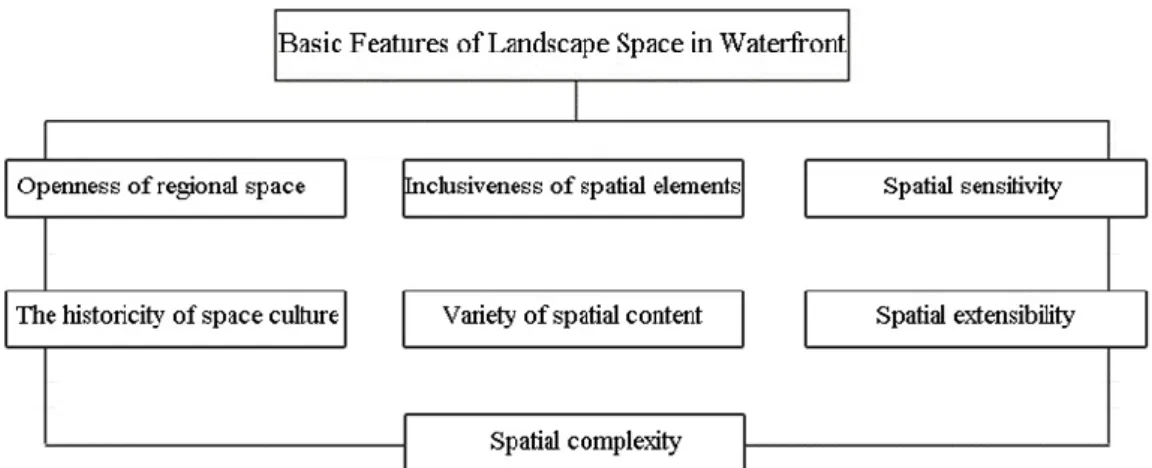
(1) The purpose and critical attributes in urban waterfront landscape space are examined. The vital qualities embodied in urban waterfront landscape space are summarized in openness, inclusiveness, sensitivity, historicity, diversity, extension and complexity of space.
(2) It classifies the waterfront landscape space from traditional landscape form and contemporary urban form, which provides the theoretical basis for selecting subsequent sample areas. The urban waterfront landscape composition is analyzed, which mainly includes the water landscape, transitional landscape, and surrounding land landscape.
(3) We discuss the water culture and its significance in the urban waterfront landscape space, analyze the regional aspects of water culture and its significant influence on urban planning, urban environment and urban image.
(4) We analyze the main landscape elements in the urban waterfront landscape space from both immaterial and material aspects.
Chapter 4, Study Case Selection and Research Perspective. The three sample areas are presented in terms of their developmental, climatic, economic, cultural, and historical functions. Secondly, in situ observation and analysis of the study sites in the three spaces are conducted, including the characteristics of the population activities in the places and the demand characteristics of the holes in which they live. Thirdly, based on the theoretical analysis and practical research, the questionnaires were designed, and the necessary distribution of the questionnaires was calculated.
In Chapter 5, the sample case data results are presented:
(1) The background of the selected areas and the main aspects of the questionnaires returned in the three sample study areas of Hangzhou Riverside Section, Hangzhou Canal Section and
III
(2) Field observation and field practice survey data are analyzed. (3) The data results of the questionnaire were statistically analyzed.
(4) The essential characteristics of the big data from the three sample regions are analyzed and summarized.
Chapter 6: Comparison and Analysis of Landscape Elements of Sample Cases. Based on the on-site practical research and relevant theoretical studies, the waterfront landscape's spatial elements are divided into the following six major categories: visual landscape, service facilities, recreational facilities, comfort design, spatial integrity survey, and renovation intention survey. Finally, the data's reliability was tested, and comprehensive situation analysis of the above six categories was carried out.
Chapter 7 discusses the results of the study. From the theoretical and practical research on the waterfront landscape space, the four most critical influential factors of the waterfront landscape space are derived, namely, human behaviour, spatial fit, contextual penetration, and the urban economy's role:
(1) From the perspective of integrated sensory, functional adaptability, comfort and convenience, and vitality, we will analyze the sense of using the space from human behaviour.
(2) We analyze the compatibility of waterfront landscape space for people's activities from the perspective of publicness, participation and softness of boundaries.
(3) We analyze the influence of cultural continuity, the spirit of the place, and support of space's development by exploring the extension and penetration of the context on the waterfront landscape space.
(4) The holistic and interrelated features of behaviour, space, culture and economy within the waterfront space are explained.
Chapter 8, Summary and Outlook. First of all, the whole study's conclusions are deduced; secondly, the innovation and importance of this study are explained. Finally, it reflects on the limitations and shortcomings of the research and gives an outlook on the course's future direction.
V
ABSTRACT
... ICHAPTER
1:
INTRODUCTION-RESEARCH
BACKGROUND AND
RESEARCH PURPOSE
1.1 Research background ... 1-1 1.2 Research summary ... 1-2 1.3 Research category and perspective ... 1-7 1.4 Definition of research object concept ... 1-9
1.4.1 Riverfront pedestrian area ... 1-9 1.4.2 Space ... 1-10 1.4.3 Behavior ... 1-10
1.5 Research purpose and significance ... 1-10 1.6 Research methods ... 1-12
1.6.1 Theoretical research ... 1-12 1.6.2 Field research ... 1-13 1.6.3 Case analysis method ... 1-14 1.6.4 Evaluation analysis ... 1-14
1.7 Research framework and technical route ... 1-19 Reference... 1-23
CHAPTER 2: RELATED THEORETICAL FOUNDATION
2.1 Related theoretical support ... 2-1
2.1.1 Urban design ... 2-1 2.1.2 Environmental psychology ... 2-1 2.1.3 Environmental behavior ... 2-3 2.1.4 Social psychology ... 2-3 2.1.5 Leisure sociology ... 2-4 2.1.6 Maslow's "hierarchy of needs theory" ... 2-4 2.1.7 Behaviorist theory ... 2-6
2.2 Behavior analysis ... 2-7
2.2.1 Behavior level ... 2-7 2.2.2 Behavior set... 2-8 2.2.3 Behavior characteristics ... 2-8
VI
2.3 Spatial properties ... 2-11
2.3.1 The nature of spatial cognition ... 2-11 2.3.2 The process of spatial cognition ... 2-11 2.3.3 Cognitive map ... 2-12 2.3.4 Spatial context ... 2-15
2.4 Behavior and space ... 2-15
2.4.1 Distance ... 2-15 2.4.2 Direction... 2-17 2.4.3 Domain and privacy ... 2-18 2.4.4 Boundary effect ... 2-18 2.4.5 Place theory ... 2-19 2.4.6 Regional space ... 2-20 2.4.7 Humanistic spirit ... 2-21 2.5 Summary ... 2-21 Reference... 2-23
CHAPTER 3: SPATIAL ANALYSIS OF URBAN WATERFRONT LANDSCAPE
3.1 The connotation of urban waterfront landscape space ... 3-1 3.2 Basic characteristics of waterfront landscape space ... 3-2
3.2.1 Openness of regional space ... 3-3 3.2.2 Inclusiveness of spatial elements ... 3-3 3.2.3 Sensitivity of spatial properties ... 3-3 3.2.4 Historicity of space culture ... 3-4 3.2.5 Diversity of spatial content ... 3-4 3.2.6 Extensibility of spatial form ... 3-5 3.2.7 Complexity of the spatial level ... 3-5
3.3 Classification and integration of urban waterfront landscape ... 3-5
3.3.1 Waterfront landscape types based on traditional landscape forms ... 3-5 3.3.2 Waterfront landscape types based on contemporary urban forms ... 3-9
3.4 The composition of urban waterfront landscape ... 3-11
3.4.1 Water landscape... 3-12 3.4.2 Transitional landscape ... 3-12 3.4.3 Surrounding land landscape ... 3-12
3.5 Water culture and significance of urban waterfront landscape space ... 3-13
VII
3.5.3 Water culture is the endogenous context of urban planning ... 3-14 3.5.4 Water culture is the ideal support for human settlements ... 3-14 3.5.5 Water culture is the representative of artistic conception of city image ... 3-15
3.6 Urban waterfront space landscape elements ... 3-15
3.6.1 Materiality elements ... 3-15 3.6.2 Non-material elements ... 3-17
Reference... 3-19
CHAPTER 4: RESEARCHING EXAMPLES AND ASPECTS
4.1 Background and characteristics analysis of three examples ... 4-1
4.1.1 District background analysis(background, environment, atmosphere) ... 4-1 4.1.2 District characteristics analysis(economy, culture, history, function) ... 4-6
4.2 Research field observation analysis ... 4-13
4.2.1 Activity characteristics of the observed population ... 4-13 4.2.2 Spatial demand characteristics of the observed population ... 4-17
4.3 Research questionnaire ... 4-20
4.3.1 Questionnaire content design ... 4-20 4.3.2 Basics of questionnaire distribution ... 4-25
4.4 Summary ... 4-25
4.4.1 Comparative analysis between the three study areas ... 4-25 4.4.2 Design and interpretation of research questionnaire ... 4-26
Reference... 4-29
CHAPTER 5: SAMPLE CASE DATA RESULT PRESENTATION
5.1 Hangzhou Binjiang section of Qiantang River ... 5-1
5.1.1 Background of sample selection and questionnaire recovery ... 5-1 5.1.2 Field observation and analysis ... 5-5 5.1.3 Questionnaire data statistics ... 5-7
5.2. Hangzhou section of Beijing-Hangzhou Grand Canal ... 5-17
5.2.1 Background of sample selection and questionnaire recovery ... 5-17 5.2.2 Field observation and analysis ... 5-19 5.2.3 Questionnaire data statistics ... 5-23
5.3. Shaoxing Ancient Canal ... 5-32
VIII
5.3.3 Questionnaire data statistics ... 5-38
5.4. Summary ... 5-46
5.4.1 Analysis of Qiantang River survey sample ... 5-46 5.4.2 Analysis of Beijing-Hangzhou Grand Canal survey sample ... 5-49 5.4.3 Analysis of Shaoxing Ancient Canal survey sample ... 5-52
Reference... 5-55
CHAPTER 6: COMPARISON ANALYSIS OF VISUAL LANDSCAPE IMAGE
FACTORS IN SAMPLES
6.1 Visual landscape image ... 6-1 6.2 Service facilities ... 6-5 6.3 Entertainment ... 6-12 6.4 Comfort design ... 6-16 6.5 Survey of spatial overall quality ... 6-19 6.6 Survey of opinions on the renovation ... 6-23 6.7 Research purpose and significance ... 6-25
6.7.1 Reliability test ... 6-25 6.7.2 Comprehensive analysis ... 6-25
Reference... 6-29
CHAPTER 7:
DISCUSSION
7.1 Human usage sense ... 7-1
7.1.1 Integrated senses ... 7-1 7.1.2 Functional adaptability ... 7-7 7.1.3 Comfort and convenience ... 7-13 7.1.4 Activity ... 7-15
7.2 Fit of waterfront space ... 7-17
7.2.1 Publicity ... 7-17 7.2.2 Participatory ... 7-19 7.2.3 Boundary permeability ... 7-22
7.3 Transmission of civilization ... 7-23
7.3.1 The media between modern and traditional cultures ... 7-23 7.3.2 Spiritual support ... 7-24 7.3.3 Supporting premises for future space turnover ... 7-26
IX
7.4.1 Scale of waterfront space layout ... 7-28 7.4.2 Qualitative function of waterfront space ... 7-29 7.4.3 Clarification of the city's comprehensive positioning ... 7-30
7.5 The relationship between behavior, space, culture and economy in waterfront space .
7-31
7.5.1 The four elements form a whole ... 7-31 7.5.2 Interpenetration among the four elements ... 7-32
Reference... 7-33
CHAPTER 8:
SUMMARY AND OUTLOOK
8.1 Conclusions ... 8-1 8.2 Innovation & importance ... 8-3
8.2.1 Identify important attributes of waterfront space ... 8-3 8.2.2 Propose a new finding of urban waterfront function ... 8-4 8.2.3 Perfect the design theory of urban waterfront space ... 8-4
8.3 Research limitations and perspectives ... 8-5
8.3.1 Research limitations ... 8-5 8.3.2 The impact of the epidemic on research and strategies to address it ... 8-5 8.3.3 Data analysis will be more diverse ... 8-6
Chapter 1
INTRODUCTION-RESEARCH BACKGROUND AND
RESEARCH PURPOSE
RESEARCH PURPOSE
1.1 Research background ... 1
1.2 Research summary ... 2
1.3 Research category and perspective... 7
1.4 Definition of research object concept ... 9
1.4.1 Riverfront pedestrian area ... 9
1.4.2 Space ... 10
1.4.3 Behavior ... 10
1.5 Research purpose and significance ... 10
1.6 Research methods ... 12
1.6.1 Theoretical research ... 12
1.6.2 Field research ... 13
1.6.3 Case analysis method ... 14
1.6.4 Evaluation analysis ... 14
1.7 Research framework and technical route ... 19
-1-1
1.1 Research background
People's water orientation has made the development of ancient and modern civilizations mostly show the phenomenon of "prosperity along the water", and gradually developed settlements, villages, towns, and even cities with water as the center. Many historical and cultural cities and global cities also have the advantages of long waterfront development, such as London and Paris, or domestic cities such as Shanghai, Suzhou, Wuhan, and Chongqing. In the long process of urban development, the waterfront environment has also played an important role in the formation of the urban form, the shaping of space, and the appearance of the image. The waterfront areas of many cities have become the core of the city and represent the image of the city. History, culture and socio-economic outlook [1]. The personality shaping of a city often relies on the spatial form, activity
behavior and context of the waterfront to create a characteristic business card for urban development and give unlimited possibilities for the future development of the city.
Urban waterfront space is an important carrier of urban comprehensive activities. As one of the areas where human activities and the process of self-recognition work most strongly in the city, the waterfront has many functions in the natural and social systems of the city, such as water conservancy, transportation, recreation, city image and ecological functions, etc [2].In the process of
urban expansion, the life, productivity, ecology, transportation convenience and cultural memory of the waterfront area make the waterfront area a distribution center for housing, production, trade, leisure and transportation. As a result, the waterfront comprehensively reflects the social, economic and cultural forms of the city, and brings strong vitality to the development of the city.
In the process of urban expansion, the life, productivity, ecology, transportation convenience and cultural memory of the waterfront area make the waterfront area a distribution center for housing, production, trade, leisure and transportation. As a result, the waterfront comprehensively reflects the social, economic and cultural forms of the city[3], and brings strong vitality to the development
of the city.
With the improvement of living standards and the gradual rise of people's needs, people pay more and more attention to the waterfront area and begin to examine the development and landscape planning of the waterfront area with a more professional perspective. Each city’s river or waterfront area has its unique functions and rich culture, which determines that the landscape and spatial planning of the waterfront area should fully reflect the characteristics of the area, tolerate all possible activities in the space, and integrate Sexual analysis of the nurturing relationship between space and behavior shapes the character of the environment and the characteristics of the crowd. This article is based on the diversification of the urban waterfront space and the interaction between the behavior
-1-2
of the people in the space and the environment. This article attempts to analyze the behavior and space of the people in the urban waterfront from the perspective of space and behavior. Shape the complex relationship between the two to provide reference and guidance for related design and research.
1.2 Research summary
Summary of foreign research on waterfront area:
The concept of waterfront landscape in foreign countries originated from North America in the 1960s. In the United States, the redevelopment of the waterfront re-discovered the "white sailboats under the bright sun disappeared from the city, the lively and prosperous seaside commercial street..." Come back; and the development of Europeans focuses on the protection and regeneration of the historical and cultural environment, inheriting historical and cultural elements related to the water environment, protecting the good relationship between the water and the city in the traditional waterfront space, and creating a good waterfront surrounding. In 1970, the renewal expanded to European port cities, especially London in the United Kingdom; in the 1980s, with the development of industries in Australia and Japan, the land use of the waterfront began to change, and people re-recognized the importance of waterfront space. Some "hydrophilic activities" and "hydrophilic spaces" have appeared. In July 1990, the International Water Capital Meeting passed the "Osaka International Water Capital Meeting Spirit", which showed that people began to re-recognize the potential of the urban waterfront to improve the comfort of the urban environment and enhance the characteristics of the region. With this as a sign, the revival and development of the urban waterfront have become a worldwide trend. Subsequently, in the 1990s, the renewal of the waterfront gradually spread to newly industrialized countries and developing countries, and the development, research and practice of urban waterfronts in Asian countries also made great strides.
In 1982, the Waterfront Center was founded in Washington, D.C., and the Waterfront World magazine was founded. In 1989, the University of Venice initiated the establishment of the international "waterfront city research center" and organized several international conferences. Many universities also offer courses in Waterfront Research, such as Harvard School of design. Waterfront albums have been released by relevant professional magazines, such as process architecture in 1984, progressive architecture in 1990 and landscape architecture in 1991. There are also plenty of related design monographs, such as I.L. McHarg's Design Combined with Nature published in 1969, John Ormsbee & Simmonds' landscape design learning site and design manual, and park and site Planning analyzes in detail the design cases of waterfront parks in the United States, such as Golden Cologne, and explains the application of the hydrophilic concept in its design techniques. There are also many related design monographs, such as I.L. McHarg's Design
-1-3
Combined with Nature published in 1969, Landscape Architecture: A Handbook of Site Planning and Design by John Ormsbee & Simmonds, and Park and Site Planning analyzes in detail the design cases of waterfront parks in the United States, such as Golden Cologne, and explains the application of the hydrophilic concept in its design techniques.
From the perspective of the development of the waterfront landscape, the waterfronts of most countries have experienced a process of development, prosperity, and decline, from the original waterfront production to the industrialization era and then to the social transformation of the post-industrial era. The development has more contemporary and endogenous characteristics. Due to the differentiation of development and evolution in different regions, the development of the waterfront is at different stages, and there are also certain differences between exploration and academic research.
First of all, related scholars have studied the motivations of waterfront renewal and believe that in the process of waterfront renewal, the popularization of sustainable development concepts and historical and cultural protection thoughts are also important reasons for its optimization. Among them, McCarthy's research on the renewal of the Dundee waterfront in Scotland, England, shows that if there is no guidance from a policy mechanism, the results of the renewal are often not ideal[4];
Stephen's research shows that different ideological orientations of government policies will lead to differences in waterfront renewal governance models[5]. However, since the mid-1990s, the
influence of the concept of sustainable development has become more and more common[6]. This
has been used as the main driving force for the development of waterfront landscapes. At the same time, more countries have begun to pay attention to and protect and renew the historical relics of the waterfront. In culturally rich countries and regions, they have even formed local waterfront management and development model.
Secondly, some scholars have found that with the progress of the industrialization revolution, the conflict between land use and water use within the waterfront port has gradually become prominent, which has affected the migration of ports and internal industries[7], and from the perspective of
spatial development The migration is divided into six stages: The first stage: from the ancient/middle world-the beginning of the 19th century, at this time the original port-city relationship, in terms of spatial function, the city and the port are connected as far as possible; the second stage: from the 19th century- At the beginning of the 20th century, due to the rapid development of industry, the volume of bulk cargo in the port increased in Japanese, and urban land could not meet the rapid development needs of the port, and the port city was in a rapid expansion stage; the third stage: the early 20th century, the freight terminal and industrial development Gradually consuming space and accelerating the separation of ports and cities; the fourth stage: from the 1960s to 1980s, the maritime technology reform promoted the expansion and separation of the coastal industrial zone;
-1-4
the fifth stage: 1970s to 1990s, the port Reconstruction in different places releases land and water space, and the core area of the old port in the city is renewed; the sixth stage: 1980-the early 20th century, the establishment of a complex transportation system with global development changed the role of pure industrialization of the port. The relationship between the port and the city began to reconnect, and the renewal and redevelopment of the port gradually came into people's field of vision[8].
In the course of social development, the roles and functions of the waterfront are gradually changing. Huang et al. (2011) combined Green and Rigby to face the waterfront based on the three waves proposed by Toffler (agricultural era, the industrial revolution, and information revolution). The division of water area types and Valleag's summary of waterfront functions are summarized into three stages of labor value-added, production value-added, and service value-added[9]. It is
believed that the current waterfront area focuses on leisure and entertainment, sightseeing and recreation. Activities such as cultural preservation, marine research and ecological experience.
However, we can find that no matter how the functions of the waterfront area change, the development of the waterfront area is still affected by the relationship between the city and the waterfront area, and we are looking for the driving force for development in between, and actively deal with the past and the present. Relationship with continuity, competition and collaboration[10].
Finally, some scholars have made comparative studies on the development and renewal models of the waterfront. From the perspective of spatial structure, it can be divided into internal reorganization and external expansion. From the perspective of function shaping, the waterfront renewal model includes three models: commercial orientation, real estate orientation and compound development; from the perspective of government participation, It can be seen that the renewal model of the waterfront shows a trend of transition from government-led to public-private partnership urban corporate governance[11].
In the mode of internal space organization, the original industrial space pattern of the waterfront area is retained, and some historical relics are protected and updated so that space retains its original characteristics, and the small-scale public space is designed and updated, Inject new business formats such as cultural tourism, service and leisure, promote the transformation of space function and restore its vitality. In the mode of outward expansion, the original industrial activities were completely moved out and commercial service industries were introduced, and the waterfront area was completely transformed in terms of space, function, and development orientation. It can be seen that regardless of the renewal model, the development of the waterfront area is closely related to commerce and real estate. It attracts people through commerce, restores activities in the space, and improves the space environment through real estate, shaping a good public space, and providing a
-1-5
good place for activities. Yes, this rule can be verified by combing through well-known waterfront update cases around the world.
In the initial stage of development of the waterfront, residential and commercial spaces are often the first to be valued because they are the prerequisite and support for people to return to space. Subsequently, in the context of urban renewal seeking economic effects, commerce and real estate gradually became the leading guide for waterfront renewal, focusing on optimizing land use and maximizing return on capital gains.
In summary, the research content of the waterfront area abroad covers the development process of the waterfront area, the evolution of the relationship between the port and the city, the spatial evolution of the waterfront area, the combination of spatial functions, and the intervention factors of spatial governance. The research latitude is relatively rich. It provides a solid theoretical basis for the follow-up research of this article.
Summary of Domestic Research on Waterfront Area:
The research of urban waterfront landscape planning and design has always been a hot research field in China. Due to the natural water-oriented or exploration of water space, the key areas of waterfront planning and design research mainly focus on the development and construction of waterfronts. , Waterfront planning and design and ecological protection, etc., ignoring the waterfront and the most core elements-people, and human behavior in space, from the perspective of human behavior to study landscape planning Construction and development ensure the rationality of the space design and highlight the "people-oriented" design concept. Summarizing the domestic research status of urban waterfront landscape, the main points are as follows:
Urban Waterfront Design and Development[13]edited by Zhang Tingwei, Feng Hui, and Peng
Zhiquan published by Tongji University Press in March 2002 is an earlier and systematic introduction to the urban design and development of urban waterfronts in China. In addition to introducing the motivation and basic principles of the development of urban waterfront areas, it also introduces the development of foreign waterfront areas in a larger space and conducts research and analysis on the examples.
Mou Di from Xi’an University of Architecture and Technology discusses the theoretical support of waterfront urban design from the perspective of the intersection of human settlements, geography, architecture, and aesthetics, and combines waterfront construction experience at home and abroad, from city to waterfront Propose a general design model and theoretical framework, that is, to build a harmonious development relationship between the waterfront and the overall urban spatial structure; to shape the overall image of the city’s waterfront; to build spatial environmental art in
-1-6 key areas of the waterfront[14].
From the perspective of recreational science, Zhou Sheng of Central South University of Forestry and Technology systematically studied the key points and points of the landscape design for the construction of recreational space in the urban waterfront, so that the landscape and recreational behaviors were coordinated and agreed to meet the recreational needs of the crowd. Design of waterfront landscape. Based on the research of landscape ecology, landscape ecological planning, and ecological design theory, Mi Wei of Northeast Forestry University analyzed several famous domestic and foreign cases such as the planning and development of the Chicago waterfront area, the Boston Strip Park System, and Guangdong Qijiang Park. It reflects the overall planning, good continuity, natural ecological restoration, industrial wasteland reconstruction, artificial wetland construction, public participation and other aspects of the waterfront area, which provide references for the planning and design of future waterfront landscape areas[15].
Bian Suping from the Nanjing University of Technology introduced the historical development process of the waterfront area through on-site investigations and by referring to urban design theories, urban renewal theories, landscape ecology theories and other related planning theories. By studying the principles and principles of waterfront programming Implement the strategy, analyze the main landscape elements and landscape structure of the waterfront area, combine the main dynamics of the waterfront development in China, and put forward a waterfront reconstruction strategy based on sustainable development, and use the Suzhou city as an example to explain the combination of urban culture At the same time as the background, the waterfront landscape was updated and transformed[16].
Lu Feng and Xu Yuhui of the School of Architecture and Urban Planning of Chongqing University analyzed the humanity and nature of the mountain waterfront urban landscape, from four aspects: protection of natural elements, restoration of waterfront vitality, reconstruction of vertical walking system, and improvement of space practical efficiency Put forward the idea of landscape planning in line with the characteristics of mountain waterfront area[17], which has certain reference
significance for other similar mountain cities.
Zhang Luhong and Xiang Yuan from the Department of Architecture of Anhui Institute of Architecture and Technology analyzed the environmental characteristics, landscape characteristics and human behavior characteristics of the urban waterfront area, combined with the waterfront landscape design practice of Tongling Lakeside Plaza, from the design principles, overall design, The method of urban waterfront landscape design is explored in terms of functional zoning, landscape composition and node design[18].
-1-7
evolution and existing problems of the urban waterfront area, and then analyzed the ecological environment characteristics of the urban waterfront area in the Loess Plateau region, as well as people’s behavior and psychology in this environment, and concluded Principles and methods for the development of urban waterfront landscape planning in the Loess Plateau[19].
Yu Kongjian, Zhang Lei, and Liu Yujie of Peking University Landscape Architecture Research Institute took the landscape design on the banks of the Sanzao River in Cixi City, Zhejiang Province as an example to explain some concepts and methods of multi-objective landscape design for urban waterfronts, and further proposed human and nature The path of landscape design related to coordinated development[20].
With the rapid development of China's economy in the past two decades and the gradual acceleration of urbanization, the waterfront of large and medium cities, an area with high-quality natural and landscape resources, has naturally become an active area for urban human settlement activities. A large number of practices and research activities for systematic and comprehensive renovation and development of urban waterfronts have emerged. Such as the development of Shanghai’s central business district on the opposite bank of the Huangpu River and the renovation of the Bund pedestrian area, the renovation of the Suzhou River area, the renovation and development of the Tianjin Haihe River, and the Chengdu Funan River treatment project. However, a considerable part of the urban waterfront has not yet been effectively transformed and developed, which is a problem that many cities still need to solve urgently. With the development of society and the improvement of urban residents' requirements for environmental quality, urban waterfront areas will inevitably become the center of attention for their unique natural environment and landscape advantages.
In summary, domestic research on waterfronts mainly focuses on the scope of the waterfront space from the perspective of urban design and ecological theory but lacks exploration of the relationship between waterfront space and people, as well as activity behaviors. And this part is the prerequisite research for exposing the vitality in the space and rationally planning the space.
1.3 Research category and perspective
The urban waterfront is one of the most sensitive areas in the urban environment. As people pay more and more attention to the urban ecological environment and the development of the city, the urban waterfront has gradually become a key area for urban development at home and abroad. The development of the waterfront has become an important way to improve the urban landscape, urban image and promote urban economic development. Among them, the pedestrian area on the riverside is an important aspect of the design of the urban waterfront. In particular, material space and public
-1-8
behavior are two major research elements, and their mutual influence and interaction are more worthy of our attention. Material space is the physical expression of urban space form and the bearing of urban life, and mass behavior and urban space interact and interact with each other. Therefore, the spatial material form of the pedestrian area on the side of the river provides the possibility of evacuation and release for the mass behavior in the state of aggregation and compounding, and its unique diversity meets the selective needs of modern urban life.
From the perspective of people's hydrophilicity, in various open public spaces in the city, the unique and characteristic natural element landscapes, artificial landscapes, activity landscapes, and human landscapes in the waterfront area are all in them. The activities provide a wealth of space. At the same time, these factors also create the possibility of diversity for human activities. In the urban waterfront landscape, its constituent elements are more complicated. The behavior of the crowd, cultural and economic elements all have an impact on the space and are the main factors that constitute the vitality of the waterfront landscape. At the same time, the balance of natural ecology produced by these four aspects, the landscape degree of plant style, the availability of building retention, and the sustainability of urban development are all decisive indicators for shaping the future of space. In this process, the background of the entire social environment, people's thoughts and customs of life, the natural features around the city and the unique regional climate of the city all directly have a comprehensive impact.
Fig. 1-1Analysis of the elements of urban waterfront landscape
On the other hand, with the development and progress of society and the improvement of people's quality of life, the construction of urban open spaces that provide places for leisure activities is also becoming increasingly important. How to better meet the needs of users in open spaces has become
-1-9 a designer The important issues facing.
Just as the goal of urban design that we advocate is to create a man-made environment and a natural environment that make human activities more meaningful, to improve the quality of human space and environment, thereby improving the quality of human life. The quality of the space environment is based on the needs of people. The quality of the space environment means the superiority of the space environment. When applied to the city, it depends on the scales that make people happy and coordinate with nature, the matching of tastes and the elimination of inconsistent contrasts. From this, we can conclude that in addition to the development and construction of the urban space material form level, urban design should also pay attention to another important level involving the visual, psychological, and behavioral connection between people and the environment, involving people's time, The sense of space and their happiness. Starting from the cultural psychology of people, studying people's experience and meaning in urban space and urban environment, as the fundamental starting point of urban design, is the thought and principle of the "connotation theory" of urban design. As Norberg Schultz once put forward, "The task of an architect is to create meaningful places to help people live." The same is true for urban design. This article will start from the perspectives of environmental psychology and behavioral psychology, and follow the theories of urban planning and urban design to systematically analyze and study the relationship between the "environment and human activities", and obtain certain design patterns and concepts arouse the awareness of urban designers to attach importance to the psychology and behavior of people in the material space.
1.4 Definition of research object concept 1.4.1 Riverfront pedestrian area
The riverside pedestrian area refers to the spatial area planned along the banks of the river in the city for people to walk and move around. Including architectural sketches, hard pavement, green planting and certain service facilities.
The riverside pedestrian area itself forms a linear space, which is an organic integration zone between the urban environment and the natural environment. However, with the improvement of the quality of the urban environment and the increasing emphasis on the development of the riverfront area, it is no longer a road space that only aims at traffic passability, but has added urban entertainment space, leisure space, cultural space, etc., and has A riverside pedestrian area formed by several enlarged nodes. It has also become an important outdoor public activity space in the city.
-1-10
1.4.2 Space
For the external environment, the space concept usually refers to the scale of the area where the object is located and its specific background and atmosphere.
Different spaces will give people completely different psychological feelings. According to human senses, space can be divided into several categories. We are usually familiar with visual space, that is, the length, width, and height of a specific space. For architectural space, it is the three-dimensional proportional size of the ground, wall, and ceiling and their The size of the enclosed space, visual space occupies a dominant position in all sensory spaces, in addition to auditory space, olfactory space, tactile space, comprehensive sensory area space, cultural psychological space and so on. For example, a sculpture designed in combination with a musical fountain, because people can only hear the music played by the fountain within a range of about 5 meters, so the sculpture and the fountain are the centers of the circle, the length of 5 meters is the radius, and the sweet music is The space defining the barrier is formed. When people appreciate this sculpture, psychologically, they must rely on this musical barrier as their spatial scope. Another example is the calligraphy, inscriptions, and joints that appear in the vision, which will make people have infinite associations. The far-reaching artistic conception conveyed by "Lonely pity on the edge of the grass, with Huang Peng and deep tree ming" becomes a vision that is thought by the viewer. The resulting intangible space is a cultural psychological space. In our actual external environment, due to the complex diversity of buildings, street layouts and structures, various sense organs are mobilized to different degrees, and these sensory spaces are often mixed.
1.4.3 Behavior
Behavior is the subject's action response to a stimulus, and it is a continuous collection of purposeful actions. Human behavior simply refers to various activities in people's daily life or external human activities that can show people's thoughts, qualities, psychology, etc., or satisfy certain goals or desires. A process of step-by-step actions taken. Behaviors can generally be divided into spontaneous behaviors and acquired operational behaviors. Human behavior is fundamentally different from the behavior of other biological systems in basic characteristics. Its particularity is manifested in self-knowledge and self-control, correct behavior, use of symbols, close communication with the environment, and concern for value.
1.5 Research purpose and significance
The waterfront is a unique part of the urban space, reflecting the microcosm of each city's society, culture and economy. Since ancient times, there has been a saying in China that "there are many
-1-11
people who rely on mountains, and they also need water to pass the boat and then build them". In ancient times, production technology was backward and people depended on natural water sources for their lives. The water system served the functions of defense, transportation, fire prevention, cleaning, drinking, and production. "Born with water, choose water for habitation" is the inheritance of wisdom of the ancestors. The waterfront is the center of urban life and also reflects the prosperity and civilization of the city. After the Industrial Revolution, the productivity developed tremendously, and the city has undergone earth-shaking changes, which have also caused water pollution, destruction of the natural waterfront landscape, and ecological imbalance. The waterway was replaced by the land road of “Dora, fast running”, and the traditional urban water environment was replaced by the city. "Window" becomes "Backyard". After experiencing "prosperity" and "decline", "rejuvenation" has become the main theme of contemporary urban water environment construction. ①Waterfront plays an important role in urban development and is a comprehensive space with urban characteristics.
First of all, the city’s waterfront is an important part of the construction of the city’s open space. It provides people with social, gathering, and entertainment venues. It is a space medium for information exchange and dissemination. The open space and strong historical deposits of the waterfront attract this The public yearning makes it a very characteristic part of the city's public open space. Secondly, the river is an important ecological corridor in the city. As the intermediate area connecting the river and the land, the waterfront is rich in natural resources and ecological resources. It is a sensitive part of urban ecology and an important balance line for urban ecology. Finally, the waterfront improves the habitability of the city, builds a rich urban living space based on the vitality of the water area, attracts people to yearn for it, and forms the most dynamic open space in the city.
②Provide a more humanistic research perspective for the development and planning of the urban waterfront
With the development of the city's economy, the reconstruction and development of the waterfront have always been a hot project of concern from all walks of life. With the gradual expansion of the urban construction area, after the urban space has undergone rapid extensional expansion, the connotative improvement is becoming more and more urgent, and the waterfront is a comprehensive space that meets the coordinated development of the two. This research focuses on the relationship between waterfront space and human behavior, explores to stimulate the inner vitality of urban space, exposes the humanistic logic of waterfront planning and design, and awakens the design humanity that designers should pay more attention to than space itself.
-1-12
③Sampling research to build an element evaluation system for waterfront spatial design Based on theoretical research, this research selects three samples for field investigation and questionnaire design evaluation analysis. From the specific landscape elements, it sorts out the actual practical situation of the waterfront landscape. According to the evaluation results, from the perspective of human use and space, The planning perspective and the cultural continuation perspective respectively give the analysis results to provide a basis for the rational planning of the waterfront landscape in the future.
1.6 Research methods 1.6.1 Theoretical research
Owned theories have been proved by a large number of facts, are scientific and practical, and are the basis for problem research and the generation of new theories. Therefore, the literature as the second-hand data provides the research foundation and argumentation evidence for the thesis.
In the process of the thesis research, I read various related books, periodicals, magazines, etc., especially in-depth study of the relevant literature that focuses on the current urban construction, behavior and environment in my country, and conducts an objective comprehensive analysis and comparison of these literatures, trying to grasp the main While obtaining evidence and support from other sources, the idea helps each tunnel to verify these theories through case studies.
One of the important contents of the research on waterfront landscape space and human behavior is the interaction analysis of environmental behavior. It is necessary to read and analyze related literature such as urban design, environmental behavior, environmental psychology, social psychology, and leisure sociology. To understand the interactive law of the mutual image of the urban waterfront space environment and behavior, summarize and sort it into the second chapter "Relevant Theoretical Basis" to support the relevant content of the third chapter of this article "Urban Waterfront Landscape Spatial Analysis". Combining theoretical research analysis and case background analysis to support the rationality of Chapter 4 "Research Case Selection and Research Angles" and other related content, Chapter 5 "Sample Case Data Results in Statement", Chapter 6 "Sample Case Landscape Elements" Comparative analysis" and follow-up discussions and prospects lay the foundation for theoretical research and case analysis. Among them, the theoretical study includes related photos, drawings, reports, etc. Document sources include secretaries, databases, the Internet, and related governments, social institutions and individuals.
-1-13
1.6.2 Field research
Field investigation is an important means in research and analysis and an effective way to test theories. Field surveys include observations, questionnaires, interviews, and other survey methods to obtain more authentic and effective information and data. Field observations are the most basic and commonly used methods for field surveys.
Among them, the following three methods are most commonly used: systematic observation method, direct questioning method and standardized questionnaire method.
The systematic observation of environmental behavior refers to systematically observing how people use their environment? What are they doing? How are various activities related to time and space? How does the spatial arrangement affect the participants? Wait, the observation is in essence Behavior in the environment, you can obtain information about people's activities and the situational information needed to support activities, or information about site rules, behavioral norms, expected functions, and new functions, including incorrect information, or behavioral support provided in certain behavioral situations Or restrictions, etc. On-site direct observation refers to the ability to collect data as objectively as possible and to facilitate the use of statistical analysis to classify data. There is also a behavioral labeling method, which is to compile a list of possible observed behaviors according to a pilot study and classify them to get a list of activity types. Tools suitable for recording behavior observations, including oral descriptions, drawings, plans, photos or videotapes, etc. The choice of tool type mainly depends on how detailed the research topic is and how well the observer understands the behavior to be observed.
Asking questions refers to asking the research object systematically to find out what he thinks, feels and does, what he knows, believes and expects. Direct questioning is a research tool with great potential. In this way, Various data can be collected. Generally speaking, there are the following steps: Observe and understand the real situation in the interviewee's specific environment one by one to find out some of the important elements, patterns and processes, that is, the researcher has a set of hypotheses ( What aspects of this situation are important to the participants? What is the significance? What impact does it have on the participants?) Based on the above analysis, the researchers formulate a questioning guide, determine the hypothesis and the main scope of the research.
A standardized questionnaire is to ask a large group of people the same set of questions, and then compare their answers. You can find commonalities and compare the differences. The standardized questionnaire provides quantitative information, so it is more convincing than qualitative information.
-1-14
This study will conduct field research in two forms: questionnaires and observation interviews. The questionnaire design mainly collects the interviewees’ senses of the use of space, element evaluations, and activity records. Etc., to conduct systematic information collection and recording from the two aspects of space and behavior, laying a data foundation for subsequent research and discussion.
1.6.3 Case analysis method
Based on theoretical research, this paper selects three actual cases of Hangzhou Canal Section, Hangzhou Riverside Section and Shaoxing Ancient Canal for sample research, using this as a starting point to explore the trajectories of behavior activities in different types of waterfront spaces, and obtain a large amount of data For analysis, these data will then be transformed into the premise for the discussion of the relationship between space and crowd behavior, completing the whole process from theory to practical investigation, data collection to thinking and discussion. The sample analysis of typical cases is conducive to summarizing the logical relationship between space and behavior in different types of waterfront areas, to promote the discussion results to practice and provide a reference for related planning and design.
1.6.4 Evaluation analysis
① System analysis method
System analysis is the basis of system synthesis, optimization, decision-making, and system design. The system analysis method is based on system theory, using modern scientific methods and technologies to analyze the various elements of the system of things and their interrelationships, compare, evaluate and optimize feasible solutions, to provide a reliable basis for decision-makers. System analysis has the following four characteristics: (1) Take the whole as the goal, (2) Focus on specific problems, (3) Use quantitative analysis methods, (4) Rely on value judgment.
This paper introduces the system analysis method into the study of waterfront space and behavior, regards the mutual relationship between the two as a system, and proposes the research purpose from the overall perspective to study the relationship between the system, the elements, and the environment and the regularity of changes, Establish a research model of the relationship between space and behavior from the elementary level to the environmental level, and analyze the endogenous logic of site planning. Using a combination of qualitative and quantitative methods, a comprehensive analysis of the relationship between space and behavior through value evaluation.
-1-15
Based on system analysis, qualitative and quantitative analyses are carried out in detail, and three types of waterfront space locations are compared and screened, and waterfront development types are divided from the nature of urban space activities to provide more latitude for research. Collect the basic data of the existing space and behavior activities in the waterfront site by designing the survey questionnaire to make preliminary preparations for the later analysis and research.
③ Multidisciplinary integrated analysis
This research is based on the waterfront space and places as the carrier, focusing on the relationship between space and crowd behavior. The research process involves urban planning and design, behavior, sociology, psychology and other disciplines. The research latitude spans multiple disciplines. Comprehensive and cross-cutting research. Aiming at the subject areas involved, this paper sorts out the related theoretical results of the previous research analyzes the main ideas of the research and conducts an integrated analysis with the topics studied in this paper to construct a more comprehensive research system on the relationship between waterfront space and behavior.
④ SPSS statistical analysis
Statistical analysis software SPSS (Statistics Package for Social Science), one of the most famous statistical analysis software in the world, can be used in data statistics of standardized questionnaire results. At the end of the 1960s, three graduate students from Stanford University developed the earliest statistical analysis software SPSS. At the same time, the SPSS company was established, and the headquarters of SPSS was established in Chicago in 1975. Before the 1980s, SPSS statistical software was mainly used in enterprises and institutions. In 1984, SPSS headquarters first launched the world's first statistical analysis software version SPSS / PC 10, which initiated the development direction of SPSS microcomputer series products, thus establishing the first position of individual users in the market. At the same time, SPSS has implemented the localization strategy and has launched nine language versions. The introduction of SPSS / PC + has greatly expanded its application scope and made it quickly applied to various fields of natural science, technical science and social science. Many influential newspapers and magazines in the world have given high praise to SPSS in terms of automatic statistical drawing, in-depth analysis of data, the convenience of use and complete functions. At present, it has gradually become popular in China. It uses windows to display various functions of data management and analysis methods, and dialog boxes show various function options. As long as you master certain windows operation skills and rough statistical analysis principles, you can use the software to serve specific scientific research work.
SPSS for windows is a combined software package, which integrates the functions of data collation and analysis. Users can select modules according to the actual needs and the functions of the computer, to meet the requirements of the system's hard disk capacity, which is conducive to the
-1-16
popularization and application of the software. The basic functions of SPSS include data management, statistical analysis, chart analysis, output management and so on.SPSS statistical analysis process includes descriptive statistics, mean comparison, general linear model, correlation analysis, regression analysis, logarithmic linear model, cluster analysis, data simplification, survival analysis, time series analysis, multiple responses, etc. each category is divided into several statistical processes, such as linear regression analysis, curve estimation, logistic regression and prob It regression, weighted estimation, two-stage least squares, nonlinear regression and other statistical processes, and each process allows users to choose different methods and parameters. SPSS also has a special drawing system, which can draw various graphs according to the data.
The results of SPSS for windows are clear, intuitive, easy to learn and use, and can directly read excel and DBF data files. Now SPSS for windows and SAS. BMDP is known as the three most influential statistical software in the world. Compared with several international statistical analysis software, its superiority is more prominent. In the statistics of the overall impression scores of SAS, BMDP, GL IM, GEN STAT, EPILOG and MiniTab, the highest scores are obtained for all the functions of many users. There is an unwritten regulation in international academic circles that in international academic exchanges, the calculation and statistical analysis completed by SPSS software can be done without an explanation of algorithms. Thus, it can be seen that the impact and reputation of the algorithm are high. The latest version 12.0 adopts DAA (Distributed Analysis Architecture) and fully adapts to the Internet. It supports dynamic data collection, analysis and HTML report. However, it is difficult to be directly compatible with general office software such as office or WPS2000. When writing survey reports, it is often necessary to use spreadsheet software and professional mapping software to redraw relevant charts, which has been criticized by many statisticians; Moreover, as one of the three comprehensive statistical software, SPSS still has some deficiencies compared with the other two software, SAS and BMDP.
However, due to its simple operation, SPSS for windows has played an important role in various fields of social science and Natural Science in China. The software can also be used in economics, biology, psychology, health care, sports, agriculture, forestry, commerce, finance and other fields.
For the three most widely used statistical software SAS, Stata and SPSS, each software has its unique style and its advantages and disadvantages. The following is a brief comparative analysis.
(1)SAS
General usage: SAS is very popular with advanced users because of its powerful function and programmability. Based on this, it is one of the most difficult software to master. When using SAS, you need to write a SAS program to process data and analyze it. If there is an error in a program, it will be difficult to find and correct it.
-1-17
Data management: in terms of data management, SAS is very powerful, allowing you to process your data in any possible way. It contains SQL (Structured Query Language) procedures that can be used in SAS datasets. However, it takes a long time to learn and master the data management of SAS software. In Stata or SPSS, the commands used to complete many complex data management tasks are much simpler. However, SAS can process multiple data files at the same time, which makes data management easier. It can handle 32, 768 variables, and the maximum number of records allowed by your hard disk space.
Statistical analysis: SAS can do most statistical analysis (regression analysis, logistic regression, survival analysis, ANOVA, factor analysis, multivariate analysis). SAS's advantages may lie in its analysis of variance, mixed model analysis and multivariate analysis, while its disadvantages are mainly ordered and multivariate logistic regression (because these commands are difficult) and robust methods (it is difficult to complete robust regression and other robust methods). Although it supports the analysis of survey data, the comparison with Stata is still quite limited.
Drawing function: among all statistical software, SAS has the most powerful drawing tool, which is provided by SAS / graph module. However, the learning of the SAS / graph module is also very professional and complex, and the production of graphics mainly uses program language. SAS is not as simple as SPSS, although it can draw interactively by clicking the mouse.
Conclusion: SAS is suitable for advanced users. Its learning process is hard, and the initial stage can be frustrating. However, it is favored by advanced users because of its powerful data management and the ability to process a large number of data files at the same time.
(2) Stata
General usage: Stata is popular with beginners and advanced users for its easy to understand and powerful functions. When using, you can input only one command at a time (suitable for beginners), or you can input multiple commands at a time through a Stata program (suitable for advanced users). In this way, even if there is an error, it is easier to find out and correct it.
Data management: Although Stata has less powerful data management capability than SAS, it still has many powerful and simple data management commands, which can make complex operations easier. Stata is mainly used to operate one data file at a time, which makes it difficult to process multiple files at the same time. With the introduction of Stata/SE, the variables in a Stata data file can now reach 32, 768, but when a data file exceeds the range allowed by computer memory, you may not be able to analyze it.
Statistical analysis: Stata can also perform most statistical analysis (regression analysis, logistic regression, survival analysis, analysis of variance, factor analysis, and some multivariate analysis).
-1-18
Stata's greatest advantages may be in regression analysis (which includes easy-to-use regression analysis feature tools), and logistic regression (with procedures to explain the results of logistic regression, which are easy to use for ordinal and multivariate logistic regression). Stata also has a series of good robust methods, including robust regression, robust standard error regression, and other commands containing robust standard error estimation. Besides, Stata has obvious advantages in the field of survey data analysis, which can provide regression analysis, logistic regression, Poisson regression, probability regression and other survey data analysis. Its shortcomings lie in the analysis of variance and the traditional multivariate methods (multivariate analysis of variance, discriminant analysis, etc.).
Drawing function: just like SPSS, Stata can provide some command or mouse click interactive interface to draw. Unlike SPSS, it has no graphical editor. Among the three kinds of software, the syntax of its drawing command is the simplest, but its function is the most powerful. The graphic quality is also very good, which can meet the requirements of publishing. Besides, these graphs play a good role in supplementary statistical analysis. For example, many commands can simplify the making of a scatter plot in regression discrimination.
Conclusion: Stata achieves a combination of easy to use and powerful functions. Although it is easy to learn, it is very powerful in data management and many cutting-edge statistical methods. Users can easily download other people's existing programs, or write them themselves, and make them closely integrated with Stata.
(3) SPSS
General usage: SPSS is very easy to use, so it is most accepted by beginners. It has a clickable interactive interface that allows you to use the drop-down menu to select the command you want to execute. It also has a way to learn its "syntax" language by copying and pasting, but the syntax is usually very complex and not very intuitive.
Data management: SPSS has an interface friendly data editor similar to excel, which can be used to input and define data (missing values, value labels, etc.). It is not a powerful data management tool (although SPS 11 adds some commands to enlarge data files, its effect is limited). SPSS is also mainly used to operate on one file, which is difficult to handle multiple files at the same time. Its data file has 4096 variables, and the number of records is limited by your disk space.
Statistical analysis: SPSS can also carry out most statistical analysis (regression analysis, logistic regression, survival analysis, analysis of variance, factor analysis, multivariate analysis). Its advantages lie in the analysis of variance (SPSS can complete the test of a variety of special effects) and multivariate analysis (multivariate analysis of variance, factor analysis, discriminant analysis,
-1-19
etc.), and the function of mixed model analysis was added in SPSS 11.5. Its disadvantages are that there is no robust method (unable to complete robust regression or obtain robust standard error), and lack of survey data analysis (spss12 version added a module to complete part of the process).
Drawing function: the interactive interface of the SPSS drawing is very simple. Once you draw a graph, you can modify it by clicking as needed. The graphics are of excellent quality and can be pasted into other files (word documents or PowerPoint, etc.). SPSS also has programming statements for drawing, but it can not produce some effects of interactive interface drawing. This statement is more difficult than the Stata statement but simpler (less functional) than the SAS statement.
Conclusion: SPSS is committed to simplicity (its slogan is "true statistics, really simple") and has achieved success. But if you're an advanced user, you'll lose interest in it over time. SPSS is a strong hand in cartography. Due to the lack of robust and survey methods, the processing of the Frontier statistical process is its weakness.
(4) Overall Evaluation
Each software has its uniqueness, but also inevitably has its weakness. In general, SAS, Stata and SPSS are a set of tools that can be used for a variety of statistical analyses. Through Stat / Transfer, different data files can be converted in seconds or minutes. Therefore, you can choose different software according to the nature of the problem you are dealing with. For example, if you want to use a mixed model for analysis, you can choose SAS; for logistic regression, choose Stata; if you want to do ANOVA, the best choice is SPSS.
In this paper, the SPSS statistical analysis method is used to analyze the data of 1200 questionnaires.
1.7 Research framework and technical route
This research first analyzes the current research background and research foundation, explains the complex relationship between urban waterfront space and crowd behavior in the order of theoretical research, case analysis, and data discussion, and analyzes its internal planning logic.
The second chapter combs the related fields involved in the research, from urban design, environmental psychology, environmental behavior, social psychology, and leisure sociology as relevant theoretical support; at the same time, it analyzes human behavior, space attributes, behavior and space The relationship provides a basis for follow-up survey questionnaire design indicators and a theoretical basis for field surveys.
-1-20
The third chapter comprehensively explains the connotation of the waterfront landscape space, the regional culture and significance of the space, the classification and characteristics of the space, and the urban waterfront landscape elements that will be studied in the key waterfront area. At the same time, the fourth chapter analyzes the background and characteristics of the three cases, on-site observation analysis, survey questionnaires, and finally data analysis. The three types of waterfront landscapes are subjected to field data quantitative analysis, which lays the data foundation for the subsequent discussion and research.
The fifth and sixth chapters carry out data presentation and comparative analysis of the survey results and quantitatively classify the landscape space of the three waterfront areas from the five aspects of lighting, greening, service facilities, sports facilities and comprehensive evaluation. The evaluation of the crowd's use of space and the influence factors of space on the crowd are subdivided one by one.
Finally, Chapters 7 and 8 discuss the results based on the full-text theoretical research and the analysis of case samples. From the three aspects of people’s sense of use, the fit of the waterfront space, and the continuation and penetration of the context, the conclusion is drawn. The endogenous logic between space and behavior.
-1-21