Japan Advanced Institute of Science and Technology
JAIST Repository
https://dspace.jaist.ac.jp/Title MOT Education Expected by Small and Medium : Sized Enterprises
Author(s) MATSUI, Hiroyuki; KIKUCHI, Shiro; MINAZUKI, Akinori
Citation
Issue Date 2007-11
Type Conference Paper
Text version publisher
URL http://hdl.handle.net/10119/4154
Rights
Description
The original publication is available at JAIST Press http://www.jaist.ac.jp/library/jaist-press/index.html, Proceedings of KSS'2007 : The Eighth International Symposium on Knowledge and Systems Sciences : November 5-7, 2007, [Ishikawa High-Tech Conference Center, Nomi, Ishikawa, JAPAN], Organized by: Japan Advanced Institute of Science and Technology
MOT Education Expected by Small and Medium-Sized Enterprises
Hiroyuki MATSUI† Shiro KIKUCHI‡* Akinori MINAZUKI*
†"SPEC" Corporation
[email protected]‡*"SPEC" Corporation
*Kushiro Public University of Economics, School of Business Management
[email protected]Abstract
In Japan, the 1990s are referred to as "the lost decade," during which companies could no longer expect sustainable growth in high-quality and mass production businesses through exclu-sive support of efficiency. Management ap-proaches using technologies as competitive strength came to be desired, in addition to "MBA" education (human resource development of management executives that realizes corporate and project strategies).
The necessity for MOT education has also been drastically affected by the historical background, and transformed. "MOT" education has been in-creasingly attracting attention in Japan, which advocates herself as built on intellectual property, unlike the old days. In fact, MOT incorporates "information" and "technology" as important management components as well as management resources: "human, development, and financial resources." It emphasizes that using technology as a great corporate strategy is a subject leading to the future era. Since our foundation, we have provided to clients technology-development sup-port and new technologies as an information in-dustry. All together, we studied in 2005 and 2006 to Monotsukuri Management Practice School (MMPS) of the University of
Elec-tro-Communications for further contribution to our customers. The expectation for MOT educa-tion through this participaeduca-tion is discussed in this report.
Keywords: MOT, Knowledge management,
Creative Human Resources, MBA, Knowledge leadership
1
Subjects and Contents of the Lectures
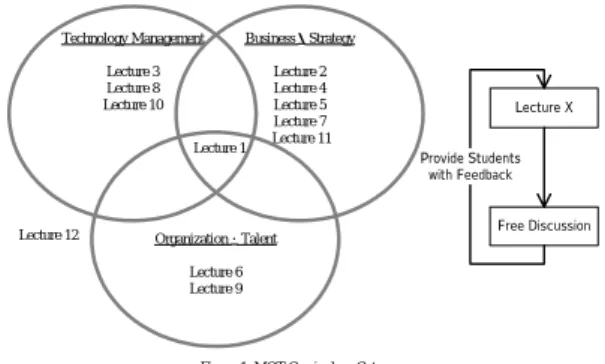
Lectures were given on every third Saturday forone year, 12 times in all, by Tadao Sumi (Princi-pal, Musashino Management School) and Toshi-aki Takeuchi (Adjunct Professor, the University of Electro-Communications). Participants were 40 working adults and 5 undergraduate and graduate students. The curriculum was as fol-lows. Technology Management Lecture 3 Lecture 8 Lecture 10 Business ・ Strategy Lecture 2 Lecture 4 Lecture 5 Lecture 7 Lecture 11 Organization ・ Talent Lecture 6 Lecture 9 Lecture 1
Figure 1. MOT Curriculum Category Lecture 12
Lecture X Provide Students
with Feedback Free Discussion
Lecture 1: Introduction to manufacturing man-agement
Lecture 2: Co-operation theory for SMEs (Small and Medium-sized Enterprises)
Lecture 3: Establishment of intellectual founda-tion using the idea marathon approach, and idea strategy
Lecture 4: Finance and accounting in enterprises Lecture 5: Business simulation
Lecture 6: Organizational ability fully using IT Lecture 7: Factory management for increased
benefit
Lecture 8: Practical industry-university coopera-tion and intellectual property rights
Lecture 9: Human resource management pro-gram for activating enterprises
Lecture 10: Quality control and quality design Lecture 11: Practical product development and
marketing
T he
ory
Figure 3. MOT Effective 4 Wheels Drive System
Pratic al Pra tical Theo ry M OT E ng ine C ase Stud y Ex erc ise (P ratic al C on te nts)
MOT Student Direction (Come up to MOT Expectation ?)
The contents of lectures were condensed because of limited time, and set to an average level con-sidering the level differences among participants. The most important subjects might be arbitrary gatherings after lectures and free discussion. However, it might take more time to lead such a discussion to the discovery of direct subjects of research.
2
Situation Surrounding MOT Education
2.1 MOT Education Observed from the Infor-mation Industry
The information industry is affected by the trend of investment reduction first related to economic slowdowns, although we can expect investment only at the end of economic recovery. A severe economic slowdown will limit investment only in direct investments in information technology (accounting systems at financial institutions), and reduce indirect investments in information technology (information systems at financial in-stitutions) at once. On the other hand, invest-ments in accounting systems connected with di-rect businesses are still expanding on economic recovery prospects, although investments in in-formation technology for encouraging different-tiation among companies will be launched only at last.
Backbone engineers in information industries (with 5 to over 20 years of experience) are
gen-erally very poor at establishing personal con-nections and marketing. Even communication among engineers who have been involved in the same development is often conducted only pas-sively and hesitantly. Once one development campaign is completed, even engineers who have shared pleasure, pain, and awareness of the problems as comrades will not usually deepen their fellowship further.
×
×
Self-Expression Deep Fellowship Unskilled Time Start A Development CampaignAwareness of the Problems ;increase
Engineers; Shared pleasure and pain as comrades
Figure2. Self-Expression in a Business Culture Awareness
Awareness
They know they are not good at communication. Furthermore, some make the excuse that they are in an environment where technical innovation is very rapid, and they are too busy getting accus-tomed to it. Engineers tend to advance develop-ment silently and become unwilling to commu-nicate with others. Consequently, a business culture of very unskilled self-expression is formed.
The core of the MOT is a new effective approach to the solution from the long-standing problem. We show the MOT effective 4 Wheels Drive system.
Participants to the MOT program in the Univer-sity of Electro-Communications have gathered expecting "contents which are practically and truly helpful to the management of SMEs using technologies as a core."
Many ASPs and software produced by the in-formation industry have become commodities. Nevertheless, that phenomenon has not ignited a motion among participating enterprises in MOT education to tie up with software houses or sys-tem integrators intentionally. Although it is up to participants after all, neither industry-university cooperation nor inter-enterprise cooperation can be expected to occur through education.
2.2 MOT Education Observed from the Uni-versity Vantage
For Japan, which aspires to be a technol-ogy-oriented nation, students' dislike of science is an issue of concern. A capacity disparity will be-come remarkable after 2007; the declining birth rate is very serious as well. Intensified survival competition among universities is not a provcial issue any longer. The consolidation and in-tegration of unpopular engineering departments has been accelerated. The merit of earning graduate degrees has also faded. Moreover, for-eign students have come to constitute a large fraction of graduate students. Universities are exposed to such severe circumstances. Naturally, universities cannot cope without forming some intention of increasing student enrollments to in-clude working adults. Admission to graduate schools will similarly not be encouraged unless the status of doctoral course graduates is im-proved.
It is necessary to promote industry (enter-prise)-university cooperation. Furthermore, it is essential for universities to take measures to call back working adults as part of lifelong education. The support of engineers' career design, the fos-tering of specialists, and the cultivation of engi-neers who are creative and can tackle manu-facturing issues might be candidates as introduc-tory courses of MOT education for fostering technology-major executives in cooperation with enterprises. University Enterprise (Industry) Social Network Innovations
Call Back Working Adult Introductory Courses
(MOT Education)
Creative Engineers Support of Career Design
Figure4. Industry(Enterprise)-University Cooperation MBA Education
Impact of Innovations
The MOT courses were originally established as independent graduate schools by the initiative of the Japanese Ministry of Economy, Trade and Industry. Now they must confront a daunting barrier. It might be necessary to reexamine their significance at primary establishment. Whereas business schools of MBA education were founded for the purpose of fostering business leaders, executives––so-called business lead-ers––are neither engineers nor administrators, but are instead independent professionals of man-agement. The MOT education for fostering ex-ecutives’ understanding of technologies or tech-nology-major executives does not necessarily have significance if one stands on this idea. Al-though the curriculum of business schools has included few technical contents so far, the sig-nificance of innovation has recently been revis-ited and technical contents have been increased. It is proof of increased understanding that tech-nical approaches have become increasingly nec-essary as a result of the reconsidered impact of innovation to management.
3
Present State of MOT Education
3.1 MOT Education Desired by the Informa-tion Industry
One must first overcome a competition of tech-nical capabilities (competition to acquire the latest technical capabilities) before discussing technology management in the information in-dustry. Project managers like SEs (System Engi-neers) must also brush up business skills. A pro-ject manager must distribute limited management resources (human, development, financial, in-formation, and technology resources) effectively for clients, and must implement project
man-agement successfully. Improving the quality of business skills will be an important key that di-vides the rise and fall of an enterprise. Enterprises that are obliged to decline often cannot ac-commodate changing circumstances.
Project Manager Human Resource Development Resource Financial Resource Information Resource Technology Resource Clients Project Management
High Quality of Business Skills
Products
Accommodate Changing Circumstance
Now it seems that everybody has noticed that no upcoming era can be created by the conventional catch-up type management. Bringing up MOT professionals is not necessarily reflecting this, although it is a subject appearing in university curriculum. Subjects highlighted in these several years are represented by the Project Management Office (PMO) including schedule control, quality control, and progress management. Project strat-egy theory is its advanced form. Many Japanese technologies, not limited to information indus-try-related technologies, such as manufacturing techniques, material technologies, and electronic devices, are considered to be comparable to those of the U.S. In some fields, such as biotechnology, software, communications, and medical technol-ogy, however, Japanese technologies are clearly lagging in strength. The background of this phe-nomenon might be the degradation of technology management capabilities. Improvement in tech-nology management capabilities is exactly the well-spring of upcoming creativity.
3.2 Is MOT Education Alone Capable of Fos-tering Value-Creative Human Resources?
The author doubts it: the basis of management must be human. It is common to fostering educa-tion overall by which a human exists right in the center. Improvement of human capabilities is re-quested simultaneously in fostering of technol-ogy management capabilities, as well as reflect-ing technical capabilities to management. Japan escaped from the no-way-out feeling of "the lost
decade" through knowledge leadership supported with human capabilities.
PMO Project Management Office
Schedule Control Quality Control
Progress Management
Bringing up MOT Professionals × Reflection
Project Strategy Theory
① ②
③
Figure6. MOT/PMO and Next PST In the Enterprises
In the University
Nothing but measures to exercise leadership, clarify management resources, and improve pro-ject processes encourages the creativity of cor-porate value. Because of co-creation, corcor-porate value can at last represent stakeholder value, collective strength, and the spirit of an enterprise. Fostering of value creativity is, after all, derived from strong leadership, which is also a goal of MBA education.
Japan is quite behind Western countries in re-spect of leadership. One must catch up in leader-ship capabilities first, before learning value creativity. "Visualization" is essential as a proce-dure to discern the outcome of practices of MOT education. An enterprise must establish a com-mon recognition of innovation, that is, "what it wants to be, and what it wants to become", in practicing MOT education therein. This requires reversion to limited management resources, and continued analysis of the progress of innovation illustratively. Although it takes considerable time for large enterprises to make big decisions, its implementation might be possible with afford-able management resources. SMEs should utilize sufficient MOT education, such as MBA educa-tion, to take risks for their survival. SMEs must challenge always boosting creativity and imagi-native power, and finding certain goals, while continuously envisioning what they should be-come.
3.3 Limit of Incomplete MOT Education
Education in Japan has encountered an important turning point. Surely professional graduate schools, such as MBA and MOT, were born of
social demands. However, it is hard to say that sufficient conclusive discussion related to their educational contents has been carried out. Req-uisite credits for MBA and MOT courses in Japan are only 30–40, just 1/3 or 1/4 of those required in the U.S. Although enterprises might appreciate such pro forma education at first, they might not give it high regard with respect to its substantial effects that they expect because a huge gap separates the MOT education that enterprises desire and the MOT curriculum provided by universities.
Represent Stakeholder
Value
Figue6. Knowledge Leadership and Value Creative Knowledge Creation Process
Supported with Technical and Human Capabilities Knowledge Leadership
Human exists right in the center
Escaped; The Lost Decade and No-way-out
Knowledge Vision Value Creative
Creativity of Corporate Value
Co-creation and Corporate
Represent Collective Strength,
Spirit Enterprise MOT
It is unlikely that only 12 lectures costing as low as 120,000 yen for attendance will provide a magnificent effect even for selected personnel to advance industry-university co-operation. It is understandable that they must strive repeatedly to improve. However, SMEs cannot send their per-sonnel endlessly to lectures while neglecting their workplace tasks. Even such selected personnel of SMEs can spare less than one month each year. Therefore, it is questionable whether MOT edu-cation that assures the continuity of lecture sub-jects and engenders the development of products or goods can be prepared during times when rapid development is sought. On the other hand, universities will not award a degree for education of less than one month per year. Their requisite must be at least two months per year for three years, i.e. six months in all. Consequently, it is clear that the demands of enterprises differ from the conditions of universities.
In conclusion, a double-featured education, for improvement in technology management capa-bilities and human capacapa-bilities supporting it, is essential. Short-time MOT education cannot an-ticipate product development that responds to direct innovation. The SMEs that gather for MOT
education will not assume that they can get im-portant information for definite innovation, either. Cross-industrial association and indus-try-university cooperation will become necessary for spreading out their networks.
Then, what on earth is requisite of a MOT edu-cational curriculum? What can be agreed upon by both enterprises and universities? It is evident that enterprises cannot compete in the world us-ing only conventional technical capabilities in the future. The "How"-type problem-solving ap-proach, which prevailed in the high-quality and mass production era, cannot respond to future globalization. Fostering of creative human re-sources with enhanced technology management capabilities should be requested. Such people can apply the "What"-type problem-solving approach of social needs. Curriculum organization along this concept will be requested. The author, for one, believes that today’s MOT programs remain far from addressing this demand.
Enterprises MOT Education Universities MOT Curriculum
×
Huge Gap Substantial Efects? Technology Management CapabilitiesHuman Capabilities
Double-Featured Education
?????
Figure7. Huge gap of the Enterprises-University Co-operation
4
Possibility of MOT Education –
Educa-tion for Fostering Business Leaders
As an extreme case, MOT can be included in an MBA. In addition, MOT and MBA should not be considered as being of two opposite extremes. Fostering of professional executives is an essen-tial issue for Japanese enterprises to remain un-defeated in globalization. For that reason, MOT education should not be limited merely to en-hancement of technology management capabili-ties. Business skills necessary for professional executives are software technologies depending on humans. An increasing number of faculty members of the University of Elec-tro-Communications are from industry. Flexible
transfer among industry, academia, and govern-ment should be admitted, and professional, value-creative executives who can overcome fu-ture competition should be produced. The dis-cussion of real enterprise management by a fac-ulty with no experience in actual business cannot go beyond bounds of theory after all. The ap-pearance of faculty from industries has ignited a period of great revolution from a traditional edu-cational approach. As Japanese enterprises glob-alize, universities and industries must pursue a fundamental common subject together: fostering competitive human resources.
Universities MOT Education Enterprises Enterprises Evaluation Feedback
The University warranted the quality of their MOT Education.
Figure9. The Quality of MOT Education
5
Concluding Remarks
To Conclude, I’d like to summarize my proposes by making nine remarks.
Remark1 MOT and MBA are Educations for Fostering Business Leaders
Remark2 MOT Education can be included within MBA Education for Fostering Business Leaders Remark3 Probably we can't bring up
value-creative business leaders from business theory, but can bring up only from solving management theme
Remark4 If SEMs and university haven't funda-mental education's philosophy together, Japa-nese SEMs can't survive in the competitive global world
Remark5 SMEs can't agree current MOT Educa-tion for the reason that SMEs can't obtain in-novative idea
Remark6 SMEs can't afford fostering business leader through 2 years MOT Education, can prepare one or two month per year
Remark7 Really, can we be value-creative busi-ness leader through MOT Education?
Remark8 Really, can we obtain essence of value-creative leader from MOT Education? Remark9 Generally we learn that human being
get sense of business leader inborn, but we try to bring up value-creative business leader con-tinuously
References
[1] Ikujiro Nonaka, Hirotaka Takeuchi, Katuhiro Umemoto, The Knowledge Creating Company, Toyo-Keizai-Shinpousha, 1996
[2] Ikujiro Nonaka, Noboru Konno, Methodology
of Knowledge Creation,
Toyo-Keizai-Shin-pousha, 2003
[3] Youichirou Hara, Tadahiko Abe, MOT Text
Series, Maruzen, 2005
[4] Ikujiro Nonaka, Ryouko Toyama, MOT Text
Series, Maruzen, 2006
[5] Yoshio Nishimura, Yoshiaki Tukamoto, MOT