
JAIST Repository: Retraction of Rod-like and Spheroidal Droplets and Stress Relaxation after Step Shear Strain in Polymer Blends
8
0
0
全文
(2) Vol35_4.book. 199 ページ. 2007年8月14日 火曜日 午前9時39分. Nihon Reoroji Gakkaishi Vol.35, No.4, 199~205 (Journal of the Society of Rheology, Japan) 2007 The Society of Rheology, Japan. Article Retraction of Rod-like and Spheroidal Droplets and Stress Relaxation after Step Shear Strain in Polymer Blends Masaoki TAKAHASHI* and Kenzo OKAMOTO** Department of Macromolecular Science and Engineering, Kyoto Institute of Technology, Matsugasaki, Sakyo-Ku, Kyoto 606-8585, Japan ** Venture Laboratory, Kyoto Institute of Technology, Matsugasaki, Sakyo-Ku, Kyoto 606-8585, Japan *. (Received : March 12, 2007). After application of a large step shear strain, a polymer droplet in an immiscible polymer matrix takes rod-like and spheroidal shapes before returning to the spherical shape. Change in semi axes of those droplets is calculated based on the Cohen-Carriere theory and the extension of the theory by Okamoto et al. From comparison with experimental data, it has been found that retraction of semi axes is well described by the theory using a hydrodynamic factor for the droplet associated with the viscous resistance of the matrix. The excess shear stress for rod-like and spheroidal droplets is predicted based on the Doi-Ohta theory by evaluating the interface tensor from the semi axes calculated. The predicted excess shear stress for the deformed droplet is close to experimental data of a polymer blend with narrow distribution of droplet size after normalization per one droplet with the volume-averaged radius. The effects of polydispersity and interaction with adjacent droplets in the blend are suggested for the remaining difference between the prediction and the data. Key Words: Polymer blend / Droplet phase / Stress relaxation / Doi-Ohta theory / Cohen-Carriere theory. 1. INTRODUCTION. rod-like droplet in a quiescent matrix was extended to a spheroidal droplet. This improved method of imbedded fiber. In polymer blends, prediction on interface shape and excess. retraction was applied to polystyrene/poly(methyl. shear stress under shear flow is very important to control the. methacrylate) melt systems4) and to PIB/PDMS systems.6) It. blend morphology and to find better processing condition.. was shown that the improved method gives comparable value. However, the prediction is still very difficult even if we limit. of interfacial tension with those obtained by the breaking. our consideration to immiscible blend systems with droplet/. thread and pendant drop methods.. matrix structure. In the present study, droplet shape and excess. For immiscible binary blends, a basic equation relating the. shear stress are considered in the simplest case, i.e., retraction. shape of interface and the excess stress tensor. due to the. of a droplet under a step shear strain, to concentrate on the. anisotropy of interface was first presented by Batchelor7), and. effect of interfacial tension. In our previous studies on a. was later reformulated by Onuki8,9) and Doi and Ohta.10). poly(isobutylene) (PIB)/poly(dimethyl siloxane) (PDMS) system1,2) we found that the interface shape of droplet observed. (1). at large step shear strains changes as: flat ellipsoid, rod-like shape, dumbbell, spheroid, and finally sphere. From the calculation of interface area of each shape, it was revealed that the droplet shape should change in this order to reduce the interfacial free energy.1,2) Recently, it was found that the amplitude of Rayleigh instability in the rod-like period is so small and that the dumbbell shape appears due to the endpinching mechanism.3) In our previous study on measurement of interfacial tension4), the theory of Cohen and Carriere5) on retraction of a. Here, Γ is the interfacial tension and q is the interface tensor describing anisotropy of interface. In Eq. (1), V represents the entire volume of the system, nn is the dyadic of the unit vector n normal to the interface, and I denotes the unit tensor. The integration is made over the entire interface of the system. Once the shape of interface in the deformed state can be obtained, Eq. (1) becomes extremely useful to calculate the interface contribution to the stress. Based on Eq. (1), Okamoto et al. calculated the excess shear stress for typical droplet. 199.
(3) Vol35_4.book. 200 ページ. 2007年8月14日 火曜日 午前9時39分. Nihon Reoroji Gakkaishi Vol.35 2007. shapes of flat ellipsoid, rod-like shape, dumbbell, and. considering a force balance between interfacial tension. spheroid. 11) Recently we evaluated Eq. (1) based on the. contribution (first term) and viscous resistance (second term).. calculated result of excess shear stress. and using. Here, A is the interfacial area, L (= 2a) the overall length, and. experimental data of droplet semi-axes for the PIB/PDMS. r (= b = c) is the radius of rod-like droplet. The time scale of. system. retraction for the stretched droplet is determined by this. 1,2). 11 ). and a Hydroxypropylcellulose (HPC) solution/. PDMS system, where the HPC solution is in the isotropic. balance and can be written as. state. In the HPC/PDMS system the viscosity ratio and the 3). interfacial tension are much larger than those of the PIB/. (3). PDMS system and also the droplet size distribution is much wider. Although the exact distribution of droplet radius should be incorporated in the HPC/PDMS system, Eq. (1) has been found applicable to predict the excess stress of real blend. where χ0 is a shape factor, ηeff is an effective viscosity, and r0 is the radius of a sphere having the same volume as the deformed droplet. The factor χ0 was introduced to describe differences in. systems. In the narrow distribution PIB/PDMS system, only. the viscous force arising from differences in droplet shapes.. the normalization by the volume-averaged radius was. The most plausible form proposed for ηeff is. 3). necessary. The objectives of the present study are: 1) evaluation of the. (4). change in the length of semi axes for rod-like and spheroidal droplets based on the Cohen-Carriere theory to obtain the interface tensor component, 2) evaluation of the excess shear stress based on Eq. (1) using the calculated interface tensor component, 3) experimental verification of the predictions on the semi axes and the excess shear stress. In Fig. 1, rod-like. Here, ηm is the matrix viscosity and K is the viscosity ratio. K = ηd /ηm with the droplet viscosity ηd. Then τret becomes. τret = χ0τD, where τD is the viscoelastic relaxation time of Palierne (emulsion model)12) with a limit of volume fraction φ = 0.. and spheroidal droplets observed in step strain experiments are. (5). schematically shown. The semi-major (a) and semi-minor axes (b and c) are defined together with the orientation angle θ to the flow direction x. A rod-like droplet is represented by a cylinder with hemispherical caps of radius r at both ends.1,3,5). 2. THEORETICAL BACKGROUND. In case of a rod-like droplet, Cohen and Carriere5) derived an expression for the normalized radius R (= r/r0). (6). 2.1 Shape Recovery of Rod-like and Spheroidal Droplets For shape recovery of a deformed droplet in a quiescent matrix, Cohen and Carriere5) presented a differential equation (2). (7). Here, RR denotes the value of R at a time tR when the droplet shape becomes rod-like. From the volume conservation requirement, R is obtained by solving the following equation5) (8). where λ is the stretch ratio of semi major axis a (principal stretch), λ = a/r0 = (L/2)/r0. The analytical solution of Eq. (8) is11). Fig. 1. Definition of semi-axes (a, b, c), radius r of semi-sphere of endcaps and orientation angle θ : Top view (upper) and side view (lower).. 200. (9).
(4) Vol35_4.book. 201 ページ. 2007年8月14日 火曜日 午前9時39分. TAKAHASHI • OKAMOTO : Retraction of Rod-like and Spheroidal Droplets and Stress Relaxation after Step Shear Strain in Polymer Blends. The time dependence of λ can be obtained by combining Eqs. (6), (7) and (9), when an initial condition λR = λ (tR, γ ) is given. Based on the above force balance equation, Okamoto et al. derived the following equations for the shape recovery process. On the other hand, Okamoto et al.4) proposed χ0 = 1/8 = 0.125 for spheroidal droplets from the following argument. In the final process of droplet retraction, 1/ λ approaches 1, and f2(x) can be approximated to be. from spheroid to sphere under the condition of constant volume4,13),. (12). (10). From Eqs. (10) and (12), we obtain (13). (11). with a constant C. where 1/ λ is the normalized semi-minor axis, 1/ λ = b/r0 = c/r0, and λ = a/r0 with a = L/2. In Eq. (10), tS is a time when. the droplet shape recovers to spheroid, and λS is the principal stretch at t = t S . It was found experimentally that λ S is. independent of the applied strain γ and the average value is. λS = 1.49 for K = 0.067.1,2) A similar, but slightly smaller value of λS is obtained for K = 0.54.3,14) On the other hand, the time tS increases with γ due to the delayed shape recovery at large γ. As shown in Eqs. (10) and (11), the retraction time χ0τD also. (14). where tS′ (> tS) and λS′ (= λ(tS′) < λS) are taken in the range where Eq. (12) can be applied. From Eq. (13), the Hencky strain ln λ for spheroidal droplet in the final process is approximated to be (15). governs the shape recovery from spheroid to sphere. In Eqs. (6) and (10), χ0 is a hydrodynamic factor originally introduced by Cohen and Carriere. An anonymous reviewer 5). kindly pointed out that in principle, χ0 is determined by flow mode (distribution of shear and elongation fields) in the droplet retraction process and that χ0 is not an adjustable parameter. We thank the reviewer for the pertinent comment on χ 0 . Cohen and Carriere introduced χ 0 based on the hydrodynamic calculation by Lamb 15) that the resistance experienced by a circular disk with radius c moving in a liquid of viscosity η becomes 6πη r u. Here, u is the velocity and r is the effective radius expressed as r = 0.850 c for broadside-on. The experimental data of ln λ in the final process 1 , 2 ) approximately have this form with a time constant equal to τD.. Thus 8χ0 becomes 1, giving χ0 = 1/8. Here, for simplicity let us consider small deformation limit. There is only one time constant 8 χ 0 τ D for shape recovery from slightly oblate spheroid to sphere due to the interfacial tension. The viscoelastic relaxation time τD associated with this process (interfacial-tension origin) should be equal to (or at least very close to) 8χ0τD. Thus χ0 should be 1/8 or around 1/8. A simple exponential form, Eq. (15), is only approximate and may be valid in the small deformation limit.. motion and r = 0.566 c for edgewise motion. Since r does not. It should be noted here that the total recovery time after. alter its geometrical meaning for the significantly different. application of a large step strain becomes longer with. motions, the viscous resistance to the fiber retraction was assumed as 6π χ0ηeff r u in the Cohen-Carrier theory. In a quiescent matrix, u is replaced by u = dL/dt. For deformable viscous droplets, a few forms of ηeff were presented, all of which. are proportional to ηm and similar in value for K<1.5,17-19) In their. treatment, the factor χ0 is always determined by comparison. between the prediction (Eqs. (6) and (7)) and experimental data. Values obtained from this comparison for rod-like. increasing γ, because both times tR and tS increase with γ.. However, Eq. (10) with constant λS suggests that the shape. recovery after tS from spheroid to sphere occurs at the same. rate (γ-independent rate) and that λ is the same for the same interval (t − tS)/τD, irrespective of γ applied. 2.2 Excess Shear Stress for Rod-like and Spheroidal Droplets. droplets by Cohen and Carriere are χ0 = 3.5/6π = 0.18616) and. We define the volume fraction φ for a single droplet with the. 1/(2×2.7) = 0.18518), where a factor 2 in the latter expression is. radius r0 by φ = (4πr03/3)(1/V ). From Eq. (1), the excess shear. due to the difference in definition of f1(x).. stress ∆σxy can be written as. 201.
(5) Vol35_4.book. 202 ページ. 2007年8月14日 火曜日 午前9時39分. Nihon Reoroji Gakkaishi Vol.35 2007. (16). For a rod-like droplet shown in Fig. 1 (or for monodisperse rod-like droplets), ∆σxy becomes. For a 20/80 (wt/wt) blend of PIB/PDMS, experimental data of stress relaxation under large step shear strains at 23 °C are already reported.11) Decomposition of the blend modulus into component and interface contributions has been made and is published elswhere.3) Dynamic viscoelastic data of the blend and components were obtained, and decomposition into. (17). component and interface contributions has been done and is reported. 3) To obtain reproducible data with the same. with the principal stretch λ (= a/r0) and R = b/r0 = c/r0 = r/r0. In a step strain experiment, a deformed droplet becomes spheroid just before returning to a spherical shape, irrespective of the magnitude of strain applied. For monodisperse spheroidal droplets having a common orientation angle θ, the analytical solution of the excess shear stress ∆σxy becomes2,11). distribution of droplet radius, pre-shear at the strain rate of 0.25 s−1 for 1240 s has been given to the blend samples before dynamic measurements,3) as already done in stress relaxation experiments.11) After the pre-shear, the volume-averaged radius rV was found to be rV = 9.0 µm, and the distribution of droplet size was rather narrow, rV /rN < 1.2, where rN is the. number-averaged radius.3,11) The relaxation time τD of the blend with φ = 0.214 becomes 4.1 s, which is evaluated by. (20) (18). 4. RESULTS AND DISCUSSION. with λ = a/r0 and b/r0 = c/r0 = λ −1/2.. When the orientation angle θ is equal to an angle given by. affine deformation assumption and does not change with time,. 4.1 Retraction of Semi Major Axis for Rod-like and Spheroidal Droplets. θ satisfies the following equation. In Fig. 2, the prediction of time dependence of the principal (19). It has been found in stress relaxation experiments for step strain that Eq. (19) holds for droplets with the viscosity ratio K = 0.0671,2) and K = 0.0476.13) Very recently, we found that Eq. (19) also holds for droplets with K = 0.54.3,14). stretch, a/r 0 , for a rod-like droplet is compared with. experimental data at γ = 3 − 5 for droplets with r0 = 230 and. 140 µm. A comparison at γ = 2 is omitted, because the rod-like. shape appears in very limited time scale at that strain,1) and exact comparison of the time dependence is impossible. For. χ0 = 0.175, the theoretical prediction by Cohen-Carriere agrees. 3. MATERIALS AND METHOD Observation of deformation and shape recovery of PIB droplets in a PDMS matrix under large step shear strains is already reported in the previous papers.1,2) The weight-average molecular weight of PIB is 1350, and the zero shear viscosities of PIB (ηd) and PDMS (ηm) at 23 °C are 60 and 900 Pas, respectively. The viscosity ratio K is 0.067. The interfacial tension obtained by the pendant drop method for this system is Γ = 3.1×10⁻³ N/m.2,6) The semi-axes a and b were observed from the side view and c was obtained from the top view. New reliable data for a droplet with r0 = 140 µm are added in the present study. The relaxation time τD calculated by Eq. (5) is. τD = 51.5 and 84.5 s for droplets with r0 = 140 and 230 µm, respectively.. 202. Fig. 2. The stretch ratio of semi-major axis as a function of normalized time in the intermediate stage of relaxation with rod-like shape. χ0 is a hydrodynamic factor originally introduced by Cohen and Carriere..
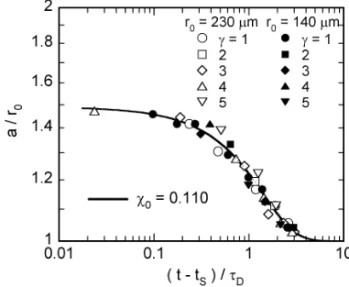
(6) Vol35_4.book. 203 ページ. 2007年8月14日 火曜日 午前9時39分. TAKAHASHI • OKAMOTO : Retraction of Rod-like and Spheroidal Droplets and Stress Relaxation after Step Shear Strain in Polymer Blends. fairly well with experimental data. The value of χ0 = 0.175 obtained in the present study is essentially the same as that. 4.2 Excess Shear Stress for Rod-like and Spheroidal Droplets. obtained by Cohen-Carrier, χ0 = 0.185 − 0.186. Considering. Time dependences of normalized ∆σ xy in the recovery. the experimental error of about 12 % in the interfacial tension. process with the rod-like shape are summarized in Fig. 5. The. Γ and somewhat greater experimental error in τD due to. excess shear stress obtained for the 20/80 blend is normalized. minor. The initial stretch λR and the time tR/τD determine the. as in Fig. 2 is used, the agreement between the theoretical. subsequent shape recovery in this process. In Fig. 3 the strain. prediction and the experimental data is fair at short and. dependencies of λR and tR/τD are shown, which are obtained. intermediate time scale of (t− tR)/τD. However, at longer time. weak, say tR ~γ. faster than the prediction. Three possibilities for the. 6). accumulated errors in Γ, ηm and r0, 6 % difference in χ0 is. experimentally at γ = 2 − 5. The strain dependence of tR is. . It seems that λR and tR/τD at each strain are. 0.54. independent of the initial droplet size r0 as shown in Fig. 3.. by replacing r0/Γ with rV /Γ. When the same value of χ0= 0.175. scale of (t− tR)/τD, the excess shear stress of the blend relaxes discrepancy may be considered. The first is uncertainty in tR/τD. In Fig. 4, the prediction of time dependence of the principal. for the polydisperse droplet system. The second is attractive. stretch, a/r0, for spheroid is compared with experimental data. interaction between adjacent droplets which may result in. at γ = 1 − 5 for droplets with r 0 = 230 and 140 µm. For. χ0 = 0.110, very good agreement with the experimental data is obtained for all the strains measured. Note that the ordinate is enlarged to emphasize the agreement. The value of χ0 = 0.110. faster recovery in the blend than the single-droplet recovery (see next paragraph). The third is reduction of hydrodynamic interaction in concentrated blend, because a smaller value of χ0 such as 0.110 seems to describe better the experimental data as. is very close to the value χ0 = 0.125 predicted by Okamoto et. shown by dotted lines in Fig. 5. However, the third possibility. al. (13.6 % difference), considering the experimental error of. is not decisive, considering somewhat large experimental error. about 12 % in Γ and accumulated experimental error in τD. It. in Γ and τD.. 4). becomes clear that the shape recovery in the final stage can be. Okamoto et al. observed collision and coalescence of two. described by specifying the initial values λS (= 1.49) and tS /τD. droplets on the same plane (parallel to the shearing plane) in an. of this stage. The effect of previous shape (memory) does not. immiscible matrix after application of large step strains.20,21) In. appear in the time dependence at t > tS. The strain dependence. case of shape recovery without coalescence, the droplets come. of tS /τD obtained experimentally for these droplets is shown in. closer with each other after recovery due to an attractive. Fig. 3. The strain dependence of tS is rather strong, say tS ~γ .. interaction during retraction process. This attractive interaction. This strain dependence is attributed to the delayed shape. is considered to be hydrodynamic origin (hydrodynamic. recovery in the early and intermediate stages of relaxation. It. tensor form). The coalescence depends on the applied strain. seems that tS /τD at each strain is also independent of r0 as. and the initial distance d0 between the centers of two droplets,. shown in Fig. 3.. or more precisely on d0/r0.20) In fact, two droplets coalesce into. Fig. 3. Strain dependencies of the characteristic times tR and tS and of the principal stretch λR at tR, where the subscripts R and S denote rodlike shape and spheroid.. Fig. 4. The stretch ratio of semi-major axis as a function of the normalized time in the final stage of relaxation. χ0 is a hydrodynamic factor originally introduced by Cohen and Carriere.. 1.8. 203.
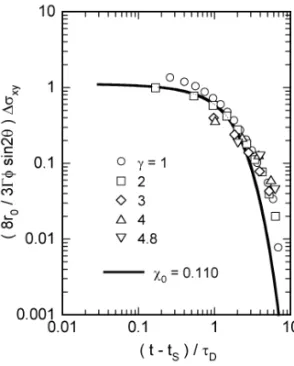
(7) Vol35_4.book. 204 ページ. 2007年8月14日 火曜日 午前9時39分. Nihon Reoroji Gakkaishi Vol.35 2007. one droplet after repetition of large step strains in the opposite. Scattering of the data at shorter time scale of (t− tS)/τD is also. directions or accumulated strains.21) It is probable that the. attributed to the uncertainty of tS/τD in polydisperse droplet. attractive interaction also occurs in the blend, because average. system. In this final stage of shape recovery, interaction. value of d0/r0 is rather small (d0/r0= 2.69) in the 20/80 blend. between adjacent droplets is reduced, because small droplets. with φ = 0.214 assuming the simple cubic lattice for the droplet. have already recovered to the spherical shape. The effect of. distribution. For PIB droplets in a PDMS matrix with very. droplet size distribution is considered to be more important. similar viscosities with those of the present study, Okamoto et. than the interaction with adjacent droplets or change in. al. found in a single step test that at γ = 4.58 two droplets. hydrodynamic interaction in the final stage.. recover to the spherical shape without coalescence for d0/r0 = 2.68, but coalescence occurs for d0/r0 = 2.29.20) Overlap. 5. CONCLUSIONS. of two droplets is observed in both cases with and without coalescence, and in the overlapped part the hydrodynamic. The Cohen-Carriere prediction on retraction of semi axes. attractive force may work between the droplets (or between. for a rod-like droplet in an immiscible matrix is compared with. the interface). The hydrodynamic force is considered to arise. experimental data on a poly(isobutylene) (PIB) droplet in a. when the local matrix flow occurs due to the change in the. poly(dimethyl siloxane) (PDMS) matrix. Satisfactory. droplet shape.20) On the other hand, in the un-overlapped part,. agreement between the prediction and the experimental data is. the interfacial tension force acts to recover to the original. obtained when a shape factor (hydrodynamic factor) χ0 is. shape. Normal vectors to the interface become isotropic due to the interfacial tension.20) The excess shear stress normalized as γ -independent form. 0.175. The prediction presented by Okamoto et al. applying the Cohen-Carrier theory to spheroidal droplet is compared with experimental data of the same system. Very good. in the final stage of relaxation with the spheroidal shape is. agreement between the prediction and the data is obtained. shown in Fig. 6. For the stress prediction in this process, the. when χ 0 is 0.110. These values of χ 0 are essentially the. same value of χ0= 0.110 is used as in Fig. 4. We can see from. same as (or very close to) those suggested by Cohen-Carrier. independent of γ as expected from the theoretical prediction.. χ0 = 0.185 − 0.186 for a rod-like droplet and by Okamoto et al. χ0 = 0.125 for a spheroidal droplet.. Fig. 6 that experimental data of normalized ∆σxy are almost However, closer look at the data reveals that the time. The excess shear stress or interfacial contribution to the. dependence of normalized stress becomes somewhat weaker. shear stress is evaluated based on the Doi-Ohta theory using. with increasing the strain. This apparent difference in the time. the calculated droplet dimensions for rod-like and spheroidal. dependence is attributed to the effect of polydispersity in droplet size. A variety of deformed shapes and difference in relaxation stage are enhanced with the applied strain.. Fig. 5. Predicted time dependence of the normalized excess shear stress in the intermediate stage of relaxation with rod-like shape is compared with experimental data for a 20/80 blend of PIB/ PDMS. The data are normalized per one droplet with the volumeaveraged radius.. 204. Fig. 6. Predicted time dependence of the normalized excess shear stress in the final stage of relaxation is compared with experimental data obtained for a 20/80 blend of PIB/PDMS. The data are normalized per one droplet with the volume-averaged radius..
(8) Vol35_4.book. 205 ページ. 2007年8月14日 火曜日 午前9時39分. TAKAHASHI • OKAMOTO : Retraction of Rod-like and Spheroidal Droplets and Stress Relaxation after Step Shear Strain in Polymer Blends. droplets. The predicted excess shear stress is compared with. 3). Y, Polymer, 48, 2371 (2007).. experimental data for a 20/80 blend of PIB/PDMS after normalization per single droplet with the volume-averaged. Takahashi M, Macaúbas PHP, Okamoto K, Jinnai H, Nishikawa. 4). Okamoto K, Takahashi M, Yamane H, Watashiba H, Tsukahara Y,. radius. In the rod-like stage, the predicted stress agrees fairly. Masuda T, Nihon Reoroji Gakkaishi (J Soc Rheol Japan), 27,. well with experimental data at short and intermediate time. 109 (1999).. scales but fails at longer times. Three possibilities (polydisperse effect, attractive interaction between adjacent droplets and reduction in χ0) are considered for the discrepancy at longer time scale. The attractive interaction is shown to be most probable. In the final stage with spheroidal shape, the predicted. 5). Cohen A, Carriere CJ, Rheol Acta, 28, 223 (1989).. 6). Hayashi R, Takahashi M, Yamane H, Nihon Reoroji Gakkaishi. 7). Batchelor GK, J Fluid Mech, 41, 545 (1970).. 8). Onuki A, Phys Rev A, 35, 5149 (1987).. 9). Onuki A, Europhysics Lett, 28, 175 (1994).. (J Soc Rheol Japan), 28, 137 (2000).. stress is close to the experimental data. However, the time. 10). Doi M, Ohta T, J Chem Phys, 95, 1242 (1991).. dependence of the experimental stress data becomes weaker. 11). Okamoto K, Takahashi M, Watanabe H, Koyama K, Masuda T,. with increasing the step strain. It is suggested that the effect of. Proceedings of the International Conference on Advanced. droplet size distribution is more important than the droplet-. Polymers and Processing (Yamagata), 195 (2001).. droplet interaction or change in χ0 in the final stage.. Acknowledgments This work was partially supported by Grant-in-Aid for Scientific Research (B) No. 16350127 and 18350119 from the Japan Society for the Promotion of Science.. REFERENCES 1). Yamane H, Takahashi M, Hayashi R, Okamoto K, Kashihara. 12). Palierne JF, Rheol Acta, 29, 204 (1990).. 13). Okamoto K, Takahashi M, Yamane H, Kashihara H, Watanabe H, Masuda T, J Rheol, 43, 951 (1999).. 14). Macaúbas PHP, Kawamoto H, Takahashi M, Okamoto K,. 15). Lamb H, “Hydrodynamics”, (1945), Dover, New York.. 16). Cohen A, Carriere CJ, Rheol Acta (Erratum), 28, 435 (1989).. 17). Carriere CJ, Cohen A, Arends CB, J Rheol, 33, 681 (1989).. 18). Carriere CJ, Cohen A, J Rheol, 35, 205 (1991).. 19). Rundqvist T, Cohen A, Klason C, Rheol Acta, 35, 458 (1996).. 20). Okamoto K, Tamura R, Ishikawa M, Nihon Reoroji Gakkaishi. Takigawa T, Rheol Acta, in press.. (J Soc Rheol Japan), 30, 45 (2002).. H, Masuda T, J Rheol, 42, 567 (1998). 2). Hayashi R, Takahashi M, Yamane H, Jinnai H, Watanabe H, Polymer, 42, 757 (2001).. 21). Okamoto K, Iwatsuki S, Osaki K, Ishikawa M, Proc XIVth Int Congr Rheology (Seoul), PM57-1 (2004).. 205.
(9)
図
関連したドキュメント
Analysis and numerical results are presented for three model inverse problems: (i) recovery of the nonlinear parameter in the stress-strain relation for a homogeneous elastic rod,
In an insightful essay, Behringer and Baxter (Mehta [55, page 107]) based on their experimental observations said, “In short, there is a need for a new kind of theory that includes
We present sufficient conditions for the existence of solutions to Neu- mann and periodic boundary-value problems for some class of quasilinear ordinary differential equations.. We
Then it follows immediately from a suitable version of “Hensel’s Lemma” [cf., e.g., the argument of [4], Lemma 2.1] that S may be obtained, as the notation suggests, as the m A
Going back to the packing property or more gener- ally to the λ-packing property, it is of interest to answer the following question: Given a graph embedding G and a positive number
(A Weissenberg number is the ratio of the relaxation time of the fluid to a char- acteristic time associated with the flow.) Analytical solutions have been obtained for the
Using a step-like approximation of the initial profile and a fragmentation principle for the scattering data, we obtain an explicit procedure for computing the bound state data..
One important application of the the- orem of Floyd and Oertel is the proof of a theorem of Hatcher [15], which says that incompressible surfaces in an orientable and
