DEVELOPMENT AID POLICY FOR MYANMAR IN THE REENGAGEMENT WITH THE WORLD BANK
An Empirical Investigation of Relationship between Official Development Assistance (ODA) and Economic Growth Rate of Myanmar by 1991 to 2010
By
THIHA KO KO March 2013
A Thesis Submitted to the Higher Degree Committee of Ritsumeikan Asia Pacific University
in Partial Fulfillment of the Requirements for the Degree of Master of Science in International Cooperation Policy
GRADUATE SCHOOL OF ASIA PACIFIC STUDIES RITSUMEIKAN ASIA PACIFIC UNIVERSITY
ii CERTIFICATION
I, THIHA KO KO, declare that this thesis, submitted in fulfillment of the requirements for the award of Master of Science in International Cooperation Policy, in the Graduate School of Asia Pacific Studies, Ritsumeikan Asia Pacific University, is wholly my own original work unless otherwise referenced or acknowledged.
THIHA KO KO January 2013
iii
TABLE OF CONTENTS
ABSTRACT iii
ACKNOWLEDGMENTS v TABLE OF CONTENTS vi LIST OF FIGURES viii
LIST OF TABLES ix CHAPTER 1: INTRODUCTION ... 1 1.1 Background... 1 1.2 Research Problem ... 5 1.3 Research Objectives ... 6 1.4 Research Questions ... 6 1.5 Definition of Terms ... 7
1.6 Significance of the Research ... 8
1.7 Scope and Limitation of the Research ... 9
CHAPTER 2: LITERATURE REVIEW ... 10
2.1 Introduction ... 10
2.2 Body of the Review ... 10
2.2.1 Development Aid ... 11
2.2.1.1 Chronological Order of Development Aid Policy ... 13
2.2.1.2 Vicious Cycle of Aid ... 18
2.2.1.3 Development Aid Policy Reform ... 24
2.2.2 The World Bank and Its Lending Policy ... 26
2.2.3 Prior Researches on the Relationship of Aid-Growth ... 35
2.3 Summary ... 41
CHAPTER 3: MACROECONOMIC ENVIRONMENT OF MYANMAR ... 43
3.1 Introduction ... 43
3.2 Macroeconomic Environment ... 43
3.3 Policy Challenges ... 46
CHAPTER 4: RESEARCH METHODOLOGY ... 51
4.1 Introduction ... 51
4.2 Research Design ... 51
4.3 Data Collection and Procedure ... 53
4.4 Data Analysis ... 54 4.5 Methodological Limitation ... 55 CHAPTER 5: RESULTS ... 57 5.1 Introduction ... 57 5.2 Quantitative Results ... 57 5.2.1 Descriptive Figures ... 58 5.2.1.1 Macroeconomic Figures ... 58 5.2.1.2 Development Figures ... 66
5.2.1.3 ODA Figures of Myanmar ... 67
5.2.2 Inferential Figures ... 72
5.3 Qualitative Results ... 74
CHAPTER 6: DISCUSSION ... 86
6.1 The Development Aid and Economic Growth ... 86
6.2 The Underlying Aid-Policy Factors ... 86
iv CHAPTER 7: CONCLUSION ... 99
v ABSTRACT
This study attempts to find the relationship of international development aid and economic development of Myanmar in the period of 1991 to 2010, by applying the quantitative analysis of correlation and regression. Additionally, this research explores the important policy factors of development aid – how to use aid effectively and efficiently for Myanmar targeted to apply in the reengagement with the World Bank by employing qualitative method of text analysis on the reports of the World Bank and aid-growth policy researches and studies. The ultimate goal of this research is to recommend a set of aid policy – when, where, how much and what composition of aid for Myanmar by which aid effectiveness level can be raised.
Literature review covers the areas of fundamental development thinking, development aid trend, prior aid-growth relationship researches, vicious cycle of aid, the development trap, chronological timeline of the World Bank and lending policy of the World Bank. Besides the external look, this study reviews on internal look on macroeconomic environment of Myanmar addressing the policy dilemmas of the past and policy reforms for the future.
As of research method, this study utilizes the quantitative method of correlation and regression analysis to know the relationship of aid and growth of Myanmar. In order to put the light on the lending policy of the World Bank, this study conducts the qualitative method of text analysis on the aid-policy reports of the World Bank and of other researchers.
Based on first analysis of correlation and regression - quantitative method, research found that the correlation of international development aid and economic growth of Myanmar during 20 years was weak and negative meaning that aid was not so much effective on that time and on that policy environment. Based on second research
vi method of text analysis, qualitative findings shows that aid alone cannot guarantee the long-term growth of the recipient countries and we need to implement ‘good policy environment’ very first in order to realize the aid-effectiveness. Both quantitative and qualitative analysis proofs that aid in poor policy environment will not be a part of solution for development and even a problem. Based on these quantitative and qualitative findings, this research come out with the result that international development aid and economic growth of Myanmar has a weak and negative relationship from 1991 to 2010. Conceptually Linked to these findings, literature review and look on policy environment of Myanmar, this study also develops a model of aid and policy – Mutually Enforcing Process of Aid and Policy (MEPAP) in which aid will interact with policy reform and policy reform will encourage aid-effectiveness level of aid and finally strong policy alone would come out for the long-term development of the country and would be an escape from risk of aid-dependency. Hence, this model can also be seen as Policy Reform to Strong Policy (PRSP) being different from old version of PRSP of the World Bank – Poverty Reduction Strategy Papers.
As of suggestion for future researches, it is recommended that further studies should explore more macroeconomic variables – saving, investment, trade and so on related to the economic growth and their knowledge contributions should also be cause-and-effect level of explanatory more than association level of exploratory in this study.
vii ACKNOWLEDGEMENTS
Firstly, I am indeed thankful to my supervisor, Professor Tsukada Shunso, for his kind support, pragmatic comments and excellence guidance in my research. Without his consideration on my proposal and continuous encouragement on my endeavors of thesis, I would not have been able to accomplish this thesis. I am more than delighted and grateful for all his kindness and understanding on my journey. Most importantly, sincerest gratitude is ever been to my parents who are who I am, what I do and why I am alive. I also extend my deepest gratitude to my Japanese scholarship organization, ASJA (Asia Japan Alumni) International for their kind assistances of both materials and mental.
A great honor is also extended to all APU professors who lighted my study life brighter with all of their knowledge and guidance. I thank Professor Mani, Professor Nair, Professor Salazar, Professor Gunarto, Professor Azra, Professor Miyoshi and others for all of conceptual supports and technical supports through their unforgettable lectures. I would like to thank my seminar class fellows for all their comments, questions and advices. I also thank academic office staff and research office staff for their very professional support for my academic life in APU. Also I thank student office staff for their kind support and service for convenient student life in APU.
Last but not least, I am certainly indebted to thank the country of rising sun, Japan for letting me live in peaceful and modernized environment and Ritsumeikan Asia Pacific University for letting me study by classic faculty and state-of-the-art learning facilities. Thank to everybody even not mentioned in here.
viii LIST OF FIGURES
Page
Figure 2.1 A Vicious Cycle of Aid From Political Perspective 19
Figure 2.2 A Vicious Cycle of Aid From Macroeconomic Point 21
of View (Demand-Supply)
Figure 2.3 A Vicious Cycle of Aid From Macroeconomic Point of 22
View (Exchange Rate)
Figure 2.4 Agencies of the World Bank 27
Figure 5.1 GDP Growth of Burma (1948-62) 60
Figure 5.2 GDP Growth of Burma (1962-88) 60
Figure 5.3 GDP Growth of Burma (1989-2000) 61
Figure 5.4 Myanmar Real GDP Growth Rates 64
Figure 5.5 Annual GDP Growth rate of Myanmar (1991-2010) 66
Figure 5.6 ODA Flows to Myanmar (1991 to 2010) 70
Figure 5.7 Top Ten Donors of Gross ODA (2009-10 average) 71
Figure 5.8 The Weak Negative Relationship of Economic 73
Growth and Development Aid of Myanmar
Figure 6.1 Mutually Enforcing Process of Aid and Policy 92
ix LIST OF TABLES
Page
Table 5.1 Myanmar Basic Economic Figures 65
Table 5.2 Balance of Payments 66
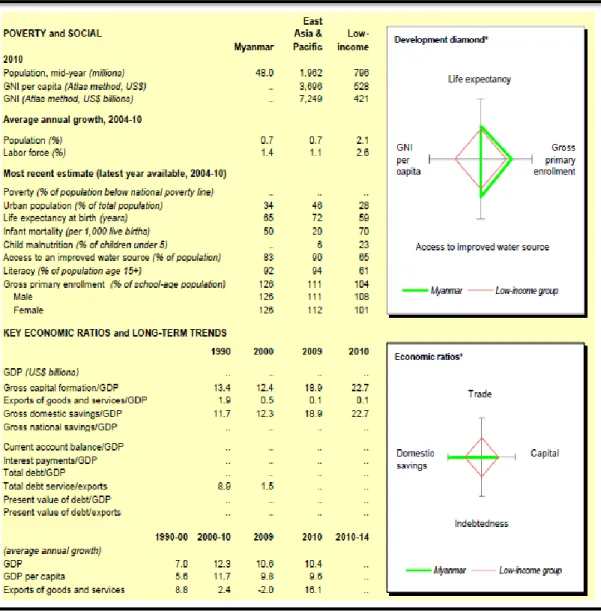
Table 5.3 Development Diamond Indicator and Economic Ratios 68
of Myanmar
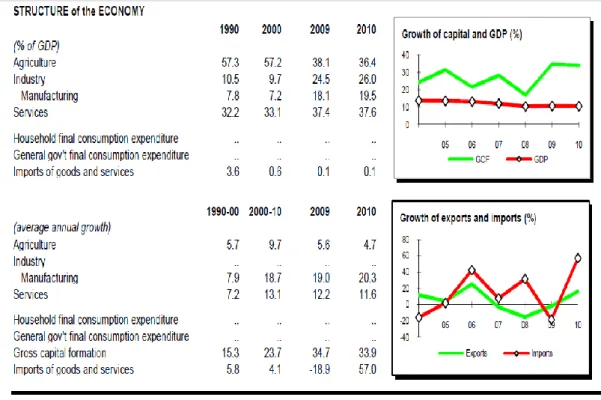
Table 5.4 Structure of Myanmar Economy from 1990 to 2010 69
Table 5.5 Prices and Governance Finance of Myanmar (1990-2010) 69
Table 5.6 Descriptive Statistics of Economic Growth and Development 72
Aid
Table 5.7 Correlation Results of Economic Growth and Development 73
Aid of Myanmar
Table 5.8 Model Summary of Regression 74
Table 5.9 Analysis of Variance 75
1 CHAPTER I INTRODUCTION
1.1 Background
Myanmar is the largest country on mainland Southeast Asia. It has a total land area of 677,000 square kilometers, and shares borders with five countries for about 6,151 kilometers sharing 274 kilometers with Bangladesh on the West, 1,339 kilometers with India on the Northwest, 2,205 kilometers with Laos on the East and 2108 kilometers with Thailand on the Southeast. It has total coastline of 2,229 kilometers (NCEA, 2009)
Being different from the countries of Association of Southeast Asia Nations (ASEAN) in development-facets and isolated from international cooperative regime since 1988, Myanmar have been keeping gradual transition from authoritarianism to her own political ideology, “discipline-flourishing democracy”, though she is not included in American-certified democracy areas. On account of this conviction, Myanmar has been patient over 20 years by paying first priority to three national causes: Non-disintegration of the Union, Non-disintegration of National Solidarity, and Perpetuation of Sovereignty more than economic development. Recent transformative elections of Myanmar 2010 stemmed from this over-20-year’s step-by-step reform can be assumed as second step-by-step of Myanmar political economy as market economy was already introduced since 1989.
In the respect of far-reaching political reforms of Myanmar, including new civilian government through 2010 election, the release of Daw Aung San Suu Kyi and political prisoners, the progress in ceasefire negotiations with armed ethnic groups, easing on media freedom as well as the noticeable economic reforms covering from
2
unifying exchange rate, legalization of trade unions, tax reform and legislation on foreign investment and banking reform, international community like US, EU, Australia and other countries have already eased sanction against the country. In particular, US President Barack Obama has announced that US companies will now be allowed to responsibly do business in Burma on July 2012. Consequently, international development organizations ranging from the multilateral organizations: the World Bank, Asian Development Bank (ADB), European Union (EU) to the bilateral organizations Department for International Development (DFID), Japan International Cooperation Agency (JICA) are getting to take a closer look at Myanmar in terms of development aid and projects. For example, DFID announced that they are going to spend 46 million pound per year until 2015. After meeting with President Thein Sein, European Commission chief Jose Manuel Barroso has also offered Burma more than $ 100 million in development aid on November 2012. In the similar vein, Tokyo on April 2012 agreed that it would forgive 300 billion yen of the 500 billion yen Myanmar is owed. Besides, the Japan Bank for International Cooperation (JBIC) and other Japanese banks will likely offer so-called bridging loans in order that Myanmar can repay past arrears to the World Bank about $ 397 million and to the ADB about $ 500 million.
Of the multilateral development institutions, the world largest giant institution, the World Bank has also reengaged with the Myanmar by introducing a very first development project called “A National Community Driven Project1”, funded by
1A National Community Driven Development Project, funded by a pre-arrears clearance grant of
US$ 80 million, was also approved to deliver quick benefits to the poor and vulnerable. It will empower rural communities to choose investments they need most, such as roads, bridges, irrigation systems, schools, health clinics or rural markets. The project will operate in 15 townships, one in each state, region and Union territory, with poverty as the key criteria in township selection. Communities will elect representative councils that will identify priority needs, prepare development plans, design
3
grant of US$ 80 million. The Bank is working with the Japanese Government and the Asian Development Bank to clear arrears in early 2013 to enable Myanmar to access International Development Association (IDA) resources, and resume a full country program (the World Bank, 2012). Before the full country program, the World Bank is currently endorsing an Interim Strategy Note that will guide the World Bank’s coming projects and works in the Myanmar for the next 18 months in the aims of accelerating poverty reduction by helping reform institutions to deliver better services to people during this cardinal transition phrase.
Under the Interim Strategy, the World Bank Group will help the government improve economic governance and create conditions for growth and jobs by providing policy advice and technical assistance in three main areas:
Public financial management, to transparently link budgets to development priorities
Regulatory reform, to provide access to finance for microfinance borrowers and small and medium enterprises
Private sector development, to promote broad-based economic growth and job
creation
The Interim Strategy was developed through extensive consultations with stakeholders including: government, development partners, academia, civil society organizations and the private sector. It was prepared jointly with International Finance Corporation (IFC), the member of the World Bank Group focused on private sector development in developing countries.
projects, contract materials and labor, and transparently manage and report on the use of project funds. (the World Bank, 2012)
4
In this context of flowing development aid and projects to the open country, absorbing capacity of the country for the aid or the digestive power of development assistance stemming from the strong macroeconomic environment, well-functioning institutions and reliable development aid policy will be core determinants of the long-term economic development of Myanmar. In particular, the research-based knowledge of development aid ranging from the impact of aid on economic growth to association of aid with economic growth will be a market-driven need of the country. In response to this need, as of March 2012, on the workshop on economic development titled by Resumption of Official Development Assistance (ODA): Views from Myanmar Perspective, U Myint2 argues, “I believe it will be useful for us, at this time, to give consideration to what Myanmar must do on its part to make ODA effective and to ensure the enhanced re-engagement brings outcomes satisfactory both to us and to the donor community. A useful way to consider how external aid could assist Myanmar’s economic and social development is to think in terms of road racing. To win a road race three things are required: a powerful engine, a smooth track, and a skillful driver. In the case of an economy, sound policies provide the powerful engine. Good infrastructure together with high-quality economic and social institutions constitutes the smooth track. The skillful driver is a leader who inspires confidence, is blessed with sound judgment and managerial capabilities to run the economy in an efficient and effective manner.” In accordance with his metaphor, the engine power of an economy firstly relies on the policy following by implementing factors. Thus, development aid policy, current mountainous area of macroeconomic policy of Myanmar in the sense of dealing with international aid can be highlighted as a fuel of
2Economic Advisor of the President
Chief, Centre for Economic and Social Development, Myanmar Development Resource Institute (MDRI), Yangon
5
the engine that can be utilized for future sustainable development of Myanmar.
1.2 Research Problem
Unquestionably, no reform will get done in venerable economy. On his masterpiece “The bottom billion”, Paul Collier (1998) addressed that beyond the few reforms that just require minister to sign something: stroke-of-the-pan reforms, most reforms needs technocrats and manager able to implement change. In line with this idea and above-mentioned background: reengagement of development aid, how to deal with development aid might be a mountain point of policy making for Myanmar Government. It will stand beyond the economic engine policy, institutional road policy, and leader-driver policy. In a simple metaphor, it is about fuel policy or development aid policy.
By considering this development aid challenge of the country, this research emphasized on the following problems:
There has been a lack of proper set development aid policy especially for the
cooperation with the giant multilateral development institution, the World Bank and it is the time of re-engagement with that giant.
There has also been a limitation on empirical studies of ODA and its impacts
on growth and associations with economic development of Myanmar since 1988.
These two absences of policy and paper can easily lead the country in to the vicious cycle of aid and aid dependency.
Even in the well-functioning engine, wrong injection of fuel can be harmful the speedy of the car. For the fresh transitioning economic engine of Myanmar, the right use of aid injection will directly affect the growth rate of the economy. Wrong and
6
short-term-focused use of development aid will not be so different from lack of development capital. Hence, depending on the quality of development aid policy, aid injection can be a solution or problem to economic growth and development of Myanmar.
1.3 Research Objective
With respect to the need of the country, this research was conducted by holding three major purposes:
To investigate the development aid policy of the World Bank
To examine relationships between official development assistance (ODA) and
economic growth of Myanmar during the twenty years of market economy in Myanmar
To recommend a proper development aid policy for Myanmar in the
re-engagement with the World Bank based on investigation of development aid policy of the World Bank and examination of aid-growth relationship of Myanmar
1.4 Research Questions
This research was conducted to answer the following questions in regard to the objectives of the study.
What is the relationship of ODA and economic growth of Myanmar during the
period of 1991-2010?
What are the crucial policy-factors in the reengagement of the World Bank Group in Myanmar that can enhance aid-effectiveness level?
7
economic growth and another is to know policy of the World Bank, this research will be dedicated to produce a proper development aid policy for Myanmar.
1.5 Definition of Terms
According to Organization for Economic Cooperation and Development (OECD), and other International Financial Institutions (IFIs) like the World Bank, International Monetary Fund (IMF), the working definition of official development assistance (ODA) or official development finance (ODF) is one used in measuring the inflow of resource to recipient countries that includes (a) bilateral official development assistance, (b) grants and concessional and non-concessional development lending by multilateral financial institutions and (c) other official flows for development which has been too low in grant element to be qualified for ODA.
Official Development Assistance (OECD, 2008) is defined as those flows to countries and territories on the Development Assistance Committee (DAC) list of ODA Recipients and to multilateral development institutions, which are:
Provided by official agencies, including state and local governments, or by their executive agencies; and
Each transaction of which:
a) is administered with the promotion of the economic development and welfare of developing countries as its main objective; and
b) is concessional in character and conveys a grant element of at least 25
per cent (calculated at a rate of discount of 10 per cent).3
3This calculation helps determine whether a loan is concessional. If the loan satisfies the ODA
criteria, then the whole amount is reported as ODA. The grant element itself is not reportable as a flow. Reporting is on a cash (nominal) basis, except for Paris Club debt service reduction. (OECD, 2008)
8 1.6 Significance of the Research
Myanmar has been living over twenty years with no cooperation and development aid with the World Bank by keeping the arrear of US$ 397 million. Now it is time of reengagement of Myanmar and the World Bank in the context of development aid. After the World Bank aid-policy research report entitled “Assessing Aid: What Works, What Doesn't, and Why” in reviewing the fifty years’ experience of development assistance of the Bank, lending policy of the Bank have shifted from conditionality to selectivity based on policy environment of recipient countries covering governance, institutions and macroeconomic performance.
In this context in which the nature and drive of the World Bank’s aid will be up to the policy environment and performance of macroeconomic management, policy and macroeconomic indicators of Myanmar including the evidence of how Myanmar used development aid in the past might be an important message to internal stakeholders of this reengagement: aid-policy makers, parliamentarians, local non-government organizations (NGOs) and other governments agencies of Myanmar as well as to external stakeholders: the World Bank Group, international donor community, other international non-governmental organizations (INGOs). This research attempted to uncover this message and policy by conducting analysis of relationship between official development aid and economic growth of Myanmar from 1991 to 2010. To date, no empirical studies are conducted to deliver this kind of message and recommendation especially for the re-engagement with the World Bank. Not only for the short-term growth of the economy caused by right after big flow of aid but also for the long-term economic development by the right treatment of this flow, aid policy will be a key determinant. That is why, taking into account of important criteria: relevance, impact, effectiveness, efficiency and sustainability, the
9
formulation of aid policy might be significant for the economic development of Myanmar.
1.7 Scope and Limitation of the Research
This research is focused on developing hypothesis about the relationship between ODA and economic growth of Myanmar during the period of 1991-2010. It has employed correlation analysis to determine the relationship between ODA and growth. In the concern of data reliability, the researcher has utilized institutionally strong secondary data form the World Bank, IMF, OECD and ADB.
Given that this study is the first exploratory research on the development aid and economic growth of Myanmar and also on the area of international cooperation policy with international development organization, the World Bank, some limitations are inevitable. The most obvious one is limited availability of data from the sources of Myanmar. Secondly, this research emphasized on the relationship of ODA and economic growth in order to know how these two variables are associated in the exploratory sense, not in the explanatory sense of cause-and-effect. Thus, knowledge contribution level of this research is just initiating level of exploratory and not yet explanatory. In this respect, this study recommends other researchers to do further investigations and researches focusing on impact of not only aid but also other macroeconomic variables: saving and investment on the economic development of Myanmar like an explanatory contribution.
10 CHAPTER 2
LITERATURE REVIEW
2.1 Introduction
Being lack of proper set of development aid policy and limited on the empirical studies of ODA and it impacts on growth and associations with economic development since 1988, Myanmar has a high possibility of using aid ineffectively and inefficiently especially in the reengagement with the World Bank.
Related to this concern, this chapter will review existing literature and researches in terms of three areas that are directly linked to the development aid policy formulation of Myanmar. The first section will address the general literature of development aid. The second section will focus on the World Bank’s aid policy. The rest will discuss prior researches about the relationship of development aid and growth. The literature review of this study is also enhanced by exploring macroeconomic environment of Myanmar in preceding chapter.
2.2 Body of the Review
Starting from the birth of Bretton Wood Conference: a big milestone of today development economics and very first origin of international financial system and monetary system and to the current twenty-first century poverty reduction strategy of the World Bank and other international development organizations, development has being debated by a hundred thousand of perspectives from the different levels of researchers. Of those ideas and researches, some important perspectives related to the development aid, the World Bank and aid-growth researches would be covered.
11 2.2.1 Development Aid
The invention of present-day use of development and development aid has rooted from underdevelopment. On 20 January 1949, US President Truman took office and launched the idea of development by saying, “We must embark on a bold new program for making the benefits of our scientific advances and industrial progress available for the improvement and growth of underdeveloped areas. The old imperialism – exploitation for foreign profit – has no place in our plans. What we envisage is a program of development based on the concepts of democratic fair dealing.” On this way, underdevelopment began and a new idea was opened for the world – the idea of development. Gustavo Esteva (2010) noted that Truman was not the first to use the word – underdeveloped. Wilfred Benson, a former member of the Secretariat of the International Labour Organization, was probably the person who invented it when he referred to the ‘underdeveloped areas’ while writing on the economic basis for peace in 1942.4 Since then, development has been assumed that getting free from the lower condition called underdevelopment.
Gustavo Esteva also remarks that, in common parlance, development describes a process through which the potentialities of an object or organism are released, until it reaches its natural, complete, full-fledged form. Hence the metaphoric use of the term to explain the natural growth of plants and animals. Through this metaphor, it became possible to show the goal of development and, much later, its programme. The development or evolution of living beings, in biology, referred to the process through which organisms achieved their genetic potential. He also highlights the transformation aspects of development idea; “it was between 1759 (Wolf) and 1859 (Darwin) that development evolved from a conception of transformation that moves
4Wilfred Benson, ‘The Economic Advancement of Underdeveloped Areas’, in The Economic Basis of
12
towards the appropriate form of being to a conception of transformation that moves towards the appropriate form of being to a conception of transformation that moves towards an ever more perfect form. During this period, evolution and development began to be used as interchangeable terms by scientists. The transfer of the biological metaphor to the social sphere occurred in the last quarter of the eighteenth century. Justus Moser, the conservative founder of social history, from 1768 talked about the transformation of some political situations, he described them almost as natural processes.” Since then, the remark of Gustavo Esteva that development cannot delink itself from the words with which it was formed – growth, evolution, and maturation is strong enough.
Another conceptual inflation of development can be seen in the reports on social situation, published by the UN. The idea of social development was introduced in the reports as a counterpart of economic development. On 1962, the Economic and Social Council of the United Nations (Ecosoc) recommended the integration of both aspects of development. Furthermore, the Proposals for Action of the First UN Development Decade (1960-70) established that “The problem of the underdeveloped countries is not just growth, but development…. Development is growth plus change. Change, in turn, is social and cultural as well as economic, and qualitative as well as quantitative…. The Key concept must be improved quality of people’s life.”5
By this philosophy of development of underdevelopment, development aid policy has been developed for the underdeveloped. Thereafter, development aid became the steering role of international development organizations. Following the concept of underdeveloped, beginning from 1950s, development aid policy has been embedded in their policies, programmes and projects around the developing countries starting
13
from 1950s. One of the international cooperation and development organizations, OECD has formalized the working definition of development aid - official development assistance or development aid (ODA) is one used in measuring the inflow of resource to recipient countries that includes (a) bilateral official development assistance, (b) grants and concessional and non-concessional development lending by multilateral financial institutions and (c) other official flows for development purposes (including refinancing loans) which have too low a Grant Element to quality as ODA.
According to Moyo (2008), development aid can be categorized into three types: Humanitarian Aid or Emergency Aid, Charity-based Aid, and Systemic Aid (government to government, multilateral and bilateral aid). Humanitarian aid and charity aid have not been debated on the literature of development aid since they are a little far from policy variables of systematic level of both donor countries and recipient governments. The policy of systemic-level development aid has been researched by a lot of development economists, researchers, and even the development organizations themselves. The chronology order of development aid policy can be seen as follow.
2.2.1.1 Chronological Order of Development Aid Policy
The very onset of the development aid policy is stemmed from the formulation of international financial system and monetary system at Bretton Woods after World War II. The main objective of Bretton Wood conference is to restructure international finance, multilateral trading system, and framework for economic cooperation. On this conference, John Maynard Keynes (British Economist), Harry Dexter White (US Secretary State) planned out three international organizations: International Bank for
14
Reconstruction and Development (origin of the World Bank), International Monetary Fund (IMF), and International Trade Organization (ITO). The World Bank was designed to facilitate the capital investment for reconstruction of, in particular, European countries. International Development Association (IDA), one agency of the World Bank, was founded later on 1960 to support for the developing countries and poorest countries. IMF was to manage the global financial system and monetary cooperation. Its primary responsibility is to promote stability of the world economy and international cooperation as well as to forestall any possible global crisis. ITO was designed to facilitate the trade liberalization of new economies.
In the concern of the World Bank’s lending, there was wide agreement that few countries would be able to fulfill the role of foreign lender. The underlying principle of the World Bank was that all member nations should participate in underwriting the risk involved no matter what country actually did foreign lending. According to Moyo, early financial transfers from that kind of international institution included a US$ 250 million reconstruction loan to France signed on 9 May 1946 and to Netherlands, Denmark, Luxembourg. It is the heart of reconstruction process that almost certainly contributed to economic powerhouse that Europe has become today. On account of Marshall Plan (1947), fourteen European countries get assistance US$ 13 billion. In the light of Marshall Plan success, the one thinking of economics was widely accepted that ‘Investment Capital’ was a key for economic growth.
Throughout 1950s, the development was targeted to improvement of gross national product of the recipient countries. The fundamental development-aid-theories at that time were big-push, takeoff, critical minimum effort. All were focused on big capital injection to the development projects. The major policy and strategy were import-substitution, industrialization, social overhead capital, and infrastructure investment
15
by state own companies (SOCs). Data system was employed by national income account. The role of aid during 1950s could be summarized as aggregate large-scale resource transfer, and bias toward industrial and SOC projects. At this time, it was obvious that there was a belief in governments’ capacity to use aid effectively and efficiently.
As of 1960s, objective focus of development has expanded from GDP growth to balance of payment and employment. Policies and strategies were balanced growth, export promotion, foreign aid, regional integration, fiscal reform and sectorial plans. The major theories at this time are economic dualism and shadow price. Data system was based on National Income Account, Employment census and Social National Account (SNA). Two-Gap Model focusing on saving and investment as well as Technical Assistance focusing on human capital have shaped the role of aid at this time. The most obvious milestone of this decade is industrialization.
On 1970s, the objective focus of development got wider from GNP growth to employment, income distribution, poverty alleviation and external equilibrium. The striking policy and strategy of this era were comprehensive employment strategy and reformist. The cardinal theories on that time were socio-economic investment criteria and dependency theory. National Income Account and Household Survey were employed as Data System. Multilateral aid practice became the major role of aid on this era. The most far-reaching concept of this decade was poverty focus.
By 1980s, stabilization, external equilibrium (balance of payment), internal equilibrium (budgetary and monetary) and structural adjustment were targeted in development look. Stabilization and structural adjustment were two major policies and strategies at this era. The common theories were ‘reliance on market’ and ‘link between Trade and Growth.’ Social Accounting Matrix (SAM) was employed as Data
16
System. The greater privatization of aid was the major role of aid on this decade. Most of economists assume 1980s as lost development decade. Mexican debt crisis (1982) had challenged to undermine the very foundation of global financial stability and speeded to other part debt crisis. As a response to the crisis, IMF restructured the debt by forming “Structural Adjustment Facility” to lend money to defaulting nations to help them repay what they owed. IMF named that kind of intervention as ‘restructuring’. In the aftermath of the crisis, stabilization and structural adjustment became two new aid-based programs of this decade. Structural adjustment was designed to encourage greater trade liberalization and reduced price and structural rigidities. In the similar vein, as a result of crisis, external equilibrium (balance of payment) and internal equilibrium (budget) became overarching objective and necessary condition to restore economic growth and poverty alleviation. Moyo (2008), on this point, argued that poor governance received cash in the form of budgetary support, and in return agreed to embrace the free market solutions to development. This free market gave African economies the freedom to succeed, but also freedom to fail. Although her argument is controversial, the obvious fact is that restructuring composed of stabilization and structural adjustment cause minimizing the role of government.
Alongside the years of 1990, structural adjustment program was continued. The new objective focus of development was expanded to good governance and institutional building. Another target was to moderate effect of Asian financial crisis. ‘Role of Market and Government’ as well as ‘Social Capital’ was major theories at this decade. The strategy practiced to implement these objectives was deregulation and liberalization. The policy of stabilization and structural adjustment was also employed. The major use of data came from demographic and health survey as well as income,
17
expenditure and household survey. Aid fatigue threatened the existence of development aid at this decade. Consequently, reducing aid dependence and re-examination of aid-effectiveness became major role of aid. The 1990s has been tagged as a question of governance. Having seen the failure of 50 years of competing aid intervention donor put the blame on political leadership and weak institutions. (Moyo, 2008). Since then, good governance became the important determinants in the aid allocation and selectivity of the international development organizations. After fifty-year-experience of development aid, good governance and policy environment are highly ranked as the most critical success factors of the aid-effectiveness.
The 2000s was seen as rise of glamour aid (Moyo, 2008). She argued that over 50 years, 2-trillion-aid has gone to the Africa and it caused slower growth, higher poverty and Africa left off the economic ladder. Although so many reports have pointed out the diversion risk of aid, international development organizations keep operations of aid alive to where they see recipient governments’ policies are in line with criteria of good policy they formulated. For example, in 2000, Millennium Development Goals (MDG) was signed up by 189 countries and US$ 130 billion a year would be needed to achieve MDGs in a number of ways. In the similar vein, UN conference on Mexico (2002), governments agreed to increase aid GNP (0.25%) to (0.7%), US$ 200 billion. However, that kind of big-push theory in development discipline looked over one of the crucial problem of aid – fungible.
In the review of this chronological order of development aid from 1950s to 2000s, it is obvious that development aid performance at different times and different places has mixed in terms of really effective and totally ineffective and any range between. The decisive drives behind this kind of different levels of aid-performance can be highlighted as: conditionality and implementation level of it, right selectivity criteria
18
and right nature of country, good governance and institution, good macroeconomic policy environment. Given that aid performance and effectiveness are over controversial and sensitive, some researchers argued that aid is working effectively if the recipient country’s policy environment is good while others remarked that aid is not effective for the economic growth in particular long-term development by using different methodologies. For example, Hansen and Tarp (2000a) argued that there seems to be strong evidence for a positive effect of aid on investment and growth. By contrast, some other researches: like Hadjimichael (1995) and Reichel (1995) uncovered a negative relationship between saving and aid. The researches pointing out positive relationship are less than the ones uncovering negative relationship. Of these studies that argue aid-ineffectiveness, the “Dead Aid” by Dambisa Moyo is the one of the far-reaching work that can point out negative aspects of the development aid. More than debating positive or negative, some ideas in this book are critical in the formulation of proper development aid policy. For example, she remarked that development aid is the silent killer of growth for the Africa by pointing out the vicious cycle of the aid. To some extent, we can argue that the Africa has different nature from the other part of the world and Myanmar as well. But, we should no longer fail to recognize the nature of the vicious cycle since the theoretical structure is based on common political and economic realm.
2.2.1.2 Vicious Cycle of Aid
If one country does not have a set of proper development aid policy or it cannot use aid in effective and efficient way, aid named to reduce poverty can even be one cause of the poverty. Basically, vicious cycle of aid can be happened in three ways. First, vicious cycle of aid can be seen from politic-based view in which the injection of aid
19
cash leads to corruption of the government in each level. That corruption that is larger than normal can make low transparency level of the government. It can also undermine bureaucracy structure of the recipient government and lower the performance of it. This kind of poor policy and institutional environment will be a bad new for prospective investment figures. No attraction to investment will bring fewer job opportunities for the people. That can easily lead to poverty. Finally, this poverty will be targeted again by development aid policy and programs. (See Figure 2.1)
Figure 2.1 A vicious cycle of aid from political perspective
Concerning about that corruption, Moyo argues that since 1946 the World Bank loan to developing countries about US$ 525 billion and 25 % (US$ 130 billion) of them has been misused and aid has gone to corrupt countries. For example, IMF gave the largest loan it had ever given to African country. Next 10 years, Mobutu’s Kleptocracy made US$ 700 million from the Fund. Moyo also answered the question
Aid Corruption No Transparency Poor Governemnt Bureaucracy Poor Performance of Government No attraction to investment Fewer Job opportunities Poverty
20
of why development aid has gone to that country if it can lead to corrupt by giving two reasons. One is about employment of the international development organizations. The World Bank employs 10,000 workforces while IMF employs 2500 staffs, and UN agencies, 5000 in the business of development aid. The other one is that donors are apparently agreed on which countries are corrupt and which are not.
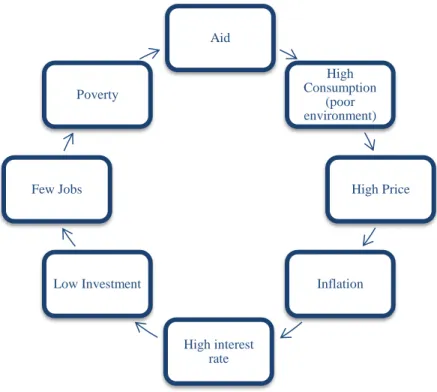
Secondly, it can also be viewed from the macroeconomic point of view in terms of basic demand and supply concept. An immediate injection of cash can raise the consumption level of the market in recipient countries. In a well-functioning macroeconomic environment, that kind of increasing demand will be equilibrated by the function of supply at one time. But, it will be a different story for the countries in which the supply side cannot follow up the immediate increasing demand and consumption. So, this higher consumption can easily make the price of the goods and services high. This situation can call for the abnormal inflation level of the country. In order to response this abnormal inflation, economic policy maker may raise the interest rates. In the way of normal process, higher interest rate can cause less investment since the borrowing cost to investment is not attractive. Less investment calls for fewer jobs and fewer jobs call for poverty. Poverty is where aid goes. (See Figure 2.2)
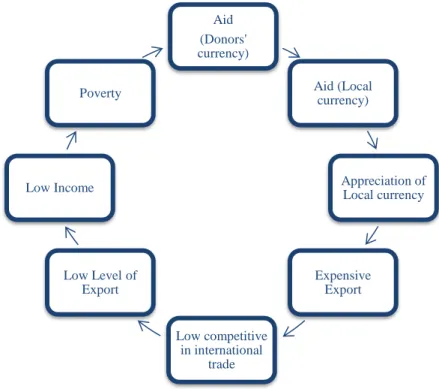
Thirdly, the vicious cycle of aid can be occurred in the way of another macroeconomic variable – exchange rate. Aid money will flow to the recipient country by the process of transition from the currencies of the donors’ countries to the currencies of the recipients’ countries. It can raise the value of local currency and encourage the appreciation of it. This appreciation of local currency will make the export of the country expensive. Since these exports are not competitive in the international trade environment, the export amount of the country will get decreased
21
along with the rising level of local currency. That low level of export will lead to the low level of national income. Low level of income can be pre-condition of the poverty. Poverty is what development aid concerns. (See Figure 2.3)
Figure 2.2 A vicious cycle of aid from macroeconomic point of view (demand-supply)
Although these conceptual looks on aid are not so much optimistic, three points of views of vicious cycles of aid: political cycle, macroeconomic cycle (demand-supply) and macroeconomic cycle (exchange-rate) are useful and concrete to be paid attention in the formulation of development aid policy by aid policy makers and also donor community.
In contrast to Moyo’s look on development aid from international development organizations, Paul Collier remarked that aid could be utilized as an instrument to escape from the trap of the poverty. He argued that a society could gradually climb
Aid High Consumption (poor environment) High Price Inflation High interest rate Low Investment Few Jobs Poverty
22
out of poverty, unless it gets trapped. He has grouped the traps in to four groups: conflict trap, natural resource trap, landlocked trap and bad government trap. Not only about the traps but also instruments that can address these traps has been mentioned – aid, military intervention, law and charter, and a charter for investment. Although landlocked trap is no longer challenge for Myanmar, the rest three traps will be important challenges for the long-term development of the country. Among instruments, aid is what Myanmar will be cooperating with international development organizations on her transition. Paul pointed out that aid alone is really unlikely to be able to address the problems of the bottom billion, and it has become so highly politicized that its design is often pretty dysfunction. Based on its application, Paul has viewed the aid from four points of views: aid as an incentive, aid as skill, aid as reinforcement, aid prior to reform. He suggested that the key objective of government conditionality should not to shift power from gov ernments to donors but to shift
Figure 2.3 A vicious cycle of aid from macroeconomic point of view (exchange-rate) Aid (Donors' currency) Aid (Local currency) Appreciation of Local currency Expensive Export Low competitive in international trade Low Level of Export Low Income Poverty
23
power from government to their own citizens so as to make aid as an incentive. Good news for Myanmar is that the project selection of the World Bank’ grant to Myanmar about US$ 80 million will be decided by the community, not government. Paul also argued that aid can be used effectively like skill-focus. Rather than giving the money to the government, focus area of aid should be the capacity building of the civil servants and government as technical assistance. He recommended that technical assistance is more effective in the transition-country headed to the development.
“The better the prospects of a turnaround, the more technical assistance the donors might choose to supply.” (Paul Collier 1998)
He also suggested that aid can be used as reinforcement so as to encourage development-oriented turnaround.
“Aid is not very effective in inducing a turnaround in a failing state; you have to wait for a political opportunity. When it arises, pour in the technical assistance as quickly as possible to help implement reform. Then, after a few years, start pouring in the money for the government to spend.” (Paul Collier 1998)
Another suggestion is that aid can be designed prior to reform. Although it can be a cumbersome approach, it can also increase success rate of project.
“The traditional way of trying to ensure that aid is spent properly is through projects. Instead of just giving unencumbered money to government, the agency agrees on a project with the government and helps to design and implement it.” (Paul Collier 1998)
Besides the aid as an instrument for the capital problem of the developing countries, he also uncovered another problem of them: a lack of reform credibility. In the situation of what the government judicial system is not enough to guarantee the investor insurance, according to Paul, two complementary solutions of international arbitration and investor insurance should be provided.
24 2.2.1.3 Development Aid Policy Reform
In the study of how policy reform and effective aid can meet international development goals, Paul Collier and David Dollar (2001) investigate scenarios of policy reform and efficient aid that point the way to how the world can cut poverty in half in every major region. They argued that poverty in the developing world will decline by about one-half by 2015 if the trends of the 1990s persist and most of this poverty reduction will occur in Asia, however, while poverty will decline only slightly in Africa. They recognized that effective aid could make a contribution to greater poverty reduction in lagging regions and even more potent would be significant policy reform in these countries. They developed a model of efficient aid in which flows respond to policy improvements that create a better environment for poverty reduction and effective aid. They also pointed out four counterfactual scenarios of aid and reform: efficient aid, efficient and more generous aid, efficient aid and policy reform, and policy reform plus efficient and more generous aid. First scenario of efficient aid holds policy constant and allocates aid efficiently year-by-year based on the algorithm in the previous section. Second scenario of efficient and more generous aid hold policy at its current level, allocate aid efficiently, and allow the marginal utility of aid to rise over time (more concern from the first world). Third scenario of efficient aid and policy reform assume that policy in sub-Saharan Africa and Europe and Central Asia (ECA) attains the average level in South Asia, and allocate aid efficiently as in first scenario. Fourth scenario of policy reform plus efficient and more generous aid combines the policy reform of third scenario above with the efficient and more generous aid of second scenario. (They call this fourth scenario the ‘partnership approach’: Third World governments provide good policies while first world governments ensure adequate aid, efficiently managed.). Among
25
these four scenarios, even fourth scenario of policy reform plus efficient and more generous aid called partnership approach of aid and policy reform is an idealistic approach for current reform and transition of Myanmar, she can enjoy the better-off condition of third scenario – efficient aid and policy reform. The current political and economic reform of Myanmar could attract aid flow from the international development organizations, in particular the World Bank, and if that flow can encourage the policy and institutional performance and can speedy the velocity of the reform, this improvement in performance can better attract not only development aid of the international organizations but also international investment of foreign direct investment (FDI) as well as foreign Portfolio Investment (FPI). After keeping effective use of aid to some years and constructing policy and institutional environment strong in enough time, Myanmar can be independent of development aid and can stand out of the world with well-functioning institution and strong macroeconomic and investment environment. That will be better-off treatment of development aid policy for Myanmar in two ways: first to use aid effectively and efficiently as means in the construction of good policy and second to conclude with the ends of good policy. This kind of aid-policy functioning by Paul and David will be helpful for Myanmar to escape so-called vicious cycle of aid by Moyo. It can be clarified by the final product of their research on aid policy – a model of efficient aid in which policy and aid interact in several important ways:
-“aid increases the benefits from good policy, while at the same time good policy increases the impact of aid; thus, the combination of good policy and aid produces especially good results in terms of growth and poverty reduction;
- by introducing the concept of the marginal utility of poverty reduction to first world taxpayers, we make the volume of aid endogenous; in particular, it increases when
26
policies are improved, because in the better policy environment more aid can be used effectively;
- we assume that policy is determined by developing country political processes and is independent of aid; however, the fact that aid increases the benefits of reform suggests that a high level of aid to strong reformers may increase the likelihood that good policy is sustained (an idea ratified in a number of recent case studies of low-income reformers); to the extent that that is the case, our estimates of the benefit of aid to good policy countries are too low.” (Paul and David, 2001)
In this context, they concluded, in positive way, in contrast to Moyo, that foreign aid with right functioning of policy could accelerate the process of economic reform. Although they have different approaches and conclusions, the similarity of their different points of views is the importance of policy – how to use the aid effectively and efficiently for the recipient countries and how the donor encourage the policy construction of government by using development aid.
2.2.2 The World Bank and Its Lending Policy
The very origin of the World Bank, the International Bank for Reconstruction and Development (IBRD) was invented together with the International Monetary Fund (IMF) on July 1944 at Bretton Woods, a small town in New Hampshire, United States. The major aim of the IBRD was to help reconstruct Europe from the devastation of World War II. At this time, the focus of lending policy existed in the reconstruction given the natural disasters, humanitarian emergencies, and post conflict rehabilitation. After Europe got on track to reconstruction, the IBRD shifted focus to the needs of the developing countries and named the mission - fighting the poverty. In order to provide special services to the poorest countries, international community agreed to create a new specialized development association. That is the reason why the
27
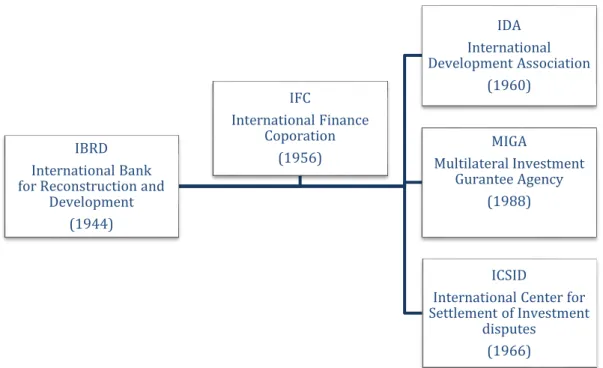
International Development Association (IDA) got appeared. Thereafter, the IBRD and the IDA together are commonly referred to as the ‘World Bank’. Nowadays, the Bank provides a service of lending money and knowledge sharing to socio-economic development of the world, operating in more than 100 countries. Over time, the greater the challenges of the development shaped the structure and operation of the organization bigger, broader and far more complex. Finally, the IBRD has become a Group, covering five closely associated development institutions: the International Bank for Reconstruction and Development (IBRD), the International Development Association (IDA), the International Finance Corporation (IFC), the Multilateral Investment Guarantee Agency (MIGA), and the International Centre for Settlement of Investment Disputes (ICSID). (See Figure 2.4)
Figure 2.4 Agencies of the World Bank Group
IBRD International Bank for Reconstruction and
Development (1944) IDA International Development Association (1960) MIGA Multilateral Investment Gurantee Agency (1988) ICSID
International Center for Settlement of Investment disputes (1966) IFC International Finance Coporation (1956)
28
By the expertise of these specialized institutions, the World Bank today has been playing the steering role in development areas of the world. Instead of running like a commercial banks and investment banks, it has specialized on the development banking by keeping two major roles of its operations: international development aid agency’s role and international development research center’s role. Under the professional role of international development aid agency, the Bank is providing ordinary loan, concessional loan, technical assistance and delivering projects and programs in developing countries once overall lending has been agreed and keeping eye to program quality and development impact. Besides, for the academician role of the international development research center, the World Bank’s research departments are publishing world-leading research papers and books. Another undeniable good thing of the World Bank’s research is open data to all. The research team processes data gathered from different countries and projects, and advices proper approaches to construct development.
The Bank’s Lending Policy
Right after the formation of the IBRD on 1944, the Bank’s lending policy has been based on reconstruction. The Bank made first loan of US$ 250 million to France. That kind of Marshall Plan was the major lending policy of the Bank around 1940s. By 1950s, the Bank’s policy focus has been shifted to infrastructure and industry by the creation of IFC. On the years of 1960s, agriculture was targeted as the most priority area of the Bank’s lending. In those years the Bank created IDA and ICSID. By 1970s, the policy focus of the Bank has been shifted to basic needs and education. The Bank made its first loan to population planning at this time. In response to the debt crisis, the World Bank has implemented structural adjustment policy lending on 1980s. The
29
Bank also created one of its agencies at this time – MIGA. On 1990s, the World Bank’ aid policy has focused on economies in transition. There have been a lot of studies that criticized failure of the aid program from the Bank and conditionality. By this aid fatigue years, the World Bank responded the criticism by publishing the policy report of ‘Assessing Aid: What works, What doesn't, and Why’ pointing out the fungibility and diversion risk of the aid. After this aid policy report and the ineffectiveness of the conditionality, the Bank lending policy has been upgraded to selectivity based on policy indicators of the recipient countries like good governance, good institutions and strong macroeconomic environment. On these years, the Bank introduced the Comprehensive Development Framework (CDF). It also started the initiative of the Heavily Indebted Poor Countries (HIPC). Getting into the year of 2000, in line with globalization wave, the policy focus of the World Bank emphasized on the global partnerships with the aim of Millennium Development Goals (MDGs).
In these timeline of the World Bank lending policy, conditionality and good governance have played a major role of aid allocation. The Bank has highlighted six major criteria of a good government as follow
- Voice and Accountability
- Political stability and absence of violence - Government Effectiveness
- Regulatory Quality - Rule of Law
- Control of Corruption
Among different determinants of aid allocation by international aid agencies like colonies country, political position of country with Western country (measured by voting behavior in UN), good governance, political right and civil liberties and GDP
30
per capita (Eric Neumayer, 2003), good governance and GDP per capita has been major policy variables of the World Bank’s loan disbursement. However, these policies of good governance and conditionality have not been a success story. In the context of Africa, Paul Collier (1999) asserted that International Financial Institutions (IFIs) have radically overestimated their own power in attempting to induce reform in very poor policy environments and in effect, ignored domestic politics. He also argued that the IFIs must radically redesign their lending policies, revisit their traditional assumptions and adopt a more selective approach rewarding good behavior and performance. Some other extremist researches also suggest that aid dependency can even undermine the quality of governance. In his research of ‘Aid Dependence and the Quality of Governance: A Cross-Country Empirical Analysis’, Stephen Knack uncovered that aid has been associated with an increase in corruption, deterioration in the quality of the bureaucracy and a weakening of the rule of the law. Looked at another way, in their influential study of aid, policy and growth, World Bank economists Craig Burnside and David Dollar (1997, 1998) argued that aid has been highly successful in reducing poverty and promoting growth in countries with sound economic management and robust government institutions. They found no empirical evidence that the policy was directly affected by the amount of aid. Devarajian, Dollar and Holgren (2001) also argued that aid cannot buy reform and that the conditionality attached to adjustment loans did not successfully induce policy change. However, when reforms had been initiated, foreign assistance helped accompany reform and assuaged social costs of adjustment (Carlos Santiso, 2001). Collier and Dollar (2001) also asserts that aid allocation needs to take corruption into account because, even if aid cannot significantly reduce corruption, corruption can significantly impair aid effectiveness. Hence, the influential impacts of corruption on macroeconomic
31
environment and aid effectiveness have been major key policy variables for the Bank’s lending and loan disbursement since 1990s.
In order to address this kind of hot debate of development aid lending policy, the World Bank issued the report “Assessing Aid: What Works, What Doesn't and Why” on 1998, recommending a more strategic way of aid allocation to poor countries with good policies and strong institutions with the aim of to increase the effectiveness of aid. As a result of this report, the determinant of aid allocation is driven not only by the obvious needs of the recipient countries but also by their performance in implementing reforms. The idea of Performance-based Aid has stemmed from that report. On the early 1999, the World Bank has also proposed the Comprehensive Development Framework (CDF). According to the Joint Note by James D. Wolfensohn and Stanley Fischer (2000), “CDF is a means by which countries can manage knowledge and resources to design and implement effective strategies for economic development and poverty reduction. It brings together many current trends in development thinking and is centered on a long-term vision – prepared by the country through a participatory national consultation process – that balances good macroeconomic and financial management with sound social, structural and human policies. The CDF, however, is not a blueprint. It is voluntary, and each country must decide on, and own, its priorities and programs. In order to ensure the most effective use of human and financial resources, the CDF emphasizes partnerships between government (at the national and local levels), civil society, the private sector, and external assistance agencies. It encourages coordination to improve efficiency and coherence in the use of financial flows and services, and to take advantage of synergies among development partners. In addition, as the international community has increasingly come to recognize, partnership and coordination of efforts can
32
enhance the capacity of governments to manage foreign development assistance.” Like other conceptual framework of economics, CDF is a useful way of formulating development aid policy for Myanmar especially focusing on the cooperation with international development community and effective use of development aid. It is useful for Myanmar because main four principles of CDF are targeted to long-term growth of the recipient country through effective use of aid. These principles can be seen as follow.
“Development strategies should be comprehensive and shaped by a long-term vision.
Each country should devise and direct its own development agenda based on citizen participation.
Governments, donors, civil society, the private sector and other stakeholders should work together in partnership led by recipient countries to carry out development strategies.
Development performance should be evaluated on the basis of measurable
results.” (the World Bank, 2012)
Of these principles, the most useful principle for Myanmar is the second principle of own development agenda based on citizen participation since the ultimate power of making development policy would be still in the hand of her own while keeping the cooperation with stakeholders. It seems that CDF is more transparent and comprehensive to the communities of the recipient countries. However, as long as it fails to enhance the capacity of government to use aid wisely, it will only be a paper-cooperation and a paper-framework.
Another leading policy paper of the World Bank’s lending is the Poverty Reduction Strategy Paper (PRSP). That is also stemmed from the principles of CDF. PRSP