
Using Expert Knowledge to Alleviate the Lack of Data in Predictive Analytics: A Case Study of Estimating Electronic Components Failure Rate
2
0
0
全文
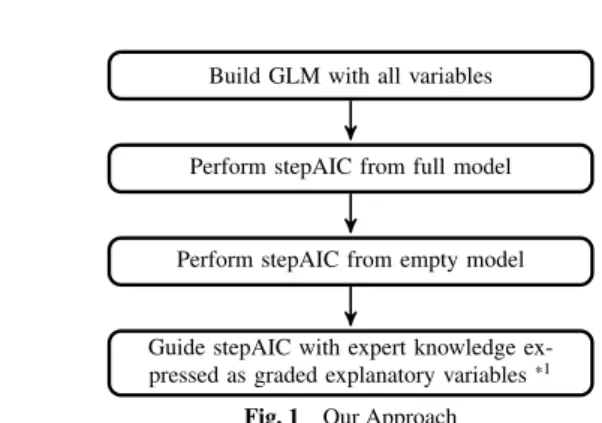
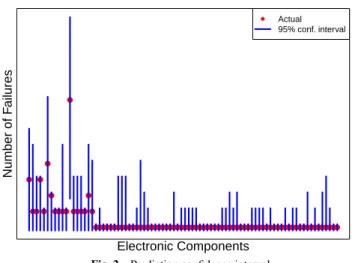
(2) 情報処理学会第 80 回全国大会. ●. Number of Failures. combine our expert’s knowledge by having him grade each potential explanatory variables from 1(no link to the kind of failure studied, should be pruned) to 5(very confident this variable is linked to this kind of failure) and to finally combine those graded explanatory variables in the stepAIC as shown in algorithm 1. Compared to previous models, it gave us an AIC of 104. Its results will be detailed in part 4 To identify the key factors in electronic components failure, during the various modeling phases, we recorded after each stepAIC modeling phases the kept variables with a significant pvalue(<0.05).. Actual 95% conf. interval. ●. ● ● ● ●. ●. ●● ● ●●●● ●●●● ● ●●●●●●●●●●●●●●●●●●●●●●●●●●●●●●●●●●●●●●●●●●●●●●●●●●●●●●●●●●●●●●●●●●. Algorithm 1 stepAIC combined with Expert Knowledge 1: 2: 3: 4: 5: 6: 7: 8: 9: 10: 11: 12: 13: 14: 15: 16: 17: 18:. procedure makeExpertModel input: data ← List of failureData exVarGraded ← set of graded explanatory variables output: GLM with variables chosen by stepAIC and exVarGraded main: currentGrade ← maxGrade(exVarGraded) while currentGrade ≥ minGrade(exVarGraded) do currentExVar ← {x ∈ exVarGraded | grade = currentGrade} currentModel ← glm(data, currentExVar) currentModel ← stepAIC(currentModel, keptExVar, currentExVar) if AIC(currentModel) ≥ prevAIC then return prevModel prevAIC ← AIC(currentModel) prevModel ← currentModel keptExVar ← var(currentModel) currentGrade ← currentGrade − 1 return currentModel. In order to combine the previously built GLM with our established explanatory variables grade, we conceived Algorithm 1: In descending order of grade importance(line 9 and line 17), we take the explanatory variables corresponding to current grade (line 10), make the GLM for those variables (line 11), select the best variables with stepAIC within current grade variables(line 12), and then check the resulting model’s AIC. If we reached a better model compared to the one built with the previously processed explanatory variables corresponding to the previous (higher) grade, we loop to process the variables in the grade below. If the previous model was better, we stop processing further and return this model (line 13).. 4.. RESULTS. 4.1 Fitting The p-value for some of our explanatory variables obtained after making our GLM showed was significant (p-value < 0.05). When we showed those results to our expert it allowed him to confront his own assumptions on what part of the specifications he thought was relevant for the studied failure type to those deemed significant GLM-wise. It revealed that the GLM was able to extract both matching and non-matching knowledge to our expert’s. For most of the non-matching cases, it highlighted the high proportion of outliers present in the available data and more importantly it led us to prune out those variables to reduce the risk of overfitting. For the matching cases, it reinforced the expert’s. 2-20. Electronic Components Fig. 2. Prediction confidence interval. confidence in his experience. We present in figure 2 the actual predicted number of failures (red dots) compared to the predicted number of failures within a 95% confidence interval for each of the components in our data. As we can observe, all the actual values fit within their predicted interval. Although not shown here, for our pure stepAIC based model, we had one component which actual value did not fit in its interval. 4.2 Cross-Validation Due to the lack of data, we chose a leave one out approach for our k-fold cross-validation. Since most of the components in our data has a low failure rate, we thought it would be relevant to compare our model’s MSE resulting from cross validation to a trivial model only predicting a failure rate of 0 for any components which we called Zero Model (ZM). It shows encouraging results: our EGM has an MSE almost five times better than the NEGM and 6.6% better than the ZM. NRMSD wise, EGM is twice better than NEGM and 3.3% better than ZM.. 5.. CONCLUSION. We successfully combined our expert’s knowledge with our small data to assess more accurately our components key factors in failures. We were also able to predict each components number of failures within a 95% interval of confidence with satisfying cross-validation results. Our future work will focus on applying this methodology to other electronic components and most importantly, we will build a framework where we accumulate expert knowledge and constantly confront it to available data in order for them to make more accurate decisions when considering buying new components. References [1] [2] [3] [4]. Akaike, H.: Akaike’s Information Criterion, Springer Berlin Heidelberg, Berlin, Heidelberg (2011). Dobson, A. J.: An Introduction to Generalized Linear Models, Chapman and Hall, London (1990). R Foundation for Statistical Computing: R: A Language and Environment for Statistical Computing, Vienna, Austria (2017). Venables, W. N. and Ripley, B. D.: Modern Applied Statistics with S, Springer, New York, fourth edition (2002).. Copyright 2018 Information Processing Society of Japan. All Rights Reserved..
(3)
図
関連したドキュメント
Furuta, Log majorization via an order preserving operator inequality, Linear Algebra Appl.. Furuta, Operator functions on chaotic order involving order preserving operator
In this, the first ever in-depth study of the econometric practice of nonaca- demic economists, I analyse the way economists in business and government currently approach
T. In this paper we consider one-dimensional two-phase Stefan problems for a class of parabolic equations with nonlinear heat source terms and with nonlinear flux conditions on the
He thereby extended his method to the investigation of boundary value problems of couple-stress elasticity, thermoelasticity and other generalized models of an elastic
Keywords: continuous time random walk, Brownian motion, collision time, skew Young tableaux, tandem queue.. AMS 2000 Subject Classification: Primary:
Section 3 is first devoted to the study of a-priori bounds for positive solutions to problem (D) and then to prove our main theorem by using Leray Schauder degree arguments.. To show
After proving the existence of non-negative solutions for the system with Dirichlet and Neumann boundary conditions, we demonstrate the possible extinction in finite time and the
This paper presents an investigation into the mechanics of this specific problem and develops an analytical approach that accounts for the effects of geometrical and material data on
