ISSN 1884-9539 要 紀 学 大 院 学 大 術 芸 学 科 報 情 第 12 0 2 0 2 ・ 巻 年
学
大
院
学
大
術
芸
学
科
報
情
要
紀
第
12
巻
0
2
0
2
・
年Journal ¦ Institute of Advanced Media Arts and Sciences
2020
年度の紀要の特集は、「COVID-19
以後のメディア表現研究」と「岐阜イノベーショ ン工房2020
」です。新型コロナウイルス感染症(COVID-19
)は、社会生活のみならず、研 究活動にも大きな影響を及ぼしました。こうした状況を前提に、IAMAS
では、どのような 研究活動の萌芽が見出されたのか? その一端を紹介することを意図しました。 「COVID-19
以後のメディア表現研究」では、ホアン・マヌエル・カストロのバイオ・アー トの研究活動、平林真実のNxPC.Lab
によるオンライン・ライブの取り組み、「福祉の技術プ ロジェクト」(研究代表:山田晃嗣)の研究ノート、「タイムベースドメディア・プロジェクト」 (研究代表:三輪眞弘)の配信による作品制作、赤松正行が2016
年から展開するクリティカル・ サイクリング(CriticalCycling
)における実践を取りあげます。 「岐阜イノベーション工房2020
」は、イノベーション創出に挑戦するための風土を岐阜県 内に醸成することを目的に、本学が2018
年度より主催する取り組みです。特集では、募集 に先駆けて行われたシンポジウムを掲載し、小林茂の基調講演と、豊田啓介(建築家、noiz
パー トナー、gluon
パートナー)との対話を掲載します。 情報科学芸術大学院大学准教授松井 茂
情報科学芸術大学院大学紀要第12巻について
2020
年度の紀要の特集は、「COVID-19
以後のメディア表現研究」と「岐阜イノベーショ ン工房2020
」です。新型コロナウイルス感染症(COVID-19
)は、社会生活のみならず、研 究活動にも大きな影響を及ぼしました。こうした状況を前提に、IAMAS
では、どのような 研究活動の萌芽が見出されたのか?その一端を紹介することを意図しました。 「
COVID-19
以後のメディア表現研究」では、ホアン・マヌエル・カストロのバイオ・アー トの研究活動、平林真実のNxPC.Lab
によるオンライン・ライブの取り組み、「福祉の技術プ ロジェクト」(研究代表:山田晃嗣)の研究ノート、「タイムベースドメディア・プロジェクト」 (研究代表:三輪眞弘)の配信による作品制作、赤松正行が2016
年から展開するクリティカル・ サイクリング(Critical Cycling
)における実践を取りあげます。 「岐阜イノベーション工房2020
」は、イノベーション創出に挑戦するための風土を岐阜県 内に醸成することを目的に、本学が2018
年度より主催する取り組みです。特集では、募集 に先駆けて行われたシンポジウムを掲載し、小林茂の基調講演と、豊田啓介(建築家、noiz
パー トナー、gluon
パートナー)との対話を掲載します。 情報科学芸術大学院大学准教授松井 茂
COVID-19
以後のメディア表現研究Non-terrestrial, kinetic and autonomous agents
CASTRO Juan Manuel・・・・・・・・・・・・・・・・・・・・・・・・・・・・・・・・・・・・・・・・・・・・・・・・・・・・・・・・・・・8COVID-19
下でのNxPC.Lab
の音楽イベントの試み 平林真実 ・・・・・・・・・・・・・・・・・・・・・・・・・・・・・・・・・・・・・・・・・・・・・・・・・・・・・・・・・・・・・・・・・・・・13 新型コロナウイルス感染症が福祉の技術プロジェクトにもたらしたもの 山田晃嗣、小林孝浩、湯澤大樹・・・・・・・・・・・・・・・・・・・・・・・・・・・・・・・20 資料編:ぎふ未来音楽展2020
三輪眞弘祭──清められた夜 三輪眞弘、前田真二郎、松井茂 ・・・・・・・・・・・・・・・・・・・・・・・・・・・・・・・・・・・・・・28 新型コロナウイルスと自転車 赤松正行、松井茂 ・・・・・・・・・・・・・・・・・・・・・・・・・・・・・・・・・・・・・・・・・・・・・・・・・・・・・・・・・・・・・・・・・・・・・・・・・・・・・・・・・・・・・53 特集: 岐阜イノベーション工房2020
シンポジウム:都市の 辺境 第1
部:基調講演: イノベーションの機会として「コロナ禍」を捉える 小林茂 ・・・・・・・・・・・・・・・・・・・・・・・・・・・・・・・・・・・・・・・・・・・・・・・・・・・・・・・・・・・・・・・・・・・・・・・・・60 第2
部:話題提供と議論: マルチバース化し、量子化する世界へ 豊田啓介、小林茂 ・・・・・・・・・・・・・・・・・・・・・・・・・・・・・・・・・・・・・・・・・・・・・・・・・・・・・・・・・・・・・・・・・・・・・・・・・・64 研究ノート:NHK
大阪において制作された電子音楽の調査 川崎弘二、松井 茂 ・・・・・・・・・・・・・・・・・・・・・・・・・・・・・・・・・・・・・・・・・・・・・・・・・・・・・・・・・・・・・・・・70 ケアメディアとしてのラジオ─コロナ禍に求められるケア・コミュニケーション 金山智子・・・・・・・・・・・・・・・・・・・・・・・・・・・・・・・・・・・・・・・・・・・・・・78 オンライン環境での共同制作における学びの実践報告─「イアマスこどもだいがくオンライン」を通して─ 野呂祐人、佐々木紘子・・・87 サイン・スタディー:コミュニケーションのほころびを手掛かりにした持続可能な運用の試み 瀬川 晃、伊澤宥依 ・・・・・・・・・・・・・・・・・・・・・95 協働的デザイン環境をめぐる試論 伊村靖子 ・・・・・・・・・・・・・・・・・・・・・・・・・・・・・・・・・・・・・・・・・・・・・・・・・・・・・・・・・・・・・・・・・・・・・・・・・・・・・・・・・・・・102 Special Issue/Research: Media Creation after COVID-19Non-terrestrial, kinetic and autonomous agents CASTRO Juan Manuel ...8 Experiments on Music Live at NxPC.Lab under COVID-19 HIRABAYASHI Masami...13 What COVID-19 brought to Technology for Welfare Project YAMADA Koji,KOBAYASHI Takahiro and YUZAWA Taiki ...20 Documents:MUSICA CRAS GIFU 2020 Masahiro Miwa Festival──Purified Night
MIWA Mashiro, MAEDA Shinjiro and MATSUI Shigeru...28 Coronavirus disease 2019 and bicycles AKAMATSU Masayuki and MATSUI Shigeru...53
Special Issue:
Gifu Innovation Workshop 2020, Symposium: Frontier about City
Keynote speech:
Taking the “COVID-19 Calamity” as an Opportunity for Innovation KOBAYASHI Shigeru...60 Discussion:
Toward the Multiversed and Quantized World TOYODA Keisuke and KOBAYASHI Shigeru ...64
Research:
Survey of Electronic Music Composed in Osaka NHK (Japan Broadcasting Corporation) KAWASAKI Koji and MATSUI Shigeru ...70 Radio as Care Media——Care Communication Desired for COVID-19 Situation KANAYAMA Tomoko ...78 A Report on the Practice of Learning in Co-Creation Through Online Environment Through IAMAS' Workshop for Children
NORO Yuto and SASAKI Hiroko...87 Sign Study: An Attempt for Sustainable Operation Using Cracks in Communication as a Clue SEGAWA Akira and ISAWA Yui ...95 A Research Note on Cooperative Design Environment IMURA Yasuko ...102
特集/研究:
COVID-19
以後のメディア表現研究Non-terrestrial, kinetic and autonomous agents
CASTRO Juan Manuel ・・・・・・・・・・・・・・・・・・・・・・・・・・・・・・・・・・・・・・・・・・・・・・・・・・・・・・・・・・・8COVID-19
下でのNxPC.Lab
の音楽イベントの試み 平林真実・・・・・・・・・・・・・・・・・・・・・・・・・・・・・・・・・・・・・・・・・・・・・・・・・・・・・・・・・・・・・・・・・・・・13 新型コロナウイルス感染症が福祉の技術プロジェクトにもたらしたもの 山田晃嗣、小林孝浩、湯澤大樹・・・・・・・・・・・・・・・・・・・・・・・・・・・・・・・20 資料編:ぎふ未来音楽展2020
三輪眞弘祭──清められた夜 三輪眞弘、前田真二郎、松井茂・・・・・・・・・・・・・・・・・・・・・・・・・・・・・・・・・・・・・・28 新型コロナウイルスと自転車 赤松正行、松井茂・・・・・・・・・・・・・・・・・・・・・・・・・・・・・・・・・・・・・・・・・・・・・・・・・・・・・・・・・・・・・・・・・・・・・・・・・・・・・・・・・・・・・53 特集: 岐阜イノベーション工房2020
シンポジウム:都市の 辺境 第1
部:基調講演: イノベーションの機会として「コロナ禍」を捉える 小林茂・・・・・・・・・・・・・・・・・・・・・・・・・・・・・・・・・・・・・・・・・・・・・・・・・・・・・・・・・・・・・・・・・・・・・・・・・60 第2
部:話題提供と議論: マルチバース化し、量子化する世界へ 豊田啓介、小林茂・・・・・・・・・・・・・・・・・・・・・・・・・・・・・・・・・・・・・・・・・・・・・・・・・・・・・・・・・・・・・・・・・・・・・・・・・・64 研究ノート:NHK
大阪において制作された電子音楽の調査 川崎弘二、松井茂・・・・・・・・・・・・・・・・・・・・・・・・・・・・・・・・・・・・・・・・・・・・・・・・・・・・・・・・・・・・・・・・70 ケアメディアとしてのラジオ─コロナ禍に求められるケア・コミュニケーション 金山智子・・・・・・・・・・・・・・・・・・・・・・・・・・・・・・・・・・・・・・・・・・・・・・78 オンライン環境での共同制作における学びの実践報告─「イアマスこどもだいがくオンライン」を通して─ 野呂祐人、佐々木紘子・・・87 サイン・スタディー:コミュニケーションのほころびを手掛かりにした持続可能な運用の試み 瀬川晃、伊澤宥依・・・・・・・・・・・・・・・・・・・・・95 協働的デザイン環境をめぐる試論 伊村靖子・・・・・・・・・・・・・・・・・・・・・・・・・・・・・・・・・・・・・・・・・・・・・・・・・・・・・・・・・・・・・・・・・・・・・・・・・・・・・・・・・・・・ 102 Special Issue/Research: Media Creation after COVID-19Non-terrestrial, kinetic and autonomous agents CASTRO Juan Manuel ...8 Experiments on Music Live at NxPC.Lab under COVID-19 HIRABAYASHI Masami ...13 What COVID-19 brought to Technology for Welfare Project YAMADA Koji,KOBAYASHI Takahiro and YUZAWA Taiki ...20 Documents:MUSICA CRAS GIFU 2020 Masahiro Miwa Festival──Purified Night
MIWA Mashiro, MAEDA Shinjiro and MATSUI Shigeru ...28 Coronavirus disease 2019 and bicycles AKAMATSU Masayuki and MATSUI Shigeru ...53
Special Issue:
Gifu Innovation Workshop 2020, Symposium: Frontier about City
Keynote speech:
Taking the “COVID-19 Calamity” as an Opportunity for Innovation KOBAYASHI Shigeru ...60 Discussion:
Toward the Multiversed and Quantized World TOYODA Keisuke and KOBAYASHI Shigeru ...64
Research:
Survey of Electronic Music Composed in Osaka NHK (Japan Broadcasting Corporation) KAWASAKI Koji and MATSUI Shigeru ...70 Radio as Care Media——Care Communication Desired for COVID-19 Situation KANAYAMA Tomoko ...78 A Report on the Practice of Learning in Co-Creation Through Online Environment Through IAMAS' Workshop for Children
NORO Yuto and SASAKI Hiroko ...87 Sign Study: An Attempt for Sustainable Operation Using Cracks in Communication as a Clue SEGAWA Akira and ISAWA Yui ...95 A Research Note on Cooperative Design Environment IMURA Yasuko ...102
Non-terrestrial, kinetic and autonomous agents CASTRO Juan Manuel
COVID-19下でのNxPC.Labの音楽イベントの試み 平林真実
新型コロナウイルス感染症が福祉の技術プロジェクトにもたらしたもの 山田晃嗣、小林孝浩、湯澤大樹
資料編:ぎふ未来音楽展2020 三輪眞弘祭──清められた夜 三輪眞弘、前田真二郎、松井茂
新型コロナウイルスと自転車 赤松正行、松井茂
ぎふ未来音楽展2020 三輪眞弘祭──清められた夜(サラマンカホール、2020年9月9日)Non-terrestrial, kinetic and autonomous agents CASTRO Juan Manuel
COVID-19下でのNxPC.Labの音楽イベントの試み 平林真実
新型コロナウイルス感染症が福祉の技術プロジェクトにもたらしたもの 山田晃嗣、小林孝浩、湯澤大樹
資料編:ぎふ未来音楽展2020 三輪眞弘祭──清められた夜 三輪眞弘、前田真二郎、松井茂
特 集 / 研 究
C O V I D - 1 9 以 後 の メ デ ィ ア 表 現 研 究
Non-terrestrial, kinetic and autonomous agents CASTRO Juan Manuel
COVID-19下でのNxPC.Labの音楽イベントの試み 平林真実
新型コロナウイルス感染症が福祉の技術プロジェクトにもたらしたもの 山田晃嗣、小林孝浩、湯澤大樹
資料編:ぎふ未来音楽展2020 三輪眞弘祭──清められた夜 三輪眞弘、前田真二郎、松井茂
新型コロナウイルスと自転車 赤松正行、松井茂
ぎふ未来音楽展2020 三輪眞弘祭──清められた夜(サラマンカホール、2020年9月9日)
Non-terrestrial, kinetic and autonomous agents CASTRO Juan Manuel
COVID-19下でのNxPC.Labの音楽イベントの試み 平林真実
新型コロナウイルス感染症が福祉の技術プロジェクトにもたらしたもの 山田晃嗣、小林孝浩、湯澤大樹
資料編:ぎふ未来音楽展2020 三輪眞弘祭──清められた夜 三輪眞弘、前田真二郎、松井茂
1. Introduction
Formata are non-terrestrial, kinetic and autonomous
agents. They are the world’s first proto-aliens and the
first work of art to be created with extraterrestrial
organ-ic analogs. The work is the outcome of a three-year
re-search collaboration at the intersection of media art,
chemistry and astrobiology entitled the Proto-Alien Project
(Proto-A). These entities deform, actively move and
self-divide in a miniature environment devoid of water
with pools of liquid formamide and an atmosphere filled
with carbon monoxide, argon and ammonia gases.
For-mata premiered on 17 December 2020 at the Art-Theque
gallery of Tama Art University in Tokyo, Japan. During
the exhibition of this artwork, visitors were able to watch
and experience the alien mini-planet with the active
agents in real time.
In order to materialize these autonomous “others”,
the Proto-A team first had to address how to synthesize
and use extraterrestrial organic matter (ETOM) to create
active material assemblages. On accomplishing this
ob-jective, they had to decide on what type of substances
should generate the agents and how would they operate?
Finally, they had to resolve how these alien agents could
be sustained while being exhibited in public spaces?
Ad-dressing each of these issues informed the direction for
each stage of the artwork which ended in the creation of a
non-terrestrial, waterless, miniature environment for
public display. This paper traces the development of this
hybrid installation, highlighting its background,
non-terrestrial substances, design of the mini-planet
and finally an overview of the premiere exhibition.
2. Background
The Proto-A project is a laboratory of ideas and
exper-iments at the intersection of astrobiology, chemistry and
media art exploring the intermingling of non-human
agency, degrees of aliveness and alien life. It is a
collabo-rative research project with artist Akihiro Kubota at
Tama Art University and scientist Taro Toyota at The
University of Tokyo. We built the Proto-A project upon
past artistic work using protocells and satellites –
sys-tems we have employed to carry out experimental art at
the micro and macro scales. Through these systems, we
have explored the boundaries between life and non-life,
wet artificial life, extraterrestrial communication and
deep space.
In the Proto-A project, we investigate the synthesis
and use of ETOM as an active medium for artistic
expres-sion. By ‘active medium’, we mean (1) the aims of our
in-vestigations are: the morphogenetic tendencies, the
abil-ity to self-assemble and the non-linear behavior of
non-terrestrial organics; and (2) we are attempting to
grow soft, kinetic and intelligent agents using such
sub-stances. In 2018, this project was awarded a research
grant from the Japan Society for the Promotion of Science
that resulted in three years of investigation toward
For-mata.
At first, we embarked on intensive research into
non-terrestrial organics inspired by the intricate
sub-stances found within meteorites. The presence of
com-plex organic compounds in outer space suggest that these
materials could have been delivered to the early Earth
and could have contributed to the origin of life. Analysis
of organic crusts extracted from carbonaceous
chon-drites, for instance, has demonstrated the presence of
amphiphilic molecules that form vesicle structures
(Yuen et al. 1984; Deamer 1985), non-polar substances
that form droplets (Krishnamurthy et al. 1992; Monnard
et al 2002;) and amino acids (Pizzarello et al. 2003;
Mar-tins et al. 2007), among others. On the other hand,
simu-lation of ultraviolet irradiation of interstellar ices
(con-taining water, methanol, carbon monoxide and ammonia)
Non-terrestrial, kinetic and autonomous agents
CASTRO Juan Manuel
Keywords Bio Art, Extraterrestrial Organic Matter, Material Agency, Alien Life
Research
stellar objects (W33A, IRAS 16293), in galactic centers
(Sgr A and Sgr B) and in the interstellar medium. But
be-sides its abundance and diffusion in the cosmos, our
main interest in formamide lied in its fluid and versatile
nature. This substance is liquid under a wide range of
temperatures. This property makes it particularly suited
for its concentration in high-temperature or desert-like
environments. The existence of formamide reservoirs
opens, thus, the intriguing probability of
non-water-based metabolisms and waterless active worlds
else-where in the universe.
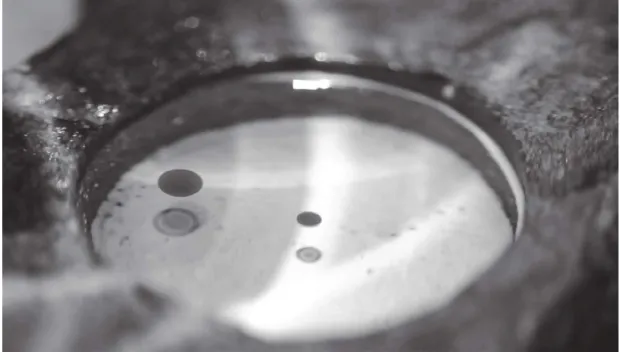
In our first prototype of the alien mini-planet, we
simulated the conditions of an environment devoid of
water and oxygen with liquid formamide. Using this
sub-stance as a solvent, we found that mixtures of
non-ter-restrial hydrocarbons spontaneously generate soft
bod-ies. Depending on their composition, these molecules
self-assemble and produce round-shaped aggregations
of about 0.5–30 mm in diameter.
Moreover, we found that the internal state of these
soft bodies can be affected by their interaction with other
non-terrestrial organics. When heterogeneous mixtures
produced complex organic compounds (Bernstein et al,
1995; Gerakines et al, 2000) as well as self-assembled
structures that resemble cellular structures (Dworkin et
al, 2001).
Although we do not have formal scientific
back-grounds in astrobiology, our artistic activity was
con-ducted in research laboratories that specialize in this
field. We investigated the outer space conditions
neces-sary to synthesize and work with ETOM. Our initial
ob-jective was to simulate the dusty and gaseous
environ-ments that surround protostars to synthetize
extraterrestrial organics. However, large amounts of
synthetic ETOM cannot be obtained easily and due to the
COVID-19 pandemic our experiments in different
labo-ratories in Japan were cancelled. Thus, we used chemical
reagents as analogs for ETOM. In parallel, we started
working on the construction of a non-terrestrial,
water-less, miniature environment. One of the objectives of the
Proto-A project was to build an alien mini-planet in which
material systems composed of ETOM could act and be
sustained while being showed in public spaces.
3. Non-terrestrial organic analogs
Recent discoveries have led astrobiologists to
be-lieve that planets and moons with water are the most
fa-vorable places for alien life to exist in the cosmos.
Euro-pa, the smallest of the Galilean moons of Jupiter, for
example, is thought to contain a salty ocean hidden
be-neath its surface. Researchers believe that this ocean is
rich in dissolved ions, mainly sodium, potassium,
mag-nesium and chlorine. In our planet, life thrives in
ion-rich solutions, thus there is a good probability that this
moon might have some kinds of organisms. However,
these may not be the only conditions under which ‘weird
life’ (Baross et al. 2007: 8) or active material assemblages
could evolve in the universe. Alien life might use as their
material basis compounds other than deoxyribonucleic
acid and fats, for example, or they might exploit liquid
methane or ammonia as a solvent.
In the Proto-A project, we focused as a first approach
on formamide (HCONH
2), a substance ubiquitous in the
universe. Formamide is formed under extreme
condi-tions via photolysis and the energetic processing of
in-terstellar ices with high-energy protons. It has been
de-tected in the long period comet Hale-Bopp, around young
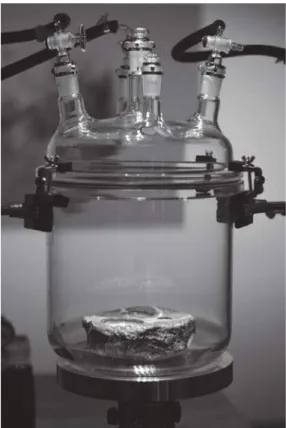
Figure 1. Image of the formamide mini-planet at the Art-Theque gallery of Tama Art University.
Non-terrestrial, kinetic and autonomous agents
1. Introduction
Formata are non-terrestrial, kinetic and autonomous
agents. They are the world’s first proto-aliens and the
first work of art to be created with extraterrestrial
organ-ic analogs. The work is the outcome of a three-year
re-search collaboration at the intersection of media art,
chemistry and astrobiology entitled the Proto-Alien Project
(Proto-A). These entities deform, actively move and
self-divide in a miniature environment devoid of water
with pools of liquid formamide and an atmosphere filled
with carbon monoxide, argon and ammonia gases.
For-mata premiered on 17 December 2020 at the Art-Theque
gallery of Tama Art University in Tokyo, Japan. During
the exhibition of this artwork, visitors were able to watch
and experience the alien mini-planet with the active
agents in real time.
In order to materialize these autonomous “others”,
the Proto-A team first had to address how to synthesize
and use extraterrestrial organic matter (ETOM) to create
active material assemblages. On accomplishing this
ob-jective, they had to decide on what type of substances
should generate the agents and how would they operate?
Finally, they had to resolve how these alien agents could
be sustained while being exhibited in public spaces?
Ad-dressing each of these issues informed the direction for
each stage of the artwork which ended in the creation of a
non-terrestrial, waterless, miniature environment for
public display. This paper traces the development of this
hybrid installation, highlighting its background,
non-terrestrial substances, design of the mini-planet
and finally an overview of the premiere exhibition.
2. Background
The Proto-A project is a laboratory of ideas and
exper-iments at the intersection of astrobiology, chemistry and
media art exploring the intermingling of non-human
agency, degrees of aliveness and alien life. It is a
collabo-rative research project with artist Akihiro Kubota at
Tama Art University and scientist Taro Toyota at The
University of Tokyo. We built the Proto-A project upon
past artistic work using protocells and satellites –
sys-tems we have employed to carry out experimental art at
the micro and macro scales. Through these systems, we
have explored the boundaries between life and non-life,
wet artificial life, extraterrestrial communication and
deep space.
In the Proto-A project, we investigate the synthesis
and use of ETOM as an active medium for artistic
expres-sion. By ‘active medium’, we mean (1) the aims of our
in-vestigations are: the morphogenetic tendencies, the
abil-ity to self-assemble and the non-linear behavior of
non-terrestrial organics; and (2) we are attempting to
grow soft, kinetic and intelligent agents using such
sub-stances. In 2018, this project was awarded a research
grant from the Japan Society for the Promotion of Science
that resulted in three years of investigation toward
For-mata.
At first, we embarked on intensive research into
non-terrestrial organics inspired by the intricate
sub-stances found within meteorites. The presence of
com-plex organic compounds in outer space suggest that these
materials could have been delivered to the early Earth
and could have contributed to the origin of life. Analysis
of organic crusts extracted from carbonaceous
chon-drites, for instance, has demonstrated the presence of
amphiphilic molecules that form vesicle structures
(Yuen et al. 1984; Deamer 1985), non-polar substances
that form droplets (Krishnamurthy et al. 1992; Monnard
et al 2002;) and amino acids (Pizzarello et al. 2003;
Mar-tins et al. 2007), among others. On the other hand,
simu-lation of ultraviolet irradiation of interstellar ices
(con-taining water, methanol, carbon monoxide and ammonia)
Non-terrestrial, kinetic and autonomous agents
CASTRO Juan Manuel
Keywords Bio Art, Extraterrestrial Organic Matter, Material Agency, Alien Life
Research
stellar objects (W33A, IRAS 16293), in galactic centers
(Sgr A and Sgr B) and in the interstellar medium. But
be-sides its abundance and diffusion in the cosmos, our
main interest in formamide lied in its fluid and versatile
nature. This substance is liquid under a wide range of
temperatures. This property makes it particularly suited
for its concentration in high-temperature or desert-like
environments. The existence of formamide reservoirs
opens, thus, the intriguing probability of
non-water-based metabolisms and waterless active worlds
else-where in the universe.
In our first prototype of the alien mini-planet, we
simulated the conditions of an environment devoid of
water and oxygen with liquid formamide. Using this
sub-stance as a solvent, we found that mixtures of
non-ter-restrial hydrocarbons spontaneously generate soft
bod-ies. Depending on their composition, these molecules
self-assemble and produce round-shaped aggregations
of about 0.5–30 mm in diameter.
Moreover, we found that the internal state of these
soft bodies can be affected by their interaction with other
non-terrestrial organics. When heterogeneous mixtures
produced complex organic compounds (Bernstein et al,
1995; Gerakines et al, 2000) as well as self-assembled
structures that resemble cellular structures (Dworkin et
al, 2001).
Although we do not have formal scientific
back-grounds in astrobiology, our artistic activity was
con-ducted in research laboratories that specialize in this
field. We investigated the outer space conditions
neces-sary to synthesize and work with ETOM. Our initial
ob-jective was to simulate the dusty and gaseous
environ-ments that surround protostars to synthetize
extraterrestrial organics. However, large amounts of
synthetic ETOM cannot be obtained easily and due to the
COVID-19 pandemic our experiments in different
labo-ratories in Japan were cancelled. Thus, we used chemical
reagents as analogs for ETOM. In parallel, we started
working on the construction of a non-terrestrial,
water-less, miniature environment. One of the objectives of the
Proto-A project was to build an alien mini-planet in which
material systems composed of ETOM could act and be
sustained while being showed in public spaces.
3. Non-terrestrial organic analogs
Recent discoveries have led astrobiologists to
be-lieve that planets and moons with water are the most
fa-vorable places for alien life to exist in the cosmos.
Euro-pa, the smallest of the Galilean moons of Jupiter, for
example, is thought to contain a salty ocean hidden
be-neath its surface. Researchers believe that this ocean is
rich in dissolved ions, mainly sodium, potassium,
mag-nesium and chlorine. In our planet, life thrives in
ion-rich solutions, thus there is a good probability that this
moon might have some kinds of organisms. However,
these may not be the only conditions under which ‘weird
life’ (Baross et al. 2007: 8) or active material assemblages
could evolve in the universe. Alien life might use as their
material basis compounds other than deoxyribonucleic
acid and fats, for example, or they might exploit liquid
methane or ammonia as a solvent.
In the Proto-A project, we focused as a first approach
on formamide (HCONH
2), a substance ubiquitous in the
universe. Formamide is formed under extreme
condi-tions via photolysis and the energetic processing of
in-terstellar ices with high-energy protons. It has been
de-tected in the long period comet Hale-Bopp, around young
Figure 1. Image of the formamide mini-planet at the Art-Theque gallery of Tama Art University.
to-aliens that contained multiple features and was robust
and modular in design.
The premiere of Formata took place on 17 December
2020 at the Art-Theque gallery of Tama Art University,
Tokyo, Japan. During the exhibition of this artwork,
vis-itors were able to watch and experience the formamide
mini-planet as well as the physical transformation and
dynamic behavior of the agents in real time. For reasons
of safety, ammonia was not used in the gallery and carbon
monoxide was replaced by carbon dioxide.
For the Proto-A team it was important that the
audi-ence experiaudi-enced how the alien aggregations become
op-erative and autonomous in a non-terrestrial
environ-ment. The intention was to reveal how their ability to act
is rooted in their materiality, without the need for
genet-ic information or complex mechanisms. An embedded
protometabolism, the capability to deform, move and
self-divide are all present within these aggregations in
the form of compositional agency.
With all the challenges and impediments posed by
the COVID-19 pandemic and the complexity of Formata, it
was nothing short of a miracle that the Proto-A team
ac-complished and exhibited the artwork. The exhibition
was not only successful but went beyond the expectations
of the team.
of non-polar molecules and amphiphilic substances are
included in the solution the blobs deform and actively
move and self-divide. Establishing and optimizing the
protocols to allow the formation of these alien material
assemblages in liquid formamide, so that they were
ac-tive enough to become non-equilibrium entities and act
for several hours, was one of the major challenges of this
artwork. Scientific papers or protocols describing such
non-terrestrial material systems could not be found,
which led to a extensive process of trial and error.
4. Formamide mini-planet
In this hybrid installation, the sculptural object that
shelters the proto-aliens is a planetary-simulation
chamber: a high-vacuum, high-pressure/temperature
reactor capable of reproducing atmospheric
composi-tions and surface temperatures of most planetary
ob-jects. To simulate the atmosphere of a formamide planet
in this chamber, carbon monoxide, ammonia and argon
gases are mixed and constantly monitored with sensors.
Likewise, the temperature of a small rock with
forma-mide pools is regulated by a heater between 50°C to 80
°C. The chamber was designed to make the activity of the
alien aggregations visible 360 degrees, while at the same
time being a functional instrument. A great amount of
time was spent designing a suitable reactor for the
pro-Figure 2. Image of the non-terrestrial, kinetic and autonomous agents in liquid formamide.
we perceive and relate to materials and objects. It
in-volves embracing the morphogenetic tendencies,
non-linear logic and active behavior of matter,
regard-less of its structural identity and place in the universe.
We live in a time when our understanding of life is
changing rapidly, when the discovery of new extrasolar
planets and moons is accelerating, and when
fundamen-tally new macro and micro-scale insights are changing
our view of humanity and life on Earth. This artwork
aims, thus, to contribute to new means of encountering
and understanding non-human materiality, the ‘other’
and alien life.
5. Alien performativity
In this work, alienness and the perception that these
agents are not yet living but already more or less alive
confronted visitors in multiple ways. By way of material
actions that become operative, autonomous and
con-struct reality these soft agents become performative
rather than figurative. This physical encounter between
the audience and alien material assemblages is critical to
our project. ETOM helps us to materialize the ‘other’ and
the unknown, but also to reassess our place in an active
universe. That alien matter can be experienced as
per-formative can not only help us understand how matter
it-self behaves, but also allow us to rethink the basis for how
References:
1. Yuen, G. U. & Kvenvolden, K. A. Monocarboxylic acids in Murray and Murchison carbonaceous meterorites. Nature
246, 301–303 (1973)
2. Deamer, D. W. Boundary structures are formed by organic components of the Murchison carbonaceous chondrite.
Nature 317, 792–794 (1985)
3. Krishnamurthy, R. V., Epstein, S., Cronin, J. R., Pizzarello, S. & Yuen, G. U. Isotopic and molecular analyses of
hydro-carbons and monocarboxylic acids of the Murchison meteorite. Geochim. Cosmochim. Acta 56, 4045–4058 (1992)
4. Monnard, P.-E. & Deamer, D. W. Membrane selfassembly processes: steps toward the first cellular life. Anat. Rec. 268,
196–207 (2002)
5. Pizzarello S, Huang Y. Carbon isotopic analyses of individual Murchison amino acids. Geochim Cosmochim Acta
Suppl. 2003; 67:380.
6. Martins Z, Alexander CMO’D, Orzechowska GE, Fogel ML, Ehrenfreund P. Indigenous amino acids in primitive CR
meteorites. Meteor Planet Sci. 2007; 42:2125–2136.
7. Bernstein, M. P., Sandford, S. A., Allamandola, L. J., Chang, S. & Scharberg, M. A. Organic compounds produced by
photolysis of realistic interstellar and cometary ice analogs containing methanol. Astrophys. J.454, 327–344 (1995)
8. Gerakines, P. A., Moore, M. H. & Hudson, R. L. Energetic processing of laboratory ice analogs: UV photolysis versus
ion bombardment. J. Geophys. Res. 106, 33381–33385 (2000)
9. Dworkin, J. P., Deamer, D. W., Sandford, S. A. & Allamandola, L. J. Self-assembling amphiphilic molecules: synthesis
in simulated interstellar/precometary ices. Proc. Natl Acad. Sci. USA 98, 815–819 (2001)
10. Baross, John A., Benner, Steven A., Cody, George D., Copley, Shelley D., Pace, Norman R., Scott, James H., Shapiro,
Robert, Sogin, Mitchell L., Stein, Jeffrey L., Summons, Roger and Szostak, Jack W. (2007) The Limits of Organic Life
in Planetary Systems, Washington, D.C.: National Academies Press.
Non-terrestrial, kinetic and autonomous agents
to-aliens that contained multiple features and was robust
and modular in design.
The premiere of Formata took place on 17 December
2020 at the Art-Theque gallery of Tama Art University,
Tokyo, Japan. During the exhibition of this artwork,
vis-itors were able to watch and experience the formamide
mini-planet as well as the physical transformation and
dynamic behavior of the agents in real time. For reasons
of safety, ammonia was not used in the gallery and carbon
monoxide was replaced by carbon dioxide.
For the Proto-A team it was important that the
audi-ence experiaudi-enced how the alien aggregations become
op-erative and autonomous in a non-terrestrial
environ-ment. The intention was to reveal how their ability to act
is rooted in their materiality, without the need for
genet-ic information or complex mechanisms. An embedded
protometabolism, the capability to deform, move and
self-divide are all present within these aggregations in
the form of compositional agency.
With all the challenges and impediments posed by
the COVID-19 pandemic and the complexity of Formata, it
was nothing short of a miracle that the Proto-A team
ac-complished and exhibited the artwork. The exhibition
was not only successful but went beyond the expectations
of the team.
of non-polar molecules and amphiphilic substances are
included in the solution the blobs deform and actively
move and self-divide. Establishing and optimizing the
protocols to allow the formation of these alien material
assemblages in liquid formamide, so that they were
ac-tive enough to become non-equilibrium entities and act
for several hours, was one of the major challenges of this
artwork. Scientific papers or protocols describing such
non-terrestrial material systems could not be found,
which led to a extensive process of trial and error.
4. Formamide mini-planet
In this hybrid installation, the sculptural object that
shelters the proto-aliens is a planetary-simulation
chamber: a high-vacuum, high-pressure/temperature
reactor capable of reproducing atmospheric
composi-tions and surface temperatures of most planetary
ob-jects. To simulate the atmosphere of a formamide planet
in this chamber, carbon monoxide, ammonia and argon
gases are mixed and constantly monitored with sensors.
Likewise, the temperature of a small rock with
forma-mide pools is regulated by a heater between 50°C to 80
°C. The chamber was designed to make the activity of the
alien aggregations visible 360 degrees, while at the same
time being a functional instrument. A great amount of
time was spent designing a suitable reactor for the
pro-Figure 2. Image of the non-terrestrial, kinetic and autonomous agents in liquid formamide.
we perceive and relate to materials and objects. It
in-volves embracing the morphogenetic tendencies,
non-linear logic and active behavior of matter,
regard-less of its structural identity and place in the universe.
We live in a time when our understanding of life is
changing rapidly, when the discovery of new extrasolar
planets and moons is accelerating, and when
fundamen-tally new macro and micro-scale insights are changing
our view of humanity and life on Earth. This artwork
aims, thus, to contribute to new means of encountering
and understanding non-human materiality, the ‘other’
and alien life.
5. Alien performativity
In this work, alienness and the perception that these
agents are not yet living but already more or less alive
confronted visitors in multiple ways. By way of material
actions that become operative, autonomous and
con-struct reality these soft agents become performative
rather than figurative. This physical encounter between
the audience and alien material assemblages is critical to
our project. ETOM helps us to materialize the ‘other’ and
the unknown, but also to reassess our place in an active
universe. That alien matter can be experienced as
per-formative can not only help us understand how matter
it-self behaves, but also allow us to rethink the basis for how
References:
1. Yuen, G. U. & Kvenvolden, K. A. Monocarboxylic acids in Murray and Murchison carbonaceous meterorites. Nature
246, 301–303 (1973)
2. Deamer, D. W. Boundary structures are formed by organic components of the Murchison carbonaceous chondrite.
Nature 317, 792–794 (1985)
3. Krishnamurthy, R. V., Epstein, S., Cronin, J. R., Pizzarello, S. & Yuen, G. U. Isotopic and molecular analyses of
hydro-carbons and monocarboxylic acids of the Murchison meteorite. Geochim. Cosmochim. Acta 56, 4045–4058 (1992)
4. Monnard, P.-E. & Deamer, D. W. Membrane selfassembly processes: steps toward the first cellular life. Anat. Rec. 268,
196–207 (2002)
5. Pizzarello S, Huang Y. Carbon isotopic analyses of individual Murchison amino acids. Geochim Cosmochim Acta
Suppl. 2003; 67:380.
6. Martins Z, Alexander CMO’D, Orzechowska GE, Fogel ML, Ehrenfreund P. Indigenous amino acids in primitive CR
meteorites. Meteor Planet Sci. 2007; 42:2125–2136.
7. Bernstein, M. P., Sandford, S. A., Allamandola, L. J., Chang, S. & Scharberg, M. A. Organic compounds produced by
photolysis of realistic interstellar and cometary ice analogs containing methanol. Astrophys. J.454, 327–344 (1995)
8. Gerakines, P. A., Moore, M. H. & Hudson, R. L. Energetic processing of laboratory ice analogs: UV photolysis versus
ion bombardment. J. Geophys. Res. 106, 33381–33385 (2000)
9. Dworkin, J. P., Deamer, D. W., Sandford, S. A. & Allamandola, L. J. Self-assembling amphiphilic molecules: synthesis
in simulated interstellar/precometary ices. Proc. Natl Acad. Sci. USA 98, 815–819 (2001)
10. Baross, John A., Benner, Steven A., Cody, George D., Copley, Shelley D., Pace, Norman R., Scott, James H., Shapiro,
Robert, Sogin, Mitchell L., Stein, Jeffrey L., Summons, Roger and Szostak, Jack W. (2007) The Limits of Organic Life
in Planetary Systems, Washington, D.C.: National Academies Press.
Formata are non-terrestrial, kinetic and autonomous agents. They are the result
of a three-year research collaboration at the intersection of media art, chemistry and
astrobiology entitled the Proto-Alien Project. These agents deform, actively move and
self-divide in a miniature environment devoid of water with pools of liquid
forma-mide and an atmosphere filled with carbon monoxide, argon and ammonia gases. A
self-assembled body, an embedded protometabolism and the capability to act are all
present within these agents in the form of compositional agency. This report
intro-duces this hybrid installation highlighting its background, non-terrestrial
sub-stances, design of the alien mini-planet and premiere exhibition.
Non-terrestrial, kinetic and autonomous agents
Abstract
COVID-19
下での
NxPC.Lab
の音楽イベントの試み
E x p e r i m e n t s o n Mu s i c L i v e a t Nx P C . L a b u n d e r C O V I D - 1 9
平林真実
HIRABAYASHI Masami
キーワード
COVID-19
,NxPC.Lab
,音楽イベント,AudioVisual
,体験拡張Keywords
CODIV-19
,NxPC.Lab
,MusicLive
,AudioVisual
,enhancedexperiences
1
はじめに 本稿では、COVID-19
影響下におけるNxPC.Lab
1の活動に ついて報告する。2020
年3
月に入り、大規模なイベントが次々と中止になっ ていく中、3
月20
日に東京渋谷のCircus Tokyo
で予定してい たNxPC.Live 10
周年は、何名かの出演者には断られつつも、 ぎりぎりのタイミングで実施することができた。その直後か らほとんどのイベントが中止され、4
月に入り緊急事態宣言 が発せられることとなった。その後は、通常のイベントスケ ジュールを大幅に変更し、完全オンラインイベント、VR
空間 を会場としたイベント、無観客イベントと状況に応じた複数 の形態で音楽イベントを実施してきた。NxPC.Lab
は、テクノジローによる音楽体験の拡張を目的 として、音楽イベントの実施による実践的な研究の展開が特 徴となっている。音楽会場という現場を中心に体験を拡張し ていくことを重要視している。そのため音楽会場という空間 はとても大切なものであり、会場を起点としてインターネッ トや拡張/仮想空間へ広げていくことで体験拡張を目指して いる。2010
年の活動当初よりほとんどのイベントでライブ配 信を行うなど、ネットワーク及びネットワーク上の人々やコ ミュニティを意識した活動を行ってきたが、基本となる会場 があることが前提だった。リアルな会場空間を失うことは大 きな損失ではあった。しかし、同時にこのような状況だから こそできる、これまで考えることが無かったことに改めて気 付かされ、敢えてやってこなかったがやる価値のある様々な 試みを行う貴重な機会とすることができたと考えている。2 COVID-19
によるイベント実施における変化2020
年3
月以降、行く予定だった音楽ライブは全て中止に なり、学会等も急遽オンライン開催となった。オンライン開 催となった情報処理学会のインタラクション2020
は、見せ る側も見る側も慣れていなかったこともあったが、VR/MR/
AR
といったXR
系のデモをオンラインで見せることの難しさ を感じさせるものだった。体験拡張環境プロジェクトのよう なインタラクティブなものやXR
系をオンラインで見せるこ とは、本来の体験とは違う確認に近い行為になってしまう。 音楽ライブにおいても、スクリーンでみるライブと会場でみ るライブは本来違う体験だと言わざるを得ない。 実会場の記憶があるがために、スクリーンでみるライブか ら実際の会場の感覚を思い起こすことはできるが、それは物 足りなく、余計に実ライブに行きたいという感情をもたらす。COVID-19
による世界の変化は、そのような状況に諦めを付 けさせる出来事であった。割り切った上で何ができるのか、 多くの試みがなされることとなった。無観客ならでは自由な ステージ構成、特に映像演出においては、配信を前提とする ことで実会場では不可能な演出が可能となり、まさにXR
技 術の適用が著しく進展した。会場での演奏者に映像を重畳し た表現は、実ライブにおいても巨大なLED
スクリーンで表現 されることはあったが、あくまで実際の演者が居る後ろに演 出としてのものであった。オンラインライブでは演者を追う カメラワークと連動したAR
空間として構成された会場構成 がなされ、ステージと照明効果、AR
による空間の重畳が一 体化されたものが多く見られた。無観客であることはステー ジ構成の大幅な自由度を与えた。これらの例としては、サカ ナクションや欅坂46
ライブでのホールの広い空間に複数のス テージを用意し曲に合わせて移動しながらライブが進むも の、BACKSPACE Production
らのChausie
2のようなリアルタイム
XR
システムを使ったライブ、また、スマートフォンの活動レポート
1 NxPC.Lab: https:nxpclab.info
Non-terrestrial, kinetic and autonomous agents
Formata are non-terrestrial, kinetic and autonomous agents. They are the result
of a three-year research collaboration at the intersection of media art, chemistry and
astrobiology entitled the Proto-Alien Project. These agents deform, actively move and
self-divide in a miniature environment devoid of water with pools of liquid
forma-mide and an atmosphere filled with carbon monoxide, argon and ammonia gases. A
self-assembled body, an embedded protometabolism and the capability to act are all
present within these agents in the form of compositional agency. This report
intro-duces this hybrid installation highlighting its background, non-terrestrial
sub-stances, design of the alien mini-planet and premiere exhibition.
Non-terrestrial, kinetic and autonomous agents
Abstract
COVID-19
下での
NxPC.Lab
の音楽イベントの試み
E x p e r i m e n t s o n Mu s i c L i v e a t Nx P C . L a b u n d e r C O V I D - 1 9
平林真実
HIRABAYASHI Masami
キーワード
COVID-19
,NxPC.Lab
,音楽イベント,AudioVisual
,体験拡張Keywords CODIV-19
,NxPC.Lab
,Music Live
,AudioVisual
,enhanced experiences
1
はじめに 本稿では、COVID-19
影響下におけるNxPC.Lab
1の活動に ついて報告する。2020
年3
月に入り、大規模なイベントが次々と中止になっ ていく中、3
月20
日に東京渋谷のCircus Tokyo
で予定してい たNxPC.Live 10
周年は、何名かの出演者には断られつつも、 ぎりぎりのタイミングで実施することができた。その直後か らほとんどのイベントが中止され、4
月に入り緊急事態宣言 が発せられることとなった。その後は、通常のイベントスケ ジュールを大幅に変更し、完全オンラインイベント、VR
空間 を会場としたイベント、無観客イベントと状況に応じた複数 の形態で音楽イベントを実施してきた。NxPC.Lab
は、テクノジローによる音楽体験の拡張を目的 として、音楽イベントの実施による実践的な研究の展開が特 徴となっている。音楽会場という現場を中心に体験を拡張し ていくことを重要視している。そのため音楽会場という空間 はとても大切なものであり、会場を起点としてインターネッ トや拡張/仮想空間へ広げていくことで体験拡張を目指して いる。2010
年の活動当初よりほとんどのイベントでライブ配 信を行うなど、ネットワーク及びネットワーク上の人々やコ ミュニティを意識した活動を行ってきたが、基本となる会場 があることが前提だった。リアルな会場空間を失うことは大 きな損失ではあった。しかし、同時にこのような状況だから こそできる、これまで考えることが無かったことに改めて気 付かされ、敢えてやってこなかったがやる価値のある様々な 試みを行う貴重な機会とすることができたと考えている。2 COVID-19
によるイベント実施における変化2020
年3
月以降、行く予定だった音楽ライブは全て中止に なり、学会等も急遽オンライン開催となった。オンライン開 催となった情報処理学会のインタラクション2020
は、見せ る側も見る側も慣れていなかったこともあったが、VR/MR/
AR
といったXR
系のデモをオンラインで見せることの難しさ を感じさせるものだった。体験拡張環境プロジェクトのよう なインタラクティブなものやXR
系をオンラインで見せるこ とは、本来の体験とは違う確認に近い行為になってしまう。 音楽ライブにおいても、スクリーンでみるライブと会場でみ るライブは本来違う体験だと言わざるを得ない。 実会場の記憶があるがために、スクリーンでみるライブか ら実際の会場の感覚を思い起こすことはできるが、それは物 足りなく、余計に実ライブに行きたいという感情をもたらす。COVID-19
による世界の変化は、そのような状況に諦めを付 けさせる出来事であった。割り切った上で何ができるのか、 多くの試みがなされることとなった。無観客ならでは自由な ステージ構成、特に映像演出においては、配信を前提とする ことで実会場では不可能な演出が可能となり、まさにXR
技 術の適用が著しく進展した。会場での演奏者に映像を重畳し た表現は、実ライブにおいても巨大なLED
スクリーンで表現 されることはあったが、あくまで実際の演者が居る後ろに演 出としてのものであった。オンラインライブでは演者を追う カメラワークと連動したAR
空間として構成された会場構成 がなされ、ステージと照明効果、AR
による空間の重畳が一 体化されたものが多く見られた。無観客であることはステー ジ構成の大幅な自由度を与えた。これらの例としては、サカ ナクションや欅坂46
ライブでのホールの広い空間に複数のス テージを用意し曲に合わせて移動しながらライブが進むも の、BACKSPACE Production
らのChausie
2のようなリアルタイム
XR
システムを使ったライブ、また、スマートフォンの活動レポート
1 NxPC.Lab: https:nxpclab.info