The Influential Factors of Opinion Leaders
towards Consumers' Purchase Intention in
Virtual Communities of Consumption
著者
Wang Yu
journal or
publication title
THE KEIZAI GAKU (Annual report of the Economic
Society, Tohoku University)
volume
76
number
1
page range
237-257
year
2017-08-31
The Keizai Gaku, Annual Report of the Economic Society, Tohoku University
Vol. 76 No. 1 March 2018
The Influential Factors of Opinion Leaders towards
Consumers’ Purchase Intention in Virtual
Communities of Consumption
Yu Wang
*Abstract
This article investigates the influential factors of opinion leaders on consumers’ purchase intention in the virtual communities of consumption. The variables of opinion leaders, of consumer and two intermediators are integrated into the original Information Adoption Model. The study uses Structural Equation Modeling to evaluate 347 valid answers of questionnaires. The results show that three variables of opinion leaders, including message quality, source credibility and tie strength with receivers, significantly affect consumers’ purchase intention. Meanwhile, the results confirmed that the variables of consumers, including confirmation with prior belief and trust towards the site, affect their purchase intention. Also, the findings indicate that perceived risk, negatively affected by trust towards the site, has a negative influence on information adoption directly and via perceived usefulness of information (PU) indirectly. Furthermore, the message credibility, which is affected by confirmation with prior belief and other variables of opinion leaders, also affect information adoption directly and indirectly via PU. Consequently, this study can provide a foundation for future researches. Key words : electronic Word of mouth (eWOM), opinion leaders, Information Adoption Model (IAM), consumers’
purchase virtual communities of consumption
* Doctoral Program, Graduate School of Economics and Management, Tohoku University The author is grateful to Prof. Seiichi Ohtaki at Tohoku University
Introduction
Electronic word of mouth (eWOM) has long been considered to play an imperative role in shaping consumers’ attitudes and behaviors in different platforms (Bickart & Schindler, 2001 ; Cheung & Thadani, 2012 ; Wang et al., 2012). The eWOM communication is a major part of online communication among individuals, especially within the virtual communities which are developing quickly and become increasingly popular (Brown, 2007). Because of information access and interactions in the virtual communities, individuals are able to share information, build relationships with others and even make transaction (Kozinets et al., 1999 ; Zhang & Watts, 2008). Inside such kind of social network, opinion leaders who used to filter and share the real valuable WOM to their offline followers begin to exert their
influences online. Previous studies have confirmed that opinion leaders play an important role in providing information to other consumers in the offline context (Flynn, 1996). Nowadays, the online communities have brought a new perspective for researchers to study how opinion leaders use eWOM to affect other individuals.
To study how eWOM affects consumers, Information Adoption Model (IAM), proposed by Sussman et al. (2003), explains the influence of message on consumers’ information adoption process and is widely used in the studies about website (Mcknight & Kacmar, 2007), online community (Christy, Matthew & Neil, 2008), social network (Jin et al., 2009) and eWOM (Christy, Matthew & Neil, 2008 ; Chen, Chen & Hsu, 2011). However, IAM and its relevant applications mainly focus on the influence of the message itself. Communication is a process of which individuals transmit stimuli to modify the behavior of oth-ers (Hovland, Janis & Kelley, 1953) and thus when studying how eWOM from opinion leadoth-ers affects con-sumers, the characteristics of the message senders and receivers should be evaluated together with messages.
Furthermore, many existing researches suggest that perceived risk inhibits consumers’ information adoption process online (Featherman, 2001 ; Pavlou & Featherman, 2003). By including the measurement of negative utility into the existing model which only measuring the positive utility, the scope of the extended model can be enlarged. Hence, in the context of the online community, the negative influence of perceived risk is also need to be added into the model.
Consequently, based on the IAM, this study developed an extended model to investigate the influential factors of opinion leaders towards the consumers’ purchase intention in virtual communities of consumption. Three variables of opinion leaders, including message quality, source credibility, tie strength, and variables of consumers, including trust towards the site, confirmation with prior belief, recommendation consistency, message credibility and perceived risk, are integrated to the original IAM.
The findings can provide theoretical implications to relevant literatures through the presented model and managerial implications for companies to have deeper understandings of the influence of opinion leaders towards consumers’ purchase intention in the virtual communities of consumption and of the question on how to utilize or cultivate opinion leaders.
Literature review
WOM and e-WOM
Word-of-mouth (WOM) communication has received extensive attentions from both academics and
practitioners for decades (De Bruyn & Lilien, 2004). It refers to the oral communication between a receiver and a communicator and the receiver perceives the information as non-commercial and
concerning a brand, a product, or a service (Arndt, 1967).
It is widely accepted that WOM communication plays an imperative role in shaping consumers’ attitudes and behaviors (Brown & Reingen, 1987) and that WOM has a greater influence on consumer behavior than print advertisements, personal selling, and radio advertising in certain circumstances (Engel, Blackwell & Kegerreis, 1969 ; Katz & Lazarsfeld, 1955).
The consumer influence through WOM communication is further accelerated with the advent of the Internet, by terms of electronic word-of-mouth (eWOM). It refers to any positive or negative statement
made by potential, actual, or former consumers about a product or a company, and the statement is made available to a multitude of people and institutions via the Internet (Hennig-Thurau et al., 2004).
Virtual Communities of Consumption
Virtual communities refers to the “social aggregations that emerge from the Internet when enough people carry on those public discussions long enough, with sufficient human feeling, to form webs of per-sonal relationships in cyberspace” (Rheingold, 1993).
According to previous researches, the most well-known typology of virtual communities is
illustrated by Hagel & Armstrong (1997) who classify virtual communities into four types, including virtual communities of interest, of relationship, of fantasy and of consumption. Here, virtual communities of consumption refer to the virtual communities which focus on facilitating consumption, serve to some kinds of commercial purposes, and encourage participants to communicate and interact with others so as to make a deal (Hagel & Armstrong, 1997).
Opinion Leader
The concept of opinion leader was first introduced by Lazarsfeld & Katz, when they theoretically introduced the Two-step Flow of Communication in 1940s. It is mentioned that the central and
influential individuals act as the intermediaries between the mass media and the public : they obtain information from the mass media and further pass it to the public by strengthening or weakening it to some degree.
To be more specific, opinion leaders actively acquire and accept the information disseminated by the mass media, process and transmit them, while most of the public rely mainly on the interpersonal interaction with the opinion leaders to get information so as to guide their own actions. Here, as a medium of information, opinion leaders have crucial influences on the public.
Obviously, the Two-step Flow of Communication emphasizes the influence of opinion leaders
towards the attitudes of the wider population, and stresses the fact that the influence of interpersonal communication towards the public is more frequent and more effective than the influence of the mass communication towards the same audience.
Because of the Internet, online opinion leaders appear. They are quite similar to traditional opinion leaders, except for the fact that online opinion leaders exert their influence towards others through the Internet.
Information Adoption Model (IAM)
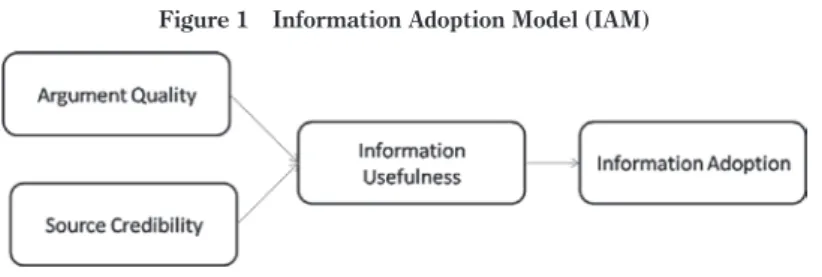
Information Adoption Model(IAM), proposed by Sussman et al. (2003), is a widely used model for examining how individuals adopt information into their intentions and behaviors within the computer
-mediated communication platforms (see Figure 1).
models of informational influence (e.g. Elaboration Likelihood Model). On one hand, TAM is used to explain users’ acceptance of information systems and technology. It can both explain the determinants of computer acceptance by measuring their intentions, and explain their intentions by their attitudes, subjective norms, perceived usefulness, perceived ease of use and external variables. One the other hand, Elaboration Likelihood Model (ELM), which serves as an example of dual process theory and which is introduced by Petty & Cacioppo (1986), is used to describe the change of attitudes form and to explain the processes underlying the effectiveness of persuasive communication. According to ELM, informational influence can occur at any degree of receiver elaboration, but the results depend on the different influence routes, which include a central route and a peripheral route. The central route results from individuals’ careful consideration of the true merits of the information and results in a high level of elaboration, while the peripheral route results from simple cues related to the information, without carefully thinking of the merits of it, and results in a low level of elaboration.
While TAM can explain the first steps on why receiver have intentions to adopt the information, ELM are useful to explain how the receivers are affected by the information within the message. Hence, Sussman et al. (2003) integrates them together and uses the argument quality as the central route, the source quality as the peripheral route, the perceived information usefulness as a mediator. Structure and hypotheses
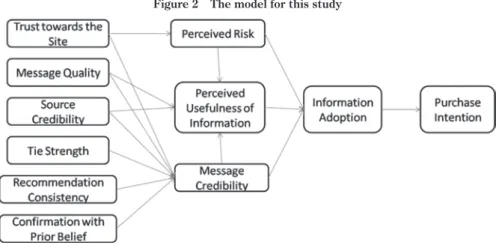
Figure 2 depicts the model used in this study.
The hypotheses of this model are explained in the following.
1) Trust towards the Site (T)
Previous researches emphasize the importance of online trust which serves as a driver for e-
com-merce adoption (McKnight, Choudhury & Kacmar, 2002a, 2002b). An online consumer’s trust is defined as consumer’s subjective beliefs that the selling entity will fulfill the transactional obligations as much as the consumer understand (Kim & Rao, 2008). The trust towards the site leads to a lower level of the perceived risk when individuals are shopping at the site, while this trust-antecedent ‘perceived risk’
neg-atively affects the attitude towards shopping online (Jarvenpaa, Tractinsky & Saarinen, 1999 ; Van der Merwe & Van Heerden, 2009).
On the other hand, individuals’ trust towards the site partly results in the credibility of the message
which they receive, because the websites are perceived as actors for individuals to interact with (Brown, Broderick & Lee, 2007 ; Cheng, 2011).
Consequently, in this study, the trust towards the site is defined as consumers’ subjective beliefs that the site will fulfill the transactional obligations as much as the consumer understand. And it follows that :
H1a : In the context of an online community, trust towards the site affects the perceived risk negatively.
H1b : In the context of an online community, trust towards the site affects the message credibility positively.
2) Message Quality (MQ)
The ELM indicates that strong arguments are logically sound and can yield favorable responses of the receivers, while weak arguments are skeptical and may lead to negative reactions (Petty & Cacioppo, 1981). The positive influence of message quality on perceived usefulness of information and on information adoption are confirmed by TAM and its application researches (Sussman et al., 2003 ; Mcknight & Kacmar, 2007 ; Christy, Matthew & Neil, 2008 ; Jin et al., 2009 ; Chen, Chen & Hsu, 2011). Additionally, the quality of message can be evaluated by its content, format, accuracy, ease of use, timeliness and so on (Doll & Torkzadeh, 1988).
Consequently, in this paper, the message quality is defined as the influential strength of the message from opinion leaders, and it includes the content, format, accuracy, ease of use, timeliness and so on. And it follows that :
H2a : In the context of an online community, message quality affects the consumers’ perceived usefulness of information positively.
H2b : In the context of an online community, message quality affects the message credibility positively.
3) Source Credibility (SC)
Source credibility refers to the receivers’ perceptions of the expertise and trustworthiness of the sources (Hovland et al., 1953 ; Sussman et al., 2003). The positive influences of source credibility on perceived usefulness of information and on the information adoption are confirmed by TAM and its application researches (Sussman et al., 2003 ; Mcknight & Kacmar, 2007 ; Christy, Matthew & Neil, 2008 ; Jin et al., 2009 ; Chen, Chen & Hsu, 2011).
Consequently, in this paper, the source credibility is defined as the extent to which consumer consider the information source (namely, the opinion leader) is competent and reliable. And it follows that :
H3a : In the context of an online community, source credibility affects the consumers’ perceived usefulness of information positively.
H3b : In the context of an online community, source credibility affects the message credibility positively.
4) Tie Strength (TS)
The theory of “the strength of weak ties”, proposed by Granovetter (1973), explain the difference between “weak tie” and the more intimate “strong tie” to characterize social networks. The “strength” of interpersonal ties is defined as a combination of time, emotional intensity, mutual confiding, and the reciprocal services. Individuals with strong ties always have greater trust to others and share more feelings and opinions ; and the information from these information senders is considered to be more credible by the receivers, when compared with that from senders who have weak ties with them (Brown & Reingen, 1987 ; Tsai & Ghoshal, 1998 ; Bansal & Voyer, 2000 ; Levin & Cross, 2004). Particularly, tie strength serves as an antecedent for process of consumers’ making purchase decision in virtual com-munities (Kozinets, 1999) and in the online peer communication (Smith et al., 2002 ; Wang et al., 2012).
Consequently, in this paper, the tie strength between opinion leaders and consumers is defined as the perceived tightness of the relationship between them. And it follows that :
H4 : In the context of an online community, tie strength affects the message credibility positively.
5) Recommendation Consistency (RC)
Recommendation consistency is defined as the extent to which the recommendation is consistent with other individuals’ experiences of the same product or service (Zhang & Watts, 2003). In an online community, with different eWOM concerning the same product or service but from different experienced individuals, consumers need to collect and compare the information. If the current recommendation from an opinion leader is highly consistent with opinions from others, the consumer is more likely to perceive this information as credible (Zhang & Watts, 2003). Previous researches also identify the significant influence of recommendation consistency towards information credibility in the online recommendation or online communities (Cheung et al., 2009 ; Chen, Chen & Hsu, 2011).
rec-ommendation from a certain opinion leader is consistent with other opinion leaders’ recrec-ommendations of the same product or service. And it follows that :
H5 : In the context of an online community, recommendation consistency affects the message credibility positively.
6) Confirmation with Prior Belief (C)
Confirmation with prior belief is defined as the level of confirmation/disconfirmation between consumers’ prior beliefs and the received information (Cheung et al., 2009). Prior beliefs affect the evaluations of to-be-acquired information (Zhang & Watts, 2003 ; Chen, Chen & Hsu, 2011). As in the
context of online communities, if the eWOM from opinion leaders confirms the consumers’ existing beliefs, the information will be considered as more credible by the consumers.
Consequently, in this paper, confirmation with prior belief is defined as the level of confirmation between consumers’ prior beliefs and the received information from opinion leaders. And it follows that :
H6 : In the context of an online community, confirmation with prior belief affects the message credibility positively.
7) Perceived Risk (PR)
The concept of “perceived risk” was introduced to the marketing field by Bauer (1960), who emphasizes that this kind of subjective risk (perceived risk) is different from objective risk (risk in the real world). Perceived risk refers to the risk of the consumers’ perceptions of the uncertainty and adverse consequences when they are going to purchase a product or service (Dowling & Staelin, 1994) or the consumers’ beliefs of the negative outcomes from e-commerce (Kim & Rao, 2008). Many empirical
evidence suggests that perceived risk inhibits perceived usefulness of information and information adop-tion (Fertherman, 2001 ; Pavlou & Featherman, 2003). Also, high perceived risk may force individuals to look for more information to judge the usefulness of information before making final decisions (Dowl-ing & Staelin, 1994 ; Cho & Lee, 2006 ; Andrew et al., 2014).
Consequently, in this paper, perceived risk is defined as the consumers’ perceptions of the uncertainty and adverse consequences when they are going to purchase a product or service online. And it follows that :
H7a : In the context of an online community, perceived risk affects the perceived usefulness of information negatively.
H7b : In the context of an online community, perceived risk affects the information adoption negatively.
8) Perceived Usefulness of Information (PU)
Perceived usefulness of information refers to the user’s subjective feelings that using a specific application system will improve his/her job performance within an organizational context (Davis, 1989). The positive influence of perceived usefulness of information on information adoption is confirmed by
TAM and its application researches (Sussman et al., 2003 ; Mcknight & Kacmar, 2007 ; Christy, Matthew & Neil, 2008 ; Jin et al., 2009 ; Chen, Chen & Hsu, 2011). Furthermore, Lee & Koo (2015) explain the influence of perceived usefulness towards purchase intention in their study.
Consequently, in this paper, perceived usefulness is defined as the extent to which people consider the information from opinion leaders as useful, after evaluating its validity. And it follows that :
H8 : In the context of an online community, perceived usefulness affects the information adoption positively.
9) Message Credibility (MC)
Message credibility refers to the believability of the message (Fogg et al., 2001). Namely, the information with high credibility is credible and can be trust. Previous researches confirm the influence of information credibility towards perceived usefulness of information and consumers’ information adoption behavior (Mcknight & Kacmar, 2007 ; Chen, Chen & Hsu, 2011).
Consequently, in this paper, message credibility is defined as the believability of the message from the opinion leaders. And it follows that :
H9a : In the context of an online community, message credibility affects the perceived usefulness of information positively.
H9b : In the context of an online community, message credibility affects the information adoption positively.
10) Information Adoption (IA)
Information adoption in the online context refers to the extent to which people accept the information after evaluating its validity (Zhang & Watts, 2008). The process of adopting some eWOM plays an important role in the process of consumers’ making purchase decision (Wang et al., 2012). According to TAM and IAM, eWOM adopted by consumers has more influence on consumers’ purchase intention than general information (Davis, 1989 ; Sussman et al., 2003).
Consequently, in this paper, information adoption is defined as the extent to which consumers accept the information from the opinion leaders. And it follows that :
H10 : In the context of an online community, information adoption affects the purchase intention positively.
Method
In order to analyze the influential factors of opinion leaders towards consumers’ purchase intention in the virtual communities, the data collection was chose to focused on Chinese consumers who have certain experiences of following or paying attention to opinion leaders, and some of them may even have the experiences of purchasing the items which opinion leaders recommend. In recent years, the number of Chinese online consumers increases at an unprecedented rate. As of December 2015, the Internet users in China increased to 668 million and as of June 2015, the Chinese online consumers
through computer and though mobile phone reach up to 373.91 million and 270.41 million respectively. The contents of the questionnaire include three parts. Part 1 consists of questions about respondents’ online activities and choices. Part 2 consists of questions about opinion leaders and purchase intention, and all the questions are from existing theories. Part 3 consists of questions about some personal information. The design of the part 3 of this questionnaire is based on the 36th China
Internet Network Development State Statistic Report. And in order to avoid the self-defense
psychology to be not willing to disclose their personal information, part 3 is put as the last part of this questionnaire.
Instrument development
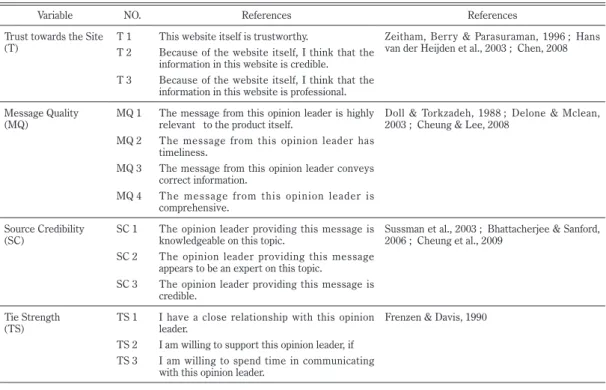
In this study, the related variables, developed from the literature, include trust towards the site, message quality, source credibility, tie strength with receivers, recommendation consistency, confirmation with prior belief, perceived risk, perceived usefulness, message credibility, information adoption, and purchase intention (see Table 1). The respondents are asked to give the answers based on the opinion leader which they pay most attention to. Measures of all the items consist of a seven-point Likert scale,
ranging from strongly disagree (1) to strongly agree (7).
Table 1 Measures
Variable NO. References References
Trust towards the Site
(T) T 1T 2 This website itself is trustworthy.Because of the website itself, I think that the Zeitham, Berry & Parasuraman, 1996 ; Hans van der Heijden et al., 2003 ; Chen, 2008 information in this website is credible.
T 3 Because of the website itself, I think that the information in this website is professional. Message Quality
(MQ) MQ 1 The message from this opinion leader is highly relevant to the product itself. Doll & Torkzadeh, 1988 ; Delone & Mclean, 2003 ; Cheung & Lee, 2008 MQ 2 The message from this opinion leader has
timeliness.
MQ 3 The message from this opinion leader conveys correct information.
MQ 4 The message from this opinion leader is comprehensive.
Source Credibility
(SC) SC 1 The opinion leader providing this message is knowledgeable on this topic. Sussman et al., 2003 ; Bhattacherjee & Sanford, 2006 ; Cheung et al., 2009 SC 2 The opinion leader providing this message
appears to be an expert on this topic.
SC 3 The opinion leader providing this message is credible.
Tie Strength
(TS) TS 1 I have a close relationship with this opinion leader. Frenzen & Davis, 1990 TS 2 I am willing to support this opinion leader, if
TS 3 I am willing to spend time in communicating with this opinion leader.
Recommendation Consistency (RC)
RC 1 The information provided by this opinion leader is consistent with information from other opinion leaders.
Zhang & Watts, 2003 ; Cheung et al., 2009 ; Chen, Chen & Hsu, 2011
RC 2 The information provided by this opinion leader is similar to information from other opinion leaders.
RC 3 The opinion leader providing this information has consistent or similar interests as other opinion leaders on the same topic.
Confirmation with Prior Belief (C)
C 1 The information providing by this opinion leader supports my impression of the product or service.
Zhang & Watts, 2003 ; Cheung et al., 2009 ; Chen, Chen & Hsu, 2011
C 2 The information providing by this opinion reinforces the information which I have had about this
C 3 The information providing by the opinion leader contradicts to what I have already known about this product or service.
Perceived Risk
(PR) PR 1 I think that the risk of purchasing a product through this site is small. Hans Van der Heijden, 2003 PR 2 I think that the potential for the loss because of
purchasing a product through this site is high. PR 3 I think that the potential for the profit because
of purchasing a product through this site is high. PR 4 I think that a good transaction is probably done
through this site. Perceived sefulness of
Information (PU)
PU 1 I think that the information from this opinion
leader is valuable. Sussman et al., 2003 ; Chen, Chen & Hsu, 2011
PU 2 I think that the information from this opinion leader is helpful.
PU 3 I think that the information from this opinion leader can increase my understanding of the product or service.
Message Credibility
(MC) MC 1 I think that the information from this opinion leader is factual. Sussman et al., 2003 ; Chen, Chen & Hsu, 2011 MC 2 I think that the information from this opinion
leader is accurate.
MC 3 I think that the information from this opinion leader is credible.
Information doption
(IA) IA 1 I agree with the action suggested in the information from this opinion leader. Sussman et al., 2003 ; Cheung et al., 2009 IA 2 I pay close attention to the information from
opinion leader and follow the suggestions. IA 3 The information from this opinion leader
motivates me to take action.
IA 4 The information from this opinion leader enhances my efficiency in making purchase decision.
Purchase Intention
(PI) PI 1 It is very likely that I will purchase the product recommended by this opinion leader. Coyle & Thorson, 2001 PI 2 I will purchase the product recommended by
this opinion leader next time when I need such kind of product.
PI 3 I will definitely try the product recommended by this opinion leader.
Refine the questionnaire and Pretest
Firstly, at the item-generation stage, a small group of participants need to be interviewed with the
questionnaire to identify and refine some slight nuances of meanings in statements for a more precise item pool (Churchill, 1979). Hence, a new Chinese version was obtained by discussing the items’ wordings with five doctor students.
Secondly, to test the model and its constructs, the instrument was pretest with 182 individuals by terms of convenience sampling. Only 128 pieces of valid answers were accepted and the data was analyzed by SPSS.As a result, the questions labeled PR3 and IA3 were deleted.
The formal questionnaire
The data was collected through the Questionnaire Star System, the largest professional questionnaire system in China. After uploading the questionnaire online, a URL was made and could be sent out by Wechat to individuals. The specific time period of collecting data was from June 17th, 2016 to
June 30th, 2016. Within these two weeks, 499 pieces of answers were received. As in the pretest, the
results of respondents who answered “never” to the questions of either “In these virtual communities of consumption, have you got experiences of finding commodity information because of the recommendation of opinion leaders” or “Have you ever paid attention to the opinion leaders in virtual communities of consumption? ” were discarded. Finally, 347 pieces of valid answers were accepted and analyzed by SPSS 22 and AMOS 21.
Descriptive data
1) Personal information
Of the respondents, 42.9% were men and 57.1% were women. A majority of them were in the 19-29 years old group. 80% of them had university education. 29.4% were general staff in companies
and 21.9% were students. 49.5% had an income more than 5,000 yuan. 79.8% had used Internet more than 5 years and 47.8% had the history of purchasing commodity online more than 5 years. 51.9% had the history of searching commodity information online more than 3 years. 83.5% shopped online for 1-6
times per month. 67.2% spent more than 20 minutes for the total time spent in the webpage every time in average. 51% visited the website for more than four times per week. 42.4% spent more than 1001 Yuan in online shopping per month.
2) Online activities and choices
Of the respondents, 70.9% answered that sometimes shopping offline, and sometimes shopping online. It depends on the commodity type. Commodity related to fashion and to culture were considered as the most suitable ones to purchase online.62.5% answered that they usually search for commodity information online before purchasing it and 39% chose word of mouth as the sources, while 28.2% chose opinion leaders. 52.2% preferred to use Taobao.com. 53.9% thought that they may be interested in commodity labeled with “some opinion leaders recommend”, while 6.1% answered with “certainly”.
Data analysis
The data is analyzed by Confirmatory factor analysis (CFA), which refers to a special form of factor analysis and the objective of CFA is to test whether the data fit a hypothesized measurement model, based on theories (Preedy & Watson, 2009).
A two-step analytical procedure for structural equation modeling are used to analyze the data, by
firstly examining the measurement model and then access the structural model (Hair et al., 1998 ; Anderson & Gerbing, 1988).
1) Measurement Model evaluation
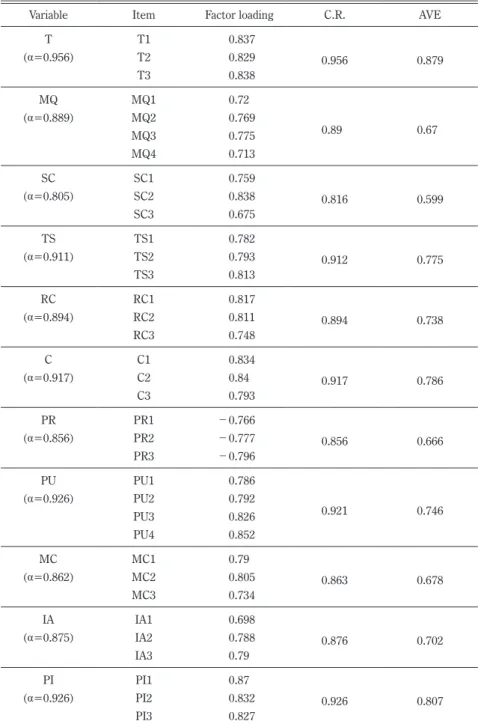
Convergent validity, examined by the composite reliability (CR) and the average variance extracted (AVE), indicates the extent to which the constructs that theoretically related, are actually related. The acceptable values of CR and AVE are above 0.70 and above 0.50 respectively (Fornell & Larcker, 1981). The results showed that all the CR ranged from 0.81 to 0.956 and all the AVE ranged from 0.599 to 0.879 (See Table 2). Namely, the convergent validity was achieved. Meanwhile, for the factor loadings, nearly all of them were higher than 0.7.
Furthermore, Discriminant validity indicates whether a measurement is not a reflection of other measurements or not (Fornell & Larcker, 1981). The squared root of the average variance extracted (AVE) for each construct should be higher than the correlations between it and all other constructs. The results show that the discriminant validity is achieved (See Table 3).
2) Structural model evaluation
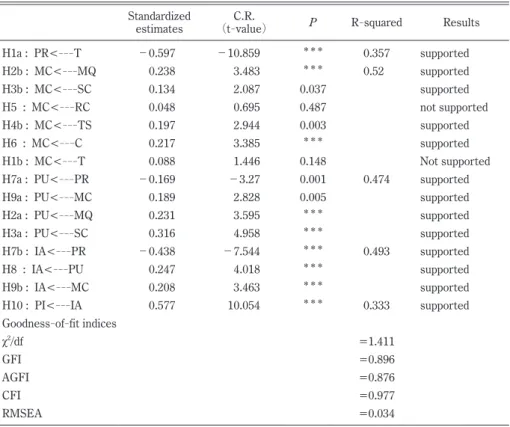
The hypotheses were tested by examining the significance of the path coefficients through AMOS 21, and the results are presented in the Table 4. The evaluation of R2 showed that it could explain
35.7%, 52%, 47.4%, 49%, and 33% of the variance in perceived risk (PR), message credibility (MC), perceived usefulness of message (PU), information adoption (IA) and purchase intention (PI). Therefore, the explanation power is acceptable. Meanwhile, all the hypotheses, except H1b and H5, were supported. To be more specific, 1) H1a, which predicts the negative influence of trust towards the site on perceived risk, was supported (β=−0.587, p<0.001). 2) The influences of message quality, source credibility, recommendation consistency and tie strength with receivers on message credibility were all significant. Namely, H2b (β=0.238, p<0.001), H3b (β=0.134, p<0.05), H4 (β=0.197, p<0.05), H6 (0.217, p<0.001) were all supported. 3) Perceived risk was found to have a negative influence on perceived usefulness of information with H7a (β=−0.169, p<0.01) being supported, while message credibility, message quality and source credibility were all found to have positive influences on perceived usefulness of information with H9a (β=0.189, p<0.01), H2a (β=0.231, p<0.001) and H3a (β=0.316,
p<0.001) being supported respectively. 4) perceived risk appeared to have a negative influence on information adoption, namely H7b (β=−0.438, p<0.001) was supported, while perceived usefulness of information and message credibility appeared to have positive influences on information adoption, namely H8 (β=0.247, p<0.001) and H9b (β=0.208, p<0.001) were supported. 5) H10, which predicts the posi-tive influence of information adoption on consumers’ purchase intention, was supported (β=0.577,
Table 2 Psychometric properties
Variable Item Factor loading C.R. AVE
T T1 0.837 0.956 0.879 (α=0.956) T2 0.829 T3 0.838 MQ MQ1 0.72 0.89 0.67 (α=0.889) MQ2 0.769 MQ3 0.775 MQ4 0.713 SC SC1 0.759 0.816 0.599 (α=0.805) SC2 0.838 SC3 0.675 TS TS1 0.782 0.912 0.775 (α=0.911) TS2 0.793 TS3 0.813 RC RC1 0.817 0.894 0.738 (α=0.894) RC2 0.811 RC3 0.748 C C1 0.834 0.917 0.786 (α=0.917) C2 0.84 C3 0.793 PR PR1 −0.766 0.856 0.666 (α=0.856) PR2 −0.777 PR3 −0.796 PU PU1 0.786 0.921 0.746 (α=0.926) PU2 0.792 PU3 0.826 PU4 0.852 MC MC1 0.79 0.863 0.678 (α=0.862) MC2 0.805 MC3 0.734 IA IA1 0.698 0.876 0.702 (α=0.875) IA2 0.788 IA3 0.79 PI PI1 0.87 0.926 0.807 (α=0.926) PI2 0.832 PI3 0.827
Table 3 Correlation matrix T MQ SC TS RC C PR PU MC IA PI T 0.938 MQ .527** 0.819 SC .416** .401** 0.774 TS .461** .508** .427** 0.88 RC .476** .513** .389** .555** 0.859 C .461** .442** .479** .480** .491** 0.887 PR −.521**−.505**−.405**−.421**−.396**−.350** 0.816 PU .383** .518** .516** .440** .421** .405**−.465** 0.8637 MC .458** .514** .421** .502** .456** .505**−.392** .471** 0.823 IA .511** .550** .419** .474** .441** .381**−.544** .492** .418** 0.838 PI .434** .481** .390** .453** .440** .392**−.379** .376** .363** .508** 0.898 **. When P<0.01, the relationship is significant
Table 4 Path coefficient
Standardized
estimates (t-C.R.value) P R-squared Results
H1a : PR<---T −0.597 −10.859 *** 0.357 supported H2b : MC<---MQ 0.238 3.483 *** 0.52 supported H3b : MC<---SC 0.134 2.087 0.037 supported H5 : MC<---RC 0.048 0.695 0.487 not supported H4b : MC<---TS 0.197 2.944 0.003 supported H6 : MC<---C 0.217 3.385 *** supported H1b : MC<---T 0.088 1.446 0.148 Not supported
H7a : PU<---PR −0.169 −3.27 0.001 0.474 supported
H9a : PU<---MC 0.189 2.828 0.005 supported
H2a : PU<---MQ 0.231 3.595 *** supported
H3a : PU<---SC 0.316 4.958 *** supported
H7b : IA<---PR −0.438 −7.544 *** 0.493 supported
H8 : IA<---PU 0.247 4.018 *** supported
H9b : IA<---MC 0.208 3.463 *** supported
H10 : PI<---IA 0.577 10.054 *** 0.333 supported
Goodness-of-fit indices
χ2/df =1.411 GFI =0.896 AGFI =0.876 CFI =0.977 RMSEA =0.034 Note : ***, p<0.001 ; **, p<0.01 ; *, p<0.05
the site on message credibility, was not supported. Meanwhile, H5, which was supposed to predict the positive influence of confirmation with prior belief on message credibility, was not supported. Additionally, the goodness-of-fit indices indicate the model fit the data very well : χ2/df=1.411<3 ; GFI
=0.896>0.9 ; AGFI=0.876>0.8 ; CFI=0.977>0.9 ; RMSEA=0.034<0.07. Consequently, this measurement model is acceptable.
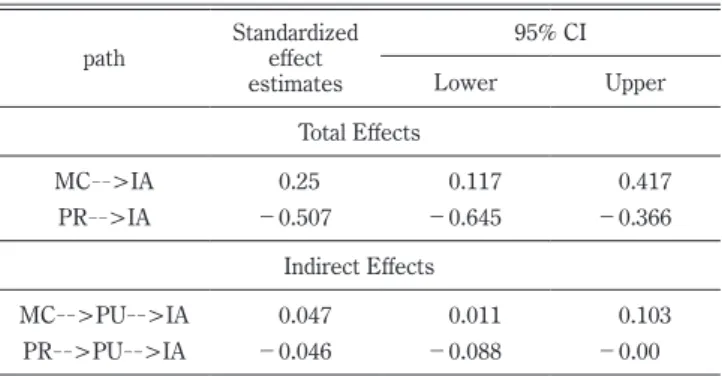
Furthermore, in order to analyze the mediating roles of perceived usefulness of information (PU) between perceived risk (PR) and information adoption (IA), and between message credibility (MC) and IA, the Bootstrapping method, proposed by Preacher and Hayes (2004), was used to assess the signifi-cance of mediation effect (see Table 5). According to this table, 1) In the path “MC-->PU-->IA”, the
function of the intermediary PU is tested and the ratio of this function was 0.047/0.25 =18.8%. Namely, MC affects IA directly and affects IA through PU indirectly. 2) In the path “PR-->PU-->IA”, the
func-tion of the intermediary PU is tested and the ratio of this funcfunc-tion was −0.046/−0.507=9.1%.Namely, PR affects IA directly and affects IA through PU indirectly.
Discussion
Previous researches show that many previous researches on TAM highlight the message itself or the environment. However, this study focuses on the side of information sender and investigates the influential factor of opinion leaders towards consumers’ purchase intention in virtual communities of consumption. The empirical results showed that all hypotheses, except the hypotheses between trust towards the site and message credibility and between recommendation consistency and message credibility, are supported.
The reasons for the two rejected hypotheses are open to discussion. On one hand, the result failed to show a significant relationship between trust towards the site and message credibility, which is not consistent with some researchers’ findings (Brown et al., 2007 ; Cheng, 2011). One possible explanation may be that the message credibility in this study refers to the credibility of the information from opinion leaders, rather than the general eWOM or online comments. Because the information sender are opinion leaders themselves, rather than the site, whether the message is credible or not is
Table 5 The mediating roles of PU
path Standardized effect estimates 95% CI Lower Upper Total Effects MC-->IA 0.25 0.117 0.417 PR-->IA −0.507 −0.645 −0.366 Indirect Effects MC-->PU-->IA 0.047 0.011 0.103 PR-->PU-->IA −0.046 −0.088 −0.00
more likely to be related to opinion leaders and less likely to be related to the site. Meanwhile, the opinion leaders may release different information on different sites and thus consumers using different sites can get the same message, making them focus less on the sites which they are using and more on the specific opinion leaders. Consequently, their trust towards the site may not affect message credibility and thus failed to show any significant relationship with it.
On the other hand, the result failed to show a significant relationship between recommendation consistency and message credibility, which is not consistent with the findings of some researchers (Zhang & Watts, 2003 ; Cheung et al., 2009 ; Chen, Chen & Hsu, 2011). One possible explanation may be that when consumers are judging the credibility of information, they focus more on the quality of the message sent out by the specific opinion leaders, the credibility of this opinion leader and their personal relationships with this opinion leader, rather than details related to other opinion leaders in the virtual community. Namely, they judge the credibility of the information based on the specific opinion leader and hardly take other opinion leaders’ messages as a reference or seldom make a comparison. Furthermore, it is the information which is generated based on an opinion leader’s personal experiences that attracts consumers. Hence, recommendation consistency may not have an added effect on message credibility and thus failed to significant relationship with it.
Furthermore, for those supported hypotheses, the results are discussed in the following.
Firstly, based on IAM, this extended model is used to investigate the influential factors of opinion leaders towards consumers’ purchase intention in virtual communities of consumption. The results confirmed that message quality and source credibility all affect perceived usefulness of information respectively, and perceived usefulness of information has a positive influence on information adoption. These findings are in line with the IAM (Sussman et al., 2003) and its application studies in online community (Christy, Matthew & Neil, 2008). Meanwhile, the result indicated that the tie strength with receivers is also an important antecedent of purchase intention. This crucial finding emphasizes the influence of tie strength with receivers in the online communities of consumption, while the previous studies focus on the influence of it in the online peer communications (Smith et al., 2002 ; Wang et al., 2012).
Secondly, this extended model also investigate the variables of consumers and confirmed that the confirmation with prior belief affects the message credibility, their information adoption and purchase intention. Meanwhile, the mediatory function of message credibility is confirmed.
Thirdly, the trust and perceived risk towards the environment, namely the virtual communities of consumption, are added into the model. The results implied that trust towards the site has a negative influence on perceived risk, and perceived risk have negative influences on both perceived usefulness of information and the information adoption. These findings emphasize the decomposition of the variables of trust towards the site and of perceived risk into researches about online communities.
Fourthly, the mediating roles of perceived usefulness between perceived risk and information adoption, and between message credibility and information adoption were examine. The results confirmed that both perceived risk and message credibility affect information adoption directly and via perceived usefulness of information indirectly.
Theoretical implications
This study aims at examining the influential factors of opinion leaders on consumers’ purchase intention in the virtual communities of consumption. Previous researches mainly focus on the applications of IAM in website (Mcknight & Kacmar, 2007), online community (Christy, Matthew & Neil, 2008), social network (Jin et al., 2009) and eWOM (Christy, Matthew & Neil, 2008 ; Chen, Chen & Hsu, 2011). The primary contribution of the findings in this study is that by incorporating more variables of opinion leaders, the extended model provides a new perspective to study the process of information adoption, namely from the perspective of information sender. Also, this new model includes consumers’ purchase intention as the outcomes of the information adoption process. Perhaps the most important contribution is that this model provides a wider understanding of the influences from opinion leaders within the virtual community of consumption by emphasizing their tie strength with the consumers. This finding extends the traditional theories used to characterize social networks, such as the theory of “the strength of weak ties” (Granovetter, 1973), and also serve as a supplement to the previous researches about the functions of tie strength in the context of online peer recommendations (Smith et al., 2002 ; Wang et al., 2012). Furthermore, the findings of the negative influence of trust towards the site on perceived risk and the negative influence of perceived risk on information adoption also help account for the influence of environment on consumers. Besides, the influence of confirmation with prior belief of consumers need also be emphasized. Additionally, the findings of the mediating roles of perceived usefulness of information between perceived risk and information adoption, and between message credibility and information adoption may give a new theoretical direction to relevant studies. Finally, the findings that the influences of both trust towards the site and the influence of recommendation consistency on message credibility failed to be supported in this study also contributes to the future research in this field.
The managerial implications
The findings also provide several managerial implications as follows. 1) Implications for marketers
Because virtual communities provide their members to share information and build relationships (Kozinets, 1999), the marketers should help the members to strengthen their relationships with others by using some approaches, such as setting up specialized discussions or special zones for opinion leads or others to invite the members to participate and socialize.
Furthermore, with the crucial influence of opinion leaders on consumers being identified, the websites can invite opinion leaders to their virtual communities or cultivate their own opinion leaders from the perspectives of their credibility, message quality and tie strength with receivers, such as helping them to accumulate professional information, to use different finds of format to convey message and to increase their interaction with followers.
Companies can cooperate with opinion leaders to get benefit by promoting their products or services or to get feedbacks from them so as to have a better understanding of the market.
3) Implications for website operators
The operators of the website should pay attention to the positive utility of consumers’ trust towards the site and the negative utility of perceived risk and thus provide more technical supports to the key functions of the website.
Limitation and Future research
Despite these implications, this study has several limitations that provide future research issues. First, the samples for the questionnaire were only from Chinese, and thus may limit the applicability of the findings to other counties. To test the applicability of theoretical framework in other counties is an area for future research. Second, the respondents were not asked to specify their favorable categories of products or services. As the questionnaire showed that respondents were more interested in following opinion leaders related to fashion, rather than those related to technology, culture and lifestyle, the influence of opinion leaders in different areas may be different. Hence, future research can integrate the product category or service category into the model. Thirdly, the sample size was relatively small. Therefore, additional researches can use a larger sample size for getting a more precise measurement of this model.
Conclusion
This study investigates the influential factors of opinion leaders on consumers’ purchase intention in virtual communities of consumption, by building up a new model based on IAM. The findings confirm the influence of opinion leader on consumers’ information adoption and purchase intention, the influence of confirmation with prior belief of consumers and other variables on the message credibility, which fur-ther affects the information adoption and the influence of trust towards the site on perceived risk. Also, the findings present the mediating functions of perceived usefulness of information between perceived risk and information, and between message credibility and information. Finally, the influence of infor-mation adoption on purchase intention is confirmed.
Reference
Andrew J. Flanagin, Miriam J. Metzger, Rebekah Pure, Alex Markov and Ethan Hartsell, “Mitigating risk in ecommerce transactions : perceptions of information credibility and the role of user-generated ratings in product quality and
purchase intention”, Electronic Commerce Research, Vol. 14, Issue 1, pp. 1-23, 2014
Arnaud De Bruyn and Gary L. Lilien, “A Multi-Stage, Model of Word of Mouth Through Electronic Referrals”,
International Journal of Research in Marketing, Vol. 25, Issue 3, pp. 151-163, 2008
Arndt J., “Word-of-mouth advertising : a review of the literature”, The Advertising Research Foundation Inc, New York,
Anol Bhattacherjee and Clive Sanford, “Influence Processes for Information Technology Acceptance : An Elaboration Likelihood Model”, MIS Quarterly, Vol. 30, Issue 4, pp. 805-825, 2006
Bauer, R.A., “Consumer behavior as risk-taking”, In R.S. Hancock (Ed.), Dynamic marketing for a changing world.
Chicago : American Marketing Association, pp. 389-398, 1960
Bansal, H.S. and Voyer, P.A., “Word of mouth process within a service purchase decision context”, Journal of Service Research, pp. 166-177, 2000
Brown et al., “Word of Mouth Communication within Online Communities : Conceptualizing the online social net-work”, Journal of interactive marketing, Vol. 21, Issue 3, pp. 2-17, 2007
Brown, J.J., Reingen, P.H., “Social ties and word-of-mouth referral behavior”, Journal of Consumer Research, Vol. 14,
Issue 3, pp. 350-362, 1987
Cheung, Matthew K.O. Lee and Neil Rabjohn, “The impact of electronic Word-Of-Mouth : The adoption of online
opin-ions in online customer communities”, Internet Research, Vol. 18, Issue 3, pp. 229-247, 2008
Cheung, C.M.K and Thadani, D.R., “The Impact of Electronic Word-of-Mouth Communication : A Literature Analysis
and Integrative Model”, Decision Support Systems, Vol. 54, Issue 1, pp. 461-470, 2012
ChienWen Chen, WenKuo Chen, and Yung-Ying Hsu, “The study of eWOM adoption Model”, Marketing Review, Vol. 2,
Issue 8, pp. 175-198, 2011
Cho, J., and Lee, J., “An integrate model of risk and risk-reducing strategies”, Journal of Business Research, Vol. 59,
Issue 1, pp. 112-120, 2006
Claes Fornell and David F. Larcker, “Evaluating Structural Equation Models with Unobservable Variables and Measure-ment Error”, Journal of Marketing Research, Vol. 18, Issue 1, pp. 39-50, 1981
Coyle and Thorson, “The Effects of Progressive Levels of Interactivity and Vividness in Web Marketing Sites”, Journal of Advertising, Vol. 30, Issue 3, pp. 65-77, 2001
Christy M.K. Cheung, Matthew K.O. Lee and Neil Rabjohn, “The impact of electronic word-of-mouth : The adoption of
online opinions in online customer communities”, Internet Research, Vol. 18, Issue 3, pp. 229-247, 2008
Daniel Z. Levin and Rob Cross, “The Strength of Weak Ties You Can Trust : The Mediating Role of Trust in Effective Knowledge Transfer”, Management Science, Vol. 50, Issue 11, pp. 1477-1490, 2004
Delone W.H. and Mclean E.R., “The Delone and Mclean model of information systems success : A ten-year update”,
Journal of Management Information Systems, Vol. 19, Issue 4, pp. 9-30, 2003
Doll W.J. and Toirkzadeh G., “The measurement of end-user computing satisfaction”, MIS Quarterly, Vol. 12, Issue 2,
pp. 259-274, 1988
D. Harrison McKnight and Charles J. Kacmar, “Factors and effects of information credibility”, Proceedings of the ninth international conference on Electronic commerce, pp. 423-432, 2007
Engel, J.E., Blackwell, R.D. and Kegerreis, R., “How information is used to adopt an innovation”, Journal of Advertising Research, Vol. 9, pp. 3-8, 1969
Fangxiu Cheng, “虚拟社区网络口碑对消费者决策行为影响研究/Study on the influence of eWOM via virtual commu-nity on consumers’ purchase behavior”, Doctor dissertation, 2011
Featherman, M., “Extending the technology acceptance model by inclusion of perceived risk”, proceedings of AMCIS, pp. 148, 2001
Flynn, L.R., Goldmith, R.E., and Eastman, J.K., “Opinion leader and Opinion Seekers : Two New Measurement Scales”, Journal of the Academy of Marketing Science, Vol. 24, Issue 2, pp. 137-147, 1996
Fogg, B.J., Marshall, J., Laraki, O., Osipovich, A., Varma, C., Fang, N., Paul, J., Rangnekar, A., Shon, J., Swani P., and Treinen, M., “What makes websites credible? A report on a large quantitative study”, proceedings of the confer-ence on Human Factors in computing systems, ACM Press, New York, pp. 61-68, 2001
Fred D. Davis, Richard P. Bagozzi and Paul R. Warshaw., “User acceptance of computer technology a comparison of two theoretical models”, Management Science, Vol. 35, Issue 8, pp. 986-1003, 1989
Grahame R. Dowling and Richard Staelin, “A Model of Perceived Risk and Intended Risk-Handling Activity”, Journal of
Consumer Research, Vol. 21, Issue 1, pp. 119-134, 1994
Press, Boston, 1997
Hans van der Heijiden, Tibert Verhagen and Marcel Creemers, “Understanding online purchase intention : Contribu-tions from technology and trust perspective”, European Journal of Information Systems, Vol. 12, Issue 1, pp. 41-48,
2003
Hair, J.F., Anderson, R.E., Tatham, R.L. and Black, W.C., “Multivariate Data Analysis, 5th ed.”, Prentice Hall, NJ, 1998
Hennig-Thurau, T., Qwinner, K.P., Walsh, G., Gremler, D.D., “Electronic word-of-mouth via consumer-opinion
platforms : what motivates consumers to articulate themselves on the Internet”, Journal of Interactive Marketing, Vol. 18, Issue 1, pp. 38-52, 2004
Hovland C.I., Janis I.L. and Kelley H.H., “Communication and persuasion : Psychological studies of opinion change”, Yale University Press, New Haven, 1953
Howard Rheingold, “The Virtual Community : Homesteading on the Electronic Frontier”, Addison-Wesley, 1993
Jin, X.L., Cheung, C.M., Lee, M.K., and Chen, H.P, “How to keep members using the information in a computer-
sup-ported social network”, Computers in Human Behavior, Vol. 25, Issue 5, pp. 1172-1181, 2009
Jonathank.Frenzen and Harry L. Davis, “Purchasing Behavior in Embedded Markets”, Journal of Consumer Research, Vol. 17, Issue 1, pp. 1-12, 1990
Katz, E. and Lazarsfeld, P.F., ‘Personal influence : the part played by people in the flow of mass communications’, The Free Press, New York, 1955
Kim, D.J., Ferrin, D.L., and Rao, H.R., “A trust-based consumer decision-making model in electronic commerce : The
role of trust, perceived risk, and their antecedents”, Decision support System, Vol. 44, Issue 2, pp. 544-564, 2008
Kozinets and Roobert V., “E-tribalized Marketing? The Strategic Implications of virtual communities of consumption”,
European Management Journal, Vol. 17, Issue 3, pp. 252-264, 1999
Lee, K.-T., and Koo, D.-M., “Evaluating right versus just evaluating online consumer reviews”, Computers in Human
Behavior, Vol. 45, pp. 316-327, 2015
Man Yee Cheung, Chuan Luo, Choon Ling Sia and Huaping Chen, “Credibility of Electronic Word-of-Mouth :
Informa-tional and Normative Determinants of On-line Consumer Recommendations”, International Journal of Electronic
Commerce, Vol. 13, Issue 4, pp. 9-38, 2009
Mark Granovetter, “The strength of Weak Ties”, American Journal of Sociology, Vol. 78, Issue 6, pp. 1360-1380, 1973
McKnight, D.H., Choudhury, V. and Kacmar, C., “Developing and Validating Trust Measure for e-Commerce : An
Inte-grative Typology”, Information Systems Research, Vol. 13, Issue 3, pp. 334-359, 2002a
McKnight, D.H., Choudhury, V. and Kacmar, C. “The impact of initial consumer trust on intentions to transact with a web site : a trust building model”, The Journal of Strategic Information Systems, Vol. 11, Issue 3-4, pp. 297-323,
2002b
Parasuraman, A., Zeithaml, Valarie A., Berry and Leonard L. servqual, “A multiple-item scale for measuring consumer
perceptions of service quality”, Journal of Retailing, Vol. 64, Issue 1, pp. 12-40, 1988
Paul A. Pavloub and Mauricio S. Featherman, “Predicting e-services adoption : a perceived risk facets perspective”,
International Journal of Human-Computer Studies. Vol. 59, Issue 4, pp. 451-474, 2003 Petty R. and Cacioppo J.,
“Communication and persuasion : central and peripheral routes to attitude change”, Springer-Verlag, New York, 1986
Petty, Richard E., John T. Cacioppo and Rachel Goldman, “Personal Involvement as a Determinant of Argument-based
Persuasion”, Journal of Personality and Social Psychology, Vol. 41, pp. 847-855, 1981
Preacher, Kristopher J., Hayes and Andrew F, “SPSS and SAS procedures for estimating indirect effects in simple medi-ation models”, Behavior Research Methods, Instruments, and Computers, Vol. 36, Issue 4, pp. 717-731, 2004
Preedy, V.R., and Watson, R.R., “Handbook of Disease Burdens and Quality of Life Measures”, Springer, New York, 2009
Sirkka L. Jarvenpaa, Noam Tractinsky and Michael Vitale, “Consumer trust in an Internet store”, Information Technol-ogy and Management, Vol. 1, Issue 1, pp. 45-71, 2000
Sussman, S.W. and Siegel, W.S., “Informational Influence in Organizations : An Integrated Approach to Knowledge Adoption”, Information Systems Research, Vol. 14, Issue 1, pp. 47-65, 2003
Wenpin Tsai and Sumantra Ghoshal, “Social Capital and Value Creation : The Role of Intrafirm Networks”, The Academy of Management Journal, Vol. 41, Issue 4, pp. 464-476, 1998
Zhang, W. and Watts, S., “Knowledge adoption in online communities of practice”, proceedings of International Conference on information systems, pp. 96-109, 2003
Zhang, W., and Watts, S.A., “Capitalizing on context : Information adoption in two online communities”, Journal of the Association for Information Systems, Vol. 9, Issue 2, pp. 73-94, 2008
Wang, X., Yu, C., and Wei, Y., “Social media peer communication and impacts on purchase intention : a consumer socialization framework”, Journal of interactive marketing, Vol. 26, Issue 4, pp. 198-208, 2012