東北大学における惑星・宇宙物理学データベース構
築への取り組み
著者 鍵谷 将人
東北⼤学惑星プラズマ・⼤気研究センター(PPARC)では、2009年度より始まった⼤学間連携プロジェク トIUGONET(超⾼層⼤気⻑期変動の全球地上ネットワーク観測・研究)に併せて、惑星宇宙物理データベ ースの構築を進めている。本データベースの中核を成すのは、福島県飯舘観測所における太陽惑星HF-UHF 帯の電波観測と、ハワイハレアカラ観測所における惑星光学観測である。今回はこれらの中から特に、 (1)飯舘惑星電波望遠鏡を⽤いた太陽電波バーストの⾼時間分解能観測 (2)ハレアカラ観測所における惑星⾼分散分光観測 に焦点を当てて発表を⾏う。
Planetary Plasma and Atmospheric Research Center (PPARC) of the Tohoku University is now in progress to build a planetary and space physics database under collaboration with the Inter-university Upper atmosphere Global Observation NETwork (IUGONET). The core data of the database are solar and planetary radio observation in HF- UHF range at Iitate observatory, Fukushima, and optical observation of planets at Haleakala observatory, Hawaii. In the presentation, we will particularly present solar radio burst observation with high time resolution using the Iitate Planetary Radio Telescope (IPRT) and high-dispersion spectroscopy of the planets at Haleakala observatory.
東北大学における
惑星・宇宙物理学データベース構築への取り組み
Planetary and Space Physics Database
of the Tohoku University
鍵⾕将⼈(東北⼤) ほか
太陽
HF-UHF帯電波
データベース
太陽電波バーストの中でもType-Iバーストは、他の太陽電波バーストに⽐べて強度が2桁
以上⼩さい微弱な電波現象であるが、その時間―周波数特性から、コロナ中で⼩規模な粒
⼦加速が頻繁に⽣じていることが⽰唆される。
しかしながら、微細なスペクトル構造と複雑な偏波特性をもつメートル波帯の太陽電波
を連続して観測できる設備は、これまで世界的にも⽋如していた。そこで飯舘惑星電波望
遠鏡に新開発のデジタル分光器を組み合わせることで、160-500MHzの帯域において、
10msの時間分解能、61kHzの周波数分解能、0.7s.f.u.の最⼩検出感度を実現し、2009年
12⽉より連続観測を実施している。
観測データは、時間分解能を1秒にリダクトしたものをfits形式のデータとして公開する
ことを予定しており、SolarSoftWare(SSW)にて取り扱うことができる。またIUGONETプ
ロジェクトで整備されるメタデータ・データベースにも登録が予定されており、地球・惑
星・惑星間空間での研究への応⽤が期待される。
Type-I is one of the solar radio phenomena frequently observed in a meter wave length. The flux density of type-I is very weak compared to other solar radio bursts so that it is thought to be emitted by some small scale particle acceleration phenomena in the solar corona. However, the acceleration processes of the non-thermal electrons are not understood well. PPARC have newly developed a radio observation system to observe solar radio bursts with IPRT. This system enables to observe solar radio bursts in the frequency range between 100 MHz and 500 MHz. Minimum detectable sensitivity in the observation frequency range is better than 0.7 S.F.U. with 10 ms time resolution and 61 kHz frequency resolution. This system also enables to observe left and right polarization
components simultaneously. The observation system is one of the best equipment for solar radio bursts in the world at present. We have started continuous observations of the Sun from the end of 2009. The observation data will be released in the FITS format, thus, we can easily analyze the data using SolarSoftWare (SSW).
The system consists of wide-band polarimeter and high-speed FFT spectrometer
installed on the IPRT, Tohoku University. The system enables to observe the solar
radio bursts in 100~500MHz with world-eminent specifications; i.e., with the sensitivity
of 0.7s.f.u(solar flux unit) and time resolution of less than 10msec. The observations
have been made everyday.
X,Y 100~500MHz
LNA
Wideband
Polari-meter
Lo:1050MHz
Mixer
LH:100~500MHz+
RH:550~950MHz
LH
RH
Δt≦10msec
ΔS=0.7s.f.u.
FFT:Spectrometer
IPRT
Diagram of the IPRT spectro-polarimeter system
Fig. Example of RH&LH spectra observed with the solar radio
spectrometer (Type-I & III bursts).
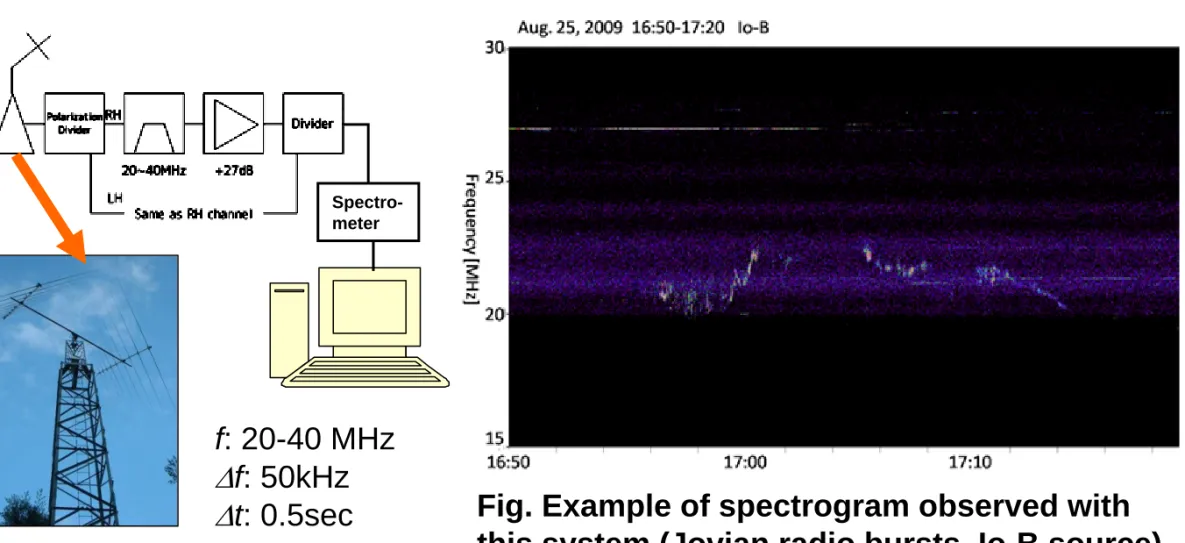
The system is wide-band spectrometer installed on the Iitate Observatory, Tohoku
University. The system enables to observe the solar/Jovian radio bursts in 20-40
MHz with a sensitivity of -190 dBW/m
2Hz (Galactic noise level) and time resolution
of 0.5 sec. The observations have been made everyday.
HF Solar/Jovian Radio Spectrometer
Fig. Example of spectrogram observed with
this system (Jovian radio bursts, Io-B source).
Spectro-meter
f: 20-40 MHz
Δ
f: 50kHz
1. Use case:
- Solar radio activity monitor with the wide-band (20-40&100-500MHz)
- Jovian radio activity monitor with the wide-band (20-40MHz)
- Researches of particle accelerations by comparative studies
with X-ray~UV~VIS solar images, micro waves etc.
2. Function of the database (minimum requirement):
- Providing spectra by direct input of required date. (今回相談に含めうるもの)
3. Function of the database (for extended use):
Î Linkage of other solar/Jovian data such as,
Jovian aurora(UV): HST
(今回相談に含めうるもの)
Wave observations
ground-based: Wide band data (Culgoora, Australia: 18M-18GHz)
Radio interferometer (NoRH, Japan: 17, 34GHz)
HF~VHF data (Nancay, France:10~70MHz)
Wide band data (ETH, Switzerland:
0.1~4GHz)
satellite: LF~HF: WIND(~14MHz), STEREO(~16MHz)
Others: Hinode, RHESSI(X-ray), SOHO(UV), VIS(Hα), Magnetograph
4.Data size
- Image data (UHF/VHF) ~50KByte/day
- Binary data (UHF/VHF) ~23MByte/day
(observation: 8hrs/day@Δf=1MHz, Δt=1sec)
- Image data (HF) ~300KByte/day
- Binary data (HF) ~250MByte/day
An example of image data of the solar radio spectrometer
DAM
An example of the header part of the binary data of
VHF-UHF Solar Radio Spectrometer (TBR)
CDF file structure of HF data (TBR)
Variable Type RecordVariance (=Time) Dimension Variance (=Frequency) Category Epoch CDF_EPOCH (REAL 8byte) Var. (0-86399)
Fix Support Data
Frequency [MHz] CDF_REAL4 (REAL 4 byte) Fix (0) Var. (0-699) Support Data RH
[dBW/m2Hz] CDF_INT2(INT 2byte) Var.(0-86399) Var.(0-699) Data
LH [dBW/m2Hz] CDF_INT2 (INT 2byte) Var. (0-86399) Var. (0-699) Data
** Conversion tool from CDF file to FITS (or converted FITS
file) will be also provided from Database.
Structure of the data directory (TBR)
Image data Binary data Year1 Year2 Year2 Month1 Month2 Month3 day1.gif day2.gif day3.gif Year1 Year2 Year2 Month1 Month2 Month3 day1.fits day2.fits day3.fits VHF/UHF data (Sun) Radio data (Tohoku U.) Image data Binary data Year1 Year2 Year2 Month1 Month2 Month3 day1.gif day2.gif day3.gif Year1 Year2 Year2 Month1 Month2 Month3 day1.cdf day2.cdf day3.cdf HF data (Sun,Jupiter)木星内部磁気圏
リモートセンシング
データベース
惑星周辺の希薄⼤気やプラズマの発光は、太陽⾵や衛星との相互作⽤によりダイナミッ
クに変動する惑星磁気圏環境を理解するうえで重要な観測⼿段の⼀つである。これらの観
測には、惑星本体からの散乱光を低減しドップラー量を測定するために⾼分散分光が必要
なだけでなく、数時間から数年におよぶ様々なスケールの変動をとらえるために連続観測
を⾏うことが求められる。
PPARCではハワイ⼤学の協⼒の下、ハワイ・ハレアカラ観測所において⼝径40cmのシ
ュミットカセグレン式望遠鏡とエシェル分光器(視野⾓4”x600”、逆線分散2.5pm/pixel、
波⻑分解能約60,000)を組み合わせて、⽊星、⼟星、⽔星、⽉周辺の中性・プラズマ発光の
連続観測を⾏ってきた。特に⽊星・⼟星観測データについては、2013年に打ち上げが予定
されているISASの極端紫外望遠鏡(Sprint-A/EXCEED)ミッションとの連携を想定し、
PDS(Planetary
Data System)に準拠した形でのデータベース構築が進められている。
Observation of plasma and atmospheric emissions around the planets is important to understand dynamics and interactions between solar wind, satellites and magnetospheres. For the observation of these targets, high-dispersion spectroscopy is essential to reduce scattered continuum from the planetary disk, as well as to derive Doppler
quantities of the emitting particles. In addition, long-term monitoring is required to investigate variability on time scales of hours to years. Optical emissions from plasma and neutrals around the planets have being made at
Haleakala observatory, Hawaii using a high-dispersion echelle spectrograph (FOV=4x600 arcsec, R=60,000,
RLD=2.5pm/pixel) coupled to a 40-cm Schmidt-Cassegrain telescope. Particularly, observation data of Jupiter and Saturn is now in progress to build a database complying with the PDS (Planetary Data System) in collaboration with the Sprint-A / EXCEED mission of ISAS.