
Investigating the Effects of Repeated Reading and NLP : Language Patterns on Reading Rate
13
0
0
全文
(2) 名古屋市立大学大学院人間文化研究科. 人間文化研究. 第 29 号. 2018 年 1 月. 〔学術論文〕. Investigating the Effects of Repeated Reading and NLP Language Patterns on Reading Rate Ben Backwell・Brian Cullen. Introduction 1. Context 2. Hypotheses 3. Results 4. Conclusion References Appendix 1. Abstract This paper investigates EFL student reading speed and describes a quasi-experimental study that attempted to quantify the effects of repeated reading and the use of NLP language patterns in the instructions. An experimental group (n=30) and a control group (n=30) carried out the same timed reading activity three times each lesson for five lessons. The instructions for the experimental group included NLP language patterns designed to promote faster reading. It was shown that the repeated reading is clearly correlated with gains in reading speed. With regard to the NLP language patterns, although there was an increase in mean reading speed, this was not shown to be statistically significant either within the lesson or over the course of the five lessons. Keywords: Reading speed, NLP, timed reading, repeated reading, EFL, ESL. 75.
(3) 名古屋市立大学大学院人間文化研究科. 人間文化研究. 第 29 号. 2018 年 1 月. Introduction This paper investigates EFL student reading speed and describes a study that attempts to quantify a) the effects of repeated reading and b) the effect of NLP language patterns in activity instructions. These two areas are discussed briefly below. One of the big challenges facing foreign and second language learners is reading at a rate that facilitates comprehension. Reading too slowly may cause difficulties in the ability to assemble the meaning of the sentences of the paragraph into a congruent whole, probably due to the limitations of short-term memory (Bell, 2001). Various studies indicate that the majority of readers (in English) read at a speed of about 200 words per minute. L2 readers usually read much slower because of their greater emphasis on the meaning of individual words and the resolving of sentence grammatical structures. By helping L2 readers to read more quickly, we can help them reach higher levels of comprehension as well as having all the benefits of being able to read more within a given period of time. Repeated reading is an activity in which learners read the same text multiple times. The benefits of repeated reading have been discussed by Taguchi et al (2004). It has been shown that repeated reading can raise learner reading rate and that it can ultimately lead to greater comprehension and improved performance in target language usage. NLP (neuro-linguistic programming) is a field of study that studies how language affects people’s behavior. For the purposes of this study, the language patterns from one NLP model called the Milton Model were used in instructions before a repeated reading activity. The language patterns were designed to encourage readers to read more quickly. In comparison with a simple pedagogic instruction given to a control group (e.g. “Read the text quickly”), giving suggestions to an experimental group to read faster in the form of NLP language patterns is postulated to increase the students’ reading speed. By continuing to give those suggestions over an extended period (5 lessons in this study), the effect of these suggestions could potentially be compounded and a significant difference might emerge between the control group and the experimental group. More examples and explanations of how these language patterns can be used in the classroom are given by Cullen & Mulvey (2012) and Cullen (2017).. 76.
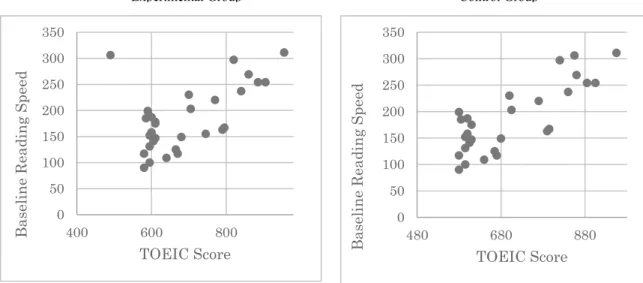
(4) Investigating Effects of Repeated Reading and NLP Language Patterns on Reading Rate(Backwell・Cullen). Context This is a study on the use of repeated reading and NLP language patterns as a means to increase student reading speed. The study was carried out as part of regular coursework in EFL (English as a foreign language) university classrooms in Japan. Two groups of students formed intact samples as an experimental group and a control group. The students’ baseline reading speed in words per minute (wpm) was measured and Figure 1 plots the correlation between TOEIC score and reading speed for both the control group and the experimental group between TOEIC. The range and spread of TOEIC scores is similar in the two groups which was to be expected as they are both advanced English classes. Control Group. 350. 350. 300. 300. 250. 250. Baseline Reading Speed. Baseline Reading Speed. Experimental Group. 200 150 100 50 0 400. 600. 800. TOEIC Score. 200 150 100 50 0 480. 680. 880. TOEIC Score. Figure 1. TOEIC Score and Baseline Reading Speed. Five texts on topics of general interest were selected. They were written to be of general interest for collegelevel classes. Each text was 500-600 words in length. Figure 2 shows the analysis of readability for the texts using the Flesch-Kincaid Grade Level.. 15 10 5 0 Text #1. Text #2. Text #3. Text #4. Text #5. Figure 2. Flesch-Kincaid grade level from Text 1 to Text 5. 77.
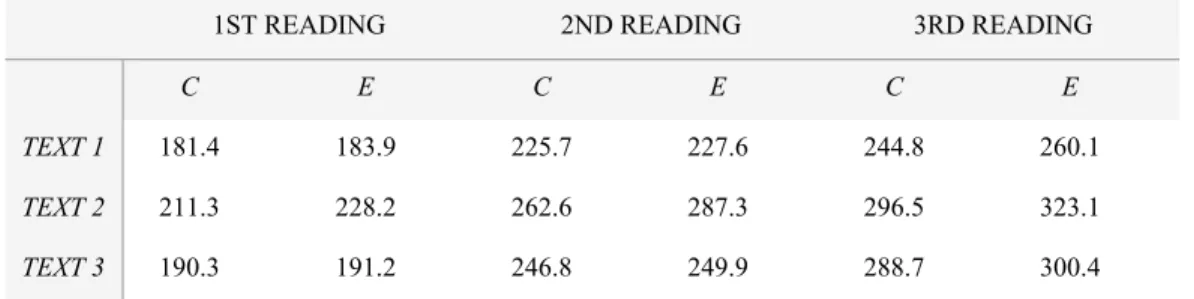
(5) 名古屋市立大学大学院人間文化研究科. 人間文化研究. 第 29 号. 2018 年 1 月. Hypotheses . Hypothesis 1: Repeated reading of the same text will increase reading rate for both the control group and the experimental group.. . Hypothesis 2: The experimental group will consistently show higher gains in reading speed than the control group.. . Hypothesis 3: The effects for the experimental group will increase longitudinally compared to the control group over the 5 week period.. . Hypothesis 4: The effects for the experimental group will increase within a single lesson compared to the control group over the repeated reading (1st reading, 2nd reading, 3rd reading).. Methodology Over a period of five consecutive lessons (one lesson per week), students carried out timed reading activities. The students were given instructions and then one minute to read the text. This was repeated twice to make a total of three readings for each text. Appendix 1 shows the instructions for teachers including scripts for the control group and experimental group for each of the five lessons in the study. To make it easier for students to count, the number of words in each paragraph was printed in a smaller font at the end of each paragraph. The students were asked to read each text three times because pedagogically, repeated reading has been demonstrated to be an effective way of increasing reading speed. If students are fast readers and finish the text, they were told to start re-reading from the beginning again. The students kept records of their reading speeds on paper and submitted this paper at the end of the study. The reading speeds were entered into a spreadsheet and analyzed.. Results Table 1 summarizes the means of all of the reading activities for the control group (C) and experimental group (E) over the five weeks. 1ST READING. 2ND READING. 3RD READING. C. E. C. E. C. E. TEXT 1. 181.4. 183.9. 225.7. 227.6. 244.8. 260.1. TEXT 2. 211.3. 228.2. 262.6. 287.3. 296.5. 323.1. TEXT 3. 190.3. 191.2. 246.8. 249.9. 288.7. 300.4. 78.
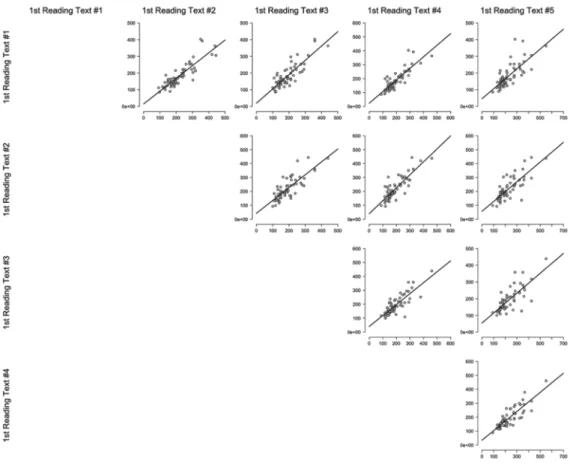
(6) Investigating Effects of Repeated Reading and NLP Language Patterns on Reading Rate(Backwell・Cullen). TEXT 4. 190.3. 196.8. 239.5. 264.8. 283.8. 322.0. TEXT 5. 224.6. 234.7. 285.6. 288.5. 326.1. 354.7. Table 1. Mean reading speed of each group In order to account for the possibility of different starting baseline speeds for the control and experimental groups, the baseline for reading speed was established using Text 1. A two-sample t-test for the baseline speeds (p=0.87) indicated that there was no significant difference in the baseline reading speeds of the control group and the experimental group. The correlation plots between the five texts is given in Figure 3 to illustrate that there is high correlation (0.75 < Pearson r < 0.87, p<0.001) between the reading rates in the 1st reading speeds on the different texts. In other words, the relative reading rates of all students is consistent between the five different texts.. Figure 3. Correlations between Reading Speeds on each Text. 79.
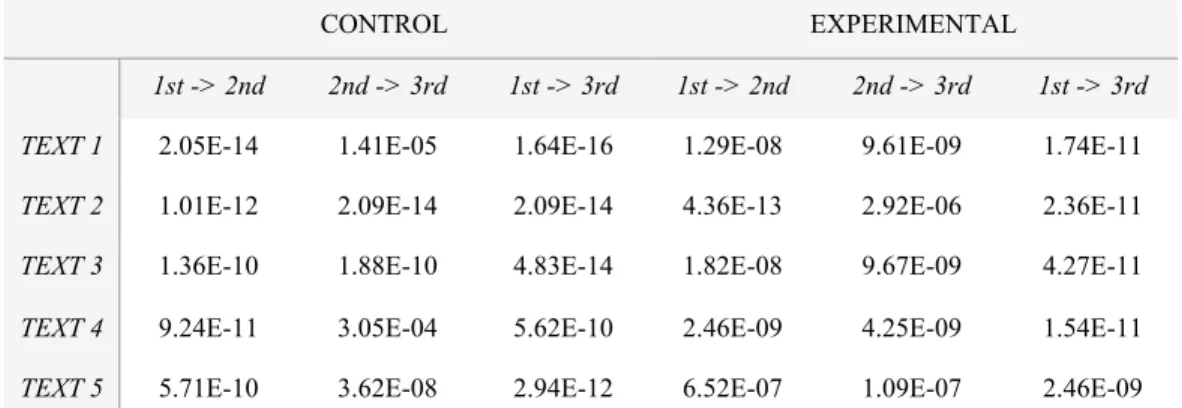
(7) 名古屋市立大学大学院人間文化研究科. 人間文化研究. 第 29 号. 2018 年 1 月. We now consider each of the four stated hypotheses one by one. Hypothesis 1: Repeated reading of the same text will increase reading rate for both the control group and the experimental group. This hypothesis is strongly supported by the very low p-values shown in Table 2, and it is clear that repeated reading of the same text is an effective method of increasing reading rate. CONTROL. EXPERIMENTAL. 1st -> 2nd. 2nd -> 3rd. 1st -> 3rd. 1st -> 2nd. 2nd -> 3rd. 1st -> 3rd. TEXT 1. 2.05E-14. 1.41E-05. 1.64E-16. 1.29E-08. 9.61E-09. 1.74E-11. TEXT 2. 1.01E-12. 2.09E-14. 2.09E-14. 4.36E-13. 2.92E-06. 2.36E-11. TEXT 3. 1.36E-10. 1.88E-10. 4.83E-14. 1.82E-08. 9.67E-09. 4.27E-11. TEXT 4. 9.24E-11. 3.05E-04. 5.62E-10. 2.46E-09. 4.25E-09. 1.54E-11. TEXT 5. 5.71E-10. 3.62E-08. 2.94E-12. 6.52E-07. 1.09E-07. 2.46E-09. Table 2. P-values for paired t-tests between 1st, 2nd, 3rd readings for control and experimental tests Hypothesis 2: The experimental group will consistently show higher gains in reading speed than the control group. As can be seen in Table 2 above, there was a consistently higher mean reading speed by the experimental group throughout all of the readings and texts. To ascertain whether the increased means are statistically significant, independent t-tests were carried out between control and experimental groups for each text and reading pair. These are shown in Table 3. Table 3. p-values for independent t-tests between control/experimental pairs 1ST READING C. 80. E. 2ND READING. 3RD READING. C. C. E. E. TEXT 1. 0.89. 0.92. 0.44. TEXT 2. 0.40. 0.28. 0.30. TEXT 3. 0.96. 0.88. 0.63. TEXT 4. 0.71. 0.22. 0.15. TEXT 5. 0.65. 0.91. 0.36.
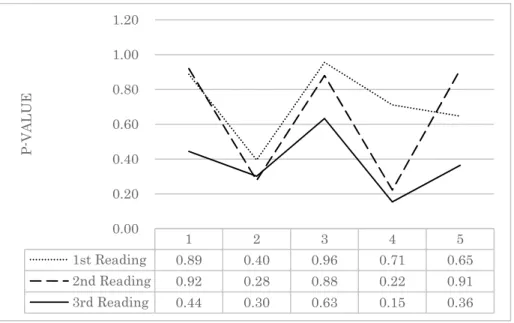
(8) Investigating Effects of Repeated Reading and NLP Language Patterns on Reading Rate(Backwell・Cullen). P-values range from a low of 0.15 (indicating an 85% probability that the increase in reading speed is significant) to a high of 0.92 (indicating an 8% probability that the increase in reading speed is significant. The average p-value is 0.57 indicating that the null hypothesis cannot be rejected. In other words, random variation may account for the differences in reading speed between the control group and experimental groups, so despite a promising trend, hypothesis 2 is rejected in this study. Hypothesis 3: The effects for the experimental group will increase longitudinally compared to the control group over the 5 week period. Figure 4 graphs the change in p-values between Text 1 and Text 5, thus showing the changing probability that there is a significant difference between the control group and the experimental group (lower p-values express greater significance). There are several jumps in the graph and there is no clear linear relationship between the p-values and the text, so hypothesis 3 is rejected in this study.. 1.20. P-VALUE. 1.00 0.80 0.60 0.40 0.20 0.00. 1. 2. 3. 4. 5. 1st Reading. 0.89. 0.40. 0.96. 0.71. 0.65. 2nd Reading. 0.92. 0.28. 0.88. 0.22. 0.91. 3rd Reading. 0.44. 0.30. 0.63. 0.15. 0.36. Figure 4. Change in p-values from Text 1 to Text 5 It is likely that the jumps in the graph are at least partly due to differences in the readability of the five texts. Figure 2 above showed a graph the Flesch-Kincaid grade level for the five texts. A higher score indicates increased difficulty in readability. Comparing this with the shape of Figure 4, although it does not mirror the p-values graph perfectly, it highlights the different readability levels of the texts and the importance of matching text readability in future studies.. 81.
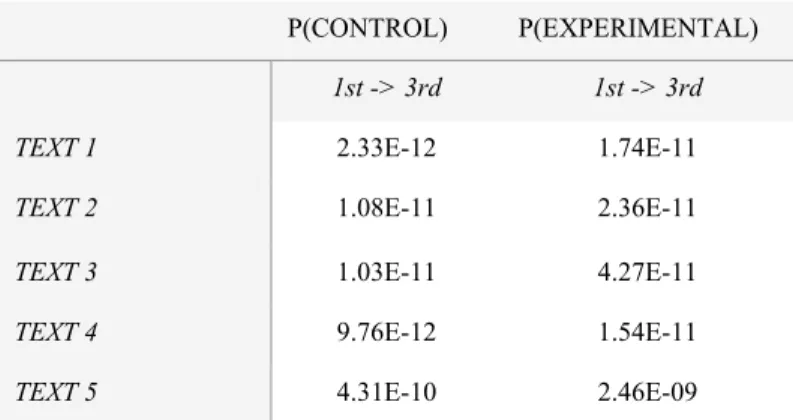
(9) 名古屋市立大学大学院人間文化研究科. 人間文化研究. 第 29 号. 2018 年 1 月. Hypothesis 4: The effects for the experimental group will increase within a single lesson compared to the control group over the repeated reading (1st reading, 2nd reading, 3rd reading). This hypothesis is investigating the short-term effects of the language patterns used for the experimental group. Table 4 shows the p-values for t-tests between the control and experimental groups for the difference between 1st and 3rd readings. If the hypothesis were true, we would expect to see lower p-values for the experimental group. This is not supported by the data, so hypothesis 4 is rejected in this study. P(CONTROL). P(EXPERIMENTAL). 1st -> 3rd. 1st -> 3rd. TEXT 1. 2.33E-12. 1.74E-11. TEXT 2. 1.08E-11. 2.36E-11. TEXT 3. 1.03E-11. 4.27E-11. TEXT 4. 9.76E-12. 1.54E-11. TEXT 5. 4.31E-10. 2.46E-09. Table 4. p-values for t-test between control and experimental groups for 1st to 3rd readings Conclusion This study has been useful in confirming the positive correlation between repeated reading and reading rate (hypothesis 1), and it is recommended that all EFL/ESL reading classes incorporate repeated reading in some form. The other hypotheses investigated the effect of NLP language patterns in the instructions on reading rate consistently (hypothesis 2), over the longitudinal period of the study (hypothesis 3) and over the short-term period of a single lesson in repeated reading activities (hypothesis 4). Although there was a clear increase in the mean reading speeds of the experimental groups, these were not found to be statistically significant at the standard confidence level of 95%. In other words, the increase in mean reading speeds can be explained by random variation in the sample data. Therefore, while this idea shows promise, the effect of NLP language patterns in instructions was found to be not significant in this study. In order to investigate this area more rigorously, some suggestions which have arisen in the course of this study are given below to act as improvements in future research design.. . The short-term effects of language patterns within a single lesson could possibly be better determined by setting a baseline for both the control group and the experimental group in every lesson. In other words, both groups would initially be given the simple instruction: “Read the. 82.
(10) Investigating Effects of Repeated Reading and NLP Language Patterns on Reading Rate(Backwell・Cullen). text.” This would enable the analysis to make comparisons between the short-term effects of the language patterns. As this would potentially reduce the long-term effects of the language patterns, it would be more straightforward to carry out a separate research study into these short-term effects.. . The timed readings in the current study were only one minute in length. This brevity likely caused ‘edge’ effects in the reading. By ‘edge’ effects, we mean that getting started and stopped can interrupt the flow of reading. A longer period for the reading would lessen the impact of these edge effects.. . Repeating the same language patterns each week is useful from an experimental research point of view. However, from a pedagogical perspective, it sounds contrived and at least some students undoubtedly recognize that the instructions are standardized which may impact on the effect. Future scripts need to have more variation or allow the teacher more flexibility in utilizing local context in the language patterns while still following the basic patterns of the Milton model.. . It would be useful to randomize participants into the control and experimental groups. This cannot be easily achieved in a classroom setting with intact research groups, so the possibilities of carrying out the reading exercises on computer are currently being investigated. This would have other additional advantages such as automating the word count and making data analysis easier.. . Because it was an EFL language class, the instructions were given in L2. This may have had some effect since there was no way to know how much of the instructions and language patterns were comprehended by the learners. To remove this issue, the instructions and language patterns could be given in L1. As with the previous suggestion, this could also be easily carried out on computer.. . One essential feature in future research is the addition of a comprehension check to ensure that participants actually read the texts. For example, Huffman (2014) followed the texts with simple YES/NO comprehension question to ensure that reading speed gains did not come at the cost of comprehension.. . This study investigated both the effects of repeated reading and the effects of NLP language patterns, a dual focus which overly complicated the study design. A simpler future design which removed the repeated reading aspect would be more robust.. The authors are planning to carry out similar studies in the near future implementing as many of these suggestions as possible. In this way, the effect of specific language patterns in instructions can be identified more clearly and the results can ultimately inform teacher practice.. 83.
(11) 名古屋市立大学大学院人間文化研究科. 人間文化研究. 第 29 号. 2018 年 1 月. Appendix 1 Students were divided (according to pre-existing classes) into control group and experimental group. Week 1 A baseline reading speed is established by giving the simple pedagogic instruction to “read the text quickly” to both groups. Control Group & Experimental Group: Follow the instructions and script for the control group Weeks 2-5 Control Group: Follow the instructions and script for the control group Experimental Group: Follow the instructions and script for the experimental group Control Group Instructions Say: “You are going to check your reading speed. You will read a text three times. If you finish the text, go back to the beginning and keep reading.” Distribute one copy of the text to each student. Prepare a one-minute timer. Start the timer when you say “go”. Say: “Read the text quickly. You have one minute. OK, 3-2-1, go.” When the timer goes off: Say “Stop. Underline the last word that you read.” Say: “Read the text quickly a second time. Start from the beginning again. You have one minute. OK, 3-2-1, go.” When the timer goes off: Say “Stop. Underline the last word that you read.” Say: “Read the text quickly a third time. Start from the beginning again. You have one minute. OK, 3-2-1, go.” When the timer goes off: Say “Stop. Underline the last word that you read.” Say: “Count the number of words that you read on the first, second and third reading.” Write your numbers in the table. Also write your speeds on your reading speed graph.”. Experimental Group Instructions Say: “You’ve read a lot of English in your life. And I’m sure you are able to read English much more quickly now that you did before, aren’t you? Of course, as you study English each week, you are naturally learning to read more quickly.. 84.
(12) Investigating Effects of Repeated Reading and NLP Language Patterns on Reading Rate(Backwell・Cullen). Today, to help you to learn to read more quickly, you are going to check your reading speed. You will read a text three times. If you finish the text, go back to the beginning and keep reading.” Distribute one copy of the text to each student. Prepare a one-minute timer. Start the timer when you say “go”. Say: “Read the text quickly. You have one minute. OK, 3-2-1, go.” When the timer goes off: Say “Stop. Underline the last word that you read.” Say: “Now that you have read the text once, you are more relaxed and ready, and you might be curious about how you can read more quickly. You have read the text once and that means that you can read it more quickly this time. And when you read faster, you can do your homework quicker, and that’s a good thing, isn’t it?” Prepare a one-minute timer. Start the timer when you say “go”. So read the text quickly a second time. Start from the beginning again. You have one minute. OK, 3-2-1, go.” When the timer goes off: Say “Stop. Underline the last word that you read.” Say: “Many of you discovered that you were able to read more the second time. That’s right. Just by reading the text again, you can begin to read more quickly because you are familiar with the text and you can let your eyes move more smoothly across the page. And this is the third time, so you can begin to enjoy reading more as you learn to read more quickly. So Read the text quickly a third time. Start from the beginning again. You have one minute. OK, 3-2-1, go.” When the timer goes off: Say “Stop. Underline the last word that you read.” Say: “Count the number of words that you read on the first, second and third reading.” Write your numbers in the table. Also write your speeds on your reading speed graph.”. References Bell, T. (2001). Extensive reading: Speed and comprehension. The reading matrix, 1(1). Cullen, B. & Mulvey, S. (2012). The Effect of Teacher Language Pattern Use on Timed Reading Speeds. Humanizing Language Teaching 14-6. Retrieved from: http://www.hltmag.co.uk/dec12/sart02.htm on August 24, 2017. Cullen, B. (2017). Utilizing Milton Language Patterns in Educational Settings. Acuity. ANLP.. 85.
(13) 名古屋市立大学大学院人間文化研究科. 人間文化研究. 第 29 号. 2018 年 1 月. Huffman, J. (2014). Reading rate gains during a one-semester extensive reading course. Reading in a Foreign Language 26(2), pp. 17–33. Retrieved from http://nflrc.hawaii.edu/rfl/October2014/articles/huffman.pdf on August 24, 2017. Taguchi, E., Takayasu-Maass, M., & Gorsuch, G. J. (2004). Developing reading fluency in EFL: How assisted repeated reading and extensive reading affect fluency development. Reading in a Foreign Language, 16(2), 70. Reading texts are from: http://college.cengage.com/collegesurvival/shared/content/timed_reading/timed_reading.html Acknowledgement The authors wish to express their gratitude to Greg Lawrence and David Urbina for their advice on statistical analysis and inference in this paper.. 86.
(14)
図
+3
関連したドキュメント
Many interesting graphs are obtained from combining pairs (or more) of graphs or operating on a single graph in some way. We now discuss a number of operations which are used
This paper is devoted to the investigation of the global asymptotic stability properties of switched systems subject to internal constant point delays, while the matrices defining
In this paper, we focus on the existence and some properties of disease-free and endemic equilibrium points of a SVEIRS model subject to an eventual constant regular vaccination
Then it follows immediately from a suitable version of “Hensel’s Lemma” [cf., e.g., the argument of [4], Lemma 2.1] that S may be obtained, as the notation suggests, as the m A
Our method of proof can also be used to recover the rational homotopy of L K(2) S 0 as well as the chromatic splitting conjecture at primes p > 3 [16]; we only need to use the
Yin, “Global existence and blow-up phenomena for an integrable two-component Camassa-Holm shallow water system,” Journal of Differential Equations, vol.. Yin, “Global weak
We study the classical invariant theory of the B´ ezoutiant R(A, B) of a pair of binary forms A, B.. We also describe a ‘generic reduc- tion formula’ which recovers B from R(A, B)
For X-valued vector functions the Dinculeanu integral with respect to a σ-additive scalar measure on P (see Note 1) is the same as the Bochner integral and hence the Dinculeanu
