International academic project analyzing
pathogenic factors in Chinese gastric B-cell
lymphomas
著者
HASUI Kazuhisa, JIA Xin Shan, SATO Eiichi,
NAKAGAWA Masanori, IZUMO Shuji
journal or
publication title
鹿児島大学医学雑誌=Medical journal of
Kagoshima University
volume
51
number
Suppl.
page range
3-5
URL
http://hdl.handle.net/10232/18346
Med. J. Kagoshima Univ., Vol. 51. Suppl. 3-5, July, 1999
International academic project
analyzing pathogenic factors in Chinese gastric B-cell lymphomas
Kazuhisa HASUI1, Xin Shan JIA2, Eiichi SATO1
Masanori NAKAGAWA3 and Shuji IZUMO4
Second Department of Pathology, Kagoshima University Faculty of Medicine
department of Molecular Pathology, China Medical University
3Third Department of Internal Medicine, Kagoshima University Faculty of Medicine
department of Molecular Pathology and Genetic Epidemiology, Centerof Chronic Viral Disease,
Kagoshima University Faculty of Medicine We have been studying virus-related malignant dis
eases in China with Prof. Jia Xin Shan, a member of this
project, who was a guest researcher in the Second Depart ment of Pathology, Kagoshima University Faculty of
Medicine.
One of our studies was the molecular pathological comparative analysis of a small number of Chinese and
Japanese cases of primary gastric B-cell lymphoma1. In
this study we found the following differences brween Chi
nese and Japanese cases. 1) Infestation of H. pylori was
recognized in smaller number of Chinese cases. 2) DNA
amplification in polymerase chain reaction (PCR) of im munoglobulin heavy chain (IgH) gene variable region in
the Chinese cases, whereas it was clarified in the result of
the PCR of human /?-globin (HBG) gene that enough qual
ity of DNA was extracted from paraffin sections. 3) Direct analysis of DNA sequence amplified in the PCR for IgH gene variable region could be performed only in two of Japanese cases. 4) The DNA sequence read suggested that the IgH gene variable region was oriented to endogenous proteins other than rheumatic factor. This study was re ported in Japanese with English abstract in the proceedings of International Gonryou Symposium in Tohoku Univer sity 1998.Then, we asked Japanese Administration of Educa tion to support our study of pathogenic factors in Chinese gastric lymphomas from a viewpoint of molecular nature of IgH gene variable region in comparison with Japanese cases. And in December 1998 we got the promise to pro mote this International academic project.
Here, we reviewed the recent studies of gastric lymphomas in Japan, made a hypothesis of gastric MALT type lymphoma and planed the survey of Chinese gastric lymphomas in comparison with Japanese cases with and without infection of human T-cell leukemia virus type 1 (HTLV-1) that is prevalent in the south part of Japan, espe cially in Kagoshima.
Recent studies of gastric lymphomas in Japan
Recent studies of the relation between infestation of
H. pylori and gastric diseases including mucosa-associated lymphatic tissue (MALT) type gastric B-cell lymphomas in
Japan were summarized by Prof. Akagi (Second Depart
ment of Pathology, Okayama University) in the sympo
sium2 of Japanese Division of International Academy of
Pathology in Nara 1998. In the infestation of H. pylori, he listed as what injuries the gastric mucosa the followings;
factors of H. pylori itself (proteinase, lipase, phospholi-pase, urease, cytotoxins, neutrophil-activating factor),
products of cells (active oxygen, free radicals, cytokines (IL-1, IL-6, IL-8, TNF-a, IFN- 7 ) and autoimmunity me diated by HLA class II antigen and heat-shock protein that
are induced with infection of H. pylori. But he stated that
pathogenesis with relation to H. pylori infection of gastric
malignant lymphoma has not yet been clarified, although infestation of H. pylori is observed in the stomach with gas tric MALT type B-cell lymphoma.
On the other hand, molecular analysis of IgH gene variable region reported by the students of Prof. Mikata
(First Department of Pathology, Chiba University) that
there were differences in the somatic hypermutation of IgH variable region of lymphoma cells between low and high
grade MALT type lymphomas3. That in low grade MALT
type lymphoma is oriented to endogenous antigen, such as rheumatoid factor, whereas that in high grade MALT type lymphoma is agianst foreign body antigen.
Nowaday, polymerase chain reaction (PCR) analy sis of IgH gene variable region has been intorudced in the diagnostic pathology to see clonality of lymphoma cells in B-cell malignant lymphoma instead of immunohistochemi-cal detection of immunoglobulin light chain restriction. But only in more or less 70% of cases applied to this PCR analysis the clonality of B-cell lymphoma cells could be proved. The number of B-cell lymphoma cells in the tis sue examined may effect on the PCR result. It is unknown whether the gastric lymphomas without DNA amplifica tion in the PCR of IgH variable region suggest a mutation in the DNA sequence corresponding to the PCR primers or on-going somatic hypermutation in IgH gene. There might be possibility of T-cell lymphomas that present mimicking histology to the MALT type B-cell lymphoma, because we experienced the gastric involvement of
angioimmu-noblastic lymphadenopathy with dysproteinemia (AILD)
type T-cell lymphoma could show many large B-cells re sembling those of high grade MALT type B-cell lymphoma.
Pathogenesis of MALT type gastric lymphoma
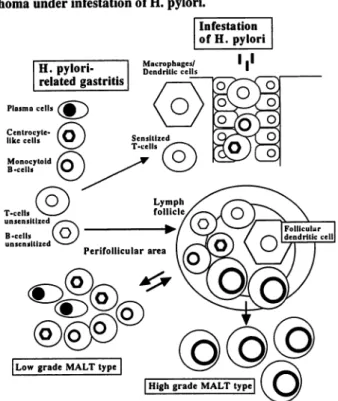
The correlation among the infestation of H. pylori4, H. pylori-related gastritis, and low and high grade MALT type lymphomas5 is presented graphically in Fig. 1.
Infestation of H. pylori induces macrophages/ histocytes and not-sensitized T-cells in the gastric mucosa. The macrophages/histiocytes, which recognized H. pylori-related antigens, present them to T-cells. The macroph ages/histiocytes and the sensitized T-cells stimulate in flammatory cells that injury gastric mucosa with free radi
synthe-C4] Kazuhisa HASUI et al.
Figure 1. A hypothesis of pathogenesis of gastric MALT type lymphoma under infestation of H. pylori.
The infestation of H. pylori induces macrophages/histocytes andnot-sensitized T-cells in the gastric mucosa. The macrophages/ histiocytes recognized H. pylori-related antigens and present them to T-cells. The macrophages/histiocytes and the sensitized T-cells stimulate inflammatory cells that injury gastric mucosa with free radicals synthesized by H. pylori and nitric oxide syn thesized by H. pylori and by induced nitric oxide synthetase
(iNOS) in the H. pylori-related gastritis. On the otherhand, the
macrophages/histiocytes and the T-cells produce a large amount of cytokines. The cytokines make B-cells to enter in germinal centerof lymphfollicle. Abnormal clones of the B-cells appear in germinal center under a large amount of the cytokines and the nitricoxide. Helper T-cells that differentiate from the sensitized
T-cells and follicular dendritic cells (FDCs) exist in the germinal
center. Neoplastic B-cellsappearalso in the abnormal clonesand pool in the marginal/perifollicular zone of the MALT. The neo plasticB-cellsmay be thoseof low-grade MALTtypelymphoma. The neoplastic B-cells form germinal center colonization, where FDCs present H. pylori-related antigens and the other antigens.
In the microenvironment with a large amount of the nitric oxide
that is a strong stimulant to lymphocytes and the other cells, the neoplasticB-cells are oriented to the antigen presented by FDCs.
The large neoplastic B-cells appeare in low grade MALT type
lymphomawould be those of high grade MALT type lymphoma.
sized by induced nitric oxide synthetase (iNOS) in the mac rophages/histiocytes in H. pylori-related gastritis.
On the other hand, the macrophages/histiocytes and
the T-cells produce a large amount of cytokines. The
cytokines make B-cells to enter in germinal center of
lymph follicle. Abnormal B-cell clones appear in germinal
center under the large amount of cytokines and the nitric oxide. Helper T-cells that differentiate from the sensitized T-cells and follicular dendritic cells (FDCs) also exist in the germinal center. Neoplastic B-cells that come from the abnormal B-cell clones pool in the marginal/ perifollicular zone. The neoplastic B-cells may be those of low-grade MALT type lymphoma. Histologically, lymphoma cells in low grade MALT type gastric lymphoma comprise centrocyte-like cells, monocytoid cells and plasma cells. The cellular composition varies from that of dominately centrocyte-like cells to that of
dominantly plasma cells (gastric immunocytoma and
plasmacytoma).
Because these lymphoma cells are of post-germinal center B-cells, occurence of these lymphoma cells is thought to be under the effects of FDCs. The IgH gene variable region of lymphoma cells in MALT type gastric
lymphoma would reflect the antigen presentation by FDCs
and nature of antigenic microenvironment of the gastric mucosa. The IgH gene variable region oriented to the en
dogenous antigens in low grade MALT type lymphoma suggests disordered presentation of endogenous antigens
by FDCs. The high grade MALT type lymphoma cells come from the low grade MAL type lymphoma cells in the germinal center colonization. Although it is unknown whether once oriented post-germinal center B-cells could be re-oriented in the germinal center, the high grade MALT
type lymphoma cells would recieve the presentation of for
eign antigen by the FDCs in the germinal center.
In the microenvironment with a large amount of
T-ccll* unsensltizcd^—^
B-cells (O )
unsensltizcd ^*—'
|Low grade MALT type
IHigh grade MALT type| ( CI)
cytokines and nitric oxide, T-cells might be disordered.
Considering the blast formation of B-cells among neoplas tic T-cells in the AILD type T-cell lymphoma, the other kind of the pathogenesis of high grade MALT type
lymphoma may be suggested. In the mixed proliferation
of T-cells and B-cells in H. pylori-related gastritis high grade MALT type B-cell lymphoma with many intermin gling T-cells might occur. Such T-cell rich B-cell lymphoma can be seen in our collected series of gastric B-cell lymphomas. Metachronous occurrence of T-cell rich gastric B-cell lymphoma was seen in a case of nodal adult
T-cell leukemia/lymphoma (ATLL)7. Stimulation of
B-cells by T-B-cells and the other microenvironmental factors such as the nitric oxide, Epstein-Barr virus (EBV) in an
immunocompromized host8 and HTLV-1 in a HTLV-1 car
rier make a chance for B-cells to be neoplastic. On the other hand, in this mixed proliferation T-cells can be neo plastic. If there is MATL type T-cell lymphoma, the MALT type T-cell lymphoma would associate B-cell pro liferation as AILD type T-cell lymphoma does.
Study design for the survey of gastric lymphomas
Considering the above-mentioned pathogenesis of MALT type gastric lymphoma, comparative study of Chi
nese and Japanese gastric lymphomas needs 1) evaluation
of H. pylori infestation in the gastric mucosa with the
lymphoma, 2) estimationof an amount of the nitric oxide in the gastric mucosa by means of immunohistochemical de tection of iNOS, 3) examination of nature of FDCs in the
germinal centers with and without germinal center coloni zation of low grade MALT type B-cell lymphoma, 4) un derstanding the state of somatic hypermutation of IgH gene variable region in low and high grade MALT type B-cell lymphoma cells by means of PCR analysis, and 5) reading DNA sequence of the IgH gene variable region for under standing the antigenic structure in a lever of DNA
se-International academic project analyzing pathogenic factors in Chinese gastric B-cell lymphomas
(5 ]
quence.The dissociation of the H. pylori infestation and the distribution of the iNOS-positive cells will suggest patho genic factors other than the H. pylori infestation in Chinese MALT type lymphomas.
The relation between the distribution of the
iNOS-positive cells and the results in the PCR analysis of IgH gene variable region will inform the degree of somatic hyper mutation and on-going somatic mutation in the IgH gene variable region of the MALT type B-cell lymphomas. Additonally, a survey of the infection of EBV and HTLV-1 will give information about the factors that con
cerns with disordered functions of the FDCs and the other
antigen-presenting cells.
Furthermore, if there will be a chance to examine
T-cell receptor (TCR) y -chain gene variable region of the primary gastric T-cell lymphomas, it will inform whether there is a MATL type T-cell lymphoma or not.
This study design will clarify the pathogenic factors
in Chinese gastric lymphomas in comparison with Japa
nese cases.
Symposium of gastric lymphomas in China
In order to success in the project study in China, we
plan symposium of gastric lymphoma in China from a
viewpointof the PCR analysis and DNA sequencing of the IgH gene variable region of gastric lymphoma cells, invit ing Japanese and Chinese speakers.
In a part of the symposium, we will understand how
Chinese gastric lymphoma is from viewpoints of clinical
diagnosis, indication of the gastrectomy in cases with gas
tric lymphoma and clinicopathological features.
The other part of the symposium concerns with technical aspect of extracting DNA from paraffin sections and with practice of the study of gastric lymphomas em ploying the molecular analysisof IgH gene variable region.
The analysis of a small piece of gastric mucosa biopsied
will be needed in some cases. In order to understand the
way of direct DNA sequencing of PCR product, technical report will be needed. Understanding somatic hypermu tation and on-goingsomatic mutation in IgH gene variable
region of B-cell lymphoma cells is quite important to per
form this project. Homology analysis of IgH gene variable region will inform the antigenic structure presented in the oncogenesis of the B-cell lymphoma.
At first, members of this project and the co-operated reseachers are necessary to understand the plan of the sym posium. We wish that the project study will start with ease after the symposium.
References
1, Jia XS, Hasui K, Sato E, Huang W, Li Y, Izumo S, Nakagawa M, Osame M. Molecular pathological comparison of primary gas tric B-cell lymphomas in China and Japan: Polymerase chain re action (PCR) analysis of immunoglobulin heavy chain gene vari able region and direct sequencing of the PCR product. Proceed ings of International Gonryou Symposium, Tohoku University, 1998. in press (in Japanese)
2, Handout of the symposium (Pathology Education Seminar) or ganized by Akagi T, Helicobacter pylori and gastric diseases. 1998.11.20 Nara Medical University, Japanese Division of Inter national Academy of Pathology
3, Yumoto N, Furukawa M, Kurosu K, Mikata A. A particular
characteristic of IgH complementary-determining region 3 sug
gests autoreactive B-cell origin of primary gastric B-cell lymphomas. Lab Invest 78(3): 261-268,1998
6, Hallas C, Greiner A, Peters K, Muller-Hermelink HK. Immu
noglobulin VH genes of high-grade mucosa-associated lymphoid
tissue lymphomas show a high load of somatic mutations and evi dence of antigen-dependent affinity maturation. Lab Invest 78(3): 277-287,1998
4, Wotherspoon AC, Ortiz Hidalgo C, Falzon MR, Isaacson PG.
Helicobacter pylori-associated gastritis and primary V-cell gas tric lymphoma. Lancet 338(8776): 1175-1176,1991
5, Isaacson PG, Norton AJ. Malignant lymphoma of the gas
trointestinal tract. In, Extranodal Lymphomas, Isaacson PG, Norton AJ., Churchill Livingstone 1994 pp. 15-65
6, NagataK, Yu H, Nishikawa M et al. Helicobacter pylorigener
ates superoxide radicals and modulates nitric oxide metabolism.
Journal of Biological Chemistry 273(23): 14071-14073,1998
7, Hasui K, Shirahama H, Sueyoshi K, Sato E, Imakuma M.
Metachronous occurrence of gastricT-cell rich B-cell lymphoma
and nodal T-cell lymphoma in a HTLV-1 carrier. Dendritic Cells 6:14-21,1996
8, Wotherspoon AC, Diss TC, Pan L, Singh N, Whelan J,
Isaacson PG. Low grade gastric B-cell lymphoma of mucosa as sociated lymphoid tissue in immunocompromised patients. Histopathology 28(2): 129-34,1996