On Infimal
Convolution of
$\mathrm{M}$-Convex Functions
東京大学大学院数理情報学専攻 室田 一雄 (Kazuo Murota)
Graduate School of Information Science and Technology, University of Tokyo
Abstract
The infimal convolution of $\mathrm{M}$-convex functions is $\mathrm{M}$-convex. This is a
funda-mental fact in discrete convex analysis that is often useful in its application to
mathematical economics and game theory. $\mathrm{M}$-convexity and its variant called $\mathrm{M}^{\mathfrak{h}_{-}}$
convexity are closely related to gross substitutability, and the infimal convolution
operation corresponds to an aggregation. This note provides a succinct description
ofthe present knowledge about the infimal convolution of$\mathrm{M}$-convex functions.
1
Definitions
Let $V$ be a nonempty finite set, and let $\mathrm{Z}$ and $\mathrm{R}$ be the sets of integers and reals,
re-spectively. We denote by $\mathrm{Z}^{V}$ the set of integral vectors indexed by $V$, and by $\mathrm{R}^{V}$ the set
of real vectors indexed by $V$. For a vector $x=(x(v)|v\in V)\in \mathrm{Z}^{V}$, where $x(v)$ is the
$v\mathrm{t}\mathrm{h}$ component of
$x$,
we
define the positive support $\mathrm{s}\mathrm{u}\mathrm{p}\mathrm{p}^{+}(x)$ and the negative support$\mathrm{s}\mathrm{u}\mathrm{p}\mathrm{p}^{-}(x)$ by
$\mathrm{s}\mathrm{u}\mathrm{p}\mathrm{p}^{+}(x)=\{v\in V|x(v)>0\}$, $\mathrm{s}\mathrm{u}\mathrm{p}\mathrm{p}^{-}(x)=\{v\in V|x(v)<0\}$.
We use notation $x(S)= \sum_{v\in S}x(v)$ for a subset $S$ of $V$
.
For each $5\subseteq V,$ we denote by$\chi_{S}$ the characteristic vector of$S$ defined by: $\chi s(v)=1$ if$v\in S$ and $\chi s(v)=0$ otherwise,
and write $\chi_{v}$ for $\mathrm{X}\{\mathrm{v}\}$ for $v\in Vr$ For a vector $p=$ $(p(v)|v\in V)$
$\in \mathrm{R}^{V}$ and a function
$f$ : $\mathrm{Z}^{V}arrow \mathrm{R}\cup\{+\infty\}$,
we
define functions $\langle p, x\rangle$ and $f[p](x)$ in $x\in \mathrm{Z}^{V}$ by $\langle p, x\rangle$ $= \sum_{v\in V}p(v)x(v)$,$f[\mathrm{p}](x)=f(x)+\langle p, x\rangle$
.
We also denote the set of minimizers of$f$ and the effective domain of $f$ by
$\arg\min f=\{x\in \mathrm{Z}^{V}|f(x)\leq f(y)(\forall y\in \mathrm{Z}^{V})\}$,
domf
$=\{x\in \mathrm{Z}^{V}|f(x)<+\mathrm{o}\mathrm{o}\}$.
We say that a function $f$ : $\mathrm{Z}^{V}arrow \mathrm{R}\cup\{+\infty\}$ with $\mathrm{d}\mathrm{o}\mathrm{m}/$ $\neq\emptyset$ is $M$
-convex
if it satisfiesthe exchange axiom:
($\mathrm{M}$-EXC) For$x$,$y\in$ dom$f$ and$u\in \mathrm{s}\mathrm{u}\mathrm{p}\mathrm{p}^{+}(x-y)$, there exists$v\in \mathrm{s}\mathrm{u}\mathrm{p}\mathrm{p}^{-}(x-y)$
21
$f(x)+f(y)\geq f(x-\chi_{u}+\chi_{v})+f(y+\chi_{u}-\chi_{v})$. (1)
The inequality (1) implicitly imposes the condition that $x-\chi_{u}+\chi_{v}\mathrm{E}$ dom$f$ and$y+\chi_{u}-$
$\chi_{v}\in$ dom/ for the finiteness of the right-hand side. A function $f$ is said to be M-concave
if $-f$ is M-convex.
As a consequence of ($\mathrm{M}$-EXC), the effective domain of an $\mathrm{M}$
-convex
function $f$ lies ona
hyperplane $\{x\in \mathrm{R}^{V}|x(V)=r\}$ forsome
integer $r$, and accordingly,we
may considerthe projection of $f$ along a coordinate axis. This
means
that, instead ofthe function $f$ in$n=|\mathrm{I}/$ $|$ variables, we may consider a function $f$
’ in $n-1$ variables defined by
$f’(x’)=f(x_{0}, x’)$ with $x_{0}=r-x’(V’)$, (2)
where $V’=V\backslash \{v_{0}\}$ for an arbitrarily fixed element $)_{0}$ $\in V,$ and a vector
$x\in \mathrm{Z}^{V}$ is
represented
as
$x=(x_{0}, x’)$ with $x_{0}=x(v_{0})\in \mathrm{Z}$ and $x’\in \mathrm{Z}^{V’}$ Note that the effectivedomain
domf’
of $f’$ is the projection of $\mathrm{d}\mathrm{o}\mathrm{m}/$ along the chosen coordinate axis 110. Afunction $f$’ derived from an$\mathrm{M}$-convexfunction by suchprojection iscalled an
$\mathrm{M}^{\mathfrak{h}}- \mathrm{c}\mathrm{o}\mathrm{n}\mathrm{v}\mathrm{e}\mathrm{x}^{1)}$
function.
More formally, an $\mathrm{M}\#$
-convex
function is definedas
follows. Let “0” denotea new
element not in $V$ and put $\tilde{V}=\{0\}\cup V.$ A function $f$ : $\mathrm{Z}^{V}arrow \mathrm{R}\cup\{+\infty\}$ is called
$M$
-convex
if the function $\tilde{f}:\mathrm{Z}^{\overline{V}}arrow \mathrm{R}\cup\{+\infty\}$ defined by$\tilde{f}(x_{0}, x)=\{$
$f(x)$ if$x_{0}=-x(V)$
$+\infty$ otherwise
$(x_{0}\in \mathrm{Z}, x\in \mathrm{Z}^{V})$ (3)
is an $\mathrm{M}$-convex function. It is known (see [4, Theorem 6.2]) that an
$\mathrm{M}^{\mathfrak{h}}$
-convex
function $f$can be characterized by a similar exchange property:
($\mathrm{M}^{\mathfrak{g}}$-EXC) For x, y $\in$ $\mathrm{d}\mathrm{o}\mathrm{m}/$ and u $\in \mathrm{s}\mathrm{u}\mathrm{p}\mathrm{p}^{+}(x-y)$ ,
$f(x)+f(y)$ $\geq$ $\min[f(x-\chi_{u})+f(y+\chi_{u})$,
$v\in \mathrm{s}\mathrm{u}\mathrm{p}\mathrm{p}\mathrm{m}\underline{\mathrm{i}}$n
$oe-y$)
$\{f(x-\chi_{u}+ \mathrm{x}v)+f(y+\chi_{u}-\chi_{v})\}]$ , (4)
where the minimum
over
an empty set is $+\mathrm{o}\mathrm{o}$ by convention. A function $f$ is said to be$M^{\mathfrak{h}}$
-concave
if $-f$ is $\mathrm{M}^{\mathfrak{h}}$
-convex.
Whereas $\mathrm{M}^{\mathfrak{y}}$
-convex functions are conceptually equivalent to $\mathrm{M}$
-convex
functions, the$\mathrm{c}\mathrm{l}\mathrm{a}\mathrm{s}$ of $\mathrm{M}^{\mathfrak{h}}$
-convex
functions is strictly larger than that of $\mathrm{M}$-convex
functions. Thisfollows from the implication: ($\mathrm{M}$-EXC) $\Rightarrow$ (
$\mathrm{M}^{\mathfrak{h}}$-EXC). The simplest example of
an
$\mathrm{M}^{\mathfrak{h}_{-}}$convex function that is not $\mathrm{M}$
-convex
is aone-dimensional
(univariate) discreteconvex
function, depicted in Fig. 1.
Proposition 1 ([4, Theorem 6.3]). An $M$
-convex
function
is l$-convex. Conversely,an $M$
-convex
function
is $M$-convex
if
and onlyif
theeffective
domain is contained in $a$hyperplane $\{x\in \mathrm{Z}^{V}|x(V)=r\}$
for
some
$r\in$ Z.$\vec{x}$
Figure 1: Univariate discrete convex function
$\mathrm{M}^{\mathfrak{h}}$
-convex
functions enjoy a number of nice properties thatare
expected of “discreteconvex
functions.” Furthermore, $\mathrm{M}^{\mathfrak{h}}$-concavefunctions provide with a natural model of
utility functions (see [4,
\S 11.3]
and [5]). In particular, it is known that $\mathrm{M}^{\mathfrak{h}}$-concavity is
equivalent to gross substitutes property, and that $\mathrm{M}^{\mathfrak{h}}$
-concavity implies submodularity,
which is the discrete version ofdecreasing marginal returns.
It follows from ($\mathrm{M}$-EXC) that the effective domain ofan $\mathrm{M}$ convex function$f$ satisfies
the exchange axiom:
($\mathrm{B}$-EXC) For $x$,$y\in B$ and $u\in \mathrm{s}\mathrm{u}\mathrm{p}\mathrm{p}^{+}(x- y)$, there exists $v\in \mathrm{s}\mathrm{u}\mathrm{p}\mathrm{p}^{-}(x-y)$
such that $x-\chi_{\mathrm{u}}+\chi_{v}\mathrm{E}$ $B$ and $ll$$+\chi_{u}-\chi v$ $\mathrm{E}$ $B$,
since $x-\chi_{u}+\chi_{v}\in$ dom$f$ and $y+\chi_{u}-\chi_{v}\in$ dom$f$ for$x$,$y\in$ dom$f$ in (1). A nonempty
set $B$ of integer points satisfying ($\mathrm{B}$-EXC) is referred to as an $M$ convex set.
2
Convolution
Theorem
For a pair of functions $f1$, $f_{2}$ : $\mathrm{Z}^{V}arrow \mathrm{R}\cup\{+\infty\}$, the integer
infimal
convolution is afunction $f_{1}\square _{\mathrm{Z}}f_{2}$ : $\mathrm{Z}^{V}arrow \mathrm{R}\cup\{\pm\infty\}$ defined by
$(f1 \square _{\mathrm{Z}}f_{2})(x)=\inf\{f1(x_{1})+f_{2}(x_{2})|x=x_{1}+x_{2}, x_{1}, x_{2}\in \mathrm{Z}^{V}\}$ $(x\in \mathrm{Z}^{V})$
.
(5)Provided that $\mathrm{A}\square _{\mathrm{Z}}f_{2}$ is away from the value of $-\mathrm{o}\mathrm{o}$,
we
have$\mathrm{d}\mathrm{o}\mathrm{m}(f_{1}\square _{\mathrm{Z}}f_{2})=$dom$f1+$dom$f_{2}$, (6)
where the right-hand side
means
the Minkowski sum ofthe effective domains.The convolution theorem reads as follows.
Theorem 2 ([4, Theorem
6.13}).
For$M$-convexfunctions
fl
and$f_{2}$, the integerinfimal
convolution
f
$=f1\square \mathrm{z}f_{2}$ is $M$-convex providedf
$>-\mathrm{o}\mathrm{p}$.A proof of this theorem is given in Section 3, whereas the $\mathrm{M}^{\mathfrak{h}}$
-version below is an
immediate corollary.
Corollary 3 ([4, Theorem 6.15]). For $M$
-convex
functions fl
and$f_{2\mathrm{z}}$ the integer23
Proof.
Let $\tilde{f}_{1}$ and $\tilde{f}_{2}$ be the $\mathrm{M}$-convex functions associated with the$\mathrm{M}^{\mathfrak{h}}$
-convex functions
$f_{1}$ and $f_{2}$ as in (3). For $x_{0}$ $\in \mathrm{Z}$, $x\in \mathrm{Z}^{V}$ we have
$(\tilde{f}_{1}\square _{\mathrm{Z}}\tilde{f}_{2})(x_{0}, x)$
$= \inf\{\tilde{f}_{1}(y_{0}, y)+\tilde{f}_{2}(z_{0}, z) |x=y+z, x_{0}=y0 +z_{0}\}$
$= \inf\{f_{1}(y)+f_{2}(z)|x=y+z, x_{0}=y_{0}+z0,\mathit{1}0=-y(V), z_{0}=-z(V)\}$
$= \inf\{f1(y)+f_{2}(z)|x=y+z, x_{0}=-x(V)\}$
$=\{$
$(f_{1}\square \mathrm{z}f_{2})(x)$ if$x_{0}=-x(V)$
$+\mathrm{c}\mathrm{x})$ otherwise.
This shows $\tilde{f}_{1}\square _{\mathrm{Z}}\tilde{f}_{2}=(f_{1}\square _{\mathrm{Z}}f_{2})^{\sim}$ in the notation of (3), whereas $\tilde{f}_{1}\square \mathrm{z}\tilde{f}_{2}$ is $\mathrm{M}$-convex by
Theorem 2 apphed to $\tilde{f}_{1}$ and $\tilde{f}_{2}$
.
Therefore, $f_{1}\square \mathrm{z}f_{2}$ is $\mathrm{M}^{\mathrm{Q}}$-convex. $\square$Remark 1. The convolution theorem (Theorem 2) originates in [1, Theorem 6.10], and
is described in [2, p. 80, Theorem 2.44 (5)], [3, p. 118, Theorem 4.8 (8)], and [4, p. $143_{;}$
Theorem 6.13 (8)$]$
.
The$\mathrm{M}^{\mathfrak{h}}$
-version (Corollary 3) is also stated in [2, p. 83], [3, p. 119,
Theorem 4.10], and [4, p. 144, Theorem 6.15 (1)]. An application of this fact to the
aggregation ofutility functionscan be foundin [3, p. 275, Proposition 9.13] and [4, p. 337,
Theorem 11.12]. In particular, the convolution theorem implies that if the individual
utility functions enjoy gross substitutes property, so does the aggregated utility function.
sg
3
Proof
The proofof Theorem 2 given here relies on two fundamental facts stated in the lemmas
below. The first shows that the class of$\mathrm{M}$-convex setsis closed under Minkowski addition,
and the second gives a characterization of an $\mathrm{M}$-convex function in terms of M-convex
sets.
Lemma 4([4, Theorem 4.23]). The Minkowski sum
of
tuto $M$-convexsetsis M-convex.Lemma 5([4, Theorem 6.30]). Let $f$ : $\mathrm{Z}^{V}arrow \mathrm{R}\cup\{+\infty\}$ be a
function
with a boundednonempty
effective
domain. Then, $f$ is $M$-convexif
and onlyif
$\arg\min f[-p]$ isan
M-convex set
for
each$p\in \mathrm{R}^{V}$Let $f_{1}$ and $f_{2}$ be $\mathrm{M}$
-convex
functions, and put $f=f1\square \mathrm{z}f_{2}$. Firstwe
treat thecase
where $\mathrm{d}\mathrm{o}\mathrm{m}/\mathrm{i}$ and $\mathrm{d}\mathrm{o}\mathrm{m}/2$ are bounded. The expression (6) shows that $\mathrm{d}\mathrm{o}\mathrm{m}/$ is bounded.
For each$p\in \mathrm{R}^{V}$
we
have$f[-p]=(f_{1}[-p])\square \mathrm{z}(f_{2}[-p])$,
from which follows
by (5). In this expression, both $\arg\min f1[-p]$ and $\arg\min f_{2}[-p]$ are $\mathrm{M}$-convex sets by
Lemma 5 (only if part), and therefore, their Minkowski sum (the right-hand side) is
M-convex by Lemma 4. This
means
that $\arg\min f[-p]$ is $\mathrm{M}$-convex for each $p\in \mathrm{R}^{V}$, whichimplies the $\mathrm{M}$-convexity of $f$ by Lemma 5 (if part).
The general case without the boundedness assumption
on
effective domainscan
betreated via limiting procedure as follows. For $i=1,2$ and $k=1,2$,$\ldots$ , define
$f_{i}^{(k)}$ : $\mathrm{Z}^{V}arrow$ $\mathrm{R}$LJ $\{+\infty\}$ by $f_{i}^{(k)}(x)=\{$ $f_{i}(x)$ if $||x||_{\infty}\leq k$ $(x\in \mathrm{Z}^{V})$, $+\infty$ otherwise
which is an $\mathrm{M}$-convex function with abounded effective domain, provided that $k$ is large
enoughfor$\mathrm{d}\mathrm{o}\mathrm{m}f_{\dot{1}}^{(k)}\neq\emptyset$. For each $k$, the infimal convolution $f^{(k)}=f_{1}^{(k)}\square \mathrm{z}f_{2}^{(k)}$ isM-convex
by the above argument, and moreover, $\lim_{karrow\infty}f^{(k)}(x)=f(x)$ for each $x$
.
It remains todemonstrate the property ($\mathrm{M}$-EXC) for $f$
.
Take $x$,$y\in \mathrm{d}\mathrm{o}\mathrm{m}f$ and $u\in \mathrm{s}\mathrm{u}\mathrm{p}\mathrm{p}^{+}(x- y)$.
Thereexists $k_{0}=k_{0}(x, y)$, depending
on
$x$ and $y$, such that $x$,$y\in \mathrm{d}\mathrm{o}\mathrm{m}f^{(k)}$ for every $k\geq k_{0}$.
Since $f^{(k)}$ is $\mathrm{M}$-convex, there exists Vk $\in \mathrm{s}\mathrm{u}\mathrm{p}\mathrm{p}^{-}(x-y)$ suchthat
$f^{(k)}(x)+f^{(k)}(y)\geq f^{(k)}(x-\chi_{u}+\chi_{v_{h}})+f^{(k)}(y+\chi_{u}-\chi_{v_{k}})$
.
Since $\mathrm{s}\mathrm{u}\mathrm{p}\mathrm{p}^{-}(x-y)$ is a finite set, at least
one
element of$\mathrm{s}\mathrm{u}\mathrm{p}\mathrm{p}^{-}(x-y)$ appears infinitelymany times in the sequence $v_{1}$,$v_{2}$,$\ldots$ . More precisely, there exists $v\in \mathrm{s}\mathrm{u}\mathrm{p}\mathrm{p}^{-}(x-y)$ and
an increasing subsequence $k_{1}<k_{2}<|$ $\cdot\cdot$ such that
$v_{k_{j}}=v$ for $j=1,2$ , $\ldots$
.
By letting $1k$ $arrow\infty$ along this subsequence in the above inequality we obtain$f(x)+f(y)\geq f(x-\chi_{u}+\chi_{v})+f(y+\chi_{u}-\chi_{v})$.
This $f$ satisfies ($\mathrm{M}$-EXC). This completes the proofof Theorem 2.
Remark 2. Here is an example to demonstrate the necessity ofthe limiting argument in
the above proof. For $\mathrm{M}$
-convex
functions fl,$f_{2}$ : $\mathrm{Z}^{2}arrow \mathrm{R}$defined by$f_{1}(x)=\{$ $\mathrm{e}\mathrm{x}+$
p(-x(l))if
$x(1)+x(2)=0,$ $f_{2}(x)=\{$ otherwise, $\exp \mathrm{x}(1)$ if$x(1)+x(2)=0,$ $+\infty$ otherwise, we have$\mathrm{f}(\mathrm{x})=(f_{1}\square _{\mathrm{Z}}f_{2})(x)=\inf\{\exp(-t)+\exp(x(1)-t)|t\in \mathrm{Z}\}=0$
for all $x\in \mathrm{Z}^{2}$ with $x(1)+x(2)=0.$ The infimum is not attained by any finite $t$, and
consequently, $f^{(k)}(x)$ isnot equalto $f(x)$ for any finite $k$
.
Thisis whywe need thelimitingargument in the proof. $\blacksquare$
Remark 3. The infimal convolution operation of$\mathrm{M}$
-convex
functionscan
be formulatedas a special case of the transformation of an $\mathrm{M}$
-convex
function by a network, and theconvolution theorem (Theorem 2) can be understood as a special case of a theorem on
25
Thegeneralframework ofthenetwork transformationisasfollows. Let $G=(V, A;S, T)$
be adirected graph withvertex set $V$, arcset$A$, entranceset $S$ and exit set$T$, where $S$ and
$T$ are disjoint subsets of$V$. We consider an integer-valued flow $\xi=(\xi(a)|a\in A)\in \mathrm{Z}^{A}$
.
For each $a\in A,$ the cost of the flow $\xi(a)$ through arc $a$ is represented by a function
$f_{a}$ : $\mathrm{Z}" \mathrm{r}$ $\mathrm{R}\mathrm{U}\{+\infty\}$
.
Given a function $f$ : $\mathrm{Z}^{S}arrow \mathrm{R}\cup\{+\infty\}$ associated with the entranceset $S$, we define another function $\hat{f}:\mathrm{Z}^{T}arrow \mathrm{R}\cup\{\pm\infty\}$ on the exit set $T$ by
$\hat{f}$(y)$)$
$= \inf_{\xi,x}\{f(x)+\sum_{a\in A}f_{a}(\xi(a))|\partial\xi=(x, -y, 0)$,
$\xi\in \mathrm{Z}^{A}$, $(x, -y, 0)\in \mathrm{Z}^{S}\mathrm{x}\mathrm{Z}^{T}\mathrm{x}\mathrm{Z}^{V\backslash (S\cup T)}\}$ $(y\in \mathrm{Z}^{T})$,
where $\partial\xi\in \mathrm{Z}^{V}$ denotes a vector defined by
$\partial\xi(v)=$ $\mathrm{p}$
{
$\xi(a)$ $|$ arc $a$ leaves vertex$v$}
- $\mathrm{B}${
$\xi(a)$$|$ arc $a$ enters vertex$v$
}
$(v\in V)$.
We may think of $\hat{f}$(tt) as the minimum cost of
an
integer-valued flow to meet a demandspecification $y$ at the exit, where the cost consists of two parts, the cost $f(x)$ of supply
or production of $x$ at the entrance and the cost $\sum_{a\in A}f_{a}(\xi(a))$ oftransportation through
arcs; the sum ofthese is to be minimized
over
varying supply $x$ and flow4
subject to theflow conservation constraint $\partial\xi=$ $(x$,-1,0$)$. We regard $\hat{f}$as a transformation of$f$ by the
network.
It is known ([4, Theorem 9.27]) that if $f_{a}$ is a univariate discrete
convex
function foreach $a\in A$ and $f$ is an $\mathrm{M}$
-convex
function, then $\hat{f}$is an $\mathrm{M}$-convex
function, provided that$\hat{f}>-\infty$ and $\hat{f}\not\equiv\dagger \mathrm{o}\mathrm{o}$.
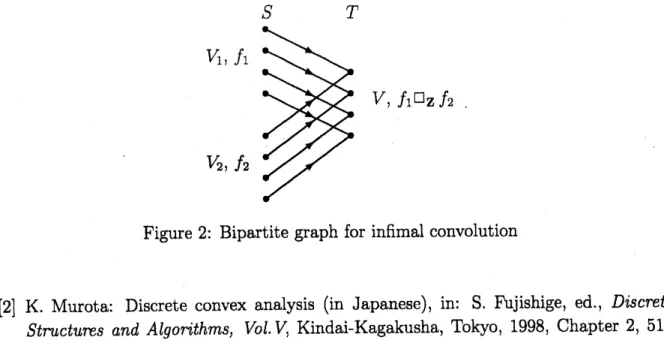
For the infimal convolution offunctions $f_{1}$ and $f_{2}$, let $V_{1}$ and $V_{2}$ be copies of $V$ and
consider a bipartite graph $G–$$(S,JT, A;S, T)$ (see Fig. 2) with $S=V_{1}\cup V_{2}$, $T=V$ and
$A=\{(v_{1}, v)|v\in V\}\cup$ {(vi,$v)|v\in V$
},
where $v_{i}\in V_{i}$ is the copy of $v\in V$ for $i=1,2$.
We regard $f_{i}$ as being defined on $V_{i}$ for $i=1,2$ and
assume
that the arc cost functions$f_{a}(a\in A)$ are identically
zero.
The function $\hat{f}$induced on $T$ coincides with the infimalconvolution $f_{1}\square _{\mathrm{Z}}f_{2}$
.
In this case it is always true that$\hat{f}\not\equiv+\mathrm{o}\mathrm{o}$. Thus the convolution
th or$\mathrm{e}\mathrm{m}$ (Theorem 2) follows from [4, Theorem 9.27]$)$ as is explained in [4, Note 9.30].
The connection to network transformation also suggests that the infimal convolution
from
$f_{2}$can
be evaluatedby solvingan
$\mathrm{M}$
-convex
submodularflow problem;see
[4, Section9.2] for the definition ofthe problem and [4, Section 10.4] for algorithms. $\blacksquare$
Acknowledgement The author thanks Takuya Iimura and Akihisa Tamura for helpful
comments.
References
[1] K. Murota: Convexity and Steinitz’s exchange property, Advances in Mathematics,
S $T$
$V_{1}$, $f_{1}$
V, $f1\square _{\mathrm{Z}}f_{2}$
$V_{2}$, $f_{2}$
Figure 2: Bipartite graph for infimal convolution
[2] K. Murota: Discrete
convex
analysis (in Japanese), in: S. Fujishige, ed., DiscreteStructures and Algorithms, Vol.V, Kindai-Kagakusha, Tokyo, 1998, Chapter 2,
51-100.
[3] K. Murota: Discrete Convex Analysis–An Introduction (in Japanese), Kyoritsu
Pub-lishing Co., Tokyo, 2001.
[4] K. Murota: Discrete Convex Analysis, SIAIVI Monographs
on
Discrete Mathematicsand Applications, Vol. 10, Society for Industrial and Applied Mathematics,
Philadel-phia, 2003.
[5] A. Tamura: Applications of discrete
convex
analysis to mathematical economics,Publications
of
Research Institutefor
Mathematical Sciences, 2004, to appear.[3] K. Murota: Discrete Convex Analysis–An Introduction (in Japanese), Kyoritsu
Pub-lishing Co., Tokyo, 2001.
[4] K. Murota: Discrete Convex Analysis, SIAM Monographs
on
Discrete Mathematicsand Applications, Vol. 10, Society for Industrial and Applied Mathematics,
Philadel-phia, 2003.
[5] A. Tamura: Applications of discrete