Fokas-Lenells
の微分型非線形シュレーディンガー方程式の直接解法
Direct method of solution for the Fokas-Lenells
derivative nonlinear Schr\"odinger equation
山口大学大学院理工学研究科 松野 好雅 (Yoshimasa Matsuno)
Division of Applied Mathematical Science
Graduate School of Science
and EngineeringYamaguchi University
E-mail address: [email protected]
Abstract
We developed
a
systematic method for obtaining soliton solutions of theFokas-Lenells derivative nonlinear Schr\"odingerequation ($FL$equation shortly) under
non-vanishing boundary condition. In particular,
we
deal with dark soliton solutionswith
a
planewave
boundary condition. We first derive the novel system ofbilinearequations which is reduced from the $FL$ equation through
a
dependent variabletransformation and then construct the general dark $N$-soliton solution of the
sys-tem, where $N$ is anarbitrary positive integer. We then investigatethepropertiesof
the one-soliton solutions in detail, showing that both the dark and bright solitons
appear on the
nonzero
background which reduce to algebraic solitons in specificlimits. Last, the interaction process of two solitons is described.
1. Introduction
We consider the following Fokas-Lenells ($FL$) equation which can be derived from
its original version by
a
simple change of variables combined with a gaugetrans-formation:
$u_{xt}=u-2i|u|^{2}u_{x}$. (1.1)
Here, $u=u(x, t)$ is a complex-valued function of $x$ and $t$, and subscripts $x$ and
$t$ appended to
$u$ denote partial differentiations. The known results about the $FL$
equation
are:
$\bullet$ An integrable generalization of the nonlinear Schr\"odinger equation, Fokas [1].
$\bullet$ Inverse scattering transform method under the vanishing boundary condition,
Lenells and Fokas [2].
$\bullet$ $A$ model equation for the propagation of nonlinear light pulses in monomode
optical fibers, Lenells [3].
$\bullet$ The
first
negative member of the integrable hierarchyof the derivative nonlinear
$\bullet$
Derivation
of the bright soliton solutions,Lenells
[4], Matsuno [5].The purposes of the present report
are:
$\bullet$ To construct the dark $N$-soliton solution of the $FL$ equation
on
the backgroundof a plane wave. Explicitly, we consider the boundary condition
$uarrow\rho\exp\{i(\kappa x-\omega t+\phi^{(\pm)})\}, xarrow\pm\infty$, (1.2)
where
$\rho(>0)$and
$\kappa$are
realconstants representing the amplitude and wavenumber,respectively, $\phi^{(\pm)}$
are
real phase constants and the angular frequency $\omega=\omega(\kappa)$obeys the dispersion relation $\omega=1/\kappa+2\rho^{2}.$
$\bullet$ To investigate the properties of dark soliton solutions.
This report is the summary of the paper by Matsuno [6].
2. Exact method of solution
2.1. Bilinearezation
Proposition 2.1. By
means
of
the
dependent variabletmnsformation
$u=\rho e^{i(\kappa x-\omega t)_{\frac{g}{f’}}}$ (2.1)
with $\omega=1/\kappa+2\rho^{2}$, equation (1.1)
can
be decoupled into the following systemof
bilinear equations
for
the $tau$functions
$f$ and$g$$D_{t}f\cdot f^{*}-i\rho^{2}(gg^{*}-ff^{*})=0$, (2.2)
$D_{x}D_{t}f\cdot f^{*}-i\rho^{2}D_{x}g\cdot g^{*}+i\rho^{2}D_{x}f\cdot f^{*}+2\kappa\rho^{2}(gg^{*}-ff^{*})=0$, (2.3)
$D_{x}D_{t}g\cdot f+i\kappa D_{t}g\cdot f-i\omega D_{x}g\cdot f=0$
.
(2.4)Here, $f=f(x, t)$ and$g=g(x, t)$ are complex-valued
functions of
$x$ and$t$, and theasterisk appended to $f$ and$g$ denotes complex conjugate and the bilinear opemtors
$D_{x}$ and $D_{t}$ are
defined
by$D_{x}^{m}D_{t}^{n}f \cdot g=(\frac{\partial}{\partial x}-\frac{\partial}{\partial x’})^{m}(\frac{\partial}{\partial t}-\frac{\partial}{\partial t’})^{n}f(x, t)g(x’, t’)|_{x’=x,t’=t}$, (2.5)
where $m$ and $n$ are nonnegative integers.
Proof. Substituting (2.1) into (1.1) and rewritingthe resultant equation in terms
of the bilinear operators, equation (1.1)
can
be rewrittenas
$- \frac{g}{f^{3}f^{*}}\{f^{*}D_{x}D_{t}f\cdot f-2\kappa\rho^{2}f^{2}f^{*}-2i\rho^{2}g^{*}(g_{x}f-gf_{x}+i\kappa fg)\}=0$. (2.6)
Inserting the identity
$f^{*}D_{x}D_{t}f\cdot f=fD_{x}D_{t}f\cdot f^{*}-2f_{x}D_{t}f\cdot f^{*}+f(D_{t}f\cdot f^{*})_{x}$, (2.7)
which can be verified by direct calculation, int$0$ the second term
on
the left-handside of (2.6),
one
modifies it in the form$\frac{1}{f^{2}}(D_{x}D_{t}g\cdot f+i\kappa D_{t}g\cdot f-i\omega D_{x}g\cdot f)$
$- \frac{g}{f^{3}f^{*}}[f\{D_{x}D_{t}f\cdot f^{*}-i\rho^{2}D_{x}g\cdot g^{*}+i\rho^{2}D_{x}f\cdot f^{*}+2\kappa\rho^{2}(gg^{*}-ff^{*})\}$
$-2f_{x}\{D_{t}f\cdot f^{*}-i\rho^{2}(gg^{*}-ff^{*})\}+f\{D_{t}f\cdot f^{*}-i\rho^{2}(gg^{*}-ff^{*})\}_{x}]=0$. (2.8)
By virtue of equations $(2.2)-(2.4)$, the left-hand side of (2.8) vanishes identically.
口
It follows from (2.1) and (2.2) that
$|u|^{2}= \rho^{2}+i\frac{\partial}{\partial t}\ln\frac{f^{*}}{f}.$ (2.9)
2.2. Trilinear equation
Proposition 2.2. The trilinear equation
for
$f$ and$g$$f^{*} \{g_{xt}f-(f_{x}-i\kappa f)g_{t}-i(\frac{1}{\kappa}+\rho^{2})(g_{x}f-gf_{x})\}=f_{t}^{*}(g_{x}f-gf_{x}+i\kappa fg)$,
(2.10)
is a consequence
of
the bilinear equations (2.2)-(2.4).Proof. By direct calculation, one can show the following trilinear identity among
the tau functions $f$ and $g$:
$f^{*} \{g_{xt}f-(f_{x}-i\kappa f)g_{t}-i(\frac{1}{\kappa}+\rho^{2})(g_{x}f-gf_{x})\}-f_{t}^{*}(g_{x}f-gf_{x}+i\kappa fg)$
$=f^{*}(D_{x}D_{t}g\cdot f+i\kappa D_{t}g\cdot f-i\omega D_{x}g\cdot f)$
$- \frac{g}{2}[\{D_{t}f\cdot f^{*}-i\rho^{2}(gg^{*}-ff^{*})\}_{x}+(D_{x}D_{t}f\cdot f^{*}-i\rho^{2}D_{x}g\cdot g^{*}+i\rho^{2}D_{x}f\cdot f^{*}-2i\kappa D_{t}f\cdot f^{*})]$
$+g_{x}\{D_{t}f\cdot f^{*}-i\rho^{2}(gg^{*}-ff^{*})\}$. (2.11)
Replacing a term $2i\kappa D_{t}f\cdot f^{*}$
on
the right-hand side of (2.11) by (2.2), the3. Dark $N$-soliton
solution
3.1. Main result
Theorem
3.1. The dark $N$-soliton solutionof
the systemof
bilinear equations(2.2)-(2.4) is expressed by the following determinants
$f=|D|, (31a)$
$D$
$g=\tau^{1_{Z_{t}^{*}}}\rho$
$z_{1}^{T}|=|D|+\frac{1}{\rho^{2}}|_{z_{t}^{*}}^{D}$ $z_{0}^{T}|.$ $(31b)$
Here, $D$ is
an
$N\cross N$ matrix and $z$ and $z_{t}$ are $N$-componentrow
vectorsdefined
below and the symbol $T$ denotes the tmnspose:
$D=(d_{jk})_{1\leq j,k\leq N}, d_{jk}= \delta_{jk}+\frac{\kappa-ip_{j}}{p_{j}+p_{k}^{*}}z_{j}z_{k}^{*},$
$z_{j}= \exp(p_{j}x+\frac{\kappa\rho^{2}}{p_{j}}t+\frac{1}{p_{j}+i\kappa}\tau+\zeta_{j0}) , (3.2a)$
$Z=(z_{1}, z_{2}, \ldots, z_{N}) , z_{t}=(\frac{\kappa\rho^{2}z_{1}}{p_{1}}, \frac{\kappa\rho^{2}z_{2}}{p_{2}}, \ldots, \frac{\kappa\rho^{2}z_{N}}{p_{N}}) , (3.2b)$
where$p_{j}$
are
complex pammeters satisfying the constraints$(p_{j}+ i\kappa)(p_{j}^{*}-i\kappa)=\frac{1+\kappa\rho^{2}}{\kappa\rho^{2}}p_{j}p_{j}^{*}, j=1,2, \ldots, N, (3.2c)$
$\zeta_{j0}(j=1,2, \ldots, N)$
are
arbitmry complex pammeters, $\delta_{jk}$ is kronecker’s delta and $\tau$ is an auxiliary variable.3.2. Remarks
$\bullet$ The dark $N$-soliton solution is parameterized by $2N$ complex parameters
$p_{j}$ and
$\zeta_{j0}(j=1,2, \ldots, N)$
.
The parameters $p_{j}$ determine the amplitude and velocity ofthe solitons whereas the parameters $\zeta_{j0}$ determine the phase of the solitons. As
opposed to the bright soliton case, however, the real and imaginary parts of$p_{j}$ are
not independent because of the constraints (3.2c).
$\bullet$ The dark $N$-soliton solution (3.1) solves the bilinear equations (2.2) and (2.3)
without the constraints (3.2c).
$\bullet$ The trilinear equation (2.10) will beproved in place ofthe bilinear equation (2.4)
where
we use
the relations$f_{t}=(1+\kappa\rho^{2})f_{\tau}, g_{t}=(1+\kappa\rho^{2})g_{\tau}.$
4. Stability of the plane
wave
We have considered the dark solitons on the background of
a
planewave
$\rho e^{i(\kappa x-\omega t)}$with $\omega=1/\kappa+2\rho^{2}$. It is important to
see
whether the background field is stableor
not against perturbations. If unstable, then darksolitons would not exist. Here,we
perform the linear stability analysis of the planewave.
Following the standard procedure, we seek a solution ofthe form
$u=(\rho+\triangle\rho)e^{i(\kappa x-\omega t+\triangle\phi)}$, (4.1)
where $\Delta\rho=\triangle\rho(x, t)$ and $\triangle\phi=\triangle\phi(x, t)$
are
small perturbations. Substituting(4.1) into the $FL$ equation (1.1) and linearizing about the plane wave, we obtain
the system of linear PDEs for $\triangle\rho$ and $\triangle\phi$
$\triangle\rho_{xt}+\rho(\omega-2\rho^{2})\triangle\phi_{x}-\kappa\rho\triangle\phi_{t}-4\kappa\rho^{2}\triangle\rho=0, (4.2a)$
$\rho\triangle\phi_{xt}-(\omega-2\rho^{2})\triangle\rho_{x}+\kappa\Delta\rho_{t}=0. (4.2b)$ Assume the perturbations of the form $e^{i(\lambda x-\nu t)}$ with $\lambda$ real and
$v$ possibly complex
and substitute them into (4.2) to obtain
a
homogeneous linear system for $\triangle\rho$and$\triangle\phi$
$(\lambda\nu-4\kappa\rho^{2})\triangle\rho+i\{\rho\lambda(\omega-2\rho^{2})+\kappa\rho v\}\triangle\phi=0, (4.3a)$
$-i\{(\omega-2\rho^{2})\lambda+\kappa\nu\}\triangle\rho+\rho\lambda v\triangle\phi=0. (4.3b)$
The nontrivial solution exists if $v$ satisfies the quadratic equation
$( \lambda^{2}-\kappa^{2})\nu^{2}-2(2\kappa\rho^{2}+1)\lambda\nu-\frac{\lambda^{2}}{\kappa^{2}}=0$
.
(4.4)Solving this equation, we obtain
$\nu=\frac{\lambda}{\lambda^{2}-\kappa^{2}}[2\kappa\rho^{2}+1\pm\frac{1}{\kappa}\sqrt{\lambda^{2}+4\kappa^{3}(\kappa\rho^{2}+1)\rho^{2}}]$ (4.5)
Thus, if the condition
$\kappa(\kappa\rho^{2}+1)>0$, (4.6)
is satisfied, then $\nu$ becomes real for all values of real $\lambda$, implying that the plane
wave
is neutrally stable. It is evident that this condition always holds for $\kappa>0.$For negative $\kappa$, on the other hand, we put $\kappa=-K$ with $K>0$ and
see
that thestability criterion turns out to be
as
$K\rho^{2}>1.$5. Properties of dark soliton solutions
We first parametrize the complex parameters $p_{j}$ and $\zeta_{j0}$ by the real quantities
$a_{j},$$b_{j},$$\theta_{j0}$ and
$\chi_{j0}$
as
and
introduce the
new
independentvariables
$\theta_{j}$and
$\chi_{j}$ according to
the
relations
$\theta_{j}=a_{j}(x+c_{j}t)+\theta_{j0},$ $c_{j}= \frac{\kappa\rho^{2}}{a_{j}^{2}+b_{j}^{2}},$ $j=1,2,$ $\ldots,$
$N.$ $(5.2a)$
$\chi_{j}=b_{j}(x-c_{j}t)+\chi_{j0}, j=1,2, \ldots, N. (5.2b)$
In terms of these variables, the variables $z_{j}$ defined by (3.2a)
are
put into the form$z_{j}=e^{\theta_{j}+i\chi_{j}}, j=1,2, \ldots, N, (5.2c)$
after setting $\tau=0$
.
Substituting (5.1) into (3.2c), the constraintsfor
$p_{j}$can
berewritten
as
a
quadratic equation for $b_{j}$$b_{j}^{2}-2\kappa^{2}\rho^{2}b_{j}+a_{j}^{2}-\kappa^{3}\rho^{2}=0, j=1,2, \ldots, N$
.
(5.3)The solution to this equation is found to be
as
follows:$b_{j}=(\kappa\rho)^{2}\pm\sqrt{\kappa^{3}\rho^{2}(1+\kappa\rho^{2})-a_{j}^{2}},j=1,2, \ldots, N$. (5.4)
We
can see
from the above expression that the real $b_{j}(j=1,2, \ldots, N)$ exist onlywhen the condition $\kappa^{3}\rho^{2}(1+\kappa\rho^{2})>0$is satisfied. This coincides with the criterion
(4.6) for the stability of the plane
wave.
Throughout the analysis,we
assume
thiscondition to
assure
the existence of soliton solutions. It is to be noted from (5.2)and (5.3) that the parameters $a_{j}$ and $b_{j}$
are
expressed in terms of$c_{j}$as
$a_{j}^{2}= \frac{\kappa^{2}}{4c_{j}^{2}}(c_{\max}-c_{j})(c_{j}-c_{\min})$, $b_{j}= \frac{1}{2\kappa c_{j}}(1-\kappa^{2}c_{j})$, $c_{\min}<c_{j}<c_{\max},$
$(5.5a)$
where
$c_{\max}= \frac{1}{\kappa^{2}}\{1+2\kappa\rho^{2}+2\sqrt{\kappa\rho^{2}(1+\kappa\rho^{2})}\},$
$c_{\min}= \frac{1}{\kappa^{2}}\{1+2\kappa\rho^{2}-2\sqrt{\kappa\rho^{2}(1+\kappa\rho^{2})}\}. (5.5b)$
Thus, the dark $N$-soliton solution is characterized by the $N$ velocities $c_{j}(j=$
$1,2,$ $\ldots,$$N)$ and the $2N$ real phase constants
$\theta_{j0}$ and $\chi_{j0}(j=1,2, \ldots, N)$, the total
number of which is $3N.$
5.1. One-soliton solution
The tau functions $f=f_{1}$ and $g=g_{1}$ for the one-soliton solution are given by
The one-soliton solution $u_{1}$ follows from (2.1) with (5.6), yielding
$u_{1}= \rho e^{i(\kappa x-\omega t)}1-\frac{\kappa+b_{1}}{+^{2}}\frac{a_{1}+ib_{1}}{ia_{1}a_{1}-ib_{1},e}e^{2\theta_{1}}1\frac{\kappa+b_{1}-a_{1}+ia_{1}}{2a_{1}}2\theta_{1}$ (5.7)
The above expression
can
be put into the form$u_{1}=|u_{1}|e^{i(\kappa x-\omega t)}\exp\{i(\phi+\phi^{(+)})\}$, (5.8)
where the square of the modulus of $u_{1}$ is represented by
$|u_{1}|^{2}= \rho^{2}-\frac{2a_{1}^{2}csgn(\kappa a_{1})}{\sqrt{a_{1}^{2}+(\kappa+b_{1})^{2}}}\frac{1}{\cosh 2(\theta_{1}+\delta_{1})+\frac{(\kappa+b_{1})sgna_{1}}{\sqrt{a_{1}^{2}+(\kappa+b_{1})^{2}}}},$ $c=|c_{1}|,$ $(5.9a)$
with
$\theta_{1}=a_{1}(x+c_{1}t)+\theta_{10},$ $c_{1}= \frac{\kappa\rho^{2}}{a_{1}^{2}+b_{1}^{2}},$ $e^{4\delta_{1}}=\frac{a_{1}^{2}+(\kappa+b_{1})^{2}}{4a_{1}^{2}},$ $(5.9b)$
and the tangent of the phase $\phi$ and $\phi^{(+)}$ being given respectively by
$\tan\phi=\frac{\{a_{1}^{2}+b_{1}(\kappa+b_{1})\}\cosh 2(\theta_{1}+\delta_{1})+b_{1}sgna_{1}\sqrt{a_{1}^{2}+(\kappa+b_{1})^{2}}}{\kappa a_{1}\sinh 2(\theta_{1}+\delta_{1})},$ $(5.10a)$
$\tan\phi^{(+)}=\frac{a_{1}^{2}+b_{1}(\kappa+b_{1})}{\kappa a_{1}}. (5.10b)$
Let us classify the one-soliton solutions in accordance with the $sign$ of $\kappa$. We
consider the two cases, i.e.,
case
1 $(\kappa>0, a_{1}\lessgtr 0)$ and case 2 $(\kappa<0, a_{1}\lessgtr 0)$separately. For each $sign$ of $\kappa$, both dark and bright solitons arise,
as we
shallshow
now.
5.1.1. Case 1: $\kappa>0$
In this case, the velocity $c_{1}(=\kappa\rho^{2}/(a_{1}^{2}+b_{1}^{2}))$ of the soliton is positive. We then
find from (5.5) and (5.9) that
$A_{d}=\rho-\sqrt{\rho^{2}-2c_{1}\{\sqrt{a_{1}^{2}+(\kappa+b_{1})^{2}}-(\kappa+b_{1})\}}$
$= \rho-\frac{1}{\sqrt{\kappa}}|\kappa\sqrt{c}-\sqrt{1+\kappa\rho^{2}}|, a_{1}>0, c_{1}=c>0$, (5.11)
$A_{b}=\sqrt{\rho^{2}+2c_{1}\{\sqrt{a_{1}^{2}+(\kappa+b_{1})^{2}}+(\kappa+b_{1})\}}-\rho$
$c$
Figure 1. Amplitude-velocity relation for the dark soliton $A_{d}$ (solid line) and
bright soliton $A_{b}$ (broken line) for $\rho=1$ and $\kappa=2.$
$-2 -1 0 1 2$
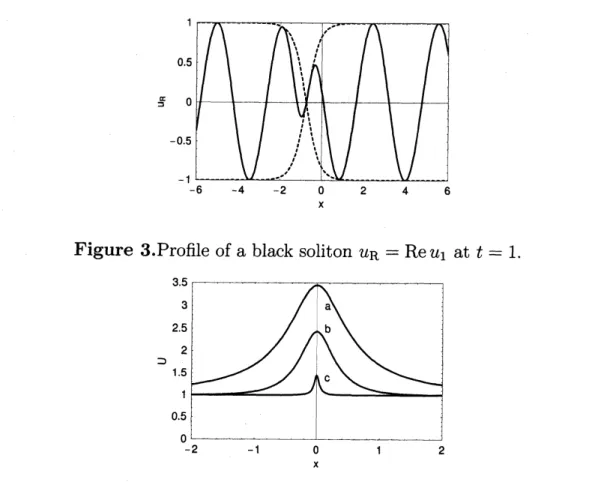
$x$Figure 2. Profile of the amplitude of the dark soliton $U=|u_{1}|$ at $t=O$
.
a:
$c=c_{0}=0.75,$ $b:c=0.33,$ $c:c=0.098$. The profile
a
isa
black soliton.where $c\equiv|c_{1}|$ lies in the interval $c_{\min}<c<c_{\max}$ with $c_{\max}$ and $c_{\min}$ being given
by (5.5b). Note from (5.5a) that $\kappa+b_{1}=(1+\kappa^{2}c_{1})/(2\kappa c_{1})>0$ for $\kappa>0$ and
$c_{1}>0.$
Figure 1 plots the dependence of the amplitudes $A=A_{d}$ and $A=A_{b}$
on
thevelocity $c=|c_{1}|$ for $\rho=1$ and $\kappa=2.$
(i) Dark $\mathcal{S}oliton:a_{1}>0$
As
seen
from figure 1, the amplitude $A_{d}$ of the dark soliton becomes an increasingfunction of the velocity $c$ in the interval$c_{\min}<c\leq c_{O}$ and
a
decreasing function inthe interval $c_{0}<c<c_{\max}$, where $c_{\max}$ and $c_{\min}$
are
given by (5.5b) and a criticalvelocity $c_{0}$ by
$c_{0}= \frac{1+\kappa\rho^{2}}{\kappa^{2}}$. (5.13)
In the present numerical example $(\rho=1, \kappa=2),$ $c_{\min}=0.025,$ $c_{0}=0.75,$$c_{\max}=$
$2.47$. Figure 2 depicts the profile of $U=|u_{1}|$ at $t=0$ for three different values
of $c$, i.e.,
a:
$c=c_{0}=0.75,$ $b:c=0.33,$$c:c=0.098$
with the parameters$-6$ $-4$ $-2$ $0$
$\cross$
2 4
Figure 3.Profile of
a
black soliton $u_{R}={\rm Re} u_{1}$ at $t=1.$Figure 4. Profile of the amplitude of the bright soliton $U=|u_{1}|$ at $t=0.$ a:
$c=2.47,$ $b:c=0.73,$ $c:c=0.025$. The profiles a and $c$
are
algebraic solitons.soliton attains the maximum value $A_{d}=\rho$.
See
figure 2 $a$. It then turns out thatthe intensity of the soliton center falls to zero. Such a soliton is well-known in the
field of nonlinear optics. It is sometimes called a black soliton.
Figure 3 shows the profile of $u_{R}={\rm Re}[u_{1}]$ at $t=1$ for the black soliton. The
broken line indicates $\pm|u_{1}|$ (see figure 2 a).
(ii) Bright soliton; $a_{1}<0$
Figure 4depicts theprofile of the bright soliton $U=|u_{1}|$ at $t=0$ for three different
values of $c$, i.e., a: $c=2.47,$ $b:c=0.73,$ $c:c=0.025$ with $\rho=1$ and $\kappa=2.$
Thefeature ofthe bright soliton differs substantiallyfrom that of the dark soliton.
To be specific, the amplitude of the bright soliton always becomes
an
increasingfunction of the velocity (see figure 1). It takes the maximum value at $c=c_{\max}$
and the minimum value at $c=c_{\min}$
.
At these limiting values of the velocity, thealgebraic soliton is produced from the soliton of hyperbolic type.
Indeed, if
we
put $\theta_{10}=a_{1}x_{0}-\delta_{1}$ in (5.7) and (5.9) with $x_{0}$ beinga
real constantand then take the limit $a_{1}arrow-0$, we find
$x+ct+x_{0}- i\frac{2\kappa+b_{1}}{2b_{1}(\kappa+b_{1})}$
$u_{1}=\rho e^{i(\kappa x-\omega t)} (5.14a)$ $x+ct+x_{0}- i\frac{1}{2(\kappa+b_{1})},$
禾
Figure 5. Profile of an algebraic bright soliton $u_{R}={\rm Re} u_{1}$ at $t=1.$
$|u_{1}|^{2}= \rho^{2}+\frac{2\kappa c^{2}}{1+\kappa^{2_{\mathcal{C}}}}\frac{1}{(x+ct+x_{0})^{2}+(\frac{\kappa c}{1+\kappa^{2_{\mathcal{C}}}})^{2}}, (5.14b)$
where $b_{1}=(1-\kappa^{2}c)/2\kappa c$ by (4.5a) and $c=c_{\max}$
or
$c_{\min}$.
Note from (5.9b) that $b_{1}^{2}=\kappa\rho^{2}/c$ when $a_{1}arrow-0.$A representative profile of the algebraic bright soliton $U=|u_{1}|$ at $t=0$ and the
corresponding profile of$u_{R}={\rm Re} u_{1}$ at $t=1$
are
shown in figure 4a
and figure 5,respectively.
5.1.2. Case $2:\kappa<0$
For negative $\kappa$, the expressions of the amplitude for the dark and bright solitons
are
given respectively by$A_{d}=\rho-\sqrt{\rho^{2}+2c_{1}\{\sqrt{a_{1}^{2}+(\kappa+b_{1})^{2}}}+(\kappa+b_{1})\}$
$= \rho-\frac{1}{\sqrt{K}}|K\sqrt{c}-\sqrt{K\prime-1}|, a_{1}<0, c_{1}=-c<0$, (5.15)
$A_{b}=\sqrt{\rho^{2}-2c_{1}\{\sqrt{a_{1}^{2}+(\kappa+b_{1})^{2}}-(\kappa+b_{1})}\}-\rho$
$= \frac{1}{\sqrt{K}}(K\sqrt{c}+\sqrt{K\rho^{2}-1})-\rho, a_{1}>0, c_{1}=-c<0$, (5.16)
where $K=-\kappa$ is a positive wavenumber and the velocity $c$ lies in the interval
$d_{\min}<c<c_{\max}’$ with
$c$
徳
$= \frac{1}{K^{2}}\{2K\rho^{2}-1+2\sqrt{K\rho^{2}(K\rho^{2}-1)}\},$$c$
Figure 6. Amplitude-velocity relation for the dark soliton $A_{d}$ (solid line) and
bright soliton $A_{b}$ (broken line) for $\rho=1$ and $\kappa=-2.$
Recall that the condition $K\rho^{2}-1>0$ must be imposed to
assure
the existence ofthe soliton solutions.
Figure 6 plots the dependence of the amplitudes $A=A_{d}$ and $A=A_{b}$ on the
velocity $c=|c_{1}|$ for $\rho=1$ and $\kappa=-2$. When compared with figure 1 for $\kappa>0,$
there appear several different features for $\kappa<0$. In particular, the algebraic dark
soliton would arise in the limit $carrow c_{\min}’$ since inthis limit, the amplitude $A_{d}$ tends
to a finite value. In addition, the algebraic bright soliton exists only in the limit
$carrow c_{\max}’$. We now proceed to the detailed description of the soliton solutions.
(i) Dark soliton: $a_{1}<0$
It follows from (5.5) with $\kappa=-K,$$c_{1}=-c$ that $\kappa+b_{1}=1/2Kc-K/2$.
Since
$c_{\min}’<c<c_{\max}’$, the possible value of $\kappa+b_{1}$ is restricted by the inequality
$K[K\rho^{2}-1-\sqrt{K\rho^{2}(K\rho^{2}-1)}]<\kappa+b_{1}<K[K\rho^{2}-1+\sqrt{K\rho^{2}(K\rho^{2}-1)}]$
(5.18)
One
can see
that the upper limit of$\kappa+b_{1}$ is attainedwhen $c=c_{\min}’$ anditslimitingvalue is positive bythe condition $K\rho^{2}>1$ whereas the lowerlimit is attained when
$c=c_{\max}’$ and is negative. In view of this fact, the algebraic dark soliton would be
produced in the limit $carrow c_{\min}’$ for which sgn$(\kappa+b_{1})>0$. Actually, taking the
limit $a_{1}arrow-0$ for the solutions (5.7) and (5.9), we find that the hyperbolic soliton
reduces to the limiting form
$x-ct+X_{0}- i\frac{-2K+b_{1}}{2b_{1}(-K+b_{1})}$
$u_{1}=\rho e^{i(-Kx-\omega t)} , (5.19a)$
$x-ct+x_{0}- i\frac{1}{2(-K+b_{1})}$$|u_{1}|^{2}= \rho^{2}-\frac{2Kc^{2}}{1-K^{2}c}\frac{1}{(x-ct+x_{0})^{2}+(\frac{Kc}{1-K^{2}c})^{2}}, (5.19b)$
$\cross$
Figure 7. Profile of the amplitude of the dark soliton $U=|u_{1}|$ at $t=0.$
a:
$c=c_{0}=0.25,$ $b:c=0.16,$ $c:c=0.043$. The profile
a
isa
black soliton and theprofile $c$ is
an
algebraic soliton.Figure 8. Profile of
an
algebraic dark soliton $u_{R}={\rm Re} u_{1}$ at $t=1.$condition $K\rho^{2}>1$, the expression $(5.19b)$ actually represents
an
algebraic darksoliton.
Theblacksoliton appears when the velocity $c$takes
a
specific value$c=d_{0}$, where$c_{0}’=(K\rho^{2}-1)/K^{2}$
.
(5.20)Its profile is represented by
$|u_{1}|^{2}= \rho^{2}[1-\frac{3K\rho^{2}-4}{2(K\rho^{2}-1)}\frac{1}{\cosh 2(\theta_{1}+\delta_{1})+_{2(K\rho-1)}^{K-2}\ovalbox{\tt\small REJECT}_{2}^{2}}]$ (5.21)
It is important to notice that the inequality$d_{\min}<d_{0}<d_{\max}$ requiresthe condition
$K\rho^{2}>4/3$ for the wavenumber $K$
.
It then turns out that expression (5.21) takesthe form of
a
black soliton.Figure 7 depicts the profile of $U=|u_{1}|$ at $t=0$ for three different values
of $c$, i.e.,
a:
$c=c_{0}’=0.25,$ $b:c=0.16,$$c:c=0.043$
with the parameters$\rho=1,$ $\kappa=-2,$$\theta_{10}=-\delta_{1}$ and $\chi_{10}=0$
.
In this example, $d_{\min}=0.043,4=0.25$Figure 9. Profile of the amplitude of the bright soliton $U=|u_{1}|$ at $t=0.$ a:
$c=1.46,$ $b:c=0.81,$ $c:c=0.19$. The profiles a is
an
algebraic soliton.$-6 -4 -2 0 2 4 6$
$\cross$Figure 10. Profile ofan algebraic bright soliton $u_{R}={\rm Re} u_{1}$ at $t=1.$
the velocity, i.e., $c=c_{\min}’$ whereas
a
black soliton arises at $c=c_{0}’$. Figure 8 showsthe profile of $u_{R}={\rm Re} u_{1}$ at $t=1$ for an algebraic dark soliton.
(ii) Bright soliton: $a_{1}>0$
Figure 9 depicts the profile of $U=|u_{1}|$ at $t=0$ for three different values of$c$, i.e.,
a: $c=1.46,$ $b:c=0.73,$ $c:c=0.025$ with $\rho=1$ and $\kappa=-2$. Figure 10 shows
the profile $u_{R}={\rm Re} u_{1}$ of an algebraic bright soliton at $t=1$ which corresponds to
the profile a in figure 9.
$\bullet$ Summary
i$)$ $\kappa>0,$ $a_{1}>0$: dark soliton (no algebraic soliton)
ii) $\kappa>0,$ $a_{1}<0$: bright soliton (algebraic soliton)
iii) $\kappa<0,$ $a_{1}>0$: bright soliton (algebraic soliton)
$0$
Figure 11. The interaction of two dark solitons.
5.2.
Two-soliton solution5.2.
1. Dark-dark solitonsThe tau functions $f_{2}$
and
$g_{2}$ representing the dark two-soliton solution
are
givenby $(3.1)-(3.3)$ with $N=2$ subjected to the conditions $\kappa>0,$$a_{1}>0,$ $a_{2}>0$
.
Theyread $f_{2}=1+ \frac{\kappa-ip_{1}}{p_{1}+p_{1}^{*}}z_{1}z_{1}^{*}+\frac{\kappa-ip_{2}}{p_{2}+p_{2}^{*}}z_{2^{Z_{2}^{*}}}$ $+ \frac{(\kappa-ip_{1})(\kappa-ip_{2})(p_{1}-p_{2})(p_{1}^{*}-p_{2}^{*})}{(p_{1}+p_{1}^{*})(p_{1}+p_{2}^{*})(p_{2}+p_{1}^{*})(p_{2}+p_{2}^{*})}z_{1}z_{2^{Z_{1}^{*}Z_{2}^{*}}}, (5.22a)$ $g_{2}=1- \frac{\kappa+ip_{1}^{*}p_{1}}{p_{1}+p_{i}^{*}p_{1}^{*}}z_{1}z_{i}^{*}-\frac{\kappa+ip_{2}^{*}}{p_{2}+p_{2}^{*}}\frac{p_{2}}{p_{2}^{*}}z_{2}z_{2}^{*}$ $+^{(\kappa+ip_{1}^{*})(\kappa+ip_{2}^{*})(p_{1}-p_{2})(p_{1}^{*}-p_{2}^{*})} \frac{p_{1}p_{2}}{**}z_{1}z_{2^{Z_{1}^{*}Z_{2}^{*}}}. (5.22b)$ $(p_{1}+p_{1}^{*})(p_{1}+p_{2}^{*})(p_{2}+p:)(p_{2}+p_{2}^{*})p_{1}p_{2}$
Figure 11 shows the intercaction of two dark solitons with the parameters $\rho=$
$1,$$\kappa=2,$$c_{1}=0.75,$ $c_{2}=0.24$ and $\zeta_{10}=\zeta_{20}=0$ so that from (4.14), $A_{d1}=1.0$ and
$A_{d2}=0.47.$
5. 2.2. Dark-bright solitons
Figure 12 depicts the interaction between a dark soliton and
a
bright soliton withthe parameters $\rho=1,$ $\kappa=2,$ $c_{1}=0.75,$$c_{2}=0.24$ and $\zeta_{10}=\zeta_{20}=0$, showing
that the
dark
soliton propagates faster than the bright soliton. The asymptoticamplitudes ofthe dark and bright solitons
are
given respectively by$A_{d1}=1.0$ and$\cup$
$0$
Figure 12. The interaction between
a
dark soliton anda
bright soliton.$\bullet$ Phase shift
Dark-dark solitons:
$\Delta x_{1}=\frac{1}{a_{1}}\ln|\frac{p_{1}+p_{2}^{*}}{p_{1}-p_{2}}|,$ $\Delta x_{2}=-\frac{1}{a_{2}}\ln|\frac{p_{2}+p_{1}^{*}}{p_{2}-p_{1}}|,$ $a_{1}>0,$ $a_{2}>0$
.
(5.23)Dark-bright
solitons:
$\Delta x_{1}=-\frac{1}{a_{1}}\ln|\frac{p_{1}+p_{2}^{*}}{p_{1}-p_{2}}|,$ $\Delta x_{2}=-\frac{1}{a_{2}}\ln|\frac{p_{2}+p_{1}^{*}}{p_{2}-p_{1}}|,$ $a_{1}>0,$ $a_{2}<0$
.
(5.24)$\Delta x_{1}>0, \Delta x_{2}<0.$
$\bullet$ Summary
i$)$ $\kappa>0,$ $a_{1}>0,$ $a_{2}>0$: dark-dark solitons
ii) $\kappa>0,$ $a_{1}>0,$ $a_{2}<0$: dark-bright solitons
iii) $\kappa>0,$ $a_{1}<0,$ $a_{2}<0$: bright-bright solitons
6. Conclusion
$\bullet$ The dark soliton solutions of the $FL$ equation have been obtained by
means
ofa
direct method.$\bullet$ The linear stability analysis of the plane
wave
has been performed toassure
the$\bullet$ The
classification of the one-soliton solutons has been
done, showingthat
both
the
dark and
brightsolitons
existon
a
constant
background which reduce toalge-braic solitons under certain conditions.
$\bullet$ The two-soliton solutions
can
be classified into three types, i.e., dark-darksoli-tons, dark-bright solitons and bright-bright solitons.
Acknowledgement
This work
was
partially supported byJSPS
KAKENHI Grant Number22540228.
References
[1] Fokas $AS$
1995 On a
class ofphysically important integrable equations Physica$D87145-150$
[2] Lenells $J$ and Fokas $A$ $S$
2009 On a
novel integrable generalization of thenonlinear Schr\"odinger equation Nonlinearty 2211-27
[3] Lenells$J$ 2009Exactlysolvable model for nonlinearpulse propagationin optical
fibers Stud. Appl. Math. 123215-232
[4] Lenells $J$
2010
Dressing fora
novel integrable generalization of the nonlinearSchr\"odinger equation
J.
NonlinearSci.
20709-722
[5] Matsuno $Y$ 2012 $A$ direct method of solution for the Fokas-Lenells derivative
nonlinear Schr\"odinger equation: I. Bright soliton solutions J. Phys. $A$: Math.
Theor.
45235202
[6] Matsuno $Y$
2012
$A$ direct method of solution for the Fokas-Lenellsderivative
nonlinear Schr\"odinger equation: II. Dark soliton solutions J. Phys. $A$: Math.