和文要約
日本産広葉樹 5 種(クリ Castanea crenata、ヤマザクラ Cerasus jamasakura、ウリカエデ Acer crataegifolium、ミズキ Cornus controversa 及びマルバアオダモ Fraxinus lanuginosa)の引張あて 材における、物理的及び機械的性質を調査した。容積密度、全収縮率(繊維、接線及び半径方 向)及び縦圧縮強さの試験片は、引張あて材部及び隣接する同一個体のラテラルもしくはオポ ジット材から作製した。本研究では、これらのラテラルもしくはオポジット材を正常材とみな した。引張あて材の容積密度は、正常材と比較して、クリ及びウリカエデで統計的に有意に大 きな値を示し、反対にヤマザクラ及びマルバアオダモにおいて、有意に小さい値を示した。繊 維方向全収縮率は、いずれの樹種においても、引張あて材の方が正常材よりも大きい値を示し た。また、接線方向全収縮率は、正常材と比較して引張あて材では、クリ及びウリカエデで小 さい値を、ミズキ及びマルバアオダモで大きい値を示した。一方、ウリカエデを除くすべての 樹種において、半径方向全収縮率は、引張あて材と正常材の間に、有意な差は認められなかっ た。縦圧縮強さについては、すべての樹種において、引張あて材の方が正常材よりも統計的に 有意に小さい値を示した。 キーワード:引張あて材、容積密度、収縮率、縦圧縮強さ Summary
Physical and mechanical properties of tension wood (TW) were investigated for five Japanese hardwoods (Castanea crenata, Cerasus jamasakura, Acer crataegifolium, Cornus controversa, and Fraxinus lanuginosa). Specimens for basic density, shrinkage (longitudinal, tangential, and radial directions), and compression strength parallel to the grain were prepared from TW position and lateral wood or opposite wood positions adjacent to TW in the same tree. In the present study, these lateral or opposite woods were regarded as normal wood (NW). The basic density of TW in C. crenata and A. crataegifolium showed significantly larger values than those of NW. In contrast, two species, C. jamasakura and F. lanuginosa, showed lower values in TW. Longitudinal shrinkage of TW in all species was significantly larger than that of NW. In tangential shrinkage, C. crenata and A. crataegifolium had lower values than NW, while C. controversa and F. lanuginosa had larger ones. No significant difference between TW and NW was found in radial shrinkage of any species except for A. crataegifolium. In compressive strength parallel to grain, TW of all species showed significantly lower values than NW.
Key words: tension wood, basic density, shrinkage, compressive strength parallel to grain
5 種の日本産広葉樹における引張あて材の物理的・機械的性質
Physical and mechanical properties of tension wood
in five Japanese hardwood species
石栗 太,豊泉竜也,田邊 純,牧野和子,
スクマナ…ウエダタマ,平岩季子,飯塚和也,横田信三,吉澤伸夫 Futoshi ISHIGURI, Tatsuya TOYOIZUMI, Jun TANABE, Kazuko MAKINO,
Wedatama SOEKMANA, Tokiko HIRAIWA, Kazuya IIZUKA, Shinso YOKOTA, and Nobuo YOSHIZAWA
Faculty…of…Agriculture,…Utsunomiya…University,…Utsunomiya…321-8505,…Japan 宇都宮大学農学部 〒 321-8505 宇都宮市峰町 350
1. Introduction
Reaction wood is an abnormal xylem formed in inclined stems or branches. In gymnosperms, compression wood forms on the under side of leaning stems or branches. In angiosperms, on the other hand, tension wood (TW) forms on the upper side of leaning stems or branches.
Physical and mechanical properties of TW differ from those of normal wood (NW).1,6,8,9) Panshin and de Zeeuw 9) reported that thick-walled gelatinous fibers increased the density of TW cells by 30% more than that of NW. Kollmann and Côté 6) reported that longitudinal shrinkage of TW may reach 1%, the shrinkage being considerably greater than the negligible longitudinal shrinkage of NW. On the other hand, the information on the mechanical properties of TW is insufficient.9) Panshin and de Zeeuw 9) reported that compression strength parallel to the grain was lower in TW at all moisture levels than in comparable NW and that the same trends are recorded for compression strength perpendicular to the grain, modulus of rupture in static bending, longitudinal shear, and modulus of elasticity in static bending; however, little evidence is available to support these findings.
Recently, several researchers are focusing on the physical properties of TW.2,3,5,10,11) Jourez et al. 5) examined the basic density and longitudinal shrinkage of TW and opposite wood (OW) in young stems of Populus euramericana cv. Ghoy. They found that TW tissues formed on the upper face of the stem showed a basic density that was 5% higher than that in OW. Ruelle et al. 10) examined the physical and mechanical properties of TW and OW in 10 tropical rainforest species. They reported that the longitudinal modulus of elasticity was slightly higher in TW than in OW and longitudinal shrinkage was also much higher in TW. Further research, however, is still needed for the physical and mechanical properties of tension wood in many hardwood species.
In the present study, we investigated the physical properties (density and shrinkage) and mechanical properties (compressive strength parallel to grain) for TW and NW in five Japanese hardwood species.
2. Materials and methods
Naturally inclined stems of five hardwood species were collected at the Funyu Experimental Forest, Utsunomiya
University, Japan (Table 1). Tension wood (TW) specimens were prepared from the upper side of inclined stems. Specimens were also prepared from lateral or OW adjacent to TW from the same tree. In the present study, these specimens from lateral woods and OW are regarded as normal wood (NW).
Transverse sections of 20 µm in thickness were prepared from TW and NW. Mäule color reaction was applied to confirm the existence of gelatinous (G)-fiber and lignin distribution. A staining procedure was performed according to a previous report.13)
For determining the basic density, 20 (L) by 20 (R) by 20 (T) mm specimens were prepared from TW and NW. The basic density was calculated by dividing oven-dried weight by green volume determined with a digital screw meter. Two types of specimens were used for measuring the shrinkage: 40 (L) by 20 (R) by 5 (T) mm for longitudinal direction and 20 (L) by 20 (R) by 20 (T) mm for radial and tangential directions. The length of the specimen was measured with a digital screw meter under green and oven-dried conditions. To avoid the collapse,specimens were air-dried and then oven-dried at 105 ℃ followed by 60 ℃ for 1 day. Shrinkage was calculated from the following equation:
Shrinkage (%) = (Lg - Lo) / Lg x 100
where Lg is the length of the specimen in the green condition, and Lo is the length of the specimen in the oven-dried condition.
For the compressive test, 50 (L) by 20 (R) by 20 (T) mm specimens were prepared. The load was applied to the longitudinal direction of a specimen at 1 mm/min by using a universal testing machine (A&D, RTC2410). Compressive strength parallel to grain was calculated by dividing the maximum load by transverse area of a specimen. To avoid changes to the mechanical properties by a decrease in moisture content, the moisture content of specimens was maintained in the green condition during the compressive test.
For all tests, three specimens were prepared at each position.
3. Results and discussion 3.1 Reaction wood anatomy
Digital images of a transverse section stained with a
Table 1 Sample of the present study.
Mäule reagent are shown in Fig. 1. The Mäule reagent stains the syringyl unit in lignin a pinkish color.7) Onaka 8) reported that G-fiber was formed in TW of five species used in the present study (Table 1). In C. crenata, C. jamasakura, and A. crataegifolium, the innermost layer of the wood fiber in TW was not stained with the Mäule reagent, suggesting that a G-layer existed. These results were similar to those obtained by Onaka.8) On the other hand, in the two remaining species (C. controversa and F. lanuginosa), no distinct G-layer was observed in TW. However, the staining intensity of the secondary wall of wood fiber in the TW was apparently weaker than those in
NW. These results suggested that syringyl lignin content in TW was lower than that in NW. The decrease of syringyl lignin content is a characteristic of TW.1,6,9)
3.2 Basic density
The basic density values of TW and NW in five Japanese hardwoods are shown in Table 2. Of 5 species tested here, the basic density of TW in C. crenata and A. crataegifolium showed significantly higher values than those of NW. In contrast, C. jamasakura and F. lanuginosa showed lower basic density in TW. However, the differences between TW and NW were not so much: TW/NW ratio ranged from 1.04 to 0.95. Panshin and de Zeeuw 9) reported that thick-walled gelatinous fibers increased the density of TW cells 30% more than that of NW. In addition, they also found that the increase in density for TW formation is usually much smaller, in the range of 5 to 10 percent, for woods with relatively thin gelatinous walls. Ueda 12) reported that air-dried density values of TW in Populus sieboldii Miq. and Fraxinus mandshurica var. japonica Maxium were greater than that of NW. Jourez et al. 5) examined the basic density of TW and OW in 2-month-old inclined Populus euramericana cv. Ghoy, which formed G-fiber in TW, and found that the basic density for TW and OW was 0.402 and 0.384 g/cm3, respectively. In the present study, distinct G-fibers were observed in C. crenata, C. jamasakura and A. crataegifolium. Therefore, the formation of G-fiber could result in an increase in the basic density in C. crenata and A. crataegifolium. On the other hand, Panshin and de Zeeuw 9) found an extreme case of Tilia, which produces TW showing lower density than NW. Ruelle et al. 11) examined the basic density of TW and OW in 9 trees from 3 tropical rainforest species. They found that only 2 of the 9 trees examined (one Eperua falcata and one Simarouba amara) showed a significant difference in basic density, but these 2 trees showed a higher and lower basic density in TW. In the present study, basic density of TW in C. jamasakura and F. lanuginosa showed significantly lower values than those of NW. Our results obtained in F. lanuginosa were inconsistent with those in F. mandshurica obtained by Ueda.12) Thus, changes of basic density due to TW formation might depend on the species. Further research is still needed for basic density in TW for many species.
Fig. 1. Transverse sections stained with Mäule reagent.
Note: scale bar, 20 µm.
Table 2 Comparison in basic density between tension wood (TW) and
normal wood (NW).
Note: SD, standard deviation; ns, no significance; *, significance at 5% level; **, signifi-cance at 1% level. Sample number = 3 specimens in each position of a species.
3.3 Shrinkage
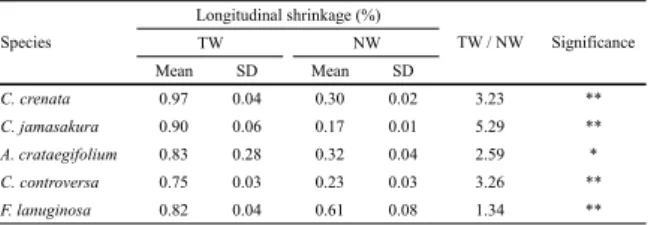
Tables 3 to 5 show shrinkage in 3 directions in TW and NW. In all species tested here, longitudinal shrinkage of TW showed significantly larger value than that of NW. The largest TW / NW ratio (5.29) was found in C. jamasakura. No significant differences between TW and NW were recognized in radial shrinkage for all species, except for A. crataegifolium. In tangential shrinkage, TW of C. controversa and F. lanuginosa showed significantly larger shrinkage values than those in NW. On the other hand, significantly lower values were observed in C. crenata and A. crataegifolium. Panshin and de Zeeuw 9) reported that even though the longitudinal shrinkage of TW was seldom greater than 1%, the increase over that of comparable NW was large. In a 2-month-old shoot inclined at 30 ° from the vertical axis in Populus cv. I4551, the longitudinal shrinkage in TW and OW was 0.769% and 0.195%, respectively.5) Our results obtained in the longitudinal shrinkage were similar to those obtained by several other researchers.9-11) On the other hand, of 10 tropical rainforest species, no significant difference between TW and OW was found in 6 and 7 species for tangential and radial shrinkage, respectively.10) Panshin and de Zeeuw 9) reported, theoretically, that transverse shrinkage for TW should be reduced more than that of NW because the longitudinal shrinkage increased in TW. However, this was true only for limited species. Thus, changes of transverse shrinkage due to TW formation are still unclear. Further research is
needed for clarifying the changes of transverse shrinkage in many species.
3.4 Compressive strength
The compressive strengths of TW and NW for 5 Japanese hardwoods are shown in Table 6. In all species tested here, the compressive strength in TW showed significantly lower value than that in NW. The lowest TW/NW ratio (0.63) was observed in C. jamasakura. Our results are similar to those obtained by Panshin and de Zeeuw.9) Ruelle et al. 11) examined the compressive strength of a total 9 trees from 3 tropical rainforest species (Eperua falcata with G-fiber in TW, Laetia procera with multilayered features of TW, and Simarouba amara without G-fiber in TW). They reported that the compressive strength was significantly lower in TW from 6 trees. They also found that the compressive strength was increased with an increase in the microfibril angle (MFA) in the 3 species, indicating that cellulose microfibril orientation along the fiber axis causes a lower compressive strength. In the present study, the TW in 3 species had G-fiber, suggesting that MFA might be very low at the innermost layer of wood fibers. Thus, it seems that the formation of the G-layer results in the decrease of compressive strength. In softwood species, on the other hand, Gindl 4) examined the relationship between compressive strength and MFA or lignin content in compression wood of Norway spruce (Picea abies). He found that compressive strength of compression wood was not negatively affected by the high MFA, whereas it was affected by the increased lignin content and altered lignin composition. Thus, the lignin content might be related to the compressive strength in hardwoods. In the present study, as shown in Fig. 1, staining intensity of the Mäule reaction in TW was apparently lower than that in NW, suggesting that the lignin content in TW was lower than that in NW. However, further research is needed for clarifying the relationship between compressive strength and lignin content in TW.
4. Conclusions
The physical and mechanical properties of TW and NW were investigated in 5 Japanese hardwoods (C. crenata, C. jamasakura, A. crataegifolium, C. controversa, and F. lanuginosa). The results obtained are as follows:
1) Basic density in TW shows lower values in C.
Table 3 Comparison in longitudinal shrinkage between tension wood
(TW) and normal wood (NW).
Note: SD, standard deviation; *, significance at 5% level; **, significance at 1% level. Sample number = 3 specimens in each position of a species.
Table 6 Comparison in compressive strength parallel to grain between
tension wood (TW) and normal wood (NW).
Note: SD, standard deviation; *, significance at 5% level; **, significance at 1% level. Moisture content of specimen at testing was kept under green condition. Sample number = 3 specimens in each position of a species.
Table 4 Comparison in radial shrinkage between tension wood (TW)
and normal wood (NW).
Note: SD, standard deviation; ns, no significance; **, significance at 1% level. Sample number = 3 specimens in each position of a species.
Table 5 Comparison in tangential shrinkage between tension wood
(TW) and normal wood (NW).
Note: SD, standard deviation; ns, no significance; *, significance at 5% level; **, signifi-cance at 1% level. Sample number = 3 specimens in each position of a species.
jamasakura and F. lanuginosa and higher values in C. crenata and A. crataegifolium than those in NW. 2) Longitudinal shrinkage in TW showed significantly
larger values than that in NW. On the other hand, no similar tendency was observed in tangential and radial shrinkages.
3) In all species tested here, compressive strength parallel to grain in TW showed significantly lower values than that in NW.
Acknowledgements
The authors express their sincere thanks to Mr. Y. Kameyama and Mr. Y. Andoh, researchers, Tochigi Prefectural Forestry Center, for conducting the compressive test. The authors also express their thanks to Mr. H. Satoh and Ms. H. Aiso, students, Faculty of Agriculture, Utsunomiya University, for assisting with the experiments. References
1) Côté, W. A. Jr., Day, A. C.: “Cellular ultrastructure of woody plants”, Côté, W. A. Jr. ed., Syracuse University Press, New York, p391-418 (1965)
2) Coutand, C., Jeronimidis, G., Chanson, B., Loup, C.: Comparison of mechanical properties of tension and opposite wood in Populus. Wood Science and Technology, 38, p11-24 (2004)
3) Fang, C-H., Guibal, D., Clair, B., Gril, J., Liu, Y-M., Liu, S-Q.: Relationships between growth stress and wood properties in poplar I-69 (Populus deltoids Bartr. Cv. “Lux” ex I-69/55). Annals of Forest Science, 65, p307 (2008)
4) Gindl, W.: Comparing mechanical properties of normal and compression wood in Norway spruce: The role of lignin in compression parallel to the grain. Holzforschung, 56, p395-401 (2002).
5) Jourez, B., Riboux, A., Leclercq, A.: Comparison of basic density and longitudinal shrinkage in tension wood and opposite wood in young stems of Populus euramericana cv. Ghoy when subjected to a gravitational stimulus. Canadian Journal of Forest Research, 31, p1676-1683 (2001)
6) Kollmann, F. F. P., Côte, W. A.: “Principles of wood science and technology, Volume I: Solid wood”, Springer-Verlag, Berlin Heidelberg New York Tokyo, p79-90 (1984)
7) Nakano, J., Meshituka, G.: “Methods in lignin chemistry”, Lin, S. Y., Dence, C. W. eds., Springer-Verlag, Berlin Heidelberg New York, p23-32 (1992) 8) Onaka, F.: Studies on compression- and tension-wood.
Wood Research, 1, p1-88 (1949)
9) Panshin, A. J., de Zeeuw, C.: “Textbook of wood technology”, McGraw-Hill Book Company, New York, p300-320 (1980)
10) Ruelle, J., Beabchêne, J., Thibaut A., Thibaut B.: Comparison of physical and mechanical properties of
tension and opposite wood from ten tropical rainforest trees from different species. Annals of Forest Science, 64, p503-510 (2007)
11) Ruelle, J., Beabchêne, J., Yamamoto, H., Thibaut B.: Variations in physical and mechanical properties between tension and opposite wood from three tropical rainforest species. Wood Science and Technology, 45, p339-357 (2011)
12) Ueda, K.: Studies on the mechanical properties of reaction woods (2) The elastic constants of Icho (Ginkgo biloba L.), Yamanarashi (Populus sieboldii Miq.) and Yachidamo (Fraxinus mandshurica var. japonica Maxim.). Bulletins of the College Experiment Forests Hokkaido University, 30, p379-388 (1973) 13) Yoshizawa, N., Inami, A., Miyake, S., Ishiguri, F.,
Yokota, S.: Anatomy and lignin distribution of reaction wood in two Magnolia species. Wood Science and Technology, 34, p183-196 (2000)