253
On
Design Verification
between Different Levels of Abstraction
Using
Regular TemporalLogic
Kiyoharu Hamaguchi,
Hiromi
Hiraishi and Shuzo Yajima口 清治 平石 裕実 矢島 脩三
Department ofInformation Science
Faculty of
Engineering,
Kyoto University1 Introduction
The
progress
of VLSI technology makesit a
pressing need to establish methods for verifying the correctness of logic design. In order to verifywhether
a
designed system satisfiesa
specification for it, formalverffi-cation
methods have been developed.In logic design, hierarchical design methodology
is
adopted toman-age
complex legic systems.Our main concern is
to developa
formalverification method applicable to hierarchical design.
We consider formal verification of sequential machines in this paper.
As a language for describing specffication,
we
adopt infinitary regulartemporal logic$(\infty RTL)[1]$ which
is
an extension
of $\epsilon$-free RTL proposedby Hiraishi et al. [2]. While traditional temporal $10$
gic
or
computationtree logic(CTL) cannot characterize finite state machines$[3,4]$, $\infty RTL$
is
powerful enough to express regular sets and $\omega$ regular sets.
In hierarchical design, specifications and implementations
are
often given at different levels of abstractions. For example,a
specification atregister
transfer level (ahigherlevel) andan
implementation at gate level(alowerlevel)
can
begiven.
In order to verify whether the lower-levelim-plementation satisfies the higher-level specffication,
we
must determinesome
formal relation and bridge thegap
between the two levels.In this paper,
we propose a
formal $fi:amework$ basedon
$\infty RTL$ toexplicitly describe relations between two different levels. We regard the
数理解析研究所講究録 第 695 巻 1989 年 253-262
254
relation as a part of an implementation and show a verification method
for a lower-level implementation (i.e., a lower-level sequential machine
and
a
relation) and a higher-level specification described in $\infty RTL$.This paper is organized as follows: Chapter 2 introduces $\infty RTL$.
Chapter 3 discusses a formal $fi:ame$work for describing relations between
different levels and shows a design verification method considering two
different levels. Chapter 4 summarizes this paper.
2 Regular Temporal Logic
The empty word $\epsilon,$
$\Sigma^{*}$ and $\Sigma^{+}$ are defined as in the usual way. An omega word over an alphabet $\Sigma$ is an infinite-length sequence of symbols from $\Sigma$. $\Sigma^{\omega}$ is the set of all
omega
words over $\Sigma$. $\Sigma^{\infty}def=\Sigma^{*}\cup\Sigma^{\omega}$.The class of infinitary regular sets is the union of regular sets [5] and
$\omega$ regular sets [6].
For $\sigma\in\Sigma^{\infty}-\{\epsilon\},$ $|\sigma|$ denotes the length of $\sigma$, i.e., the number of
symbols in $\sigma$ (If$\sigma$ is in $\Sigma^{\omega}$, then we denote $|\sigma|=\omega$)
.
$\sigma(i)$ denotes the ithsymbol of $\sigma$
.
In the case that $|\sigma|\geq i,$$\sigma^{i}$ denotes the suffix sub-sequence
of a starting from $\sigma(i)$.
2.1 Definition of Regular Temporal Logic Definition 1 Syntax
An $\infty RTL$
formula
is
simply calledan RTL formula. RTL formulas
are
defined inductively as follows. Let $AP$ be a set of
atomic
propositions.If$p\in AP$, and $\eta$ and $\xi$ are RTL formulas, then
so are
$(p),$ $(\neg\eta),$ $(\eta\vee\xi)$,$(O\eta),$ $(\eta:\xi)$ and $($ : $\eta)$. $\square$
Definition 2 Model and semantics
$M=(\Sigma, I)$ is a linear model, where $\Sigma$ is
a
set of states
and $I$ : $\Sigmaarrow$$d\mathfrak{J}5$
Let $\sigma\in\Sigma^{\infty}-\{\epsilon\}$. $M,$$\sigma|=\eta$ denotes that
an
RTL formula $\eta$ holdsalong the sequence $\sigma$ with respect to a linear model $M$. If there is no
confusion, $M$ is omitted like $\sigma\models\eta$
.
Let $p$ be an atomic proposition, $\eta$and $\xi$ be RTL formulas. The relation $|=is$ defined inductively
as
follows:1. $\sigma\models p$
iff
$p\in I(\sigma(1))$.2. $\sigma\models(\neg\eta)$
iff
$\sigma\#\eta$.3. $\sigma\models(\eta\vee\xi)$
iff
$\sigma\models\eta$ or $\sigma\models\xi$.4. $\sigma\models(O\eta)$
iff
$|\sigma|\geq 2$ and $\sigma^{2}\models\eta$.5. $\sigma\models(\eta:\xi)$
iff
there exist $\sigma_{I}\in\Sigma^{+}$ and $\sigma_{2}\in\Sigma^{\infty}-\{\epsilon\}$
such that $\sigma=\sigma_{1}\sigma_{2},$$\sigma_{1}\models\eta$ and $\sigma_{2}\models\xi$
or
$|\sigma|=\omega$ and $\sigma\models\eta$.
6. $\sigma\models(:\eta)$
iff
there exist $\sigma_{i}\in\Sigma^{+}(i=1, \ldots, m-1)$ and $\sigma_{m}\in\Sigma^{\infty}-\{\epsilon\}$
such that $\sigma=\sigma_{1}\sigma_{2}\ldots\sigma_{m}$ and $\sigma_{i}\models\eta$ for all $i$
or
there exist an infinite number of finite sequences $\sigma_{i}\in\Sigma^{+}$
such that $\sigma=\sigma_{1}\sigma_{2}\ldots$ and $\sigma_{i}\models\eta(i=1,2, \ldots)$
$\square$
In the following, $‘\wedge,$ $V_{T}$ and $V_{F}$ represent $co$njunction, tautology
and ‘invalid‘ respectively. Unary operators have
higher
precedence thanbinary operators. If there is no ambiguity, ‘(’ and ‘)’ are omitted.
Finite $RTL$ is defined
as a
subclass of $\infty RTL$, whosesemantics
do-main is restricted to $\Sigma^{+}$. Finite RTL is exactly the same as
$\epsilon$-free RTL[2].
2.2 Regular Temporal
Logic
and Regular SetsFirst,
we
introduce several notations. $Len1$ holds alonga
set ofse-quences whose length is 1. ‘$C\rangle$ (sometime’) and ‘$\square$ (always’) correspond
to the temporal operators used traditionally
in
other temporal logic. In$f$$\bullet$ Lenl
$def=$
$\neg OV_{T}$.
$\bullet\langle\rangle\eta$
$def=$
$\eta\vee(V_{T}:\eta)$
.
$\bullet\square \eta$ $def=$$\neg C\rangle_{\neg\eta=\eta\wedge\neg(V_{T}:\neg\eta)}$
$\bullet$
Inf
$def=$ $(V_{T} : V_{F})$
.
$\bullet$ Fin
$def=$ $\neg Inf=\neg(V_{T} : V_{F})$.
In order to discuss the relation between $\infty RTL$ and regular sets, we
define $L\langle\Sigma,$$I$
}
$(\eta)def=\{\sigma|\sigma\in\Sigma^{\infty}-\{\epsilon\}, \sigma\models\eta\},$ $L_{f}\langle\Sigma,$ $I$}
$(\eta)def=\{\sigma|\sigma\in$ $\Sigma^{+},$$\sigma\models\eta$}
and $L_{\omega}\{\Sigma,$ $I\rangle$$(\eta)def=\{\sigma|\sigma\in\Sigma^{\omega}, \sigma\models\eta\}$.
If there is no confusion, $L(\eta)$ etc. are used, omitting $\langle\Sigma, I\rangle$.
Theorem 1 For an arbitrary $RTL$
formula
$\eta$ and an arbitrary model$(\Sigma, I),$ $L\{\Sigma, I\}(\eta)$ is an $\epsilon$
-free
infinitary regular set. Conversely,for
anarbitrary $\epsilon$
-free
infinitary regular set $R$ over $\Sigma$,we
can $co$nstruct an $RTL$formula
$\eta$ such that $L\{\Sigma, I\}(\eta)=R$, by introducing,for
each state $s\in\Sigma$,an atomic proposition $p_{s}$ such that $I(s)=\{p_{s}\}$.
This theorem is proved in [1].
Corollary 1 $L_{f}(\eta)$ and $L_{\omega}(\eta)$ are an $\epsilon$
-free
regular set and an omegaregular set respectively.
From the definition of $L(\eta),$ $L_{f}(\eta)$ and $L_{\omega}(\eta)$,
we can see
thatan
RTL formula $\eta$
can
be used to specifysome
property of sequences, and$L(\eta)$ is a set of the sequences that have the property.
3 Formal Verification between Two Different Levels
3.1 Formal Framework for Describing Relations between Two
Different Levels
In this section,
we
providea
formal framework to explicitly describerelations between the two different levels. We
assume
two differentlev-els, that is, a higher levet for a specification and
a
lower level for an257
As an implementation to be verified, we consider a Mealy type
deter-ministic sequential machine $M$ with $n$ binary input signals $x_{1},$ $x_{2},$ $\ldots,$ $x_{n}$
and $m$ binary output signals $z_{1},$ $z_{2},$ $\ldots,$$z_{m}$. Let $ilT=(X, Z, S, \delta, \lambda, s_{0})$
be a Mealy type determministic sequential machine with an initial stat$e$,
where $X,$ $Z$, and $S$ are finite, nonempty sets ofbinary input signals,
bi-nary output signals, and states, respectively. $s_{0}\in S$ is the initial state.
$\delta$ : $2^{X}\cross Sarrow S$ is the state
transition
function (Weassume
that at leastone next stat$e$
is
defined for each statein
$S$). $\lambda$ : $2^{X}\cross Sarrow 2^{Z}$ (Weassume
that the $\lambda$ is defined so long as $\delta$ is defined).A poss\’ible input-output sequence of the sequential machine $M$ is an
infinite
orfinite
sequence $\rho$ over$2^{X\cup Z}$ such that $x_{i}\in\rho(k)$ iff $x_{1}=1$
at the kth input and $z_{j}\in\rho(k)$ iff $z_{j}=1$ at the kth output, where
$i=1,2,$ $\ldots,$$n,$ $j=1,2,$ $\ldots,$ $m$ and $k=1,2,$ $\ldots,$ $|\rho|$.
We can regard the behavior of the machine as the set of all ofits
pos-sible input-output sequences. Furthermore, we
can
identify a possibleinput-output sequence with a sequence of states of $\infty RTL$, by
introduc-ing atomic propositions $p_{x;}$ and $p_{z_{j}}$ associated with input signal $x_{i}$ and
output signal $z_{j}re$spectively, such that $p_{x_{i}}$ is true iff $x_{i}=1$ and $p_{z_{j}}$ is
true iff $z_{j}=1$. From Theorem 1 and Corollary 1, we can specify the
behavior of the sequential machine in finite RTL or $\infty RTL$
.
In [2], specifications
are
described for $fini_{j}te$ possible input-outputse-quences by using finite RTL. While finite RTL
can
express any behaviorof sequential machines, fairness constraints[4], which are important in
describing input constraints, cannot be described. In this paper, we
(1) adopt $\infty RTL$ to describe specifications and
(2) focus
our
attention to onlyinfinite
possible input-output sequences.When
we
describe a specification at the higher level,we assume
thatthere are possible input-output sequences at the level, even if there does
258
by an RTL formula. In describing relations between two different
lev-els formally, we should pay attention to higher-level and lower-level
se-quences of states of$\infty RTL$. We formalize the relations as mappings from
lower-level sequences to higher-level
ones.
The fiiamework for describing the relation of two state sequences
of $\infty RTL$ is formalized by the following the
transformation
rule andabstraction mapping. Here subscripts $H$ and $L$ are used to distinguish two
objects which belong to the higher level and the lower level respectively.
Definition 3
Transfo
rmation RuleFor two given sets of atomic propositions $AP_{H}$ and $AP_{L},$
{
$\eta_{L},$ $SI\rangle$ iscalled a
transformation
rule, where$\bullet$
$\eta_{L}$ is a finite RTL formula,
$\bullet SI=\bigcup_{p_{H}\in AP_{H}}$
{
$p_{H}arrow f_{L}|f_{L}$ is a lower-level (finite) RTLformula.}.
$\eta_{L}$ is called a time marker and $p_{H}arrow f_{L}$ a state interpreter.
$\square$
Definition 4 Abstraction Mapping
For alower-level sequence $\{I_{L}, \sigma_{L}\}$ anda transformation rule $A=$
{
$\eta_{L},$SI},
it
is
calledtransfo
rmationof
$\sigma_{L}$ by $A$ to obtaina
higher-level sequence
\langle
$I_{H},$ $\sigma_{H}$}
such that, if$s_{L1}s_{L2}\cdots s_{Li}\models\eta_{L}$, then $\sigma_{H}(i)$is a
higher-level state such that $I_{H}(\sigma_{H}(i))\ni p_{H_{\ell}}i_{j}ff_{S_{L1^{S}L2}}\cdots s_{Li}\models\xi_{L_{l}}$ for all $p_{H_{1}}arrow\xi_{L_{t}}\in SI$,otherwise $\sigma_{H}(i)=\epsilon$. $\square$
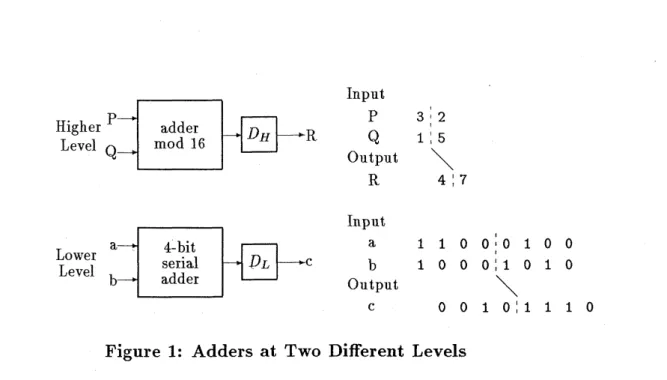
Let us consider the example of Figure 1; a specification is assumed
to be written at the higher level, and
an
implementation is given at thelower level. The higher-level adder calculates the addition $(mod 16)$ of
twointegers $P,$ $Q$ given as inputs and then, after a higher-level
unit
delay,it outputs the result. The lower-level adder serial$ly$ adds two integers as
4-bit binary numbers. And then, after a tower-level
unit
delay, starts to259
Input $P$ $3_{1}|2|$ $Q$ 1 $||5$ $OutputR$ $\backslash _{1}4^{t}7$ Input a 1 1 $0$ $0|||0$ 1 $0$ $0$ Lower Level $0_{utput}^{b}$ 1 $0$ $0$ $0||\backslash ^{1}0$ 1 $0$ $c$ $0$ $0$ 1 $0(|1$ 1 1 $0$Figure 1: Adders at Two Different Levels
In Figure 1, a higher-level stat$e$ corresponds to the lower-level
se-quences wltich end with four consecutive bits of inputs, and the output
0010 at the lower level corresponds to 4 at the higher level.
A transformation rule $A=\langle\eta,$
SI}
of the example of Figure 1 isshown as follows, where $P,$ $Q,$ $R$ are represented in binary representation
using atomic propositions, i.e., $(p_{3},p_{2},p_{1},p_{0}),$ $(q_{3}, q_{2}, q_{1}, q_{0}),$ $(r_{3}, r_{2}, r_{1}, r_{0})$
respectively. $p_{3},$ $q_{3}$ and $r_{3}$
are
the most significant bits. Here thehigher-level integers
are
regardedas
binary numbers, for simplicity.$def=$
: Len4
$\eta$
SI $def=$
$\{p_{0}arrow last(4,$ $a),$ $p_{1}arrow last(4,$$Oa),$ $\cdots$
:
$r_{0}arrow last(7, c),$$r_{1}arrow last(7, Oc)$,
$r_{2}arrow last(7, OOc),$ $r_{3}arrow last(7, OOOc)$
}
where last$(i, \eta)def=(\eta\wedge Leni)\vee(V_{T} : (\eta:Leni))$
.
$Leni$ holds only alongthe sequences that consist of exactly $i$ states.
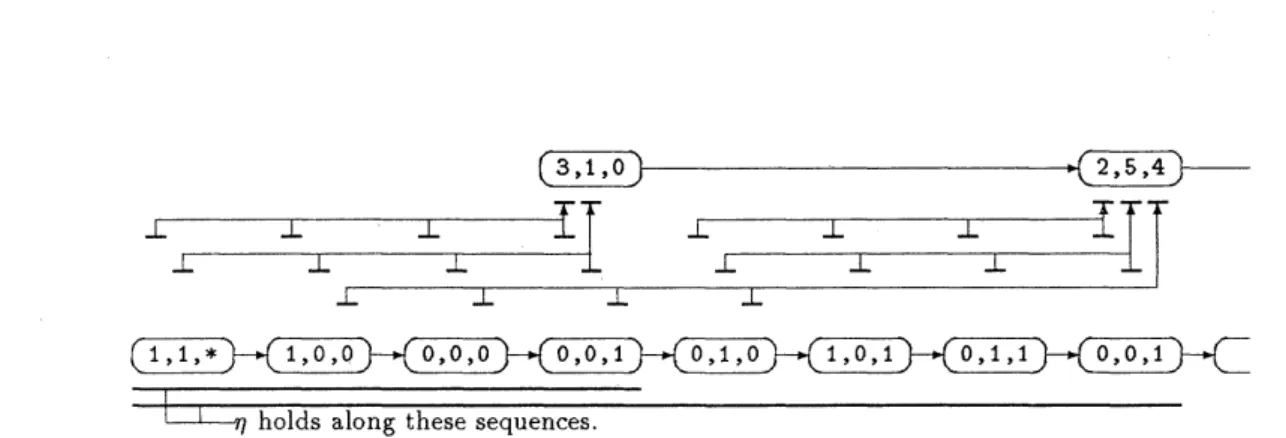
The example of the transformation fiom
a
lower-levelse
quence to a260
Figure 2: Transformation from a Lower-level Sequence to a Higher-level
Se-quence
Although the detail is ommitted in this paper, we
can
prove that theabstraction mapping can be simulat$ed$ by a generalized sequential
ma-chine $(gsm)[5]$
.
Because regular sets and infinitary regular sets are closedunder gsm mapping[5], any higher-level sequence obtained through the
abstraction mapping can be characterized by $\infty RTL$
.
3.2 A Formal Verification Method Considering Two Different
Levels
In this section, we show the outline of a formal verification method for
an
implementation and a specification given at two different levels.We regard that a transformation rule is a part of
an
implementation.Here
a
structure modelis
introduced to handle possible input-outputsequences easily.
Definition 5 Structure model
$K=(\Sigma, I, R, \Sigma_{0})$ is called
a
structure model, where $(\Sigma, I)$is
a
linearmodel of $\infty RTL$
.
$R\subseteq\Sigma\cross\Sigma$ is a total binary relation on $\Sigma$ and denotesthe possible
transitions
between states. $\Sigma_{0}\subseteq\Sigma$is
a set ofinitial states.An RTL formula $\eta$ is said to be universally K-true, if $\eta$ holds along
all finite and all infinite paths $\pi$ from $s_{0}$ for all $s_{0}\in\Sigma_{0}$ in the structure
For a Mealy machine $M_{l}$ $=$ $(X, Z, S, \delta, \lambda, s_{0})$, its corresponding structure $K_{l}$ $=$ $(\Sigma, I, R, \Sigma_{0})$ is constructed as follows:
$\bullet$ $\Sigma=\{s_{i,j,h}’|s_{i}\in S, j\in 2^{X}, k\in 2^{Z}, \lambda(j, i)=k\}$
$\bullet I(s_{i,j,k}’)=\{p_{x}|x\in j\}\cup\{p_{z}|z\in k\}$
’ $R=\{(s_{i,j,k}, s_{i^{t},j’,k’})|s_{i,j,k}, s_{i’,j’,k^{l}}\in\Sigma, \delta(j, s_{i})=s_{i’}\}$
$\bullet\Sigma_{0}=\{s_{0,j,k}’\in\Sigma\}$
Figure 3: Generation ofa Structure Model from a Sequential Machine [2]
When we focus to only infinite paths on the structure model $K$, the
term universally K-omega true (or false) is employed. $\square$
A structure model $K$ corresponding to a designed sequential machine
$\mathbb{J}I$ is obtained so
tbat
the possible input-output sequences of $M$ haveone-to-one correspondence with paths on $K$. The ways of generating a
structure model from a given Mealy machine are shown in Figure 3.
Then
formal
verification
is to make sure that a given specification formula holds along all the higher-level state sequences obtained by thetransformation rul$e$ from all the lower-level state sequences.
To do this, firstly, we generate a higher-level structure model $K_{H}$
from the lower-level structure model $K_{L}$ corresponding to the machine.
The transformation is performed by applying the abstraction
mapping
to all the paths of $K_{L}$
.
Its algorithm is omitted in this paper. Ourremaining
work is to check whether a specification formula is universally$I\sigma_{H}$-omega true. The outline ofits algorithm is shown in [7].
4
Considerations
In this paper,
we
show a formal framework basedon
$\infty RTL$ fordescrib-ing relations between two different levels ofabstraction and a verification
method for them.
lower-262
level
one can
be larger than that ofthe lower-levelone.
In order to avoid theincrease
of the size,some
restriction
will benecessary
to the frame-work of abstractionmapping.
However, describing the correspondencebetween
a
higher-level sequence anda
lower-levelone
explicitly,seems
a
suitable approach for formal $ve$rification ofhierarchical design.
Acknowledgment
The authors would like to $e$xpress their
sincere
appreciation to Dr. N.Takagi,
Mr. N. Ishiura, Mr. H. Danjo and all the members of the YajimaLaboratoryin Kyoto University for their$pre$cious discussion and advice.
Refere
nces
[1] K. Hamaguchi, H. Hiraishi, and S. Yajima. A Tempo$ral$ Logic Expressively
Equiva-lent to $\omega$-Regular Set. Technical Report COMP88-8, IEICE, 1988. In Japanese.
[2] H. Hiraishi. Design
Verification of
Sequential Machines Based on a Model Check-ing Algorithmof
$\epsilon$-free
Regular Tempo$ral$ Logic. Technical Report CMU-CS-88-195,Carnegie Mellon University, 1989.
[3] P. Wolper. Temporal Logic Can BeMore Expressive. In Proceedings
of
$22nd$AnnualSymposium on Foundations
of
Computer Science, pages 340-348, 1981.[4] E. M. Clarke, E. A. Emerson, and A. P. Sistla. AutomaticVerfficationofFinite State
Concurrent Systems Using Temporal Logic Specifications: A Practical Approach. In 10th $ACM$ Symposium on Principles
of
Programming Languages, pages 117-126,January 1983.
[5] J. E. Hopcroft and J. D. Ullman. Formal Languages and their Relation toAutomata.
Addison-Wesley, 1968.
[6] S. Eilenberg. Automata, Languages, and Machines. Academic Press, 1976.
[7] 濱口、平石、 矢島. 正則時相論理による論理設計の形式的検証. 情報基礎理