The Role of good governance in the knowledge-based
economic growth of East Asia ‒ A study on Japan, Newly
Industrialized Economies, Malaysia and China
Debnath Sajit Chandra
*and Kenji Yokoyama
**Abstract
Technology transfer from the developed countries has been made possible by foreign direct investments (FDI). The East Asian Miracle of industrial development with FDI has been led by the governments. The Newly Industrialized Economies (Korea, Taiwan, Hong Kong and Singapore), Malaysia and China, led by Japan, are currently moving towards knowledge-based economy from the product economy in the post-industrialization period. It is now well established that knowledge created through innovation and technological progress is the long-term driver of economic growth for the stated economies. The governments of the above mentioned economies have shown remarkable success in creating a knowledge-based economy through attracting large amount of FDI. It appears that countries with ‘good governance’ environments tend to attract more FDI. In the case of the selected countries of this study, FDI is contributing to the development of knowledge-based economy as it did during the industrialization period. This paper attempts to explain the impact of good governance in attracting FDI to promote knowledge-based economy in Japan, the Newly Industrialized Economies (NIES), Malaysia and China. In doing so, this paper investigates the good governance indicators and their role in attracting FDI to promote knowledge-based economy in the selected countries.
査読論文
* Correspondence to:Debnath Sajit Chandra
Ph.D., Visiting Professor, Graduate School of Economics, Kyushu University
** Correspondence to:Kenji Yokoyama
Ph.D., Dean, Graduate School of International Management, Ritsumeikan Asia Pacifi c University 1-1 Jumonjibaru, Beppu, Oita 874-8577 Japan
Keywords
Good governance, Knowledge-based Economy, Foreign Direct Investment, and Japan, NIES, Malaysia and China
1. Introduction
Some economic concepts introduced by evolutionary economists have been successful in describing economic growth than that of knowledge-based economy’ (KBE) (Leydesdorff, 2005). Recent studies on economic growth in a globalizing world, however, indicate knowledge as the main driver of the economy. Many developed countries recognized the importance of KBE in the face of fierce global competition. European Union (EU), for example, emphasized KBE to reform the economic base of EU countries (European Commission, 2000). During the European Summit in March 2000, the commission concluded, among many things, “the shift to a digital, knowledge-based economy, prompted by new goods and services, will be capable of improving citizens’ quality of life and the environment.” Thus, an economy that creates and diffuses knowledge for economic development is considered as knowledge-based.
It is now well established that knowledge created through innovation and technological progress is the long-term driver of economic growth. In an emerging global knowledge-based economy fuelled by the fast pace of human capital development through creating excellent education and training sectors and the development of the enabling environment for highly qualifi ed human resources through technological innovation, it is important for any country to lay solid foundations for building self capability to acquire and create knowledge by acquiring, creating and using new and dynamic technology for innovation. This would ensure the advantage of opportunities offered by globalization, and at the same time, to meet the rising challenges of an emerging global knowledge-based economy. The fundamental challenge in an emerging knowledge-based economy, therefore, is to harness knowledge for development by providing an enabling environment of competitive education system and highly qualifi ed human resources, excellent information and communication technology infrastructure (ICT) and capable scientifi c infrastructure for innovations.
Science and technology are at the heart of knowledge-based economic growth and development. Different schools of growth theory, whether of the neoclassical or endogenous
types, have all recognized the indispensable role of technological progress and its corollary, knowledge, in sustaining the growth process and increasing the level of per capita income (UNCTAD, 2007). However, diffusion and transfer of technology for economic development is not straightforward. Identifying the factors, policies and institutional arrangements that promote technology diffusion is the fi rst step in helping any country secure access to and use of technologies developed by technology leaders. As such, it is needless to say that the whole process of knowledge creation and diffusion in a knowledge-based economy heavily depends on appropriate government policies that are usually the outcome of good governance.
After the Second World War the government of Japan had shown great success in attracting large amount of FDI to enhance economic growth. During the high growth era of 1970s and 1980s, Japanese government policies enabled the transformation of Japanese economy into a knowledge-based economy. The efforts by the government were fully paid off as Japan gradually became world’s second largest economy after the U.S. Following the similar foot step, the governments of NIES, Malaysia and China have shown remarkable success in creating a knowledge-based economy through attracting large amount of FDI. Although other countries in East Asia such as Thailand, the Philippines, Indonesia and Vietnam have joined the race of economic development over the last two decades or so, their inspiration to create knowledge-based economy falls behind from the above countries. Moreover, most of these countries are yet trying to be stabilized politically while making economic progress, which is the opposite in Japan, NIES, Malaysia and China. As a result, considering presence of political stability in Japan, NIES, Malaysia and China along with the developments in creating a knowledge-based economy, this study tries to investigate the role of good governance in Japan, NIES, Malaysia and China in creating knowledge-based economy by attracting FDI.
2. Different Approaches to Knowledge-based Economy
Knowledge-based economy is an economy that creates and diffuses knowledge and thereby achieves economic growth (Debnath, 2007). In contemporary global economy where competition is very enormous and uncertainty is associated with everything (Nonaka et al., 1995), the importance of knowledge creation and diffusion is an absolute requirement in every sector of the society. In such a situation, the importance of knowledge creation is a high priority for any sector of society where government policies play a
greater role in promoting integration among and within different sectors. Among the recent successful economies, Singapore in East Asia is frequently used as an example in the studies of policy directed knowledge-based economy (Bercuson et al., 1995; Low, 2001) while other countries such as South Korea, Hong Kong, Taiwan and Malaysia are also considered as the emerging knowledge based economies (Mani, 2005; Mustapha and Abdullah, 2004) in the region.
The single most important goal of the economists, from Adam Smith to Thomas Malthus, Karl Marx, and the more modern neoclassical economists and endogenous growth’ economists has been to understand the mechanism of economic growth. The evolution of economic thought has led to a universal acceptance of the role of technology and knowledge as an engine of growth (Schumpeter, 1943). Technology has a direct impact not only on the productivity at micro level of a country, but also at the macro level. Economic growth cannot be sustained by capital accumulation alone, as the contribution of capital, without technological progress, will be subject to diminishing returns (UNCTAD, 2007).
The neoclassical approach takes the view that technological progress has only a transitory effect on the rate of growth. Under the neoclassical approach, the economic development of countries at different levels of development will converge towards the same steady state level (the catch-up phenomenon), given conditions of perfect competition and free fl ow of technology between countries (UNCTAD, 2007). Sheehan (1997) addressed this assumption problem of the neo-classical economic theory by saying:
“As it is well known, the standard neo-classical model on which so much of our policy and institutional structure is based is one which takes as given the existence of an adequate supply of fi rms with necessary skills and capabilities; which assumes full information and complete markets, including in relation to future technological developments and the skill inputs to production; which assumes that technological change is external to the economic system, taking place as a result of the independent development of science rather than the intentional action of profit-seeking agents; which abstracts from increasing returns and feedback mechanisms, which otherwise might lead to increasing polarization of economic outcomes for regions and countries, and so on. It is now clear that in these and other ways the basic neo-classical model falls far short of describing the central features of modern economies.”
The developmental-state approach views market failures as more pervasive for developing economies and, thus, looks to government intervention as a substitute mechanism for resolution of these more common market failures (Aoki et al., 1997:1). Johnson (1982) points out that the “soft authoritarian character” of the state was the source of East Asia’s autonomy which merges with Wade’s conception of the developmental state. Toner and Butler (2004) summarized Wade’s arguments on Governing the Market’ based on the particular political and economic conditions that were propitious for the development of the Northeast Asian developmental states as follows:
1. The particular national histories of Northeast Asian states which resulted in these states entering the postwar period with “authoritarian regimes or tightly circumscribed democracies”. Japan also provided a model for neighboring states of a country which had undergone an unprecedented rapid transformation in the prewar era from a feudal state into an industrial power. These histories facilitated the establishment of clear national development strategies directed at both resource creation and resource allocation. Political and bureaucratic control or infl uence was made through a wide range of industry policy instruments̶such as controls over credit, import and export licenses, public sector research and development (R&D), and government procurement;
2. That the Cold War gave the United States an overriding interest in the Northeast Asian states that abutted the Soviet Union and China. The United States fostered “their state-led capitalisms in order to prove that capitalism was superior to the communist systems next door”. This support took the form, inter alia, of the United States acting as the principal market for the developmental states’ exports; and 3. The change in the postwar strategy of multinational corporations, whose investment
in developing countries had hitherto been restricted largely to primary production. The scope of such investments was significantly widened to include manufacturing industry, including the “re-location” of these activities from developed economies.
Although the cooperative dynamism of the developmental state was supported by Evans’s concept of embeddedness (Evans, 1995) and Weiss’s concept of Governed Interdependence’ (Weiss, 1998), a major weakness of these conceptual frameworks is that state-society relations are limited to government-business relations – an elite coalition (Edigheji, 2005). Pointing out the wider society which is not addressed adequately in
developmental-state approach, Seddon et al. (1995) note, “effective insulation from immediate pressures of special interests enables policy-makers to respond swiftly and effectively to new circumstances; but the capacity to identify and implement appropriate policies to promote effective medium - and longer-term development requires the maintenance of strategic relations with wider civil society”. Toner and Butler (2004) also state the limitations of Wade’s developmental-state model by saying:
“Finally, and very briefl y, the principal purpose of Governing the Market was to prove the existence and efficacy of intelligent state action directed at creating and allocating resources within Northeast Asian economies. A principal means of achieving this objective was to criticize neoclassical orthodoxy by contrasting actual developmental state action with neoclassical prescriptions for development. Governing the Market was not attempting to detail and prove the efficacy of some underlying economic model for such state action.
While Wade at various points in his book explicitly and implicitly suggests such an alternative model, he does not develop it fully. In this sense the purpose of Governing the Market was negative ̶ to disprove the explanatory power of neoclassical orthodoxy, rather than to positively describe and confi rm an alternative economic theory of growth and development.”
Aoki et al. (1997) suggested a third view based on the neo-classical market-friendly view and developmental-state view which is the market-enhancing’ view where instead of viewing the state (government) and the market as the only alternatives, and mutually exclusive substitute, the role of government policy to facilitate or complement private-sector coordination is examined (Aoki et al., 1997). This new approach of market-enhancing view is capable of explaining the role of government in bringing out the proper combination in private-sector. The East Asian Miracle is, thus explained very well by applying this view.
However, the selected East Asian countries have been greatly influenced by “the presence of technological change and rapid innovation”, which is missing in the market-enhancing view. The market-market-enhancing view, thus, fails to explain the complex dynamism of economic growth where technological development and innovation play extremely important role. As a result, this new view cannot explain the economic growth of the post East Asian Miracle where technological advancement and greater innovation is becoming
a huge input in the economic growth.
Dolfsma (2006) pointing out the importance of the emerging realization that our economies are knowledge economies argues that economists should study much more closely than hitherto what knowledge is, and how it accumulates and dwindles away. As a further consequence developments in the economy may also need to be evaluated differently than before. Numerous recent contributions have pointed out the importance of so-called communities of practice in a knowledge economy. The prominence of those communities has been perceived in several fi elds of enquiry, such as the knowledge-based theory of firm, open source software development or industrial clusters (Muller, 2006). Economic fi rms are institutions, sustained by corporate law and fi scal arrangements and they are basic units of the market economy and drivers of change. Stam and Garnsey (2006) mention that in knowledge economy, new fi rms have proliferated as a result of the lowering of barriers to entry by information technologies and the associated emergence of new economic activities.
However, it is still difficult to understand these new comers to the economy or the basis of the growth on which their innovative contributions depend. The research and development, both at domestic and international level, is an integral part of a knowledge-based economy. Ferne (1997) mentions that the variety and scope of international Research and Development (R&D) programs and activities has rapidly become a major feature on the global scientific and technological scene and these activities range from structured and closely monitored efforts launched by governments to informal groupings of researchers who join forces in areas of common interest, and increasingly include R&D alliances between fi rms.
3. Relationships among Good Governance, FDI and Knowledge-based
Economy in Japan, NIES, Malaysia and China
The institutional framework should ensure a good fl ow of knowledge between scientifi c research and technological applications, as well as a good flow of information among researchers and users. Here, the governments play a crucial role, as knowledge creation cannot rely on market mechanism alone. As the market for knowledge is often characterized by imperfections – that is to say, social and private returns derived from knowledge can widely differ (UNCTAD, 2007) and in the area of knowledge creation, any market failure’ may lead to private underinvestment in knowledge. Thus, policies to
support knowledge creation through various efforts such as government funding, government procurement, tax subsidies, intellectual property rights protection and so on, as well as knowledge diffusion such as establishment of libraries, communication networks, access cost subsidies, etc. are to be formulated by the government.
As we postulate the role of government as indispensible in creating knowledge-based economy our hypothesis for this study is that good governance is required for creating knowledge-based economy. In examining how good governance plays a role in creating knowledge-based economy, we have investigated the relations between good governance and FDI inflows and domestic investments that contribute to the development of KBE infrastructure.
Figure 1 shows the relationship among the three components of our study such as good governance, FDI inflows and domestic investments and development of KBE infrastructure. The two black arrows show the first-order development of KBE infrastructure which indicate that good governance will lead to attract more FDI and allow more domestic investment to develop KBE infrastructure in the initial stage. Once the fi rst-order development works steadily, the second-order developments take place where all the three interact with each other mutually or independently to improve all the three components to create a complete knowledge-based economy.
Source: Developed by authors. Figure 1
4. Good Governance in Japan, NIES, Malaysia and China
Good governance would include an effective, impartial and transparent legal system that protects property and individual rights; public institutions that are stable, credible and honest; and government policies that favor free and open markets. These conditions encourage FDI and presumably private domestic investment as well, by protecting privately held assets from arbitrary direct or indirect appropriation. Generally, “good governance” indicators have six dimensions: i) Voice & Accountability, ii) Political Stability and Lack of Violence/Terrorism, iii) Government Effectiveness, iv) Regulatory Quality, v) Rule of Law, and vi) Control of Corruption (Kaufmann et al., 1999). Using the data from 1998-2007 for the above six indicators, a comparative analysis has been made for selected countries.
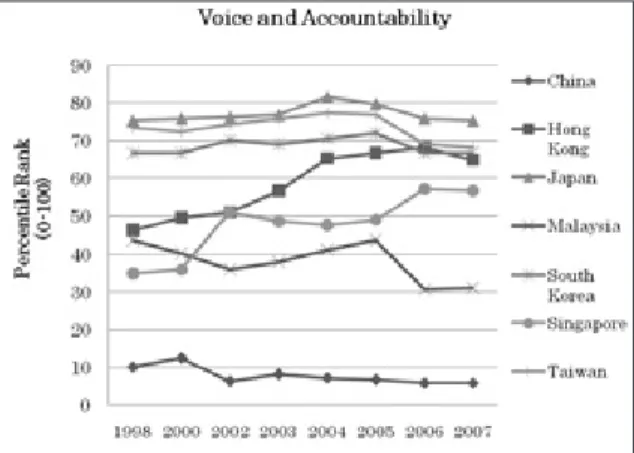
Figure 2 asserts that all the selected countries indeed performed much better than China in terms of voice and accountability measures of good governance. This is because all the countries except China are democratic. Being a socialistic country China’s performance, in this regard is quite poor below 40% in the percentile ranking.
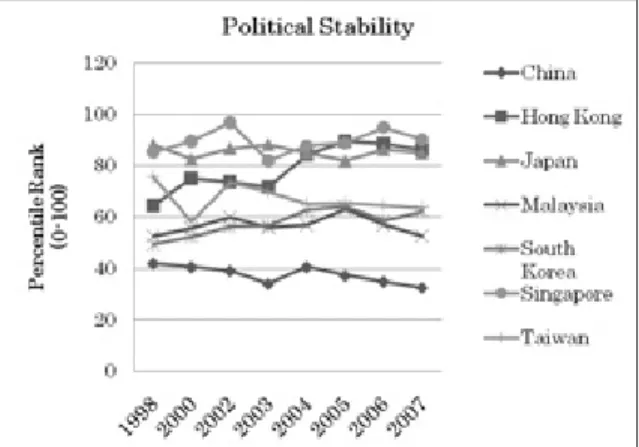
Figure 3 indicates that almost all the selected countries have been performing consistently well in terms of political stability. Although China’s performance in this regard is below all the other selected countries, yet China has been successful in maintaining the political stability around 40% level as shown in the percentile rank.
Source: Computed data collected from Worldwide Governance Indicators, 1996-2007. Figure 2
Figure 4, indicates that all the selected countries have been performing consistently well in terms of government’s effectiveness. China is performing above 60% level while other selected countries’ performance in 2007 was above the 80% level in the percentile ranking, which indicates that China’s performance in this regard has improved over the last 10 years.
Figure 5 shows that regulatory quality in the selected countries. From the Figure, it is evident that all the selected countries except China are performing well above the 60% level whereas China is performing above the 40% level in the percentile ranking. However,
Source: Computed data collected from Worldwide Governance Indicators, 1996-2007. Figure 3
Political Stability in Japan, NIES, Malaysia and China, 1998-2007
Source: Computed data collected from Worldwide Governance Indicators, 1996-2007. Figure 4
China’s performance has been gradually getting better over the years.
In terms of rule of law, all the selected countries except China are performing well above the 60% level whereas China is performing above the 40% level in the percentile ranking (See Figure 6). China, although is behind in this regard, has shown steady development in the last 10 years.
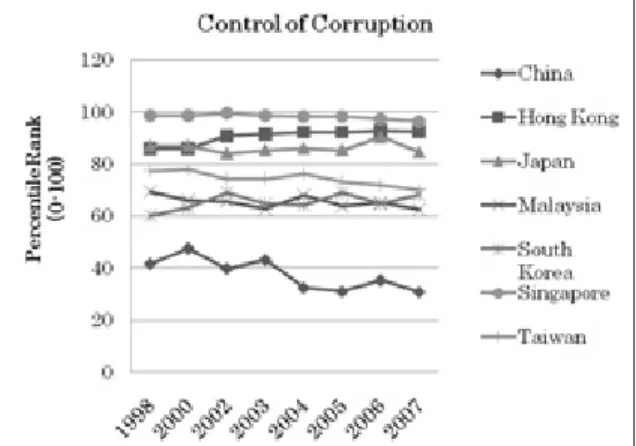
From Figure 7, we can note that all the selected countries are performing above 60% level in the percentile rank in controlling corruption. Only China has been experiencing poor performance in this regard with the below average level of 50%. China’s performance
Source: Computed data collected from Worldwide Governance Indicators, 1996-2007. Figure 5
Regulatory Quality in Japan, NIES, Malaysia and China, 1998-2007
Source: Computed data collected from Worldwide Governance Indicators, 1996-2007. Figure 6
has been declining since 2003.
If we combine all the six indicators of good governance, we will see that Singapore, Hong Kong, Japan, South Korea, Taiwan and Malaysia have been performing well above the 60% level in the percentile ranking which is much better than China. On the other hand, China, the only socialist country in this study has shown relatively poor performance in terms of all the six indicators. However, having said that China has maintained above 40% level on average which is quite significant compared to other socialist countries.
5. The Impact of Good Governance in Attracting FDI to Promote
Knowledge-based Economy in Japan, NIES, Malaysia and China
The role of good governance in promoting knowledge-based economy in East Asia has been to attract large volume of FDI and increase domestic investment to build the KBE infrastructure to bring better economic growth. FDI can increase competition in the host economy, making domestic companies more efficient and improving living standards. A recent study found that with a 1 per cent increase in FDI in developing economies will increase growth in GDP per capita by close to 0.5 per cent (McLean and Shrestha, 2002). Figure 8 shows that almost all the selected countries have positive FDI inflows. This indicates that the stable sociopolitical environment in the selected countries, a product of good governance is one of the core reasons for the large volume of FDI infl ows in these
Source: Computed data collected from Worldwide Governance Indicators, 1996-2007. Figure 7
Source: IMD online. Figure 8
Inward FDI Flows in Japan, NIES, Malaysia and China, 1998-2007
Source: Government Finance Statistics Yearbook 2007 Figure 9
Public Expenditure in Education in Japan, NIES, Malaysia and China, 1997-2005
Source: UNESCO online database (http://stats.uis.unesco.org) Figure 10
countries compared to South Asia or Africa.
On the other hand, the domestic investments in education, Research and Development (R&D) and ICT has been quite steady for most of the selected countries, which indicates that the governments in the selected countries while attracting more FDI also put efforts to develop knowledge-based economic infrastructures (See Figure 9, 10 & 11).
6. The Current Status of Knowledge-based Economy in East Asia
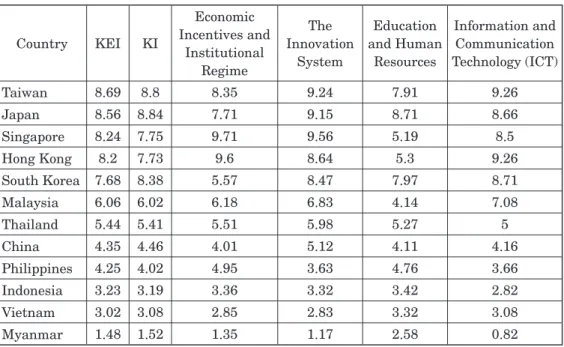
Measuring the knowledge-based economy is very challenging. For simplifi cation, we have used here the knowledge index (KI), and knowledge economy index (KEI) to investigate the status of knowledge-based economies in Japan, NIES, Malaysia and China. K I m e a s u r e s a c o u n t r y ’ s a b i l i t y t o g e n e r a t e, a d o p t a n d d i f f u s e k n o w l e d g e. Methodologically, the KI is the simple average of the normalized performance scores of a country or region on the key variables in three Knowledge Economy determinants such as Education and human resources, scientifi c infrastructure, and technology infrastructure. KEI takes into account whether the environment is conducive for knowledge to be used effectively for economic development. The KEI is calculated based on the average of the normalized performance scores of a country or region on all 4 determinants related to the knowledge economy such as role of government, education and human resources, scientifi c infrastructure, and technology infrastructure. Among the selected countries in this study, almost all the countries are quite successful in transforming their economy towards a knowledge-based one except China (See Table 1).
Note: Taiwan’s data is not available. Source: World Development Index Database
Figure 11
Considering the indicators of good governance and FDI inflows, investments in education, R&D and telecommunications which refl ect investments in KBE infrastructures and examining the current KBE status of the selected East Asian countries, it is evident that the same countries that have superior good governance have also performed better in terms of creating knowledge-based economies.
Similar trends have been observed in terms of overall productivity in East Asia (See
Table 1
Knowledge-based Economy Status in East Asian Countries
Country KEI KI Economic Incentives and Institutional Regime The Innovation System Education and Human Resources Information and Communication Technology (ICT) Taiwan 8.69 8.8 8.35 9.24 7.91 9.26 Japan 8.56 8.84 7.71 9.15 8.71 8.66 Singapore 8.24 7.75 9.71 9.56 5.19 8.5 Hong Kong 8.2 7.73 9.6 8.64 5.3 9.26 South Korea 7.68 8.38 5.57 8.47 7.97 8.71 Malaysia 6.06 6.02 6.18 6.83 4.14 7.08 Thailand 5.44 5.41 5.51 5.98 5.27 5 China 4.35 4.46 4.01 5.12 4.11 4.16 Philippines 4.25 4.02 4.95 3.63 4.76 3.66 Indonesia 3.23 3.19 3.36 3.32 3.42 2.82 Vietnam 3.02 3.08 2.85 2.83 3.32 3.08 Myanmar 1.48 1.52 1.35 1.17 2.58 0.82
Source: (Knowledge Assessment Methodology), World Bank
Source: The Conference Board and Groningen Growth and Development Centre, Total Economy Database, September 2008.
Figure 12
Figure 12). Overall productivity indicates the steady growth of the economy. We see from Figure 12 that the countries that are leading KBEs in East Asia are also leading the economic growth in East Asia. In terms of FDI inflows, China has shown much better performance than other East Asian countries. On the other hand, all the East Asian countries have better performance in investing in education, R&D and ICT which refl ect investments in KBE infrastructures.
7. Critical Evaluation of the Achievements of Japan, NIES, Malaysia and
China in Terms of Creating Knowledge-based Economy
Scholars evaluate the miraculous growth of Japan, NIES, Malaysia and China from different view point. On the one side, some scholars argue that there is nothing miraculous about the success of the NIES or other rising East Asian economies. Paul Krugman, one of most infl uential scholars with this view, argues that the rise of the NIES or other recent rising Asian economies was fueled by mobilizing resources such as inputs of machinery, infrastructure and education sector development (Krugman, 1994). He goes as far as to say that the development of the NIES and other selected economies resembles the development pattern of United States of Soviet Russia (USSR) of the 1950s which must experience diminishing return.
On the other side, some scholars, especially prominent economists in World Bank and International Monitory Fund (IMF), argue that the pace of miraculous economic growth of the above countries is much faster than that of Western world. The developments in the economic achievements tickled down on other sectors of society such as education, information communication technology, research and development, transportation and so on and these East Asian economies will continue to grow in the coming decades.
After the remarkable economic success since 1950s, the collapse of the Soviet Russia in the 1990s surprised many economists who started arguing that the Soviet Russia, after many decades of widespread economic development, experienced the inevitable diminishing returns effect because it had relied on a massive accumulation of capital and labor while failed to adopt, adapt and create new technology through innovation. These scenarios of the Soviet Russia raised concerns about NIES and other East Asian economies that have invested heavily in labor and capital, thanks to large amount of FDI infl ows and increase in domestic investment while technological innovation had been slow during their high growth era in the 1980s and the 1990s. Krugman (1994) argues strongly:
“The newly industrializing countries of Asia, like the Soviet Union of the 1950s, have achieved rapid growth in large part through an astonishing mobilization of resources. Once one accounts for the role of rapidly growing inputs in these countries’ growth, one fi nds little left to explain. Asian growth, like that of the Soviet Union in its high-growth era, seems to be driven by extraordinary growth in inputs like labor and capital rather than by gains in effi ciency.”
In the similar manner, Young (1994b) in explaining the astonishing economic growth of the NIES argues that “while the growth of output and manufacturing exports in the newly industrializing countries of East Asia is virtually unprecedented, the growth of total factor productivity in these countries is not”. In the similar vein, Kim and Lau (1994) argue that by far the most important source of economic growth in the NIES is capital accumulation, accounting for between 48 and 72 percent of their economic growth, in contrast to the case of the group of fi ve industrialized countries such as Germany, France, Japan, United Kingdom and United States, in which technical progress has played the most important role, accounting for between 46 and 71 percent of their economic growth.
However, the results of these studies are not only strikingly different from the view presented earlier of the creation of knowledge-based economy whose main goal is to enhance technological progress through continuous innovation, but also suggest a very wrong message which fails to explain the why innovations are fl ourishing in the NIES and other rising knowledge-based economies in East Asia. In fact, the conclusions of the above studies are highly restrictive to many assumptions like many other neoclassical economic theories. Sarel (1996) argues two problems with the conclusions from the above studies. First, the main reason for this sensitivity is the diffi culty of estimating the rate of growth of capital stock in the East Asian countries during the period under study because of absence of good data before 1960. So, dubious assumptions about the depreciation rate of capital stock and about how much investment flowed in during the years of explosive growth beginning in 1960 have been made to estimate the capital availability in 1960.
The second problem comes from trying to estimate the share of national income attributable to capital and the share attributable to labor. Sarel (1996) argues in this regard by saying:
“Does the same amount of capital produce equal income in all countries and in all industries? Can statistics about the labor participation rate be trusted? Is the amount
of effective work proportional to the hours that people work, or does working extra hours lead to diminishing returns? Should different types of labor (factory, offi ce) be summed together? How should human capital be treated?”
Thus, the critics of the economic growth in the East Asia, especially regarding Japan and NIES do not held convincing as Japan and other NIES economies have been very insistent to continuous improvement of productivity through continuous innovation as they are moving towards creating knowledge-based economy. In fact, available recent data shows that there is clear technology progress in the NIES and other rising East Asian knowledge-based economies.
8. Technological Progress is Fueling the Development of Knowledge-based
Economy in East Asia
Krugman (1994) argued that from the perspective of the year 2010, the projections that East Asian economic growth would experience diminishing returns because of lack of enough technological progress does not hold true as the economies in East Asia continues to grow by venturing new technologies through adoption, adaption and innovation. Although knowledge flows from advanced countries remain the primary source of new ideas for the East Asian knowledge-based economies though three main channels for knowledge fl ows to East Asia – international trade, acquisition of disembodied knowledge and foreign direct investment are discernible, the exceptionally fast growth in domestic innovation efforts in Japan, Korea, Taiwan, Hong Kong, Singapore, Malaysia and China has been mentioned by many scholars.
The selected East Asian economies have made substantial developments in capacity building by increasing the R&D expenditures and creating greater number of R&D personnel. Figure 13 indicates whether the companies in East Asia obtains technology exclusively from licensing or imitating foreign companies (1 in scale), by conducting formal research and pioneering their own new products and processes (7 in scale) for the year 2007-2008. From the Figure 13 it is apparent that the capacity for innovations has been quite higher in the major KBEs in East Asia whereby the countries obtain technology by conducting formal research and pioneering their own new products and processes rather than from licensing or imitating foreign companies. Japan, Korea, Taiwan and Singapore are leading the table while Hong Kong falls behind Malaysia and Singapore.
This effort of capacity building has been further boosted by the institutional improvements, reducing microeconomic instability and improving overall human capital status in East Asia. The research institutions have been playing very key role in advancing the innovation capacity in East Asia. Figure 14 shows scientific research institutions in East Asian countries are nonexistent (1 in scale) or the best in their fi elds internationally (7 in scale). From the Figure it is quite evident that the scientifi c research institutions in selected East Asian economies have been very active in internationally competitive research. This trend is also visible in other late comers in East Asia.
Source: World Economic Forum, Executive Opinion Survey 2007, 2008 Figure 13
Capacity for Innovations in East Asia, 2007-2008
Source: World Economic Forum, Executive Opinion Survey 2007, 2008 Figure 14
Again, in the area of R&D, collaboration between the business community and local universities (1 = minimal or nonexistent, 7 = intensive and ongoing) has been very strong in most of the selected East Asian countries (See Figure 15). The major East Asian KBEs also have performed superior in this regard except the case of Hong Kong which falls below Malaysia.
The selected East Asian economies realized the importance of innovation as they approached the frontier of knowledge where they have lesser opportunities of integrating and adapting exogenous technologies. They are putting tremendous efforts to create cutting-edge products and processes to maintain competitive edge with the other developed countries around the globe. Both the public and private sectors are jointly building the conducive environment for competitive innovation in East Asia. Government procurement decisions have been facilitating the technological innovation in major East Asian KBEs. Figure 16 shows the executive opinion survey done by the World Economic Forum (1 = strongly disagree, 7 = strongly agree). From the figure, we see that Malaysia also performed well in this regard along with the advanced East Asian KBEs.
Many scholars argue that there is a signifi cant relationship between the innovation inputs such as R&D expenditure and innovation outputs such as patents. In addition to the R&D expenditure, openness to foreign knowledge has been a contributing factor in East Asia’s innovation. As the innovation infrastructure in the selected East Asian economies has been developing, there has been greater increase in patent applications in most of the countries. If we see Table 2, we find that since 2000, there has been steady
Source: World Economic Forum, Executive Opinion Survey 2007, 2008 Figure 15
increase in number of patent applications fi led for residents and non-residents in all of the East Asian economies. This trend is more prevalent in Japan, China, Korea, Taiwan, Hong Kong and Singapore.
In terms of patents granted to the residents, Japan, Korea, Taiwan and China are the leading economies in East Asia (See Table 3). If we compare the change in patents per 1000 people between 1990 and 2000, we see that the newly industrialized economies (See Table 4) have shown tremendous success while the other late comers also experienced the
Source: World Economic Forum, Executive Opinion Survey 2007, 2008 Figure 16
Government procurement for technological innovation, East Asia
Table 2
Number of patent applications fi led for residents and non-residents, East Asia
Country 2000 2001 2002 2003 2004 2005 2006 2007 China 51,906.00 63,450.00 80,232.00 105,317.00 130,384.00 173,327.00 210,501.00 245,161.00 Hong Kong 8,295.00 8,914.00 9,130.00 9,102.00 10,005.00 11,763.00 13,790.00 13,766.00 Indonesia 3,889.00 3,922.00 3,837.00 3,300.00 3,667.00 4,303.00 4,606.00 N/A Japan 419,543.00 440,248.00 421,805.00 413,093.00 423,081.00 427,078.00 408,674.00 396,291.00 Korea 102,010.00 104,612.00 106,136.00 118,651.00 140,115.00 160,921.00 166,189.00 172,469.00 Malaysia 6,227.00 5,934.00 4,937.00 5,062.00 5,442.00 6,286.00 4,800.00 N/A Philippines 3,636.00 2,605.00 854.00 1,873.00 2,696.00 2,351.00 3,265.00 N/A Singapore 8,236.00 8,656.00 8,199.00 7,906.00 8,585.00 8,605.00 9,163.00 9,951.00 Taiwan 61,231.00 67,860.00 61,402.00 65,742.00 72,082.00 79,442.00 80,988.00 81,834.00 Thailand 5,049.00 5,332.00 4,489.00 5,131.00 5,373.00 6,340.00 6,248.00 1,388.00 Source: World Intellectual Property Organization and the WIPO Patent Report, 2008 Edition.
similar growth.
Patent quality provides us with greater view of a country’s real innovation output as the technological and economic values of the patents differ significantly. Scherer and Harhoff (2000) have done survey on this and found that in case of the USA and Germany, the top 10% of the patents accounts over 80% of the economic value which indicates that number of patents alone is suffi cient to portrait the true patent quality. While the patent productivity in most East Asian KBEs has been increasing over the years (See Table 5), the patent quality differs signifi cantly across East Asia. Although the volume of patenting in economies such as Korea and Taiwan equals or exceeds that in most developed economies, however, the quality varies a lot among the East Asian countries. Patent
Table 3
Total number of patents granted to residents, East Asia
Country 1998 1999 2000 2001 2002 2003 2004 2005 2006 2007 China 1,592.00 2,091.67 3,640.33 4,887.67 5,813.33 7,555.67 11,837.67 16,783.33 21,341.00 25,909.00 Hong Kong 25.50 25.00 34.67 27.33 27.00 22.67 29.67 51.00 59.00 65.33 Indonesia N/A N/A N/A N/A N/A N/A N/A N/A N/A N/A Japan 127,820.50 129,867.00 123,977.67 118,534.67 110,053.00 109,575.00 110,625.67 111,483.33 116,806.33 127,644.00 Korea 25,188.00 31,219.67 34,035.33 29,353.00 24,983.67 27,511.00 31,994.67 39,742.67 59,335.33 78,122.33 Malaysia 36.50 37.33 28.00 27.00 24.67 27.00 29.00 30.67 82.67 187.33 Philippines 15.50 12.00 6.33 7.67 10.00 9.67 11.67 12.67 23.00 N/A Singapore 25.00 32.67 62.67 109.33 174.33 196.00 272.67 376.67 464.33 487.33 Taiwan 17,984.00 18,006.67 19,402.00 24,699.67 26,964.33 29,370.33 29,772.67 35,598.67 36,538.00 36,721.67 Thailand 35.50 33.33 39.00 44.00 47.33 51.00 50.67 58.33 79.00 98.67
Source: World Intellectual Property Organization, the WIPO Patent Report, 2008 Edition and national Sources
Table 4
USPTO Patents Granted, East Asia (Annual Average) Patents per 1000 People
Country 1990-1994 2000-2004 % Change China 0.00 0.03 22.9 Hong Kong 3.15 9.32 11.4 Indonesia 0.00 0.01 8.8 Japan 18.23 28.54 4.6 Korea 1.44 8.67 19.7 Malaysia 0.07 0.28 15.3 Philippines 0.01 0.02 10.4 Singapore 1.09 9.87 24.6 Taiwan 6.30 30.17 17.0 Thailand 0.01 0.07 20.9
quality in the US is much higher than in many East Asian countries. In East Asia, Japan is the closest to the US quality with a quality rating of 80%-90% than that of US one while Korea is close to Japan in most technology areas, even matching or exceeding it in some followed by Taiwan with a score of 70%-80% of the US level (Brahmbhatt and Hu, 2007).
9. Conclusion
Among the selected countries in East Asia, Japan, South Korea, Hong Kong, Singapore, Taiwan, and Malaysia have shown superior performance in maintaining good governance than China. The same countries have also shown superior performance in terms of creating knowledge economy as measured by the Knowledge Economy Index (KEI) in Table 1. If we consider the knowledge base of each country which is measured by KI, we see that the same countries achieved better development in strengthening the knowledge base of their economies. Again, the same is found true in terms of achieving superior growth in all the four determinants of knowledge-based economy such as role of government, education and human resources, scientific infrastructure, and technology infrastructure.
Now, if we investigate the six good governance indicators further, we will find that Taiwan, Japan, Singapore and Hong Kong are leading while Malaysia has been performing
Table 5
Patent Productivity, East Asia*
Country 1998 1999 2000 2001 2002 2003 2004 2005 2006 2007 China 5.33 8.82 13.40 10.14 9.76 17.38 26.18 23.45 25.39 26.92 Hong Kong 14.18 7.45 15.59 5.17 5.04 3.76 4.01 7.14 4.10 4.49 Indonesia N/A N/A N/A N/A N/A N/A N/A N/A N/A N/A Japan 205.01 221.59 192.99 194.71 195.25 190.89 191.56 182.17 204.79 N/A Korea 460.82 514.84 263.37 186.58 249.96 237.66 266.25 348.23 520.28 N/A Malaysia 10.52 N/A 7.15 N/A 5.03 N/A 3.92 N/A 33.23 60.06 Philippines N/A N/A N/A N/A N/A 1.31 2.99 3.04 7.44 N/A Singapore 3.44 4.97 10.74 17.12 21.21 13.98 26.95 32.50 24.86 N/A Taiwan 233.36 257.93 339.57 445.85 333.44 384.41 372.90 437.62 317.83 288.70 Thailand N/A 5.48 N/A 8.34 5.41 7.99 8.40 8.00 15.27 13.42 Source: World Intellectual Property Organization, the WIPO Patent Report, 2008 Edition (http:// www.wipo.int/ipstats/fr/statistics/patents), OECD Main Science and Technology Indicators 2/2007, UNESCO Web and national Sources
better than China taking the fi fth position in all indicators. If we further break down the normalized score of KEI, KI and the four determinants of each selected country of East Asia, we see that the same four countries have achieved better growth in terms of creating knowledge economy while Malaysia has been performing better than China taking the fifth position. The same four countries also achieved superior growth in all the four determinants of knowledge-based economy with Malaysia occupying the fifth position among the East Asian Countries. A similar trend has been observed in terms of overall productivity in East Asia (See Figure 12). Overall productivity indicates the steadiness of the economy and we see from Figure 12 that the countries that are leading KBEs in East Asia are also leading the economic growth in East Asia.
In terms of FDI infl ows, China has shown much better performance than other East Asian countries although FDI has played a major role in advancing all the East Asian K n o w l e d g e - b a s e d E c o n o m i e s. H o w e v e r, t h e i n wa r d F D I w i t h i n C h i n a f l o w s disproportionately into provinces with less corrupt governments and governments that better protect private property rights. This, therefore, suggests that if China had higher quality governance across all the provinces, the country as a whole would have attracted even more FDI. Among the East Asian countries, China attracts the highest FDI as China has maintained political and ideological stability with growing wealth. Although China ranks at the bottom in the good governance rankings among the selected East Asian countries, China’s success story in attracting FDI is largely attributed to the spectacular growth track record, the relatively better government executive power, a relative political stability, good infrastructure, abundant educated labor force, and its large domestic market. So, China’s case is not exceptional in East Asia.
Our objective in this paper was to explain the role of good governance in promoting knowledge-based economy in East Asia by investigating the good governance and KBE indicators and examining how they are interrelated in selected East Asian countries. From the analysis, it is clear that the relationship between good governance and the creation of knowledge-based economy in East Asia is positively correlated. In East Asia, good governance played an important role in attracting FDI, which helped developing the knowledge-based economic infrastructures to create knowledge-based economy. In the case of China, the country is still a long way behind the other selected East Asian countries in terms of knowledge-based economy. The same can be said about the overall productivity which is a powerful indicator of economic growth. If China wants to be similar to other East Asian knowledge-based economies, China has to further improve its governance
quality.
References
Aoki, M., Murdock, K. and Okuno-Fujiwara, M. (1997). “Beyond The East Asian Miracle: Introducing the Market-Enhancing View” in Aoki et. al. (eds.) The role of government in
East Asian economic development: comparative institutional analysis, Oxford: Clarendon
Press.
Bercuson, Kenneth et al. (1995). “Singapore: A Case Study in Rapid Development”, IMF
Occasional Paper No. 119, Washington, DC: IMF, February.
Brahmbhatt, M. and Hu, A. (2007). Ideas and Innovation in East Asia. Policy Research Working
Paper 4403, World Bank, November 2007.
Cohen, J. W. (1988). Statistical power analysis for the behavioral sciences (2nd
edn). Hillsdale, NJ: Lawrence Erlbaum Associates.
Debnath, S. C.(2007). “Emerging Knowledge-Based Economies in the Southeast Asia and its Impact on the Trade: A Comparative Study of Malaysia and Singapore”, Environment and Trade Under the WTO, Volume 1, No. 1, pp 5-42.
Debnath, S. C. (2008). “Policy Formulations for a Knowledge-based Economy: A Comparative Study of Malaysia and Singapore”, The International Journal of Knowledge, Culture &
Change Management. Vol. 8, No. 1, Page 147-157.
Debnath, S. C. (2009) “Higashi ajiano chisikikibankeizai ni Okeru kaigaichokusetsutoushi wo yuinsuru gabanensu no yakuwari東アジアの知識基盤経済における海外直接投資を誘引する ガ バ ナ ン ス の 役 割 (Role of Governance in Attracting Foreign Direct Investment in East Asian Knowledge-based Economies)”, The 49th
National Convention of Japan Academy for International Trade and Business, Kinki University, Japan, 30-31 May, 2009.
Debnath, S. C. (2009). “Developing Competitive Educational Infrastructure in Southeast Asian Knowledge-based Economies”, International Convention of Asia Scholars ICAS 6, Daejeon Convention Center, Korea, 06-09 August.
Debnath, S. C. and Mani, A. (2008). “Scientifi c Infrastructure Development in Southeast Asian Knowledge-Based Economies: A Case Study of Malaysia and Singapore”, The 4th Annual
Meeting of the Asian Law and Economics Association, Kyushu University, Japan, 27-28
September.
Debnath, S. C., Yokoyama, K. and Mani, A. (2009). “Technological Infrastructure Development for Knowledge-based Economies in Southeast Asia: A Comparative Study of Malaysia and Singapore”, The International Journal of Technology, Knowledge and Society, Volume 5, No.
1: 21-42.
Dolfsma, W. (2006). “Knowledge, the knowledge economy and welfare theory” in Dolfsma, W. and Soete, L. (eds.). Understanding the Dynamics of a Knowledge Economy, Edward Elgar, Massachusetts.
European Commission. (2000). Preparing the Transition to a Competitive, Dynamic, and
Knowledge-based Economy: An information society for all. Retrieved from http://ue.eu.int/
ueDocs/cms_Data/docs/pressdata/en/ec/00100-r1.en0.htm on June 20, 2008.
Evans, P. (1995). Embedded Autonomy: States and Industrial Transformation. New Jersey: Princeton University Press.
Edigheji, O. (2005). “A Democratic Developmental State in Africa? A concept paper”, Center for
Policy Studies, Research Report 105, Johannesburg, South Africa.
Ferne, G. (c1997). “Collective Research and IPRs in the Global Environment” in Industrial
competitiveness in the knowledge-based economy: the new role of governments, OECD
Proceedings, OECD.
Johnson, C. (1982). MITI and the Japanese Miracle: The Growth of Industrial Policy, 1925-1975. Stanford: Stanford University Press.
Kaufmann, D., Kraay, A. and Zoido-Lobatón, P. (1999a). “Aggregating Governance Indicators,”
World Bank Working Paper, No. 2195, available at: http://www.worldbank.org/wbi/
governance.
Krugman, P. (1994). “The Myth of Asia’s Miracle”, Foreign Affairs, Vol. 73, Issue 6:62-78.
Leydesdorff, L. (2005). The Knowledge-based Economy: modeled, measured, simulated. Boca Raton, Fla.: Universal Publishers.
Low, L. (2001). “The Singapore developmental state in the new economy and polity”, The Pacifi c
Review. 14(3): 411-441.
Mani, A. (2005). “Creating Knowledge Based Economies in Southeast Asia”, The Ritsumeikan
Economic Review. 54(3): 114-132.
Mustapha, R. and Abdullah, A. (2004). “Malaysia Transitions Toward a Knowledge-Based Economy”, The Journal of Technology Studies. xxx(3): 51-61.
Muller, P. (2006). “Reputation, leadership and communities of practice: the case of open source software development” in Dolfsma, W. and Soete, L. (eds.). Understanding the Dynamics of
a Knowledge Economy, Edward Elgar, Massachusetts.
Muller, P. (2006). “Reputation, leadership and communities of practice: the case of open source software development” in Dolfsma, W. and Soete, L. (eds.). Understanding the Dynamics of
McLean, B. and S. Shrestha (2002), “International financial liberalization and economic growth”, research Discussion paper, available at http://www.rba.gov.au/PublicationsAnd Research/RDP/RDP2002-03.html, accessed 14 November, 2008.
Nonaka, I. and Takeuchi, H. (1995). The knowledge-creating company: how Japanese companies
create the dynamics of innovation. New York: Oxford University Press.
Schumpeter, J. A. (1943). Capitalism, Socialism and Democracy. Allen and Unwin, London. Sheehan, P. J. (1997c). “Learning to Govern in the Knowledge Economy: Policy Co-ordination or
Institutional Competition” in Industrial competitiveness in the knowledge-based economy:
the new role of governments, OECD Proceedings, OECD.
Seddon. D. and Betto-Jones, T. (1995). “The political determinants of Economic Flexibility, with special reference to the East Asian NICs” in Killick Tony (ed). The Flexible Economy: Causes
and Consequences of the adaptability of national economies. London and New York:
Routledge.
Stam, E. and Garnsey, E. (2006). “New fi rms evolving in the knowledge economy: problems and solutions around turning points” in Dolfsma, W. and Soete, L. (eds.). Understanding the
Dynamics of a Knowledge Economy, Edward Elgar, Massachusetts.
Sarel, R. (1996). “Growth in East Asia – What We Can and What We Cannot Infer”, Economic
Issues 1, International Monetary Fund, pp. 1-22.
Scherer, F.M. and Harhoff, D. (2000). Technology Policy for a World of Skew-distributed Outcomes. Research Policy, 29.
Toner, P. and Butler, G. (2004). Some Refl ections on Governing the Market. Issues & Studies 40, no. 1 (March 2004): 81-102.
UNCTAD. (2007). Information Economy Report 2007-2008.
Weiss, L. (1998). Myth of the Powerless State, Ithaca: Cornell University Press.
Young, A. (1992). “Tale of Two Cities: Factor Accumulation and Technical Change in Hong Kong and Singapore”, NBER Economic Annual, pp. 13-54.