A Report on the Implementation of Password
Speaking and Writing Tests in an English
as an Academic Purpose Program
Yuko I
GARASHI ※ AbstractIn 2017, our college experimentally implemented newly developed standardized tests, Password Speaking and Writing, to measure students’ English productive skills. Password tests were introduced in 2008 in the UK, which have been mainly used to measure international students’ English ability for the admission of a university and a university’s EAP programs worldwide (English Language Testing Ltd., 2017). The score of Password tests is comparable with that of TOEFL and IELTS, and is aligned to the CEFR. The demand of measuring English productive skills has increased in Japan, since MEXT (2002) has been encouraging the Japanese to acquire the sufficient level of English communicative skills, and many universities have been attempting to equip students with English competency which helps them work in international settings. At our college, 45 students who were in their first year and belonged to two classes, Advanced and Intermediate, in our English as an Academic Purpose (EAP) program took Password Speaking and Writing tests in May and December. In the interset of examining how they evaluate the tests, we conducted a questionnaire survey asking for their experience of taking the tests. From this survey, it was found that the students’ overall im-pression about Password Speaking and Writing was positive, although some stu-dents mentioned that they had difficulty in typing for the writing test. There are some other issues revealed in the questionnaire survey that are valuable to men-tion. Moreover, in employing these tests, some issues were found; for example, there is no agent in Japan to provide the tests. These issues will be introduced in this paper.
※ Associate Professor, College of International Relations, Ritsumeikan University
© The International Studies Association of Ritsumeikan University:
1. Introduction
Traditionally, Japanese people had good reading skills because the main concern in Japan’s English language education was the development of learners’ reading comprehension with extensive grammar knowledge. Recently, however, this type of education is seen to be unsuitable for the current globalized society which requires people to communicate with others in English. Many people believe that the Japanese should have a good command of English to live in the globalized society; moreover, the Japanese business community shows a great concern about Japanese people’s poor level of English which might lead Japan eventually to lose its leading position in world economy, so that it requested a government to improve English language education which makes the Japanese possess sufficient English compe-tence (Green, 2016). Responding to this, the Ministry of Education, Culture, Sports, Science and Technology of Japan (MEXT) (2002) has implemented a policy in 2002 which encourages the Japanese to acquire the sufficient level of English communi-cative skills. This policy made a big shift from the development of reading skills with grammar to that of English communicative skills in English language educa-tion in Japan.
Although MEXT states “communicative skills,” the skills it intends is under-stood as communicative competence, knowledge and skills that make it possible for people to have successful communication with others, and thereby learners need to develop not only grammatical knowledge but also other skills including speaking and writing in English. In Applied Linguistics, communicative competence is sim-ply referred to speech production; however, in Japan’s case, it should include not only speech production but also writing skills since one of the goals in English language education is to nurture the Japanese who can work in international set-tings where speaking skills as well as writing skills in English are necessary for successful communication with others on business. In theory, communicative competence is composed of the following three sub-competences: (1) grammatical (grammatical and vocabulary knowledge to produce correct utterances), (2) socio-linguistic (knowledge of rules to have appropriate utterances in society), and (3) strategic (knowledge of strategies to solve communication problems while speaking) (Canale & Swain, 1980). By possessing communicative competence, people are considered to communicate with others successfully in a given society.
As a consequence of the Japanese government implementing the 2002 policy, many universities have employed English language programs attempting to equip students with English communicative competence thereby helping them work
ultimately in international settings. Japanese people also recognize that possessing English productive skills (speaking and writing) is important, and this is supported by the fact that the number of Japanese people who have taken TOEIC and TOEFL speaking and writing tests has increased (Ito, 2008). Moreover, Green (2014) found that more than half of students and high school teachers in his study think produc-tive skills tests should be included in university entrance exams. Since the Japanese government has been promoting Japanese people’s acquisition of English communicative skills and the Japanese acknowledge the importance of possessing English productive skills, the way to evaluate Japanese people’s English skills, especially English productive skills, has become a crucial issue.
As a measurement of English productive skills, there are two types of assess-ments that institutions can conduct. The first assessment is an “achievement as-sessment” which is carried out to measure how much learners achieve through taking a course (Brindley & Ross, 2001). In general, an evaluation through a course syllabus is a tool of an achievement assessment since students’ achievement is evaluated in each class according to the criteria stated in a syllabus (Brindley & Ross, 2001). The results of this assessment can be also used to determine whether “a language program is achieving its stated goals” (Brindley & Ross, 2001, p.149); accordingly, this assessment is seen as a program-internal measure. The second type of assessment is a “proficiency assessment” which is used to determine learn-ers’ proficiency in a target language by using external tests such as TOEFL and IELTS. This assessment is employed commonly “as general indicators of attain-ment of programme goals for programme evaluation purposes, in cases where no programme-internal measures are available” (Brindley & Ross, 2001, p.149).
As described, the institution choses the assessment tool type depending on their personal objectives, and this paper introduces a newly implemented assess-ment tool that our college1 implemented. In 2017, we employed standardized tests,
Password Speaking and Writing, to measure students’ achievement through taking our English for Academic Purposes (EAP) program where the development of pre-sentation skills and academic writing skills are emphasized in addition to improv-ing students’ four basic skills of English. Password tests were used to conduct our students’ proficiency assessment; this is a proficiency assessment because our EAP program has not developed an internal test to measure students’ productive skills. There is no program-internal measure for productive skills in our program. For 1. Ritsumeikan University consists of various colleges. Under the umbrella of Ritsumeikan University, several colleges are organized, and each college generally possesses a few departments.
years, we have been using TOEFL ITP as a general indicator to measure students’ English knowledge and progress through taking our English program: The students take it upon entering our college for their English class assignment, and they take it again in December. While we have been implementing TOEFL ITP, we always confront an issue as it does not measure students’ English productive skills; TOEFL ITP is a well-known test to measure students’ reading comprehension skill and grammar knowledge through academic content. We need the information of how much students develop their productive skills to see the effectiveness of our EAP program. Thus, finding an appropriate measurement of productive skills test has been desired for several years in our college.
There were a few issues that our college needed to consider while selecting an English productive skills test. First, a test had to be implemented easily on campus, especially in terms of the computer operating system. Due to the security reason, testing organizations have not been allowed to use remote access to our university’s computer system. Thus, the computer operating system of the test had to be easy for teachers to manage. This is the first issue that we needed to deal with. Second, the date and time of the test had to be accommodated with our school schedule. At our college, undergrad classes have not been assigned on Saturdays, but they have been all aligned on weekdays. Consequently, weekdays have been tightly sched-uled, so that it was difficult to find a slot for external tests run by English language teaching organizations such as TOEFL and IELTS. Third, it was advised by our administration that test fees must be reasonable as our college covers the test fees for students. In order to satisfy all of these issues, we decided to experimentally implement Password Speaking and Writing tests, rather than conducting either TOEFL iBT or IELTS, both of which also contain speaking and writing tests.
This report will introduce characteristics of Password Speaking and Writing tests, which have some advantages of being used as an assessment tool in many institutions in Japan, while characteristics of our EAP program will be also demonstrated. In addition to the introduction of both Password tests and our English program, this paper will provide the results of our questionnaire survey asking for our students’ experience of taking Password tests. In the end, this paper will describe the issues revealed by implementing the tests.
2. Background information on our English for Academic Purposes (EAP) program
Relations for Japanese university, which initially consisted of three independent areas: (1) Politics and Law, (2) Economics and Business Administration, and (3) Culture and Society (College of International Relations, 2017). Today, the three areas are modified as (1) Governance and Peace, (2) Development and Sustainability, and (3) Culture and Society, one of which students are required to engage in from their 2nd year. From its establishment, our college’s aim is to in-crease the number of students enrolling in our exchange programs with English-speaking universities and to nurture those who wish to possess sufficient English skills to work for international companies and organizations (College of International Relations, 2017). Along with our college’s general goals, our English education has set its own goal to develop English communication skills by improv-ing students’ listenimprov-ing, speakimprov-ing, and writimprov-ing abilities. Generally speakimprov-ing, our first-year students have good reading skills since they were well trained at high school; thus, our English education was designed to give more focus on the develop-ment of other skills, listening, speaking and writing. Accordingly, our English program currently puts a lot of effort in nurturing students’ academic writing and speaking skills which help their study of academic classes in English-speaking universities. At our college, almost all of the students are willing to join our ex-change programs with English-speaking universities which require students to reach the TOEFL or IELTS score criteria set by each university. In order to let our students join the exchange programs, we are working for developing students’ aca-demic English skills. Moreover, through our English program, we expect them to be equipped with practical English abilities, which eventually help them interact with people in international settings.
In our college, an EAP program has been conducted since 1988. Flowerdew and Peacock (2001) define EAP as “the teaching of English with the specific aim of helping learners to study, conduct research or teach in that language” (p.8). In general, EAP is recognized as “one of two branches of English for Specific Purposes (ESP), the other being EOP (English for Occupational Purposes)” (Flowerdew & Peacock, 2001, p.11). Although ESP has two branches, EAP and EOP, EAP domi-nates ESP in many fields such as journal and English language teaching, so that ESP is sometimes expressed equivalently to EAP (Flowerdew & Peacock, 2001). Strevens (1988) provides the following characteristics of ESP/EAP which is:
• designed to meet specified needs of the learner
• related in content (i.e. in its themes and topics) to particular disciplines, oc-cupations and activities
• centred on the language appropriate to those activities in syntax, lexis, dis-course, semantics, etc., and analysis of this discourse
• in contrast with ‘General English’ (cited in Flowerdew & Peacock, 2001, p.13) Our English program is particularly designed to develop students’ academic English skills and its content is specifically restricted to International Studies. Thus, it is categorized as EAP.
Our EAP program serves mainly the first and second-year students. Classes for the first-year students in this program are intensive ones where each class has 25 students at maximum and they take four English classes in a week: English I, II, III and IV. English I and III are academic reading classes where students are expected to improve their reading comprehension ability by reading materials rel-evant to international studies and analyzing the structure of the materials. These are taught by Japanese teachers mostly in English. English II is a speaking class taught by native English speakers, and English IV is a writing class where students engage in various types of writing from a paragraph to an academic essay. In their second year, students take English bridge courses that make them ready to take academic subject classes conducted in English from their third year or at an English-speaking university. In these bridge courses, the students experience con-tent-based English classes with global issues. They read academic books and papers relevant to international relations and make presentations/discussions in English in class. Through all of these classes, students are expected to improve their English productive skills which they were not usually trained in Japanese high schools, and are also required to equip themselves with knowledge of global issues in English.
In order to measure students’ English performance, our EAP program uses a program-internal measure; students are evaluated in each English class according to the criteria stated in a syllabus (Brindley & Ross, 2001). However, this assess-ment does not completely fulfill our college’s necessity; our college needs not only a program-internal measure but also a proficiency assessment which measures stu-dents’ English level from the world standard since our college has been provided a mission to increase the number of students enrolling in our exchange programs with English-speaking universities and to nurture those who wish to possess suffi-cient English skills to work for international companies and organizations. These inevitably require students to possess their English proficiency measured by world standard. Because of this situation, English teachers in our college are assigned to experiment a new evaluation tool, Password, developed in the UK by the Centre for
Research in English Language Learning and Assessment at the University of Bedfordshire. The next section explains Password in detail.
3. Background information on Password
In 2017, our college implemented newly developed standardized tests, Password Speaking and Writing, to measure students’ English productive skills. Password tests themselves were introduced in 2008 in the UK by the Centre for Research in English Language Learning and Assessment at the University of Bedfordshire, which have been mainly used to measure international students’ English knowl-edge for the admission of a university and a university’s EAP programs worldwide (English Language Testing Ltd. (ELT), 2017e).
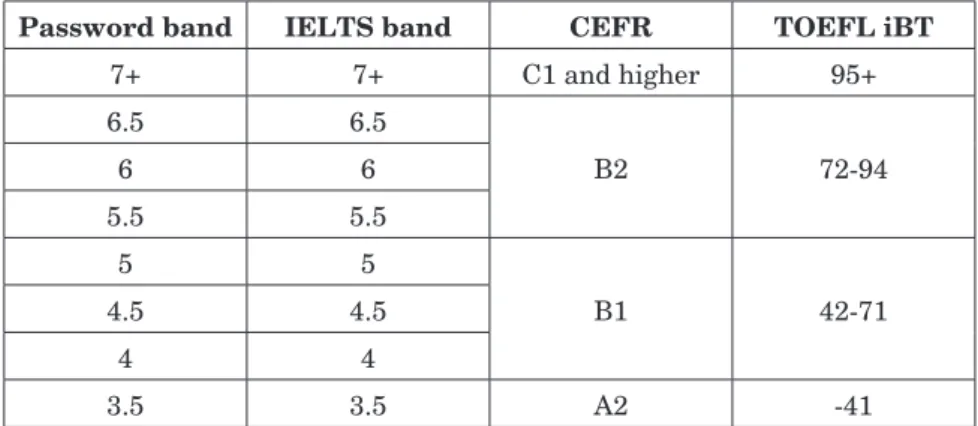
Password has several characteristics. First, it is an online test incorporating academic topics into its content; thus, it is useful for a university running an EAP program to measure students’ English knowledge. In addition, the test score of Password is comparable to IELTS and TOEFL scores, and is aligned to the CEFR standards (ELT, 2011). This is another advantage of Password. The score compar-ison of these tests is demonstrated in Table 1.
Table 1. The comparison between Password, IELTS, CEFR, and TOEFL iBT
Password band IELTS band CEFR TOEFL iBT
7+ 7+ C1 and higher 95+ 6.5 6.5 B2 72-94 6 6 5.5 5.5 5 5 B1 42-71 4.5 4.5 4 4 3.5 3.5 A2 -41
Note: This table is organized on the basis of the official data released by ELT (2017a), IELTS (2017) and ETS (2015).
As shown in the table above, the Password band is identical to the IELTS one, and this is easy to compare with CEFR and TOEFL iBT. For example, if a student re-ceives 6.5 on a Password Speaking test, this is equivalent to IELTS band 6.5. This student belongs to the B2 level of the CEFR, and possesses the English ability be-tween 72-94 of TOEFL iBT. Furthermore, Password is targeting to measure
English knowledge for CEFR’s B1 and B2 level of students; thus, this test is appro-priate for our students whose English level is usually fallen into the range of CEFR’s B1 and B2.
Second, due to the nature of the online test, students can receive their Password test score immediately after the test except for speaking and writing, which can take two to five days for Password staff to grade (ELT, 2017d). Students do not have to wait as long to receive their overall test score, which is very conve-nient for both universities and the students.
The third characteristic of Password is that it allows for free choice among Knowledge (lexico-grammar, 60 min.), Listening (60 min.), Reading (75 min.), Speaking (20 min.) and Writing (30 min.); any combination of the tests is possible. Moreover, the test can be implemented in different dates: for example, a university can give the Knowledge test to students on the first day and the Reading test the next day. The flexibility of test choice and test implementation makes it easy for universities to manage the test.
The fourth characteristic is that the Password Speaking test allows students to write a memo during the test although the memo must be erased completely after the test. This allowance creates a less stressed condition for the students to answer questions in the speaking test since they can organize their thoughts by writing them down.
Lastly, Password is reasonably priced compared to other standardized tests such as ILETS and TOEFL. For example, Password knowledge costs ₤14/test when 100 people take the test. When any two Password tests are taken, the cost becomes ₤22 for two tests for 100 people, and ₤19 for two tests for 500 people. Password set prices according to types of test and the number of test-takers. In general, if more people take the test, it becomes cheaper (Please see Appendix 1 for more details).
Then, what kind of content do Password Speaking and Writing have? The fol-lowing will illustrate how speaking and writing tests are organized with examples. First, in terms of Password Speaking, “[it] has five sections with one or more speaking tasks (questions) in each, simply answered by speaking into the micro-phone” (ELT, 2017b). Any microphone attached to a headset which is compatible with a computer works for this test. Section 1 is self-introduction, so that it takes just a few seconds for students to complete. Section 2 has five simple questions such as the description of students’ family and the explanation of today’s weather, and students are given 20 seconds to answer each.
Section 3 and 4 require students to speak longer than Section 1 and 2. The table below shows an example of Section 3 and 4.
Table 2. An example question of Section 3 and Section 4 (ELT, 2017b)
Section 3 Section 4
You are feeling ill. You go to the pharmacist. You walk up to the pharmacist.
Talk to the pharmacist: • Ask for help.
• Explain the problem. • Ask for advice.
Learning to play a sport or learning to play a musical instrument.
Which one is more difficult?
As described in the table above, Section 3 gives students a particular condition, and they need to give an appropriate explanation. Students are provided three scenar-ios in Sections 3, each of which needs to be answered in 45 seconds. Section 4 re-quires students to tell their own view about the topic, and they have to answer it in one minute.
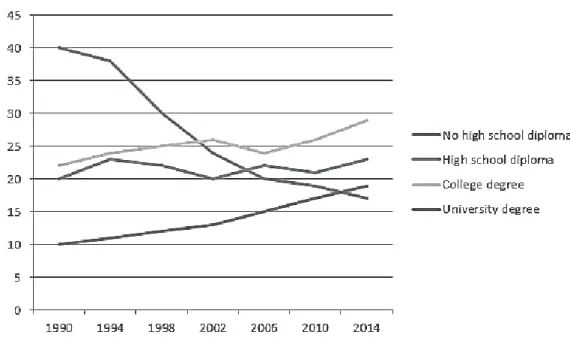
Then, students go to Section 5, which is the most difficult question to answer since they need to talk about the information on a provided graph/chart/diagram in two minutes. An example graph of Section 5 is given below.
Figure 1. An example of Section 5 “Level of education in adults over 15 in Canada (in %)” (ELT, 2017b)
fol-lowing questions to answer:
• What is the situation shown in the graph/chart/diagram? • Why is this happening?
• What do you think will happen in the future?
The questions above are useful for the students to answer as it helps them organize their thoughts.
These are example questions in Password Speaking. As shown here, the ques-tions in Password Speaking are based on an academic content or relevant to school events.
In terms of Password Writing, it assesses students’ ability to write an essay in 30 minutes with more than 200 words, and they need to type an essay, not hand-write it (ELT, 2017c). They are provided with two essay titles to choose from. The following are examples of essay titles:
(a) School children should be able to choose the subjects they study from a young age and stop studying subjects they find uninteresting.
(b) Old people are an essential part of society, so they should be respected. (ELT, 2017c). This section introduced example questions in both speaking and writing tests. As demonstrated, Password has academic content and requires students to write an academic essay. This is a significant characteristic of Password. Because of this, our college, which runs an EAP program, decided to experimentally implement the tests to measure our students’ English productive skills and achievement.
4. The Implementation of Password Tests
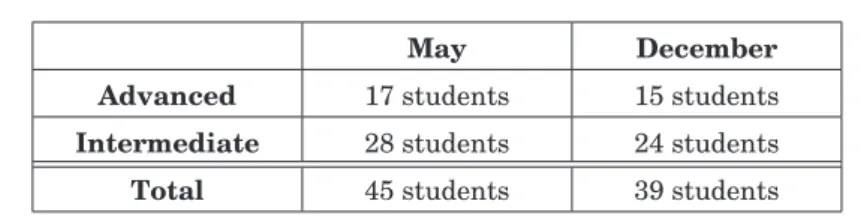
Characteristics of both our EAP program and Password tests were illustrated in detail in previous sections, and in this section the way how we implemented Password tests will be described. In 2017, we gave students Password Speaking and Writing twice, first in May and then in December. The tests were conducted during class, and class instructors served as a proctor. Students who took the tests were in their first year and belonged to two classes, Advanced and Intermediate, in our EAP program. The number of students who took the tests are indicated in the table below.
Table 3. The number of students who took Password tests
May December
Advanced 17 students 15 students
Intermediate 28 students 24 students
Total 45 students 39 students
As described in Table 3, the number of students who took the test in December is different from that in May because some students were absent in December. In May, 45 students in total took the tests; in contrast, 39 students took them in December.
In order to help students take the online test smoothly, we made a handout showing a step by step procedure from the beginning where the students were in-structed to make a shortcut on their computer to the end where they were inin-structed to exit the test site, which is attached in Appendix 2. In this handout, a procedure to do a headset and microphone check is also included since each student must do this check by him/herself.
Although most of students finished their tests without any problem, a few of them had trouble. Among problems that students had, the following two problems occurred mainly: (1) the recording did not stop in some sections in the speaking test, and (2) some students received an “invalid password” message when they logged into the test. In order to handle these problems, we had on-time technical support from English Language Testing Ltd. in England via Skype. This company is the English agent providing Password tests to institutions worldwide. With their support, all students were able to complete their tests. In a week, we provided the students with a test score certificate, which we printed out by accessing the online results site (see Appendix 3 for an example certificate).
5. Results of a questionnaire survey
Immediately after the Password tests in May, we conducted an anonymous online questionnaire survey to the students asking for their experience of taking Password Speaking and Writing. The questionnaire had the following four questions:
(1) Comparing the Password tests to other tests (TOEFL iBT, TOEFL ITP/ PBT, IELTS, and TOEIC), which one do you think is the most interesting? (2) How easy is typing for you?
(3) How do you rate your overall experience of the Password tests? (4) What are the positive points of the Password tests?
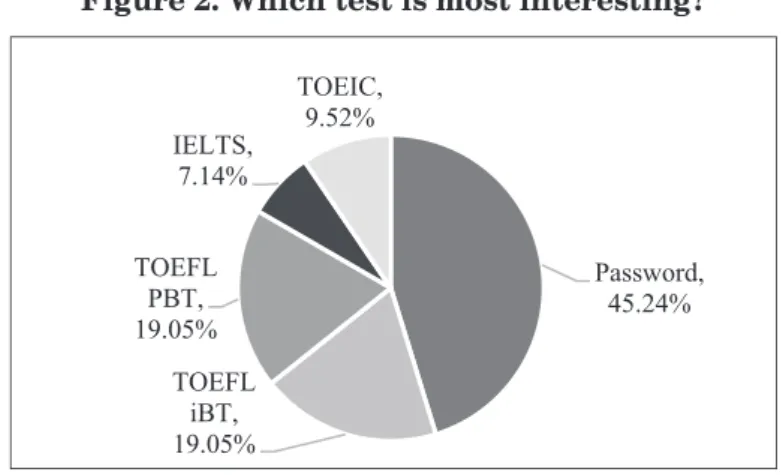
In May, 45 students took the Password tests, and we received the question-naire answers from 42 students. The answer for the first question “Comparing the Password tests to other tests (TOEFL iBT, TOEFL ITP/PBT, IELTS, and TOEIC), which one do you think the most interesting?” is illustrated in the figure below.
Figure 2. Which test is most interesting?
Password, 45.24% TOEFL iBT, 19.05% TOEFL PBT, 19.05% IELTS, 7.14% TOEIC, 9.52%
As shown in Figure 2, 45.24% of students, 19 out of 42 students, think Password tests are the most interesting. All of the students have taken TOEFL PBT/ITP since our college uses this test to assign students an English class at the beginning of the first year. In addition, some of them are familiar with TOEFL iBT and IELTS since they are interested in joining an exchange program to an English-speaking university. The number of students who think Password is interesting exceeds that of TOEFL PBT/ITP. This clearly describes that Password is an interesting test for many students.
Then, we asked for a reason to the 19 students who answered that Password is more interesting than other tests, and the table below shows their answer.
Table 4. Reasons why students think Password tests are more interesting than others
Reason The number of students
Password Speaking test is interesting. 12 Password tests seem easier and simpler than other tests. 4 The test time is shorter than other tests. 2 The content of Password is different from other tests. 1
As illustrated in Table 4, 12 students out of 19 (63.2%) answered that the Password Speaking test is interesting. This result is very significant because it infers that the students are interested in taking a speaking test.
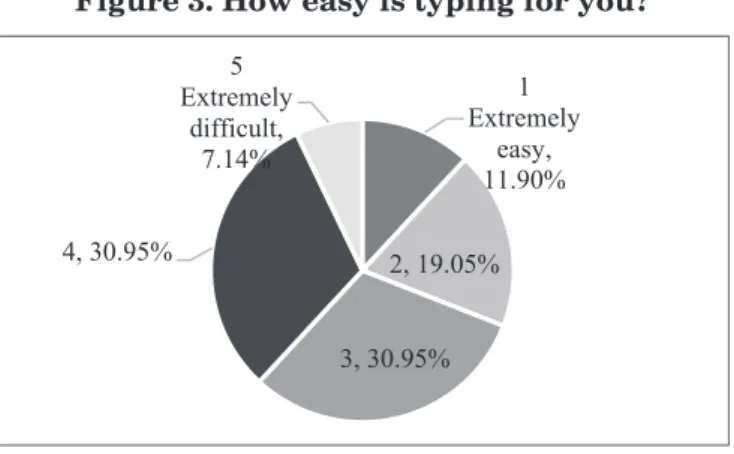
The next question we asked in the questionnaire is how easy typing is for stu-dents since we assume that some of them have never typed an essay even though they are familiar with using a computer and they may have handwritten an essay. The students answered this question by rating their easiness of typing from 1 (ex-tremely easy) to 5 (ex(ex-tremely difficult).
Figure 3. How easy is typing for you?
1 Extremely easy, 11.90% 2, 19.05% 3, 30.95% 4, 30.95% 5 Extremely difficult, 7.14%
As indicated in Figure 3, about 40% (Extremely difficult: 7.14%, and Difficult: 30.95%) of students mentioned that typing is difficult/extremely difficult. This means that almost half of students are not familiar with typing. Thus, it seems our assumption that some students have never typed an essay was correct.
The fourth question is “How do you rate your overall experience of the Password tests?” We asked students to rate it from 1 (Extremely negative) to 5 (Extremely positive), and the result is described below.
Figure 4. How do you rate your overall experience of the Password tests? 1 Extremely negative, 4.88% 2, 24.39% 3, 41.46% 4, 21.95% 5 Extremely positive, 7.32%
Figure 4 shows that 29.27% (Extremely positive: 7.32%, and Positive: 21.95%) of students answered that their experience of taking the Password tests was positive, and 29.27% (Extremely negative: 4.88%, and Negative: 24.39%) of students an-swered their experience was negative. These numbers are interestingly identical. In contrast, 41.46% of students answered that their experience was moderate. Thus, many students tend to think that taking the Password tests is a moderate experience for them, not negative but not positive either.
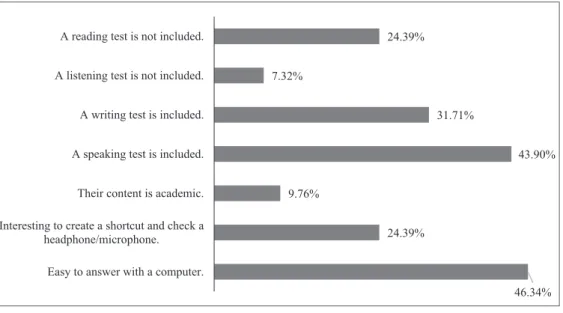
The last question that we asked is “What are the positive points of the Password tests?” In this question, we asked students to choose answers from seven choices, which are illustrated in Figure 5. Note that students can choose more than one answer from the choices. Figure 5 describes the result.
Figure 5. What are the positive points of the Password tests?
46.34% 24.39% 9.76% 43.90% 31.71% 7.32% 24.39%
Easy to answer with a computer. Interesting to create a shortcut and check a
headphone/microphone. Their content is academic. A speaking test is included. A writing test is included. A listening test is not included. A reading test is not included.
As illustrated in Figure 5, many students answered that a positive point of the Password tests is that they have the speaking test (43.9%). In addition, 46.34% of students answered that it was easy to answer with a computer although about 40% of students mentioned that typing was difficult for them. This means that about half of the students prefer using computer to marking an answer sheet with a pencil even though they are not good at typing. These students seem familiar with using a computer, but not typing. Moreover, students liked to take the Password Writing test, since 31.71% of students answered that a positive point of the Password tests is that the writing test is included. This is interesting because 40% of students mentioned that typing is difficult/extremely difficult for them. This in-dicates that students are willing to take production tests, since they would like to know their productive skills through standardized measurements.
These are the questionnaire results found through our implementation of Password tests. From these results, it can be said that the students’ overall impres-sion about Password Speaking and Writing was as positive as other standardized tests. Students evaluated Password positively because the Password tests were able to measure students’ production skills.
6. Issues found from the implementation of Password Speaking and Writing
This report illustrated the characteristics of our EAP program and the Password tests, and introduced the results of the test and questionnaire in detail. The tests as a production assessment tool are evaluated by the students as positively as other standardized tests. However, some issues are revealed in this test implementation.
First, seven out of 42 students commented in our questionnaire that the Password test score cannot be used for applying for our exchange program to for-eign universities which require either TOEFL iBT or IELTS scores; thus, they preferred TOEFL iBT and IELTS to Password. Because this test is recently devel-oped, it is not used extensively as a standardized test for university admission of international students. International students need to fulfill English requirement set by each university in order to enroll in the university in English-speaking countries. To date, many universities require them to submit their score of either TOEFL iBT or IELTS, which allows the universities to judge whether applicants possess sufficient English knowledge and abilities to enroll in classes. Since Password is compatible to IELTS and aligned to CEFR, its score should be admitted
as a measurement of academic English skills by universities, and this admittance needs to be done as quickly as possible.
Second, about 40% of students mentioned that typing is difficult/extremely difficult; however, the Password Writing test requires students to type an essay. Today, typing essays is standard at university worldwide. Therefore, students in Japan need to know how to type. It is therefore recommended that typing lessons should be included in English classes at high school or university to make students acquire touch-typing skills.
Third, there is no agent in Japan to provide the Password tests today. This is a problem for Japanese universities because they must contact the Password agent in England to handle problems once the problems occur. In addition, due to the time difference between England and Japan, universities need to set the test time to the appropriate local English time in order to receive technical support from England. Another problem is that test proctors are necessary from the university side, unlike TOEFL iBT or IELTS whose agents sometimes provide universities with proctors. Finding the proctors can become an issue for universities, as it did for us.
Fourth, Japanese universities generally do not allow outsiders to access to their own computer system. Because remote access to a university computer system is not allowed to the Password technical support staff, it creates more work for the proctors. When problems occur during the test, they must contact the Password staff to solve the problems.
These are the issues found through our implementation of the Password tests. It may take several years to solve these issues. But once they are done, the tests can be used as a very reliable measurement to assess students’ English knowledge in Japan.
7. Conclusion
While we implemented Password Speaking and Writing twice a year, we found the following issues: (1) there is no agent in Japan to provide the Password tests, so that we need to directly contact Password staff in the UK whenever we have issues, (2) our university does not allow the Password staff to do remote access to our computer system, and (3) when computer problems occur during the tests, we need to contact technical support staff in the UK, because the remote access from the Password staff was not permitted.
tests, several interesting findings were revealed in our questionnaire survey, which examined how students perceive the new tests. First, the tests themselves are evaluated favorably by our students: 45.24% of them think Password tests are more interesting than other tests such as TOEFL iBT and TOEFL PBT/ITP. In addition, 63.2% of students mentioned that taking Password Speaking is interest-ing, and 31.71% of students answered that a positive point of the Password tests is that the writing test is included. These findings indicate that our students were keen to measure their speaking and writing ability through a standardized test. As a matter of fact, this may not be only the case for our students. Many Japanese students might be interested to know about their English productive skills mea-sured by a world standard test. Therefore, it is advised that institutions need to provide such a standardized test for students.
In relation to production tests, our questionnaire results demonstrated a noteworthy issue: The number of students who like taking the speaking test is greater than those who like taking the writing test. The difficulty in typing an essay seems to affect their preference of the speaking test over the writing test.
Although some issues for conducting Password tests were revealed, it was found that the tests are a useful tool to measure students’ English knowledge in speaking and writing. Furthermore, our questionnaire illustrated that about 45% of the students thought Password is more interesting than other standardized tests. Therefore, it is better for universities to consider this test as one of the choices of measuring students’ English knowledge for their proficiency assessment. As a greater number of universities recognize the benefits of these tests, the day will certainly come when the tests will be admitted as official scores for universities’ English proficiency requirement together with TOEFL iBT and IELTS.
References
Brindley, G. & Ross, S. (2001). EAP assessment: Issues, models and outcomes. In J. Flowerdew & M. Peacock (Eds.), Research perspectives on English for academic purposes (pp.148-166). Cambridge, UK: Cambridge University Press.
Canale, M., & Swain, M. (1980). Theoretical bases of communicative approaches to second lan-guage teaching and testing. Applied Linguistics, 1(1), 1-47.
College of International Relations, Ritsumeikan University (2017). Interviews. Retrieved from www.ritsumei.ac.jp/ir/30th/interview/
English Language Testing Ltd. (ELT). (2011). The Password test: Design, development and reliability. Retrieved from https://www.englishlanguagetesting.co.uk/wp-content/uploads/ 2016/03/The-Password-Test-Design-Development-and-Reliability_5.pdf
English Language Testing Ltd. (ELT). (2017a). Password and the CEFR. Retrieved from https:// www.englishlanguagetesting.co.uk/universities-colleges/password-and-the-cefr/
English Language Testing Ltd. (ELT). (2017b). Password speaking-Sample questions. Retrieved from https://www.englishlanguagetesting.co.uk/about-password-tests/password-skills/ password -speaking-sample-questions/
English Language Testing Ltd. (ELT). (2017c). Password writing-Sample questions. Retrieved from www.englishlanguagetesting.co.uk/about-password-tests/password-knowledge-and-writing/password-writing-sample-quesions/
English Language Testing Ltd. (ELT). (2017d). Results and certificates. Retrieved from https:// www.englishlanguagetesting.co.uk/schools/results-and-certificates/
English Language Testing Ltd. (ELT). (2017e). Universities and colleges. Retrieved from https:// www.englishlanguagetesting.co.uk/universities-colleges/
ETS. (2015). Research memorandum: ETS RM-15-06. Retrieved from https://www.ets.org/Media/ Research/pdf/RM-15-06.pdf
Flowerdew, J. & Peacock, M. (2001). Issues in EAP: A preliminary perspective. In J. Flowerdew & M. Peacock (Eds.), Research perspectives on English for academic purposes (pp.8-124). Cambridge, UK: Cambridge University Press.
Green, A. (2014). The test of English for academic purposes (TEAP) impact study: Report 1- Preliminary questionnaires to Japanese high school students and teachers. Retrieved from http://www.eiken.or.jp/teap/group/pdf/teap_washback_study.pdf
Green, A. (2016). Testing four skills in Japan. British Council New Directions in Language
Assessment: JASELE Journal Special Edition, 135-144.
IELTS. (2017). Common European framework. Retrieved from https://www.ielts.org/ielts-for- organisations/common-european-framework
Ito, H. (2008). Autoputto juushino eigo jugyou [English classes with the output emphasis]. Tokyo: Kyouiku syuppan.
The Ministry of Education, Culture, Sports, Science and Technology (MEXT). (2002). Eigo ga tsukaeru nihonjin no ikuseino tameno senryakukousou no sakutei ni tsuite [A strategic plan to cultivate Japanese with English abilities]. Retrieved from http://www.mext.go.jp/b_menu/ shingi/chousa/shotou/020/sesaku/020702.htm
Appendix 1
Password Pricing for Universities and Colleges Password Knowledge and Writing tests
Test 100 tests 500 tests 1,000 tests
Knowledge £14 per tests £12 per tests £10.50 per tests Knowledge and Writing £14 per tests £12 per tests £10.50 per tests
Password Skills tests
Test 100 tests 500 tests
Password Skills (Reading, Writing, Listening and Speaking) £30 per tests £25 per tests Password Skills Receptive (Reading and Listening) £20 per tests £17 per tests
Other Combinations
Number of Password test modules 100 tests 500 tests
Any one Password test module £14 per tests £12 per tests Any two Password test modules £22 per tests £19 per tests Any three Password test modules £28 per tests £24 per tests Any four Password test modules £34 per tests £29 per tests
Marking by the Password Team of the writing task is £3 pet test and £7 per test for the speaking test.
Appendix 2
A Step by Step Procedure
1) Log in with your Rainbow ID and password 2) Choose internet explorer ONLY
3) Put on a headset. →Check the sound level in the task bar lower right via youtube (adjust both computer and headset volumes; louder setting is better.) → Close youtube.
4) Create shortcut
❖ Right click (of a mouse) on your desktop, select “New” then select “Shortcut” ❖ In “Type the location of the item” COPY and PASTE the following link from
your MANABA course site (copy the URL with “)
“C:¥Program Files¥Internet Explorer¥iexplore.exe” -k -nohome http://passwordplatform.englishlanguagetesting.co.uk • Click on “Next”
• In “Type a name for this shortcut” enter “Password” • Click on “finish”
5) CLOSE ALL OTHER BROWSERS (youtube, manaba, Rits, Mozilla), and then OPEN shortcut
6) Check headset (login: checksetup – password: setup – click login in the lower right-hand corner) → start →continue
– Enter “your name” and “status (student)” in Candidate Details IF YES-NO POP-UP APPEARS, CLICK X (NEVER yes or no!!!) 7) Click “▷” for the sound check. After checking, click “finish” in the lower
right-hand corner. Then, click “OK” in the pop up.
8) Click • (red button) to start recording (click once). During mic check, click “allow” if flash player asks to record data (green).
9) Try to have the mic in front of your mouth (you can do that manually). DO NOT WISPER!
– If it’s not recording (red line does not move up/down), check if the mic is on (switch on headset cable)!
10) Wait for voice sample to encode and upload (seconds below line count up to 30 in the test), DO NOT CLICK TWICE, (mic check may not stop automatically, in that case click Microsoft key and continue)
11) Click “finish” after encoding and uploading → “OK” → “finish”
12) Check the sound level of your recording by entering login: resultscheck, pass-word: check → Click login
13) Enter: name of candidate, click search, view record, view, view, and ▷ (play). 14) Click X, and logout (in the lower left-hand corner (or Alt+F4)) to exit the
checking site.
15) Enter your real test code (login) with password, and START the TEST.
– Once you have entered your real test codes, DO NOT USE KEYBOARD (ex-cept Writing section, use half-width characters)
16) Start only after confirmation, one by one (30 min writing, 20 min speaking, click upper right)
17) Enter 8 pieces of candidate information (all required):
1. Full name (your family name first, then your first name: Yamada Hanako), 2. date of birth,
3. form of identification (=student ID), 4. ID number,
5. first language,
6. test location (Ritsumeikan),
7. invigilator in charge (your teacher’s family name),
8. to take the test you must accept the terms below (choose “accept”) 18) When ready, click on “continue” to start the test.
Appendix 3
Password certificate sample
Password Skills Sample
This is to certify that
Name of Test-Taker
Date of Birth: dd mm yyyy
achieved the following scores in the
Password Skills Sample Test
Taken on: dd mm yyyy
Password Reading: Password 7.0 or above Password Writing: Unmarked
Password Listening: Password 7.0 or above Password Speaking: Unmarked
Password CEFR Password 7.0 or above C1 Password 6.5 B2 Password 6.0 Password 5.5 Password 5.0 B1 Password 4.5 Password 4.0 Password 3.5 A2 Password 3.0 Pre-Password