西 南 交 通 大 学 学 报
第 54 卷第 6 期
2019
年 12 月
JOURNAL OF SOUTHWEST JIAOTONG UNIVERSITY
Vol. 54 No. 6
Dec. 2019
ISSN: 0258-2724 DOI:10.35741/issn.0258-2724.54.6.50
Research ArticleMathematics
A
N
E
FFICIENT
A
LGORITHM FOR
S
OLVING
I
NTEGRO
-D
IFFERENTIAL
E
QUATION
Hassan Hamad AL-Nasrawy a*, Abdul Khaleq O. Al-Jubory a**, Kasim Abbas Hussaina***
aDepartment of Mathematics, College of Science, Mustansiriyah University, Baghdad, Iraq *Email: [email protected]
**Email: [email protected] *** Email:[email protected]
Abstract
In this paper, we study and modify an approximate method as well as a new collocation method, which is based on orthonormal Bernstein polynomials to find approximate solutions of mixed linear delay Fredholm integro-differential-difference equations under the mixed conditions. The main purpose of this paper is to study and develop some approximate methods to solve the mixed linear delay Fredholm integro-differential-difference equations. We employ a new algorithm to find approximate solution via perpendicular Bernstein polynomials on the interval [0,1], and we construct a new matrix of derivatives that will be used to find an approximate solution of matrix equation, that will reduce it to the systems of linear algebraic equations. We study the convergence approximate solutions to the exact solutions. Finally, two examples are given and their results are shown in figures to illustrate the efficiency and accuracy of this method. All the computations are implemented using Math14.
Keywords: normalization-delay, orthonormal Bernstein, delay-difference, Fredholm-difference equations,
orthonormal difference equations
摘要 在本文中,我们研究和修改了一种近似方法以及一种新的搭配方法,该方法基于正交伯恩斯坦多 项式来找到混合条件下混合线性时滞 Fredholm 积分微分方程的近似解。本文的主要目的是研究和 发展一些近似方法来求解混合线性时滞 Fredholm 积分微分-差分方程。我们采用一种新算法通过 区间[0,1]上的垂直 Bernstein 多项式找到近似解,并构造了一个新的导数矩阵,该矩阵将用于寻找 矩阵方程的近似解,并将其简化为系统线性代数方程组。我们研究收敛解的精确解。最后,给出 了两个例子,其结果在图中显示,以说明该方法的效率和准确性。所有计算均使用 Math14 实现 关键词: 归一化延迟,正交伯恩斯坦,延迟差分,Fredholm 差分方程,正交差分方程
I. INTRODUCTION
In recent years, the problems of solving delay differential equations have witnessed a steadily increasing activity in the development and the
analysis of new classes of approximate and numerical methods for solving linear or nonlinear of integral and integro delay differential equations of Fredholm type. In some cases,
integro delay differential equations are the natural mathematical models for representing a physically interesting situation. The study of the numerical method for solving integro delay differential equations has become a topic of considerable interest, also the form of their solution is often more suitable for today's extremely fast machine computations [1]. Finding the approximate or exact solutions of integro-differential equations is an important task. Save in a limited number, there is a difficulty in finding the analytical solutions of integro-differential difference equations. Therefore, there have been attempts to develop new methods for obtaining analytical solutions which reasonably approximate the exact solutions.
Linear Fredholm integro delay difference equations have been studied by many authors [2]. A numerical approach was applied for solving delay integro-differential equations in [3]. The Taylor expansion approach was used for the conditions of the matrix equation which corresponds to a linear algebraic equation system [4]. Legendre polynomials were adopted for the solution of the integro-differential-difference equation of high order [5]. A matrix method using collocation points was proposed to solve the higher order integro-difference under the initial-boundary conditions [6]. Petrov-Galerkain method was employed to obtain approximate solution to solve Volterra and Fredholm integro-differential equation via normalization Bernstein polynomials [7], [8].
II. DEVELOPMENT STUDY
In this paper, we adopted a new method employing orthonormal Bernstein operational matrix for numerical computation of the higher order linear Fredholm integro delay difference equations (LFIDDEs):
(1) under the mixed conditions
(2) where ajk, bjk, cjk; γ and λj are constants and
where the known functions Pk(t), Pr *
g(t) and K(t,s) on a ≤ t, s ≤ b, y(t) must be determined to find an approximate solution of Eq. (1) and Eq.(2), expressed in the following form:
(3)
where denotes the orthonormal Bernstein basis, and ; are unknown orthonormal Bernstein constants.
We substitute Eq(3) into Eq(1) and Eq(2) to find approximate solution by the procedure:
(4) The orthonormal Bernstein polynomial is given by:
(5)
A. Algorithm of the approach:
The matrix of the orthonormal Bernstein polynomial can be written in the as follows
(6) where
], A=[ ]T
We find the corresponding matrix relations
, (7) where ] , where where
Thus, Eq (1) can be written in the form:
when
(9)
Let us give the solution of y(t) and find derivative of Eq(3) for its k-th ,... . Then we have the form:
(10) Thenbased on Eq (6) , Eq(7) and Eq (10) , we can construct matrix forms:
A (11) where
(12)
To get X(k)(t) of X(t), the following computations are performed:
, , , (13) , where ,
By putting Eq (12) and Eq(13) into Eq (10) we have
, (14) By putting in Eq(6) we have
, (15) Similar to Eq. (13), the relation between the matrix
(16) where
(17)
We differentiate both sides of Eq(16) and using the Eq (13) we get
(18) Thus , from (12) and (18) , we can write:
(19) We use collocation method to find approximate solution, therefore we put Eq(4) into Eq (8) and obtain a new system:
, (20) So that
(21) Therefore, Eq.(20) can be put into the form D + F = + , (22) where
(23)
1. Algorithm of the approach of D(t):
Using Eq.(4) we converted matrix D as in Eq. (23) as follows:
(24)
,
(25)
By putting Eq.(4) into Eq. (14) , we have
(26)
where
(27)
We employ Eq. (25) and Eq. (27), to find D(x)
2. Algorithm of the approach of F(t):
We construct the matrix R presented for F(t). Using Eq (9), we can put F(t) in the form:
(29)
Or briefly
(30) where
(31)
3. Algorithm of the approach of :
First, let be the truncated orthonormal Bernstein polynomial:
(32) And let the truncated Taylor series has the form (33) where Then where (34)
With the integral part , we get the matrix: (35) Let (36) where i,j=0,1,…N (37)
4. Algorithm of the approach of mixed conditions:
Form the conditions of Eq(2), by means of Eq(14) we have
(38) Briefly , the matrix form for conditions (2) is
(39) where
(40)
III.
METHOD OF SOLUTIONSFrom Eq(1), we can construct the fundamental matrix equation by putting Eq(19), Eq(29) and Eq(35) into Eq(1). Then we will get the fundamental matrix equation:
By plugging the collocation points
(41) Then
Or briefly the fundamental matrix equation can be written as:
(42)
Thus, Eq. (42) can be put as follows:
for (43)
where
(44) Finally, to obtain the solution of Eq. (1) under the conditions (2), by replacing the row matrices (39) with the last m rows of the matrix (43), we have the new augmented matrix :
If rank
Thus matrix A (with coefficients is uniquely determined.
To find the best approximate solution, we
suppose that and
put it in Eq(1), when
(46)
For . Then the error can be estimated by the function:
If
IV. NUMERICAL EXAMPLES:
To illustrate the effectiveness of the proposed method we consider several test examples to carry out the applicability of our approach.
Example 1:
Consider the orthonormal Bernstein series solution of the second order LFIDDEs:
.
Let
where
N=5 ,
The collocation points are computed as
From Eq. (42) the fundamental matrix equation of the problem is written as:
(48) where the matrices are defined by:
= = ,
(49)
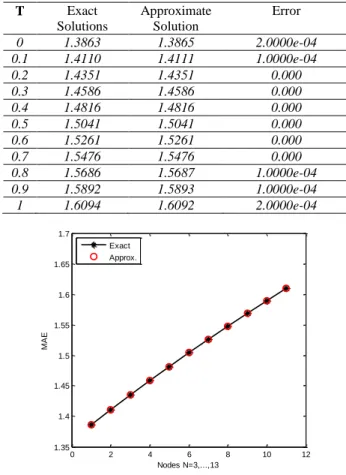
Then Eq.(49) is substituted in Eq.(48) and we obtain a numerical solution of the problem.
Table 1:
Comparison between the approximate and exact solutions of example 1 T Exact Solutions Approximate Solution Error 0 1.3863 1.3865 2.0000e-04 0.1 1.4110 1.4111 1.0000e-04 0.2 1.4351 1.4351 0.000 0.3 1.4586 1.4586 0.000 0.4 1.4816 1.4816 0.000 0.5 1.5041 1.5041 0.000 0.6 1.5261 1.5261 0.000 0.7 1.5476 1.5476 0.000 0.8 1.5686 1.5687 1.0000e-04 0.9 1.5892 1.5893 1.0000e-04 1 1.6094 1.6092 2.0000e-04 0 2 4 6 8 10 12 1.35 1.4 1.45 1.5 1.55 1.6 1.65 1.7 Nodes N=3,...,13 M A E Exact Approx.
Figure 1. Approximate and exact solution curves.
Example (2)
Consider the following LFIDDEs:
, , and the exact solution
is with N=5.
Table 2.
Comparison between the approximate and exact solutions of example 2
T
Exact
solution Approximate Error
0 7 7.0002 2.0000e-04 0.1 6.6230 6.6231 1.0000e-04 0.2 6.3040 6.3040 0.000 0.3 6.0610 6.0610 0.000 0.4 5.9120 5.9119 1.0000e-04 0.5 5.8750 5.8750 0.000 0.6 5.9680 5.9680 0.000 0.7 6.2090 6.2090 0.000 0.8 6.6160 6.6160 0.000 0.9 7.2070 7.2069 1.0000e-04 1 8 7.9998 2.0000 e-004 0 2 4 6 8 10 12 5.5 6 6.5 7 7.5 8 Nodes N=3,...,13 M A E Exact Approx.
Figure 2. Approximate and exact solution curves.
5.Conclusion
A new matrix method based on the orthonormal Bernstein polynomials is developed numerically to solve higher order linear Fredholm integro delay difference equations (LFIDDEs) under the mixed conditions. It is observed that the method has the best advantage when the known functions in equation can be expanded to orthonormal Bernstein series. Another considerable advantage of the method is that orthonormal Bernstein coefficients of the solution function are found very easily by using the Matlab15 computer programs.
References