Classification of
Type
II
code
over
GF(4)
of
some
small
lengths
名古屋大学多元数理科学研究科
別宮耕一
(Koichi Betsumiya)
Graduate School of
Mathematics,
Nagoya
University
1
Introduction
Let
$\mathrm{G}\mathrm{F}(2^{r})$be the finite field with
$2^{r}$elements. Let
$C$
be acode
over
$\mathrm{G}\mathrm{F}(2^{r})$of
length
$n$
,
which is asubspace
of the vector space
$\mathrm{G}\mathrm{F}(2^{r})^{n}$. Let
$B=\{b_{1}, b_{2}, \ldots, b_{r}\}$
be abasis
of
$\mathrm{G}\mathrm{F}(2^{r})$
over
$\mathrm{G}\mathrm{F}(2)$. We
denote by
$\phi_{B}(a)=$
(
$a_{1}$
,
a2,
$\ldots$
,
$a_{r}$
)
$\in \mathrm{G}\mathrm{F}(2)^{r}$
the representation
of
$a\in \mathrm{G}\mathrm{F}(2^{r})$
over
$\mathrm{G}\mathrm{F}(2)$with respect to
abasis
$B$
,
that
is,
$a= \sum_{i=1}^{r}a_{i}b_{i}$
. For
$u=$
$(u_{1}, u_{2}, \ldots,u_{n})\in \mathrm{G}\mathrm{F}(2^{r})^{n}$
,
we
also
denote
by
$\phi_{B}(u)$
the vector
in
$GF(2)^{rn}$
obtained
by concatenating
$\phi_{B}(u_{1})$
,
$\ldots$
,
$\phi_{B}(u_{n})$
.
We call
$\phi_{B}(C)$
the binary image
of
$C$
with
respect
to B.
$B$
is
called
atrace-Orthogonal
basis (TOB) if
$\mathrm{T}\mathrm{r}(b_{ij}b)=\delta_{ij}$
for
$1\leq i,j\leq r$
where
Tr denotes
the
$\mathrm{t}\mathrm{r}\mathrm{a}\mathrm{c}\mathrm{e}$function
of
$\mathrm{G}\mathrm{F}(2^{r})$over
$\mathrm{G}\mathrm{F}(2)$.
In
$1980’ \mathrm{s}$
,
Pasquier
and
Wolfmann studied self-dual codes
over
$\mathrm{G}\mathrm{F}(2^{r})$whose
binary
images with respect
to
aTOB are
binary
TyPe
II codes
(that is, binary
doubly-even
self-dual codes) including the
extended
Hamming
code
and the extended Golay code
(cf. [8, 10]).
We say that such codes
over
$\mathrm{G}\mathrm{F}(2^{r})$are
Type
II codes with
respect
to
a
TOB
[4] (see [6]
for
TyPe II
codes
over
$\mathrm{G}\mathrm{F}(4)$).
Recently, it
has been
proved by
the
author that
the
TyPe II property
with
respect
to
a
$\mathrm{T}\mathrm{O}\mathrm{B}$for self-dual codes
over
$\mathrm{G}\mathrm{F}(2^{r})$is independent
of the
choice
of
aTOB
[1].
This allows
us
to
call
$C$
aType
$\mathrm{I}\mathrm{I}$code if
$C$
is aType II code
with
respect
to aTOB,
without
areference
to
an
explicit
TOB. The
binary length
of
acode
over
$\mathrm{G}\mathrm{F}(2^{r})$of
length
$n$
is
defined
by
$rn$
,
which
is
the
length
of
its binary image.
The
TyPe
II
codes with
binary
length
uP
to 24 have been
classified
(cf.
[2, 4, 6]).
We
refer
to [9]
for the classification of
binary TyPe II
codes. The next
problem
would be
to classify
all
TyPe
II
codes
over
$\mathrm{G}\mathrm{F}(2^{r})$for any
$r$
with
binary length
32.
Theorem 1.1 (Munemasa [7]) The total number
of
Type
$II\mathrm{G}\mathrm{F}(2^{r})$
-codes
of
length
$n$
is given by
$N_{II,r}(n)= \prod_{i=0}^{n/2-2}(2^{ri}+1)$
,
(1)
if
$rn\equiv 0$
$(\mathrm{m}\mathrm{o}\mathrm{d} 8)$and
$n\equiv 0$
$(\mathrm{m}\mathrm{o}\mathrm{d} 4)$,
and 0othemise.
数理解析研究所講究録 1228 巻 2001 年 43-50
The
formula
(1)
is called the
mass formula
for Type II codes
over
$\mathrm{G}\mathrm{F}(2^{r})$.
By
The
orem
1.1, the
possible
cases
for which there
is
aType II code
over
$\mathrm{G}\mathrm{F}(2^{r})$of
length
$n$
with binary lengh
32
are
$(n, r)=(32,1)$
,
$(16, 2)$
,
$(8, 4)$
and
$(4, 8)$
. For the
cases
$(n, r)=(32,1)$
and
$(n, r)=(8,4)$
,
the
complete
classifications
are
given in [5] and [4],
respectively. Furthermore,
for the
case
$(n, r)=(4,8)$
,
it is shown that there
exists
a
unique
TyPe II code
uP
to
permutation-equivalence
[7].
In this paper,
we
give
aclassification for
the
case
$(n, r)=(16,2)$
,
that
is,
Type II codes
over
$\mathrm{G}\mathrm{F}(4)$of length
16.
It is the only
remaining
case
to
complete
the
classification
of
Type
$\mathrm{I}\mathrm{I}$codes with binary length
32.
2
Classification
of Type II
Codes
over
$\mathrm{G}\mathrm{F}(4)$
of Length
16
In this
section,
we
give
aclassification
of Type II codes of length
16
over
$\mathrm{G}\mathrm{F}(4)=$
$\mathrm{G}\mathrm{F}(2)[\omega]/(\omega^{2}+\omega +1)$
.
A
bisorted matrix is constructed by
sorted
vectors
on
alexic0-graphical
order with both
directions
North to
South
and
West
to
East.
We check
all the
bisorted
$8\cross 8\mathrm{G}\mathrm{F}(4)$
matrices
$A$
’s
such
that
(I
$A$
) generates
aType II
code,
where
$I$
is
the
$8\cross 8$
identity matrix. It is
sufficient
to consider such matrices to
complete
the
classification
[3].
Indeed,
we
obtain
82588
distinct
Type
II codes by the method above.
Let
$C$
be acode
over
$\mathrm{G}\mathrm{F}(4)$of length 16, and let
$\tilde{C}=\{(\hat{c}_{1},\hat{c}_{2}, \ldots,\hat{c}_{16})|\mathrm{w}\mathrm{t}(c)=6, c=(c_{1}, c_{2}, \ldots, c_{16})\in C\}$
,
where
$\mathrm{w}\mathrm{t}(c)$is
the Hamming
weight
of
$c$
and
$6=0$
if
$\mathrm{q}$
.
$=0$
and
$\hat{\mathrm{q}}$.
$=1$
otherwise. Then
$\overline{C}$is anon-linear binary code
of
length
16. We
now
consider three invariants of codes
under the
permutation-equivalence:
1. the Hamming
weight
enumerator
$W(C)$
,
2.
the order
$|\mathrm{A}\mathrm{u}\mathrm{t}(C)|$of the
permutation automorphism
group
of
$C$
,
3.
the order
$|\mathrm{A}\mathrm{u}\mathrm{t}(\tilde{C})|$of the
permutation automorphism
group
of
$\tilde{C}$.
Calculating the invariants for every code
using MAGMA,
we
find
48
codes
$D_{1}$
,
$\ldots$
,
$D_{48}$
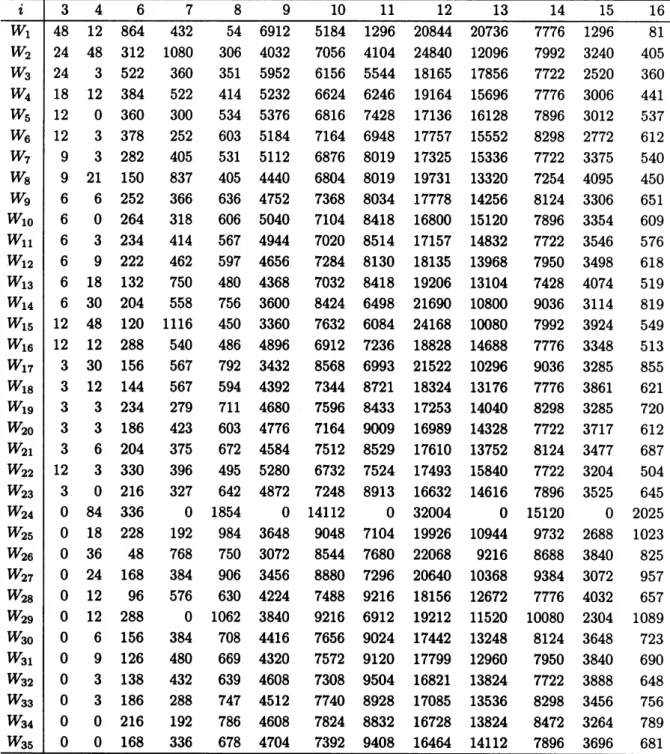
with distinct sets of invariants. The minimum Hamming weight
$d(D_{i})$
of
$D_{i}$
,
the
Ham-ming
weight enumerator
$W(D:)$
of
$D_{:}$
and
the values
$|\mathrm{A}\mathrm{u}\mathrm{t}(D:)|$axe
listed
in
Table 1. The
weight
enumerators
axe
listed
in
Table 2where
only
the coefficients of the
monomials
$x^{16-i}y^{:}$
for
$i=3,4,6,7$,
$\ldots$
,
16
are
given.
For all weight
enumerators,
the
coefficients
of
the monomials
$x^{16}$
,
$x^{15}y$
,
$x^{14}y^{2}$
and
$x^{11}y^{5}$
are
1, 0, 0and 0, respectively. We verified that
Table 1:
Properties
of the
Type
II
codes
over
$\mathrm{G}\mathrm{F}(4)$of
lengh
16
Table 2: The
weight
enumerators
$|\mathrm{A}\mathrm{u}\mathrm{t}(D_{32}\ovalbox{\tt\small REJECT}$
and
$|\ovalbox{\tt\small REJECT} \mathrm{t}(D\mathrm{S}3)|$are 7962624
and 36864,
respectively.
By Table
1,
$D_{\mathrm{I}_{\rangle}}\ovalbox{\tt\small REJECT}\ovalbox{\tt\small REJECT}$ $\ovalbox{\tt\small REJECT}$
\rangle
$D_{48}$
are
not
permutation-equivalent.
By Theorem 1.1,
we
have that
$\sum_{i=1}^{48}\frac{16!}{|\mathrm{A}\mathrm{u}\mathrm{t}(D_{i})|}$
$=$
11925737086250
$=N_{II,2}(16)$
.
Thus,
we
obtain the following:
Theorem
2.1
There
exist
48
Type
$II$
codes
over
$\mathrm{G}\mathrm{F}(4)$of
length 16,
up to
permutation-equivalence.
Generator
matrices
of the codes
are
given
in
Section
3. The
Probenius
automorphism
is
the
ffield
automorphism
on
$\mathrm{G}\mathrm{F}(4)$defined
by
$a\mapsto a^{2}$
. Each of these
48
codes
is
permutation-equivalent
to
its
Frobenius
image. Finally,
we
calculate the binary
images
of
the codes
using
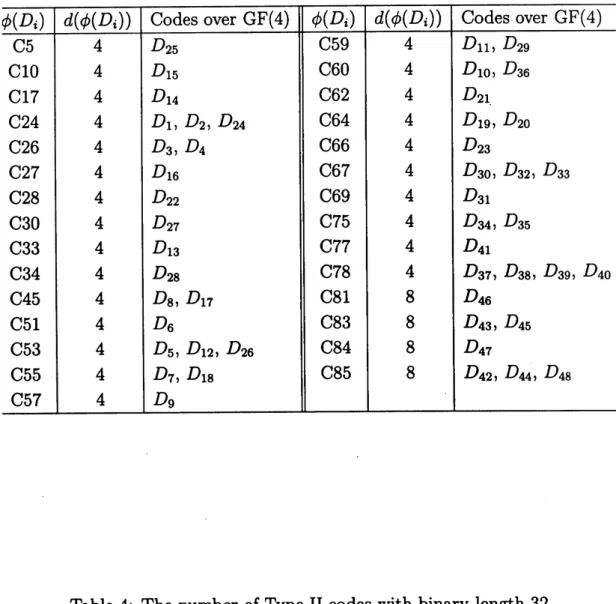
MAGMA. In Table
3,
the binary codes
$\phi(C)$
are
given
and
the minimum
Hamming weights
$d(\phi(C))$
of
$\phi(C)$
are
also given. We
use
the notation in [9]
for
the
binary Type II
codes
of
length
32. There
exist 7Type
II codes whose binary images
are
of minimum Hamming
weight
8uP
to permutation-equivalence.
Only 4codes
among
the 5extremal binary Type
$\mathrm{I}\mathrm{I}$codes of length 32
are
the
binary images
of
Type
II codes
over
$\mathrm{G}\mathrm{F}(4)$.
As aconsequence,
we
obtain the
complete
classification
of Type II codes
over
$\mathrm{G}\mathrm{F}(2^{r})$with binary length
32. The numbers of
Type
II codes
over
$\mathrm{G}\mathrm{F}(2^{r})$with
binary
length
32 up
to permutation-equivalence
are
in
Table
4.
In
the
table,
$\# 1$
,
$\# 2$
and
$\# 3$
denote
the number of codes up to permutation-equivalence, the
number of
codes
whose
binary
images
are
extremal,
and the number of
extremal
binary codes obtained
as
the binary
images, respectively.
3
Generator Matrices
In
order to
save
space,
we
list
generator
matrices
$(I\{a_{i,j}\})$
as
$a_{1,1}a_{1,2}\cdots a_{1,8}$
,
$a_{2,1}\cdots a_{2,8}$
,
$\ldots$
,
$a_{8,1}\cdots a_{8,8}$
,
where
$\overline{\omega}$denotes
$\omega^{2}$.
$D_{1}$
:
$000000\alpha\overline{w}$
,
000000uxD,
$0000a\mathrm{x}\overline{v}00,0000‘\overline{\mathrm{a}}\mathrm{v}00$
,
$00(\mathit{1}x\overline{v}0000,$
$\mathrm{O}\mathrm{O}\overline{\alpha}w\mathrm{O}\mathrm{O}\mathrm{O}\mathrm{O},$ $a\mathrm{x}\overline{v}\mathrm{O}\mathrm{O}\mathrm{O}\mathrm{O}\mathrm{O}\mathrm{O},\overline{\iota\alpha}\mathrm{v}\mathrm{O}\mathrm{O}\mathrm{O}\mathrm{O}\mathrm{O}\mathrm{O}$$D_{2}$
:
$\mathrm{O}\mathrm{O}\mathrm{O}\mathrm{O}\mathrm{O}\mathrm{O}ax\overline{v}$,
$000000\overline{\omega}(v$
,
00011100, 00101100, 00110100, 00111000,
$‘\alpha\overline{v}000000,\overline{a}\mathrm{x}\mathrm{v}\mathrm{O}\mathrm{O}\mathrm{O}\mathrm{O}\mathrm{O}\mathrm{O}$
$D_{3}$
:
$000000a\overline{w}$
,
$000000_{\mathrm{t}}^{-}‘ w$
,
$0000\omega\overline{\omega}00,00\omega(\overline{v}0000,0\{v\overline{\alpha}xv1\overline{\omega}00,$
$\mathrm{O}\{\overline{u}v1‘\overline{a}v00$,
$\omega 01\overline{a}\lambda\overline{v}(v00,\overline{\omega}0\overline{\alpha}x_{k}xv100$$D_{4}$
:
$000000_{A\lambda}‘\overline{v}$
,
$000000\overline{\omega}(v$
,
00011100, 00101100, 0
$‘ u\overline{d}\overline{u}v1$$00,0\{\overline{u}uv1\overline{\omega}00$
,
$\omega \mathrm{o}_{(}\overline{u}\overline{v}1\omega 00,\overline{\omega}0_{\mathrm{A}}‘[](k\lambda\overline{v}100$$D_{5}$
:
$000000\{Ax\overline{v}$
,
$0000\mathrm{c}\mathrm{j}^{-}00$
,
$000\alpha\overline{w}(v1\overline{\omega},$$00\omega 0$
$1\overline{a}x_{k}^{-}\mathrm{x}v$,
0
$‘\alpha\overline{v}100\overline{\alpha}w$,
$0\overline{\omega}\alpha x\overline{v}00\mathrm{r}v1$,
$\omega 01‘\overline{u}_{\lambda}^{-}xv00,\overline{\omega}0‘\overline{v}\mathfrak{u}X\theta 100$Table
3:
Binary images
of the Type II code
over
$\mathrm{G}\mathrm{F}(4)$of lengh
16
Table 4: The number
of
TyPe
II
codes with
binary
length
32
$r$
#1 #2
$\# 3$
$r$
$\# 1$
$\# 2$
$\# 3$
reference
1
85
5
5
[5]
2
48
7
4
Section
2
4
6
1
1
[4]
8
1
0
0
[7]
85
5
5
48
7
4
6
1
1
1
0
0
$|$Sec
$\{$ $|$ $|$[5]
$\mathrm{t}\mathrm{i}\mathrm{c}$$[4]$
$[7]$
$|$ $)\mathrm{n}$$2$
$|$ $|$48
$D_{6}$
:
000000
$‘ u\overline{v}$,
$\mathrm{O}\mathrm{O}\mathrm{O}\mathrm{O}\omega\zeta\overline{v}\mathrm{O}\mathrm{O},$ $0001‘\overline{u}u_{\mathrm{A}}^{-}w$, 0010
$‘\overline{u}4\lambda\overline{\alpha}d$,
$0\omega\overline{(\iota}\overline{w}00\omega 1,$ $\mathrm{O}\overline{\omega}\alpha xv\mathrm{O}\mathrm{O}1\overline{\omega}$,
$\omega 0‘\overline{\alpha}_{\iota}\overline{\mathrm{x}}v100,\overline{\omega}0\{uv1\overline{\omega}00$$D_{7}:000000‘ a\overline{v}$
,
0000uaD00,
000
$‘\alpha_{l}^{-}\mathrm{x}v1\overline{\omega}$,
$\mathrm{O}\alpha w1\omega 1\omega 1,$ $\mathrm{O}ax\overline{v}1\mathrm{O}\mathrm{O}\overline{\alpha}w$,
$\mathrm{o}_{\{}\overline{\alpha}v10\circ[\overline{\alpha}v,$
$\omega 1111\overline{\omega}00,--\ovalbox{\tt\small REJECT}^{---}00$
$D_{8}$
:
$\mathrm{o}\mathrm{o}\mathrm{o}\mathrm{o}\mathrm{o}\mathrm{o}_{(u\overline{v}}$,
$0000\alpha \mathrm{x}\overline{v}00,0011\omega 1$
$1\overline{\omega}$,
$0101\omega 1$
$1\overline{\omega}$,
$0110\omega 1$
$1\overline{\omega}$,
01110000,
$\omega 000\overline{\alpha}w1\overline{\omega},\overline{\omega}000\omega 1\overline{\alpha}w$$D_{9}$
:
0000000xj,
$000(Ax\alpha\overline{v}1\overline{\omega},$ $000\alpha \mathrm{x}_{4}^{-}xv1\overline{\omega}$,
$0\{\mathrm{t}w\mathrm{o}_{\{}u\alpha\overline{u}v$,
$0[a_{l}^{-}xv001\overline{\omega},$
$\mathrm{O}\overline{a}\mathrm{x}uv\mathrm{O}\mathrm{O}1\overline{\omega}$,
$\omega 1$$1\overline{\omega}1100,--\ovalbox{\tt\small REJECT}^{---}00$
$D_{10}$
: OOOOOOci,
$\mathrm{o}\mathrm{o}\mathrm{o}_{(}\alpha_{\ell}x\overline{v}1\overline{\omega}$,
$00\omega 0\overline{\omega}1(\overline{a}v,$ $0\omega 0\overline{\omega}\mathrm{O}1\overline{\alpha}w$,
0
$‘\iota \mathrm{u}\overline{J}0\overline{\omega}0\omega 1,0\overline{\omega}1101\omega 1$,
$\omega 1\overline{a}x^{-}\ovalbox{\tt\small REJECT} w1\overline{\omega},\overline{a}x\overline{\alpha}_{k}xv11(\overline{\alpha}v$$D_{11}$
: 0000000xj,
000
$‘\alpha u\overline{v}1\overline{\omega}$,
$00\omega 1$
$111\overline{\omega}$,
$0\omega 1\omega\overline{a}x_{l}^{-_{J}\mathrm{o}\mathrm{o}}$,
$0\omega 1[\overline{u}\alpha\overline{v}00,0\overline{\omega}1‘\overline{\alpha}\overline{v}11\overline{\omega},$$\omega 1$$10011\overline{\omega}$
,
$‘\overline{\alpha}_{\overline{\iota}}\overline{w}00[\overline{u}\overline{a}v$$D_{12}$
:
$\mathrm{O}\mathrm{O}\mathrm{O}\mathrm{O}\mathrm{O}\mathrm{O}\mathrm{a}\mathrm{x}\mathrm{I}/$,
$\mathrm{o}\mathrm{o}\mathrm{o}_{(}uv\overline{\omega}1\overline{\omega}$,
00111000,
$0\omega 1\{\mathrm{A}\mathrm{x}_{\overline{\iota}}\overline{w}00,0\omega 1[\overline{\alpha}\alpha\overline{v}00,0\overline{\omega}0\overline{\mathrm{m}}^{-}x\overline{\alpha}\overline{u}v,$ $\omega 1000[\overline{u}\overline{u}v,$ $‘\overline{\alpha}\overline{v}000\alpha w1$$D_{13}$
:
$\mathrm{o}\mathrm{o}\mathrm{o}\mathrm{o}\mathrm{o}\mathrm{o}_{[\alpha\overline{v}}$,
$\mathrm{o}\mathrm{o}\mathrm{o}_{[}ua\overline{v}1\overline{\omega}$,
00111000, 01011000,
$01101\omega 1\overline{\omega}$
,
$01110\omega 1\overline{\omega}$
,
$\omega 00$
$1111\overline{\omega},\overline{\omega}00\overline{a}\overline{\mathrm{u}}\overline{h}\overline{u}w$$D_{14}:000000a\overline{w}$
, 00011100,
00101100,
01001100,
$011101‘\overline{\mathrm{a}}\mathrm{v}$, 01111
$0\overline{\alpha}w$,
$\omega 000\overline{\omega}\mathrm{t}\overline{\alpha}v1,\overline{\omega}000\alpha xv1\overline{\omega}$$D_{15}$
:
$\mathrm{O}\mathrm{O}\mathrm{O}\mathrm{O}\mathrm{O}\mathrm{O}\alpha\overline{w}$,
$000000(\overline{u}v$
,
00011100, 00101100, 01001100, 10001100,
$1111[\iota\overline{w}00,1111‘\overline{\mathrm{a}}\mathrm{v}00$
$D_{16}$
:
$000000a\overline{w}$
,
000000aw,
00011100,
$\mathrm{o}_{\{}\ovalbox{\tt\small REJECT}^{-}xu\overline{v}100,0\overline{\omega}_{\mathrm{A}}w\overline{\omega}100,1‘ u_{\lambda}\lambda\overline{v}0\overline{\omega}00,1\overline{\alpha}\overline{w}0\{uv00,111\overline{\alpha}w1\mathrm{O}\mathrm{O}$$D_{17}:000000_{[}4X\overline{\theta}$
,
000
$‘ uv\overline{\omega}1\overline{\omega}$,
$000[\alpha\overline{\iota}w1\overline{\omega},$ $000\overline{\omega}[1w1\overline{\omega},$$011\iota\iota hX\iota w1,101‘\alpha Ahxv1$
,
$110M\lambda\alpha d1$
,
11100000
$D_{18}$
: 000000aw,
000
$‘ a\alpha\overline{v}1\overline{\omega}$,
$\mathrm{o}\mathrm{o}\mathrm{o}_{[}lx\overline{v}\omega 1\overline{\omega}$,
$00\omega 1$
$111\overline{\omega}$,
$01\overline{\omega}011\omega 1$
,
$10\overline{\omega}011\omega 1$
,
1
$1ax\overline{v}11\mathrm{O}\mathrm{O},$$111\overline{\omega}00\omega 1$
$D_{19}$
:
0000000xj,
$000axv\overline{\omega}1\overline{\omega}$,
$00\omega 0\overline{\omega}1\overline{\alpha}w$,
$0\omega 0\overline{\omega}01\overline{\alpha}\omega$,
$\mathrm{o}_{[_{k}}^{-}x\overline{v}00‘ av1$,
$1\omega 1\overline{\omega}1100,1^{-}[\lambda\overline{w}$uvOOO,
$11\omega 1\overline{\omega}100$
$D_{20}$
:
$\mathrm{o}\mathrm{o}\mathrm{o}\mathrm{o}\mathrm{o}\mathrm{o}_{(v\overline{\omega}}$,
$\mathrm{o}\mathrm{o}\mathrm{o}_{(\mathrm{A}}\mathrm{u}x\overline{v}1\overline{\omega}$,
$\mathrm{O}\mathrm{O}\omega \mathrm{O}\overline{\omega}1\overline{a}w$,
$0\omega 01111\overline{\omega}$
,
0
$‘\overline{u}_{L}^{-}w1\omega 00,1\omega 1\overline{\omega}1100,1\overline{\omega}\overline{a}x\overline{v}1\mathrm{O}1\overline{\omega}$,
$11\omega 00$
$11\overline{\omega}$$D_{21}$
:
OOOOOOci,
$000\omega(u\overline{v}1\overline{\omega}$,
00111000,
$0\alpha\lambda v0[Ax\alpha_{\mathrm{A}}^{-}xv,$ $0‘\overline{a}_{\mathrm{t}}w001\overline{\omega}$,
$1a\overline{w}\mathrm{O}\overline{a}xv\mathrm{O}\mathrm{O},$ $1\overline{\omega}0\overline{\omega}\overline{\omega}11\overline{\omega}$
,
$11^{-}\{\lambda x\overline{v}0\overline{\omega}1\overline{\omega}$$D_{22}$
: 000000uw, 000000uw,
$\mathrm{o}_{\{}l\lambda lh^{-}x\overline{v}100$,
$\omega 0\overline{a}\mathrm{x}v1\overline{\omega}00$,
$\omega[_{\mathrm{J}}-\lambda\overline{v}0\omega 100,$[
$\overline{u}v0\overline{\omega}1\omega 00,\overline{\omega}1\omega 1$1100,
$1\overline{\omega}1\omega 1$$100$
$D_{23}$
:
$\mathrm{o}\mathrm{o}\mathrm{o}\mathrm{o}\mathrm{o}\mathrm{o}_{\omega(_{\lambda}J}^{-}$,
$\mathrm{o}\mathrm{o}\mathrm{o}_{\{}\mathrm{A}\kappa\alpha_{\mathrm{A}}^{-_{J}}1\overline{\omega}$,
$0[Axv0‘ au_{A}^{-}x\theta$
,
$\omega 0\overline{\omega}0\omega 01\overline{\omega}$,
$‘\alpha_{\overline{\iota}}\overline{w}1\omega 1\overline{\alpha}\mathrm{x}v,\overline{\alpha}xv\mathrm{O}\overline{\omega}\mathrm{O}\mathrm{O}\omega 1,\overline{\omega}1\omega_{4}^{-}x_{\mathrm{A}}^{-}\mathrm{x}av1,1\overline{\omega}1m\lambda_{\mathrm{A}}^{-}x_{\mathrm{A}}^{-}xv$$D_{24}$
:
00000111, 00001011, 00001101, 00001110, 01110000, 10110000, 11010000, 11100000
$D_{25}$
:
00000111, 00001011, 00010011, 00100011, 01000011, 10000011,
111111
1,
11111110
$D_{26}$
:
00000111,
00001011,
$00\mathrm{O}ah\overline{\mathrm{X}}_{l}-\lambda v1,$ $\mathrm{O}\mathrm{O}\omega \mathrm{O}\overline{\alpha}\overline{w}1\omega$,
0
$1\overline{\alpha}\overline{w}\mathrm{O}\mathrm{O}\alpha \mathrm{x}v$,
1
$0\overline{\alpha}x\overline{v}\mathrm{O}\mathrm{O}\alpha w$,
$11\omega 1\omega\omega 0\omega$
,
1
$11\alpha x_{\lambda}xuv0$
$D_{27}$
:00000111, 00001011, 00010011,
$001111\alpha\overline{\omega}$
,
$010111\{a\overline{\theta}$
,
$100111\{Ax\overline{v}$
,
lll[
xuv
0,
11
$1\overline{a}\lambda\overline{v}\overline{\omega}\mathrm{O}\overline{\omega}$$D_{28}$
:
00000111, 00001011, 00010011,
$0\mathrm{m}^{-}\mathrm{A}a\alpha_{\{}J0\omega$,
$0\overline{m}x\alpha\alpha v\mathrm{O}\omega$,
$1u\alpha\overline{\alpha}_{\overline{\iota}}\overline{w}1\omega$,
$1\overline{\omega}\overline{\omega}000\omega\omega$,
$111a^{-}x\overline{u}_{\mathrm{A}}^{-}\mathrm{x}\overline{v}0$$D_{29}$
:
00000111, 00001011,
$001111(v\overline{\omega},$
$0\alpha M\overline{x}_{l}xv0\omega$,
$0^{-}\ovalbox{\tt\small REJECT}^{----}0,1(Ax\overline{v}01101,1\overline{\omega}0\omega 1110,11\overline{\alpha}xv\mathrm{O}\mathrm{O}11$
$D_{30}$
:
00000111,
$000\alpha x\overline{\alpha}\mathrm{t}\lambda\overline{v}1,000\overline{a}hxv\overline{\omega}1,0^{-}\ovalbox{\tt\small REJECT} 0,0^{-}\ovalbox{\tt\small REJECT} 0$,
$1ax_{l}xuv01$
$1,1[\overline{a}^{-}\mathrm{t}xA\lambda v1\overline{\omega}\omega,$$111001\omega\overline{\omega}$
$D_{31}$
:
00000111,
00
$‘\alpha v10(\overline{u}\overline{v},$$010111\omega[\overline{AJ},$
$01a\mathrm{x}v00^{-}(\mathrm{A}\overline{w},$ $011\mathrm{O}11a\lambda\overline{v}$,
$1^{-}\ovalbox{\tt\small REJECT}^{--}1,1\overline{a}\overline{m}\overline{\alpha}\overline{d}110,11001\alpha\overline{\omega}1$$D_{32}$
:
00000111,
$000a\mathrm{x}\overline{\iota}\mathrm{X}_{\lambda}\lambda\overline{v}1$,
$\mathrm{o}\mathrm{o}\mathrm{o}_{(\overline{\iota}\mathrm{u}x\alpha_{kJ}^{-1}}$,
$\mathrm{o}_{\iota_{\lambda}x\overline{v}}\mathrm{o}\mathrm{o}_{\{a\mathrm{t}J1}^{-},0\overline{a}\omega 0\mathrm{o}_{(}\mathrm{t}\overline{w}1$,
$1axuuv011$
,
$1^{-}(\ovalbox{\tt\small REJECT}^{-}x_{A}^{-}x\overline{v}101$,11111110
$D_{33}$
:
00000111,
$\mathrm{o}\mathrm{o}_{(A}xv10_{A\lambda}^{-}‘\overline{v}$,
$0\omega 0\omega 1\overline{\omega}0\overline{\omega}$,
$\mathrm{O}\alpha xv01\overline{\omega}\overline{\omega}0$,01110000,
$10\overline{a}\mathrm{x}\overline{v}00(ud,$ $1\overline{\omega}0\overline{\omega}0\omega 0\omega$,
$1\overline{\omega}\overline{\omega}00(Axv0$$D_{34}$
:
00000111,
$\mathrm{O}\mathrm{O}\mathrm{O}\omega\overline{a}_{\iota}\overline{w}1,00\omega 0\overline{\omega}1\{\overline{u}v$,
$0\omega 0\overline{\omega}0^{-}\{A\lambda v1,$ $\mathrm{O}\overline{a}\mathrm{x}\overline{v}\mathrm{O}1\mathrm{O}aw$,
$1\omega 1\overline{\omega}0110,1\mathrm{o}^{-}x\overline{\alpha}uv1\overline{a}w$,
$11\omega 1\omega \mathrm{O}\mathrm{a}\mathrm{x}\mathrm{v}$$D_{35}$
:
00000111,
$\mathrm{O}\mathrm{O}\mathrm{O}ax\overline{\alpha}_{\iota}\overline{w}1,001(\alpha v\overline{\omega}0\overline{\omega},$$0^{-}ww[[XtJ0\omega$
,
$0^{-}\ovalbox{\tt\small REJECT}^{----}0,1^{-}\ovalbox{\tt\small REJECT}^{--}1,1\overline{\omega}00\overline{\omega}(a\mathrm{t}J0,11\overline{\omega}\omega 0101$$D_{36}$
:
00000111, 00001011,
$\mathrm{O}u\ovalbox{\tt\small REJECT}^{-}x_{\mathrm{A}}u’ 0\omega$,
$\omega \mathrm{o}_{\overline{\alpha}um\iota J}\mathrm{o}$,
$\mathfrak{u}x_{A}^{-}x\overline{v}\mathrm{o}_{(}\overline{\alpha}\overline{v}\overline{\omega}0,\overline{a}\omega \mathrm{o}_{\overline{\omega}[_{\mathrm{A}}}^{-}\overline{w}0\overline{\omega},\overline{\omega}1\omega 100$$11,1\overline{\omega}1\omega 00$
$11$
$D_{37}$
:
00000111,
$\mathrm{O}\mathrm{O}\mathrm{O}\alpha x\overline{\alpha}u\overline{v}1$,
$\mathrm{o}_{[}av01\overline{\mathfrak{a}}x\overline{v}0$,
$\omega 0\overline{\omega}00\overline{\omega}1\omega$,
$\omega(\overline{\iota}\overline{w}1[\iota w1\overline{\omega},\overline{a}xv\mathrm{o}_{[}\overline{a}\overline{u}_{\lambda}^{-}\overline{w}0,\overline{\omega}1[u\overline{m}\alpha\overline{v}1,1\overline{\omega}1\omega 0$$101$
$D_{38}$
:
00000111,
$\mathrm{o}\mathrm{o}\mathrm{o}_{(}u_{l}^{-}xa\overline{\iota}\prime 1,0a\overline{w}00[\mathrm{A}\overline{w}1,$$\omega 0\overline{\omega}a\iota uw0$,
$\omega 1[\overline{u}\overline{a}\alpha\overline{d}1\omega,\overline{a}x\overline{\alpha}av11(\lambda x\overline{v},\overline{a}x\overline{\alpha}\overline{\alpha}v0^{-}(\mathrm{A}\overline{w}0,1^{-}\ovalbox{\tt\small REJECT}^{--}1$$D_{39}$
:
00000111,
00(twl
$\mathrm{O}\overline{a}x\overline{v}$,
$0\omega 0\omega 1\overline{\omega}0\overline{\omega}$,
$\omega 0\overline{\omega}axv0(4xd,$
$\omega 1\overline{\omega}\alpha\overline{\iota}\mathrm{u}x\overline{v}1$,
$(\overline{\alpha}\overline{v}001\omega 0\omega,\overline{a}x\overline{\alpha}x\overline{v}\mathrm{O}\overline{\omega}\mathrm{O}\overline{\omega},$$1\omega 1\omega 10\omega\omega$
$D_{40}$
:00000111,
$ooo_{[}\alpha\overline{u}_{A}x\overline{v}1$,
$0_{(uv}01\overline{\alpha}\overline{w}0$,
$\omega 0\overline{\omega}$11110,
$‘\iota\overline{w}\overline{u}v1\overline{\omega}1\omega$,
$‘\overline{u}\prime J\mathrm{O}\mathrm{O}\mathrm{O}\iota\alpha\overline{v}1,\overline{\omega}1a\mathrm{x}\overline{\alpha}au\overline{v}1,1\overline{\omega}1\overline{\omega}1\overline{\omega}0\overline{\omega}$$D_{41}$
:
00000111,
$00aw10\overline{\omega}(\overline{v},$$0\omega 0\omega 1\overline{\omega}0\overline{\omega}$,
$\omega 00\omega 1^{-}[kx\overline{v}0,$$‘ \mathrm{A}x_{\mathrm{A}}^{-}\overline{w}\mathrm{o}_{\overline{\omega}(\mathrm{t}}^{-}\overline{w}0,\overline{\alpha}w1\omega(\overline{\alpha}\overline{v}1\omega,\overline{\omega}1\{uv\overline{\omega}1\overline{a}xv,$ $1‘\overline{\alpha}\overline{a}\overline{\alpha}\overline{v}110$$D_{42}$
:
$\mathrm{O}\mathrm{O}\mathrm{O}\alpha w\overline{\omega}\overline{\omega}1,00\omega 0‘\overline{u}v1\overline{\omega}$,
$\mathrm{O}\omega \mathrm{O}\mathrm{O}\overline{\omega}1ax\overline{v}$,
$\omega 0001[\overline{\alpha}\overline{\alpha}v,$$\omega(\overline{u}\overline{v}1000\omega,\overline{\alpha}w1\overline{\omega}\mathrm{O}\mathrm{O}\omega \mathrm{O},\overline{\omega}1[kx\overline{v}0\omega 00,$$1‘\overline{u}\overline{u}uv000$
$D_{43}:000ax\iota \mathrm{K}_{\mathrm{A}}^{-}\overline{w}1,00\omega \mathrm{o}_{(_{L}}^{-}\mathrm{u}J1\overline{\omega}$
,
$0\omega 0\omega 1\overline{\omega}0\overline{\omega}$,
$\omega 0\omega 0\overline{\omega}1\overline{\omega}0$,
$a\overline{w}1\overline{\omega}00\omega 0$,
$‘\overline{\alpha}a\overline{\mathrm{t}J}1000\omega,\overline{\omega}10^{-}(Axv00\omega,$ $1^{-}(\mathrm{t}\overline{\mathrm{u})}00a\omega 0$49
$D_{44}$
:000\sim
工禾
1,
$\mathrm{O}\mathrm{O}\omega \mathrm{O}\overline{\alpha}\mathrm{x}v1\overline{\omega}$,
$\mathrm{O}\omega \mathrm{O}\mathrm{O}\overline{\omega}1\alpha\overline{w}$,
$\omega 0001‘\overline{u}\overline{\alpha}v$,
$ti1^{-}$
み
-1,
$[\overline{u}\alpha\overline{\iota’}1\alpha w1\overline{\omega},\overline{\omega}1\overline{\alpha}w1\overline{a}\lambda\alpha v,$$1\overline{a}\mathrm{x}u_{\mathrm{A}}^{-}x\overline{v}1\omega\omega$$D_{45}$
:
000 は諷科 1,
00uOuwlw,
$0\omega 0\omega 1\overline{\omega}0\overline{\omega}$,
$\omega 0\omega 0\overline{\omega}1\overline{\omega}0$,
$(\lambda X\overline{d}1[\overline{\alpha}\alpha\overline{w}1,$$\{\overline{u}_{\mathit{1}}x\overline{v}1‘\alpha v1\overline{\omega},\overline{\omega}10\{\overline{u}\overline{v}1\overline{\omega}1,1\overline{\omega}\overline{\omega}01\overline{\omega}1\overline{\omega}$$D_{46}$
:
$\mathrm{O}\mathrm{O}\mathrm{O}\omega u\kappa\overline{u}\overline{v}1,00\omega 0‘\overline{a}d1\overline{\omega}$,
$\mathrm{O}\omega \mathrm{O}\mathrm{O}\overline{\omega}1a\overline{w}$,
$\omega 0\overline{\omega}10\omega 0\overline{\omega}$,
$\omega 1\{\overline{\overline{m}}\alpha\overline{\alpha}d1,\overline{\alpha}\overline{w}\mathrm{O}\omega 1\omega 00,\overline{\alpha}x\overline{u}_{\lambda}x\overline{v}\mathrm{O}\overline{\omega}0\overline{\omega}$,
$1\omega 1$
$00$
Ll
$D_{47}:000‘ u\alpha\overline{\alpha}\overline{\theta}1,00\omega 0[\overline{\alpha}d1\overline{\omega},$ $0\omega 0\omega 1\overline{\omega}0\overline{\omega}$
,
$\omega 0\omega 0\overline{\omega}1\overline{\omega}0$,
$\omega 1‘\overline{\alpha}\iota\overline{m}\overline{w}1,\overline{\alpha}^{-}\lambda kX\mathrm{t}\lambda v1\overline{\omega}1,\overline{\alpha}\mathrm{x}^{-}\ovalbox{\tt\small REJECT}\lambda v1\omega 1\overline{\omega}$,
$1\iota\alpha\overline{M}\overline{w}1\overline{\omega}$$D_{48}:000[a\alpha\overline{a}^{-}‘ J1,00\omega 01\overline{\omega}(k-x\iota"$
$0\omega 0\overline{\omega}\overline{\omega}0\omega 1$,
$\omega 0\overline{\omega}01\omega 0\overline{\omega}$,
$\omega 1\overline{\omega}$10101,
[
$\overline{a}\overline{d}0\omega 1$two,
$[\overline{u}\overline{v}[v00\omega 01,1\omega 1\overline{\omega}1010$
References
[1]
K. Betsumiya, The Type II property for self-dual codes
over finite fields
of
charac-teristic
two, (submitted).
[2]
K. Betsumiya, T.
A.
Gulliver,
M. Harada and A.
Munemasa,
On
Type
II codes
over
$\mathrm{F}_{4}$