The
Reduction of
a
Quantum
System of
Three
Identical Particles
on
a
Plane
Toshihiro Iwai and Toru Hirose
Department of Applied Mathematics and Physics
Kyoto University
1
Introduction
In this report, a quantum $\mathrm{c}\mathrm{e}\mathrm{n}\mathrm{t}\mathrm{e}\mathrm{r}-\mathrm{o}\mathrm{f}$-mass system of three identical particles
on
a
plane is considered, and reduced toa
system which has less degrees offreedom. The reduction will be performed through two symmetry structures
in the system, which are;
1. rotation of all particles about the origin makes
no
difference in thephysical state of the system,
2. the system is indistinguishable when particles
are
exchanged, becauseall particles are identical.
Figure 1 shows the overall idea of reduction. As
a
practical application of theFigure 1: The configurationspaceadmits the action ofthe rotationgroupand
of the symmetric group, which are to the left and to the right respectively.
theory, a free three-particle quantum planar system is considered. On the
basis of the rotational symmetry, the $\mathrm{c}\mathrm{e}\mathrm{n}\mathrm{t}\mathrm{e}\mathrm{r}-\mathrm{o}\mathrm{f}$-mass system for the planar
three-body system is made into a principal fiber bundle $\dot{\mathrm{R}}^{4}arrow\dot{\mathrm{R}}$3 with
structure group $\mathrm{S}\mathrm{O}(2)$, where the action of the group is to the left, and the
数理解析研究所講究録
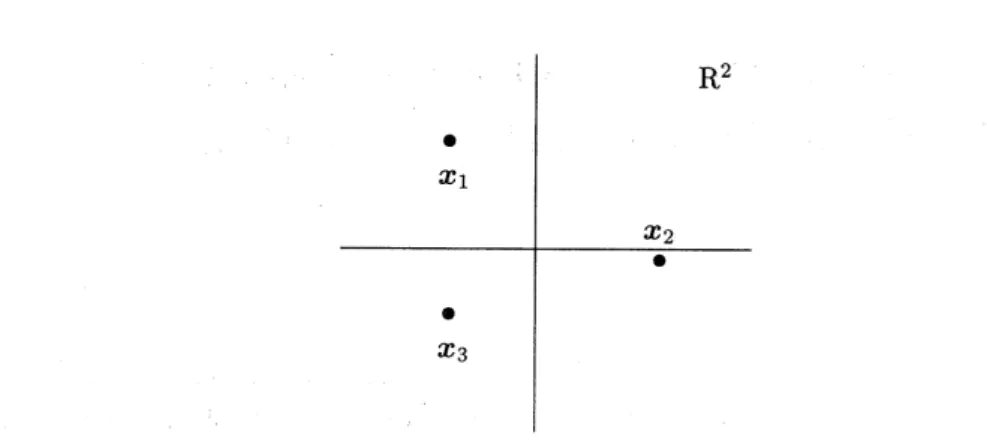
Figure 2: Three particles
are
tomove
aroundon
the plane. All particlesare
labeled,
so
that exchanges ofparticles are trackable.dot symbol indicates that the origin is removed from the space in question.
A similar process should be taken for the particle exchange symmetry, which
may be carried out in terms of the symmetric group $S_{3}$. A point to make
here is that the theory should apply to a system containing any number
of particles, and of
course can
do in three dimensions, too. Thereason
why this particular example is chosen is because for systems with four or
more
particles, the symmetric group $S_{n}$ arriving from particle exchangesgets rapidly
more
difficult to treat in an explicit manner, and we feel that$n=3$ for the number ofparticles is comfortable to present the idea.
2
Configuration Space
and Jacobi
Vectors
Suppose thereare threeparticles
on
aplane, each with position vectors $x_{1},$$x_{2}$,and $x_{3}$, and
masses
$m_{1},$ $m_{2}$, and $m_{3}$, respectively. The particles arecon-strained to move on the plane, so $x_{j}\in \mathrm{R}^{2}$. The set of all possible particle
positions is identified with $X\cong \mathrm{R}^{2\cross 3}$, which consists of ordered triples of
position vectors $(x_{1}, x_{2}, x_{3})$. The position vector ofparticle 1 is entered into
the left most slot in the brackets. Figure 2 illustrates the spreaded particles
on the plane. Each particle is labeled for the time being.
Since equations of motion
are
not yet given, the particles have nopre-scribed motions. The purpose of the current discussion is to give a rough
idea of the space that particles can lie in.
funda-mental motions traced by the particles, one of which is the translation;
$(x_{1}, x_{2}, x_{3})\mapsto(x_{1}+a, x_{2}+a, x_{3}+a)$, $a\in \mathrm{R}^{2}$, (1)
and the other is the rotation
$(x_{1}, x_{2}, x_{3})rightarrow(gx_{1}, gx_{2}, gx_{3})$, $g\in SO(2)$. (2)
The space $X$ is endowed with the inner product $K$ : $X\cross Xarrow \mathrm{R}$,
$K(x, y)= \sum_{j=1}^{3}m_{j}(x_{j,y_{j}})$, $x,$$y\in X$, (3)
where $(x, y)$ denotes the standard inner producton$\mathrm{R}^{2}$
. Note that this metric
incorporates mass, which will cause later the absence of$m$, a massfactor, in
the Schr\"odinger equation. This is because the coordinate system that is to
be produced on the basis of this metric contains mass already.
We shall now focus on the $\mathrm{c}\mathrm{e}\mathrm{n}\mathrm{t}\mathrm{e}\mathrm{r}-\mathrm{o}\mathrm{f}$-mass system, which means that the
center of
mass
of the particles remains fixed at the origin;$\sum_{1}^{3}m_{j}x_{j}=0$, (4)
and this will imply that noaction of translations is possible. We shall denote
this $\mathrm{c}\mathrm{e}\mathrm{n}\mathrm{t}\mathrm{e}\mathrm{r}-\mathrm{o}\mathrm{f}$-mass system by
$X_{0}= \{(x_{1}, x_{2}, x_{3})\in X|\sum_{j=1}^{3}m_{j}x_{j}=0\}$ (5)
The space $X$ has its natural orthonormal basis $(e_{1},0,0),$ $(e_{2},0,0),$ $\ldots$,
con-forming to the inner product defined by (3), but this does not mean that the
subspace $X_{0}\subset X$ has the
same
basis. Here $e_{j}$are
the standard basisvec-tors for $\mathrm{R}^{2}$
. Any basis for $X_{0}$ must satisfy the condition (4) and so must be
manually constructed by the Gram-Schmidt process. We note that the pair
$(-m_{2}e_{1}, m_{1}e_{1},0)$ and $(-m_{2}e_{2}, m_{1}e_{2},0)$ satisfies (4), and that these vectors
are
orthogonal with respect to the metric (3). Normalizing theses vectorsand using them
as
the seeds for the process, we find thata
suitable set oforthonormal basis vectors shall be given by
$f_{1}$ $=$ $N_{1}(-m_{2}e_{1}, m_{1}e_{1},0)$, (6)
$f_{2}$ $=$ $N_{1}(-m_{2}e_{2}, m_{1}e_{2},0)$, (7)
$f_{3}$ $=$ $N_{2}(-m_{3}e_{1}, -m_{3}e_{1}, (m_{1}+m_{2})e_{1})$, (8)
$f_{4}$ $=$ $N_{2}(-m_{3}e_{1}, -m_{3}e_{2}, (m_{1}+m_{2})e_{2})$, (9)
where $N_{j}$
are
the normalizing factors explicitly given by$N_{1}$ $=$ $(m_{1}m_{2}(m_{1}+m_{2}))^{-1/2}$, (10)
$N_{2}$ $=$ $(m_{3}(m_{1}+m_{2})(m_{1}+m_{2}+m_{3}))^{-1/2}$. (11)
Since $f_{j},$$j=1,$
$\ldots,$$4$
are
basis vectors on $X_{0}$, any $x\in X_{0}$ can be representedas a
linear combination of$f_{j}’ \mathrm{s}$;$x= \sum_{j=1}^{4}q_{j}f_{j}$, $q_{j}=K(x, f_{j}))$ (12)
where $q_{j}$
are
the coefficients, and define the new coordinate system for $X_{0}$,and in what follows we shall call the space $X_{0}$ the configuration space. The
coordinate system $(q_{j})$ will reappear later, but for the time being an
alter-native system is considered, as the new system is
more
suitable for dealingwith particle exchanges.
The space $X_{0}$ is isomorphic to $\mathrm{R}^{4}$
and also to $\mathrm{R}^{2}\cross \mathrm{R}^{2}$
, the set of pairs of
vectors in $\mathrm{R}^{2}$. We define
the pair of two vectors as follows;
$r_{1}$ $=$ (13)
$r_{2}$ $=$ $q_{3}e_{1}+q_{4}e_{2}= \sqrt\frac{m_{3}(m_{1}+m_{2})}{m_{1}+m_{2}+m_{3}}(x_{3}-\frac{m_{1}x_{1}+m_{2}x_{2}}{m_{1}+m_{2}})$ . (14)
The vectors $r_{1}$ and $r_{2}$
are
called the Jacobi vectors. One vector is pointingalong the line between particles 1 and 2, while the other is pointing along the
line between particle 3 and the center ofmass ofparticles 1 and 2. Figure 3
Figure 3: Illustrating the Jacobi vectors $r_{1}$ and $r_{2}$
as seen
in Eqs. (13-14). $r_{1}$ points along the line joining particles 1 and 2, while $r_{2}$ points along theline joining particles 3 and the center ofmass ofparticles 1 and 2. Note that
the
arrow
lengthsare
not drawn to scale.3
Exchanges
of Particles
It it
now
important to recall thatone
of the symmetries that is utilized toperform the reduction is theindistinguishibilityofconfigurations arisingfrom
exchanges of identical particles. Thus in this section,
we
make all particlesidentical and without loss of generality put $m_{j}=1,$$j=1,2,3$. Then the
Jacobi vectors defined in Eqs. (13-14) become
$r_{1}$ $=$ $\frac{1}{\sqrt{2}}(x_{2}-x_{1})$, (15)
$r_{2}$ $=$ $\sqrt{\frac{2}{3}}(x_{3}-\frac{x_{1}+x_{2}}{2})$ . (16)
If, for example, particles 1 and 2
are
exchanged, then the configurationun-dergoes
a
change$(x_{1}, x_{2}, x_{3})rightarrow(x_{2}, x_{1}, x_{3})$ . (17)
This
can
bemore
generalized.Since
any combination ofexchanges ofparti-cles
can
beexpressed as aparmutation map$\sigma\in S_{3}$, where$S_{3}$ is thesymmetricgroup oforder six, the change the configuration takes is expressed
as
$(x_{1}, x_{2}, x_{3})-(x_{\sigma(1)}, x_{\sigma(2)}, x_{\sigma(3)})$. (18)
The Jacobi vectors associated with $(x_{\sigma(1)}, x_{\sigma(2)}, x_{\sigma(3)})$ are then expressed as
$r_{1}’$ $=$ $\frac{1}{\sqrt{2}}(x_{\sigma(2)}-x_{\sigma(1)})$, (19)
$r_{2}’$ $=$ $\sqrt{\frac{2}{3}}(x_{\sigma(3)}-\frac{x_{\sigma(1)}+x_{\sigma(2)}}{2})$
.
(20)If particles are exchanged in the manner of (17), then visually the direction
of the
arrow
drawn to represent $r_{1}$ is reversed. Bearing this in mind, onesoon
realizes that any combination of particle exhcnages can be representedby a linear transformation of Jacobi vectors $r_{1}$ and $r_{2}$. This will imply that
this center-of-mass system of three identical particles admits the action of$S_{3}$
to the right. As in the
case
of example (17),one
finds that thenew
pair ofJacobi vectors after the particle exhcnage is given by
$(r_{1}’, r_{2}’)=(r_{1}, r_{2})$
.
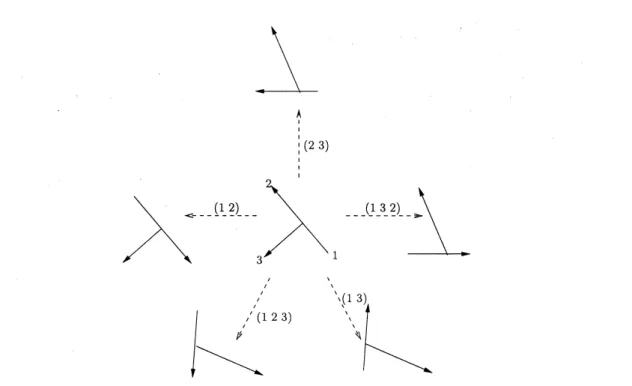
(21)Ifone works through all possible combinations of exchanges, one will find the
correspondence of permutations with linear transformation matrices. The
graphical representation of this is simply given in Figure 4 indicating which
transformation takes the reference Jacobi vectors to which pair ofnew Jacobi
vectors. We have to note here that we are dealing with the right action of
matrices, which is expressed as
$(r_{1}, r_{2})A=( \sum_{j=1}^{2}r_{j}a_{j1}, \sum_{j=1}^{2}r_{j}a_{j2})$ for $A=(a_{ji})$, (22)
and has the property
$((r_{1}, r_{2})A)B=(r_{1}, r_{2})(BA)$. (23)
Hence, the representation of$S_{3},$ $\rho$
:
$S_{3}arrow GL(2, \mathrm{R})$ that is required to satisfy$\rho(g_{1}g_{2})=\rho(g_{1})\rho(g_{2})$ for $g_{1},$$g_{2}\in S_{3}$, must act on $X_{0}$ in the manner
Figure 4: This diagram represents the graphical view of all possible particle
exchanges. Numbers in brackets are the elements of permutations from $S_{3}$.
A straightforward calculation then provides
$\rho(e)$ $=$
$\rho(123)$ $=$ $(-\sqrt{3}/2-1/2$ $\sqrt{3}/2-1/2)$ , $\rho(132)$ $=$ $(\sqrt{3}/2-1/2$ $-\sqrt{3}/2-1/2)$ ,
$\rho(23)$ $=$ $(\sqrt{3}/21/2$ $\sqrt{3}/2-1/2)$ , $\rho(13)$ $=$ $(-\sqrt{3}/21/2$ $-\sqrt{3}/2-1/2)$ .
(25)
It is
an
easy matter to verify that the matrices in (25) form a discretesub-group of $0(2)$ which is isomorphic to the symmetric
group
$S_{3}$.Implementing this for
an
$n$-particle system with $n\geq 4$ is notan
easytask, as we have alluded in Introduction.
4
The Internal Space
What was established in Sec.3, was to describe the action of$S_{3}$ onthe
center-of-mass system, which comes from exchanges of particles. In this section,
the symmetry due to the rotation is considered. Having removed the
trans-lational degrees of freedom,
we can now
consider the relative positions of theparticles. If a given configuration of particles $x\in X_{0}$ is rotated about the
origin and is found to fit another configuration $y\in X_{0}$, say, then $x$ and $y$ are
said to be ((
$\mathrm{s}\mathrm{i}\mathrm{m}\mathrm{i}\mathrm{l}\mathrm{a}\mathrm{r}$” and there exists a linear
transformation $g\in \mathrm{S}\mathrm{O}(2)$ such
that $x=gy$. For convenience, we forget the case where all particles collide
at the origin, and consider the configuration space $\dot{X}_{0}:=X_{0}-\{0\}$ in the
following. Here the $\mathrm{e}\mathrm{x}\mathrm{p}\mathrm{l}\mathrm{i}\mathrm{c}\mathrm{i}\mathrm{t}$expression of the
$g$ action is given by;
$x=(x_{1}, x_{2}, x_{3})\mapsto(gx_{1}, gx_{2}, gx_{3})=gx$, $g\in \mathrm{S}\mathrm{O}(2),$ $x\in\dot{X}_{0}$, (26)
and the ((
$\mathrm{s}\mathrm{i}\mathrm{m}\mathrm{i}\mathrm{l}\mathrm{a}\mathrm{r}\mathrm{i}\mathrm{t}\mathrm{y}$
” of
$x$ and $y$ can be easily shown to be an equivalence
relation;
$x\sim y$ if and only if $x=gy$ . (27)
Then there exists the natural projection $\pi$ from the configuration space to
the quotient space,
$\pi$ : $\dot{X}_{0}arrow M:=\dot{X}_{0}/\mathrm{S}\mathrm{O}(2)$, (28)
which is defined to be
$\pi(x)=[x]$, $x\in X_{0}$, (29)
where $[x]$ denotes the equivalence class of $x$. The space $M$ in (28)
con-tains all possible inequivalentclasses with respect to the equivalence relation
(27). Physically, the elements of$M$ express labels of different triangle shapes
formedby $(x_{1}, x_{2}, x_{3})$ without counting the duplicated ones due to rotations
about the origin.
In addition, $M$ turns out to be
a
manifoldwhich we shall call the internalor
shape space, and $\dot{X}_{0}$ is made intoa
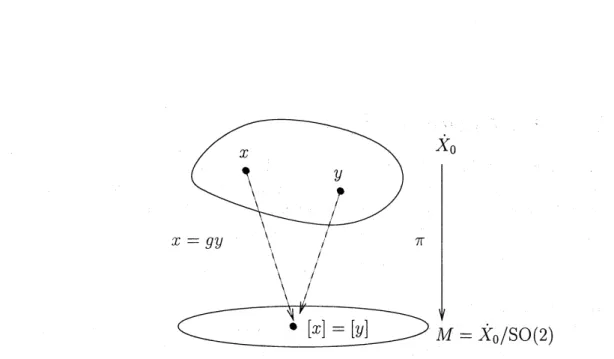
fiber bundle. Agraphical view of this
projection (28) is presented in figure 5.
To elaborate the discussion,
we
wish to give the explicit form of theFigure 5: The projection $\pi$ takes two equivalent configurations to the
same
equivalent class in $M$. In reality, $x$ and $y$ are on the same fiber.
space $\dot{X}_{0}$,just as
was
previously defined. We notice that $X_{0}$ can be identifiedwith $\mathrm{C}^{2}$ by introducing the complex vriables
$z_{1},$ $z_{2}$ through
$z_{1}$ $=$ $q_{1}+iq_{2}$, (30)
$z_{2}$ $=$ $q_{3}+iq_{4}$. (31)
We work in terms of the new coordinates. On account of (13), (14), and
(26) with
$g=$
, the action of SO(2) on $\mathrm{C}^{2}$ turns out to beexpressed
as
$z=(z_{1}, z_{2})\mapsto(e^{it}z_{1}, e^{it}z_{2})=e^{it}z$. (32)
Here$t$is not considered
as
the temporal variable, but asa
parameter ofSO(2).With the identification $X_{0}\cong \mathrm{C}^{2}$, the natural projection $\pi$ is expressed as
$\pi$ : $(z_{1}, z_{2})rightarrow(\xi_{1}, \xi_{2}, \xi_{3})$, (33)
where
$\xi_{1}+i\xi_{2}$ $=$ $2z_{1}\overline{z}_{2}$, (34) $\xi_{3}$ $=$ $|z_{1}|^{2}-|z_{2}|^{2}$. (35)
It
can
be verified that the internal space $M$ is diffeomorphic with $\dot{\mathrm{R}}^{3}\mathrm{w}$, hich
is $\mathrm{R}^{3}$ with the origin removed,
$M:=\dot{X}_{0}/\mathrm{S}\mathrm{O}(2)\cong\dot{\mathrm{R}}^{3}:=\mathrm{R}^{3}-\{0\}$ . (36)
5
The Action of
$S_{3}$on
$M$In Section 3, we have observed that the exchanges of identical particles give
rise to the action of $S_{3}$ on $X_{0}$, and $S_{3}$ turned out to be represented as a
discrete subgroup of $\mathrm{O}(2)$ consisting of six elements. With the identification
$X_{0}\cong \mathrm{C}^{2}$, the action of $S_{3}$
on
$X_{0}$ is expressedas
$(z_{1}, z_{2})-+(z_{1}, z_{2})\rho(h)^{-1}$, $h\in S_{3}$, (37)
as
is seen from (24).We now consider how this action behaves
on
the internal space $M$. For$h\in S_{3}$, the associated matrix $\tau(h)$ is defined by
$[x\rho(h)^{-1}]:=[x]\tau(h)^{-1}$, $[x]\in M$. (38)
Note here that this definition is independent of the choice ofrepresentatives.
From (34-35) together with (37-38), the symmetric group $S_{3}$ is shown to act
on $M$ to the right;
$(\xi_{1}, \xi_{2}, \xi_{3})-+(\xi_{1}, \xi_{2}, \xi_{3})\tau(g)^{-1}$, $g\in S_{3)}$ (39)
where $\tau$ is
a
representation $\tau$ : $S_{3}arrow \mathrm{G}\mathrm{L}(3, \mathrm{R})$. A straightforward calculationshows that $\tau(S_{3})$ forms
a
discrete subgroup of $\mathrm{S}\mathrm{O}(3)$, which is expressedas
$\tau(e)$ $=$
$\tau(123)$ $=$ $(\sqrt{3}/2-1/20$ $001$ $-\sqrt{3}/2-1/20)$ , $\tau(132)$ $=$ $(-\sqrt{3}/2-1/20$ $001$ $\sqrt{3}/2-1/20)$ ,
$\tau(23)$ $=$ $(\sqrt{3}/21/20$ $-100$ $\sqrt{3}/2-1/20)$ , $\tau(13)$ $=$ $(-\sqrt{3}/21/20$ $-100$ $-\sqrt{3}/2-1/20)$
(40)
It is of interest to observe that the matrices acting on $M$ have the unit
determinant while those acting
on
$X_{0}$ have determinants either 1or
$-1$. Atfirst sight, the dimension of matrices presented in (40) is 3 $\cross 3$, which is
larger than those presented in (25), resulting an increase in the number of
is less than that of$\dot{X}_{0}$. However, this is not
a
contradiction. While we haveidentified $X_{0}$ with $\mathrm{R}^{2\cross 2}$, the set of Jacobi vectors, we
are
allowed to identify$X_{0}$ with $\mathrm{R}^{4}$
, the set ofrow vectors of length 4, so that we would have seen a
discrete subgroup of$\mathrm{G}\mathrm{L}(4, \mathrm{R})$ acting, and have been able tosee an immediate
reduction in the size of matrices. In fact, the $\mathrm{O}(2)$ action given in (24) proves
to take the form
$(q_{1}, q_{2}, q_{3}, q_{4})-arrow(q_{1}, q_{2}, q_{3}, q_{4})$ for
$\rho(g)=$
, (41)where $g\in S_{3}$ and $I_{2}$ denotes the $2\cross 2$ unit matrix. Thus we also
see
that thedeterminant ofthe $4\cross 4$ matrix in the above is the square ofthe determinat
of the 2 $\mathrm{x}2$ matrix $\rho(g)$, that is, unity,
so
that the $S_{3}$ is representedas a
discrete subgroup of$\mathrm{S}\mathrm{O}(4)$.
6
Reduction
by
Rotation Symmetry
In this section, we present the reduction of the system of three free particles
by rotation symmetry. The reduction goes through irrespective of whether
all three particles are identical or not. The Schr\"odinger equation for free
particles we consider here is given by
$i \hslash\frac{\partial\psi}{\partial t}=-\frac{\hslash^{2}}{2}\nabla^{2}\psi$
with $\nabla^{2}=\sum_{j=1}^{4}\frac{\partial^{2}}{\partial q_{j}^{2}}$. (42)
In fact, since the oprator $\sum_{k=1}^{3}(1/m_{k})(\partial/\partial x_{k})^{2}$ is the Laplacian with respect
to the metric (3) on $X$, and since this metric is expressed
as
$\sum_{j=1}^{4}dq_{j}^{2}$ ifrestricted to the linear subspace $X_{0}$ of $X$,
so
thatour
Laplacian takes theform of $\nabla^{2}=\sum_{j=1}^{4}\partial^{2}/\partial q_{i}^{2}$ in the coordinates $(q_{j})$. As is well known, this
equation
can
be solved by Fourier transform with little difficulty, to givesolution of the form
$\psi(z, t)=\int_{\mathrm{C}^{2}}G(z, t,\cdot w, t_{0})\psi_{0}(w, t_{0})dw$, (43)
where $G$ is the Green function, of which the explicit form is given by
$G(z, t;w, t_{0})=[ \frac{1}{2\pi ih(t-t_{0})}]^{2}\exp(\frac{i|z-w|^{2}}{2h(t-t_{0})})$. (44)
By $|z-w|^{2}$, we mean the Euclidian distance in $\mathrm{C}^{2}$ ; $|z-w|^{2}$ $=$ $|z_{1}-w_{1}|^{2}+|z_{2}-w_{2}|^{2}$ (45) $=$ $\sum_{j=1}^{4}(q_{j}-p_{j})^{2}$, (46) where $w_{1}$ $=$ $p_{1}+ip_{2}$, (47) $w_{2}$ $=$ $p_{3}+ip_{4}$, (48)
and $q_{j}’ \mathrm{s}$ as previously defined in (30-31).
Since the Schr\"odinger equation (42) is invariant under the $\mathrm{S}\mathrm{O}(2)$ action
(32), the free particle system will be shown to be reduced to a system on
$\mathrm{t}_{J}\mathrm{h}\mathrm{e}$ internal space $M$
. Before proceeding with the reduction, we need a
decomposition of $L^{2}(\mathrm{C}^{2})$ with the $\mathrm{S}\mathrm{O}(2)$ action. For $f\in L^{2}(\mathrm{C}^{2})$ given,
we
consider a function $f(e^{is}z)$ with a parameter $s$, which can be expanded into
the Fourier series
$f(e^{is}z)= \sum_{m=-\infty}^{\infty}f_{m}(z)e^{ims}$, $f_{m}(z)= \frac{1}{2\pi}\int_{-\pi}^{\pi}f(e^{is}z)e^{-ims}ds$. (49)
In particular, we have, for $s=0$,
$f(z)= \sum_{m=-\infty}^{\infty}f_{m}(z)$. (50)
Note that the function $f_{m}$ defined in (49) satisfies $f_{m}(e^{is}z)=e^{ims}f_{m}(z)$. Any
function $f$ on $\mathrm{C}^{2}$ satisfying the equation
$f(e^{\iota s}z)=e^{\iota ms}f(z)$ (51)
is called $\rho_{m}$-equivariant, where $\rho_{m}$ denotes a unitary irreducible
representa-tion of SO(2) $\cong \mathrm{U}(1),$ $\rho_{m}(e^{is})=e^{ims}$. On account of the invariance of the
Lebesgue measure $dz$ on $\mathrm{C}^{2}$ under the
$\mathrm{S}\mathrm{O}(2)$ action, we can verify in the $L^{2}$
norm that
which implies that $L^{2}(\mathrm{C}^{2})$ can be decomposed into the direct sum of $L_{m}^{2}$’s;
$L^{2}( \mathrm{C}^{2})=\bigoplus_{m=-\infty}^{\infty}L_{m}^{2}(\mathrm{C}^{2})$ , (53)
where
$L_{m}^{2}(\mathrm{C}^{2})=\{f\in L^{2}(\mathrm{C}^{2})|f(e^{is}z)=e^{ims}f(z)\}$. (54)
We note that $f_{m}\in L_{m}^{2}(\mathrm{C}^{2})$.
Our task in the following is to decompose the time evolution (43) in
$L^{2}(\mathrm{C}^{2})$ intoaseriesof those in respective subspaces $L_{m}^{2}(\mathrm{C}^{2})$. This process will
be called the reduction of the free particle system for simplicity. We will
see
later how the time evolution in $L_{m}^{2}(\mathrm{C}^{2})$ is looked upon as the time evolution
ofastate on the internal space$M$. However, before performing the reduction,
it is rather necessary to
see a
few properties of this Green’s function and theintegral transform. For the purpose of easier reading,
we
shall write simply$G_{t}(z, w)$ and $\psi_{t}(z)$ for $G(z, t;w, t_{0})$ and $\psi(z, t)$, respectively. Then $G_{t}(z, w)$
is invariant under the SO(2) action to the left defined in (32);
$G_{t}(e^{is}z, e^{is}w)=G_{t}(z, w)$, (55)
which is equivalent to the invariance of the Laplacian $\nabla^{2}$. Further, the
integral transform with the Green’s kernel$G_{t}(z, w)$ has thefollowingproperty
for any $s\in \mathrm{R}$
$\int_{\mathrm{C}^{2}}G(z, w)\psi_{0}(w)dw=\int_{\mathrm{C}^{2}}G(z, e^{-is}w)\psi_{0}(e^{-is}w)dw$, (56)
since the Lebesgue
measure
$dw$ is invaraint under the $\mathrm{U}(1)$ action, $w\vdasharrow e^{is}w$.For $\psi_{0}\in L^{2}(\mathrm{C}^{2})$ given, $\psi_{0}(e^{is}w)$ can be expanded into Fourier series, $\psi_{0}(e^{is}w)=\sum_{m=-\infty}^{\infty}\psi_{0}^{m}(w)e^{ims}$ where $\psi_{0}^{m}(w)=\frac{1}{2\pi}\int_{-\pi}^{\pi}\psi_{0}(e^{is}w)e^{-ims}ds$.
(57)
Using the above properties and the expansion, we obtain
$\psi_{t}(z)$ $=$ $\int_{\mathrm{C}^{2}}G_{t}(z, w)\psi_{0}(w)dw$ (58)
$=$ $\frac{1}{2\pi}\int_{-\pi}^{\pi}ds\int_{\mathrm{C}^{2}}G_{t}(z, w)\psi_{0}(w)dw$ (59) $=$ $\frac{1}{2\pi}\int_{-\pi}^{\pi}ds\int_{\mathrm{C}^{2}}G_{t}(z, e^{-is}w)\psi_{0}(e^{-is}w)dw$ (60) $=$ $\frac{1}{2\pi}\int_{-\pi}^{\pi}ds\int_{\mathrm{C}^{2}}G_{t}(z, e^{-is}w)\sum_{m=-\infty}^{\infty}\psi_{0}^{m}(w)e^{-ims}dw$ (61) $=$ $\sum_{m=-\infty}^{\infty}\int_{\mathrm{C}^{2}}G_{t}^{m}(z, w)\psi_{0}^{m}(w)dw$, (62) where $G_{t}^{m}(z, w):= \frac{1}{2\pi}\int_{-\pi}^{\pi}G(e^{is}z, w)e^{-ims}ds$, (63)
and assuming that the order of integration and summation
can
beinter-changed safely, which is the
case
for $f\in S(\mathrm{C}^{2})$, rapidly decreasing $C^{\infty}$func-tions. The $G_{t}^{m}(z, w)$ in (63) is the Green’s kernel which operates
on
$L_{m}^{2}(\mathrm{C}^{2})$..
At
a
glance of $G_{t}^{m}(z, w)$,we
may expect it to have properties thatare
likesof equivariance. In fact, we can show that
$G_{t}^{m}(e^{is}z, w)$ $=$ $e^{ims}G_{t}^{m}(z, w)$, (64) $G_{t}^{m}(z, e^{is}w)$ $=$ $e^{-ims}G_{t}^{m}(z, w)$, (65)
which
means
that $G_{t}^{m}(z, w)$ is equivariant with respect to the $\mathrm{U}(1)$ actionon
$z$, and is anti-equivariant with respect to that on $w$. Thus we havede-composed the time evolution of the original system in $L^{2}(\mathrm{C}^{2})$ into a series of
those in $L_{m}^{2}(\mathrm{C}^{2})$, accomplishing the reduction, as is expressed in (62).
Carrying
on
from the last passage, (63) can be explicitely computed togive
where $J_{m}$ is the Bessel function and
$B(z, w)$ $=$ $\sum_{j=1}^{2}(|z_{j}|^{2}+|w_{j}|^{2})$ for $z_{j},$$w_{j}\in \mathrm{C}$, (67)
$A(z, w)$ $=$ $2|z_{1}\overline{w}_{1}+z_{2}\overline{w}_{2}|$, (68)
$\theta(z, w)$ $=$ $\arg\sum_{j=1}^{2}z_{j}\overline{w}_{j}$. (69)
It is ofgreat interst to observe that $A(z, w)$ and $B(z, w)$
can
be expressed inthe coordinates of the internal space $M$. In fact, we
can
verify that$B(z, w)$ $=$ (70)
$A(z, w)$ $=$ $[ \frac{1}{2}\uparrow\sum_{k=1}^{3}\xi_{k\uparrow 2}^{2}\sum_{k=1}^{3}\xi_{k}’+\frac{1}{2}\sum_{k=1}^{3}\xi_{k}\xi_{k}’]^{1/2}$, (71)
where $\xi_{k}’$
are
given by the formulae$\xi_{1}’+i\xi_{2}’$ $=$ $2w_{1}\overline{w}_{2}$, (72)
$\xi_{3}’$ $=$ $|w_{1}|^{2}-|w_{2}|^{2}$. (73)
We notice further that under the $\mathrm{S}\mathrm{O}(2)$ action $z\vdasharrow e^{is}z$ (resp., $w-te^{is}w$),
the factor $e^{im\theta(z,w)}$ is subject to the transformation $e^{im\theta(z,w)}\mathrm{f}\Rightarrow e^{ims}e^{im\theta(z,w)}$
(resp., $e^{im\theta(z,w)}rightarrow e^{-ims}e^{im\theta(z,w)}$).
7
Symmetry due
to
Particle Exchanges
This section deals with identical particles. According to whether particles
are all bosons or fermions, the wave function must be symmetric or
antisym-metric with respect to
a
particle interchange. For our three-particle system,according as paprticles are all bosons or fermions, the wave function $\psi$ on
the center-of-mass sytem must satisfy
$\psi(x_{\sigma(1)}, x_{\sigma(2)}, x_{\sigma(3)})=\psi(x_{1}, x_{2}, x_{3})$ for $\sigma\in S_{3)}$
or
(74) $\psi(x_{\sigma(1)}, x_{\sigma(2)}, x_{\sigma(3)})=\mathrm{s}\mathrm{g}\mathrm{n}(\sigma)\psi(x_{1}, x_{2}, x_{3})$ for $\sigma\in S_{3}$, (75)where sgn denotes the signum of $\sigma;\mathrm{s}\mathrm{g}\mathrm{n}(\sigma)$ equals 1 of $-1$, depending on
whether $\sigma$ is an even or odd permutation. In particular, afunction satisfying
(75) is called satisfying the Pauli principle. For a wave function $\psi$ on the
configuration space $\mathrm{C}^{2}$, one can construct a wave
function satisfying the
above respective symmetry by the following procedures,
$\psi^{(s)}(x):=\sum_{h\in S_{3}}\psi(x\rho(h)^{-1})$, (76)
$\psi^{(a)}(x):=\sum_{h\in S_{3}}\mathrm{s}\mathrm{g}\mathrm{n}(h)\psi(x\rho(h)^{-1})$, (77)
where$\rho$ is the representationof$S_{3}$ in $\mathrm{O}(2)$. The $\psi_{s}$ and$\psi_{a}$ indeed satisfy (74)
and (75), respectively. We note that $G_{t}(z, w)$ is invariant under the action
of$h\in S_{3}$ on account of the very definition (44) together with (41);
$G_{t}(z\rho(h)^{-1}, w\rho(h)^{-1})=G_{t}(z, w)$, (78)
which is equivalent to the invariance of the Laplacian $\nabla^{2}$ under the action
of$S_{3}$. This invariance together with the invariance of the Lebesgue measure
$dw$ under the action of $S_{3}$ will imply that the time evolution preserves the
statistics to which theparticles aresubject, that is, bosonic orfermionic state
remains preserved during the time evolution. In fact, for the action of $S_{3)}$
the time evolution (58) of the initial state undergoes the change
$\psi_{t}(z\rho(h)^{-1})$ $=$ $\int_{\mathrm{C}^{2}}G_{t}(z\rho(h)^{-1}, w)\psi_{0}(w)dw$ (79)
$=$ $\int_{\mathrm{C}^{2}}G_{t}(z, w\rho(h))\psi_{0}(w)dw$ (80)
$=$ $\int_{\mathrm{C}^{2}}G_{t}(z, w)\psi_{0}(w\rho(h)^{-1})dw$, (81)
which implies that according to whether$\psi_{0}(h\rho(h)^{-1})=\psi_{0}(z)$ or$\psi_{0}(z\rho(h)^{-1})=$
$\mathrm{s}\mathrm{g}\mathrm{n}(h)\psi_{0}(z)$ initially, we have for all time $t$
$\psi_{t}(z\rho(h)^{-1})=\psi_{t}(z)$ or $\psi_{t}(z\rho(h)^{-1})=\mathrm{s}\mathrm{g}\mathrm{n}(h)\psi_{t}(z)$. (82)
Since the action of SO(2) and of $S_{3}$ commute, the time evolution (81) is
decomposed into
$\psi_{t}(z\rho(h)^{-1})=\sum_{m=-\infty}^{\infty}?l_{t}^{)^{m}}(z\rho(h)^{-1})=\sum_{m=-\infty}^{\infty}\int_{\mathrm{C}^{2}}G_{t}^{m}(z, w)\psi_{0}^{m}(w\rho(h)^{-1})dw$.
Putting (83) together with (76) and (77), we obtain the time evolution of
bose or fermi particles in the form,
$\psi_{t}^{(s)}(z)=\sum_{m=-\infty}^{\infty}\sum_{h\in S_{3}}\psi_{t}^{m}(z\rho(h)^{-1})$, (84)
$\psi_{t}^{(a)}(z)=\sum_{m=-\infty}^{\infty}\sum_{h\in S_{3}}\mathrm{s}\mathrm{g}\mathrm{n}(h)\psi_{t}^{m}(z\rho(h)^{-1})$ (85)
respectively.
8
Complex
line
bundles
The time evolution $\psi_{t}$ in $L^{2}(\mathrm{C}^{2})$ was decomposed into the series ofthose in
$L_{m}^{2}(\mathrm{C}^{2})$,
$\psi_{t}^{m}(z):=\int_{\mathrm{C}^{2}}G_{t}^{m}(z, w)\psi_{0}^{m}(w)dw$, $\psi_{0}^{m}\in L_{m}^{2}(\mathrm{C}^{2})$. (86)
Since $G_{t}^{m}$ and $\psi_{0}^{m}$
are
anti-equivariant and quivariant, respectively, under the$\mathrm{S}\mathrm{O}(2)$ action $w$ -; $e^{is}w$, the integrand in (86) is invariant under the $\mathrm{S}\mathrm{O}(2)$
action,
so
that the integration with respect to $w$ over $\mathrm{C}^{2}$ will reduce to thatover the internal space $M$. Hence the time evolution $\psi_{t}^{m}(z)$ may define the
time evolution ofa quantum state on the internal space $M$. To discuss this
evolution strictly,
we
must introduce the notion of complex line bundles.For a unitary irreducible representation $\rho_{m}$ of SO(2) $\cong \mathrm{U}(1),$ $\rho_{m}(e^{i.s})=$
$e^{ims}$, the complex line bundle $E_{m}$ associated with the $\mathrm{S}\mathrm{O}(2).\mathrm{b}\mathrm{u}\mathrm{n}\mathrm{d}\mathrm{l}\mathrm{e}X_{0}\cong$
$\dot{\mathrm{C}}^{2}$
a
$M$ is defined to be the quotient of the product space $X_{0}\cross \mathrm{C}$ by theequivalence relation defined through $(z, ()\sim(e^{is}z, e^{ims}\zeta)$ for $(z, \zeta)\in\dot{\mathrm{C}}^{2}\cross$ C.
By $[(z, \zeta)]$ andby $\pi_{m}$ wedenote theequivalenceclass in $E_{m}$ andthe projection
$E_{m}arrow M$, respectively, so that one has $\pi_{m}([(z, \zeta)])=\pi(z)$. A section $\sigma$ in
$E_{m}$ is a map $Marrow E_{m}$ such that $\pi_{m}\circ\sigma=\mathrm{i}\mathrm{d}_{hI}$, where $\mathrm{i}\mathrm{d}_{M}$ is the identity
map of $M$. Then any $\rho_{m}$-equivariant function $f$ on
$\dot{X}_{0}$ determines a section $\sigma$ in $E_{m}$ by
$\sigma(\pi(z))=[(z, f(z))]$. (87)
Sections
and equivariant functionsare
in one-to-one correspondence. For sections $\sigma_{1)}\sigma_{2}$ corresponding to respective $\rho_{m}$-equivariant functions $f_{1},$ $f_{2}$,the inner product $\langle\sigma_{1}, \sigma_{2}\rangle$ is defined through
$\langle\sigma_{1}, \sigma_{2}\rangle=\int_{M}(\sigma_{1}, \sigma_{2})d\mu_{M}=\int_{\mathrm{C}^{2}}\overline{f_{1}(z)}f_{2}(z)dz$, (88)
where $(\sigma_{1}, \sigma_{2})$ denotes the inner product in each fiber $\pi_{m}^{-1}(\pi(z))\cong \mathrm{C}$, and
$d\mu_{M}$ is the
measure on
$M$ defined for any function $\chi$on
$M$ through theequation
$\int_{M}\chi(p)d\mu_{M}=\int_{\mathrm{C}^{2}}\chi(\pi(z))dz$ with $\pi(z)=p$. (89)
By the definition ofthe inner product for sections,
we
see
that anyfunc-tion $f\in L_{m}^{2}(\mathrm{C}^{2})$ determines a square integrable section in $E_{m}$. For the
equivariant function $\psi_{t}^{m}(z)$ given in (86),
one
has the time evolution of thecorresponding section $\sigma_{t}^{m}$ in $E_{m}$,
$\sigma_{t}^{m}(\pi(z))=[(z, \psi_{t}^{m}(z))]$. (90)
Since the time evolution $\psi_{t}$ is unitary, that is, $||\psi_{t}||=||\psi_{0}||$, in particular,
$||\psi_{t}^{m}||=||\psi_{0}^{m}||$, the time evolution of the corresponding section $\sigma_{t}^{m}$ is also
unitary, that is, $||\sigma_{t}^{m}||=||\sigma_{0}^{m}||$ for all time $t$.
The $S_{3}$ action on $L_{m}^{2}(\mathrm{C}^{2})$ can be transferred to that
on
square integrablesections in $E_{m}$. From (84) and (85),
we
obtain corresponding time evolutionsin $E_{m}$, respectively,
$\sum_{h\in S_{3}}\sigma_{t}^{m}(\pi(z)\tau(h)^{-1})$, (91)
$\sum_{h\in S_{3}}\mathrm{s}\mathrm{g}\mathrm{n}(h)\sigma_{t}^{m}(\pi(z)\tau(h)^{-1})$. (92)
The reduction is thus completed for the time evolution of free three
iden-tical particles on
a
plane. We have to stress here that we have made full useof the symmetry arising from both the rotation and the particle exchanges
in order to obtain the above equations. We found that the key to the
re-duction by the action of$\mathrm{S}\mathrm{O}(2)$ was the formation of$f_{m}(z)\in L_{m}^{2}(\mathrm{C}^{2})$, which
was
obtained by operating $\mathrm{U}(1)$on
$z$ and then integrating $f(e^{is}z)e^{-ims}$ withrespect to the group variable $s$, as
was seen
in (49), and that $f_{m}$ is in-one-onecorrespondence with asection in $E_{m}$ which describes a quantum state on the
of the formation of $f_{m}$. In fact, particle exchanges were performed by first
operating $h\in S_{3}$ on $z$ and then instead of integrating, discrete sum was
taken for $\psi(\sigma(z)\tau(h)^{-1})$ or for $\mathrm{s}\mathrm{g}\mathrm{n}(h)\psi(\sigma(z)\tau(h)^{-1})$. We may say that this
procedure is a form of reduction, while no degrees of freedom are lowered.
These two procedures have been put together to yield (91) and (92).
9
Remarks
Let
us
be reminded that $\psi_{t}^{m}$, which is put in the integral transform given by(86), has determined $\sigma_{t}^{m}$, which describes the time evolution of
a
quantumstate
on
the internal space $M$,as
isseen
in (90). In view ofthis, we wouldlike to attempt to put (90) in the following integral transform,
$\sigma_{t}^{m}(\pi(z))$ $=$ $[(z, \int_{\mathrm{C}^{2}}G_{t}^{m}(z, w)\psi_{0}^{m}(w)dw)]$ (93)
$=$ $\int_{M}K_{t}^{m}(\pi(z), \pi(w))\sigma_{0}^{m}(\pi(w))d\mu_{M}$. (94)
However, the integral transform in (94) is purely symbolical. In fact, the
existence of the Green kernel $K_{t}^{m}$ and the way to define integrals for sections
are not sure yet. In spite of this, we have already observed in Sec. 8 that
the time evolution $\sigma_{t}^{m}$ is unitary, so that we see that there exists a unitary
operator $U_{t}^{m}$ such that $\sigma_{t}^{m}=U_{t}^{m}\sigma_{0}^{m}$, where $U_{t}^{m}$ acts
on
square integrablesections in $E_{m}$.
In conclusion,
we
try to express the integral transform (86)as an
integralon the
internal.space
$M$ explicitly. To this end, weuse
local sections in theSO(2) bundle $X_{0}arrow M$, which are defined to be
$\sigma_{+}(\xi)=(\frac{\sqrt{r+\xi_{3}}}{\sqrt{2}},$
$\frac{\xi_{1}-i\xi_{2}}{\sqrt{2(r+\xi_{3})}})$ for $\pi(z)=\xi\in D_{+}$, (95)
$\sigma_{-}(\xi)=(\frac{\xi_{1}+i\xi_{2}}{\sqrt{2(r-\xi_{3})}},$$\frac{\sqrt{r-\xi_{3}}}{\sqrt{2}})$ for $\pi(z)=\xi\in D_{-}$, (96)
where $r^{2}=\xi_{1}^{2}+\xi_{2}^{2}+\xi_{3}^{2}$, and $D_{\pm}$ are domains in $M$ defined, respectively, to
be
$D_{+}=\{\xi\in\dot{\mathrm{R}}^{3}|\xi_{3}+r\neq 0\}$, (97)
$D_{-}=\{\xi\in\dot{\mathrm{R}}^{3}|\xi_{3}-r\neq 0\}$. (98)
In the intersection $D_{+}\cap D_{-}$, one has the transformation
$\sigma_{-}(\xi)=\frac{\xi_{1}+i\xi_{2}}{\sqrt{\xi_{1}+\xi_{2}^{2}}}\sigma_{+}(\xi)$ , $\xi\in D_{+}\cap D_{-}$. (99)
By using the section $\sigma_{+}$, points of $\pi^{-1}(D_{+})$ are expressed as $z=e^{i\phi}\sigma_{+}(\xi)$
with $\xi=\pi(z),$ $\phi$beingan angle variable. Then, for a
$\rho_{m}$-equivariant function
$f$on $\pi^{-1}(D_{+})$, we obtain$f(z)=e^{im\phi}f(\sigma_{+}(\xi))$, anexpression in terms of local
coordinates $(\xi_{j}, \phi)$ in $\pi^{-1}(D_{+})$.
We first devide $M$ into a disjoint union $M=M_{+}\cup M_{-}$, where $M_{\pm}$
are
the upper and the lower half space of $M\cong\dot{\mathrm{R}}^{3}$
. Accordingly, the integral
transform (86) is broken up into
$\psi_{t}^{m}(z)$ $=$ $\int_{\pi^{-1}(M)}G_{t}^{m}(z, w)\psi_{0}^{m}(w)dw+$ $+ \int_{\pi^{-1}(M_{-})}*$ (100)
$= \int_{\pi^{-1}(M)}F_{t}^{m}(\xi, \xi’)e^{im\arg\langle z,w\rangle}\psi_{0}^{m}(w)dw+$ $+ \int_{\pi^{-1}(M_{-})}*$ , (101)
where $\langle z, w\rangle=\sum_{j}z_{j}\overline{w}_{j}$ and
$F_{t}^{m}( \xi, \xi’)=\frac{e^{-im\pi/2}}{(2\pi ih(t-t_{0}))^{2}}\exp(\frac{\overline{B}(\xi)\xi’)}{2h(t-t_{0})})J_{m}(\frac{\overline{A}(\xi,\xi’)}{2h(t-t_{0})})$ , (102)
and also $\overline{A}(\xi, \xi’)=A(z, w),\overline{B}(\xi, \xi’)=B(z, w)$
on
account of (70) and (71).Then we use the local sections $\sigma_{+}$ and $\sigma_{-}$ on $M_{+}$ and $M_{-},$ respecCively, to
rewrite the last integrals. In particular, for $z\in\pi^{-1}(D_{+}),$ $\mathrm{E}\mathrm{q}.(101)$ results in
$\psi_{t}^{m}(\sigma_{+}(\xi))$ $= \int_{M}F_{t}^{m}(\xi, \xi’)e_{++}^{m}(\xi, \xi’)\psi_{0}^{m}(\sigma_{+}(\xi’))d\mu_{M}(\xi’)+$
$+ \int_{M_{-}}F_{t}^{m}(\xi, \xi’)e_{+-}^{m}(\xi, \xi’)\psi_{0}^{m}(\sigma_{-}(\xi’))d\mu_{M}(\xi’)$, (103)
where
$e_{++}^{m}(\xi, \xi’)$ $=$ $e^{im\arg\langle\sigma(\xi),\sigma(\xi’)\rangle}++$, (104)
$e_{+-}^{m}(\xi, \xi’)$ $=$ $e^{im\arg\langle\sigma_{+(\xi),\sigma_{-(\xi’)\rangle}}}$. (105)
A similar expression for $\psi_{t}^{m}(\sigma_{-}(\xi)),$ $\xi\in D$
-can
be obtainedas
well with$\psi_{t}^{m}(\sigma_{+}(\xi))$ are related on $D_{+}\cap D_{-}$ by
$\psi_{t}^{m}(\sigma_{-}(\xi))=(\frac{\xi_{1}+i\xi_{2}}{\sqrt{\xi_{1}^{2}+\xi_{2}^{2}}})^{m}\psi_{t}^{m}(\sigma_{+}(\xi))$ , $\xi\in D_{+}\cup D_{-}$, (106)
which is observed from (99) and the fact that $\psi_{t}^{m}$ is
$\rho_{m}$-equivariant. We
conclude this section with saying that the section $\sigma_{t}^{m}(\xi)$ is expressed
as
$\sigma_{t}^{m}(\xi)=[(\sigma_{+}(\xi), \psi_{t}^{m}(\sigma_{+}(\xi))]$ for $\xi\in D_{+}$ and $\sigma_{t}^{m}(\xi)=[(\sigma_{-}(\xi), \psi_{t}^{m}(\sigma_{-}(\xi))]$
for $\xi\in D_{-}$, respectively.
References
[1] Toshihiro Iwai: A gauge theory
for
the quantum planar three-bodyprob-lem, J. Math. Phys. 28 (4), April 1987